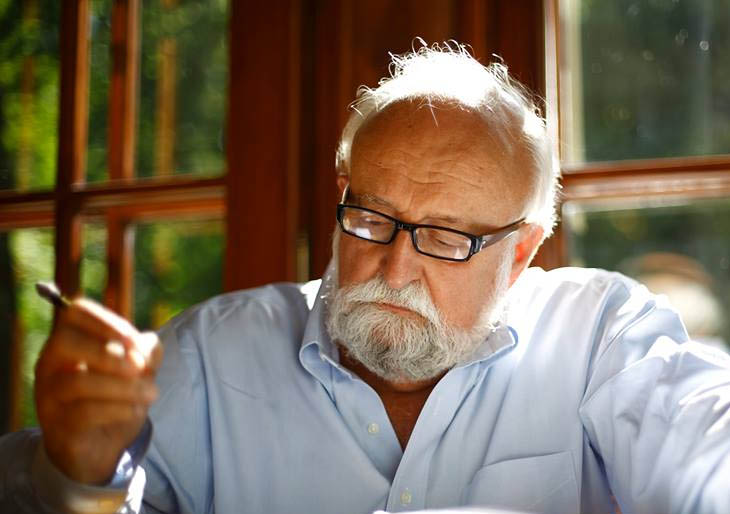
Above: the composer Krzysztof Penderecki
Sunday February 15th, 2015 matinee – This series of chamber music concerts by musicians from The New York Philharmonic looked so appealing when I saw the initial announcement. Due to my crowded calendar, this was my first opportunity to attend one of the concerts this season, and I’m most grateful to Lanore Carr of the Philharmonic for arranging it for me. Aside from the very interesting repertoire, the concert gave us an opportunity to ‘meet’ many of the Philharmonic’s artists in a more intimate setting.
Merkin Hall is a fine venue for chamber music – with a very clear acoustic – and the audience, who braved frigid temperatures to attend, were held in a sustained state of attentive delight by both the music and the playing.
The outstanding contemporary Polish composer Krzysztof Penderecki’s String Trio was premiered in 1990 at Krakow. Today, cellist Nathan Vickery introduced the piece, citing the fact that Penderecki set out early in his career to write music that would antagonize his listeners, but that, over time, his approach mellowed.
The String Trio is a vivid and very pleasing miniature – about 12 minutes long – and was played to perfection by Mr. Vickery with Quan Ge (violin) and Dawn Hannay (viola). After a slashing, jagged introductory phrase, the viola, then the cello, and then the violin make opening statements. The work takes on a conversational feel, as the instruments seem to murmur or chatter to one another with buzzing intimacy. The second movement is dance-like. All three players excelled in both tonal appeal and rhythmic surety. It was a bracing, lively performance, with intriguing touches of wit subtly expressed..
Jean Sibelius’s String Quartet in D minor, Voces intimae, Op. 56 was the only familiar work on the programme. This is music rich in expressions of melancholy and tenderness – even the more animated passages have a rather forlorn undercurrent – and in introducing it, violist Irene Breslaw quoted Sibelius as saying it was “…music that brings a smile to your lips at the time of death.”
The musicians – Anna Rabinova and Hyunju Lee (violins), Ms. Breslaw, and cellist Qiang Tu (superb depth of tone!) – vied with one another in poignancy of expression and beauty of line. Combined, their voices mingled in heartfelt harmonies, most especially in the quartet’s autumnal Adagio where their evocations of longing and regret spoke so deeply to me. In the scurrying finale, the players’ technical deftness was truly impressive.
The chance to hear music by Vittorio Giannini was an important factor in wanting to attend this concert. This now-nearly-forgotten composer was so prolific, writing operas, symphonies, sacred works, chamber music, and songs. His sister, Dusolina Giannini, was an operatic soprano who sang two dozen performances at The Met from 1938-1941. Vittorio Giannini was well-regarded in his lifetime – he taught at Juilliard, The Manhattan School of Music, and the Curtis Institute, and he founded the North Carolina School of the Arts – and his music won favor with audiences. Yet he and his music seem to have lapsed into obscurity following his premature death in 1966 at age 63.
Today we heard Vittorio Giannini’s Piano Quintet, and a gorgeous work it is! Melodically rich in the spirit of Puccini and Rachmaninoff, this quintet presents a rhapsodic blend of piano and strings in which theme follows theme in a steady flow of passionate lyricism. Giannini is so adept in his art that the music is able to speak directly to the heart without ever becoming cloying. Violinist Yulia Ziskel, commenting on the composer and his forgotten works, spoke of the ‘silver screen’ quality of certain passages of the quintet, and how right she was. But the music does more than just bathe the senses in a sea of opulent melodies, for the composer also shows a keen talent for rhythmic nuance.
Guest artist Keun A Lee – who I had heard previously playing for an Alek Shrader recital – was simply a luminous central force for the quintet. Her playing is elegant and generous, and she is also a delight to watch. Ms. Ziskel was joined by Shanshan Yao (violin), Rémi Pelletier (viola) and Mr. Vickery (cello). They played with warm resonance, most especially in the second movement where the cello takes the melodic lead (with the piano) which is then picked up by the viola. This adagio featured some of the evening’s most passionate playing. The third movement gets dance-y, developing a swaying effect at one point before swirling onwards to the fast and furious finale.
Chamber music must be so rewarding to play; and imagine how delightful it must have been for these musicians to discover the Giannini anew. The caliber of playing was stellar, and this was a really engaging programme.



 Oberon's Glade