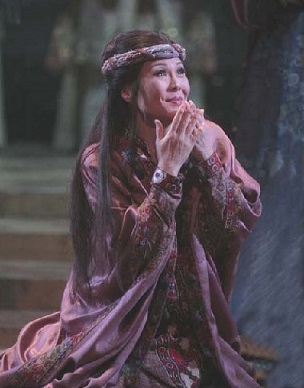
Above: Hei-Kyung Hong as Liu in a Beatriz Schiller/Met Opera photo
~ Author: Oberon
Thursday November 16th, 2017 – I invited my friend Claudia Schreier to this evening’s performance of TURANDOT at The Met; I wanted her to experience one of last truly grand opera productions in the Met’s repertory. The presence in the cast of Hei-Kyung Hong as Liu was a major factor in choosing this particular evening.
As at every performance of TURANDOT I’ve attended in the past 30 years, the house was packed. And, as at every Hei-Kyung Hong performance I have attended at The Met, the soprano’s presence in the cast drew large numbers of Asian opera fans. It turned out to be – yet again – Ms. Hong’s night.
The evening got off to a sluggish start: Carlo Rizzi’s pacing of the Mandarin’s opening address was slower than the MTA and caused baritone Jeongcheol Cha to dig deep for sufficient breath to sustain the phrases of his proclamation. Later, Rizzi thoughtlessly allowed too much orchestral volume at times, undermining expressive opportunities for his singers.

The towering figure of Bulgarian basso Giorgi Kirof as Timur (above, taking a curtain call) came onto the scene; in his Met debut, Mr. Kirof’s looming stature gave Ms. Hong’s petite figure as Liu an almost childlike aspect. The basso – a stalwart of the Sofia National Opera – gave a vocally moving performance, reaching emotional heights in the heartbreak of “Liù…Liù…sorgi! È l’ora chiara d’ogni risveglio!” which literally choked me up.
Alexey Lavrov was a terrific Ping, with a big, warm sound; his “Ho una casa nell’Honan…” was superbly sung. As his sidekicks Pang and Pong, Tony Stevenson and Eduardo Valdes gave characterful singing. I actually love the scene of the three ministers, which Puccini orchestrated so precisely. As the Emperor Altoum, Ronald Naldi’s voice ‘spoke’ clearly – all the way from Amsterdam Avenue.
Aleksandrs Antonenko had a fine evening as Calaf. He measures out the voice thoughtfully in Act I, saving up for the arduous singing ahead. But his “Non piangere, Liu” was finely judged, revealing veins of beauty in his powerhouse voice. Throughout the Riddle Scene, the tenor scored with dramatically-lit singing, and joined Oksana Dyka’s Turandot on a firm and sustained high-C at the end of “In questa reggia“. Mr. Antonenko also took – and held – a strong high-C at “No, no, Principessa altera! ti voglio ardente d’amor!“
Mr. Antonenko’s “Nessun dorma” was persuasively sung, reveling in the music’s inherent lyricism; he pulled off the climactic phrase impressively and managed to both acknowledge and forestall a wave of ‘bravos!’ by holding up his hand, letting the opera flow forward. The tenor’s singing in the final duet was first-rate, with some lovely expressions of tenderness as Turandot succumbed to him.
Oksana Dyka’s voice is slender of tone yet strong of projection. The top range doesn’t blossom but the notes are there; it took a few phrases for the sound to shake loose. As she moved downstage in the course of “In questa reggia” the voice began to speak into the house with increasing effect. Her Riddle Scene was filled with characterful expression: fire and ice. Following her collapse and her desperate plea to her father, the scene turned dramatically absorbing.
Ms. Dyka, her hair down and nearly prone with despair, is literally overcome with wonderment when Calaf/Antonenko offers her a way out of the bargain. She simply stares at him, realizing that this is a different kind of man than she’s accustomed to dealing with. Then he gently helps her to her feet. The chemistry between the two singers here was genuine; I’ve never seen that moment done quite that way.
Ms. Dyka’s voice seemed freer in Act III, and she was sustaining the phrases more and reveling in the upper range notes, holding them to generate increased excitement. Her “Del primo pianto” was movingly sung, opening up her humanity which has been bound in ice for so long. In the final moments of the opera, the soprano’s “Padre augusto…Conosco il nome dello straniero! Il suo nome è…Amor!” had a silvery gleam and a prolonged top-B.
Hei-Kyung Hong’s Liu has captivated audiences time and again in her long Met career. As someone who has seen and heard so many splendid sopranos essay the role of Liu – people like Moffo, Freni and Caballe – I feel Hei-Kyung’s stands at the pinnacle both for her physical perfection and her deeply moving singing.
If her Wikipedia page is accurate, Hei-Kyung is now 58 years old. Her voice has retained its freshness thanks to her wisdom in choosing repertoire. Tonight both the beauty of her sound and the instinctive rightness of her phrasing gave the music a deeply feminine quality; she also has a feeling for the Italianate style that escapes many non-Italian-born singers. Both her arias were as finely sung as I’ve ever heard them, and her death scene was truly heart-rending. She received a vociferous ovation, very much deserved.
All evening, the Met Orchestra made marvelous music, with particular magic from the violin of concertmaster David Chan who made so many of his phrases shine. Likewise, the chorus were at their most fervent and full-voiced.
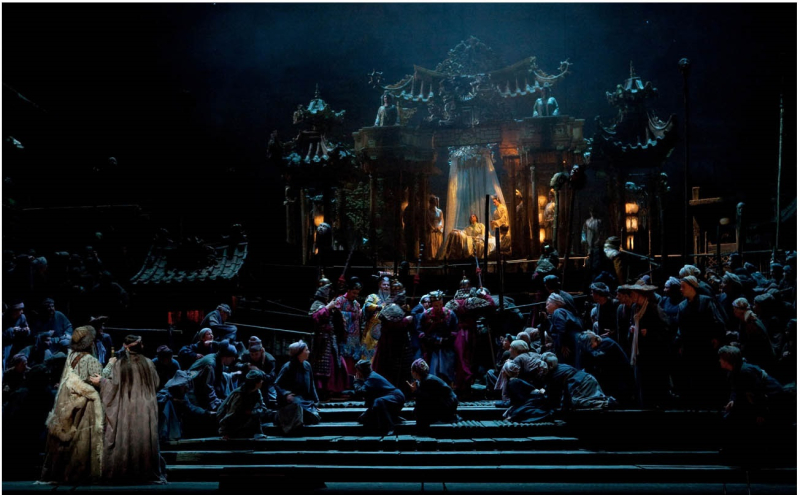
Above: Act I production photo by Marty Sohl/Met Opera
Some of the original staging has been altered and to me this weakens the overall effect of the opera. And the crowd scenes seem less crowded than in the past. The 45-minute intermission after the 35-minute first act would have been unbearable had I not had the one-and-only Claudia Schreier to keep me company.
Catch the curtain calls here, with the charming episode of the “missed bouquet”.
~ Oberon

 Oberon's Glade