Tag: Lane Raffaldini Rubin

  • The Composers are Present at the New York Philharmonic

    Geffen-Hall-1

    ~ Author: Lane Raffaldini Rubin

    Saturday March 29th, 2025 – Not one but two composers were present at David Geffen Hall tonight to receive enthusiastic ovations for their music performed by Leonard Slatkin and the New York Philharmonic. It was, in a sense, a family affair. The composer John Corigliano has been a friend of Slatkin’s and the Philharmonic for half a century, while the other composer, Cindy McTee, is Slatkin’s wife. While the third composer of the evening—Dmitri Shostakovich—was not on hand, this evening’s concert was a testament to the vitality of music of the present era.

    Cindy McTee’s 2010 piece Double Play is a two-movement fantasia on Charles Ives’s 1908 composition The Unanswered Question. More than just an exercise in Ivesian orchestral writing, the piece is a sonic lava lamp of shifting ambiguities and cinematic episodes. A low drone in the double basses unifies the fragmentary material in the woodwinds while hushed string chords oscillate between gorgeous dissonance and consonance.

    The second movement, entitled “Tempus Fugit”, begins with the ingenious tick-tocking of an ensemble of mallets, sounding like a cupboardful of disagreeing clocks and metronomes. The Ivesian writing of the first movement returns under this misaligned timekeeping, establishing an fascinating non-relationship between the disparate concepts of the two movements.

    This juxtaposition is muddied in the second movement by the inclusion of passages of chase-scene-style music and Gershwin-like big-band flourishes (although played brilliantly crisply by the Philharmonic brass). McTee’s piece was intricately orchestrated and finely crafted but went on a bit longer than it needed to and wouldn’t have suffered from cuts in the second movement.

    A1A06759

    Above: Cindy McTee and Leonard Slatkin take a bow; photo by Chris Lee. 

    For John Corigliano’s 2020 piece Triathlon the soloist Timothy McAllister brought three saxophones to the stage. In writing the piece, Corigliano asked himself “what would happen if I wrote a concerto for saxophonist and orchestra, not saxophone and orchestra.” McAllister, the preeminent classical saxophonist for whom the concerto was written, is, after all, a skilled player of the soprano, alto, and baritone saxophones. Corigliano exploits the unique qualities of all three in Triathlon.

    The first movement, “Leaps” for soprano saxophone, bursts right out of the gate with slinking high and low figures, bustling orchestral sounds, and swaggering bravura material for the soloist. McAllister’s playing is assured and confident while maintaining a chamber music sensibility, which suits well the elaborate dialogues that Corigliano writes between the soloist and various voices in the woodwinds and brass. One notable section of this movement appears to quote Ravel’s children’s opera L’enfant et les sortilèges with ravishingly mysterious textures in the woodwinds, providing a fluttering backdrop for lyrical solos in the soprano saxophone.

    The second movement, entitled “Lines”, hews close to its name by eschewing rhythmic figuration in favor of “linear” melodic material. This movement for alto saxophone occupies a hybrid sound-world somewhere between the hazy atmosphere of Coltrane and the broad horizons of Copland’s A Lincoln Portrait.

    Things get wilder in the third movement, which begins with a baritone saxophone cadenza of key clicks, slap tonguing, and other extended techniques up and down the range of the instrument. “Licks”, the title of this movement, has multiple meanings as the soloist seems to riff and improvise and produce very physical sounds from the tongue itself. The entire movement is a rollicking pseudo-improvisatory accompanied recitative. In a fun plot twist at the very end of the piece, McAllister picks up the soprano sax for one last picaresque lick.

    A1A07046

    Above: Timothy McAllster and Maestro Slatkin playing the Corigliano; photo by Chris Lee

    In the second half of the program, Slatkin led the Philharmonic in Shostakovich’s Symphony No. 5 of 1937. It’s a piece that is, as Slatkin writes, “a bit more familiar for both musicians and audience”. Indeed, it was an admirable if conventional performance, with thrilling—booming—climaxes, flawless details across the woodwinds, and propulsive treatment of dramatic transitions.

    A1A08985

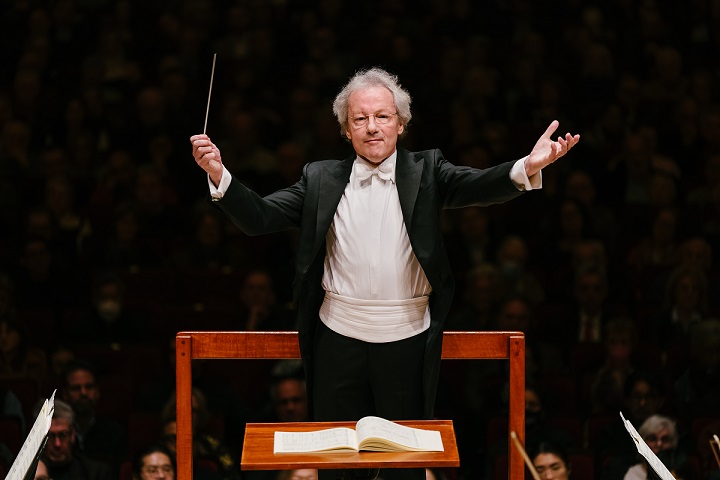
    Throughout the concert, Slatkin (above, photo by Chris Lee) frequently put down his baton to conduct with his hands, only to pick the baton back up within the same movement. Slatkin holds the baton from the end of its long handle, rather than gripping it, which means that he relies on his left hand to communicate finer-grain detail to the players. His conducting was at its best when he put down the baton (as in the first movement of McTee’s piece and the sublime Largo of Shostakovich), allowing him to be expressively geometric—an impressively effective semaphore for the musicians. During the Shostakovich Largo, which he conducted from memory, I wondered where his baton had gone, since there was no music stand on the podium for him to rest it on. When the movement was over, he reached behind the folder on the first desk of the violas to retrieve his baton from where he had stashed it. Meant to be invisible, it was just one of the many clever details that added up to this superbly crafted concert.

    ~ Lane Raffaldini Rubin 

    Performance photos by Chris Lee, courtesy of the New York Philharmonic
  • Franz Welser-Möst and the Cleveland Orchestra Make a Statement @ Carnegie Hall

    CH11527596

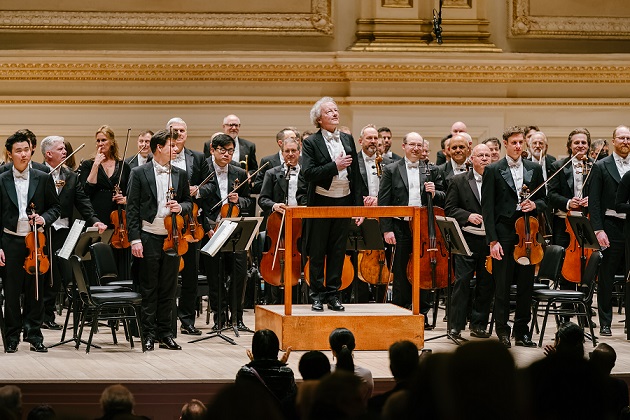
    Above: Maestro Welser-Möst and the Cleveland Orchestra onstage at Carnegie Hall; photo by Fadi Kheir

    ~ Author: Lane Raffaldini Rubin

    Tuesday March 18th, 2025 – Tuesday March 18th, 2025 – Franz Welser-Möst led The Cleveland Orchestra tonight in the first of two back-to-back Carnegie Hall performances. The second concert will feature music of Stravinsky and Tchaikovsky, but the Orchestra was forced to make a major change in the program of tonight’s concert after Asmik Grigorian announced her withdrawal for personal reasons. Ms. Grigorian, the Lithuanian soprano, was set to sing Richard Strauss’s Four Last Songs and the final scene from Puccini’s Suor Angelica with the Clevelanders.


    Missing a chance to hear the Four Last Songs is a real shame, but Welser-Möst took this opportunity instead to make a timely political statement in what might be one of his last Carnegie Hall appearances before his retirement in 2027:

    “This program change has given us a chance to say something important about our world today. As people fight for freedom everywhere, these pieces tell that same human story. Beethoven’s Fifth shows us the journey from darkness to light. Janáček’s From the House of the Dead reveals how human dignity survives even in the most desolate of circumstances. And the Leonore Overture is, to me, simply the greatest music about freedom ever written. These works together create a profound statement that I believe will resonate deeply with our audiences in both Cleveland and New York.”

    The first notes of the performance were the V-for-victory theme of Beethoven’s Fifth Symphony. Besides being perhaps the world’s most famous four notes, this music represents Allied Europe’s victory over the Axis in World War II. (Russia, are you listening?)

    CH11527621

    Maestro Welser-Möst (above, photo by Fadi Kheir) mobilized the full forces of the Cleveland Orchestra for the Fifth, making it an orchestra more than twice the size of that envisioned by Beethoven. The result was an impressive, explosive sonority at the expense of contrast and transparency. In the first movement the Clevelanders’ sound was burnished and energetic as it traversed Beethoven’s volatile landscape of darkness and light.

    The second movement was beautifully elegant, with notable vibrato-less hushed passages and flawless string crossings throughout the later variations of the theme. The finale was brisk without being breathless and avoided the Indiana Jones clichés that this movement often receives.

    The second half of the program featured the suite (arranged by František Jílek) from Leoš Janáček’s final opera From the House of the Dead as well as Beethoven’s Leonore Overture No. 3. These pieces both come from larger dramas about imprisonment and the liberation of the steadfast human body and spirit. If Beethoven’s Fifth Symphony lays out a hero’s abstract journey through conflict toward triumph, the latter two pieces give a much more visceral view into their protagonists’ struggles against adversity and fate.

    Janáček’s suite is wonderfully off-kilter and begins with a herculean violin solo—a free-associating kind of playing that involves an almost desperate sawing away at the top of the instrument’s register. Chaotic passages of music played by smaller sections of instruments are interspersed between bursts of the full orchestra with towering clusters of sound, always grounded by the low strings and brass. Inventive sounds made by rachet noisemakers, wood clappers, percussively plucked strings, and relentless repetitive figures all have the effect of boring a hole into one’s skull, slipping toward madness.

    Passages drawn from a scene in the opera in which the prisoners stage a play feature macabre oom-pah-pahs, vaudeville fragments, and whiffs of a klezmer band. The final movement of the suite is a fauvist palette of blurry chords, a luxuriously strange and gorgeously dissonant tableau that concludes too optimistically considering all that came before.

    It seems odd, then, to conclude the concert with an overture. Rare, too, is the chance to hear Beethoven after Janáček. But the Leonore Overture—from the opera that would become Fidelio—is a concise encapsulation of Welser-Möst’s message for the evening.

    This piece was better suited than the Fifth to the large orchestra, which was able to achieve subtle shades ranging from the bright fanfare of the full orchestra (in C-major, like the final movement of the Fifth) to the eerie distance in the flute after the portentous off-stage trumpet call.

    Fidelio is ultimately about the triumph of enlightenment values over despotism. Although Welser-Möst’s program had the potential to come off as trite and facile, his linking of these two Beethoven scores to Janáček’s and his reversal of the obvious order of their performance charted an intelligent, moving, and novel course that he hopes—despite our current administration’s unenlightened displays of power—might be followed in Europe.

    ~ Lane Raffaldini Rubin

    Performance photos by Fadi Kheir, courtesy of Carnegie Hall

  • Les Arts Florissants/Zankel Hall Center Stage

    CH11515039

    Above: William Christie, photo by Richard Termine

    ~ Author: Lane Raffaldini Rubin

    Tuesday January 28th, 2025 – Tonight,  Les Arts Florissants made what has become the rare appearance of an early music ensemble on a Carnegie Hall stage.

    To celebrate the eightieth birthday of its founder and co-musical director William Christie, the group presented selections from the core of its repertory, including scenes from the operas of Marc-Antoine Charpentier (1632-1704), Jean-Baptiste Lully (1632-1687), and Jean-Philippe Rameau (1683-1764). Christie has been a champion of these composers since the 1970s and it was with a 1986-87 production of Lully’s Atys – an opera that had not been staged since 1753 and whose music was excerpted at Tuesday’s performance – that Les Arts Florissants made its first big break.

    Seeing the thirteen players and six vocalists take the stage of Zankel Hall’s intimate in-the-round configuration, one might get the sense that Les Arts Florissants is simply a small group of musicians dedicated to the French Baroque. Back in France, however, this group is just one component of a multifaceted institution that includes early music performance, music pedagogy, professional development for young singers and instrumentalists, a historic country house with fanciful Baroque-style gardens (themselves home to many of the group’s activities), training for gardeners, and a garden studies research center. Christie himself (an American, mind you, who left the States as an objector to the Vietnam War) is the godfather of this musical-cultural web.

    Tuesday’s performance was a testament to the group’s decades-long legacy of learning and teaching, its total grasp of this body of music, and the kinship of its members, who played and sang together like family.

    CH11515040

    The chosen excerpts reveal the dramatic directness and emotional turbulence of French Baroque opera. We heard none of the repetitive music of Italian da capo arias or strophic forms. Instead, we heard through-written works that interweave recitative dialogues and monologues with airs and duets. The transitions between air and recitative were at times fitful and at times seamless, but always served a clear dramatic function. That formal range and psychological charge were on display in the excerpts from Charpentier’s 1693 Médée, where a dialogue between Médée and her confidante Nérine is interrupted by outbursts of jealousy and vengefulness. This all culminated in the aria “Quel prix de mon amour”, sung by mezzo-soprano Rebecca Leggett, a lamentation undergirded by fleeting but searing dissonances in the orchestra.

    Another characteristic of this music is its emphasis on French diction. Lully, the favorite composer of Louis XIV, explicitly sought to differentiate his music from the florid and opaque sounds of Italian opera of the time. In excerpts from the later acts of Atys of 1676, the tenor Bastien Rimondi sang with clarity and shapely elegance as he communicated his character’s yearning and anguish.

    The highlight of the program was Rimondi’s “Règne, Amour” from Rameau’s Pigmalion (1748). Rameau’s opera music, which dominated the evening, was presented simultaneously as a development of Lully’s legacy as well as an innovation upon and a perversion of it. In the Pigmalion excerpts we hear varied instrumental colors, free-spirited use of the recorders and reeds, heavy basso continuo inversions that drive harmonic motion, and a Handelian rhythmic motor. Rimondi sang his part with pure joy. His exquisitely crisp diction permeated ornate passages and more straightforward melodic lines, never hindering a sweet, clear tone and blooming vibrato on sustained notes.

    The program concluded with two scenes from Rameau’s 1735 Les Indes galantes, the flagrantly cancelable opera-ballet featuring unrelated tales of exotic places and their inhabitants. Both scenes were drawn from the act “Les sauvages” depicting North American landscapes and natives. One might think the inclusion of the “Forêts paisibles” chorus to be pandering to the New York audience, but this scene also includes the famous dance of the savages which serves as Les Arts Florissants’s frequent sendoff at the end of their concerts. They tossed off this music with swung beats and confident restraint.

    CH11515089

    As an encore, Christie and Les Arts Florissants offered the quartet “Tendre amour” from the third act of Les Indes galantes (which Rameau cut from the opera after its first performances). Christie described this music as “one of the most beautiful pieces of the eighteenth century” and indeed it was gorgeous and pastoral with vocal lines floating high in the air. It was a birthday gift from Christie to the audience.

    CH11515067

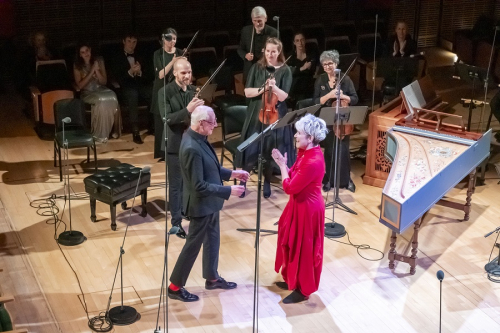
    Above: Maestro Christie greets Joyce DiDonato; photo by Richard Termine

    But the ensemble members had something else up their sleeve. The star mezzo-soprano Joyce DiDonato emerged onto the stage and lavished praise on Christie, whom she met while rehearsing for his 2004 production of Handel’s English-language opera Hercules. In tribute to Christie, she and the ensemble presented “As with rosy steps the morn” from the oratorio Theodora (why didn’t they choose something from Hercules?). After a full program of Charpentier, Lully, and Rameau, DiDonato’s Handel seemed monumentally scaled, possessing a different species of substance and intensity. The strophic form of this piece (repeating sections of music with new verses of text) set an obvious contrast with the French music of the main program and put the French works’ organic, dramatic, and transparent value into focus.

    The program was, after all, a didactic showcase of French Baroque music and its performance techniques. Among early music groups, Les Arts Florissants is a champion of craft, forgoing the temptations to produce the highly biting, peppery sound that is so en vogue these days. Surrounding the ensemble on all sides, it was as if we the audience could simply enjoy overhearing a reading of this music being shared among friends.

    Performance photos by Richard Termine, courtesy of Carnegie Hall

    ~ Lane Raffaldini Rubin