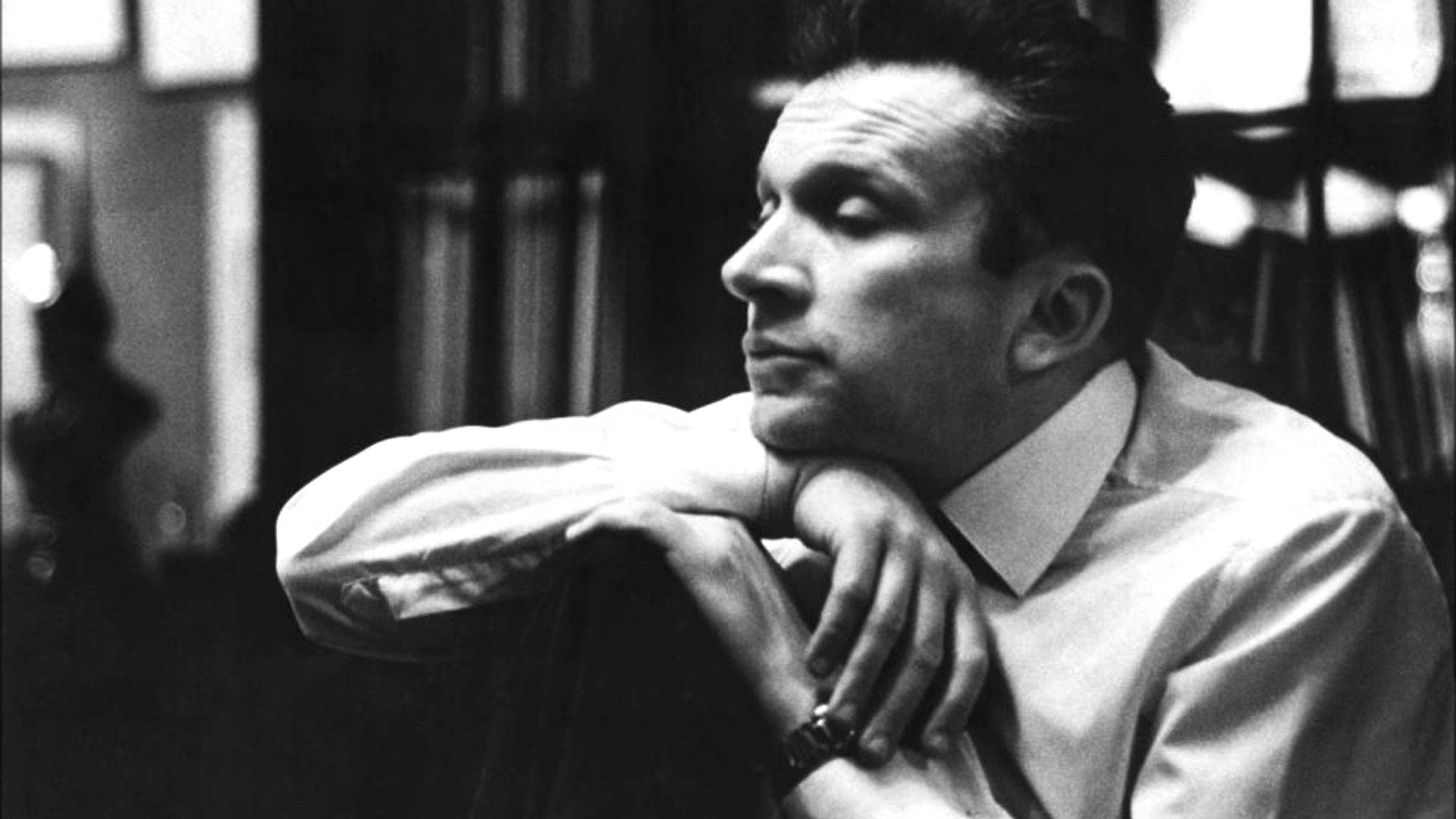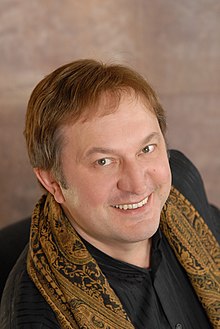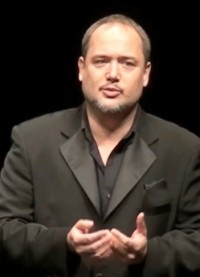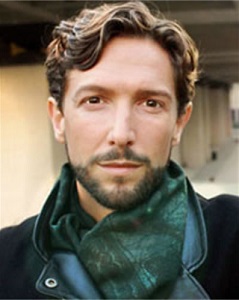
Tag: Leon Botstein

  • ASO ~ Gurre-Lieder @ Carnegie Hall

    Gurre 4

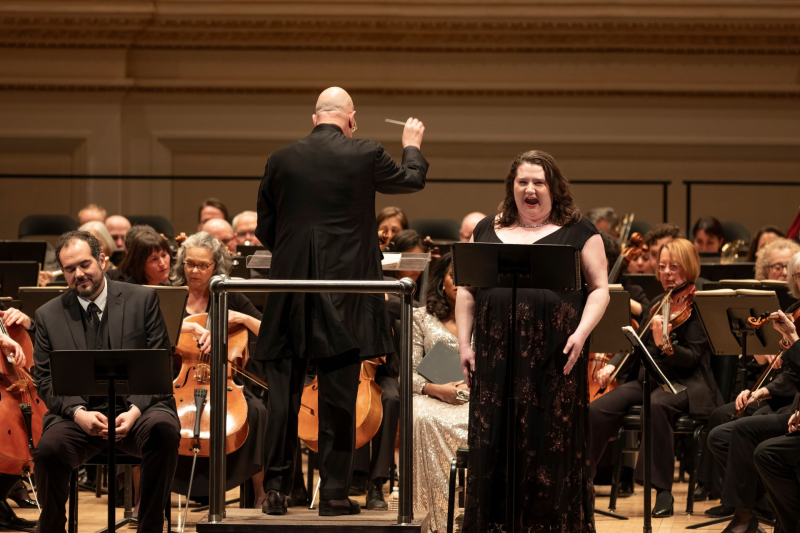
    Above: tenor Dominic Armstrong (seated), conductor Leon Botstein, and soprano Felicia Moore onstage at Carnegie Hall; photo by Matt Dine

    ~ Author: Ben Weaver

    Friday March 22nd, 2024 – Arnold Schoenberg’s gargantuan Gurre-Lieder, composed in 1900-03 (revised 1910-11), is unlike anything else in his catalog. With this lush and highly melodic work – for soloists, chorus and orchestra – he reached the ceiling of Romanticism and the only way out was to shatter it to smithereens. For Schoenberg, a mix of musical philosophy and observing the ravages of WWI signaled that music could not continue on the path laid out by his predecessors (Bach, Haydn, Mozart, Beethoven, Brahms, Wagner, etc. etc.) Schoenberg may have overreacted quite a bit, but, at a least with Gurre-Lieder, he left us with a grand finale of sorts to the excesses of 19th century music.

    Gurre-Lieder’s libretto is adapted from Jens Peter Jacobsen’s dramatic poem Gurresange, written in 1868. It tells the story of King Waldemar and his love for the beautiful Tove, who is murdered by Waldemar’s jealous wife. Enraged, Waldemar curses God and is condemned to roam every night on wild hunts with his ghostly vassals. Waldemar is redeemed with arrival of Spring, and he and Tove are reunited as they become one with nature. Performances of this work are extremely rare, no doubt because Schoenberg calls for more than 150 musicians, an extravagance few organizations can afford, and none can afford frequently.

    Part I opens with what Gabriel Adorno called “fairy land” music, a shimmering tapestry of harps, celesta, flutes, piccolo and some strings. Waldemar and Tove exchange declarations of love in extended monologues, set to ravishing Wagnerian and Straussian sounds.

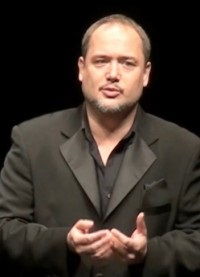
    Tenor Dominic Armstrong (above) took on the – let’s face it – impossible role of Waldemar. Schoenberg wrote the part for at least three different voices; not many singers have been able to possess them all. This is a Tristan/Parsifal/Tannhäuser part, with Tamino thrown in for good measure. I honestly don’t know who can really sing all this in a live performance. Dominic Armstrong is a lyrical tenor with a strong top, but sadly the voice disappears in the lower registers. And conductor Leon Botstein was not very kind, allowing the orchestra to cover Mr. Armstrong all evening. Armstrong’s strongest moments were in the lighter passages; his best singing came late in Part 3, in his final aria “Mit Toves Stimme flüstert der Wald”, when Schoenberg’s orchestration relaxed, allowing Waldemar to finally emerge.

    Soprano Felicia Moore (above) possesses a large, blooming voice, that managed to break through the orchestral cacophony, in spite of an insensitive conductor. Her Tove was exotic and warm.

    Gurre 2

    Mezzo-soprano Krysty Swann (above, in a Matt Dine photo), as the Wood-Dove who describes the terrifying details of Tove’s murder, was exciting in her long monologue. The voice is large and steely, the vibrato a bit loose at the top, but Ms. Swann possessed an excellent sense of drama, managing to build to thrilling and hair-raising final moments of the Wood-Dove’s narrative.
    Gurre 3

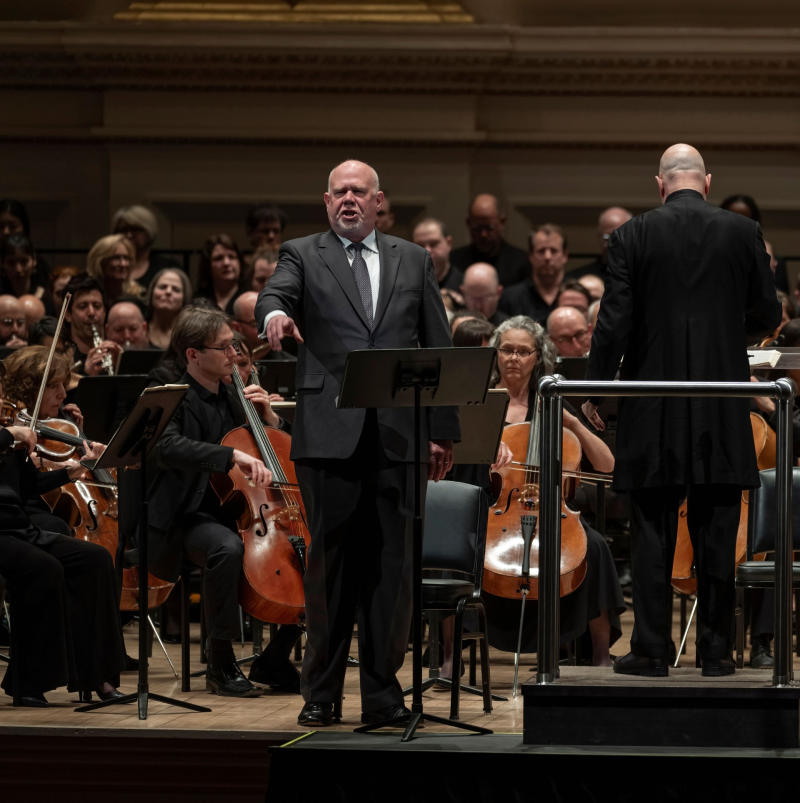
    Bass-baritone Alan Held (above, photo by Matt Dine) has been a favorite of mine for many years. Though it seemed like James Levine always kept Mr. Held back at the Metropolitan Opera, where he should have been singing Wotan among many other roles, I still vividly recall a searing Wozzeck Mr. Held sang at the Met in 2011. It was wonderful to hear him once again, his large voice easily filling Carnegie Hall as the Peasant who is terrified by Waldemar and his men’s nightly processions.

    Gurre

    Tenor Brenton Ryan (photo above by Matt Dine) was a very memorable Klaus the Jester, starting his long monologue from the house floor, then jumping on to the stage. Mr. Ryan possesses a strong, characterful tenor that made me think he might have been a better choice to sing Waldemar.

    And German bass-baritone Carsten Wittmoser was a magnificent Narrator, his crystal clear diction perfect for the sprechstimme part, which is usually given to older singers nearing retirement or even non-singer actors (Karl Maria Brandauer and Barbara Sukowa, for example.) So it was nice to hear a singer still in his prime take on this role.

    The American Symphony Orchestra was founded by Leopold Stokowski – who conducted the US Premiere of Gurre-Lieder in 1932, so it has a direct connection to this work, and they played quite beautifully, and certainly loudly. Here I must fault Leon Botstein for not being more considerate of his singers. Even the Bard Festival Chorale found itself drowned out by the orchestra, occasionally becoming just a mass of garbled sounds coming from somewhere at the back of the stage.

    Still, any live performance – flaws aside – of this supremely difficult work is was a special treat to be able to experience. How long before another performance is organized in New York City?

    ~ Ben Weaver

    Performance photos by Matt Dine, courtesy of Carnegie Hall

  • Ewa Podleś Has Passed Away

    Podles jpg

    The magnificent Polish contralto Ewa Podleś (above) passed away on January 19, 2024, at the age of 71. Hers was one of the most remarkable voices I ever heard, but ironically I only saw her live one time: she sang Mahler’s Kindertotenlieder with the American Symphony Orchestra under Leon Botstein’s baton at a concert given at Alice Tully Hall in 1999. 

    That evening, the Mahler cycle was the last thing on the program. Ms. Podleś walked onstage, a short and rather plump woman. She took a stance on the stage and, as, the music commenced, she tipped her head back slightly and began to pour the music forth as if from the depths of her soul. The richness of the voice, with its cavernous lower register, was like nothing else I had ever heard. For one magical half-hour, she had the audience completely under her spell. A the end, she took a couple of bows, nodding to us slightly.

    Back in those days, Alice Tully Hall still had its cozy greenroom, and I went there to greet Maestro Botstein and the evening’s two soloists: soprano Edith Wiens, and Ms. Podleś. Of course, I was too shy to say anything, so Ms. Podleś signed my program, and nodded to me with a slight smile. I will always recall that evening as one of the most profound musical experiences of my life.

    Aso 1999-1 jpg

    You can read all about the Podleś career here, and listen to her unique voice in Wagner…

    The Norns~GOTTERDAMMERUNG – Eva Podles – Stephanie Blythe – Margaret Jane Wray – Seattle 2006

    …and Rossini: 

    Ewa Podles – scena d’Arsace – SEMIRAMIDE

    And her monumental rendering of “Cara sposa” from Handel’s RINALDO can be savored here.

    Spoczywaj w pokoju, beloved Ewa.

  • The ASO Presents Martinů’s JULIETTA

    B martinu

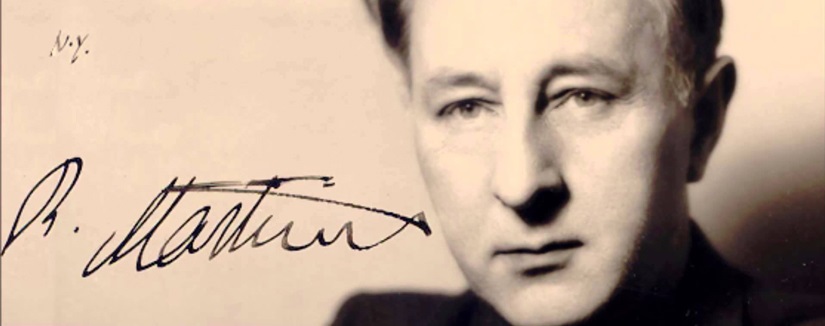
    Above: the composer Bohuslav Martinů

    ~ Author: Oberon

    Friday March 22nd, 2019 – Bohuslav Martinů’s opera JULIETTA in a concert presentation by The American Symphony Orchestra at Carnegie Hall, conducted by Leon Botstein. Based on the French play Juliette, ou La clé des songes (Juliette, or The Key of Dreams) by Georges Neveux, Martinů’s opera explores a world where dreams and reality converge.

    The plot of the opera was once described thus: “Michel Lepik, a bookbinder from Paris, is dreaming. Finding himself in a small seaside town, he sets out to look for a woman, Julietta, he’s absolutely convinced he met there three years before. The only problem is, everyone in the town has lost their memory. After a search, he finally finds her and tries to coax from her memories of their time together. Frustrated, he shoots her. But did it all really happen? Michel finds himself  in the “Central Office for Dreams”, where the nightwatchman tries to persuade him to leave…because, if he stays past the allotted time, he must stay forever.”

    While it was interesting to experience JULIETTA live, not all operas work well in a concert setting. The story is somewhat intriguing in its own right, but it seems to me that it cries out for an imaginative staging: it is not really a strong enough narrative to sustain interest over a three-hour span without some visual context. Beyond the leading roles of Julietta and Michel, the singers each portrayed multiple characters. A booklet with the full text was provided, but it is not easy to watch the stage, read the words, and take notes all at the same time. Also, throughout the performance, the sound of text booklets dropping to the floor was annoying.

    Martinů’s orchestration is sometimes fascinating, but only in the final moments of Act II did the opera draw me in musically. Much of the first act is given over to banter – some of it spoken, in English – and at times it felt more like a play or a Broadway show than an opera; I must say, in truth, it became tiresome after a while. At 10:00 PM, there was an intermission, with another act still to come. Knowing how whimsical the MTA is at night, I decided it was safest to leave Carnegie Hall at the point. Sure enough, I had an ordeal getting home.
    The orchestra played very well under Maestro Botstein’s detailed leadership; the score is strewn with brilliant little instrumental opportunities, which the players eagerly seized upon. Tenor Aaron Blake, slender and lively, impressed in the role of Michel. His music calls for plaintive lyricism but also power and passion. Mr Blake’s voice had the needed beauty of tone as well as the intensity required to give a truly impressive performance. In the title-role, the attractive soprano Sara Jakubiak sang with a warm spinto sound, making me wish the character had more extended passages of song. David Cangelosi, who has been so excellent as Wagner’s Mime and in other highlighted character roles at The Met, was simply superb as the Police Chief.

    Multi-tasking in myriad roles were: the comely young mezzo Rebecca Jo Loeb, the lively and boisterously endearing mezzo Raehann Bryce-Davis, the always-wonderful contralto Tichina Vaughn, Met stalwart and strong-voiced baritone Philip Cokorinos, the fine basso Kevin Burdette – who I heard many times in his Juilliard days – and the inimitable Alfred Walker, a vocal scene-stealer and impressive presence, with ultra-clear diction. A small vocal ensemble from the Bard Festival Chorale (James Bagwell, director) sang from stage right.

    I wish I could feel more enthusiastic about the piece itself; I also wish the ASO would start their performances at 7:00 PM, so as to end before the MTA makes getting home a chore.

    ~ Oberon

  • The ASO Presents Martinů’s JULIETTA

    B martinu

    Above: the composer Bohuslav Martinů

    ~ Author: Oberon

    Friday March 22nd, 2019 – Bohuslav Martinů’s opera JULIETTA in a concert presentation by The American Symphony Orchestra at Carnegie Hall, conducted by Leon Botstein. Based on the French play Juliette, ou La clé des songes (Juliette, or The Key of Dreams) by Georges Neveux, Martinů’s opera explores a world where dreams and reality converge.

    The plot of the opera was once described thus: “Michel Lepik, a bookbinder from Paris, is dreaming. Finding himself in a small seaside town, he sets out to look for a woman, Julietta, he’s absolutely convinced he met there three years before. The only problem is, everyone in the town has lost their memory. After a search, he finally finds her and tries to coax from her memories of their time together. Frustrated, he shoots her. But did it all really happen? Michel finds himself  in the “Central Office for Dreams”, where the nightwatchman tries to persuade him to leave…because, if he stays past the allotted time, he must stay forever.”

    While it was interesting to experience JULIETTA live, not all operas work well in a concert setting. The story is somewhat intriguing in its own right, but it seems to me that it cries out for an imaginative staging: it is not really a strong enough narrative to sustain interest over a three-hour span without some visual context. Beyond the leading roles of Julietta and Michel, the singers each portrayed multiple characters. A booklet with the full text was provided, but it is not easy to watch the stage, read the words, and take notes all at the same time. Also, throughout the performance, the sound of text booklets dropping to the floor was annoying.

    Martinů’s orchestration is sometimes fascinating, but only in the final moments of Act II did the opera draw me in musically. Much of the first act is given over to banter – some of it spoken, in English – and at times it felt more like a play or a Broadway show than an opera; I must say, in truth, it became tiresome after a while. At 10:00 PM, there was an intermission, with another act still to come. Knowing how whimsical the MTA is at night, I decided it was safest to leave Carnegie Hall at the point. Sure enough, I had an ordeal getting home.
    The orchestra played very well under Maestro Botstein’s detailed leadership; the score is strewn with brilliant little instrumental opportunities, which the players eagerly seized upon. Tenor Aaron Blake, slender and lively, impressed in the role of Michel. His music calls for plaintive lyricism but also power and passion. Mr Blake’s voice had the needed beauty of tone as well as the intensity required to give a truly impressive performance. In the title-role, the attractive soprano Sara Jakubiak sang with a warm spinto sound, making me wish the character had more extended passages of song. David Cangelosi, who has been so excellent as Wagner’s Mime and in other highlighted character roles at The Met, was simply superb as the Police Chief.

    Multi-tasking in myriad roles were: the comely young mezzo Rebecca Jo Loeb, the lively and boisterously endearing mezzo Raehann Bryce-Davis, the always-wonderful contralto Tichina Vaughn, Met stalwart and strong-voiced baritone Philip Cokorinos, the fine basso Kevin Burdette – who I heard many times in his Juilliard days – and the inimitable Alfred Walker, a vocal scene-stealer and impressive presence, with ultra-clear diction. A small vocal ensemble from the Bard Festival Chorale (James Bagwell, director) sang from stage right.

    I wish I could feel more enthusiastic about the piece itself; I also wish the ASO would start their performances at 7:00 PM, so as to end before the MTA makes getting home a chore.

    ~ Oberon

  • The ASO: Sounds of the American Century

    DSC09652

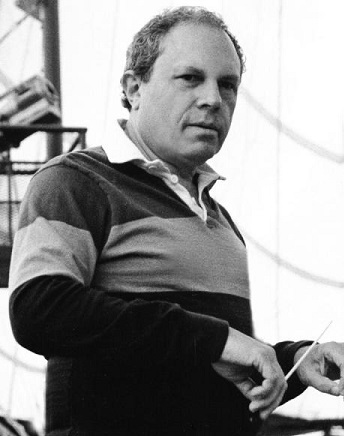
    Above: Maestro Leon Botstein, in a Matt Dine portrait

    ~ Author: Brad S. Ross

    Friday, January 25th, 2019 – It was another fine program Friday night at Carnegie Hall’s Isaac Stern Auditorium as the music director Leon Botstein led The American Symphony Orchestra in an all-American program of under-performed greats aptly titled “Sounds of the American Century.”  And that it most certainly was.

    Mann

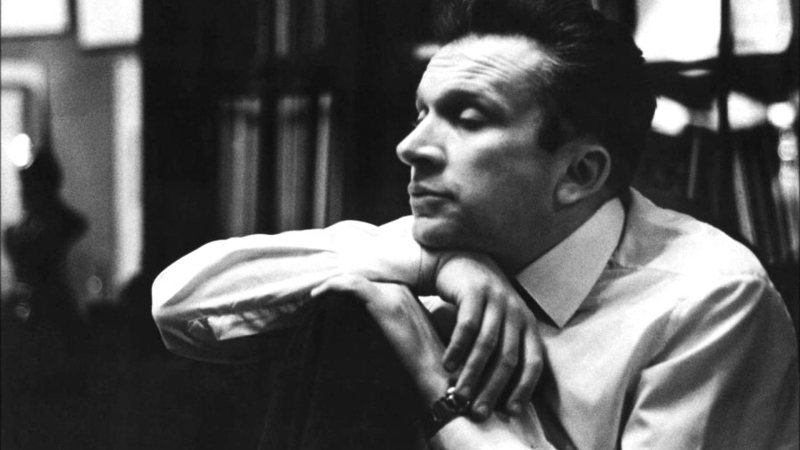
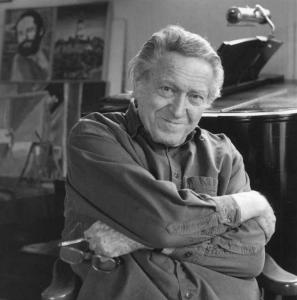
    The evening began with Fantasy for Orchestra, a tone poem by the late violinist and educator Robert Mann (above).  Mann, who died last year at the ripe old age of 97, was a long-time staple of the New York classical music scene, in front of and behind the scenes, and was first violinist of the Juilliard String Quartet for over fifty years.  In addition to performance and education, Mann also dabbled in composition to pleasantly effective results.  His Fantasy for Orchestra was originally commissioned by the New York Philharmonic and first performed by that ensemble under the direction of Dimitri Mitropoulos at Carnegie Hall itself in 1957.
    The piece opened on the violas sustaining a single note.  Other members of the orchestra soon joined and a collage of atonal sonorities began to emerge.  This menace continued to build until a percussive roll launched the work into more energized and frenzied territory.  Mann’s Fantasy played almost programmatically, as if scoring the unseeing drama of some unsettling film or ballet.  A haunting violin solo emerged, performed by the concertmaster Cyrus Beroukhim, as harp ostinati and melancholic low brass chords created an almost dream-like atmosphere.  After a near-silent decrescendo, the drama then built up to a sequence of full-orchestra blasts that rang the piece to a volatile conclusion.  This was a decidedly above-average mid-century tone poem, played with force by the American Symphony Orchestra, and one that should warrant more-frequent airings.

    Vivian-Fine

    Next, receiving its long-overdue New York premiere, was Concertante for Piano and Orchestra by Vivian Fine (above).  Fine, who was one of a handful pioneering female composers in the early 20th century, is perhaps best known for her many chamber works, including the atonally adventurous Capriccio for Oboe and String Trio.  The Concertante for Piano and Orchestra, composed in 1944, was the first of her orchestral repertoire.

    After Mann’s Fantasy for Orchestra, Fine’s Concertante was almost strikingly tonal, as if ripped from the pages of some lost Romantic-era score composed sixty years prior.  Comprising two movements, it opened on a stately and delicate Andante con moto and closed on a convivial and spirited Allegro risoluto.

    Charliealbright

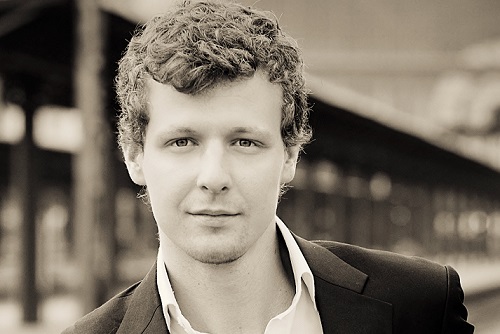
    Pianist Charlie Albright (above) made solid sport of the piece’s numerous solo passages and improvised an impressively intricate and lively cadenza that charged the work to its end.  His admirable commitment to the piece brought much life to what otherwise struck me as a very dainty and anachronistic work, one I don’t expect to hear programmed again anytime soon.

    A minor ovation brought Albright back to the piano bench for an encore of a work that, as a friend of his apparently put it, “takes balls to perform.”  He then ripped into a breezy rendition of 1957’s “Great Balls of Fire” that cheekily concluded the first half of the concert.


    J Druckman

    After intermission came a performance of Prism, a three-movement orchestral set by written in 1980 the great and often unsung composer Jacob Druckman (above).  Inspired in part by Luciano Berio’s 1968 Sinfonia, Druckman crafted Prism by blending the musical styles of historic composers with his own decidedly modern voice.  Fittingly, each movement references the music of a Baroque or Classical-era composer for which it is titled.

    The first movement “After Marc-Antoine Charpentier” began on otherworldly textures consisting of percussion, woodwind clusters, pizzicato hits, and haunting tremolo in the strings.  Quotations of Charpentier soon emerged, complete with a synthesized harpsichord, but carrying with it the wild distortions and eerie timbres of the 20th century.  The second movement, “After Francesco Cavalli”, carried on in similar fashion, blending the sonorities of these disjointed eras.  A clarinet solo accompanied by atonal statements throughout the orchestra brought some much-appreciated color and allowed the piece to stand more fully on its own legs, rather than succumb to pastiche.  Violent punctuations opened the third movement, “After Luigi Cherubini,” which was occasionally discursive to a fault.  Nevertheless, this built to an impressively bombastic finale that rekindled any waning interest.

    Compositions that blend the styles of different musical eras like Prism or Berio’s Sinfonia (or Steven Stucky’s Dreamwaltzes or John C. Adams’s Absolute Jest, for that matter) tend to walk a fine line between tasteful reference and cheeky gimmickry.  While the merits of such genre-bending continue to be up for debate, I must confess enjoying Prism best when lived in its own era.

    P01l7krp

    The final piece of the evening was the Third Symphony by one of America’s greatest composers, William Schuman (above).  A contemporary of Robert Mann, Schuman was also a staple of New York’s classical music scene, albeit with a much wider influence.  Throughout the course of his life, he served as the president of the Juilliard School, president of Lincoln Center, and in 1943 became the first-ever recipient of the Pulitzer Prize for Music.  Among his impressive catalog of compositions are numerous ballets and concertante, two operas, dozens of chamber and orchestral works, and a whopping ten symphonies.  The Third Symphony, composed in 1941, is perhaps his most famous.

    Clocking in at about thirty minutes, the symphony is cast in two parts played with short pause—Part I comprising a Passacaglia and Fugue and Part II concluding on a Chorale and Toccata.  It begins on a slow and somber viola line that is gradually joined by the remainder of the strings and, finally, the rest of orchestra.  This tragic crescendo continues until a great fortissimo brass statement launches the work into new, dramatic frontiers.  Its form relaxed, but never rambling, the rest of the work is colored with mysterious string runs, noble brass statements, haunting solo passages, and occasionally violent musical statements.  Its final Toccata, opening on droning bass and military snare, eventually leads to vigorous string runs and bombastic low brass that slowly build it to a brilliant full-orchestral finale.

    Alternately lively and melancholic, stately and haunting, beautiful and ferocious, the symphony marks a high point of American orchestral writing.  It is one our nation’s finest symphonies and should be played as often as any of the best works of Aaron Copland or Leonard Bernstein.  Alas, it tends to languish, as do so many other great American orchestral works, on the dusty shelves of music libraries as the works of Beethoven, Brahms, and Mozart are performed ad infinitum.  It’s a scandal that American orchestras don’t find more time in their seasons to honor the music of their native soil, one that I’m happy to see Leon Botstein and company attempting to combat.

    While I wasn’t always thrilled with this interpretation of the piece, which occasionally leaned on the sluggish side, this still ultimately made for triumphant conclusion to a grand evening of American classical music at Carnegie Hall.  The mission of the American Symphony Orchestra, now in its 57th season, is one of the most admirable kind.  New Yorkers could do far worse than to hear this orchestra unearth great works of art from our nation’s past.

    ~ Brad S Ross

  • American Symphony Orchestra Presents ‘Hollow Victory’

    Weinberg

    Above: composer Mieczysław Weinberg

    ~ Author: Ben Weaver 

    Sunday February 29th, 2018 – Leon Botstein and his American Symphony Orchestra always present interesting programming of rarely-performed works. On January 28th, the theme was “Jews in Soviet Russia after the World War” and was perhaps one of their finest concerts. Presented were three works by two composers: first half was dedicated to Mieczysław Weinberg and second half to Vieniamin Fleishman. Both men were close friends with Dmitri Shostakovich, whose influence can be heard in their works.

    Mieczysław Weinberg is perhaps the better-known of the two. Born in 1919 in Warsaw, Poland into an artistic family (his father was a conductor and composer of the Yiddish theater and his Ukrainian-born mother was an actress.) During the war his parents and younger sister were interned in the Lodz ghetto and died in the Trawnicki concentration camp. After the war, in the Soviet Union where he settled, Weinberg was arrested by the KGB in 1953. Shostakovich’s personal appeal to Lavrenti Beria – and Stalin’s death soon thereafter – saved Weinberg’s life. Weinberg’s vast musical output includes 22 symphonies, 17 string quartets, 9 violin sonatas, 7 operas, 40 film and animation scores (including for the Palm d’Or-winning film “The Cranes are Flying.”)

    Leon Botstein began the concert with Weinberg’s “Rhapsody on Moldavian Themes,” composed in 1949. An ancient state – forced to be one of the Soviet Union’s republics between 1940 and 1991 – Moldavia’s culture is closely related to Romania’s and it’s folk melodies sometimes will bring to mind folk melodies Brahms and Dvořák used in their famous collection of dances. Weinberg’s Rhapsody begins with a drive from the low strings and then an oboe introduces the first mournful theme. The Rhapsody moves easily between the mournful and infectious dance tunes, alternating soaring full string section and solos for individual instruments. There is a definite Klezmer dance tune near the end, which brings the work to an exciting close.

    Weinberg’s substantial Symphony No. 5, composed in 1962, without a doubt takes inspiration from Shostakovich’s Symphony No. 4, which though it was premiered in 1961 was composed 25 years earlier, and Weinberg and Shostakovich used to play a two piano arrangement of it for friends long before the premiere. The work opens with a slow “siren,” two repeated notes, from the violins. This motif returns over and over throughout the symphony like a wail of doom, sometimes picked up by other instruments. There are sudden interruptions from the timpani, bringing to mind Mahler’s 6th Symphony. There are beautiful and beautifully-played solos for various instruments, most notably the flute (Yevgeny Faniuk is listed as principal flautist) and horn (Zohar Schondorf)). The Symphony ends with a hushed march, growling trombones and a mysterious celesta.

    Veniamin Fleischman was born in 1913 and entered the Leningrad Conservatory in 1939. His teacher, Shostakovich, called Fleishman his favorite student. While a student, on Shostakovich’s suggestion, Fleishman began composing the opera “Rothschild’s Violin,” from a short story by Chekhov. (Fleishman wrote his own libretto.) When the Nazis invaded the USSR in the summer of 1941 Fleishman enlisted in the Red Army and was killed on September 14 near Leningrad. Shostakovich went to great lengths to retrieve Fleishman’s manuscript of the opera. He completed and orchestrated the work in 1943-44, and later went to great lengths to have it performed, though without much success. Its sympathetic portrayal of Jewish people no doubt did not fit comfortably with the Soviet regime. There was one concert performance in Moscow in 1960 and a staged performance did not take place until 1968. Shostakovich wrote in his memoirs: “It’s a marvelous opera – sensitive and sad. There are no cheap effects in it; it is wise and very Chekhovian. I’m sorry that theatres pass over Fleishman’s opera. It’s certainly not the fault of the music, as far as I can see.” 

    The main character, a Christian coffin maker Yakov Ivanov, undergoes a spiritual crises and something of an awakening. After Yakov’s wife Marfa informs him that she is dying, they both reminisce about their dead child, and Yakov realizes he will have to build his own wife’s coffin. “Life is all loss, only death is gain,” he says. Though Yakov quarrels with Rothschild, the young flautist in the local Jewish orchestra, at the end he leaves Rothschild his most prized possession: the violin, which Rothschild begins to play as the opera ends.

    Rothschild’s Violin” is a magnificent opera. Fleishman, editing Chekov’s story, brilliantly removed all secondary characters and stories, keeping only the story of the coffin-maker. We know nothing even about the young Jew to whom Yakov leaves his violin; nor about Yakov’s wife Marfa, who is dying. This is a story of one man, there are no loungers or pauses in the narrative. It moves quickly through monologues and dialogues, only pausing for Yakov’s final apotheosis where he comes to understand his life and losses. Though the characters, especially Marfa, feel sorry for themselves, there is no sentimentality or cheap dramatic effects. The simplicity of it is what gives the work so much power.

    220px-Mikhail_Svetlov_bass.jpg_300_(2)

    The quartet of singers assembled for the opera was perfect. Bass Mikhail Svetlov (above) was a deeply moving and beautifully sung Yakov. The only native Russian speaker in the cast, he projected the text and all its nuances in a way few can. His is a big, rich voice, with an easy top.

    Index

    Mezzo-soprano Jennifer Roderer (above) was a plum-voiced Marfa; managing to be both a nagging self-pitying wife and a woman who, perhaps on her deathbed, has obviously suffered so much. What kept flying through my head as she was singing is that Ms. Roderer’s large, beautiful and booming mezzo would make a fantastic Fricka; it is a role she sings and we can only hope she is able to sing it at the Metropolitan Opera (which is supposed to bring back its Ring cycle soon.)

    M heller

    Tenor Marc Heller (above), singing the role of the leader of the Jewish orchestra, would make a pretty good Siegfried. The huge, ringing voice flew easily over the orchestra and Maestro Botstein’s rather unforgiving volume.

    AaronBlake200

    Lyric tenor Aaron Blake (above) was a lovely and nervous young Rothschild. There is actually very little for Rothschild to sing, so Mr. Blake made up for it with pantomime acting, particularly at the end after Yakov has gifted him his fiddle (kindly loaned for the proceedings by a violinist on stage), and an extended orchestral postlude (including lovely solo violin playing by concertmaster Gabrielle Fink) summarizes not only Yakov’s sacrifice, but Rothschild’s future. Intentionally or not, there was something quite poetic and moving in the fact that a member of the orchestra gave up her violin and was not able to play the extended orchestral passage in the end, mirroring Yakov’s own losses.

    It is also worth nothing that the final orchestral passage goes from being lightly scored and transparent to having a very close resemblance to the searing final moments of Shostakovich’s 5th Symphony.

    Rothschild’s Violin” is a great opera; it deserves to be staged.

    ~ Ben Weaver

  • American Symphony Orchestra Presents ‘Hollow Victory’

    Weinberg

    Above: composer Mieczysław Weinberg

    ~ Author: Ben Weaver 

    Sunday February 29th, 2018 – Leon Botstein and his American Symphony Orchestra always present interesting programming of rarely-performed works. On January 28th, the theme was “Jews in Soviet Russia after the World War” and was perhaps one of their finest concerts. Presented were three works by two composers: first half was dedicated to Mieczysław Weinberg and second half to Vieniamin Fleishman. Both men were close friends with Dmitri Shostakovich, whose influence can be heard in their works.

    Mieczysław Weinberg is perhaps the better-known of the two. Born in 1919 in Warsaw, Poland into an artistic family (his father was a conductor and composer of the Yiddish theater and his Ukrainian-born mother was an actress.) During the war his parents and younger sister were interned in the Lodz ghetto and died in the Trawnicki concentration camp. After the war, in the Soviet Union where he settled, Weinberg was arrested by the KGB in 1953. Shostakovich’s personal appeal to Lavrenti Beria – and Stalin’s death soon thereafter – saved Weinberg’s life. Weinberg’s vast musical output includes 22 symphonies, 17 string quartets, 9 violin sonatas, 7 operas, 40 film and animation scores (including for the Palm d’Or-winning film “The Cranes are Flying.”)

    Leon Botstein began the concert with Weinberg’s “Rhapsody on Moldavian Themes,” composed in 1949. An ancient state – forced to be one of the Soviet Union’s republics between 1940 and 1991 – Moldavia’s culture is closely related to Romania’s and it’s folk melodies sometimes will bring to mind folk melodies Brahms and Dvořák used in their famous collection of dances. Weinberg’s Rhapsody begins with a drive from the low strings and then an oboe introduces the first mournful theme. The Rhapsody moves easily between the mournful and infectious dance tunes, alternating soaring full string section and solos for individual instruments. There is a definite Klezmer dance tune near the end, which brings the work to an exciting close.

    Weinberg’s substantial Symphony No. 5, composed in 1962, without a doubt takes inspiration from Shostakovich’s Symphony No. 4, which though it was premiered in 1961 was composed 25 years earlier, and Weinberg and Shostakovich used to play a two piano arrangement of it for friends long before the premiere. The work opens with a slow “siren,” two repeated notes, from the violins. This motif returns over and over throughout the symphony like a wail of doom, sometimes picked up by other instruments. There are sudden interruptions from the timpani, bringing to mind Mahler’s 6th Symphony. There are beautiful and beautifully-played solos for various instruments, most notably the flute (Yevgeny Faniuk is listed as principal flautist) and horn (Zohar Schondorf)). The Symphony ends with a hushed march, growling trombones and a mysterious celesta.

    Veniamin Fleischman was born in 1913 and entered the Leningrad Conservatory in 1939. His teacher, Shostakovich, called Fleishman his favorite student. While a student, on Shostakovich’s suggestion, Fleishman began composing the opera “Rothschild’s Violin,” from a short story by Chekhov. (Fleishman wrote his own libretto.) When the Nazis invaded the USSR in the summer of 1941 Fleishman enlisted in the Red Army and was killed on September 14 near Leningrad. Shostakovich went to great lengths to retrieve Fleishman’s manuscript of the opera. He completed and orchestrated the work in 1943-44, and later went to great lengths to have it performed, though without much success. Its sympathetic portrayal of Jewish people no doubt did not fit comfortably with the Soviet regime. There was one concert performance in Moscow in 1960 and a staged performance did not take place until 1968. Shostakovich wrote in his memoirs: “It’s a marvelous opera – sensitive and sad. There are no cheap effects in it; it is wise and very Chekhovian. I’m sorry that theatres pass over Fleishman’s opera. It’s certainly not the fault of the music, as far as I can see.” 

    The main character, a Christian coffin maker Yakov Ivanov, undergoes a spiritual crises and something of an awakening. After Yakov’s wife Marfa informs him that she is dying, they both reminisce about their dead child, and Yakov realizes he will have to build his own wife’s coffin. “Life is all loss, only death is gain,” he says. Though Yakov quarrels with Rothschild, the young flautist in the local Jewish orchestra, at the end he leaves Rothschild his most prized possession: the violin, which Rothschild begins to play as the opera ends.

    Rothschild’s Violin” is a magnificent opera. Fleishman, editing Chekov’s story, brilliantly removed all secondary characters and stories, keeping only the story of the coffin-maker. We know nothing even about the young Jew to whom Yakov leaves his violin; nor about Yakov’s wife Marfa, who is dying. This is a story of one man, there are no loungers or pauses in the narrative. It moves quickly through monologues and dialogues, only pausing for Yakov’s final apotheosis where he comes to understand his life and losses. Though the characters, especially Marfa, feel sorry for themselves, there is no sentimentality or cheap dramatic effects. The simplicity of it is what gives the work so much power.

    220px-Mikhail_Svetlov_bass.jpg_300_(2)

    The quartet of singers assembled for the opera was perfect. Bass Mikhail Svetlov (above) was a deeply moving and beautifully sung Yakov. The only native Russian speaker in the cast, he projected the text and all its nuances in a way few can. His is a big, rich voice, with an easy top.

    Index

    Mezzo-soprano Jennifer Roderer (above) was a plum-voiced Marfa; managing to be both a nagging self-pitying wife and a woman who, perhaps on her deathbed, has obviously suffered so much. What kept flying through my head as she was singing is that Ms. Roderer’s large, beautiful and booming mezzo would make a fantastic Fricka; it is a role she sings and we can only hope she is able to sing it at the Metropolitan Opera (which is supposed to bring back its Ring cycle soon.)

    M heller

    Tenor Marc Heller (above), singing the role of the leader of the Jewish orchestra, would make a pretty good Siegfried. The huge, ringing voice flew easily over the orchestra and Maestro Botstein’s rather unforgiving volume.

    AaronBlake200

    Lyric tenor Aaron Blake (above) was a lovely and nervous young Rothschild. There is actually very little for Rothschild to sing, so Mr. Blake made up for it with pantomime acting, particularly at the end after Yakov has gifted him his fiddle (kindly loaned for the proceedings by a violinist on stage), and an extended orchestral postlude (including lovely solo violin playing by concertmaster Gabrielle Fink) summarizes not only Yakov’s sacrifice, but Rothschild’s future. Intentionally or not, there was something quite poetic and moving in the fact that a member of the orchestra gave up her violin and was not able to play the extended orchestral passage in the end, mirroring Yakov’s own losses.

    It is also worth nothing that the final orchestral passage goes from being lightly scored and transparent to having a very close resemblance to the searing final moments of Shostakovich’s 5th Symphony.

    Rothschild’s Violin” is a great opera; it deserves to be staged.

    ~ Ben Weaver

  • Russian Jewish Composers @ ASO

    Leon-Botstein

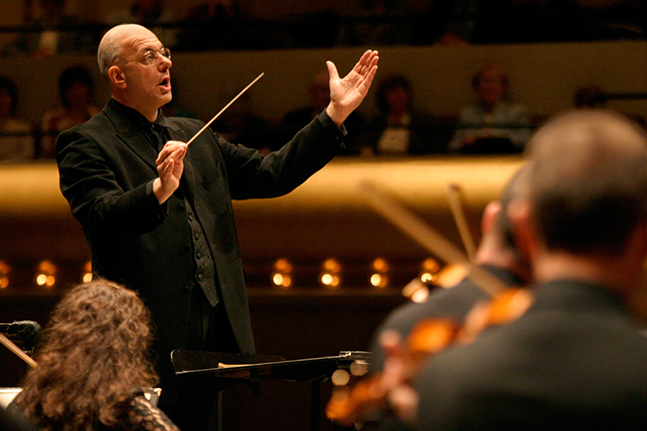
    Thursday December 17th, 2015 – Tonight at Carnegie Hall, Leon Botstein (above) was on the podium for a program of music written by Russian Jewish composers between 1874 and 1921. Performed by the American Symphony Orchestra, the concert featured two U.S. premieres and one New York premiere, as well as Anton Rubinstein’s 2nd cello concerto with soloist István Várdai.

    Aleksandr Krein’s The Rose and The Cross (‘Symphonic Fragments after Aleksandr Blok’) was composed between 1917-1920, making it the newest work on tonight’s program. Blok was a great Symbolist poet and his mystical drama The Rose and The Cross went thru more than 200 rehearsals at the Moscow Art Theater but was never performed in public. The composer Krein was inspired by Blok’s writing and composed this suite to honor the poet. Tonight’s performance marked the suite’s New York premiere.

    The music, which shows traces of harmonic advancement over the other three – older – works played this evening, opens with a somber, rather creepy atmosphere. Later it will take on an almost cinematic feeling, with effects such as trumpet fanfares and shades of exotica from the harp. A songful melody becomes a recurring theme, and the suite rises to a triumphant conclusion depicting the “boundless energy of the heart that sings.” 

    Várdai István nagyfelbontású fotó

    The Hungarian cellist István Várdai (above) then took the stage for the evening’s one (somewhat) familiar work: the second cello concerto of Anton Rubinstein. The oldest and most conservative piece on tonight’s bill, it marks the pianist-composer as a pioneer, since he was the first major Russian composer to work in the concerto genre (Tchaikovsky’s violin concerto still lay four years in the future). Rubinstein draws upon a very ‘Russian’ sense of melody; the concerto is a vastly pleasing work, and one which places great demands on the soloist.

    Mr. Várdai, tall and youthful-looking, is an extraordinarily gifted musician and seemed to win the hearts of the Carnegie Hall audience this evening within moments of starting to play. His timbre has a lovely, deep-violet colour and his technique is refined in both agility and dynamic control. From his opening soulful song, the cellist moved thru a scampering passage and on to a strikingly brisk downhill scale that ended on a delicious trill. A second theme plumbs the most pungent depths before turning into a rapid dance.

    The concerto’s movements flow into one another, with a wind chorale signaling the start of the Andante; Mr. Várdai embarks on an optimistic melody but the composer cannot resist a desire to let the music dance. After a mini-cadenza, a jogging Allegro carries us along. The orchestral texture lightens, with cello filigree, then lapses into an interlude and grows quiet. Things slow down beautifully for another injection of melody and the cellist then serves up a more sustained cadenza before a final surge to the end.

    Mr. Várdai’s superb performance elicited a very enthusiastic response from the audience; I very much hope to have further opportunities to experience his artistry.

    Following the interval, Mikhail Gnesin’s From Shelley (‘Symphonic Fragment after Percy Bysshe Shelley’s Prometheus Unbound‘) had its U.S. premiere. Written between 1906 and 1908 this short (8 minutes) work was composed while Gnesin was studying with Rimsky-Korsakov. Its brevity precludes any real development of ideas, yet there is a fine sense of the theme blossoming, and some very nice writing for the horns and harp. The ending is, in a word, beautiful. 

    The U.S. premiere of Maximilian Steinberg’s first symphony raised the question: why did it take nearly one hundred and ten years for this symphony to reach us? It’s as exciting and finely-crafted as many other well-known symphonies; the composer appears to have drawn inspiration from such symphonists as Beethoven and Schumann, eschewing the Russian-nationalist influence of his teacher Rimsky-Korsakov. 

    Steinberg’s 1st has an animated, congenial opening with the immediate establishing of a rich theme that that put me in mind of – of all things – Humperdinck’s HANSEL UND GRETEL (“Der Wind! Der Wind!”); this theme will re-sound throughout the symphony. This is big, pleasing music with a variety of rhythmic patterns. The timpani lend a stately quality.

    In an exuberant Allegro vivace, the composer lightens things to a scherzo quality, later taking on a waltzy air. This second movement ends with Mendelssohnian charm.

    After a darkish start, the Andante features a clarinet theme which develops into a tutti passage. In a gentle acceleration, horns and oboe play a part, and then in a richer build-up the horns grow passionate. Horn and clarinet voices entwine; oboe and flute pipe up. The music becomes cinematic in sweep before receding to solo clarinet.

    “Der Wind! Der Wind!” is again evoked by horns and trumpets as the finale commences. The oboe speaks out, then the horns launch a fugue. As the Allegro moderato continues on, the music meanders somewhat, as though Steinberg was unsure how best to end the piece: but end it does – strongly. 

    Kudos to Maestro Botstein for assembling a rewarding program of relative rarities, for including the Rubinstein cello concerto (and Mr. Várdai’s excellent playing of it), and for bringing the Steinberg symphony to these shores.

    This evening’s repertory – click on each composer’s name for biographical information:

    Aleksandr Krein – The Rose and the Cross (N.Y. Premiere)
    Anton Rubinstein– Cello Concerto No. 2
    Mikhail GnesinFrom Shelley (U.S. Premiere)
    Maximilian Steinberg– Symphony No. 1 (U.S. Premiere)

  • American Symphony Orchestra’s MUSIC U

    Cd_cover460

    Sunday April 19th, 2015 – This note from the press release describes the inspiration for today’s programme, entitled ‘MUSIC U’, by the American Symphony Orchestra: “In a country without kings and courts, universities have served as the patrons for many of America’s greatest composers.” Leon Botstein and the ASO were joined by the Cornell University Glee Club & Chorus in a celebration of five Ivy League composers.

    RandallThompson480

    In 1940, Randall Thompson (above) who taught at Harvard and was director of the Curtis Institute, was commissioned to compose a choral work for the opening exercises of the new Berkshire Music Center at Tanglewood, to be performed by the entire student body. The composer offered a setting of the Alleluia. Distraught over the Nazi invasion of France, Thompson could not bring himself to compose a joyous fanfare. Instead, he produced this solemnly beautiful and introspective piece, inspired by the Biblical passage (Job 1:21): “The Lord gave and the Lord has taken away; blessed be the name of the Lord.”

    Performing a cappella under the direction of Robert Isaacs, the young singers from Cornell displayed a lovely vocal blend in the heavenly harmonies of this slow, lilting choral miniature. The gentle pace quickens somewhat near the work’s end, but falls back into calm with a very sustained final note that hung on the air.

    Parker

    After a rather long pause, the concert continued with the oldest work (late 19th century) on the programme: the cantata Dream-King and his Love by Horatio Parker (above), one-time Dean of Music at Yale. This cantata won first prize in its category in a competition judged by Dvořák himself. A fanciful romantic text tells the tale of a maiden visited in her dream by a kingly lover.

    The work is melody-filled and seems to echo some of the exotic works of Jules Massenet. From the lyrical opening (the harp is prominent) thru passages dance-like, rapturous, and triumphant by turns, the music opens out like a perfumed lotus blossom. The naturally youthful sound of tenor soloist Phillip Fargo fell pleasingly in the ear, and the singers from Cornell again gave of their best.

    Rochberg-George-01

    The Symphony No. 2 by George Rochberg (above), who ran the music department at the University of Pennsylvania, was the longest work on the programme. Composed in 1955-1956, this symphony today sounds like a generic work from an era when classical music was not quite sure what direction it was headed in. It’s a big-scale piece, one which seems to take itself very seriously. One can sense such influences as Prokofiev, Stravinsky and Schönberg in the writing, and the composer’s fine craftsmanship is never in doubt. Yet despite its rhythmic variety and interesting sonic textures – oboe and horns are well-employed – the piece seemed over-extended. Melody is pretty much banished – a promising duet passage for two violas evaporated after a few seconds – and although melody is not essential, it is inevitably gratifying. Maestro Botstein’s commitment to the work and the excellent playing of the ASO – many fleeting bits of solo work are strewn throughout the score – made as strong a case for the symphony as one could hope to hear.

    300h

    Music for Cello and Orchestra by Harvard’s Leon Kirchner (above)…

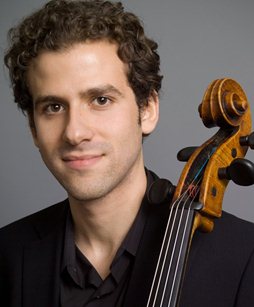
    Nicholas-Canellakis

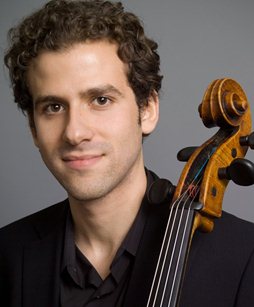
    …with soloist Nicholas Canellakis (above) opened the second half of the concert. The cellist is a frequent participant in Chamber Music Society of Lincoln Center‘s superb concerts.

    Today, Kirchner’s music seemed to me to have found what was missing from the Rochberg: a connection to the heart. Throughout the Kirchner, the solo cello gives his piece a sense of unity and purpose that – to my ears – the Rochberg lacks. Kirchner’s orchestration is colorful and dense, with excellent use of percussion, and the music sometimes takes on a cinematic quality. I love hearing a piano mixed into an orchestral ensemble work, and at the reference to TRISTAN UND ISOLDE, my friend Adi and I exchanged smiles.

    Mr. Canellakis was simply breathtaking right from the cello’s passionate opening statement. He was deeply involved in the music, moving seamlessly from a gleaming upper register to the soulful singing of his middle range. Capable of both redolent lyricism and energetic, jagged flourishes, Nicholas’s playing seemed so at home in the venerable Hall. The audience gave him lusty and well-deserved round of applause as he was called back to the stage after his exceptional performance.   

    Robertosierraheadshot

    The chorus then returned to the stage for the concert’s grand finale: the world premiere of Cantares by Roberto Sierra (above), which Cornell University commissioned for this concert in celebration of their 150th anniversary. In this panoramic work, the cultures of the African, Spanish, Native Peruvian, and Aztec peoples are entwined in vivid musical settings of texts dating back to the 16th and 17th centuries. The composer has re-imagined these invocations and narratives for the contemporary world; for this piece, the Cornell choristers leapt readily from Quechua to Spanish.

    A long sustained tone opens Cantares; then, emerging from dark turbulence, the chorus begins to ‘speak’. A trumpet call, a wandering xylophone, a celestial harp, an oddly ominous rattle: these are all heard as kozmic sound-clouds drift by. The music is mystical and – with the under-pacing of rhythmic chant – takes on an other-worldly feeling.

    The second movement evokes African ritual and that continent’s ancient connection to Cuba. The music seems to echo thru time in its heavenly, ecstatic vibrations. Somehow Chausson’s Poeme de l’amour et de la Mer came to mind.

    An orchestral interlude has the flutter of birdsong and a dense-jungle yet transparent appeal and leads into the final Suerte lamentosa, an epic of dueling cultures told from both the winners’ and the losers’ points of view.

    The work is perhaps a trifle too long, but the composer has been successful in drawing us to contemplate the oft-forgotten (or ignored) events surrounding the injection of Christianity into the Western Hemisphere. And musically it’s truly brilliant.

  • American Symphony Orchestra’s MUSIC U

    Cd_cover460

    Sunday April 19th, 2015 – This note from the press release describes the inspiration for today’s programme, entitled ‘MUSIC U’, by the American Symphony Orchestra: “In a country without kings and courts, universities have served as the patrons for many of America’s greatest composers.” Leon Botstein and the ASO were joined by the Cornell University Glee Club & Chorus in a celebration of five Ivy League composers.

    RandallThompson480

    In 1940, Randall Thompson (above) who taught at Harvard and was director of the Curtis Institute, was commissioned to compose a choral work for the opening exercises of the new Berkshire Music Center at Tanglewood, to be performed by the entire student body. The composer offered a setting of the Alleluia. Distraught over the Nazi invasion of France, Thompson could not bring himself to compose a joyous fanfare. Instead, he produced this solemnly beautiful and introspective piece, inspired by the Biblical passage (Job 1:21): “The Lord gave and the Lord has taken away; blessed be the name of the Lord.”

    Performing a cappella under the direction of Robert Isaacs, the young singers from Cornell displayed a lovely vocal blend in the heavenly harmonies of this slow, lilting choral miniature. The gentle pace quickens somewhat near the work’s end, but falls back into calm with a very sustained final note that hung on the air.

    Parker

    After a rather long pause, the concert continued with the oldest work (late 19th century) on the programme: the cantata Dream-King and his Love by Horatio Parker (above), one-time Dean of Music at Yale. This cantata won first prize in its category in a competition judged by Dvořák himself. A fanciful romantic text tells the tale of a maiden visited in her dream by a kingly lover.

    The work is melody-filled and seems to echo some of the exotic works of Jules Massenet. From the lyrical opening (the harp is prominent) thru passages dance-like, rapturous, and triumphant by turns, the music opens out like a perfumed lotus blossom. The naturally youthful sound of tenor soloist Phillip Fargo fell pleasingly in the ear, and the singers from Cornell again gave of their best.

    Rochberg-George-01

    The Symphony No. 2 by George Rochberg (above), who ran the music department at the University of Pennsylvania, was the longest work on the programme. Composed in 1955-1956, this symphony today sounds like a generic work from an era when classical music was not quite sure what direction it was headed in. It’s a big-scale piece, one which seems to take itself very seriously. One can sense such influences as Prokofiev, Stravinsky and Schönberg in the writing, and the composer’s fine craftsmanship is never in doubt. Yet despite its rhythmic variety and interesting sonic textures – oboe and horns are well-employed – the piece seemed over-extended. Melody is pretty much banished – a promising duet passage for two violas evaporated after a few seconds – and although melody is not essential, it is inevitably gratifying. Maestro Botstein’s commitment to the work and the excellent playing of the ASO – many fleeting bits of solo work are strewn throughout the score – made as strong a case for the symphony as one could hope to hear.

    300h

    Music for Cello and Orchestra by Harvard’s Leon Kirchner (above)…

    Nicholas-Canellakis

    …with soloist Nicholas Canellakis (above) opened the second half of the concert. The cellist is a frequent participant in Chamber Music Society of Lincoln Center‘s superb concerts.

    Today, Kirchner’s music seemed to me to have found what was missing from the Rochberg: a connection to the heart. Throughout the Kirchner, the solo cello gives his piece a sense of unity and purpose that – to my ears – the Rochberg lacks. Kirchner’s orchestration is colorful and dense, with excellent use of percussion, and the music sometimes takes on a cinematic quality. I love hearing a piano mixed into an orchestral ensemble work, and at the reference to TRISTAN UND ISOLDE, my friend Adi and I exchanged smiles.

    Mr. Canellakis was simply breathtaking right from the cello’s passionate opening statement. He was deeply involved in the music, moving seamlessly from a gleaming upper register to the soulful singing of his middle range. Capable of both redolent lyricism and energetic, jagged flourishes, Nicholas’s playing seemed so at home in the venerable Hall. The audience gave him lusty and well-deserved round of applause as he was called back to the stage after his exceptional performance.   

    Robertosierraheadshot

    The chorus then returned to the stage for the concert’s grand finale: the world premiere of Cantares by Roberto Sierra (above), which Cornell University commissioned for this concert in celebration of their 150th anniversary. In this panoramic work, the cultures of the African, Spanish, Native Peruvian, and Aztec peoples are entwined in vivid musical settings of texts dating back to the 16th and 17th centuries. The composer has re-imagined these invocations and narratives for the contemporary world; for this piece, the Cornell choristers leapt readily from Quechua to Spanish.

    A long sustained tone opens Cantares; then, emerging from dark turbulence, the chorus begins to ‘speak’. A trumpet call, a wandering xylophone, a celestial harp, an oddly ominous rattle: these are all heard as kozmic sound-clouds drift by. The music is mystical and – with the under-pacing of rhythmic chant – takes on an other-worldly feeling.

    The second movement evokes African ritual and that continent’s ancient connection to Cuba. The music seems to echo thru time in its heavenly, ecstatic vibrations. Somehow Chausson’s Poeme de l’amour et de la Mer came to mind.

    An orchestral interlude has the flutter of birdsong and a dense-jungle yet transparent appeal and leads into the final Suerte lamentosa, an epic of dueling cultures told from both the winners’ and the losers’ points of view.

    The work is perhaps a trifle too long, but the composer has been successful in drawing us to contemplate the oft-forgotten (or ignored) events surrounding the injection of Christianity into the Western Hemisphere. And musically it’s truly brilliant.