
Leontyne Price sings Aida’s “O patria mia“, her signature aria. This comes from her remarkable “Blue Album”: some of her finest singing ever, and still available.
Leontyne Price sings Aida’s “O patria mia“, her signature aria. This comes from her remarkable “Blue Album”: some of her finest singing ever, and still available.
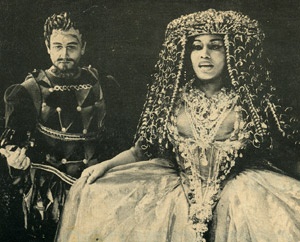
Above: Justino Diaz and Leontyne Price in Samuel Barber’s ANTONY & CLEOPATRA at The Met, 1966
~ Author: Oberon
By chance, I came upon this film of Leontyne Price singing Cleopatra’s final aria from Barber’s ANTONY & CLEOPATRA at a 1984 concert at Juilliard, conducted by Jorge Mester. Ms. Price’s singing here shows some of the vocal idiosyncrasies that crept into her performances as the 1970s progressed into the 1980s. But the sheer sound is glorious, the upper notes sustained, steady, and thrilling. What I love most about her in this brief video is her stillness – she doesn’t flail her arms about melodramatically; it’s all contained in the music – and her great sense of personal dignity.
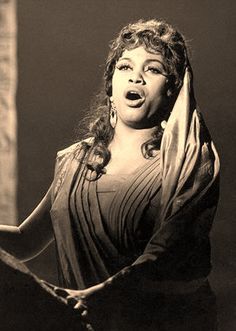
Barber wrote Cleopatra’s music specifically with Leontyne Price’s voice in mind. After the run of performances that opened the New Met in 1966 – of which I attended the last – the opera vanished from the Met repertoire. The composer devised a concert ending for the great final aria so that Ms. Price, and others to follow, might include it in their appearances with symphony orchestras.
A revised version of ANTONY & CLEOPATRA was given at Juilliard in 1975, a performance of which I attended:

The European premiere of the opera (in concert form) took place at the Théâtre des Champs Elysées, Paris, in 1980. Chicago Lyric Opera gave the opera in 1991 with Richard Cowan and Catherine Malfitano in the title-roles. There was a telecast, which I watched – really impressive – and which you can watch here and here!
In 2009, New York City Opera gave the opera in concert form at Carnegie Hall with Teddy Tahu Rhodes and Lauren Flanigan as Antony and Cleopatra. I was there, and the cumulative effect of the opera was powerful.
Writing about this opera gives me an opportunity to bring forth one of the great rarities from my collection: a performance of the final aria of Cleopatra by mezzo-soprano Beverly Wolff from a concert at Cincinnati in 1971. Martina Arroyo was to have been the vocal soloist that evening, but she was taken ill and Ms. Wolff stepped in on very short notice; musical revisions were made to accommodate the switch from soprano to mezzo-soprano.
Beverly Wolff ANTONY & CLEOPATRA aria Cincinnati 1971
~ Oberon

Roberta Peters has passed away at the age of 86. I first heard her voice on the Texaco broadcasts in the early 1960s, when I was in the earliest stages of my lifelong obsession with opera. She was also on the very first opera LP set I ever owned: an RCA aria collection which my parents had given me. Roberta appeared frequently on the Ed Sullivan Show during those years.
I first saw Roberta live at the Old Met; she sang Despina in an English-language production of COSI FAN TUTTE, and her co-stars included Leontyne Price, Rosalind Elias, and Richard Tucker. After the New Met opened at Lincoln Center in 1966, I saw her as Gilda, the Queen of the Night, Oscar in BALLO IN MASCHERA, Adina (with Pavarotti), and Norina.
My parents took me to Saratoga, where Eugene Ormandy conducted a concert FLEDERMAUS in which Roberta sang Adele opposite Hilde Gueden (Rosalinda) and Kitty Carlisle (Prince Orlofsky). While I was living in Houston briefly in 1973, Roberta gave a delightful recital there, singing everything from Donizetti to Debussy. I saw her onstage for the last time at the Met’s 100th Anniversary Gala in 1983; she sang in the sextet from LUCIA DI LAMMERMOOR.
Her recordings of Gilda, the Queen of the Night, and Rosina remain favorites of mine, and – even with Sutherland, Scotto, and Sills being among my most memorable Lucias – I still really enjoy Roberta’s recording of the role, opposite Jan Peerce.
Roberta Peters – Spargi d’amaro pianto – LUCIA DI LAMMERMOOR

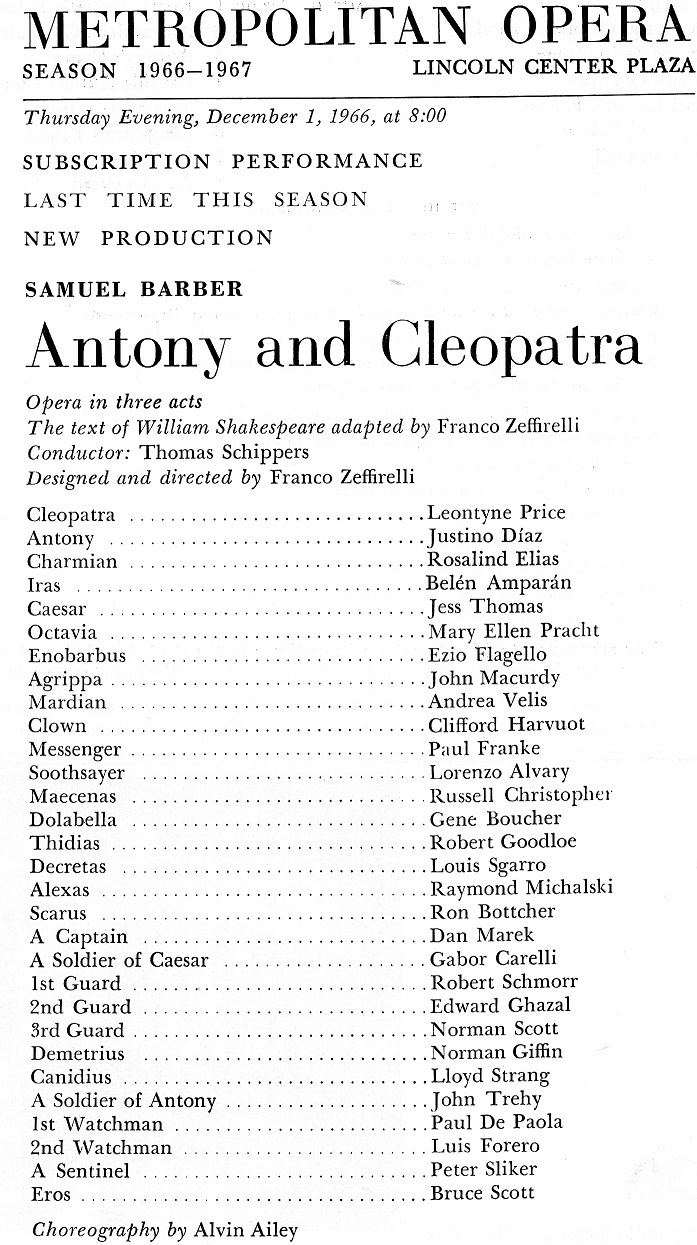
September 16th, 2016 – Fifty years ago tonight, the Metropolitan Opera opened at their new home at Lincoln Center with the world premiere performance of Samuel Barber’s ANTONY AND CLEOPATRA starring Leontyne Price, Justino Diaz, and Jess Thomas, conducted by Thomas Schippers. The performance was broadcast live, and – needless to say – I was tuned in.

I remember listening in my little room in the big house in tiny Hannibal, New York, where I grew up. The possibility of a strike by the musicians of The Met’s orchestra had left the future of the season beyond this first night up in the air; but during the intermission, Rudolf Bing stepped out before the gold curtain to announce that the strike had been averted and new contracts signed. I – always so reticent – let out a whoop and raced downstairs, excitedly telling my parents the news; they thought I was deranged, but that was nothing new.
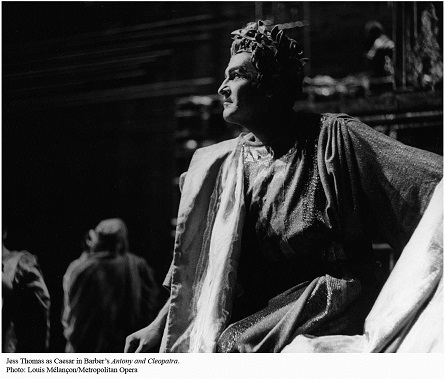
But I had a vested interest in the outcome of The Met’s contract negotiations, because in August I had made my first solo trip to New York City and I had tickets to several upcoming performances, including the final ANTONY AND CLEOPATRA of the run. So now my plans were a “go”, and I was soon making frequent pilgrimages to Lincoln Center and falling in love with the City where I would eventually live.
Read an article about my experience on the first ticket line for The Met at Lincoln Center here.

Nicolai Ghiaurov, Fiorenza Cossotto, Renata Tebaldi, Leontyne Price and Carlo Bergonzi backstage at Carnegie Hall following a performance of the Verdi REQUIEM in 1964. Price, Cossotto, Bergonzi and Ghiaurov were the soloists, and Tebaldi was visiting her colleagues in the green room after the performance. Herbert von Karajan conducted.
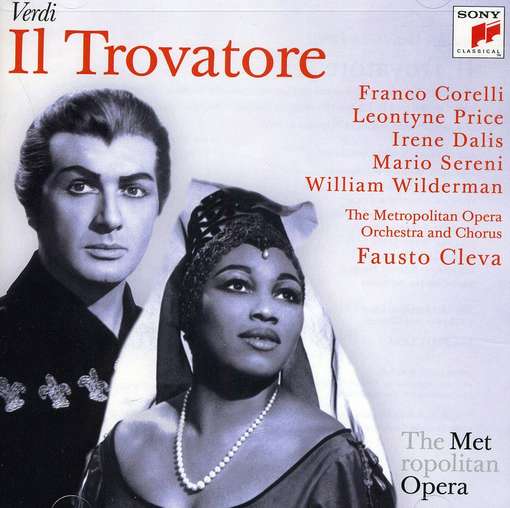
The Metropolitan Opera on SONY series recently issued the famous February 4, 1961 TROVATORE broadcast with Leontyne Price and Franco Corelli which followed by a week their wildly acclaimed joint Met debut in the Verdi opera. The 1960-61 Met broadcast season was happening without my knowledge, otherwise I would certainly have been glued to my radio. But I did not discover the Met broadcasts until the following season when the fabled Sutherland ‘debut’ LUCIA was the first time I tuned in. From then until just a couple of years ago, I hardly ever missed a broadcast.
I heard Price and Corelli many times at The Met – Leontyne I actually heard at the Old Met as Fiordiligi in COSI FAN TUTTE (in English) and Franco sang in the first performance I saw at the New Met (as Calaf in TURANDOT). I loved them both in those golden years though I knew Franco could be sloppy at times and Leontyne, over the years, developed some annoying idiosyncrasies. I’d never heard the 1961 TROVATORE so I set aside time to concentrate on it; I must say, it is a very erratic performance.
Fausto Cleva, a favorite conductor of Renata Tebaldi, takes much of TROVATORE at a breathless clip. For the most part the singers manage to keep up though there’s some scrambling here and there. Aside from Leontyne Price, who strives throughout for thoughtful musicality, the principal quartet of singers tend to sing TROVATORE in verismo style rather than treating it like a god-child of the bel canto era. I suppose there’s a temptation to snarl and bluster in the opera’s dramatic utterances and in a live performance there is no recourse other than to let the singers do what they will in declaiming the text. But it becomes a bit tiresome after a while.
Corelli is the most lachrymose Manrico I ever heard; he gives the same impression on his commercial recording of the role for EMI, though that is more artfully sung. Of course there is a lot of very powerful and exciting vocalism in his interpretation, but this is somewhat compromised by his melodramatic excesses. Upon receiving news that Leonora is to take the veil, Corelli has a little mad scene which wanders right off the musical map. But despite some slight variability of pitch at times, the utterly distinctive Corelli timbre and his sheer generosity of voice make him a Manrico on the grand scale. Interestingly, Corelli only sang this opera at the Met eleven times, retiring it from his repertory at the House in 1964. A new production in 1969 was reportedly planned for Corelli but in the event Placido Domingo was the Manrico.
Leontyne Price on the other hand kept Leonora in her repertoire for over twenty years; the great aria “D’amor sull’ali rosee” might be considered the soprano’s theme song and she sang it superbly at the gala that closed the Old Met in 1966. The warmth and shimmering beauty of her timbre provide the vocal high points of this 1961 broadcast where she manages to maintain the Verdian line while her colleagues wander into melodramatic over-accenting of certain passages. For my money, Price was not a soprano with a first-rate forte top; she was best in the floating upper phrases of a role. Corelli drowns her out on the final D-flat of Act I, and her high-C at the climax of the Act IV duet with di Luna doesn’t have any zing to it. But overall it’s wonderful to hear the soprano in all her freshness in this music. Over the ensuing years Price developed a vocal ‘style’ that could be off-putting: growling in the lower register and introducing some bluesy mannerisms that could spoil her performances for me. You don’t hear these on her commercial recordings so much, but in the House she could be very self-indulgent. Nevertheless her singing could still thrill, right to her farewell operatic performance.
I always loved the sound of Mario Sereni’s voice, so warm and attractive. For me he was at his best in verismo: his Marcello, Carlo Gerard and Tonio (PAGLIACCI) were all very fine; he did leave behind some wonderful studio recordings too, notably his Germont with de los Angeles and his Enrico on the RCA/Moffo LUCIA. But in this TROVATORE he seems way off form. I wonder in fact if he was actually originally scheduled for this broadcast since Robert Merrill had sung di Luna in the Price/Corelli debut performance and sang it again in the next performance following the broadcast. Whatever the case, Sereni seems unprepared. He sings the wrong entry line in the first scene of Act III and gets lost in the recitative on his entry in Act IV. Some handsome singing along the way is offset by serious pitch problems in the great aria “Il balen”. It’s sad that this particular broadcast should be chosen as a document of Sereni’s live Met performances; I know I can never listen to it again.
Irene Dalis was a great favorite of mine. She was a powerful stage presence and a singer who could be both passionate and subtle. Her performance is exciting but I feel of all the singers she may have been most put-off by Cleva’s fast tempi. In the Act III, Scene 1 finale Irene is pushed to the limits by the conductor’s absurdly rapid pace and it seems to me that she simply stops singing during the final bars of music. Her final scene is very impressive, though, with the quiet calm of her “Ai nostri monti” and a sustained high B-flat in her last triumphant, vindictive phrase. Ten years after this broadcast, I saw Irene’s Azucena at the Met during a June Festival performance. Despite the intervening decade of singing some of opera’s most demanding roles, she was in fact far more thrilling and vocally secure than on this 1961 broadcast.
It’s good to have a document of William Wilderman’s performance of Ferrando; his ample and darkishly dramatic singing gets the opera off to a strong start. Teresa Stratas sings the brief role of Inez and there is no mistaking her voice. She strives to make something lovely of her phrase bidding farewell to Leonora at the convent, but Price trumps her by coming in a shade early and stepping on the younger soprano’s tapering piano.
For all its flaws, listening to this recording reminded me of how much I love this opera. Despite its improbable plot, the vast treasury of Verdi melody makes TROVATORE essential.
 Oberon's Glade