Tag: Lili Tobias

  • More from the Time:Spans Festival ~ False Division

    Author: Lili Tobias

    @ the di menna center

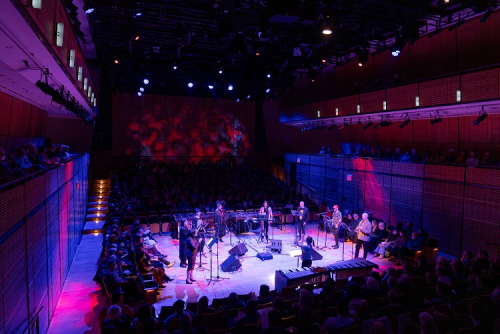
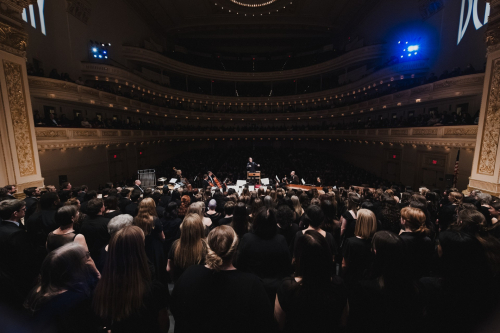
    On Thursday, August 21st, 2025, I headed back to the DiMenna Center for my second concert of the week to see another performance that was part of the Time:Spans Festival. On the program was the world premiere of False Division, a collaboration between Endlings (Raven Chacon and John Dieterich) and Yarn/Wire (Laura Barger, Julia Den Boer, Russell Greenberg, and Bill Solomon), which created an emotional experience entirely different from Tuesday’s concert. While Chaya Czernowin’s the divine thawing of the core was powerfully haunting, False Division ultimately maintained a sense of underlying safety amidst the chaotic banquet of noise.

    The music began with glowing bell tones in the percussion and electronics, reminding me of fireflies or droplets of water on a summer night. Everything that followed was incredibly different though! While I wasn’t a fan of each and every sound in the piece (such as the nails-on-a-chalkboard sound of bowing a block of styrofoam), each one was an experience of some sort, and many sounds were completely new to me (like the rumbling of a massage gun on the surface of a bass drum). There were often quick shifts between sections with very different sound profiles, each one with its own unique character.

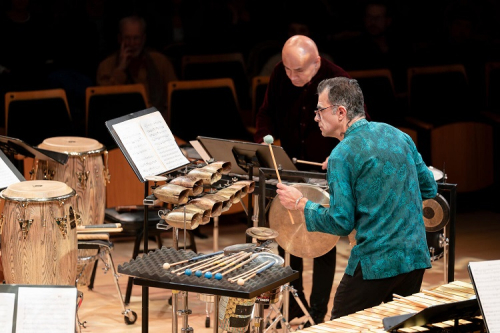
    False Division celebrated the joy of musical exploration and experimentation. I had really great seat, with a direct line of sight towards one of the elaborate percussion setups, so I could not only hear everything, but also see the process of how those sounds were brought to life. One of my favorite moments of the piece was when the percussionist nearest to me ecstatically bowed a cymbal resting on a drum until nearly half the bow hairs had frayed and split—and he did all this with a mallet held between his teeth!

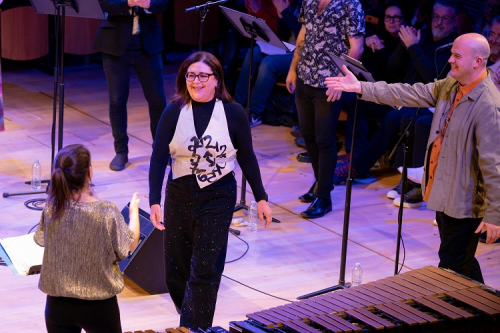
    I could tell all the musicians were having a ton of fun, and this fun continued through the duration of the performance. To kick off the “grand finale,” the keyboardist pulled out a twirly noisemaker, and, spinning it around above her head, made her way over to the piano bench to join the pianist for a lively 4-hand explosion of notes. Even as just an audience member, I could feel the joy of making music together, and I left the concert hall far more lighthearted than I did on Tuesday. Both nights were filled with incredibly inspiring music, and it’s always good to have variety at a long festival like this!

    ~ Lili Tobias

  • Chaya Czernowin ~ the divine thawing of the core

    chaya c

    Above: composer Chaya Czernowin, photo by Astrid Ackerman

    ~ Author: Lili Tobias

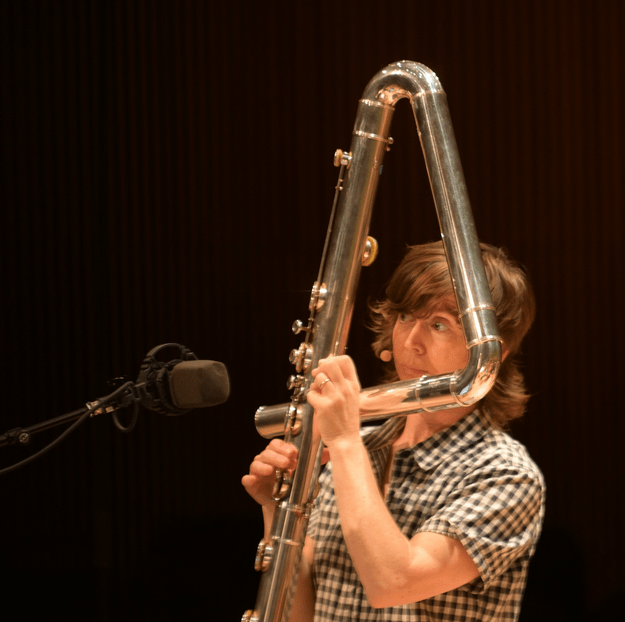
    Tuesday August 19th, 2025 – This evening, the Talea Ensemble, with Claire Chase on solo contrabass flute, performed the US premiere of Chaya Czernowin’s the divine thawing of the core at the DiMenna Center. The concert was part of the Time:Spans Festival, and the musicians delivered a stunning performance to a nearly full house!

    Breathing played a prevalent role in the sound world of the divine thawing of the core. The unusual collection of instruments in the ensemble, which included six flutes, six oboes, and six trumpets, leaned heavily on the winds, which were truly “windy” to the greatest extent. It was as if the musicians made up a collective weather system, at times calm and at others, stormy. The music began with a plaintive, single-note call-and-response structure between Claire Chase on the contrabass flute and the other sections of instruments. Tranquil, but at the same time eerily apprehensive and ill at ease.

    Screenshot 2025-09-02 at 22-28-47 Mail – philip gardner – Outlook c

    Above: Claire Chase (rehearsal photo)

    Further on in the piece, the storm broke: the winds and brass howling and screaming, the notes swirling behind the frantic trills of the contrabass flute. Chase displayed incredible breath control when the music got chaotic. Although it seemed at first as though she was struggling for breath with sharp uptakes of air, I could ultimately tell that this effect was deliberate. The breath in was just as important as the breath out, as it added an extra layer of humanity to the music that can be difficult to achieve with a non-vocal ensemble.

    From the first few delicate tones to the turmoil of a “demonic waltz,” Czernowin’s music continually circled around exact pitches, rarely landing solidly on a frequency. The winds bent the notes, wavering and unstable, while the cellos bowed deep into the strings, producing rumbly low sounds. Even the piano, when it first entered the soundscape, provided key strikes that oscillated up and down in their decay. 

    And together as an ensemble too, the musicians often behaved as one entity emitting and ever-shifting collection of sound. The addition and subtraction of tones from the cumulative voice of the ensemble created a brand new form of pitch variance, and this perpetual suggestion—but never clarification—of pitch kept me attuned to every tiny transformation.

    Suddenly though, all airflow was cut off, and just the breathing of the audience was left in the hall. After a moment of silence, applause erupted through the rows of seats and lasted for a good 5 minutes!

    The musicians of the Talea Ensemble:

    Laura Cocks, Flute

    Yoshi Weinberg, Flute

    Isabel Lepanto Gleicher, Flute

    Catherine Boyack, Flute

    Amir Farsi, Flute

    Michael Matsuno, Flute

    Michelle Farah, Oboe

    Stuart Breczinksi, Oboe

    Christa Robinson, Oboe

    Jeffrey Reinhardt, Oboe

    Karen Birch Blundell, Oboe

    Mekhi Gladden, Oboe

    Sam Jones, Trumpet

    Jerome Burns, Trumpet

    ChangHyun Cha, Trumpet

    Alejandro López-Samamé, Trumpet

    Atse Theodros, Trumpet

    Robert Garrison, Trumpet

    Mike Lormand, Trombone

    Dan Peck, Tuba

    Margaret Kampmeier, Piano

    Sae Hashimoto, Percussion

    Chris Gross, Cello

    Brian Snow, Cello

    Thapelo Masita, Cello

    Conductor: James Baker

    ~ Lili Tobias

  • The Crossing: The Book of Never

    The+Crossing +Summer+2024+(credit_+Charles+Grove)+

    Above: The Crossing; photo by Charles Grove

    ~ Author: Lili Tobias

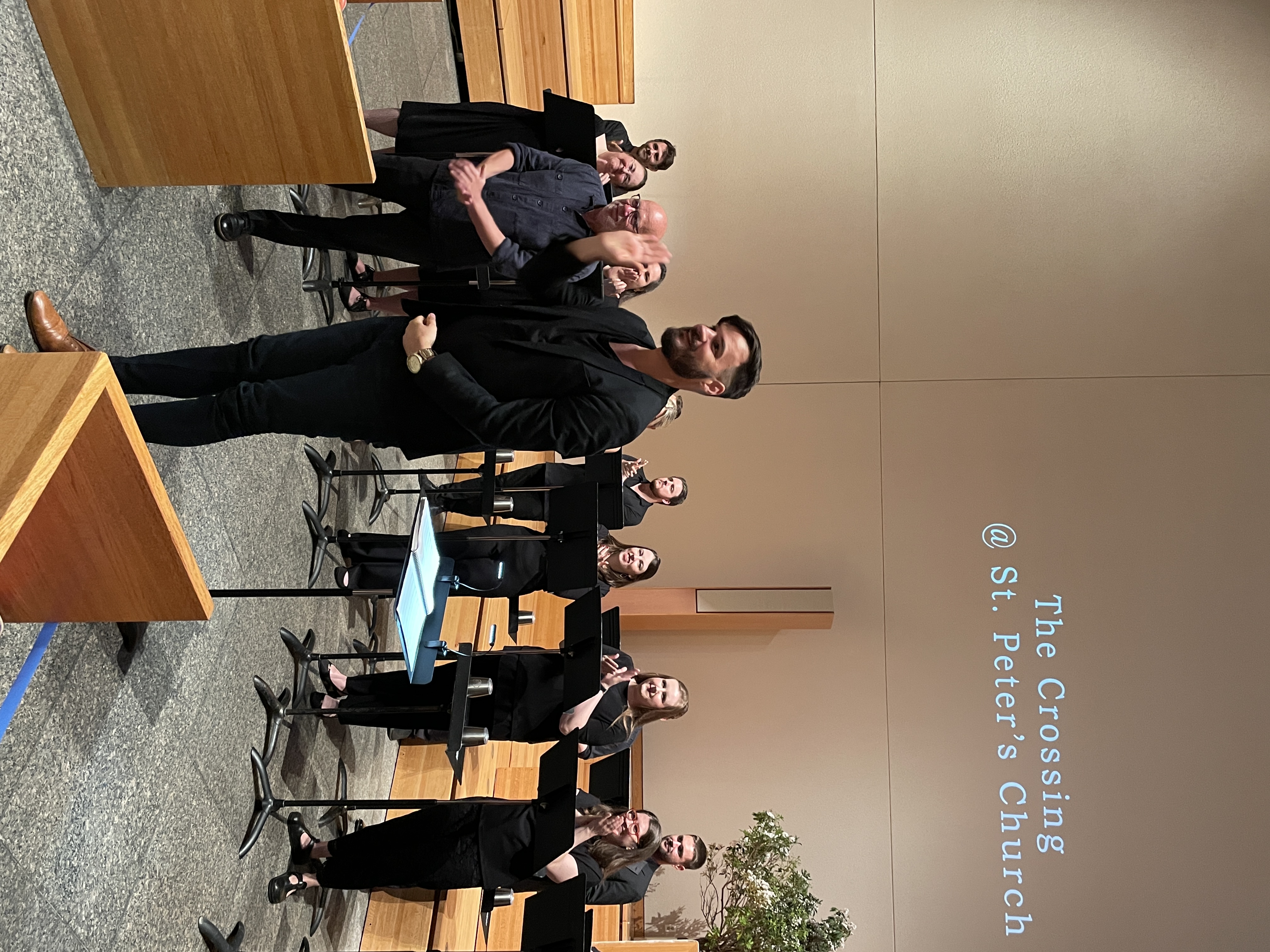
    Friday June 20th, 2025 – The Crossing, conducted by Donald Nally, presented the New York premiere of Aaron Helgeson’s The Book of Never, along with selections from Gavin Bryars’s The Last Days of Immanuel Kant—two adventurous works of music! The program was presented by the Arts and Architecture Conservancy at Saint Peter’s.

    The Last Days of Immanuel Kant began the concert, the text of which is drawn from Thomas DeQuincey’s book of the same title. Bryars set the words true to the rhythms of the original prose, with flowing sentence-shaped phrases. The lush harmonies were full of suspended notes, some resolving and others remaining in a state of lingering uncertainty. But no matter what happened eventually, the result was always beautiful!


    In the program notes for “II. Prologue,” Bryars notes “DeQuincey’s astonishing assumption: ‘I take it for granted that every person of education will acknowledge some interest in the personal history of Immanuel Kant.’ I, for one, do not have any particular interest in Immanuel Kant, but that didn’t detract from my enjoyment of the music at all. Without the historical context, the text could have been about any regular person in their final stages of life. The singers describe mundane activities like recording conversations on scrap paper in order to remember them, difficulty sleeping, visiting a friend’s garden, etc.—all things that are shared by many in the process of aging and dying, no matter if you’re a famous philosopher or ordinary person.


    04+Sam+Gehrke


    Above: Aaron Helgeson, photo by Sam Gehrke


    The text for The Book of Never also originates from an unconventional source. Composer Aaron Helgeson sets the fragmented remains of the Novgorod Codex, at the same time weaving in text from a variety of other sources (including Gertrude Stein and the Rolling Stones, to name a few). Themes of exile tie the patchwork of text and personal histories of the authors together, and the powerful vocalizations of The Crossing brought Helgeson’s musical realization to life. All proceeds from this concert were donated to Safe Passage 4 Ukraine, an organization which helps Ukrainians displaced from the war find safety and new homes.


    Helgeson describes the contents of the Novgorod Codex in part as like “the chanting of a vindictive spell,” and the music certainly embodied that. The singers recited words one after the other on the same pitches or oscillated across wide intervals. Textures like this often punctuated more polyphonic sections, inciting a sense of urgency (like the near shouting of “And you bow down” in “III. Burns I’d Like to Forget…”). The harmonies, too, were mysteriously intriguing. Helgeson upended the traditional distinctions of “consonance” and “dissonance” (which are completely relative anyway) with notes and melodies drawn from a collection of hymns associated with the Novgorod Codex. During any moment of silence within the piece, the haunting echoes of dense cluster chords lingered in the air.


    All in all, The Book of Never is true choir music. Not just because it’s written for singers, but because Helgeson achieves an assembly of notes, words, vocal expression, and meaning that only a choir can facilitate. Arranged for any other ensemble, I feel that the music would lose a significant amount of the deep emotional nuance it has in its original form. Many of the movements feature different sequences of words sung nearly simultaneously, the listener’s attention shifting from one phrase to the next and back again but absorbing the meaning of both at the same time.


    A Helgeson - TBON curtain call


    Above: The Crossing and Aaron Helgeson, photo by Steven Swartz


    The final movement, “VII. Names of Things I Once Believed…,” exhibited this truly non-linear presentation of ideas to the extreme. Half the choir sustained multiple words at once (“all/always,” “why/waiting, “end/ever,” etc.) while the other half chanted longer, more descriptive phrases of resilience amidst suffering and self doubt. The intricate layers of music illuminated the complicated contradictions of existence in a world that does not value everybody’s existence. From start to finish, Helgeson’s innovative choral writing brought The Book of Never to an entirely new dimension of comprehension, and it was an absolutely exhilarating space to inhabit!

    ~ Lili Tobias

  • New Music for Percussion, Piano, and Strings

    S swartz

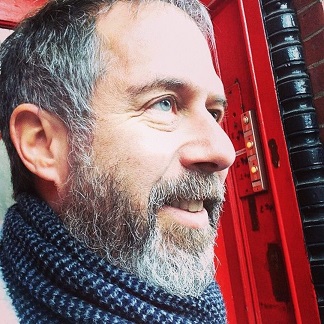
    Above: composer Steven Swartz

    ~ Author: Lili Tobias

    Thursday April 24th, 2025 –  It was unexpectedly difficult to get to the location of the New Music for Percussion, Piano, and Strings concert, performed at NYU. After waiting in the lobby for half an hour and being ushered towards the elevators with no other directions, the other audience members and I finally arrived at Room 620 shortly before the music began. Composer Steven Swartz, who had an exciting premiere on the program, described the feat as “breaching the walls of the castle.” But fortunately, all the music on last night’s program was entirely worth the struggle of getting there!

    The program began with two pieces for piano trio, each made up of a handful of very short movements. These were Miu Sato’s Threads of Belonging and Takashi Yoshimatsu’s Atom Hearts Club Suite No. 1. Despite the brevity of the music, both composers packed an incredibly diverse array of sounds into each piece, from lush, pianistic arpeggios that filled out the space around the violin and cello’s melodies to energetic syncopated rhythms in odd meters. The three performers, Angel Guanga (violin), Noelia Carrasco (cello), and Malka Bobrove (piano) are all currently undergraduate students at NYU, but their sound as an ensemble was nothing short of professional, playing with an incredible level of confidence and precision.

    I was also impressed with pianist Miles Avery’s performance of …couple égyptienne en route vers l’inconnu… by György Kurtàg. The music featured pointillistic collections of notes, connected together through the overtones left behind by the sustain pedal. Avery played every single note with such intention that each sound that emanated from the piano seemed to have an entirely different character from the last.


    Soundcheck - MN + JH


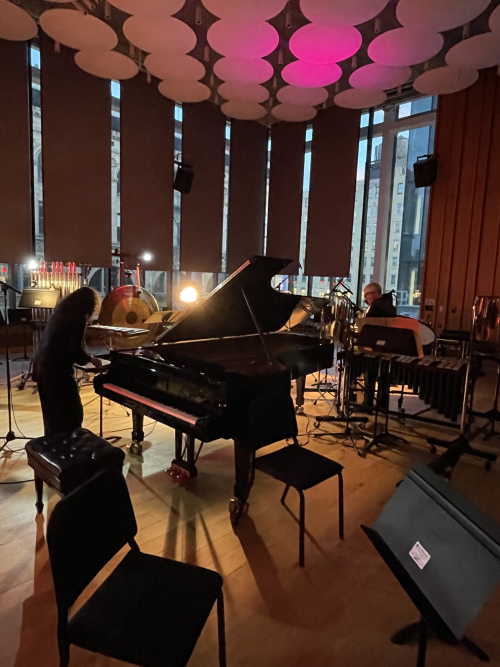
    Above: pianist Marilyn Nonken and percussionist Jonathan Haas do a soundcheck before the world premiere of Steven Swartz’s When the horizon has a mind of its own.


    I was absolutely mesmerized by the fragments of sound that emerged just to trail off again, reminding me of light refracted through glass. Swartz’s inspiration for this piece came from a light source as well—he observed the intricacies and ever-changing motion of the sunset and aimed to capture the elusiveness of those moments in this piece. I certainly felt that ephemeral nature: The music felt aimless in an entirely good way, the sort of aimlessness you might have when you’re walking through nature on a summer afternoon without being in a hurry to get anywhere in particular. I also felt an all-encompassing sense of serenity in the moments of silence between the notes, especially in the silences after the deep rumble of the bass drum or passages in the very lowest register of the piano. This piece of music is certainly one of those pieces that I want to listen to over and over again!


    The program ended with two pieces by Jacob Druckman, Reflections on the Nature of Water  (Shiqi Zhong, marimba) and Animus II (Bowen Zheng, mezzo-soprano, Natalie North, percussion, Zhaoxuan Song, percussion). Animus II was certainly the most eclectic music of the night: The colorful lighting, unintelligible singing, and bubbly electronic noises turned the room into an extraterrestrial landscape. As I was heading out, I caught a glimpse of one of the percussion scores, which was one of those half traditional notation, half graphic scores that bridges the gap between a useful tool and visual art. I also spoke with percussionist Natalie North, who told me that they had been working on this piece for the whole semester and had never performed from a score like that before. It certainly looked like they knew what they were doing though!


    Swartz mentioned in the program notes the playful nature of a sunset, and his music was equally playful. In fact, all the pieces on this program were exceptionally playful, each in their own unique ways, which made for such a joyful evening. I hope that When the horizon has a mind of its own has the opportunity to be performed many more times going forward!

    Lili Tobias

  • Roomful of Teeth/Tambuco Percussion Ensemble

    CH11514760

    Above: performance photo by Jennifer Taylor

    ~ Author: Lili Tobias

    Saturday January 25th, 2025 – Tonight, I had the joy of hearing Roomful of Teeth and Tambuco Percussion Ensemble perform at Carnegie Hall’s Zankel Hall. Between the two ensembles, I got to hear music by six different composers, from familiar favorites of mine like Caroline Shaw, to names that were completely new to me (but who I will certainly listen to again)

    Both Caroline Shaw’s and William Brittelle’s pieces were exceptionally chaotic—which is completely on brand for Roomful of Teeth! The eight singers performed a vast variety of vocal techniques and styles, including but not limited to guttural croaking sounds, throat singing, really really high notes, muttering repeated syllables, low glissandos, and speaking normally. Shaw’s piece, The Isle, in which she set text from Shakespeare’s The Tempest, also contrasted the chaos at times with more homophonous singing—hearty choral triads and flowing solo melodies—which provided a good balance so we could still hear the words.

    The text of Brittelle’s piece, Psychedelics, was very different. He explains in the program notes that the surreal collection of words in this music are “meant to form a swarm of images, not a literal, linear narrative.” And they certainly did just this! As I listened, I caught snippets of the words, such as “I watch for dogs,” and these fragments created a very joyful experience in their meaninglessness. Throughout this piece, I never knew what to expect in the best possible way!


    The bridge between the vocal portion of the concert and the percussive potion was the composer Gabriela Ortiz. Ortiz is Carnegie Hall’s composer in residence this year, and both Roomful of Teeth and Tambuco Percussion Ensemble performed a piece of hers in this concert.


    In Canta la Piedra-Tetluikan (of which this would have been a world premiere performance if not for the group of elementary school kids who got to sit in on a rehearsal), Ortiz set the words of poet Mardonio Carballo. And these words were in Nahuatl! Nahuatl is a language (sometimes considered a group of languages) spoken in Central Mexico, and I was very excited to hear it in a musical context. Ortiz’s setting of Carballo’s poem was joyously animated. The mesmerizing repetitions—“atl, atl, atl” (water, water, water), “tlitl, tlitl, tlitl” (fire, fire, fire), and more—and energetic (and very difficult!) rhythms grounded the music in the natural world. 


    I had been especially looking forward to hearing the voiceless alveolar lateral affricate (tɬ), since that sound is common in many variants of Nahuatl (and doesn’t appear whatsoever in English), but if the singers were singing it, the distinctly fricative sound didn’t come across prominently. Perhaps they were singing in a variety of this language that doesn’t include this consonant though, and no matter what, it was very exciting to hear music in Nahuatl!


    CH11514773


    Photo by Jennifer Taylor


    After intermission, Tambuco Percussion Ensemble performed the movement “Liquid City,” from Ortiz’s 2014 piece, Liquid Borders. The four members of the ensemble played facing each other in a circle (the perfect set-up for the central stage!) and the blooms of sound radiated outwards into the hall. The diverse timbres of the instruments certainly reflected the diverse borders of urban and rural Mexico which Ortiz aimed to reflect in this music, the sounds mixing and shifting into unique and beautiful shapes.


    CH11514777


    Photo by Jennifer Taylor


    The other three pieces on the program were very different in that they were far more homogenous in terms of the instrumental inventory: Jorge Camiruaga’s Cuarteto en chico for four drums, Leopoldo Novoa’s Sábe cómo e’? for four guacharacas (and briefly one marímbula), and Steve Reich’s Mallet Quartet for two vibraphones and two marimbas. While these pieces were certainly reigned in the chaos compared to the first half of the program, they also proved that you could still create a wide variety of sounds and musical textures even among more similar instruments. 


    CH11514766


    Above: Gabriela Ortiz, photo by Jennifer Taylor


    It was especially fun to see how many of the composers on the program were in the concert hall enjoying the music alongside me and the rest of the audience! I enjoyed this concert so much, and I have a feeling they did too.

    ~ Lili Tobias

  • An Eric Whitacre Holiday @ Carnegie Hall

    Cms-1 jpg

    ~ Author: Lili Tobias

    Tuesday November 26th, 2024 – I don’t celebrate Christmas, but I do love the traditions of music written for the holiday, especially when that music is choral! So this past Tuesday, I attended An Eric Whitacre Holiday at Carnegie Hall. This annual concert is a celebration of Whitacre’s Christmas music, his Christmas-adjacent music, and some other Christmas music by different composers (including Melissa Dunphy who was in the audience!).

    Whitacre himself conducted the Distinguished Concerts Singers International (DCSI), part of Distinguished Concerts International New York (DCINY), which produces concerts around New York that bring together singers from around the globe. This concert featured two different 250-member choirs, accompanied by pianist Kelly Yu-Chieh Lin and the Distinguished Concerts Orchestra. These musicians had only been rehearsing all together for the past two days, but they performed so well together that the short time wasn’t at all apparent. I was impressed with the clarity of the singers’ diction, as well as their ability to reach incredibly low volumes despite how many of them there were. I always enjoy the sound of a really large choir too, since the diverse array of different voices actually enhances the blend of sound.


    Whitacre is best known for the enchanting harmonies he uses in his music, in particular his tone clusters. The majority of the program for this concert was indeed very harmony-focused and, overall, very slow moving. While this aspect of Whitacre’s music is certainly beautiful, I find that his music really shines when it’s faster and more rhythmic. There were a few moments of quick music that I absolutely loved, including in the “An Unexpected Turn” scene from his opera The Gift of the Magi. In particular, Whitacre is really good at utilizing odd time signatures to drive the music forward while still maintaining the flow. These moments were a refreshing change, and I bet the singers had so much fun singing them too!


    Thumbnail_image0-48


    As I briefly mentioned earlier, this concert also included Whitacre’s Christmas opera, The Gift of the Magi. This was actually the world premiere of the orchestrated version, orchestrated by Evan L. Snyder and Whitacre. I was impressed with how the staging was done, given that most of the stage was taken up by 250 singers and a small orchestra. The action took place in the areas on either side of the orchestra, so the characters could travel across the stage for the different scenes. The singers also used the conductor’s podium to sit on or lay down props such as gift boxes. I felt that the production was just right for the venue, and the singing was wonderful too!


    This concert had an extremely warm and welcoming atmosphere. It was a family affair all around, as the audience was largely made up of the choir members’ relatives coming to support them. And not only that, but Whitacre’s wife, soprano Laurence Servaes, starred as Della in the opera, and his son (for whom he had written Goodnight Moon) was in the audience. While I won’t be celebrating Christmas this year, I certainly celebrated an Eric Whitacre holiday on Tuesday night!


    The performance photos are by Dan Wright.


    ~ Lili Tobias

  • Rectangles and Circumstance @ 92nd Street Y

    Thumbnail_So Percussion-0014

    Above: Caroline Shaw; performance photo by Joseph Sinnott

    ~ Author: Lili Tobias

    Wednesday October 23rd, 2024 – As part of a tour of the new album Rectangles and Circumstance, Caroline Shaw and Sō Percussion performed a concert at the 92nd Street Y’s Kaufmann Concert Hall this past Wednesday. The concert was split into two halves—the two sides of the record—plus a performance in between of Shaw’s 2017 piece for Sō Percussion, Narrow Sea.

    As I walked into the concert hall, my eyes were immediately drawn to the immense set-up of musical instruments. There were truly so much stuff on stage that was hard to pinpoint exactly what was making what noise most of the time, leaving the origin of many of the sounds a mystery to me. Regardless of the specifics, I thought that Shaw and Sō Percussion were able to craft incredibly effective transitions from phases of primarily vocals (sung by Shaw herself) to mostly instrumentals to a balance of both. I’m curious how this performance might feel in a smaller venue though, so that the audience could get a better view of the instruments.


    Thumbnail_So Percussion-0693


    Singer Alicia Olatuja joined Sō Percussion (above, photo by Joseph Sinnott) for the performance of Narrow Sea. Her voice was quite different from Shaw’s, and it was cool to hear the contrast in how it blended with the percussion. Water also played a large part in both Narrow Sea and Rectangles and Circumstance. The final song on the first half of Rectangles and Circumstance was “The Parting Glass,” which is a Scottish/Irish folk song. During the performance of this song, a pitcher water was poured into a bowl, which one of the percussionists then dipped a set of crotales (I think) into. This had the effect of bending the pitch downwards and dampening the sound—very cool! In Narrow Sea, Olatuja multi-tasked by pouring water into bowls, all while still singing. The percussionists then hit the bowls with mallets as the water filled them up.


    Shaw is definitely no stranger to setting interesting lyrics, and the lyrics on Rectangles and Circumstance were especially intriguing. They were largely inspired by nineteenth-century poems, taken in new directions by Shaw and the members of the quartet. In many of the songs, the repetition and extra-grammatical usage of the words felt mesmerizingly surreal. Shaw often sang into some kind of vocoder that added harmonies or looped her singing. She was also joined by another singer (whose name unfortunately doesn’t appear in the program!) on a few of the songs, and the two of their voices were balanced so well that it almost sounded like the vocoder, but more natural.


    Thumbnail_So Percussion-0254


    Performance photo by Joseph Sinnott


    I was blown away by the cover of Schubert’s “An die Musik,” which ended the concert (and the album). The ensemble seamlessly transitioned into this final song through a long sustained rumbling sound that I could literally feel echoing through my body as it radiated through the hall. Going with a water metaphor (since that seemed to be a theme in this performance) I felt like I was submerged in water but the water was music, fragments of melody floating by on the waves of sound. As the song came to its end, Shaw introduced some distorting effects on her vocals. It was almost as if I was drifting off to sleep while listening to the song playing on an old record player in another room. The perfect end to the evening!


    While I had only heard Shaw’s more “classical” music in the past, I felt so much resemblance in her compositional language to the music tonight as well. In particular, I’ve always admired how Shaw handles very simple sounds in her music. She’s able to tread the line between simple and complex sounds exceedingly well, never over-complicating anything that doesn’t need to be. I also find that she is able to create very effective transitions between contrasting parts of her music, bringing the listener to the new sonic environment in a completely instinctive way. She and the members of Sō Percussion seemed to gel really well on stage, and that strong partnership was apparent in the music itself too. It was wonderful to hear a different side of Shaw’s music, and side full of collaboration, that felt both new and also familiar at the same time! 


    ~ Lili Tobias

  • Paola Prestini’s SILENT NIGHT @ National Sawdust

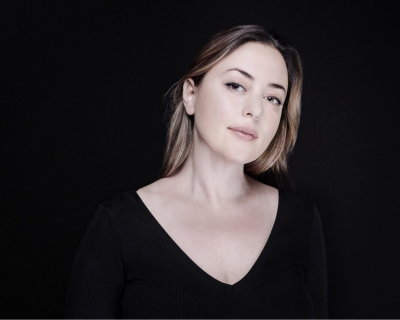
    Prestini

    Above: composer Paola Prestini; photo by Caroline Tompkins

    ~ Author: Lili Tobias

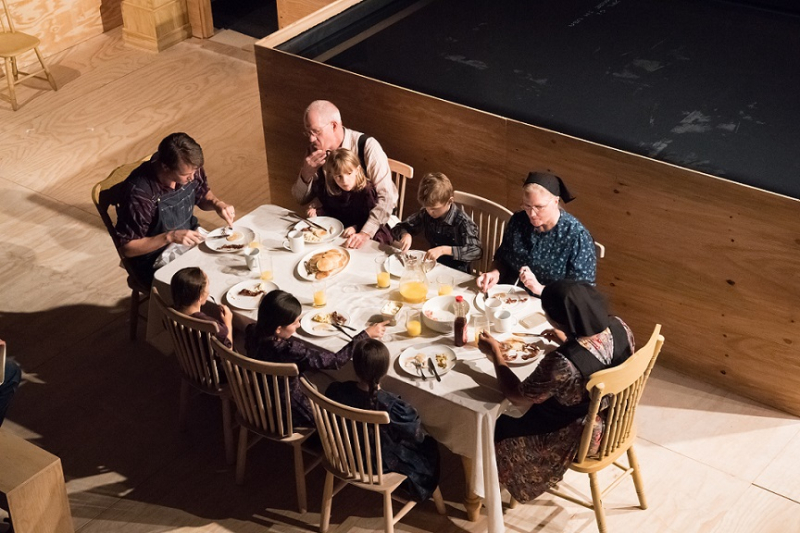
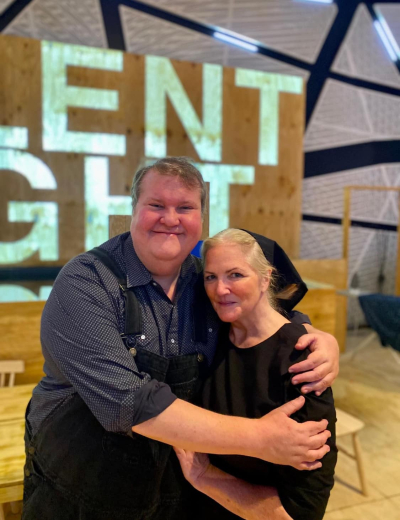
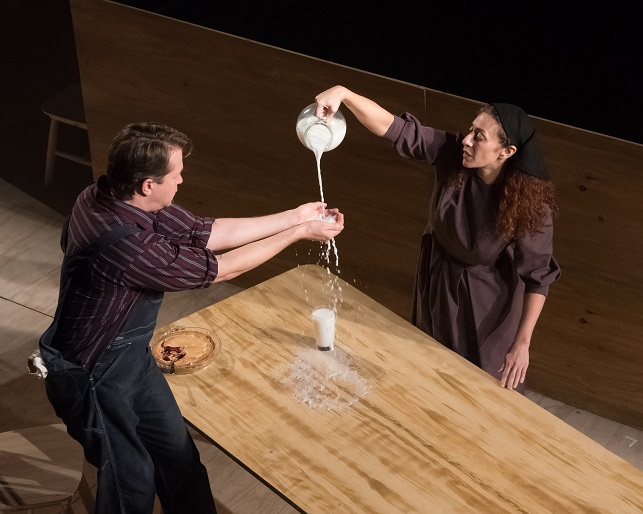
    Saturday October 28th, 2024 – I was lucky enough to have a front row seat to the world premiere of composer Paola Prestini’s new opera, Silent Light. I walked into National Sawdust on Saturday night to ambient insect noises mingling with the chatter of the audience finding their seats. As I looked out over the set of unfinished wood, I could smell the faint hint of bacon, eggs, and pancakes. And these things were just the beginning of how this production expanded not only my ears, but all of my senses!

    The innovative ways Prestini played with the sounds, visuals, and physical objects on stage really made Silent Light stand out, though the plot stuck close to standard operatic tropes—love, infidelity, etc. One of the first aspects of this that caught my attention was how she used mundane sounds either by themselves or incorporated into the musical sounds. The opera gets underway with the loud tick-tock of a grandfather clock (seen in the back left corner of the stage) oscillating in volume. The louder it gets, the more surreal the set feels. As that first scene progresses, the women and children of the family come onstage to set the table for breakfast (cooked onstage!) and all begin eating. The natural clatter of plates and utensils mingling with the warm low brass and string instruments created a very fun and realistic soundscape. It truly felt like the audience members were invisible observers within the room with the characters.


    Silent Light performance at NS_0115_


    Above: the ensemble, photo by Jill Steinberg


    I was especially impressed with the transitions between scenes, both in terms of the music and the staging. As breakfast wraps up, a wave of construction sounds rise up from the left side of the stage as the chorus becomes a team of workers. There’s a large waft of dust, which visually separates the two halves of the stage between the men at work outside and the women at work in the house. There were also two wonderful moments of transition between diagetic and non-diagetic music. One occurred during this scene as the chamber ensemble begins playing what seemed to me a lively popular song and the chorus sings along, simultaneously moving the chairs and table to prepare for the next scene. And later on, a French ballad begins playing on a television in the kitchen, then becoming the background for the characters Johan and Marianne to meet up in a hotel room. Both transitions were executed so seamlessly and really helped push the the flow of action forward.


    Silent Light performance at NS_0498_


    Above: Brittany Renee; photo by Jill Steinberg


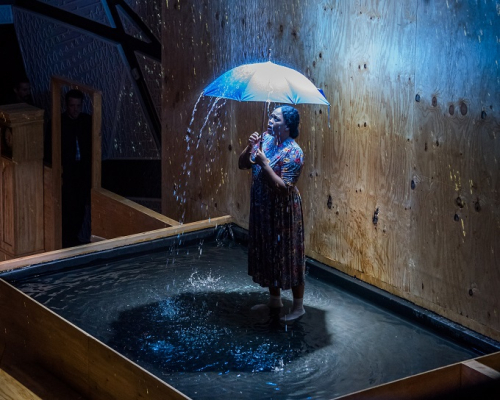
    Another remarkable aspect of this opera were the juxtapositions between silence or quiet sounds and loud, nearly overbearing sounds. Overall, I felt like there was minimal actual singing in this opera, but not in a bad way at all! As a listener, I tend to get fatigued when operas have extra long passages of continuous singing, so I really appreciated the many moments of silence or instrumental music—or even just foley sounds—that provided contrast (and rest for the singers’ voices too). There were also many moments of abrupt shift from sound to silence. One especially striking moment takes place when Johan and his wife Esther are driving in a truck, Esther knowing that Johan has just slept with Marianne. The music, accompanied by the sound of heavy rain, creates a steady and unceasing anxiety as Esther finally comes to terms with her own feelings about her husband’s affair. Then it suddenly stops as she rushes out of the truck, leaving behind just the sound of the rain (and the literal water which has started pouring down onto the stage!).


    Tony & margaret silent light


    Above: Anthony Dean Griffey and Margaret Lattimore; photo courtesy of Mr. Griffey


    I also want to add that the novelties of this opera did not go unsupported by amazing musicianship. All the singers were incredibly strong both vocally and as actors, and the lyricism of Prestini’s music really helped them sound even more amazing! I also enjoyed Prestini’s writing for brass. Because of the small size of the instrumental ensemble, the proportion of brass instruments to other types felt very high relative to, for example, an orchestra. I liked how predominant a role the trumpet and trombone played in the music, and they really added a unique depth to the sound that was especially resonant in the small performance space.


    Silent Light performance at NS_0230_


    Above: Daniel Okulitch and Julia Mintzer, photo by Jill Steinberg


    This opera contained so many interesting things that it’s honestly been difficult to write about everything that caught my attention! I thought it was a huge success at National Sawdust, and I hope it gets many more performances. It will be super interesting to see how the staging evolves in different spaces and with different cast members. Silent Light was an incredibly immersive experience, and there was always something of interest to listen to, look at, and even smell!


    ~ Lili Tobias

  • Parlando: Night Music @ Merkin Hall

    Merkin

    ~ Author: Lili Tobias

    Thursday September 26th, 2024 – A wonderful night to spend listening to Parlando’s Night Music! Led by conductor Ian Niederhoffer, Parlando is a one-of-a-kind orchestra that strives to introduce listeners to underrepresented works through inventive programming and spoken introductions that provide context for each piece. As is standard for the ensemble, Thursday’s program featured a wide range of classical music all united under the theme of “night” (and this concert covered a span of just over 200 years!).

    The concert opened with the Nocturne from Fauré’s The Shylock Suite, Op. 57. I was unfamiliar with this piece, but it was a pleasure to hear for the first time. The orchestra played with an exceedingly delicate and precise tone. Though the piece was quiet all the way through, every note was clearly audible throughout the hall.


    Next was Takemitsu’s By The Sea, which I was really looking forward to (and it didn’t disappoint)! In the past, I’ve seen some of Takemitsu’s chamber music scores and have always been blown away by how beautiful the written music itself is. This was my first time hearing any piece of his live, and any conception of how I thought the written music might sound was eclipsed by the incredible real-life sounds of the orchestra and two soloists. When introducing By The Sea, Niederhoffer mentioned that the first version of this piece was a duo between flute and guitar, and I could still feel the chamber music-like qualities present in the orchestral re-arrangement. The soloists and the strings lead each other back and forth in a constant ebb and flow of dynamic swells—just like the waves of the ocean the piece was inspired by.


    Parlando


    Flautist Yoobin Son and harpist Parker Ramsay (photo above by Crios Photography) then joined the orchestra once more for the second movement from Mozart’s Concerto for Flute, Harp, and Orchestra in C Major, K. 299. I was especially impressed with Son’s incredible phrasing and expressive playing, which brought this intensely lyrical movement to another level. (She also wore a stunning lilac dress from designer Issey Miyake which seemed to float and dance along to the music.)


    The final piece on the program, Bartók’s Music for Strings, Percussion, and Celesta, Sz. 106, was a pleasant surprise. As someone who is not generally a fan of Bartók, I happened to love this piece. However, even after learning a bit about the social context surrounding its composition, I had a very different emotional response to the music. While the first movement wasn’t quite my cup of tea (especially after having had to sightread the fugue subject once for a musicianship class in college!), I greatly enjoyed the second, third, and fourth movements. The second and fourth I found especially fun—a stark contrast with the anguish Bartok may have intended it to convey. My ears latched onto the driving rhythms and confident percussive attacks and interpreted the music as lively and powerful, in a predominantly positive way.


    The orchestra was met with a well-deserved standing ovation at the end, and the concert was followed by a lively reception. While there was talk during the reception of finding a larger venue for future Parlando concerts, I actually think that smaller-scale performances could be a huge benefit towards Niederhoffer’s vision. A more intimate concert space could help open up dialogue between the musicians, audience, and even composers if they’re still living. As an audience member, I felt a bit boxed in by the spoken introductions to each piece—almost as if I was being told what to feel rather than encouraged to react to the music in my own way. While I completely understand the value in providing this musical context to the audience, I think there is a lot of further potential to create a more multi-faceted dialogue that draws from the diverse backgrounds and unique interpretations of both the musicians and the audience members. I’m excited to see what the future of Parlando holds!


    ~ Lili Tobias

  • 2024 Chelsea Music Festival ~ Opening Night

    Lili

    ~ Author: Lili Tobias

    Friday June 21st, 2024 – The opening night concert of the 2024 Chelsea Music Festival was held in by far the most surprising venue I’ve ever been to. It took place in Genesis House, which is a restaurant/car showroom/performance venue associated with the luxury car brand, Genesis. In fact, the audience walked into the building through the showroom, so we were surrounded by new cars as the event staff offered glasses of wine. We then descended down a flight of stairs, through a lounge area, to the performance space. 


    The stage floor was actually a large screen itself, as were the back wall and the ceiling. This concert featured not only music but visual art completely surrounding the musicians as they played. While I thought the visuals were beautiful and intriguing, I didn’t quite see how they were connected to each specific piece. I think both the music and the visual art could have stood on their own just as well as together!


    The concert opened with two pieces by Augusta Read Thomas: Bebop Riddle V and Dancing Stars. Both were very joyful and bouncy! I particularly enjoyed the juxtaposition of staccato and legato moments in Dancing Stars. This piece was primarily staccato throughout, but there were brief moments when more legato phrases rose up and then dissipated. These moments got more expansive as the piece progressed, and culminated in one bright pluck, followed by its echo in the resonance of the piano strings.


    Wooden Bodies, by Tebogo Monnakgotla, was next on the program, performed by the Aizuri Quartet. Beginning with a slow melody in the lowest register of the viola, this motif was then explored by the other instruments in turn. In general, this piece was very fugue-like with all the motifs that got passed around within the quartet. My favorite moment was when the two violins traded off short, choppy phrases, creating a sort of panning effect between them. As a nice contrast to the explorative nature of the previous piece, Augusta Read Thomas’s next piece, Clara’s Ascent, felt calmer and more relaxed. The music stayed slow and legato for most of the time, punctuated by a fun pizzicato solo for the cello near the very end.


    Next was a beautiful string quartet arrangement of Clara Schumann’s song, Die stille lotosblume. Having played the original piano and voice version myself, I really appreciated the liberties Miho Saegusa took in adapting the music for strings. First of all, the vocal melody is traded between string instruments which creates fun contrasts within one performance of the piece. And second, Saegusa added some delicate arpeggios which don’t exist in the piano part. These added interesting variety to the texture which the piano part just doesn’t have, and the half cadence ending left me wanting more!


    To end the first half of the program was the world premiere of Nicky Sohn’s wind quintet, A Night at Birdland. Despite being accompanied by images of birds, this piece has nothing to do with birds, but rather is inspired by Charlie Parker, who is known as “Bird.” It was a really wonderful piece, and WindSync performed it so well. The music traversed many different musical textures, often featuring a consistent bouncy rhythm and really lush chords.


    Beginning the second half of the program were two solo piano pieces, first the theme from the 2022 movie, The Fabelmans, composed by John Williams. Melinda Lee Masur, one of the artistic directors of the festival, performed this piece herself. It was a beautiful progression of a melody through different accompanying textures. Next was Against Time, written and performed by 2024 composer-in-residence Ania Vu. Starting with a single barely-there note, the music evolved into an exploration of different piano textures and techniques: full chords vs single notes, clusters vs octaves, steady pulses vs filigree. I’d love to try out playing this one myself!


    The concert ended with Poulenc’s Sextuor (1931-32, performed impeccably by WindSync and pianist Andrea Lam. After the music, the audience was invited back upstairs to the Genesis House Restaurant for more drinks and canapés. This opening night concert featured such a wide variety of artistic ideas, and I’m sure the rest of the festival will live up to that as there’s a full week of performances ahead—from Bach to jazz to Brazilian forró. Congratulations to the Chelsea Music Festival on their 15th season!


    ~ Lili Tobias