Tag: Lincoln Center

  • Strings Only @ Chamber Music Society

    K lee

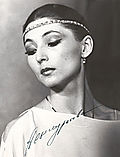
    Above: violinist Kristin Lee

    Tuesday January 18th, 2022 – Chamber Music Society of Lincoln Center brought together six virtuoso string players from their stellar roster for a program of music by Beethoven, Schulhoff, and Dvořák at Alice Tully Hall.

    Beethoven’s Quintet in C-minor for Two Violins, Two Violas, and Cello, Op. 104, started life as a piano trio composed in 1794–95; the composer arranged the work for string quintet in 1817.

    An almost waltzy feeling springs up for the opening of the Allegro con brio. The music spills forth with contrasting passages of animation and lyricism, which tonight’s five musicians graced with delicious harmonies and finely-judged dynamics. Violist Matthew Lipman’s playing (all evening) was of particular note.

    A gentle flow of melody opens the Andante cantabile. Ensuing variations include a sad interlude and some boisterous passages; Mr. Lipman and cellist Keith Robinson seize on their opportunities. The irresistible magic of Beethoven abounds here. The Menuetto has a courtly feeling, but fabulous flourishes from Kristin Lee’s violin add a spicy touch. Later, some charming echo effects are heard.

    Ms. Lee takes the lead in the quintet’s Finale: Prestissimo. Here I found myself deriving great joy from watching the five musicians reveling in the pleasure of playing such marvelous music. After all that has gone before, Beethoven pulls off a final magic trick: the quintet ends quietly.   

    Erwin-Schulhoff

    Above: composer Erwin Schulhoff

    The centerpiece if this evening’s program was Czech composer Erwin Schulhoff‘s Sextet for Two Violins, Two Violas, and Two Cellos, composed in the early 1920s. This evening was my first hearing of this work, and it was an engrossing, revelatory experience. My only other Schulhoff encounter was a powerful performance of the composer’s 5th symphony by the American Symphony orchestra in 2017.

    Schuhoff’s Sextet opens with an Allegro risoluto, the musicians digging in and then trudging along with numerous dramatic effects. The music calms, with wisps of melody woven in; our two violists (Mssrs. Lipman and Neubauer) have much to do here, with plucking and tremolo passages. The music has hauntingly somber harmonics and brusque accents.

    In the eerie Tranquillo: Andante which follows, the music is spine-tingling: unsettling yet beautiful. Mr. Neubauer and cellist Keith Robinson share an evocative exchange, and Kristin Lee spins a silky violin theme over a rocking motif. A solo from Mr. Robinson sustains the mood, and then a creepy, insectuous theme yields to a hushed atmosphere. The cello sings low, and then, with fantastic control, a final passage for viola and cello. “Wow!” I scrawled in my notes.  

    An agitato movement, marked Burlesca. Allegro molto con spirito brought forth fun, lively rhythms and some fiery playing from Matthew Lipman. The tempo speeds up for a propulsive unison passage at the finish.

    Inbal Segev’s deep, dolorous cello sound opens the concluding Molto adagio; the music has a dense, plaintive quality. Mr. Sussmann and Ms. Lee exchange lamenting themes; and while the violas sustain a tremolo effect, Mr. Robinson joins: his cello imitates the sound of a pendulum clock. An uneasy quietude settles over the hall as the music takes a long fade, and Mr. Robinson’s cello has a last utterance.
     
    This magnificent rendering of the Schulhoff will linger long in my memory.

    Arnaud-Sussmann-Photo-V-Photo-Credit-Carlin-Ma jpg

    Above: violinist Arnaud Sussmann, photographed by Carlin Ma

    To close the evening, Antonin Dvořák’s Sextet in A-major for Two Violins, Two Violas, and Two Cellos, Op. 48 (1878) was gorgeously played by our six artists.

    From the start, this sextet is a veritable font of melody. And the dance rhythms are indeed toe-tappingly appealing. But after a while, it all becomes so very pleasant, and I began to think back to the jarring fascination of the Schulhoff. As time goes by, I find that Dvořák’s music seldom draws a deep response from me.

    Despite such quibbles, I was so glad to stand up and cheer at the end of the concert, joining my fellow music-lovers in a heartfelt homage to these six great musicians. 

    ~ Oberon

  • CMS Brandenburgs ~ 2021

    Bach

    Sunday December 19th, 2021 – Chamber Music Society of Lincoln Center‘s annual Yuletide performances of Bach’s immortal Brandenburg Concertos are always a highlight of the New York musical season. Music lovers turn out on droves for each of the program’s three presentations, giving themselves an early Christmas gift.

    One tradition at the CMS Brandenburgs is the annual reshuffling of the order in which the six concetros are played. This year, the odd-numbered concertos were played first, with the even-numbered ones coming after the interval.

    The 1st Brandenburg (in F-major) briought together the program’s largest ensemble of players, which produced a wonderful fullness of sound. The wind instrument lineup tonight was impressive indeed: there are three oboes, led by Stephen Taylor with Randall Ellis and Mr. Smith, two mellow horns (David Byrd-Marrow and Stewart Rose); and Marc Goldberg’s rich-toned bassoon. On the string team, led by violinist Daniel Philllips (excellent in the Adagio), Arnaud Sussmann and Sean Lee (violins) were joined by Che-Yen Chen (viola) and Dimitri Atapine (cello). The outstanding continuo duo – Kenneth Weiss (harpsichord) and Joseph Conyers (double bass)- made marvelous music all evening. Mr. Phillips made a lovely thing of the Adagio, where he and Mr. Taylor duetted cordially. The bustling Allegro drew a warm round of applause, but then comes a built-in ‘encore’, in which the wind players outdid themselves.

    The 3rd concerto, in G-major, is unique in that the anticipated central slow movement is replaced by a mere couple of chords and a violin flourish before going immediately on to the exhilarating Allegro. Bach calls for three trios of strings: violinists Sean Lee, Arnaud Sussmann, and Alexander Sitkovetsky gave us lively playing in the opening movement, whilst Mr. Phillips traded his violin for his viola to join Mr. Chen and Yura Lee. Add the cello trio of Timothy Eddy, Mr. Atapine, and Inbal Segev, and you have a veritable string-fest. My companion, Cherylyn Lavagnino and I were much taken with Mr. Conyers’ rich and nimble bass playing. The final Allegro sailed blithely onward: so many notes! 

    In the 5th concerto (in D-major), harpsichordist Kenneth Weiss mesmerized the crowd with his fantastic playing of the long cadenza; people stood up and cheered when he stepped forward for a bow at the end of the evening’s first half. From its familiar opening theme, the 5th concerto puts the violin (Sean Lee) and the flute (Ransom Wilson) in the spotlight; these two gentlemen played the central Affetuoso divinely, whilst Mr. Weiss’s harpsichord cunningly etched a filigree around their melodies. In the concerto’s light and lively final Allegro, Mssrs. Sitkovetsky, Phillips, Eddy, and Conyers were a top-class ensemble. 

    Following the interval, flautist Tara Helen O’Connor drew a warm welcome as she walked out onto the Tully Hall stage, goddess-like in a glimmering red gown. Yura Lee and Inbal Segev had also chosen red frocks for the evening, giving the scene a festive Yuletide glow.  In the 2nd concerto (in F-major), dazzling trumpet virtuosity from David Washburn set the hall alight, whilst Ms. O’Connor’s timbre had its familiar crystalline clarity.

    In the Andante, the quartet of Ms. O’Connor, James Austin Smith (oboe), Arnaud Sussmann (violin), and Timothy Eddy (cello) wove a tapestry of sound that warmed the soul: simply perfect. Then Mr. Washburn’s trumpet calls rang out, summoning us to revel in the concerto’s festive finale. A rock-star ovation saluted these extraordinary musicians as they returned for a bow.

    Yura Lee and Che-Yen Chen put us under a viola spell with their playing of the 6th concerto (B-flat major) – the one in which no violins are heard: a trio of cellists (Mr. Atapine, Ms. Segev, and Mr Eddy) and the continuo players are all Bach needed here. The Adagio – one of Bach’s most moving and melodious inventions – was entrancing as Ms. Lee and Mr. Chen exchanged phrases. This could have gone on and on – such a balm to the ear – but the closing Allegro sweeps us inexorably forward with its thrice familiar theme..

    The evening ended with the fourth concerto (in G-major), in which Alexander Sitkovetsky dazzled us with his silky tone and incredible dexterity. Duetting flautists Ransom Wilson and Tara Helen O’Connor displayed jewel-like qualities in their playing of the animated phrases of the outer movements, whilst bringing a sweet sadness to the harmonies of the central Andante. Mr. Conyers’ double bass and Ms. Segev’s cello provided a resonant counterpoise to the high voices of the flutes and violin. Then we are down to the final Presto: a fugue-like race in which Mr. Sitkovetsky’s fabulous virtuosity led his colleagues in a final sprint to a victorious finish. The audience saluted the musicians with a vociferous standing ovation, recalling them for a second bow.

    Leaving Alice Tully Hall, which has become dear to me over these past few years as a refuge of peace and beauty in an increasingly perilous world, we stepped out into the brisk evening air, feeling on top of the world. How wonderful to experience this concert with my friend Ms. Lavagnino, who is truly a kindred spirit.

    ~ Oberon

  • Teresa Zylis-Gara Has Passed Away

    Z-g

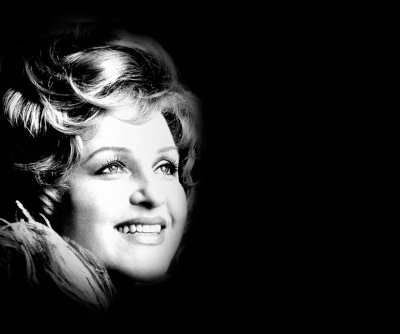
    Teresa Zylis-Gara, the Polish soprano who possessed one of the most beautiful voices of my experience, has passed away at the age of 91. From 1968 to 1984, she sang nearly 250 performances with the Metropolitan Opera at Lincoln Center and on tour; I had the good fortune to see her in several roles, and to hear her on a number of live radio broadcasts.

    Ms. Zylis-Gara studied at Łódź, and in 1954 won first prize in the Polish Young Vocalists Contest at Warsaw. This led to her operatic debut in 1956. From 1960-1970, the soprano was based in Germany where she sang at Oberhauser, Dortmund, Frankfurt, Frankfurt, Hamburg, Cologne, Munich, and Berlin. She also appeared at Vienna, Glyndebourne, Paris, London, Salzburg, and San Francisco.

    ln 1968, Ms. Zylis-Gara made her Metropolitan Opera debut as Donna Elvira; she sang there frequently over the next several seasons. I first saw her as Violetta in TRAVIATA where she made a lovely impression, though hindered by inferior cast-mates and lacklustre conducting. Thereafter, I saw her as Donna Elvira, Elisabeth in TANNHAUSER, Amelia in BALLO IN MASCHERA, Manon Lescaut, Leonora in TROVATORE, Cio-Cio-San, and as Adriana Lecouvreur. In each of these roles, her creamy voice and ultra-feminine persona made  a memorable impression.

    Z-g desdemona jpg

    Above: Teresa Zylis-Gara as Desdemona; photo by Louis Mélançon

    Among the roles in which I missed seeing her onstage but greatly enjoyed her singing of on broadcasts included Desdemona (in a new production with James McCracken in the title-role, conducted by Karl Böhm), Mozart’s Pamina and Contessa Almaviva, Marguerite in FAUST, Puccini’s Suor Angelca, Mimi, and Liu, Elsa in LOHENGRIN and – most movingly – as Tatyana in ONEGIN and as the Marschallin.

    Zg tosca

    While I was living in Hartford, Ms. Zylis-Gara came up from New York City to the Bushnell to sing Tosca. Inferior conducting almost ruined the performance, but her singing was luminous.

    Leaving The Met in 1984, the soprano settled in Monte Carlo and continued to sing on the Continent, where she took on roles like Maddalena in CHENIER, Ariadne, Sieglinde, and Chrysothemis which had not been offered to her at The Met.

    Zg makeup

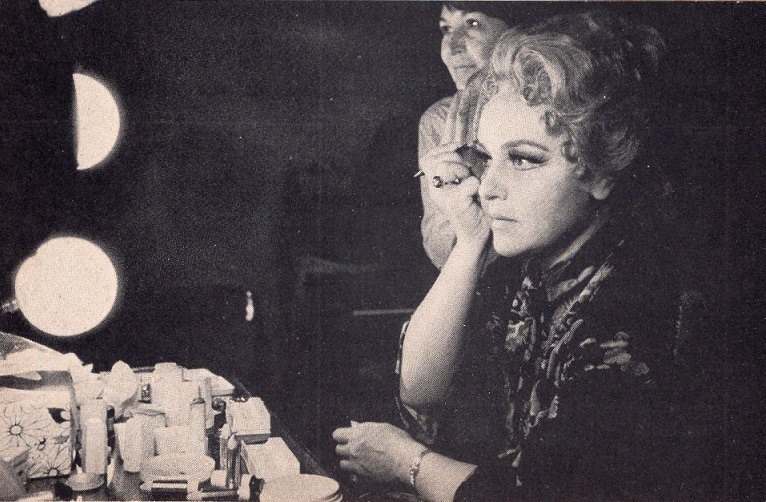
    Above: getting ready…I love this photo!

    I remember listening to Zylis-Gara’s Four Last Songs for the first time, and thinking: this is perfection. And when the music ended, there was applause; this was recorded live. For me, no other version of these beloved songs compares.

    Z-g adriana-1 jpg

    I’ve reached that inevitable point in my life when the great singers who fanned the flames of my passion for opera are passing away, one by one. Thinking of Teresa Zylis Gara, I recall with special affection seeing her in the title-role of Cilea’s ADRIANA LECOUVREUR at a matinee performance given on the Met’s 1983 tour in Boston. It was to be the last time I saw her onstage. And it was a marvelous afternoon, with the soprano and her colleagues all singing divinely: Neil Shicoff as Maurizio, Bianca Berini as the Princesse de Bouillon, and Sesto Bruscantini as Michonnet. For all the glorious sounds that filled the hall that day, nothing sent such a thrill thru me as Zylis-Gara’s gossamer pianissimo on the phrase: “La promessa terrò …”  when Adriana vows to save her rival from humiliation in the opera’s second act. It’s of such moments that the fabric of dreams are woven.

    ~ Oberon

  • Jean Kraft Has Passed Away

    Emilia

    Above: Jean Kraft as Emilia in OTELLO

    Jean Kraft, a unique singing-actress of the highest calibre, has passed away at the age of 94. She made her Metropolitan Opera debut in 1970 as Flora Bervoix in TRAVIATA and went on to give nearly 800 performances with the Company at Lincoln Center and on tour.

    Slender of form, and with a face that could register the slightest nuances of emotion with uncanny clarity, Ms. Kraft excelled in every role she took on. I saw her countless times during her Met career, and she never failed to lure my eye…and ear. 

    Cav

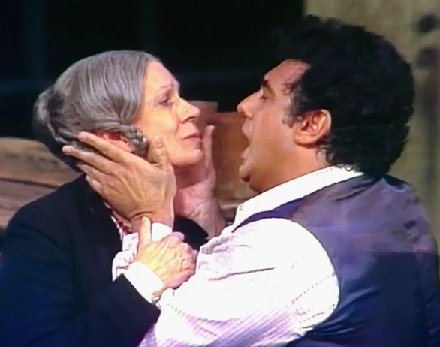
    She was a fascinatingly stoic/vulnerable Mamma Lucia in CAVALLERIA (above with Placido Domingo), an uptight Emilia under her husband’s evil thumb in OTELLO, a regal Hecuba in the Met premiere of TROYENS, an aristocrat striving to keep her composure as the Comtesse in CHENIER, the struggling, poverty-stricken Gertrude in HANSEL & GRETEL, the gracious Madame Larina in EUGENE ONEGIN, the arthritic Mother Jeanne managing her walk to the guillotine in DIALOGUES DES CARMELITES.

    Kraft mrs sedley

    Jean Kraft was the Borough’s busybody/drug addict Mrs. Sedley in PETER GRIMES (above), Berta in BARRBIERE, Marthe in FAUST, Duchess Federica in LUISA MILLER, Marcellina in NOZZE DI FIGARO, the Duchesse in FILLE DU REGIMENT, Dryade in ARIADNE AUF NAXOS, a stalwart Rossweisse in WALKURE, Annina in ROSENKAVALIER, Suzuki in BUTTERFLY, and – a couple of times – Ulrica in BALLO IN MASCHERA. She gave her last Met performance as Madama Larina on April 5th, 1989.

    Here is a brief audio excerpt of Ms. Kraft as Mamma Lucia with Reneta Scotto as Santuzza, from the commercial recording:

    Renata Scotto & Jean Kraft – Cavalleria Rusticana ~ scene

    And it’s so wonderful to have this thrilling souvenir of Jean Kraft performing the trio from HOFFMANN with Catherine Malfitano and James Morris at the 1984 Gala of Stars, conducted by James Levine. Watch and listen here.

    Here is an incredible audio-only document of Ms. Kraft’s 1969 Town Hall debut recital, accompanied by David Garvey. Listen here.

    And here is a fascinating interview that she gave Bruce Duffie: LINK

    Rest peacefully, dear Ms. Kraft. You are unforgettable.

    ~ Oberon

  • Elena Cernei

    Cernei jpg

    Above: Elena Cernei as Amneris

    You never forget your first Amneris; mine happened to be Elena Cernei, a comely Romanian mezzo-soprano with a marvelous chest-register. My first AIDA came during the Met’s second season at Lincoln Center, on December 27th, 1967; Ms. Cernei’s colleagues were Gabriella Tucci, Flaviano Labo, Mario Sereni, and Bonaldi Giaiotti, with Thomas Schippers on the podium.

    Born in 1924, Ms. Cernei studied at Bucharest. She joined the Romanian National Opera in 1952, singing there thru 1977. She also sang at La Scala, Paris, Barcelona, Brussels, Mexico City, and at the Bolshoi.

    She debuted at The Met in 1965 as Dalila; her other Met roles were Amneris, Maddalena in RIGOLETTO, the Princesse de Bouillon in ADRIANA LECOUVREUR, and Carmen.

    Ms. Cernei’s repertoire further included Azucena, both Laura and La Cieca in LA GIOCONDA, Ulrica, Rossini’s Arsace, and Gluck’s Orfeo. She was named an Honored Artist of the Republic of Romania. Upon retiring from the stage, she lived and taught at Rome. She passed away in 2000, and a commemorative postage stamp was issued in her honor.

    Stamps_of_Moldova _2014-16

    Elena Cernei sings the Séguédille from Bizet’s CARMEN here.

    And here’s a sampllng of her Dalila:

    Elena Cernei – Printemps qui commence – SAMSON ET DALILA

  • Backstage at the Kirov

    I’ve just been re-watching a favorite ballet video of mine…this article was originally published in 2008!

    51HPJ9WGC9L._SL500_AA280_

    Now that the ballet season at Lincoln Center has ended, we’ve been watching some videos from the Library of the Performing Arts. Unfortunately, I have found that many of the DVDs in their collection turn out to be badly scratched; it’s a shame that people who are sophisticated enough to want to to watch SLEEPING BEAUTY or GISELLE are not correspondingly considerate enough to take good care of the library’s property. I’ve actually been having better luck with VHS tapes, since they are not in plastic sleeves and thus you can check their condition before signing them out. The library has quite a substantial VHS dance collection.

    Mezen09Asylmuratova-jw The 1982 film BACKSTAGE AT THE KIROV starts out as a run-of-the-mill (though interesting) documentary but soon the story starts to revolve around two Odettes: the established prima ballerina Galina Mezentseva and the (then) rising young Altynai Asylmuratova. Performance footage is interspersed with specially recorded passages where the camera actually takes us into the midst of the Kirov’s corps. This produces an especially vivid effect in such moments as the Cygnets where we follow the four girls around the stage. Later, when Asylmuratova and her husband Konstantin Zaklinsky are performing a segment of the adagio, the camera magically circles around them, catching the attendant Swans in their long rows as a swirling backdrop.

    Wei and I both thought Mezentseva was an exceptional Odette. Against the sustained slowness of the tempo set for the adagio, Mezentseva’s dancing – her fluent upper body, long arms and elegant legs – has a timeless, suspended quality. Asylmuratova’s youthful candor – she says she’d rather have slept in than attend class – is slyly sweet; she is a beautiful girl and we can already see emerging the ballerina who was to be such an impressive Nikiya in the filmed version of the Royal Ballet’s 1991 BAYADERE.

    BACKSTAGE AT THE KIROV (now available on DVD) also shows some very young students in class, and the hard-working corps of Kirov swans, some of whom come in for sharp reprimands from the ballet masters. It’s an intriguing view of SWAN LAKE from the inside: I ended up watching it four times in a week.

  • Danish String Quartet ~ CMS Beethoven Cycle – Part 2

    Beethoven 250

    Author: Ben Weaver

    February 2020 – The Danish String Quartet continuing their Beethoven marathon at Chamber Music Society of Lincoln Center. Ben Weaver wrote about earlier concerts here, and he completes the story below:

    I suspect that the Danish String Quartet’s cycle of all 16 Beethoven String Quartets for Chamber Music Society of Lincoln Center in 2020 will long be remembered as one of this great organization’s finest moments. The raggedy long-time friends who make up the quartet (its two violinists and violist have been friends since childhood), with their casual wear, messy hair and reserved physical presence, may not at first glance strike one as deeply probing and philosophical musicians. But they are that, and more. The clean, beautiful lines they produce as part of the ensemble, with a full grasp of structure and context, could hardly be improved upon by another quartet. They truly are one of the finest chamber ensembles performing today.

    The cycle’s final concert featured Beethoven’s final two quartets: String Quartets Nos. 15 & 16. No. 16 being notable for being the very last piece of music Beethoven ever composed. (The only other thing he is known to have written is the alternative final movement to Quartet No. 13, replacing the Große Fugue.)


    With Quartet No. 15, Op. 131, composed in 1825-26, Beethoven created something unique in the canon: an extended, played-without-pause composition that is still divided into multiple (seven!) movements that are all connected to one another. The opening fugue morphs into a set of variations leading into a demented scherzo – so on and so forth. Almost as if recapping his life’s achievements and all the musical forms he has perfected, this may well be Beethoven’s version of “This is my life.” The Danish Quartet’s performance of this was ravishing, with stunningly sustained slow tempi over long periods, without ever losing focus or tension or structure. Violinists Frederik Øland and Rune Tonsgaard Sørensen, violist Asbjørn Nørgaard, and cellist Fredrik Schøyen Sjölin made time stop.


    The last Quartet No. 16, Op. 135, composed in 1826, would become Beethoven’s last completed composition. How does a musical giant, who has shaken the world, say goodbye? With another outburst, a challenge to the world? Hardly. Like the final Piano Sonata No. 32 – and so unlike the last Symphony No. 9 – Beethoven’s last will and testament is actually a thing of lyricism and beauty, not defiance (ok, with an occasional outburst of crankiness, like the opening pages of the last movement where anger quickly dissipates.) In all, perhaps knowing that is health was failing and that he may not have the strength to complete another piece of music, Beethoven seems to reminisce about his younger self and the music that he composed as a student of Haydn and when Mozart had only just died.


    The first movement opens with Viola leading a playful tune, like something Beethoven rescued from an early sketchbook: but with an old man’s wisdom tempering the enthusiasm. It’s like an echo of youth, playful but with a denser sound than a younger Beethoven would have employed, the viola and especially the cello better integrated into the ensemble instead of accompanying the violins. 


    The slow movement, Lento assai, tantalite e tranquillo, is one of those works of art shared with us by the gods. Rune Tonsgaard Sørensen on first violin in this performance (the two violinists alternated), as the more lyrical player, was the perfect musician to lead this magical piece. (I’d watched a performance of this movement on YouTube that was recorded in an airplane hangar. Someone wisely commented that even an airplane hangar could not contain everything this movement has to say.)


    And then the final movement – Allegro – pulls in ideas from the previous ones and then turns them into dance. It is the perfect ending, like Verdi’s “Falstaff” (still to come) or Shakespeare’s “The Tempest” (long past): to finish laughing and free would be the greatest gift of all.


    ~ Ben Weaver

  • All-French Program @ Chamber Music Society

    Paulhuang

    Above: violinist Paul Huang

    ~ Author: Oberon

    Sunday January 26th, 2020 – As darkness continues to settle over the world at an alarming rate, the reassurance of great music, poetry, and art becomes increasingly essential in keeping our spirits from being battered down beyond repair. Tonight’s program of music by three French masters, played with elegance and passion by a quartet of extraordinary artists, was an uplifting experience such as Chamber Music Society of Lincoln Center are wont to offer us.

    In her enlivening and reassuring speech of welcome, the Society’s co-Artistic Director (and tonight’s pianist) Wu Han spoke of the connection between the program’s three composers: Camille Saint-Saëns was the teacher of Gabriel Fauré, who in turn taught Maurice Ravel. Though the perfume of each work is distinctive, the feeling of a continuum was a key element as the evening progressed.

    Saint-Saëns’ Trio No. 1 in F-major for Piano, Violin, and Cello, Op. 18 (1864) opened the program, played to perfection by Wu Han (piano), Paul Huang (violin), and Clive Greensmith (cello). It is a work full of mood swings. The work’s opening Allegro vivace has a playful, exhilarating, dance-like feeling. Briefly rhapsodic, the music mostly maintains a lightness which the three players seemed to revel in. At the Steinway, the virtuosic keyboard passages were given a quicksilver feeling by Wu Han. The silent communication between the musicians was charming to behold as the work unfurled with a lively sense of optimism. 

    A sustained tone from Mr. Huang’s 1742 “ex-Wieniawski” Guarneri del Gesù is heard over Wu Han’s mysterious pacing motif as the Andante commences. The violin’s wistful song leads the music to a darker, more dramatic place. Clive Greensmith’s rich cello tone is heard in an exchange of phrases with the Huang violin, building to arching, gorgeous harmonies. Twinkling sounds from the piano underscore an à la Russe passage from the cellist which is taken up by the violin, Mr. Huang’s tone at its most alluring and silken. Fascinating subtle sounds shine from the keyboard; the violin has a sweetly rambling paragraph which morphs into a cello cadenza. In a da capo, the movement’s feeling of mystery returns, but is even more pronounced. The music, played with captivating nuance, moves to a fading end. As silence fell, my companion and I sighed from the sheer beauty of it all.

    The plucking, prancing Scherzo – alive with syncopated staccati – transforms into a swaying dance. The music romps along, witty and exuberant, with a da capo that leads to a false ending – the applause charmingly vetoed as the players hastily resumed in a dash to the actual finish line.

    The trio’s final Allegro opens with the violin and cello trading very brief phrases over a sparkling piano accompaniment. A unique series of slides up-and-down the scale becomes emblematic here: first played by violin and cello, and later by the piano, they create a slightly woozy effect. With a sense of hustle and flow, this Saint-Saëns masterpiece concluded, igniting the first of the evening’s enthusiastic ovations.  

    Mssrs. Huang and Greensmith returned for Maurice Ravel’s Sonata for Violin and Cello. In 1920, Ravel was asked by his publisher Durand to contribute to an issue of “La Revue Musicale“, dedicated to Claude Debussy. Included were the first movement of Ravel’s Sonata for Violin and Cello, as well as works contributed by Debussy’s friends Stravinsky, Satie, Dukas, Bartok and de Falla. This first movement of Ravel’s Sonata, of which the autograph is lost, was later expanded upon by the composer into a four-movement work which includes some tantalizing modernities in the writing.

    This Ravel work is rarely heard, and it seemed so fresh and contemporary in the hands of our two outstanding players this evening. Clocking in at twenty minutes, the sonata is in four brief movements. A touch of jazz can be felt in the opening Allegro, wherein the two impeccable musicians treated us to music with a feel of perpetual motion. Très vif describes the second movement, a pluck-fest that evolves into swift bowing. A bit of slashing is heard, followed by an almost boogie-woogie cello line and some delicious trills from the violin. After a slight lull, things pulse up again for a jazzy finish.

    Marked Lent, the third movement opening with a deep, searching cello passage. Following this is a pensive duet that has an oddly liturgical feel, and gets quite eerie. A rise in passion is temporary, for the movement ends with a air of quiet sadness; Mssrs. Huang and Greensmith displayed consummate control in sustaining the atmosphere here. The final movement, established by the rhythmic cello, is dancelike and fun; at its end, the two players were heartily cheered as they bowed to the house, and to one another. Excellent! 

    Following the interval, violist Matthew Lipman joined his colleagues in a gorgeous performance of Gabriel Fauré’s Quartet No. 1 in C-minor for Piano, Violin, Viola, and Cello, Op. 15 (1876-79).

    The rich opening of this piano quartet has a dramatic feeling, with the strings in unison. Mr. Lipman’s viola takes up a dipping motif, which is passed about as melodic strands develop. From the pianist, a solo is heard over sustained strings. Mr. Huang pursues the melody, so persuasively, as the movement flows along lyrically. Plucking sprightliness and brief disputes of rhythm mark the Scherzo, with its trio section offering a change of pace.

    Wu Han’s magical mastery of the softest dynamics becomes a key element in the Adagio. Cello, viola, and violin in turn are each heard in a rising passage before meshing in somber harmonies. An interlude, tinged with regret, is finely rendered. Again Wu Han’s exquisitely delicate lyricism can be savoured, drawing us into the poignant sadness that permeates this movement: the composer’s reaction to having been rejected in his romantic pursuit of Pauline Viardot’s daughter. 

    The energetic Allegro molto is not the music that concluded this work when it was premiered in 1880. Fauré replaced the movement in 1883, prior to the piano quartet’s publication in 1884. The replacement offers a rising motif which the string players constantly return to, and makes for an enjoyable finale. Still, we are left wondering what the original final movement was like.

    A packed Alice Tully Hall reverberated with applause and cheers as the musicians took their bows to a full-house standing ovation. The players responded to our acclaim by offering a lovely Schumann encore before sending us forth to face the realities of life with a renewed sense of hope.

    ~ Oberon

  • Shanghai Ballet’s SWAN LAKE

    AatgRM6U

    ~ Author: Oberon

    Saturday January 18th, 2020 – Billed as the “Grand SWAN LAKE“, Shanghai Ballet’s production of the Tchaikovsky classic arrived at Lincoln Center for four performances, of which we saw he third. In this very traditional setting, the Derek Deane Petipa-based choreography offers no surprises, aside from the sheer number of swans to be seen: I guess that’s what makes it “grand”.

    The production is mostly pleasing visually, but the scene in the palace ballroom has a very ugly mish-mash of a set in which the vision of Odette seems like an afterthought, thus missing a key dramatic point. Garish costumes for the national dances added to the cheesy effect.

    NpBsJKht

    But the lakeside scenes were fine, and the 48 swans were wonderfully in-sync choreographically, making the stage seem full but not over-crowded. Mr. Deane deploys them skillfully as they form pleasing patterns and make smooth entrances and exits throughout the White Swan act. Zhu Haibo, a Rothbart with expansive wings dripping with seaweed, menaced Odette and her prince as Rothbarts have ever been wont to do.

    There’s no Jester in this production, nor does the prince have any friends to join him on his hunting expedition. There is a Tutor, who is thankfully not given much to do.

    DI8YdXbF

    At the heart of the matter, Qi Bingxue as Odette/Odile and Wu Husheng as Siegfried (above) danced expressively and with technical polish. Their love, doomed from the start, played out in the moving tenderness of their partnering, in their effortless brilliance in the feats of the Black Swan pas de deux, and in the jolt of betrayal. But the production ends rather weakly, as the lovers float over the stage on a large swan-boat while Rothbart lay dying. Once you’ve experienced the final moments of the Peter Martins SWAN LAKE, nothing else compares. 

    The New York City Ballet orchestra played the familiar score with some very nice solo parts shining thru, and Charles Barker conducted, keeping a firm rein on things whilst also admirably supporting the principal couple thru both the poignant and the showy passages.

    Late seating, and ushers wandering the aisles to admonish viewers about cellphones during the music, were serious distractions, as were the constant babbling of the two Russian women seated next to us, and of the two silly queens sitting behind us. But we stayed until the end, because Wei was enjoying it.

    Production photos by North American Photography Associates, courtesy of Michelle Tabnick PR

    ~ Oberon

  • Shanghai Ballet’s SWAN LAKE

    AatgRM6U

    ~ Author: Oberon

    Saturday January 18th, 2020 – Billed as the “Grand SWAN LAKE“, Shanghai Ballet’s production of the Tchaikovsky classic arrived at Lincoln Center for four performances, of which we saw he third. In this very traditional setting, the Derek Deane Petipa-based choreography offers no surprises, aside from the sheer number of swans to be seen: I guess that’s what makes it “grand”.

    The production is mostly pleasing visually, but the scene in the palace ballroom has a very ugly mish-mash of a set in which the vision of Odette seems like an afterthought, thus missing a key dramatic point. Garish costumes for the national dances added to the cheesy effect.

    NpBsJKht

    But the lakeside scenes were fine, and the 48 swans were wonderfully in-sync choreographically, making the stage seem full but not over-crowded. Mr. Deane deploys them skillfully as they form pleasing patterns and make smooth entrances and exits throughout the White Swan act. Zhu Haibo, a Rothbart with expansive wings dripping with seaweed, menaced Odette and her prince as Rothbarts have ever been wont to do.

    There’s no Jester in this production, nor does the prince have any friends to join him on his hunting expedition. There is a Tutor, who is thankfully not given much to do.

    DI8YdXbF

    At the heart of the matter, Qi Bingxue as Odette/Odile and Wu Husheng as Siegfried (above) danced expressively and with technical polish. Their love, doomed from the start, played out in the moving tenderness of their partnering, in their effortless brilliance in the feats of the Black Swan pas de deux, and in the jolt of betrayal. But the production ends rather weakly, as the lovers float over the stage on a large swan-boat while Rothbart lay dying. Once you’ve experienced the final moments of the Peter Martins SWAN LAKE, nothing else compares. 

    The New York City Ballet orchestra played the familiar score with some very nice solo parts shining thru, and Charles Barker conducted, keeping a firm rein on things whilst also admirably supporting the principal couple thru both the poignant and the showy passages.

    Late seating, and ushers wandering the aisles to admonish viewers about cellphones during the music, were serious distractions, as were the constant babbling of the two Russian women seated next to us, and of the two silly queens sitting behind us. But we stayed until the end, because Wei was enjoying it.

    Production photos by North American Photography Associates, courtesy of Michelle Tabnick PR

    ~ Oberon