Tag: Lincoln Center

  • The Soldier’s Tale @ Chamber Music Society

    McDermott_1600x660

    Above: pianist Anne Marie McDermott

    ~ Author: Oberon

    Sunday November 24th, 2019 – A thoughtfully-devised program this evening at Chamber Music Society of Lincoln Center gave prominence to the inspired – and inspiring – pianist Anne-Marie McDermott. Ms. McDermott has given me some of my happiest times at CMS, most memorably with her playing of Mozart’s K. 466 in May 2018: a performance which drew a vociferous ovation.

    Tonight, the pianist played in every work on the program, commencing with Beethoven’s Trio in B-flat major for Clarinet, Cello, and Piano, Op. 11 (1797) for which she was joined by the Spanish clarinetist Jose Franch-Ballester, and cellist Gary Hoffman, whose leap to prominence followed his 1986 win of the Rostropovich International Competition in Paris. Together, the three musicians filled Beethoven’s score with vibrant musicality.

    The timbres of the three ‘voices’ aligned perfectly, and rhythmic clarity was a hallmark of their performance. Dramatic accents cropped up in the opening Allegro con brio, to which a pensive interlude brings contrast.

    A waltz-like motif for the cello is taken up by the clarinet in the Adagio: a fine opportunity to savor the coloristic gifts of Mssrs. Franch-Ballester and Hoffman. Ms. McDermott brought gentley nuances to the mix, and, after a slightly darker passage, her delicacy of touch underscored Mr. Hoffman’s graciously expressive softness of melody.

    The trio’s finale is a theme-and-variations affair which gets off to a perky start. The first variation brings some elaborate piano passages, the second a cello/clarinet duo, and the third is fast and fun. After veering into minor mode for the fourth variation, the music proceeds to a passing about of the theme, a petite marche, some tickling trills from the keyboard, and a witty finish. 

    The concert’s centerpiece was a vivid performance of Igor Stravinsky’s L’Histoire du soldat (The Soldier’s Tale), in the trio version for violin, clarinet, and piano (1918, arranged 1919), Mr. Franch-Ballester brought two clarinets to the stage for this work, which commences with The Soldier’s March, filled with jaunty swagger and relentless piano. A bouncing piano figuration introduces The Soldier’s Violin, wherein Ida Kavafian’s bow dances across the strings, and the clarinet provides a sense of jollity. The music seems about to fade away until it hits a punctuating chord.

    A Little Concert brings swirls of notes, the piano rhythm pulsing along. The music has an ironic feeling, and turns insistent before its sudden end. A dance triptych (Tango, Waltz, Ragtime) finds Ms. Kavafian’s violin in waltzing mode, with rhythmic piano and commenting clarinet. The final movement of his colourful suite, The Devil’s Dance, has a wild streak. The three musicians seemed truly to enjoy playing this miniature masterpiece, which clocks in at a mere fifteen minutes but covers a lot of musical territory in its course.

    Following the interval, Ms. McDermott had the stage all to herself with some marvelous Mendelssohn: selections from Lieder ohne Worte (Songs Without Words). She chose numbers 1, 2, and 3 from the cycle which made for a nicely contrasted segment of the program. Her playing was both elegant and passionate, and her mastery of dynamics was very much to the fore.

    Bedřich Smetana’s Trio in G-minor for Piano, Violin, and Cello, Op. 15 (1855, revised in 1857) was written in memory of the composer’s four-year-old daughter Gabriela, who succumbed to scarlet fever in 1854.

    Thus, the work begins with Ida Kavafian’s playing of a violin solo of yearning tenderness, with a rise in passion which subsides to a cello theme and an ascending phrase for the violin. Suddenly, a forward impetus springs up, and the music gathers steam to a grand outburst. Following a brief violin cadenza, the string players introduce a buzzy agitato, over which Ms. McDermott plays some sparkling piano passages. The music grows rhapsodic, and grand passions burst forth before Mr. Hoffman’s lyrical cello and Ms. Kavafian’s shining violin conspire to play on our emotions. The Moderato assai comes to an emphatic, passionate conclusion.

    Bustling, almost furtive strings lend a scherzo-like feeling to the start of the second movement. Melodic motifs sing forth, building to grandeur before finding a quiet place to conclude. The three musicians dig in for the final Presto, for which Ms. McDermott sets a fast pace. In a reflective mood, Ms. Kavafian and Mr. Hoffman have appealing solo passages, and the pianist a thoughtful interlude.

    Now some fast plucking takes over, and the music dances along for a bit. But a calmer mood returns, with the music going deep. The trio ends grandly, with an affirmative air of hope springing from the ashes of tragedy.

    ~ Oberon
  • All-Beethoven @ Lincoln Center’s Great Performers

    66153624_23843479431240714_7828252017846910976_n.png

    ~ Author: Ben Weaver

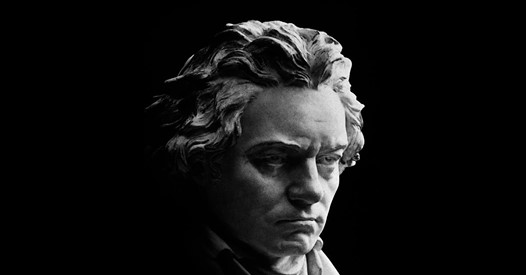
    Wednesday November 20th, 2019 – Violinist Isabelle Faust and pianist Alexander Melnikov – long time musical partners – joined the celebrations of Beethoven’s 250th birthday as part of the Lincoln Center’s Great Performers series with an all-Beethoven recital at Alice Tully Hall. The 70-minute, no-intermission, program featured Beethoven’s last three violin sonatas.

    Composed in 1801-02 and dedicated to Tsar Alexander I of Russia, the three sonatas of his Op. 30 were Beethoven’s final word on the genre, even though he was only 31 years old. (In total, he composed 8 violin sonatas.) At this stage Beethoven had not yet written his Eroica Symphony (that would come 2 years later), changing the trajectory of the symphony and his own musical development

    Beethoven’s violin sonatas, like so much of his “early” music, look back on Mozart’s contributions to the genre, while at the same time developing new languages. Whereas Mozart’s violin sonatas were focused on the violin – with the piano as an accompaniment – Beethoven forced the piano into the spotlight, with a more prominent voice and bigger, more “symphonic” writing. In the sonata No. 6’s opening movement the violin seems to be playing catch-up with the piano in introducing the melodies. In the final movement, a theme and set of variations, the piano again dominates.

    While the following two sonatas give the violin a much bigger role, as performed by Isabelle Faust and Alexander Melnikov, the piano’s dominance was clear throughout the evening. Ms. Faust’s playing, quiet and brittle at times, with an edge to the tone, required the listener to lean in. She rarely demanded attention for her instrument or her playing; she is certainly not a “showboat” performer. Mr. Melnikov, a more aggressive player by nature, was the dominant force on the stage almost by default. The relaxed tempos set by the duo made clear this was not heaven-storming Beethoven.

    Sadly, as the evening progressed, the quiet playing by Faust, which I initially attributed to a “lean-in” personality, started to grow flat and dull. Whether drama or joy, one could hardly tell the difference. I almost got the sense that Faust was sight-reading the music, as if she’d hardly ever seen these notes before. (That’s clearly not the case: she and Melnikov recorded the complete sonatas for Harmonia Mundi some years ago and did so very well.) How unfortunate then that on this evening she was unable to gather enough spirit to help launch New York’s Beethoven year celebration.

    ~ Ben Weaver

  • All-Beethoven @ Lincoln Center’s Great Performers

    66153624_23843479431240714_7828252017846910976_n.png

    ~ Author: Ben Weaver

    Wednesday November 20th, 2019 – Violinist Isabelle Faust and pianist Alexander Melnikov – long time musical partners – joined the celebrations of Beethoven’s 250th birthday as part of the Lincoln Center’s Great Performers series with an all-Beethoven recital at Alice Tully Hall. The 70-minute, no-intermission, program featured Beethoven’s last three violin sonatas.

    Composed in 1801-02 and dedicated to Tsar Alexander I of Russia, the three sonatas of his Op. 30 were Beethoven’s final word on the genre, even though he was only 31 years old. (In total, he composed 8 violin sonatas.) At this stage Beethoven had not yet written his Eroica Symphony (that would come 2 years later), changing the trajectory of the symphony and his own musical development

    Beethoven’s violin sonatas, like so much of his “early” music, look back on Mozart’s contributions to the genre, while at the same time developing new languages. Whereas Mozart’s violin sonatas were focused on the violin – with the piano as an accompaniment – Beethoven forced the piano into the spotlight, with a more prominent voice and bigger, more “symphonic” writing. In the sonata No. 6’s opening movement the violin seems to be playing catch-up with the piano in introducing the melodies. In the final movement, a theme and set of variations, the piano again dominates.

    While the following two sonatas give the violin a much bigger role, as performed by Isabelle Faust and Alexander Melnikov, the piano’s dominance was clear throughout the evening. Ms. Faust’s playing, quiet and brittle at times, with an edge to the tone, required the listener to lean in. She rarely demanded attention for her instrument or her playing; she is certainly not a “showboat” performer. Mr. Melnikov, a more aggressive player by nature, was the dominant force on the stage almost by default. The relaxed tempos set by the duo made clear this was not heaven-storming Beethoven.

    Sadly, as the evening progressed, the quiet playing by Faust, which I initially attributed to a “lean-in” personality, started to grow flat and dull. Whether drama or joy, one could hardly tell the difference. I almost got the sense that Faust was sight-reading the music, as if she’d hardly ever seen these notes before. (That’s clearly not the case: she and Melnikov recorded the complete sonatas for Harmonia Mundi some years ago and did so very well.) How unfortunate then that on this evening she was unable to gather enough spirit to help launch New York’s Beethoven year celebration.

    ~ Ben Weaver

  • Table of Silence ~ 2019

    L2010773

    Wednesday September 11th, 2019 – Today marked the annual Lincoln Center performance of Jacqulyn Buglisi’s Table of Silence, a danced ritual commemorating the 9/11 terrorist attacks on New York City and Washington DC. This year, it took on an even deeper resonance as a plea for reason and compassion in our dark and dangerous world.

    As each day seems to bring ever more unsettling headlines, I am constantly put in mind of the words sung by the desperate wife and mother Magda Sorel in Gian-Carlo Menotti’s opera The Consul:

    “To this we’ve come:
    that men withhold the world from men.
    No ship nor shore for him who drowns at sea.
    No home nor grave for him who dies on land.
    To this we’ve come:
    that man be born a stranger upon God’s earth,
    that he be chosen without a chance for choice,
    that he be hunted without the hope of refuge.
    To this we’ve come. And you, you too, shall weep.”

    Table of Silence shines like a beacon of hope; each year, it seems more beautiful…and more meaningful. 

    ~ Oberon

    Note: some photos here.

  • Guangzhou Ballet @ Lincoln Center

    DSCF1949

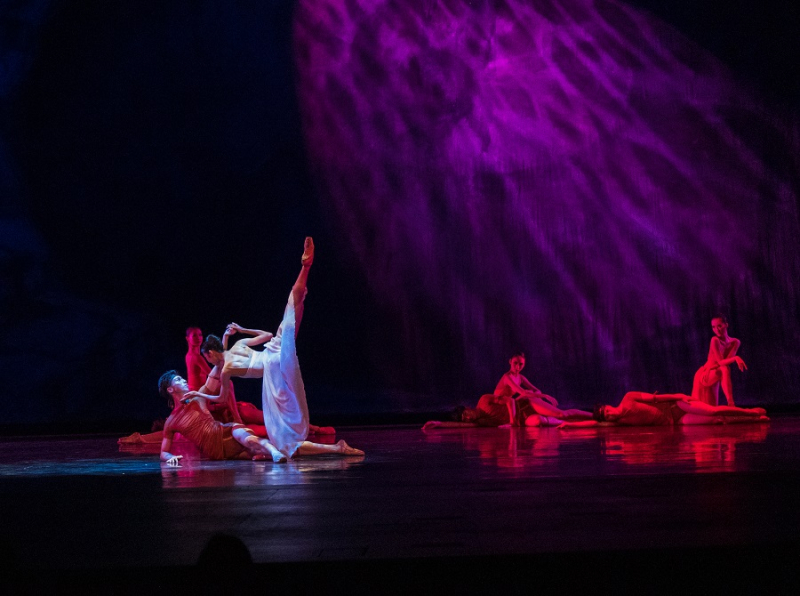
    Above: from Guangzhou Ballet‘s production of Carmina Burana as performed at Lincoln Center; photo by Dmitry Beryozkin

    ~ Author: Oberon

    Saturday August 17th, 2019 – Guangzhou, China, is the birthplace of my beloved Wei, so I arranged tickets for us to Guangzhou Ballet’s performance at Lincoln Center tonight. Earlier in the day, my friend Dmitry Beryozkin photographed the dress rehearsal of the production.

    Although tested by numerous audience distractions, we stayed to the end because of the impressive work of the Guangzhou Ballet‘s dancers, who are beautifully trained and who excel in both virtuosity and artistry.

    DSCF1527

    Above: from Goddess of the Luo River; photo by Dmitry Beryozkin

    Goddess of the Luo River is set to a violin concerto by the venerated Chinese composer Du Mingxin, who is now in his 90th year. The music has both rhythmic and lyrical appeal, though the Adagio begins to feel overly sweet after a while.

    The program note for Goddess of the Luo River was basically incomprehensible to me, but the ballet seems to tell of a pair of young lovers yearning to be together, and of the goddess who helps make their dream come true.

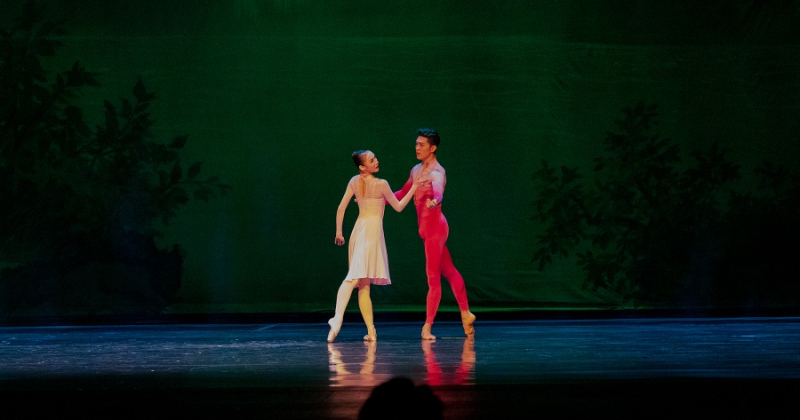
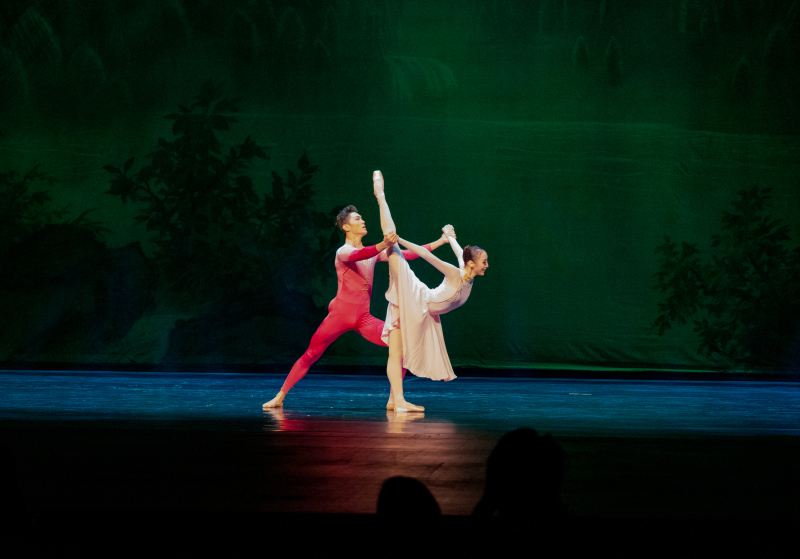
    Peter Quanz, a Canadian choreographer beloved by my friend Arlene Cooper, has re-staged the Du Mingxin concerto to beautiful effect. Mr. Quanz is a master of classical styling who has a gift for structure and for creating pleasing and musically-inspired combinations. The opening segment of Goddess of the Luo River, danced by an ensemble of women, was emblematic of Mr. Quanz’s work, which sustained our interest for the 30-minute duration of this atmospheric piece.

    Against a backdrop of a misty forest river-glade, Goddess of the Luo River unfolds like a blooming flower. If I have read the Playbill correctly, the principal dancers tonight were Fang Afang, Ma Minghao, and Huang Bairnao, and they were all simply entrancing to watch. But in fact, everyone onstage danced gorgeously, with musicality and grace.

    At the end, the bow lights cam up and we looked forward to hailing the dancers in their curtain calls, but the applause dwindled away and there were no bows.

    DSCF1510

    Above: from Goddess of the Luo River; Dmitry tells me they only did a brief excerpt from this ballet at the dress rehearsal. Too bad, because there were some lovely passages for the corps and the other featured dancer that I would like to have had photos of.

    Following the interval, a three-act choreographic rendering by Qi Jiang of Carl Orff’s Carmina Burana was presentedThe score was first performed on June 8, 1937, at Frankfurt, and is a setting of Medieval poems for three solo voices, chorus, and orchestra. This work was Orff’s “greatest hit” (though he wrote some truly fascinating operas) and it became one of the best-known musical works of the 20th century thru its use in film and commercials. Carmina Burana greatly appealed to the Nazi regime, to whom its rhythms were reminders of the “stamping columns of the Third Reich”.

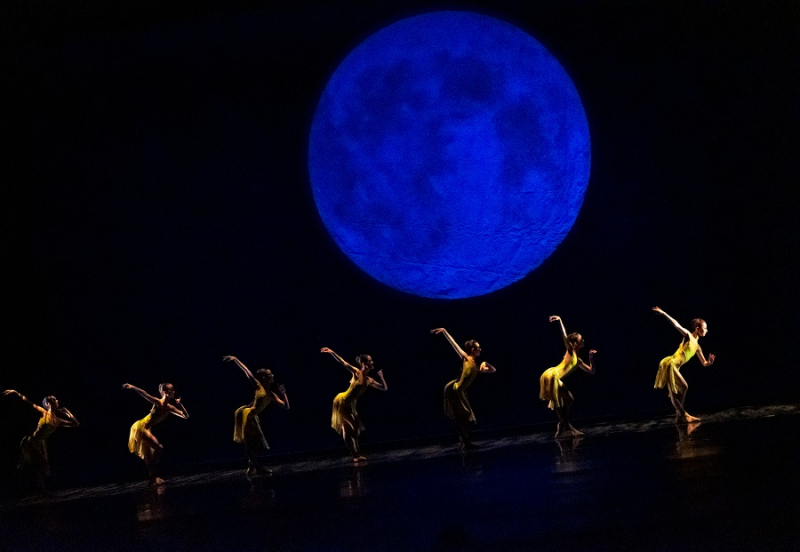
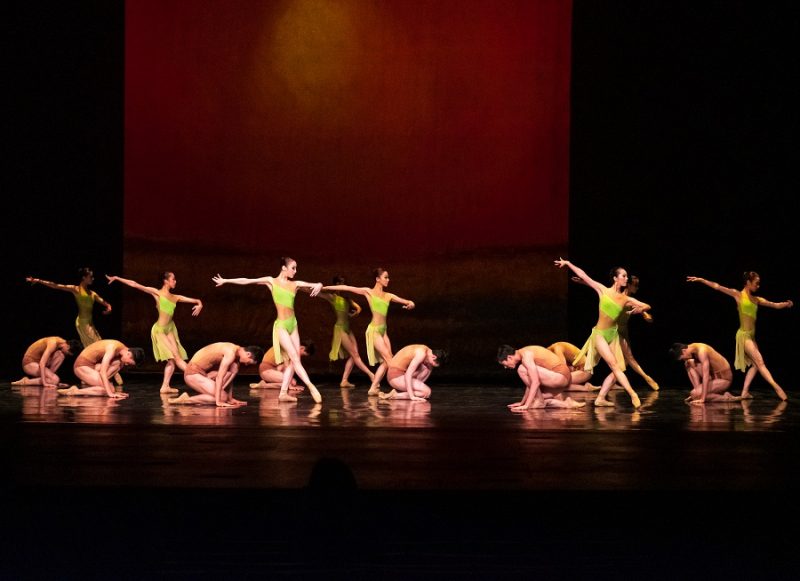
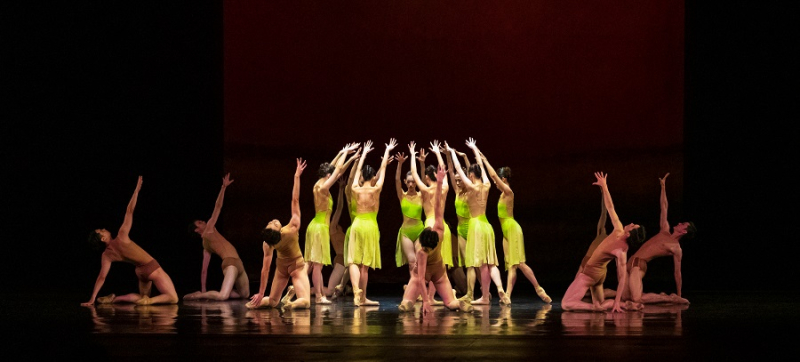
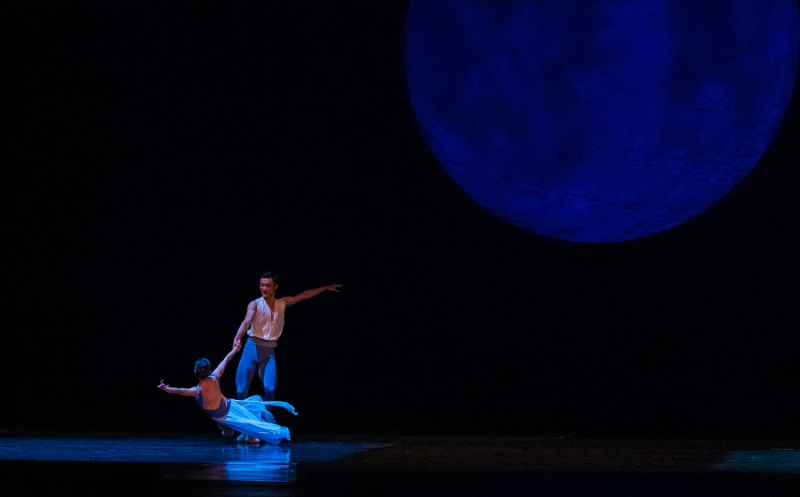
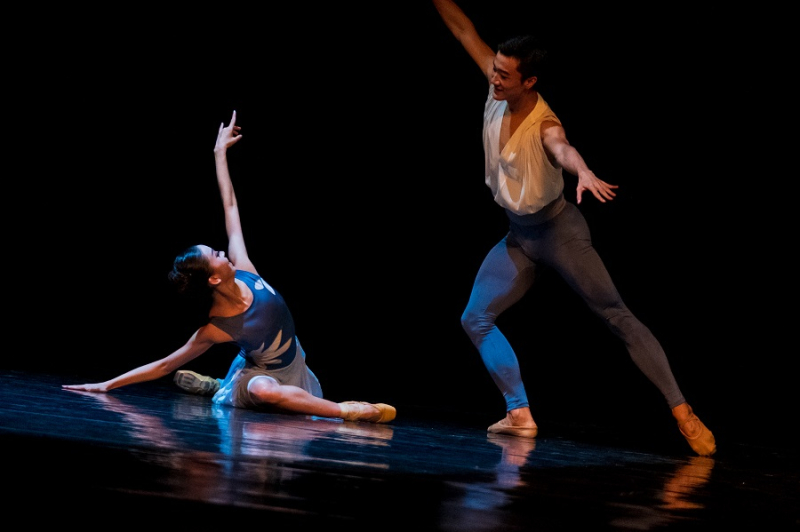
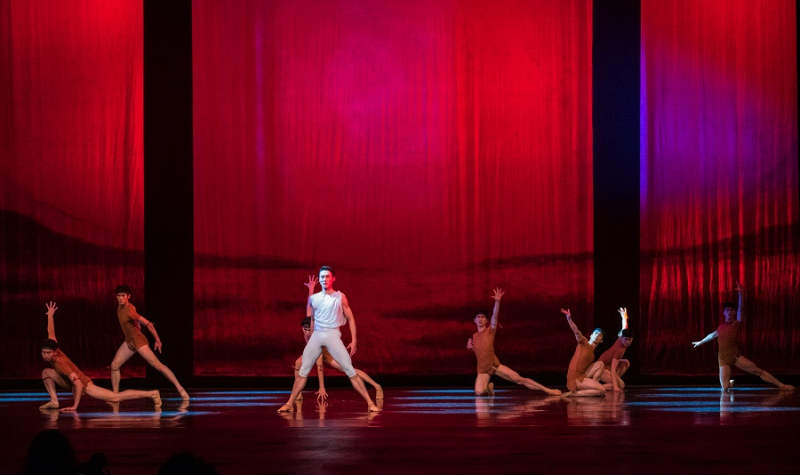
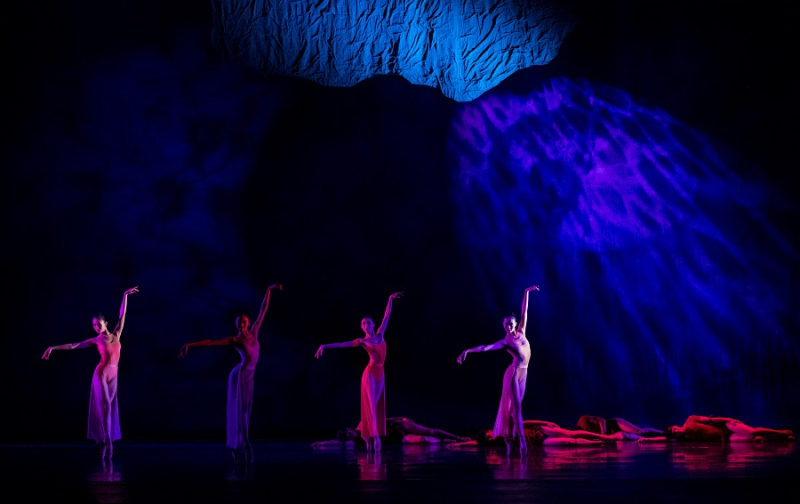
    Guangzhou Ballet did not choose one of the many top-notch recordings of the piece for their ballet production but it was very well reproduced over the theater’s sound system. The music has an irresistible emotional force. Han Jiang (scenic designer) and Chen Xiaji (lighting designer) have created a production full of impressive visuals, as you can see from Dmitry Beryozkin’s photos, below.

    The Company’s Carmina Burana, however, did not reach the same level of involvement for either Wei or I as the evening’s opening work. It’s nearly an hour long, and there were stretches when the choreography seemed uninspired and repetitive. Perhaps some judicious pruning of the music would have helped make it more coherent: there are stories being told, but they become rambling after a bit.

    Such striking moments as the powerful, smoky opening segment with dancers emerging from under a large blanket of fabric, and – especially – the gigantic moon that looms over some scenes kept us focused. But the constant whispering and checking of cellphones by people around us, the amorous boy in front of us who wanted to cuddle his girlfriend, and the continuous undercurrent of a whimpering child somewhere to our left (eventually taken out, with 5 minutes of music left to go) became so aggravating as the ballet progressed. If we could have made a graceful exit (some people did), we would have left midway thru.

    But it was nice to see the dancers taking their bows at the end, though these were staged Broadway-style, with a reprise of music from the Orff score.

    Here is a gallery of Dmitry Beryozkin’s images from Carmina Burana:

    DSCF1677

    DSCF1850

    DSCF2041

    DSCF2030

    DSCF2270

    DSCF2326

    DSCF2297

    DSCF2273

    ~ Oberon

  • Kuusisto/Sundquist ~ A Little Night Music

    Hp-little-night-music

    Above: the Stanley H. Kaplan Penthouse at Lincoln Center

    Author: Ben Weaver

    Saturday July 27th, 2019 – Finnish violinist Pekka Kuusisto and Swedish double-bassist Knut Erik Sundquist had a long evening at the Mostly Mozart Festival: first they performed a full concert of Bartok and Vivaldi with the Mostly Mozart Festival Orchestra, conducted by Andrew Manze, followed by a special appearance at the Stanley H. Kaplan Penthouse for a series called A Little Night Music, an intimate one-hour program of music and wine.

    Pekka Kuusisto is not your traditional classical violinist. Although classically trained and a winner (first place) of the Jean Sibelius Violin Competition (Kuusisto was the first Finn to win there, in 1995), he spends as much time performing non-classical music as classical. “Crossover” would not be the right word; he’s not necessarily playing arrangements from Cats. But his dedication to playing many different types of music and his improvisational skills place him in a somewhat different category from most other concert violinists. When he does venture into the strictly classical repertoire – as he did last year with a recording of J.S. Bach’s complete Sonatas and Partitas for Solo Violin – the results are unpredictable and often electrifying. 


    Kuusisto is a dynamic stage personality; encountering him in a small space like the Kaplan Penthouse is a singular experience. With the night-time NYC skyline shining behind the stage, Kuusisto and his frequent stage partner, the great double-bassist Knut Erik Sundquist, easily filled the hour with a wide range of music, hilarious banter (like a vaudeville act, the ease of their interactions can only be perfected over many years of friendship) and sound life advice (after a night of drinking, make sure you go home before you go to bed.)


    The duo broke up the musical selections into aptly titled Minuet Section, Sad Section, and Happy Section. The Minuets were courtesy of Bach and traditional Finnish folk dance, played and improvised seamlessly. The middle Sad Section was launched by a mysterious Austrian tune Kuusisto once heard on TV while watching a weather report at the Ischgl ski resort and transcribed for posterity. (Since Kuusisto has never been able to figure out the source of the tune, he simply calls it Memories from Ischgl.) Occasionally he hummed while playing this lovely, orphaned tune. And the final Happy Section of cheerful traditional melodies from Finland and Sweden, and – of all things – a Spanish tango from Poland that’s especially beloved in Finland. (Here I was reminded of a famous line from Edith Wharton’s The Age of Innocence about the opening night of the (Old) Met: “She sang, of course, ‘M’ama!‘ and not ‘he loves me,’ since an unalterable and unquestioned law of the musical world required that the German text of French operas sung by Swedish artists should be translated into Italian for the clearer understanding of English-speaking audiences.”)


    The beauty of all this music and the intimacy of the presentation made for a fascinating evening. Kuusisto’s command of his instrument, the ease of the playing, his ability to transform the sound from a “serious violin” to a “dancing fiddle” were extraordinary. The dreamy expression on his face when playing Bach and a Finnish folk tune reveal a deep love and appreciation for music, the source is secondary.


    Sometimes classical music lovers can get too hung up on purity. Truth is that music from any source can trigger the deepest feelings and memories: from Traditional to Bach to Cole Porter to Madonna. As the only truly universal language on Earth, music of all kind can bring out every imaginable emotion. This ability to communicate in different musical languages – and helping the audience embrace the differences – may be Kuusisto’s greatest gift to his audience.


    ~ Ben Weaver


    Note: Oberon has written about the July 26th performance of the Suusisto/Lundquist/Manze Four Seasons here.

  • 2nd Summer Evening @ CMS ~ 2019

    Artist_2237

    Above: pianist Juho Pohjonen

    ~ Author: Oberon

    Sunday July 14th, 2019 – The second of three concerts in Chamber Music Society of Lincoln Center‘s annual Summer Evenings series brought together a trio of esteemed CMS artists joined by The New York Philharmonic’s beloved principal clarinetist Anthony McGill. No French music on this Bastille Day program; Austria, Germany, and Russia were represented. The playing was superb.

    Bella-Hristova-FI

    Above: violinist Bella Hristova, photo by Lisa-Marie Mazzucco

    With Mr. Pohjonen at the Steinway, Ms. Hristova opened the concert with Mozart’s Sonata in B-flat major for Violin and Piano, K. 454, which dates from 1784. Fittingly enough, this sonata was composed for a female violinist: Mozart wrote it for the Viennese debut of Regina Strinasacchi, and he himself was the pianist on that occasion. Female violinists were quite rare in those days. Signorina Strinasacchi had studied at the famous Ospedale della Pietà in Venice where Antonio Vivaldi had once served as music director. She was 21 years old at the time of her Vienna debut, and was said to be a dazzling violin virtuoso who had also trained as an opera singer.

    Ms. Hristova, who in March of this year gave a dazzling recital at Merkin Hall, looked fetching in a dusty rose à la Grecque frock. After a courtly – almost regal – introduction, Ms. Hristova’s playing of the affecting first melody set the mood. She and Mr. Pohjonen traded melodic statements, making it clear from the start that they are ideal colleagues. The music gets lively, with little hesitations and subtleties woven in; abundant charm and sweet lyricism prevail.

    A tender theme commences the Andante; the musicians take turns playing melody and rhythmic figurations. Ms. Hristova’s phrasing is so appealing here. The music turns a bit melancholy, with a sense of passion restrained. A sustained note from the violinist leads on to a sort of coda and a gentle finish.

    The sonata’s concluding Allegretto is a lot of fun; violinist and pianist sometimes play in unison and sometimes harmonize. The pacing and dynamics offer pleasing contrasts along the way to a virtuosic finale.

    IMG_7629-e1350511246980-1024x748

    Anthony McGill (above) then joined Nicholas Canellakis and Mr. Pohjonen for Johannes Brahms Trio in A-minor for Clarinet, Cello, and Piano, Op. 114. This was composed in 1891, after Brahms had heard the great clarinetist Richard Mühlfeld and was much taken with the sound of the instrument.

    Mr. Canellakis has the trio’s opening statement – a rich melodic passage – and soon Mr. McGill’s clarinet makes its sublime entrance. From the Steinway, Mr. Pohjonen pulses up and the music takes off, calming for a cello solo in which Mr. Canellakis’s depth of tone makes a marvelous impression. Cello and clarinet bring incredible subtlety to a scale passage, and there’s a trace of gypsy lilt in the music. Following more scalework, the Allegro fades away.

    At the start of the Andante, Mr McGill’s lambent tone is beautifully matched to Mr. Canellakis’s, producing a spellbinding blend: ‘phrasing is all’ here as the voices entwine. To their mix, Mr. Pohjonen adds his poetic playing. The Andantino grazioso begins like a serenade: the clarinet sings while the cello provides a plucked accompaniment. This lighthearted movement transforms itself into a waltz, which proceeds lyrically.

    Mr. Canellakis’s cello digs into the final Allegro, with the piano urgent and the clarinet vibrant. The music is broad, with a folkish feel. Descending phrases are heard, and the trio finds a brisk ending.   

    N C

    Following the interval, Nick Canellakis (above) along with Ms. Hristova and Mr. Pohjonen, offered Anton Arensky’s Trio No. 1 in D-minor for Piano, Violin, and Cello, Op. 32. Whenever I hear Mr. Canellakis playing, I find myself thinking back to his magnificent performance of Leon Kirchner’s Music for Cello and Orchestra at Carnegie Hall in 2015.

    Images

    Arensky (above) is something of a forgotten composer – unfairly, in my view. You can read about him, and hear some of his music, here. Listening to his music, you can see where Scriabin and Rachmaninoff profited from having been Arensky’s students.

    Bella Hristova’s gorgeous violin solo plays over restless patterns from the Steinway; the cello then takes up the melody. Mr. Pohjonen relishes the con moto sweep of the virtuoso writing for piano.  “This is fabulous music!”, I scrawled across my notes.  The string players exchange bits of melody, the pianist deftly dispatches phrase after lovely phrase. A soft, sustained violin note ends the Allegro moderato.

    The second movement is a sprightly Scherzo, with plucked strings and high trills from the piano: at times the instruments sound almost like toys. Mr. Pohjonen’s tone shimmers throughout. An engaging waltz gets quite grand, and, after some wry hesitations, the Scherzo‘s end is lighthearted.

    A tender, reflective cello solo opens the Elegia; the music seems to recall happier times that have been left behind. Ms. Hristova’s violin climbs poignantly higher and higher, whilst Mr. Canellakis’s cello again sounds from the depths. 

    From a turbulent start, the cello and then the violin carry the melody of the concluding Allegro non troppo: this music is very much à la Russe. As passion ebbs and flows thru the melodies, the shining piano and soft strings lend an ethereal air. The composer then crafts a lively finale for his trio.

    Ms. Hristova and Mssrs. Canellakis and Pohjonen were greeted with great enthusiasm at the program’s end, and insistent applause brought them out for a second bow.

    ~ Oberon

  • CMS: New Music @ The Rose Studio

    Commissions_pintscher_1024px

    Above: composer Matthias Pintscher

    ~ Author: Brad S. Ross

    Thursday March 21st, 2019 – Thursday was a unique night of sounds with the Chamber Music Society of Lincoln Center in the organization’s cozy and intimate Daniel & Joanna S. Rose Studio.  The all-contemporary music program, featuring four works written between 1983 and 2013, ran the gamut of cutting-edge of sonorities, offering its refreshingly engaged audience a small cornucopia of contemporary classical music.  It was also a heavily American program, featuring only a single piece by a European composer—something that can seldom be said of most music programmed at Carnegie Hall or the New York Philharmonic.  Performing that night of the CMS players were the pianist Micheal Brown, violinist Bella Hristova, violist Richard O’Neill, and cellist Mihai Marica.  Their playing was at such a high level of proficiency that one could be forgiven for scarily noticing the ease with which they navigated such technically demanding music.

    The evening began with some academic and mercifully brief opening remarks by the CMS Director of Artistic Planning and Administration Elizabeth Helgeson about the composition of the first two pieces.  Once finished, the players wasted no time diving into the first work of the evening:  Alexandra du Bois’s L’apothéose d’un rêve for Piano, Violin, and Cello.  L’apothéose d’un rêve, translated in English as “The Apotheosis of a Dream,” was originally commissioned by the pianist Menahem Pressler for the Beaux Arts Trio for the trio’s semicentennial in 2005.  The work is cast in five movements played without pause and features a musical voice much befitting its decidedly ambiguous title.

    Its tone is often longing and somber, lingering and dramatic—a stark contrast to the ferocity for which so many contemporary compositions have been known.  Light on extended technique, but rife with developed thematic material, du Bois achieved an almost tragic beauty in L’apothéose d’un rêve, evoking the dreamlike imagery of its name.  The third movement Molto vivo, with its arpeggiating piano lines, seemed almost to harken the swells of some discontented ocean.  The closing movement Misterioso ended with haunting and almost funereal bell tones on the piano as the strings suspended an eternal minor third above them.  Its beauty set a lofty standard for the works to come.

    Next was the revered octogenarian Charles Wuorinen’s Trio for Piano Violin, and Cello.  Composed in the summer of 1983, the piece was originally commissioned and performed by the Arden Trio.  It is cast in a single movement over approximately ten minutes, making it handily the most concise work of the evening.  Compared with the previous piece by du Bois, Wuorinen’s Trio was volatile and ferocious—rich with exquisite colors and textures that brought the most out of the ensemble.  The players had their best work out here and effortlessly demonstrated their expert musicianship on its numerous intricate runs, tightly dissonant intervals, and relentless difficult counterpoint.  It all culminated in an unsettling and richly dramatic ending that, in the best possible sense, left me wanting more.

    Helgeson returned to the stage for a few more brief words about the program and the performers soon launched into the third work of the evening: Matthias Pintscher’s Janusgesicht for Viola and Cello.  The German-born Pintscher, the sole aforementioned non-American on the program, composed Janusgesicht in 2001.  Its title refers to the god of Roman mythology Janus, whose two faces stair simultaneously in opposing directions.  Janusgesicht, as the composer writes, is “less about correspondence or communication among the two voices, but about the dissolution of one’s voice into the other.”  For this piece, the players thus faced away from each other as the lights in the hall were near-completely darkened, minus some ambient blue lighting cast upon the back wall.  Gimmicky as this setup may seem (I indeed had my doubts), it turned out to be one of the more interesting performances of the evening.

    Janusgesicht was understandably the most dissonant and atonal work of the night—no tone center was to be found amidst its eerie scratchings and unholy strikes as these two string players weathered some of the most discordant sonorities of the evening.  The work is characterized by myriad unnerving atmospheres, haunting silences, and arresting sonic textures, none of which ever outstayed their welcome.  Following a lugubrious and tantalizing final decrescendo, the performers froze in place for what must’ve been half a minute before finally lowering their bows to receive a well-earned applause.  Though it required patience and a mind considerably open to challenging music, Janusgesicht was well-worth the effort—the audience knew it, too.

    The fourth and final piece of the night was David Serkin Ludwig’s Aria Fantasy for Piano, Violin, Viola, and Cello.  Written in 2013, this quartet was the most recent composition of the program, though its roots stretched the furthest back of all. It was inspired, as the program indicated, by the opening and closing arias of Johann Sebastian Bach’s Goldberg Variations from 1741, but was pleasantly light on direct quotations.  Ludwig, who was present for the night’s proceedings, was humorously short-winded in a pre-performance talk about the work, quipping that “a composer should never speak for longer than the duration of the piece.”  What unfolded over the next sixteen minutes turned out to be a wild and adventurous combination of musical idea.

    Aria Fantasy began on a lullaby-like piano line accompanied by almost science fiction-like glissandi in the strings.  This unusual combination of pleasantly tonal melodies contrasted with obstinately discordant harmonies and modern musical techniques played like a dream that was equal parts pleasant and frightening.  After this eerie opening came a dramatic and eventful middle section (andanteadagio), followed by a growing momentum that built to a grand final section (con moto).  When the final diminuendo played the piece to its close (tempo di aria), the audience—including yours truly—was left wanting it to continue long after the piano’s final harmonic resolution.

    This was a resounding finale to a night of superb contemporary music—music that should be performed as often and as widely as anything by the late masters.  Other ensembles would do well to take their example and program more works by living composers.  If Thursday night’s enthusiasm was any indication, audiences are itching to hear it.

    ~ Brad S. Ross  

  • Hilary Hahn @ White Light Festival

    ~Author: Scoresby

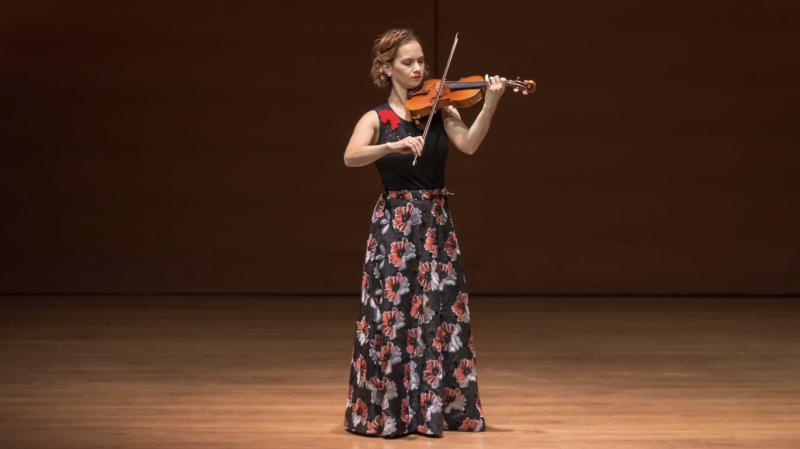
    Tuesday October 23 2018 – Lincoln Center’s White Light Festival every October/November is always an interdisciplinary highlight of the season that offers a variety of different events. This year’s ranges from the upcoming US Premiere of Kaija Saariaho’s new opera Only the Sound Remains to a music with dance performance of Feldman’s Triadic Memories featuring pianist Pedja Muzijevic and choreographer Cesc Gelabert. Part of this celebration of spiritual/communal art featured the genial violinist Hilary Hahn in all too rare NY concert. She performed two of the three of the Bach Sonatas and Partitas that she just released on recording. The last work was one of the other three she recorded as her debut album, and it seems will perform them this Spring in Europe. According to Ms. Hahn’s Instagram, this was her first solo concert in the US in her career.

    Screen Shot 2018-10-25 at 12.38.40 PM
    Above: Violinist Hilary Hahn playing Bach; Photo by Kevin Yatarola Courtesy of Lincoln Center

    Ms. Hahn was performing to a sold out, enthusiastic audience in the intimate Alice Tully Hall yesterday evening. It should be said that all six of these pieces are extremely difficult to play well and yet at the core of the violin repertoire. The first work on the program was Sonata No. 1 in G minor. Ms. Hahn coaxed a large, beautiful sound out of her violin in the opening Adagio. Her sound was reminiscent of a purer Arthur Grumiaux (different intepratively). In the Fugue, Ms. Hahn took a more aggressive sounding virtuosic as she traversed each of the many double and triple stops. Out of the many live performances I’ve seen of this work, this is the first time I’ve heard this movement sound almost as clean as a recording – a near impossible feat. In addition to her accuracy, it was striking to be able to hear the countermelodies in the bass that usually disappear in the dense textures rang with clarity. In Ms. Hahn’s rendering, the intricate contrapuntal structure was easy to hear. While she was retuning before the third movement, the audience gave a hearty applause. After the gorgeous Sciliano, Ms. Hahn gave a brisk, full-bodied account of the presto. Her use of a quick tempo and her interesting finger work let the entire bass line ring through the movement letting the entirety of the piece shine.

    In the opening Allemende of the Partita No. 1 in B minor Ms. Hahn took her time and employed small cells of melodic phrases that were punctuated by the larger chords. It was a unique take on this movement, make it sound angular – almost in the vein of Stravinsky. She seemed to take a similar approach in Courante that when moving into the Double expanded into a carefully coordinated flash of notes that was always clear. Part of that clarity came from giving almost every note its own bowing, making each shine in its own way. The audience applauded here too before the final four movements. Another highlight was the careful pacing of the Sarabande. As in other areas, Ms. Hahn’s preternatural ability of voicing every line let the music sing.

    Screen Shot 2018-10-25 at 12.41.23 PM

    Above: Violinist Hilary Hahn

    After intermission was Partita No. 2 in D minor. Ms. Hahn continued with the same big sound and near orchestral quality of playing. While beautifully rendered and intellectual satisfying, I couldn’t help but feel that her performance felt lacking in intimacy. As encore to the Partita, Ms. Hahn opted to replay the massive Chaconne. While I felt it was quite a bit odd at first to play a 15 minute encore of music just performed earlier, this was her best playing of the night. Perhaps relieved to be over with her first US solo concert, she seemed relaxed and personal with this second reading. Phrases that had been burly had a softer edge to them, the lyrical parts of the work had more space, and Ms. Hahn seemed to use quieter dynamics than she had the rest of the evening. It was thrilling to hear such a change in performance style from the rest of the concert and the crowd seemed to be just as enthralled.

    Scoresby

  • CMS Summer Evenings ~ 2018 – Concert 3

    Se_news

    ~ Author: Oberon

    Sunday July 15th, 2018 – The last of Chamber Music Society of Lincoln Center‘s Summer Evening concerts for 2018: perfect playing from a quintet of wonderful artists in music of Mozart, Weber, and Schubert.

    Nothing sets an evening of chamber music on its way to finer effect than Mozart: his Quartet in C-major for Flute, Violin, Viola, and Cello, K. 285b dates from the 1780s and was the last of three quartets Mozart wrote for the amateur flautist Ferdinand De Jean.

    The quartet is in two movements: the opening Allegro finds the sound of Sooyun Kim’s flute floating on the air over an elegant string accompaniment; her tone is delicious, her ruby-red gown a delight. Her colleagues – Erin Keefe (violin), Paul Neubauer (viola), and David Requiro (cello) – have a lovely feel for the pacing of the music, which occasionally veers into the minor…and back.

    The first movement comes to a pretty end, then the Andantino begins with the players harmonizing to fine effect. The music has a gentle pulse, and we can savour the velvety texture of Mr. Requiro’s cello sound. Ms. Keefe commences a theme, echoed by Mr. Neubauer’s viola and then the cello launches a fresh idea. Following a cadenza for Ms. Kim, the strings pulse gently as the flautist sends forth a sweet song which she repeats before the quartet reaches a light and charming finish.

    Carl Maria von Weber’s Trio in G-minor for Flute, Cello, and Piano, Op. 63 (composed 1818-19) – a gem of a piece – was superbly played by Ms. Kim, Mr. Requiro, and pianist Orion Weiss. von Weber is best-remembered today for the overture to his opera OBERON and for the irresistible Invitation to the Dance which inspired Fokine’s romantic ballet Le Spectre de la Rose. Weber’s music abounds in melody, and his music often seems like German bel canto.

    The opening Allegro moderato begins with a somewhat mysterious piano passage, then Mr. Requiro’s gorgeous-toned cello enters, followed by Ms. Kim’s flute, weaving together in a lovely mix. The three voices dovetail perfectly in a da capo, and the movement ends on a sustained flute tone.

    After a dramatic start, the Scherzo turns Spring-like, with the flute spinning out a tune accompanied by waltz figurations. In the Andante, entitled ‘Schäfers Klage’ (‘Shepherd’s Lament’), piano and cello seem to imitate a guitar; then each voice takes the melody in turn. Shifts from major to minor are intriguing, and – after a brief flute cadenza – comes a calm finish. Mr. Weiss commences the Finale quietly. As the pace builds, the flute takes up a tune: Ms. Kim and the pianist really sparkle here, and the music is fast and fun. After a lull, the three musicians take a da capo and sail on to a lively ending. The audience lavished them with enthusiastic applause, and deservedly so.

    Franz Schubert’s 1827 Trio No. 1 in B-flat major for Piano, Violin, and Cello, D. 898, Op. 99, filled the program’s second half. As chamber works go, it is quite long; the composer makes numerous repeats of themes throughout the four movements, and to me it seems his best ideas come in the first two. But, played as it was tonight, this trio became quite engrossing.

    The first movement, Allegro moderato, has an almost triumphant start; as the music calms, lovely nuances are brought forth by Ms. Keefe, Mssrs. Requiro and Weiss. The pianist, who was truly marvelous throughout the evening, plays a fresh melody over plucked strings. Another winning theme passes from cello to violin. In alternating passages of delicacy and melodrama, the three musicians display the agility and passion of their impeccable playing.

    The Andante has a peaceful opening, and Mr. Requiro shines yet again in a radiant melody that is then taken up by Ms. Keefe to ravishing effect. The gently animated Scherzo has a Mendelssohnian grace, but as it neared its end, a cellphone went off to disastrous effect. Yet the players were able to re-establish the mood in the charming, light, and brilliant Allegro vivace finale, much to the delight of the crowd.

    ~ Oberon