Tag: Lincoln Center

  • CMS Brandenburgs ~ 2017

    Bach

    Above: the Master of Music, Johann Sebastian Bach

    ~ Author: Oberon

    Tuesday December 19th, 2017 – Chamber Music Society of Lincoln Center‘s annual holiday-season performances of Bach’s immortal Brandenburg Concertos offer an antidote to NUTCRACKER and MESSIAH – not that there’s anything wrong with Tchaikovsky or Handel, to be sure. But the Brandenburgs speak to us without sentimentality or piety: pure music, pure joy.  

    This year marked my fifth CMS Brandenburgs, and as usual the Society have assembled a brilliant ensemble – from beloved Bach specialists to rising stars – to make the season merry and bright:

    Kenneth Weiss, HARPSICHORD • Kristin Lee, Cho-Liang Lin, Daniel Phillips, Danbi Um, VIOLIN • Mark Holloway, Yura Lee, Richard O’Neill, VIOLA • Efe Baltacigil, Nicholas Canellakis, Colin Carr, CELLO • Joseph Conyers, DOUBLE BASS • Robert Langevin, Carol Wincenc, FLUTE • Randall Ellis, James Austin Smith, Stephen Taylor, OBOE • Peter Kolkay, BASSOON • Julie Landsman, Jennifer Montone, HORN • Brandon Ridenour, TRUMPET

    Wu Han, co-Artistic Director of Chamber Music Society, welcomed the packed house with her customary enthusiasm and wit. Does any other Artistic Director on the Gotham scene evince such pride in the organization she heads, in the ‘product’ she dispenses (great music), and in the people – these super-musicians – who make each program so meaningful and enjoyable? The overflow crowd, filling the extra rows of seats installed specially for this program, attest to the fact that she and David Finckel are doing everything right.

    I’ve never before been in a theater when the classic yet ominous line “Is there a doctor in the house?”  comes over the loudspeakers. A gentleman quickly rose and went to see what he could do to help an individual in distress; hopefully it was all resolved to the good.

    Each year at the CMS Brandenburgs, the six concertos are played in a different order: tonight it was the fifth which opened the evening. From the New York Philharmonic, Robert Langevin brought his magic flute to the festivities. In music entwining flute and violin, Mr. Langevin and Cho-Liang Lin were exquisite in matters of subtle dynamics and pristine trills. Cordial playing from the string ‘choir’ – Daniel Phillips (violin), Yura Lee (viola), Colin Carr (cello), and Joseph Conyers (bass) – gave the concerto an appealing, warm resonance. In a dazzling cadenza near the end of this concerto’s opening Allegro, harpsichordist Kenneth Weiss thrilled me with his sparkling dexterity, made all the more alluring with hints of rubato. Although applause between movements is normally unwelcome, I couldn’t blame the audience for breaking in here to salute Mr. Weiss and his colleagues.

    The fifth concerto’s wistful Affetuoso was dreamily played by Mssers. Lin, Langevin, and Weiss. The deeper voices inaugurate the final Allegro, and here is the perfect opportunity to heap praise on the phenomenal Joseph Conyers, whose grand and glorious bass sound was a constant source of pleasure throughout the evening.

    Josephconyers

    Above: Joseph Conyers

    In concerto #6 (B-flat major), violins are absent. Instead, a formidable pair of violists – Yura Lee and Richard O’Neill – face a deluxe trio of cellists (Colin Carr, Efe Baltacigil, and Nicholas Canelakkis) across the music stands. The pulsing Allegro is highlighted by some high-speed coloratura from Mr. Carr; when his fellow cellists join in, watching their swift unison bow-work gave me a smile.

    In the sixth concerto’s Adagio – one of Bach’s most moving creations – commences with Richard O’Neill and Colin Carr (under-pinned by the Conyers bass) poignantly drawing us in. Yura Lee then takes up the theme, and for a few blessed moments, the music gives us a transfusion of hope. Colin Carr’s plush sound here gave a soul-reaching expressiveness. Sublime! But, without a pause, the closing Allegro sweeps us inexorably forward: Mr. Carr and the two violists make music that is fast and fun.

    Carol+Wincec+%281%29

    Above: Carol Wincenc

    The fourth Brandenburg commenced. Flautist Carol Wincenc’s name looms legendary in my pantheon; how wonderful to hear her playing live tonight for only the second time in my experience. Svelte and serene, Ms. Wincenc looked fetching in a ruffled black frock which drew admiring comments from the people sitting around us as she took her bows. Her flute sounds pure and sweet, and in Mr. Langevin she found a duetting partner of equal prestige. Their harmonizing was so elegant, abetted by Mr. Conyers’ amiable bass. Yet another voice is heard: violinist Kristin Lee’s tone mingled with the two flutes in a luminous blend, wondrous and subtle. A petite cadenza from Ms. Wincenc had a shimmering quality.

    For the 4th’s finale, I jotted “Speed Demon” next to Ms. Lee’s name: I vastly enjoyed watching her rapid bowing here: fabulous! The flautists were warbling divinely, and cellist Nick Canellakis contributed his customary polished playing: it felt like these musicians were setting the world to rights. A series of modulations carries the fourth concerto to its finish.

    Following the interval, the second Brandenburg found Danbi Um in the lead, with superb wind playing from Ms. Wincenc, James Austin Smith (oboe), Peter Kolkay (bassoon), and with trumpet virtuoso Brandon Ridenour soaring on high. Cellist Efe Baltacigil’s pacing motif set the stage for a delectable playing of the Andante in which Mlles. Um and Wincenc and Mr. Smith vied to see who could play the sweeter: a ravishing mix of timbres from these great artists. In the concluding Presto, trumpet and oboe matched wits to delight us even further.

    The third concerto, a particular favorite of mine, calls for three violins (Mr. Phillips, Ms. Um, and Kristin Lee), three violas (Richard O’Neill, Mark Holloway, and Yura Lee) and three cellos (Mssrs. Canellakis, Carr, and Baltacigil) whilst the intrepid Kenneth Weiss and Joseph Conyers continued to keep everything vivid. This concerto is unusual in that its Adagio movement consists only of a brief passage from Mr. Phillips’ violin: Bach immediately sends the players back into a swirling Allegro. This evening’s performance of the third showed yet again why the Brandenburgs are so cherished.

    First came last tonight, as the program concluded with the first Brandenburg (in F-major): the one that always reminds me of Handel. The ensemble here features two horns and a trio of oboes. With violinist  Daniel Phillips in charge, Jennifer Montone and Julie Landsman sounded velvety in their harmonized horn calls whilst Stephen Taylor, Randall Ellis, and James Austin Smith piped up to gratifying effect with their oboes, joined by Peter Kolkay on bassoon. Oboe, violin, bassoon, and bass sound the poignant Adagio, then the high horns ring out briskly in the Allegro. You think this concerto is over, but there’s a surprise fourth movement – it veers between Minuet and Polonaise – in which separate choirs of winds and strings summon up rhythms of the dance. This self-fulfilling ‘encore’ gave us a fine opportunity to enjoy Peter Kolkay’s lively bassoon playing.

    ~ Oberon

  • Flute Affair @ Chamber Music Society

    11.19.17_Flute_Affair

    Above: flautists Ransom Wilson and Tara Helen O’Connor

    Author: Oberon

    Sunday November 19th, 2017 – In a well-conceived program of works composed in four different centuries, Chamber Music Society of Lincoln Center presented two of today’s foremost flautists – Tara Helen O’Connor and Ransom Wilson – joined by an ensemble of top-flight artists. The ink’s probably not totally dry yet on John Luther Adams’ newest score, a CMS co-commission having its New York premiere this evening.

    Music of Bach opened the concert: his Trio Sonata in G-major for two flutes and continuo was given an elegant performance by Ms. O’Connor and Mr. Wilson, with cellist Timothy Eddy and Juho Pohjonen at the harpsichord providing a gracious continuo. The sound of blending flutes has an enchantment that few other instruments playing in duo can evoke. The sonata’s Adagio e piano has an air of sweet melancholy, and in the propulsive rhythmic figures of the two Allegro sections, Mr. Eddy made music that went beyond keeping time.

    For Mozart’s C-major flute quartet, K 285b, Ms. O’Connor was joined by violinist Kristin Lee, violist Paul Neubauer, and cellist Timothy Eddy. In this two-movement work, the composer keeps the flute prominent but doesn’t neglect the other instruments. Rising from the gentle flow of the opening Allegro, Ms. O’Connor’s quicksilver fluting sends a melodic line over to Ms. Lee’s violin. The strings provide a rich yet cultivated blend. We then head into the second movement: a theme-and-variations setting. The theme feels like a courtly dance; in the first variation the flute sings over gently rocking strings. Ms. Lee shines in the second variation and Mr. Eddy in the third, where the Neubauer viola injects an insinuating little phrase that’s so delicious. The fourth variation takes a minor-key turn, with a sighing quality. Flute-song is the attractive essence of the fifth variation: Ms. O’Connor’s playing is soft and sweet. The sprightly closing variation is in spirit of the country dance known as the Ländler. It’s a short dance, but full of charm.

    John luther adams

    Above: composer John Luther Adams

    The new Adams was up next: ‘there is no one, not even the wind’ proved to be both intriguing and a bit problematic. The stage had been set for the work’s large ensemble, which includes our two flautists – Ms.O’Connor now playing alto flute – two percussionists (the excellent Ayano Kataoka and Ian David Rosenbaum, with a marimba for each…and a bass drum as well), piano (Mr. Pohjonen), violin (Ms. Lee), viola (Mr. Neubauer), cello (Mr. Eddy), and bass Anthony Manzo.

    The music begins delicately with the striking of individual bell tones. Ms. Lee’s violin enters on high; slowly, the other voices of the ensemble are mixed in: we seem to be floating thru space and time. Piercing flute notes from Mr. Wilson seem like signals from distant worlds; meanwhile Ms. O’Connor’s alto flute evokes ancient realms on Earth. Notes struck on the marimbas linger on the air, enveloping us in mystery.The bass drum sounds like distant thunder, with deep piano tones adding to an ominous feeling. The flutes resume; the music transcends reality as sound-clouds move across the horizon of the mind.

    The music is marvelously crafted and – needless to say – magically played. But there’s simply too much of it: even the most poetic dream can outlast itself. An annoying cougher infringed on the atmosphere, and a sense of restlessness began to intrude. Much as I loved the sounds I was hearing, I began to wonder if we had been adrift too long. And yet, I could definitely listen to this work again – preferably at home, where the imagination could be allowed full play.

    During the interval, there was considerable buzz about the Adams work: from what I could gather, people around us found it essentially fascinating but too extended.  

    Dutilleux young

    Above: composer Henri Dutilleux around the time he wrote his Sonatine

    Henri Dutilleux passed away in 2013 at the age of 97. His Sonatine for flute and piano was commissioned by the Paris Conservatory as a test piece for the graduating flautists of 1942; tonight, Ransom Wilson and Juho Pohjonen turned it into ten minutes of magic.

    The Sonatine begins mysteriously, the piano soon entwined with the flute. The music is very “French” with lingerings in the upper range and twisty rising scales. A bird-song cadenza shows off Mr. Wilson’s fluency of technique; this leads to a lyrical developmental section. There’s a full stop, and then rippling figurations from the piano draw us into music that’s light, bright, and subtly ironic. The piano writing turns grand before another cadenza – this one heading downhill – carries us on to a witty speed-up to the end. The audience gave the players – and the piece – a warm reception. I’m going to tell some of my choreographer-friends about it.

    We bounced back to the second decade of the 19th century for the evening’s final work: the Septet in D-minor by Johann Nepomuk Hummel. Dating from 1816, this septet sounds rather ahead of its time, thanks to the composer’s ideas about instrumentation, harmony, and modulation. It’s a piece that brings the listener a sense of elation in both its musical freshness and its inspired instrumentation: Hummel calls for a trio of strings and a trio of winds, and he sets them off brilliantly against writing for the piano that calls for great virtuosity and sensitivity.

    Juho pohjonen

    Within moments of the start of the Hummel, the audience could grasp the fact that the man at the Steinway, Juho Pohjonen (above), was playing with extraordinary dexterity, feeling, and commitment. He wasn’t just playing the notes, but investing them with colour and nuance – one could often sense a full dynamic range within a single passage; and how fine were Mr. Pohjonen’s taperings of the many scale phrases to keep us under his spell. When the septet ended, his colleagues urged the pianist to step forward where he was greeted by a barrage of bravos. Called back to the stage, the players sent Mr. Pohjonen out first, then they all held back so that he had a solo bow. It was one of my favorite moments from among the many evenings I’ve spent at Alice Tully Hall.

    The Hummel is simply bursting with great opportunities for each of the seven players to show what they can do. After a full-bodied start, hesitations creep in. Mr. Manzo’s bass makes the first of numerous incursions with rich, rhythmic sound. Mr. Neubauer’s viola pulses as the three wind players comment. Meanwhile, the piano writing is a joy to hear as Mr. Pohjonen veers from extroverted to delicate in the twinkling of an eye. He can be pensive at one moment and wryly light-hearted the next. Before the first movement ends, Mr. Eddy’s cello has its say.

    “It’s a piano thing!”, I wrote as the second movement commenced: it’s cleverly marked Menuetto o scherzo by the composer, and the bass gets us involved before the piano again draws our attention. Cello and viola meld with smooth sounds from Eric Reed’s horn; Mr. Reed repeatedly sustains notes which lead into melodic motifs.

    In the Andante cantabile, a melody gets passed about with variations. Mr. Pohjonen dazzles us yet again, later adopting a ‘toy piano’ sound for some fanciful coloratura. A slow-rising tutti sends the piano swirling; the bass lures us to a fun finish.

    The forward impetus of the concluding Vivace brings us to a conversation between the Neubauer viola and James Austin Smith’s congenial oboe; Mr. Eddy has a heartfelt cello passage with piano, and then Ms. O’Connor’s flute blends beautifully with the oboe and horn as Mr. Pohjonen’s playing is honed down to a thread. Cascades of notes from the keyboard underscore the final measures of this fantastic piece. 

    • Bach Trio Sonata in G-major for Two Flutes and Continuo, BWV 1039 (c. 1736-41)
    • Mozart Quartet in C-major for Flute, Violin, Viola, and Cello, K. 285b (1781)
    • J. L. Adams there is no one, not even the wind for Two Flutes, Two Percussionists, Piano, Violin, Viola, Cello, and Bass (New York Premiere, CMS Co-Commission) (2017)
    • Dutilleux Sonatine for Flute and Piano (1943)
    • Hummel Septet in D-minor for Flute, Oboe, Horn, Viola, Cello, Bass, and Piano, Op. 74 (c. 1816)

    ~ Oberon

  • Monteverdi’s L’ORFEO @ Alice Tully Hall

    Monteverdi ORFEO

    ~ Author: Oberon

    Wednesday October 18th, 2017 – Tonight marked the first event in our Great Performers at Lincoln Center subscription series: Monteverdi’s L’ORFEO was performed by the Monteverdi Choir and the English Baroque Soloists under the baton of Sir John Eliot Gardiner. Tenor Krystian Adam appeared as Orfeo, enjoying great personal success in the role. The large cast was peopled by fine singing-actors who made their characters come alive in a semi-staged setting. There was some off-pitch singing in the course of the evening, but by the final moresca all was forgiven.

    The opera, which was fiirst performed in 1607 as the ducal court of Mantua, charts the story of the singer Orfeo’s love for Euridice, her death from a snake bite, and Orfeo’s journey to hell to bring his beloved back. Moved by Orfeo’s despair and devotion, Plutone allows Euridice to leave the underworld – with the stipulation that Orfeo not look at her during their journey. Orfeo cannot resist, and by gazing at his beloved, he causes her second death. The intervention of Orfeo’s father, Apollo, sends Orfeo heavenward, where he can spend eternity observing Euridice in the afterlife.

    Soprano Hana Blažíková opened the prologue as La Musica (she later also appeared as Euridice). At first Ms. Blažíková’s voice seemed too large – almost Tosca-like – but she settled in quickly and did some really impressive, controlled singing in her solo with the excellent harpist Gwyneth Wentink. The story then unfolds. 

    I hated the semi-staging, at least in the opening scenes where the costumed nymphs and shepherds cavorted in fake camaraderie that had the air of a high-school play. They seemed self-conscious as they embraced one another endlessly, whilst singing repeatedly about how very happy they were for Orfeo. When the story turns darker, things improved considerably. Thenceforth, everyone was clad in black and moved in stylized formations, with the musicians sometimes part of the action. 

    Mr. Adam as Orfeo made a vivid impression from his first lines. As the character moves from joy to despair, the tenor’s palette of vocal colour provided phrase after phrase of deeply satisfying singing. His long scena upon losing his Euridice for a second time was a vocal marvel, with the words and his poignant phrasing of the music all of a piece.

    Basso Gianluca Buratto, a masterful singing-actor, doubled as Caronte and Plutone. As Caronte, having  denied Orfeo entrance to the underworld, moved eerily around the stage, intrigued by the sounds of the musical instruments and the people playing them. Mr. Buratto’s large, inky bass sound was superbly inflected, making his scenes highlights of the evening.

    A third fascinating voice was that of Korean counter-tenor Kangmin Justin Kim who – as Speranza – sang from the mezzanine. The voice is clear, steady, mystical. There was also fine singing from Lea Desandre (Messagera) and Francesca Boncompagni (Prosperina) – each with a lovely face and form – and notable beauty of tone in Gareth Treseder’s Eco, sung from above with a voice that hung on the air.

    Under Sir John Eliot Gardiner’s expert leadership, the evening musically provided endless pleasures. The instrumental ensemble played superbly and there was so much fine vocalism to savour. L’ORFEO was played straight thru in a 2-hour+ stretch, but it flew by.

    ~ Oberon
  • Table of Silence ~ 2017

    L1870606

    Above: vocal soloist Courtney Cook

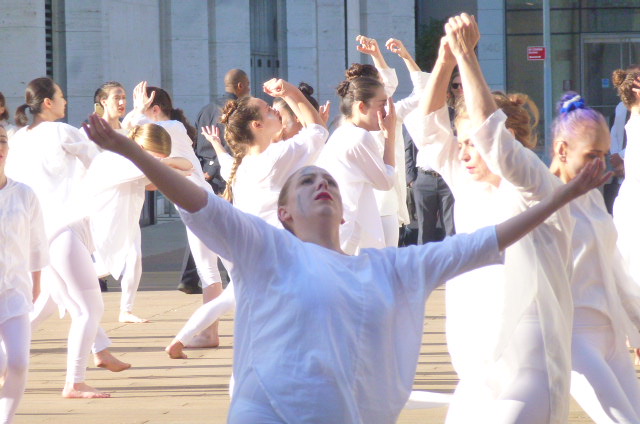
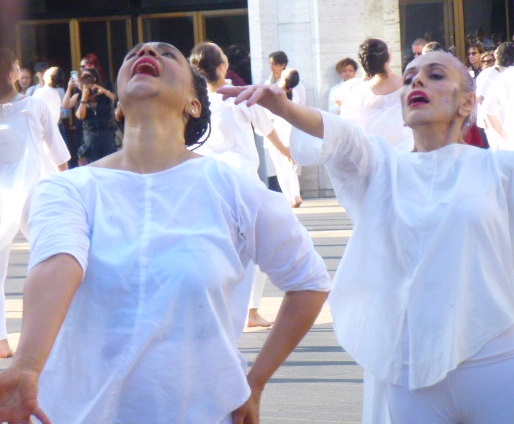
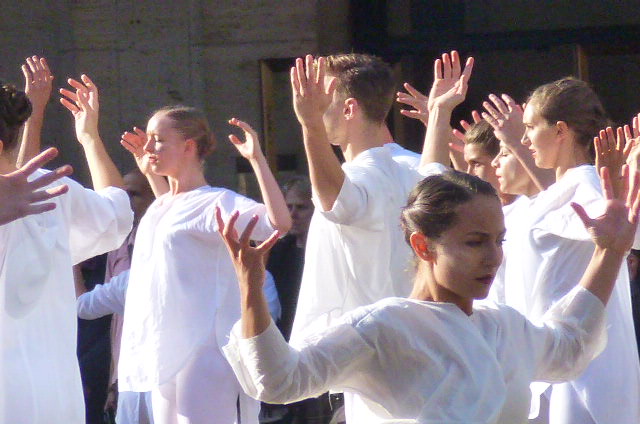
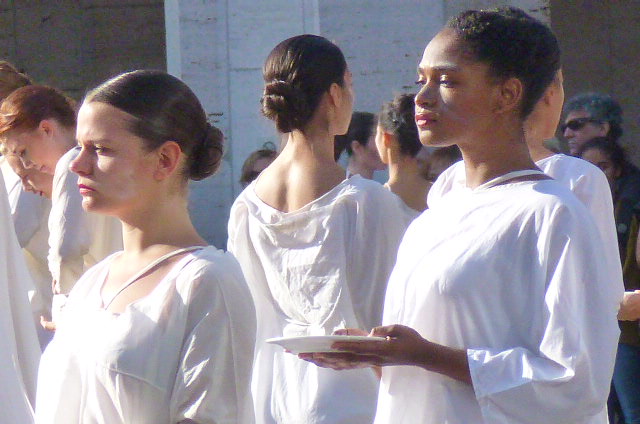
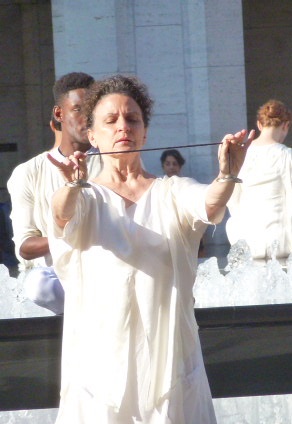
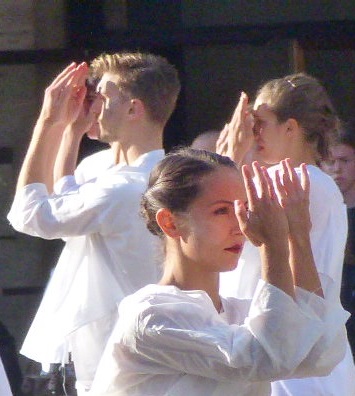
    Monday September 11th, 2017 – The seventh annual performance of Jacqulyn Buglisi’s ritual of hope and peace, Table of Silence, was given on the Plaza at Lincoln Center this morning. Commemorating the 9/11 terrorist attacks, this astonishing work gathers together more than one hundred dancers and an ensemble of singers, flautists, and percussion players who perform an ethereal score conceived by Andrea Ceccomori (flutes) and Libby Larsen (vocals). 

    This year, Table of Silence seemed more moving and more necessary than ever. A pall of darkness hangs over our daily lives as self-serving and often incoherent world leaders, deranged perpetrators of senseless violence, and a succession of natural catastrophes fill the headlines with presages of doom. Thus, we turn ever more fervently to music, dance, poetry, and art, both for solace and to inspire a hope that our common humanity may prevail.

    Here are some images from this morning’s uplifting and thought-provoking performance of Table of Silence

    L1870609

    Percussionists at the ready

    L1870622

    L1870626

    L1870644

    L1870704

    L1870709

    L1870728

    L1870749

    L1870753

    L1870755

    L1870766

    L1870783

    Dance Theatre of Harlem‘s Da’Von Doane on the right

    L1870793

    Graham priestess Virginie Mécène summons the faithful

    L1870802

    L1870807

    L1870819

    Vocalists Lydia Graham and Carla Lopez-Speziale

    L1870830

    Lloyd Knight of the Martha Graham Dance Company

    L1870845

    Courtney Cook

    L1870860

    Graham diva and Associate Founder of Buglisi Dance Theatre: Terese Cappuccilli

    L1870754

    L1870942

    Virginie Mécène signals the end of the rites

    L1870949

    Virginie Mécène

    More photos on Facebook: here.

    “The 9/11 Table of Silence Project represents the common threads of humanity which unite all mankind into a single force with common goals and aspirations regardless of race, culture, or religion. Through this ritual, we celebrate compassion, and honor the bravery of all those affected by acts of war and suppression of freedom…a call for Peace in our world.” ~ Jacqulyn Buglisi

  • CMS ~ Summer Evenings 2017 ~ Concert 3

    Efe

    Above: cellist Efe Baltacigil

    Author: Oberon

    Sunday July 16th, 2017 – All too soon, Chamber Music Society of Lincoln Center‘s Summer Evenings series for 2017 has come to an end. Over the course of the three concerts, we heard magnificent music, played to perfection. Each summer I find myself hoping that a fourth concert might be added to the series: the packed houses indicate how successful these summertime concerts are. But perhaps it’s just a question of timing, as so many musicians are making appearances at the various summer festivals. Also, the Society is about to commence a run of concerts at Saratoga Springs. So, we can feel grateful for what we have heard this summer, whilst looking forward to the 2017-2018 CMS season

    Anticipation ran high as Alice Tully Hall was again filled to the rafters with Gotham’s music-lovers, thirsting for the classics as the doldrums of the summer lazed along. A cordial greeting to Mr. Baltacigil and his colleagues…

    Keefe-erin

    …violinist Erin Keefe (above)…

    Fullsizephoto372849

    …and violist Richard O’Neill (above), as they appeared onstage for the opening Beethoven.

    The D-major Trio opens serenely, but things soon become quite lively. It was quickly evident that our three musicians were well-matched, and as the shifting themes unfolded their playing was marked by a fine mixture of impetus and elegance.

    As is so often the case, it is in the second movement, marked Andante quasi allegretto, that we get to the heart of the matter. A nostalgic feeling pervades here, though the textures remain translucent. Mr. Baltacigil’s cello enhances the lyrical aspects of the music, and some gracious plucking maintains an active feeling so that things don’t turn dolorous. A beautiful viola passage receives loving attention from Mr. O’Neill, and Ms. Keefe’s relishing of the Andante‘s most subtle moments is a distinctive asset.

    Delicate playing in the Menuetto dances us along with courtly charm. Then, after a longish pause, the concluding Rondo is quite jolly, with the cello prominent, the viola harmonizing, and the three voices eventually in finely-timed exchanges. A passing lull into lyricism again brings subtle mastery from our expert trio before the piece reaches its happy ending.

    Kristin Lee

    A brilliant performance of the Prokofiev Violin sonata in D-major followed. While I have enjoyed the playing of Kristin Lee (above, in an Arthur Moeller potrait) on many CMS evenings in the past, I can’t recall having heard her in a sonata performance. Her Prokofiev was, in a word, spectacular. And, with their usual knack for matching up musicians of like quality, Michael Brown at the Steinway played with thrilling verve and clarity.

    Brown-Michael_credit_Jeanette_Beckman

    Above: Michael Brown, photographed by Jeanette Beckman

    Originally a flute sonata, this piece was re-worked by Prokofiev for violin as several violinists – notably David Oistrakh – took an interest in it. In the opening Moderato, the violin floats in a lyrical dream. An almost fanfare-like passage leads to some scurrying before resuming its more song-like aspect, with some piercing highs; a pensiveness evolves and a short coda concludes the movement.

    The ensuing Scherzo begins as a jig, with dance-like swirls from both violin and piano. A more tranquil interlude temporarily lulls us, but things again speed up to a big dance.

    The Andante features a soaring, romantic theme for the violin: Ms. Lee was at her most poetic here before passing the melody along to Mr. Brown, who takes it up at the piano. The music aches the heart until a quiet restlessness steals in; the violin goes high and sounds on the verge of spacing out.

    The Allegro con brio finale opens with a rollicking passage and then jogs along for a bit until Mr. Brown’s pianistic passion takes over. Things simmer down and become quite delicate; then a song wells up and a triumphant feeling builds. A increase in velocity carries the sonata to the finish line.

    Kristin Lee, a beauty in black, was so impressive in her technical command, with Mr. Brown an ideal colleague in both the passion and precision of his playing. As the duo embraced at the end of their superb performance, the audience lavished well-deserved cheers upon them.

    Yuralee1586color_608x265

    Violist Yura Lee (above) joined the ensemble after the intermission for a richly rewarding performance of Antonin Dvorák’s String Quintet in E-flat major, Opus 97.

    “Spillville is an ideal place; I would like to spend the rest of my days there,” wrote the homesick Dvorák of the Iowa town where he had gone (in 1893) to mingle with the local Bohemian community. But while he was there, something else happened: a road-show of Native American entertainments and crafts came to Spillville for two weeks. Dvorák was intrigued by the rhythms and harmonies he heard in the group’s presentations and worked some of these elements into his E-flat major Quintet.

    One of the most delightful aspects of this work is in the composer’s assigning of equal prominence to the “1st” and “2nd” violins and violas; this division of labor gives everyone a chance to shine. And underlying the melodious marvels produced by his colleagues, Mr. Baltacigil’s honey-toned cello playing gave the ensemble a pleasing depth of feeling: for both rhythmically and melodically, Mr. Baltacigil is first class.

    Dvorák himself was a viola player, and it is to that instrument that the composer gives the quintet’s opening statement, played from the heart by Richard O’Neill. Chamber Music Society is like a paradise for lovers of the viola sound (count me in!) where one is likely on a given evening to hear the likes of Paul Neubauer, Matthew Lipman, or Pierre Lapointe. In tonight’s Dvorák, Yura Lee shared the viola spotlight with Mr. O’Neill: her rich, pliant tone is always so inviting. Likewise, on the violin side, Mlles. Keefe and Kristin Lee were each heard to advantage.

    In the quintet’s first movement, Ms. Keefe’s lambent tone was particularly enhancing. As ribbons of melody pass from player to player, we can savor the unique sound of each voice as well as their combined appeal when they sang in unison in a passage with an unusual drawling quality. The two violists were having a heyday, unwrapping each phrase the composer has given them and relishing it for us to enjoy.

    For the second Allegro movement, Mr. O’Neill again takes the lead. Ms. Keefe and Yura Lee trade passages and then, to the genial plucking of her colleagues, Yura takes up a gorgeous theme which explains why she wanted to be “1st”;  Ms. Keefe, playing high and sweet, makes the same case for being “1st” violin.

    The Larghetto offers a set of variations, shifting between major and minor. Here a sad melody is given out by the lower voices with a hymn-like quality. More magic from Yura Lee, and then Ms. Keefe plays a sinuous obbligato over the choir; the opposite effect is created when Mr. Baltacigil’s animated cello is overlain by the harmonizing violins and violas. The cellist then sings forth while the higher voices take a tremelo stance. Amazing delicacy is achieved in a plucked interlude, the audience breathlessly charmed by the effect. Following a dynamic outburst, calm is restored and Kristin Lee carries the Larghetto to a fade out.

    Erin Keefe leads a dance to start the Finale: Allegro giusto. Plucking again; then Kristin Lee, Mr. Baltacigil, and Yura Lee each have their say before a broad flow of melody ensues. Ms. Keefe takes up a ‘Native’ theme and then Yura Lee has a final viola gesture which leads to a rush to the finish: an exhilarating end to a great evening of music.

    ~ Oberon
  • Alexander Sitkovetsky/Wu Qian @ CMS

    2171-sitkovetsky

    Above: Wu Qian and Alexander Sitkovetsky

    Author: Scoresby

    Thursday May 11th, 2017 – I had the experience of going to Chamber Music Society of Lincoln Center’s wonderfully intimate Rose Studio for a duo performance – from a married couple no less: violinist Alexander Sitkovetsky  and pianist Wu Qian. I am always a fan of performances in the Rose Studio as you feel enveloped in the music – there is no bad seat in a hall this small. I have only ever heard solo piano performance and all string chamber music in here, so it was interesting to see how the space is different with a mixed ensemble.

    The program was well-balanced, with each half starting with one shorter piece followed by one full-length sonata. It commenced with Korchánski’s arrangement of Manuel De Falla’s Suite populaire espagñole for Violin and Piano. While I have heard the entirety of the piece once in performance, violinists tend to only play the jaunty last movement as an encore piece. It was a pleasure to hear it in full here.

    Mr. Sitkovetsky’s playing was clean and clear. He seemed to use extra bow pressure to make the lines come out very smoothly, adding a sweeping vibrato in the more romantic lines. Mr. Sitkovetsky was at his best during the pulsing dance sections. As a whole, their take was slower than I am used to, which allowed Ms. Qian to do an excellent job bringing out the impressionistic elements of the piano part. Particularly noteworthy was her silky tone in the second movement and percussive pulses in the fourth movement, both reminding me of de Falla’s Nights in the Gardens of Spain (which composed within a year of the Suite).

    he first half of the program ended with Schumann’s Sonata in D minor for Violin and Piano, Op. 121. While I hadn’t heard it live before this program, I have never had much of an affinity for this piece. I typically find it too busy-sounding, with the first movement quite repetitive. Nonetheless, the duo did a fine job with the piece making many of the lines more clear than they typically are. They took a structured approach, allowing one to hear a coherent flow of ideas through the piece (which is not always the case). Mr. Sitkovetsky managed to get a more muscly sound than earlier, most noticeable in the last movement. Ms. Qian handled the technical demands and quirky off-beats well.

    The second half of the program began with Alfred Schnittke’s Suite in the Old Style for Violin and Piano. Schnittke’s pieces typically have a conglomerate sound, mixing a modernist idiom with other styles. Here Schnittke composed the piece in a completely Baroque style (with the exception of one note). Mr. Sitkovetsky had a sweet and playful tone. He and Ms. Qian seemed in complete sync as they wove their way through the various movements. I loved the way they played the third movement, a minuet that sounds more like a lullaby. Here the dance pulse of the minuet was clear. They managed to conjure up a beautiful sense of yearning for another time: it was nostalgia in the best way possible.
    This led straight into the difficult fugue which they played with a bouncy, light tone, and sheer virtuosity. They managed to highlight all of the voicing well, with great coordination between them – the violin almost felt like an extension of the piano. In the final movement “Pantomime“, they took a slow, methodical approach that emphasized the humor. This made the dissonant climax after the child-like introduction hysterical – a few audience members let out quiet chuckles. The piece ends with an amusing incomplete scale into silence.

    The program concluded with Grieg’s Sonata No. 3 in C minor for Violin and Piano, Op. 45. This was once a favorite of the violin repertoire, but has decreased in popularity over the years. I’ve always been a fan and found this reading invigorating. The passionate and edgy melody of the first movement fit Mr. Sitkovetsky’s full sound well. Ms. Qian provided sparkling playing with Lisztian waterfall-like arpeggios mixed with dark coloring. The start of second movement is a sugary and sentimental, reminiscent of a Trenet song if the violin were a vocalist. It is a nice escapist melody. 

    In the final movement, Mr. Sitkovetsky and Ms. Qian brought out all of the folksy dance-like rhythms. It is always a good sign when everyone in the audience seems to be tapping their feet or bobbing their head. The back and forth between the instruments was lovely, as was watching their shadows move on the back of the hall. They brought Grieg’s colors to life, making every phrase ring. To hear such lush music in a small space was a treat.

    ~ Scoresby

  • Mendelssohn’s Sorrow @ Chamber Music Society

    20170226_MS

    Above: the Schumann Quartet

    Sunday February 26th, 2017 – Following last week’s Chamber Music Society of Lincoln Center‘s program centering on joy-filled music by Felix Mendelssohn, we were back at Alice Tully Hall to experience the great composer’s more melancholy moods. With music of Bach and Schumann also on offer, we became acquainted with Schumann String Quartet, and could admire once again three artists whose CMS performances to date have given particular pleasure: violinist Danbi Um, cellist Jakob Koranyi, and pianist Juho Pohjonen.

    Juho_Pohjonen009_0

    Mr. Pohjonen (above) opened the evening with Bach’s Chromatic Fantasy and Fugue in D minor for Keyboard, BWV 903. The Finnish pianist’s elegance of technique and his Olde World mystique always summon up for me visions of pianists from bygone days performing in the drawing rooms of Paris, Budapest, or Vienna. But for all those dreamworld allusions, Mr. Pohjonen’s playing has vibrant immediacy and is very much of our time.  

    Mr. Pohjonen, in a program note, describes the Chromatic Fantasy as “labyrinthine”, and that it most surely is; but it’s a wonderful work to get lost in, and as the pianist drew us along the music’s sometimes eccentric, almost improvisational pathways, we could only marvel at the gradations of both subtlety and passion in his playing.

    The Schumann Quartet intrigued us from the very opening notes of their rendering of Mendelssohn’s Fugue in E-flat major. From her first phrase, violist Liisa Randalu drew us in; the three Schumann brothers – Erik and Ken (violins), and Mark (cello) – take up the wistful melody in turn. The music becomes gently animated, with the four voices blending serenely. Poignant colours from the rising violin and the honeyed resonance of the cello frame Ms. Randalu’s expressive playing. These textures will become key elements in the Schumann Quartet’s performance of the composer’s Quartet in F-minor, which followed immediately.

    Mendelssohn’s last completed major work, the F-minor quartet was composed in 1847. On returning to Frankfurt from a tiring stay in London in early May, the composer soon learned that Fanny, his beloved sister, had died of a stroke. Mendelssohn struggled that summer with work on numerous projects, but was only able to complete this final quartet, dedicated to Fanny’s memory. On November 4th, he died following a series of strokes. He was 38 years old.

    The F-minor quartet opens with scurrying attacks and a sense of restless energy. The music softens to a nervous pulsing as the cello sings from lyrical depths, with the luminous violin overhead. The movement then accelerates to a striking finish. The “scherzo” ironically mixes passionate phrases with delicate commentary. Viola and cello rumble darkly in the brief trio passage, then the tempest stirs up again before a little coda vanishes into thin air.

    A simple song that Mendelssohn and Fanny had shared in happier times memorializes their bond in the touching Adagio, which commences with a descending cello passage. The recollections evoked by the song, which is a sweet melody in its own right, are now tinged with sadness. Superbly controlled tone  from Erik Schumann’s violin was most affecting; the pulsing cello then heralds a surge of despairing passion.

    The finale is restless, at times verging on dissonant. Passing notions of lyricism are swept away, and wild passages for the violin warn of an impending disaster. This is a composer on the brink.

    The Schumann Quartet’s very impressive playing of this disturbing yet strangely beautiful piece earned them a very warm acclamation from the Tully Hall crowd. It is pleasing to know that they will be back with us next season in this same lovely space to share other aspects of their artistry – music from The Roaring Twenties on March 4th, 2018, and a full Schumann Quartet evening on April 29th, 2018, when they’ll play works of Haydn, Bartok, Reimann, and Schumann. 

    Following the interval, Mr. Pohjonen offered Robert Schumann’s Arabesque in C major for Piano, Op. 18. This episodic piece has a narrative aspect, though none is stated or even implied. Mr. Pohjonen relished the melodious themes that rise up, veering from major to minor as the Arabesque flows forward. Subtle passages become treasurable in this pianist’s interpretation, and the poetic finish of the work was lovingly expressed.

    Juho Pohjonen returned with his colleagues Danbi Um and Jakob Koranyi for Schumann’s Trio No. 1 D minor for Piano, Violin, and Cello, Op. 63.

    Danbi-Um-Banner_2

    Above: Danbi Um, photo by Vanessa Briceño

    Koranyi_Jakob_pc_Anna-Lena_Ahlström_1_72

    Above: Jakob Koranyi, photo by Anna-Lena Ahlström

    Ms. Um, lithe and lovely in a fair burgundy-hued gown, displayed the sweetness of tone that makes listening to her so enjoyable; Messrs Koranyi and Pohjonen are masters of dynamic nuance, and thus the three together delivered page after page of radiant, colorful playing. 

    The D-minor trio’s opening movement calls for rippling arpeggios from the pianist, expertly set forth by Mr. Pohjonen. Ms. Um and Mr. Koranyi harmonize and converse in passages which switch from lyrical yearning to emphatic declamation. A pause, and a new theme emerges: delicate at first, then turning passionate. A sense of agitation prevails in this movement, despite ‘settled’ moments: the three musicians captured these shifts of mood so well, and they savored the rather unexpected ending. 

    Marked “Lebhaft, doch nicht zu rasch” (‘Lively, but not rushed’), the scherzo has the feel of a scuffing, skipping dance. Rising and falling scales glow in the calmer interlude; but the dance soon strikes up again…and comes to a sudden halt.

    The trio’s third movement embarks on a disconsolate violin passage, played with affecting expressiveness and lovely control by Ms. Um. When Mr. Koranyi’s cello joins in, this simple melody becomes increasingly touching. A gently urgent central section reverts to the slow, sad gorgeousness so evocatively sustained by our three musicians, the cello sounding from the depths.

    The tuneful finale seems almost joyous, but shadows can still hover. The playing is marvelously integrated, becoming tender – almost dreamy – with smoothly rippling piano and the violin on the ascent. The themes mingle, developing into a big song. This simmers down briefly before a final rush of energy propels us to the finish. 

    I had felt pretty certain the Um-Koranyi-Pohjonen collaboration would produce memorable results, and I was right. We must hear them together again – soon – and let’s start with my favorite chamber works: the Mendelssohn piano trios. The audience shared my enthusiasm for the three musicians, calling them back for a second bow this evening.

    • Bach Chromatic Fantasy and Fugue in D minor for Keyboard, BWV 903 (before 1723)
    • Mendelssohn Fugue in E-flat major for String Quartet, Op. 81, No. 4 (1827)
    • Mendelssohn Quartet in F minor for Strings, Op. 80 (1847)
    • Schumann Arabesque in C major for Piano, Op. 18 (1838-39)
    • Schumann Trio No. 1 D minor for Piano, Violin, and Cello, Op. 63 (1847)
  • Mendelssohn’s Sorrow @ Chamber Music Society

    20170226_MS

    Above: the Schumann Quartet

    Sunday February 26th, 2017 – Following last week’s Chamber Music Society of Lincoln Center‘s program centering on joy-filled music by Felix Mendelssohn, we were back at Alice Tully Hall to experience the great composer’s more melancholy moods. With music of Bach and Schumann also on offer, we became acquainted with Schumann String Quartet, and could admire once again three artists whose CMS performances to date have given particular pleasure: violinist Danbi Um, cellist Jakob Koranyi, and pianist Juho Pohjonen.

    Juho_Pohjonen009_0

    Mr. Pohjonen (above) opened the evening with Bach’s Chromatic Fantasy and Fugue in D minor for Keyboard, BWV 903. The Finnish pianist’s elegance of technique and his Olde World mystique always summon up for me visions of pianists from bygone days performing in the drawing rooms of Paris, Budapest, or Vienna. But for all those dreamworld allusions, Mr. Pohjonen’s playing has vibrant immediacy and is very much of our time.  

    Mr. Pohjonen, in a program note, describes the Chromatic Fantasy as “labyrinthine”, and that it most surely is; but it’s a wonderful work to get lost in, and as the pianist drew us along the music’s sometimes eccentric, almost improvisational pathways, we could only marvel at the gradations of both subtlety and passion in his playing.

    The Schumann Quartet intrigued us from the very opening notes of their rendering of Mendelssohn’s Fugue in E-flat major. From her first phrase, violist Liisa Randalu drew us in; the three Schumann brothers – Erik and Ken (violins), and Mark (cello) – take up the wistful melody in turn. The music becomes gently animated, with the four voices blending serenely. Poignant colours from the rising violin and the honeyed resonance of the cello frame Ms. Randalu’s expressive playing. These textures will become key elements in the Schumann Quartet’s performance of the composer’s Quartet in F-minor, which followed immediately.

    Mendelssohn’s last completed major work, the F-minor quartet was composed in 1847. On returning to Frankfurt from a tiring stay in London in early May, the composer soon learned that Fanny, his beloved sister, had died of a stroke. Mendelssohn struggled that summer with work on numerous projects, but was only able to complete this final quartet, dedicated to Fanny’s memory. On November 4th, he died following a series of strokes. He was 38 years old.

    The F-minor quartet opens with scurrying attacks and a sense of restless energy. The music softens to a nervous pulsing as the cello sings from lyrical depths, with the luminous violin overhead. The movement then accelerates to a striking finish. The “scherzo” ironically mixes passionate phrases with delicate commentary. Viola and cello rumble darkly in the brief trio passage, then the tempest stirs up again before a little coda vanishes into thin air.

    A simple song that Mendelssohn and Fanny had shared in happier times memorializes their bond in the touching Adagio, which commences with a descending cello passage. The recollections evoked by the song, which is a sweet melody in its own right, are now tinged with sadness. Superbly controlled tone  from Erik Schumann’s violin was most affecting; the pulsing cello then heralds a surge of despairing passion.

    The finale is restless, at times verging on dissonant. Passing notions of lyricism are swept away, and wild passages for the violin warn of an impending disaster. This is a composer on the brink.

    The Schumann Quartet’s very impressive playing of this disturbing yet strangely beautiful piece earned them a very warm acclamation from the Tully Hall crowd. It is pleasing to know that they will be back with us next season in this same lovely space to share other aspects of their artistry – music from The Roaring Twenties on March 4th, 2018, and a full Schumann Quartet evening on April 29th, 2018, when they’ll play works of Haydn, Bartok, Reimann, and Schumann. 

    Following the interval, Mr. Pohjonen offered Robert Schumann’s Arabesque in C major for Piano, Op. 18. This episodic piece has a narrative aspect, though none is stated or even implied. Mr. Pohjonen relished the melodious themes that rise up, veering from major to minor as the Arabesque flows forward. Subtle passages become treasurable in this pianist’s interpretation, and the poetic finish of the work was lovingly expressed.

    Juho Pohjonen returned with his colleagues Danbi Um and Jakob Koranyi for Schumann’s Trio No. 1 D minor for Piano, Violin, and Cello, Op. 63.

    Danbi-Um-Banner_2

    Above: Danbi Um, photo by Vanessa Briceño

    Koranyi_Jakob_pc_Anna-Lena_Ahlström_1_72

    Above: Jakob Koranyi, photo by Anna-Lena Ahlström

    Ms. Um, lithe and lovely in a fair burgundy-hued gown, displayed the sweetness of tone that makes listening to her so enjoyable; Messrs Koranyi and Pohjonen are masters of dynamic nuance, and thus the three together delivered page after page of radiant, colorful playing. 

    The D-minor trio’s opening movement calls for rippling arpeggios from the pianist, expertly set forth by Mr. Pohjonen. Ms. Um and Mr. Koranyi harmonize and converse in passages which switch from lyrical yearning to emphatic declamation. A pause, and a new theme emerges: delicate at first, then turning passionate. A sense of agitation prevails in this movement, despite ‘settled’ moments: the three musicians captured these shifts of mood so well, and they savored the rather unexpected ending. 

    Marked “Lebhaft, doch nicht zu rasch” (‘Lively, but not rushed’), the scherzo has the feel of a scuffing, skipping dance. Rising and falling scales glow in the calmer interlude; but the dance soon strikes up again…and comes to a sudden halt.

    The trio’s third movement embarks on a disconsolate violin passage, played with affecting expressiveness and lovely control by Ms. Um. When Mr. Koranyi’s cello joins in, this simple melody becomes increasingly touching. A gently urgent central section reverts to the slow, sad gorgeousness so evocatively sustained by our three musicians, the cello sounding from the depths.

    The tuneful finale seems almost joyous, but shadows can still hover. The playing is marvelously integrated, becoming tender – almost dreamy – with smoothly rippling piano and the violin on the ascent. The themes mingle, developing into a big song. This simmers down briefly before a final rush of energy propels us to the finish. 

    I had felt pretty certain the Um-Koranyi-Pohjonen collaboration would produce memorable results, and I was right. We must hear them together again – soon – and let’s start with my favorite chamber works: the Mendelssohn piano trios. The audience shared my enthusiasm for the three musicians, calling them back for a second bow this evening.

    • Bach Chromatic Fantasy and Fugue in D minor for Keyboard, BWV 903 (before 1723)
    • Mendelssohn Fugue in E-flat major for String Quartet, Op. 81, No. 4 (1827)
    • Mendelssohn Quartet in F minor for Strings, Op. 80 (1847)
    • Schumann Arabesque in C major for Piano, Op. 18 (1838-39)
    • Schumann Trio No. 1 D minor for Piano, Violin, and Cello, Op. 63 (1847)

  • Joyous Mendelssohn @ Chamber Music Society

    16729309_10211418741411574_4800437195826780331_n

    In the days leading up to this evening’s concert at Chamber Music Society of Lincoln Center, it was announced that violinist Paul Huang was among the recipients of the 2017 Lincoln Center Awards.   

    Tuesday February 21st, 2017 – In the midst of their season celebrating Mendelssohn, Chamber Music Society of Lincoln Center offer two programs contrasting the joyous and the sorrowful. Today we reveled in the positive, sunny side of chamber music; on Sunday, February 26th, melancholy will prevail.

    The Variations in E-flat major, Op. 44, by Ludwig van Beethoven, is a series of fourteen variations on a theme written for piano, violin and cello. The theme is set forth, plain as day: the musicians play a series of arpeggios at a moderate pace. From thence, the variations proceed in a variety of rhythms, instrumentation, harmony, and embellishment. Orion Weiss (piano), Sean Lee (violin), and Paul Watkins (cello) played deftly, and I greatly enjoyed observing their musical camaraderie and silent communication with one another.

    The evening’s two pianists, Huw Watkins and Orion Weiss, gave us Mendelssohn’s Andante and Allegro brillant for Piano, Four Hands, Op. 92. And “brillant” aptly describes their performance, for they followed up the melodious Andante with a striking virtuoso display in the Allegro. Mr. Watkins took the lower octaves, and Mr. Weiss the upper, but they sometimes invaded each others domain. When things got fast and furious, each player had to lean out of the way to give the other access to the full keyboard in alternating solos. Thus their performance was as appealing to watch as to hear.

    _90769994_prom

    Above: British brothers Huw and Paul Watkins

    Cellist Paul Watkins was joined by his pianist/brother Huw Watkins in a magnificent rendering of Mendelssohn’s Sonata in D-major for Cello and Piano, Op. 58. Their performance was truly engrossing, with the cellist’s soul-reaching depth of tone and the pianist’s perfect blend of elegance and vitality combining for a spell-binding musical experience.

    In the D-major Sonata, Mendelssohn exults in the outer movements, giving the pianist a barrage of arpeggios with which to delight us while the cellist sings felicitous melodic passages.The sonata gets off to a fast start, with a lively pulse; both players bring mellifluous tone which they are able to maintain even in the most rapid phrases. Paul’s cello buzzes while Huw plays melody for a spell; then they seem to reverse roles. The word ‘amazing’ is so over-used these days, but that’s what I wrote as this fabulous Allegro assai vivace carried us along. The playing hones down to great subtlety before re-bounding and sweeping onward.

    The second movement starts with a sprightly piano tune, with the plucking cello commenting, and then humming low. A lovely cello theme leads onto a more boisterous, slightly gritty passage before recurring. This little scherzo ends with a gentle whisper.

    Rhapsodic phrases from the piano herald the Adagio, the heart of the matter. A poignant melody wells up from the cello, Paul Watkins’ glowing tone like a transfusion for the soul. Huw rhapsodizes again, then takes up his own melody over long-sustained tones from the cello. This Adagio seemed all too brief when played so nobly as it was this evening; the brothers then took only the briefest pause before attacking the opening of the final movement.

    In this Molto allegro e vivace, both players flourished in the coloratura passages and in the melodic exchanges that ensue. After a lull, a slithery scale motif from the cello made me think of the moment in Strauss’s ELEKTRA before the murder of Klytemnestra – a far-fetched association to be sure, but there it is. The music ebbs and flows on to the finish, the Watkins brothers rightly hailed with spirited applause for their remarkable performance.

    Orion-WeissB09_credit-Jacob-Blickenstaff

    Mr. Weiss (above, in a Jacob Blickenstaff portrait) returned to the Steinway for Chopin’s Ballade in A-flat major for Piano, Op. 47, a piece long-familiar to me thru its appearance in the Jerome Robbins ballet The Concert. The pianist savoured the music, displaying a vast dynamic spectrum (blissful high pianissimi) and a keen appreciation for the shifting rhythmic patterns. When the music gets grand, Mr. Weiss’s playing is absolutely regal.  

    The Mendelssohn Quintet No. 2 in B-flat major for Two Violins, Two Violas, and Cello, Op. 87, drew together a most impressive string ensemble: Paul Huang and Sean Lee (violins), Paul Neubauer and Matthew Lipman (violas), and Paul Watkins (cello): their performance might be sub-titled ‘The Glory of Mendelssohn‘.

    The players plunged immediately into the music with a vibrant agitato rhythm, from which Paul Huang’s violin soars up to the heavens. Throughout the performance, Mr. Huang’s tone shone with an achingly beautiful polish, his profusion of technique and his uncanny ability to mix refinement and passion in perfect measure defined him an artist of exceptional gifts.

    This ensemble of wonderful musicians created a blend of particular cordiality, and each player took up their solo opportunities with stylish élan. Paul Neubauer’s playing was – as ever – aglow with poetic nuance; Matthew Lipman seconded him handsomely, displaying his trademark love of and commitment to the music, and Sean Lee’s suave phrasing is ever-pleasing to the ear. I found myself wishing that Mendelssohn had given the cello a bit more prominence, simply because I could not get enough of Paul Watkins’s playing.

    The quintet’s Adagio e lento found all the musicians at their most expressive, a reassurance in uncertain times; we so desperately need great music at this point in our lives when the future seems poised on the edge of a knife. With the dedication of such artists as we heard today, the light of hope continues to shine as a testament against the powers of darkness. 

    • Beethoven Variations in E-flat major for Piano, Violin, and Cello, Op. 44 (1804)
    • Mendelssohn Andante and Allegro brillant for Piano, Four Hands, Op. 92 (1841)
    • Mendelssohn Sonata in D major for Cello and Piano, Op. 58 (1843)
    • Chopin Ballade in A-flat major for Piano, Op. 47 (1841)
    • Mendelssohn Quintet No. 2 in B-flat major for Two Violins, Two Violas, and Cello, Op. 87 (1845)

  • Lisette Oropesa @ Chamber Music Society

    IMG_0207Lisette

    Tuesday October 18th, 2016 – Soprano Lisette Oropesa (above, photographed by Steven Harris) making her Chamber Music Society of Lincoln Center debut in the opening concert of the Society’s 2016-2017 season.

    The program commenced with a charming performance of Haydn’s ‘Surprise‘ symphony, and if the element of surprise in this very familiar work has long since evaporated, there was still a murmur of delight which passed thru the packed house when that ‘wake up!’ chord sounded. The symphony, a veritable fountain of melodic and rhythmic delights, was played by an ensemble of top-notch musicians: the kind of artists that maintain the Society’s impeccable standards.

    With Michael Brown’s wonderfully attentive and polished playing of the Steinway setting the pace, we could relish the divine piping of Tara Helen O’Connor’s flute and a most pleasing mixture of swiftness and sweetness from Erin Keefe’s violin. Danbi Um, in a pretty forest-green frock, stood out in a brief mingling of voices with Ms. O’Connor flute – Danbi would have more expansive opportunities in the Palestrina/Mendelssohn combination after the interval. Of the lower voices, Richard O’Neill’s dusky viola sound and his deep involvement in the music are always most welcome; and though music stands blocked our view of Mihai Marica, his cello spoke clearly. This assemblage of musicians were as pleasing to watch as to hear, and they set the tone for the evening with their virtuosity and grace.

    It seems incredible that ten years have passed since the voice of Lisette Oropesa first captured my imagination when she sang a very brief role in a performance of Mozart’s IDOMENEO at The Met. I immediately seized on the notion that this was a singer who would be going places, and she has proven me correct: her career has positively bloomed, and she moves from engagement to engagement, conquering audiences from Munich to Santa Fe, from Dallas to Madrid. Conductors tend to love her, as much for her vocal clarity and musicianship as for her preparedness and sunshine-filled personality.

    Lisette walked onstage this evening in a midnight-blue gown, jewels at her neckline, superbly coiffed: the very picture of elegance. With the one-and-only Gilbert Kalish at the Steinway, the soprano proceeded to captivate the audience with her shimmering voice and rapturous delivery. All of the things I love about her singing were in abounding evidence tonight: the distinctive colour, the mastery of dynamics, the magical turns of phrase, the imaginative way with words. In three Mendelssohn songs – “Wanderlied“, “On the Wings of Song” and “Suleika” – Lisette cast a spell over the hall, and Mr. Kalish was a most valuable fellow sorcerer. Together, they created an atmosphere of fascination; and the audience’s enthusiastic response affirmed my feelings.

    Soprano and pianist returned immediately, joined by David Schifrin; some Schifrin fans seated near me buzzed with anticipation. Following the brief piano introduction, the eminent clarinetist made a breathtaking entrance on the sustained tone that heralds Franz Schubert’s “Shepherd on the Rock“; moments later, Lisette began to sing and all seemed right with the world. 

    Shepherd on the Rock” has the feeling of a bel canto scena. Passages of sustained lyricism give way to flights of coloratura, with voice and clarinet mingling in a way that reminds us a bit of the flute and soprano mix in Lucia di Lammermoor’s ‘Mad Scene’.

    The singer must convey the moods of Schubert’s shepherd: his delight in hearing his own voice echo back to him from the valley, his tender longing for his sweetheart far away, and his optimism at the coming of Spring. All this Lisette accomplished with her intrinsic sensitivity to the narrative, finding an ideal give-and-take with her collaborators. The vocal writing here covers a wide range, from peaky top notes to some unusual plunges to the depths; Lisette had it all at her fingertips, and her voice once again spun a web of enchantment. She and the two gentlemen basked in the audience’s very cordial applause.

    At a time when so many lyric-coloratura sopranos on the scene seem to me lacking in real distinction, Lisette shows us what a ‘vocal personality’ really is: it’s not just the sound, nor the technique, nor the communicative gifts; nor really anything to do with physical attractiveness. It’s a light from within, and that’s what sets Ms. Oropesa apart from the rest. 

    Following the intermission, David Finckel let us know that we’d be hearing an added work this evening: a Mendelssohn fugue would follow the brief and rare Palestrina piece we were about to hear. Mr. Finckel then joined Danbi Um, Erin Keefe, and Richard O’Neill to perform Palestrina’s ‘Sanctus’ from Missa Aeterna Christi Munera. The spiritual simplicity of the music, with its poignant beauty, was finely underscored by Mr. Finckel’s gently resonant cello.

    After only a brief pause, the quartet gave us the Mendelssohn fugue: it is launched by Richard O’Neill’s velvety viola, taken up by Ms. Keefe and Ms. Um in turn, and then by the Finckel cello. This lovely work, perhaps too brief to be programmed often, displayed Danbi Um’s satin-sheened tone and the appealing expressive qualities of her playing. 

    We had reached that point in the evening where the final work loomed before us. With all that had gone before, what kind of finale could be devised that would cap the performance in a properly spectacular way? With their customary flair for programming, the Society had kept an ace up their sleeve, and within literally five seconds of Michael Brown’s introduction to the Ravel A-minor trio, I had goosebumps and a tingling spine. What playing from Mr. Brown and his colleagues, Ms. Keefe and Mr. Marica…simply astounding!

    Ravel produced his only work in the piano-trio genre in a burst of fevered inspiration during the summer of 1914, as Europe’s armies mobilized for war. The result is one of Ravel’s most intense – yet still lyrical – works.

    Michael Brown immediately established the atmosphere of the opening movement with his darkish, misterioso playing. Ms. Keefe and Mihai Marica were well-matched in beauty of timbre. A remarkable sustained tone from the cellist was followed by Ms. Keefe’s exquisite ascent to the heights: their perfumed mingling of voices gave me the chills. Simply ravishing passages in the upper reaches from the violin, and then the piano becomes more animated with a rising sense of drama. This subsides to a sweet cello theme; the players demonstrate fantastic pianissimo control. The violin goes deep, the piano quietens to a whisper. Spellbinding fade-away…an engrossing moment.

    Immediately the mood shifts to bright and then lilting in the plucky second movement, featuring a rising motif and a skittishness that sets up a fun ending.

    Mr. Brown’s left-handed piano introduction to the third movement hints at the ominous; Mr. Marica’s cello enters: pensive and low, whilst Ms. Keefe’s violin expresses a sense of yearning. In a hypnotic interlude, Mr. Brown drew me ever deeper into the mood with his incredibly intimate playing. The cello and then the violin re-enter; passion builds, and it’s sublime. Following a soft string duo, the cello sinks to the deep register, and the piano even deeper.

    The finale commences high and buzzy, with a light, bright texture. All three musicians are simply sailing along, and a feeling of rapture develops. Ms. Keefe and Mr. Marica launch a series of trills that might go on forever; but then the swirls and eddies of melody sweep everything forward, to a simply gorgeous end. Such extraordinary playing of an extraordinary piece: the audience burst into eager applause, and the three musicians were called back for a second bow. 

    Marilyn Horne was in the audience tonight, bless her heart. And having Lisette Oropesa and Richard O’Neill on the same program gave me the notion of wanting to hear them together in William Bolcom’s Let Evening Come. This song cycle was composed for the beloved soprano Benita Valente, to whose voice Lisette’s bears a kinship; as a Met Young Artist, a decade ago, Lisette had an opportunity to work with Ms. Valente. I’ve been listening to Benita’s atmospheric recording, and now I’m really wanting to hear the Bolcom performed live

    The Repertory:

    • Haydn Symphony in G major for Piano, Flute, Two Violins, Viola, and Cello, Hob. I:94, “Surprise” (1791)
    • Mendelssohn Selected Songs for Soprano and Piano, Opp. 34 and 57 (1835-41)
    • Schubert Der Hirt auf dem Felsen for Soprano, Clarinet, and Piano, D. 965, Op. 129 (1828)
    • Palestrina Sanctus from Missa Aeterna Christi Munera (1590)
    • Ravel Trio in A minor for Piano, Violin, and Cello (1914)