Tag: Lincoln Center

  • Paul Taylor @ Lincoln Center 2013 #5

    Profireco

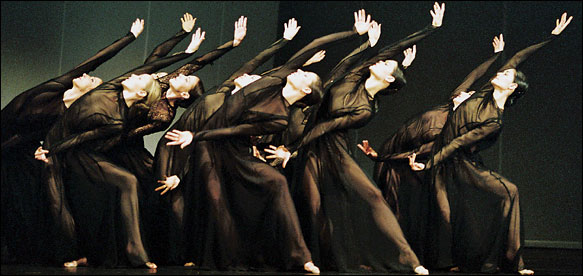
    Above: from Paul Taylor’s PROMETHEAN FIRE. Photo by Paul B Goode. Click on the image to enlarge.

    Saturday March 23rd, 2013 matinee – My final performance of the Paul Taylor Dance Company‘s 2013 Lincoln Center season. It’s been a brilliant three weeks and the Company are dancing superbly. Celebrating Bach’s birthday with a Bach ballet on every single programme has been an added source of joy, and the Company’s press liaison Lisa Labrado assured me of a warm welcome every time I attended. The Taylor company are outstandingly generous to dance writers, and it’s always a great pleasure to find Rachel Berman and Richard Chen-See – former Company dancers – circulating among the guests, making us feel a part of the Taylor family.

    This matinee opened with KITH AND KIN, dating from 1987 and set to a Mozart serenade. A tall and elegant couple in brown – radiant Amy Young and James Samson – preside over a flock of energetic young people who seem to be celebrating the sheer joy of being alive in stylized passages of leaps and restless comings and goings. Set slightly apart from this community is the magnetic Heather McGinley, a friendly (and gorgeous) guardian angel. In the central adagio, Amy and James dance with formal grace as Aileen Roehl and Michael Apuzzo swirl about them, perhaps representing their younger selves. This ballet, new to me this season, shows a happy meeting place of generations, with the stately ‘senior’ couple presiding overall yet still capable of having a little fun of their own.

    The poignantly dark splendours of THE UNCOMMITTED evolve first to the gleaming, celestial strains of Arvo Part’s Fratres as the dancers – in richly-hued body stockings with rose-red highlights – appear in a series of brief solos. This is a world inhabited by lonely spirits, seeking – but eventually unable – to connect with one another. Paul Taylor again turns again to Mozart as a series of duets unfold; each couple hovers on the brink of understanding but in the end none can sustain a relationship. Even the number of dancers involved – eleven – implies from the start that there will always be an odd man out. Despite its rather bleak emotional outlook, THE UNCOMMITTED provides a wonderful opportunity to focus on the individual lustre of each of the dancers – and what an ensemble it is: Michael Trusnovec, Amy Young, Robert Kleinendorst, Michelle Fleet, Parisa Khobdeh, Eran Bugge, Francsco Graciano, Laura Halzack, Michael Apuzzo, Aileen Roehl and Michael Novak.

    Bach provides the setting for a grand finale to the programme: PROMETHEAN FIRE. For this ballet, the entire Company are onstage; the dancers listed above are joined by James Samson, Sean Mahoney, Jamie Rae Walker, Heather McGinley and George Smallwood. In their velvety black costumes subtly trimmed with silver, the dancers revel in Mr. Taylor’s complex and visually inspiring combinations: PROMETHEAN FIRE is a masterpiece of structure, formal yet joyously human in expression. The heart of this sumptuous ballet is an adagio in which the combined genius of Mozart and Taylor moves us to the highest realms of spiritual satisfaction. Parisa Khobdeh and Michael Trusnovec were at their most transportive here, the partnering remarkable in its beauty and power, their personal magnetism magically aglow. Indeed it was one of the most moving and soul-stirring experiences in my long memory of watching dance.

    PROMETHEAN FIRE concludes with a splendid tableau of the Company dancers and for a moment we could simply relish their collective perfection, for it is they who in the end have the ultimate responsibility of making the choreography live and breathe. Then Mr. Taylor appeared for a bow and the audience swept to their feet with resounding cheers.

  • POB: Orpheus and Eurydice

    Orpheus

    Saturday July 21, 2012 – The Paris Opera Ballet concluded their 2012 guest-season at Lincoln Center with Pina Bausch’s staging of Gluck’s immortal opera based on the myth of the singer Orpheus, a man who braves the furies of hell to bring his beloved wife back from the dead. Bausch created her version of the opera in 1975 at Wuppertal and it entered the repertoire of the Paris Opera Ballet in 2005.

    Ms. Bausch eschews Gluck’s plan for the opera to end happily; the composer has the gods taking pity on Orpheus after he has caused Eurydice’s ‘second death’ and she is restored to him. In her setting, Ms. Bausch follows the course of the myth: by disobeying the decree that he not look at his wife until they have left the Underworld, Orpheus loses Eurydice forever. He is condemned to wander the Earth, lonely and tormented, until he his torn to shreds by the Maenads. This gruesome conclusion is not depicted onstage; we simply see the dead Eurydice and her distraught husband in a final tableau as the light fades.

    The Paris Opera Ballet‘s production, vivid in its simplicity and superbly performed by dancers and musicians alike, made for an absorbing evening. A packed house seemed to be keenly attentive to the narrative; the silence in the theatre was palpable. The only slight drawback in the presentation was the need for two rather long set-changing pauses during the first half of the evening; the house lights were brought to quarter and the audience began to chatter. Fortunately, order was quickly restored once the music started up again. The second act, with its unbroken spell of impending doom and its heart-breaking rendering of the great lament “J’ai perdu mon Eurydice” by the superb mezzo-soprano Maria Riccarda Wesseling – the audience seemed scarcely to draw breath while she spun out a miraculous thread of sound in the aria’s final verse – was as fine a half-hour as I have ever spent in the theatre.

    The opera was sung in German, with the chorus seated in the orchestra pit. Each of the three principal roles in the opera is doubled by a dancer and a singer. The three singers, clad in simple black gowns, move about the stage and sometimes participate in the action. So fine were the musical aspects of the performance that the opera could well have stood alone, even without the excellent choreography.

    151

    Ms. Wesseling (above) was a revelation; her timbre reminded me at times of the younger days of Waltraud Meier and she shares with that great artist an intensity and personal commitment that make her singing resonate on an emotional level. Ms. Wesseling’s sustained and superbly coloured rendering of  “J’ai perdu mon Eurydice” – with remarkable dynamic gradations – was so poignant; how I wish we could have her at The Met, as Gluck’s Iphigenie perhaps. The two sopranos, Yun Jung Choi (Eurydice) and Zoe Nicolaidou (Amour), gave lovely performances. Conductor Manlio Benzi wrought the score with clarity and dramatic nuance, wonderfully carried out by the musicians and singers of the Balthasar-Neumann Ensemble

    In this powerful musical setting, Ms. Bausch moves her dancers with dignity and grace; the ritualistic passages for female ensemble evoked thoughts of Martha Graham, and reminded Kokyat of Lydia Johnson’s stylishly flowing images of sisterhood. As Orfeo, Nicolas Paul looked spectacular in flesh-tone briefs, his torso god-like and his anguish expressed by every centimeter of his physique. Tall and radiant, Alice Renavand looked tres chic in her red gown as Eurydice. Charlotte Ranson was a lively angel in white as Amour. 

    It was in the second half of the evening where Ms. Bausch’s vision transcended theatricality and took on a deeply personal aspect. Nicolas Paul as Orpheus strove movingly to ignore his wife’s pleas to look her in the face; when at last he could no longer withstand her torment, the fatal moment comes. Ms Renavand collapses on her singer-counterpart’s body and remains prone and absolutely still as Ms. Wesseling sings the great lament. Mr. Paul kneels, facing upstage, in a pool of light which accentuates the gleaming sweat on his back. In this simple tableau, so much is expressed without movement of any kind. The voice of Orpheus in his grief fills the space and the soul.

    The Dancers:

    Alice Renavand (Eurydice), Nicolas Paul (Orphée), Charlotte Ranson (Amour)

    The Singers:

    Orpheus: Maria Riccarda Wesseling
    Eurydice: Yun Jung Choi
    Amore: Zoe Nicolaidou

  • YAGP GALA 2012

    State

    Friday April 27, 2012 – Winners from the 2012 Youth America Grand Prix competition joined a constellation of great dancers from the world’s top companies for this gala evening at Lincoln Center. New ballets by Jiri Bubenicek, Marcelo Gomes and Justin Peck were premiered. Unfortunately, what could/should have been a memorable dance experience was marred by jarring flaws in the presentation and an audience who seemed to think they were at a basketball game. 

    Not to dwell on the negatives, but a 7:00 PM start time means you’d better have the curtain up no later than 7:07. It was 7:20 and we were still sitting there, twiddling our thumbs as the fashionably-late crowd drifted down the aisles to their seats. Women teetering past us hilariously in way-too-high heels looked absurd. But despite not starting til 7:25, there were still large numbers of even-later latecomers and they were all allowed to stagger around in the dark trying to find their seats.

    Worse still were the idiotic couple -TV personalities (I use the term loosely) supposedly – who hosted the evening. Their lame jokes, inept reading of a prepared script, and complete lack of personal dignity or charm gave the evening an air of low-class entertainment that even the great dancers who appeared after the intermission could not thoroughly dispel. Ballet is one of the last bastions of beauty and civility; why reduce it to a crude reality show?

    Then there was the audience with its large percentage of screaming, whooping adolescents blended with adults who chatted throughout and came and went from their seats at whim. A disastrous second late-seating took place after the break as they darkened the house lights and started Justin Peck’s new ballet (the main reason I attended) long before the crowd were back in their seats. So, more distractions disrupted Justin’s work and the excellent dancing of Teresa Reichlen and Robert Fairchild. Inexcusable.

    With these distractions, the first half of the gala went for nought. Although the Competition winners who danced in Part I were announced, I mostly had no clue who I was watching. A couple of the boys made outstanding impressions, but the announcer referred to a solo from LA SYLPHIDE as being from LES SYLPHIDES. A beautiful ensemble piece by Choo San Goh marked the high point of Part I, along with a dazzling performance of the DON QUIXOTE variation by a Korean boy whose name I know not.

    Furiant, Justin Peck’s ballet to a beautiful Dvorak score (played live, and ravishingly) was rather lost in the shuffle of the post-intermission seating debacle, but I could tell it’s another nice addition to Justin’s catalog, and hopefully we can see it again under more favorable circumstances. Tess Reichlen and Rob Fairchild look wonderful together though I could have wished that Robbie had worn a fitted top rather than the billowy blouse. I continue to commend Justin Peck not only for his choreographic imagination but also for his inspired musical choices. So far, in my view, he hasn’t made a single false creative move.

    Tamara Rojo gave a luminous performance in the mysterious duet for woman and goldfish entitled Life Is A Dream (choreographed by Fei Bo). The ballerina begins seated in a pool of light; opposite her is a second light-pool with a fishbowl globe holding a single, swishing goldfish. Intrigued by the fish, the dancer moves about the space in a reverie. Really nice.

    Herman Cornejo’s marvelous dancing of his self-choreographed solo Tango Y Yo was a brilliant vignette, but Jose Manuel Carreno and his partner Karina Smirnoff couldn’t match Herman for sheer artistry; their tango was a more gaudy, reality-show version. And at one point Jose seemed about to lose control of Karina.

    Yolanda Correa Frias (Norwegian Ballet) and Yonah Acosta (English National Ballet) paired successfully in the CORSAIRE pas de deux, the bare-chested and handsome Jonah winning applause for every leap and pose; the ballerina has a lovely quality but what was with the rhythmic clapping during her solo? Disgusting.

    Marcelo Gomes (would that he had danced!) choreographed a movement-rich duet for his ABT colleagues Misty Copeland and Alexandre Hammoudi. Entitled Toccare, the pas de deux is set to a colorful contemporary score by Ian Ng, played live by the adorable-punk violinist Charles Yang and pianist Dmitri Dover. Misty and Alexandre make a radiant pair, and the ballet was further enhanced by huge black-and-white still images of the two dancers projected on the back wall. The images, by Jade Young, were so striking that they might have over-shadowed the dancing; but Marcelo, Misty and Alexandre made sure the whole performance was finely integrated. Bravi tutti!

    Alicia Amatriain and Friedermann Vogel from Stuttgart Ballet gave a spacious rendering of the Cranko Romeo and Juliet pas de deux. The dancers held the audience in the palms of their hands with their lovely lyricism, though I found myself thinking that Sean Lavery’s version of this duet surpassses Cranko’s as a distillation of an immortal love.

    Jiri Bubenicek’s Gentle Memories brought the great Mariinsky ballerina Ekaterina Kondaurova to the stage. This woman made such a stunning impression when she danced here in Gotham at the Mariinsky’s last visit (time for an encore, dear Russians!).  Looking splendid in a long deep-rose gown, La Kondaurova held the center of this ballet as three men (Islam Baimuradov, Otto Bubenicek, and Jon Vallejo) vied for her favor. Yet in the end it was the pianist Simon Mulligan who won her heart. Mr. Mulligan played Karen LeFrak’s melodious yet very au courant score impeccably. This ballet and these performers generated a unique atmosphere; I’d love to see this piece again – and Justin’s and Marcelo’s as well. A single viewing of a new ballet is never enough. 

    Tamara Rojo and Sergei Polunin were announced to be dancing Esmerelda but they certainly looked like Diana and Acteon to me. Ms. Rojo seemed a bit out of focus early on but by the time she reached her uncanny set of fouettes she was back on the gold standard. Mr. Polunin danced quite grandly and together they brought the gala to a rousing conclusion.

  • Paul Taylor’s BELOVED RENEGADE

    895_6111
    Thursday March 29, 2012 – Nearing the end of their exciting seaon at Lincoln Center, the Paul Taylor Dance Company tonight presented one of the choreographer’s finest recent creations, BELOVED RENEGADE. In Tom Caravaglia’s photo above, dancers Michael Trusnovec and Laura Halzack.

    BELOVED RENEGADE premiered in 2008 and was hailed not only as an outstanding example of Taylor’s choreographic genius but also as a perfect vehicle for one of the greatest dancers of our day, Michael Trusnovec. Danced to Francis Poulenc’s GLORIA and drawing inspiration from the poetry of Walt Whitman, this large-ensemble work is both sensuous and spiritual. Mr. Trusnovec gave a luminous performance which elicited a particularly warm response form the audience. The dancer’s slender, all-muscle form moved through this poetic dreamworld with consummate power and grace.

    With Michael Trusnovec at the work’s epicenter, the other dancers made vivid impressions: notably Laura Halzack, Amy Young, Parisa Khobdeh and Robert Kleinendorst all of whom have been at their finest during this wonderfully pleasing Taylor season.

    Michael Trusnovec and Amy Young opened the evening in a performance of AUREOLE which – in its fiftieth year – still looks fresh and vital. Francisco Graciano, Michelle Fleet and Heather McGinley danced with great verve; Michael Trusnovec’s solo was a page of visual poetry and the lovely tenderness of his duet with Amy Young gave AUREOLE its gentle soul.

    Trusnovec Michael

    The evening in fact was something of a Michael Trusnovec festival as he finished off the programme in the exciting Bach/Stokowski PROMETHEAN FIRE. Parisa Khobdeh danced radiantly here, and indeed the entire Company seemed inspired tonight. The appearance of Paul Taylor at the end caused much joy in the House as the audience swept to their feet to acclaim both the dancers and the dancemaker.

    Copy of 8

    Curtain call. Click on the image to enlarge.

  • Monodramas @ NYC Opera

    Monodramas0055

    Tuesday March 29, 2011 – Tonight was my first visit to New York City Opera as a member of the press. I’ve been going to NYCO since 1966; my first evening with them at Lincoln Center was the opening of GIULIO CESARE when Beverly Sills made her sensational splash as Cleopatra. But even before that I had seen the Company on tour up in Syracuse and Oswego NY – I even saw Beverly before she was Beverly, singing Rosalinda in FLEDERMAUS.

    Throughout the 1970s, 80s and 90s I went to NYCO as often as to the Met; I experienced several operas at the State Theater for the first time: CAPRICCIO, MEFISTOFELE, BALLAD OF BABY DOE, PRINCE IGOR, THE MAKROPOULOS CASE, the Donizetti/Tudor operas and many more. Singers from the Company became top favorites of mine: Maralin Niska, Patricia Brooks, Phyllis Curtin, Johanna Meier, Gilda Cruz-Romo, Beverly Sills, Susanne Marsee, Frances Bible, Beverly Wolff, Placido Domingo, Enrico di Giuseppe, Dominic Cossa, William Chapman, Richard Fredricks, Robert Hale, Norman Treigle.

    In recent seasons I have gone less and less to NYCO; of couse the Company have been thru exasperating times of late,  but let’s hope now that their future will be a bright one. Tonight’s triple bill of 20th/21st century works for solo female voice looked fascinating on paper, and I asked my longtime opera-companion Paul to join me.

    Aside from the three principal singers and an ensemble of dancers in MONODRAMAS, the key elements of this unusual evening were the direction of Michael Counts, the choreography of Ken Roht, and the conducting of NYCO’s stalwart maestro George Manahan. The visual aspects of the evening were the work of video artist Jennifer Steinkamp, motionographer Ada Whitney, and as an homage to laser artist Hiro Yamagata.

    There was one aspect of the production that I felt should be re-thought. About ten minutes before the curtain rose, a young man and woman dressed in tuxedos walked onstage before the curtain to pose and gaze about the house with in a somewhat bored manner. When the curtain rose on the Zorn the music didn’t start til these two had sauntered around the stage a while, removing the bhurkas of a couple members of the ensemble and then of the soprano. They continued rather pointlessly to participate in the action during the opening work.

    After the Zorn there was an interlude in which a digitized film of flowering tree branches (quite lovely) was shown as insects buzzed and chirped quietly. While this alluded to The Woman’s lines in the Schoenberg about the garden at evening and the sounds of crickets, it went on a bit too long and then The Couple returned and removed more bhurkas to expose the women of ERWARTUNG in white dresses. All this business seemed stagey and self-consciuous and too drawn out; yet it might have worked had the orchestra then gone directly into the Schoenberg. But instead when the pit lights came up, they took a tuning break. Whatever dramatic connection was being sought between the Zorn and Schoenberg was thus lost. The Couple appeared later in NEITHER but simply as members of the ensemble, thus diluting their (pointless) presence as a link between the three works. In general, the movement group added a shifting visual dynamic to the staging; it would have been more potent in my opinion to maintain this ‘choral’ effect rather than trying to interject them as individuals into the ‘plot’.

    Beyond this each work was uniquely and impessively staged, the orchestra dealt persuasively with all the demands placed on them, and the three sopranos did their utmost to assure the success of the evening. The audience were extremely attentive and focused; why can’t NYCB audiences behave like this? 

    Monodramas0026

    The evening opened with John Zorn’s LA MACHINE DE L’ETRE, having its staged premiere in these performances. In this rather brief wordless piece, the Finnish soprano Anu Komsi gave a truly impressive rendering of the demanding vocal line. Jagged coloratura roulades occupy the vocalist for most of the work’s duration; she also whispers, speaks and screams. There is no plot, no meaning, no message other than the music itself – colorfully orchestrated with piano, celesta and a variety of percussion effects. 

    Monodramas0021

    Backed by a ‘chorus’ of bhurka-clad dancers, Ms Komsi not only sang compellingly but moved with statuesque grace. I’d love see her again in a more familiar piece, the better to judge her capabilities.  

    Monodramas0032

    Above: Kara Shay Thompson as The Woman in Schoenberg’s ERWARTUNG, the only one of tonight’s three works with which I am somewhat familiar, having seen a peformance of it at the Met in 1989 with Jessye Norman, James Levine conducting. That production remains vividly in the mind – the stage setting consisted of a grand piano and hundreds of white candles – as does Ms. Norman’s powerful singing. Tonight at NYCO, The Woman was portrayed by Kara Shay Thompson whose voice at first seemed more lyrical in quality than one might expect to hear in this music. She proved however to be an accomplished vocalist, taking the demands of the piece in stride.

    Red rose petals fell gorgeously against the deep blue sky throughout this piece in which a deranged woman wanders thru the woods in the depths of night, seeking her lover. She stumbles upon him…literally; his corpse has been abandoned on the forest path. The Woman speaks of another Woman, a rival. Which of them is the murderer? Or are they one and the same?

    Schoenberg wrote of his work: “In Erwartung the aim is to represent in slow motion everything that occurs during a single second of maximum spiritual excitement, stretching it out to half an hour.” Based on a case study of Freud, The Woman’s multiple personalities are here evoked by six identically dressed woman who cunningly slip down a trap door as the opera draws to a close.

     Monodramas0052

    When I worked at Tower, Morton Feldman’s NEITHER was a much-sought-after item; the one existing recording at the time came and went from the distributor with maddening uncertainty. If a definitive recording were to be made today, it should most surely feature Cyndia Sieden who tonight turned the fiendish vocal writing of the work into a personal tour de force. The libretto of NEITHER is actually a poem by Samuel Beckett:

    “to and fro in shadow from inner to outer shadow

    from impenetrable self to impenetrable unself by way of neither

    as between two lit refuges whose doors once neared gently close, once away turned from gently part again

    beckoned back and forth and turned away

    heedless of the way, intent on the one gleam or the other

    unheard footfalls only sound

    till at last halt for good, absent for good from self and other

    then no sound

    then gently light unfading on that unheeded neither

    unspeakable home”

    Feldman met Beckett in Berlin in 1976 and asked the writer to provide a text for a vocal work commissioned by the Rome Opera. After replying that he didn’t like having his words set to music, Beckett finally agreed to style a brief libretto based on “the theme of my life”. He mailed Feldman the poem a few weeks later; the composer meanwhile had already started to write the music. The result, nearly an hour-long, is a unique and challenging work – challenging both the singer and the listener.   

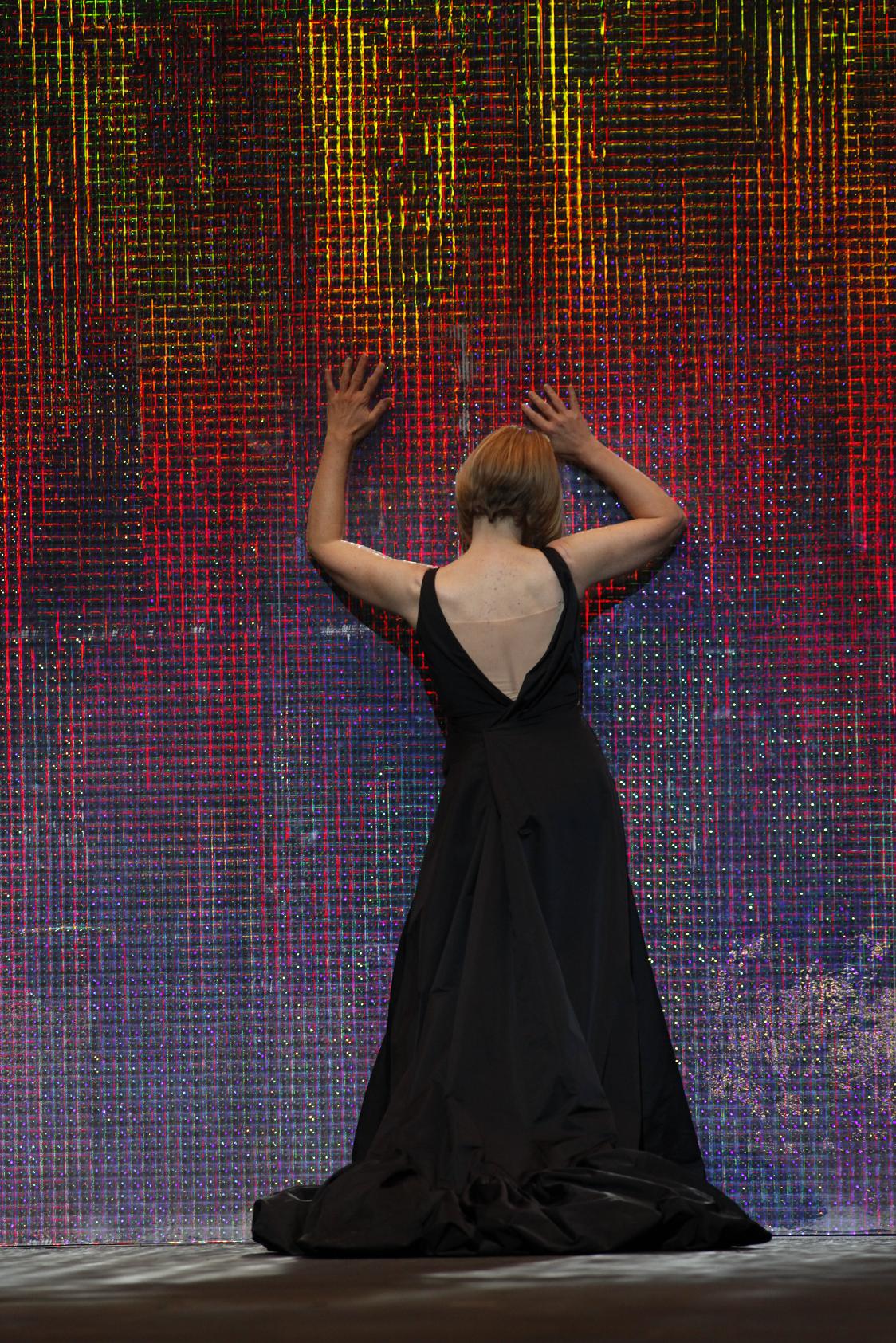
    New York City Opera‘s visually rich production sets the protagonist and ‘chorus’ surrounded by high walls of textured reflective material above which are suspended mirrored cubes which fall and rise above the action. The cubes reflect dazzling light into the auditorium while the walls are illuminated in rich hues: green, mauve, yellow, red, purple by turn. In this dreamlike space the tuxedoed choristers move with stylized gestures as Ms. Sieden, in a striking black gown with train, takes on the aspect of a priestess.

    Monodramas0016

    I first heard Ms. Sieden singing Mozart in the film ANDRE’S MOTHER; later she was a Met Lulu and Queen of Night. It was exciting to re-connect with her tonight and find her on such thrilling form. The vocal writing lingers in a very high tessitura – clarity of diction cannot thus be expected, and the super-titles here compensated – and Ms. Sieden proved not only a mistress of the heights but also produced tone of unusual beauty, almost sweetness, with some lovely taperings of dynamic.

    Watch a video featuring the three protagonists of the MONODRAMAS here. Three performances remain to catch this unusually powerful and rewarding triple-bill of music and theatre: March 31, April 2 matinee and April 8.

    Production photos by Carol Rosegg, courtesy of New York City Opera.