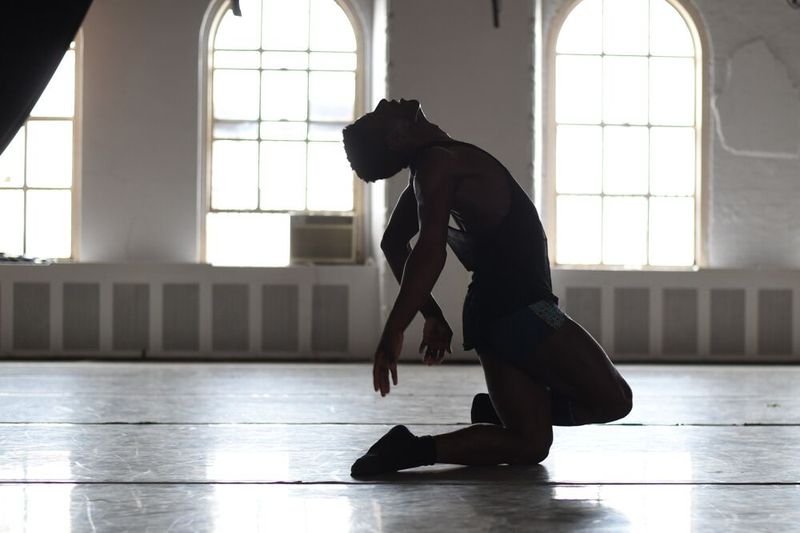
Tag: Lloyd Knight

  • Graham @ City Center 2024 ~ RITE OF SPRING

    SCREEN~1

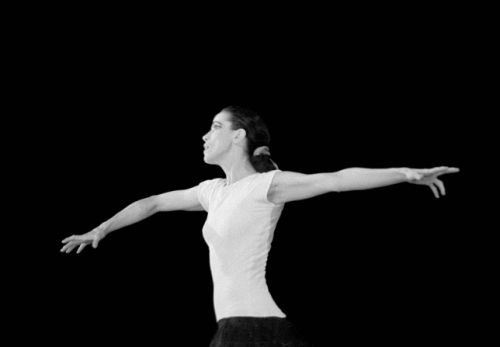
    Above:  Marzia Memoli and Lloyd Knight ~ THE RITE OF SPRING ~ photo by Hibbard Nash

    ~ Author: Oberon

    Friday April 19th, 2024 – Two of Martha Graham’s masterworks book-ended a repeat of Jamar Roberts’ newest work as the Martha Graham Dance Company continued their stint at City Center.

    The Aaron Copland score for APPALACHIAN SPRING was performed by the Mannes Orchestra under the baton of David Hayes. From my 5th row seat on house left, I had a great perspective of the Isamu Noguchi set, and a close-up view of the dancers’ expressive faces. The cast was perfection: the preacher’s followers were a delightful quartet of Graham girls: So Young An, Meagan King, Devin Loh, and Marzia Memoli; their worshipful interest in the pastor was charming.

    MGDC_Appalachian-Spring_MSherwood-74

    Above: Leslie Andrea Williams and Alessio Crognale-Roberts as the Pioneering Woman and The Preacher; photo by Melissa Sherwood

    As the object of his followers attentions, Alessio Corgnale-Roberts made a vivid impression, both in his dancing and his acting. The Preacher is framed as a good guy, but he has a dark side; in a solo danced while the young marrieds pray, Alessio showed a sinister undercurrent in the holy man’s personality. Brilliant!  And Leslie Andrea Williams as the Pioneering Woman was captivating in her quiet strength, her face reflecting the character’s innate nobility. Leslie is the epitome of personal magnetism; even when she is sitting stock still while others dance, you are drawn to her. 

    MGDC_Appalachian-Spring_MSherwood-15

    Above: Jacob Larsen and Anne Souder in APPALACHIAN SPRING; photo by Melissa Sherwood

    Over the years, I have seen many wonderful partnerships in the roles of the Husbandman and his Bride, back to those incredible Graham artists, Miki Orihara and Tadej Brdnik: my first Graham experience – many years ago – at Jacob’s Pillow. Each couple since then have seemed ideal in their own way, and this evening I felt an intrinsic perfection in Jacob Larsen and Anne Souder. Their sheer personal attractiveness would be enough to make them engrossing to watch, but they made so much of their roles, both in their dancing and their acting, that the time-honored ballet took on a new freshness.

    MGDC_Appalachian-Spring_MSherwood-10

    Jacob (above, in Melissa Sherwood’s photo) brings all the facets of his character to life: the energy of a young man, but also his far-searching gaze as he looks out over the land, and the pensive qualities of a new husband who now has a bride to care for and – undoubtedly – a family to raise in his future. Jacob’s athleticism was evidenced in the jumps and barrel turns that Graham weaves into the choreography. His partnering has lyricism and grace.
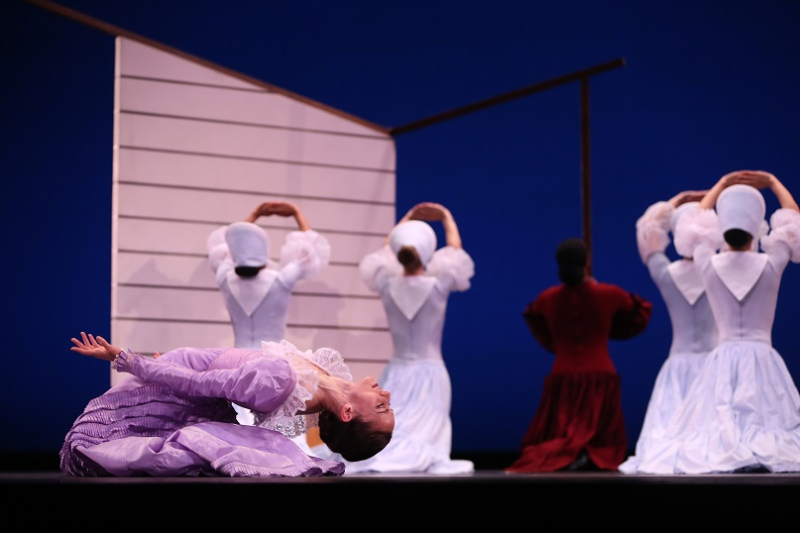
    MGDC_Appalachian-Spring_MSherwood-103

    Anne Souder as The Bride (above, in Melissa Sherwood’s photo) is a dancer who captures the nuance of every expression, step, and gesture; in doing so, she is never fussy or theatrical…rather, she dances from the heart. Her smile speaks of tenderness, and of hope for the future. There is a solo passage, though, when a shadow of worry passes over this young woman’s lovely face: can she do – and become – everything that is expected of her? Her husband’s embrace reassures her; the dark cloud vanishes.

    MGDC_Appalachian-Spring_MSherwood-91

    Ms. Souder’s technique has a silken, seamless quality; she has the extension of a prima ballerina as well as the combination of power and poetry that is the requisite of a great Graham dancer. I expected so much from her in this role, and was thrilled by her perfection.

    MGDC_Appalachian-Spring_MSherwood-96

    In the end, the newlyweds are left alone, and life begins.

    (APPALACHIAN SPRING photos by Melissa Sherwood)

    WE THE PEOPLE seemed even more powerful than on opening night, which is really saying something. The choreographer described the piece as “Part lament, part protest” which is manifested in the alternating passages of silent solos and vibrant, big-rhythm dance passages for the ensemble. 

    On opening night, I was far back from the stage and, in the prevailing darkness of the piece, I could not always tell who was dancing at any given moment. Tonight, sitting close, I could savour the individual energy and personality of each person onstage. Two of the company’s newer dancers – Devin Loh and Ane Arrieta – seemed super-charged by the music. The spotlit solos for Leslie Andrea Williams, Alessio Crognale-Roberts, and Lloyd Knight were riveting, and the duet for Meagan King and Jacob Larsen provides a contrasting touch of lightness and subtle humor. Laurel Dalley Smith, still on a RODEO high, was fantastic. There were times when it felt like someone (or maybe two) was missing, and that certain phrases had changed hands. A sextet for six women seemed like an octet on opening night, or am I hallucinating?  

    At any rate, WE THE PEOPLE should become a repertory staple of the Graham Company: it’s that good

    The evening closed with my favorite Graham work: RITE OF SPRING. The Mannes Orchestra were back in the pit, playing very impressively indeed under David Hayes’ vibrant command. The Stravinsky score, which – along with Nijinsky’s controversial choreography – caused a near riot at the ballet’s 1913 premiere, no longer seems radical, but instead is a powerful musical document of an unforgettable date in dance history. The wind players of the Mannes ensemble reveled in the score’s quirky demands. The setting where the ritual sacrifice takes place, conceived by the Company’s Artistic Director, Janet Eilber, is under an ominous sky; the feeling is both vast and curiously claustrophobic.

    The choreography is some of the most demanding imaginable, calling for extreme athleticism, intricate steps and gestural motifs, and pinpoint timing. The full Company participates in this grand-scale work, and so we get to know the apprentices – Zachary Jeppsen, Matthew Spangler, Justin Valentine, and Jai Perez – as well as the newest dancers (already making a mark for themselves) – Ane Arrieta, Meagan King, and Antonio Leone. 

    Alessio Crognale-Roberts and Jacob Larsen have a prominent place in the ritual; as the Shaman’s acolytes, they have a lot of work to do, and they do it handsomely, and with stoic resolve.

    It is The Shaman whose solo opens the piece with a ceremonial dance to sanctify the space for the dire ritual to come. The charismatic Lloyd Knight gave a magnificent portrayal as the man ordained by the gods to perform the sacrificial ritual; nothing will deter or distract him from his cold-hearted purpose. Lloyd’s command of the role’s uncanny partnering demands was something to behold. 

    In her debut performance as The Chosen One, Marzia Memoli gave a thrilling performance as she moved from being just another village girl to being the central figure in the gruesome ritual that will keep the community in the good graces of the gods for another year.

    Marzia has always been a truly vivid dancer, fearless and committed, and she now has a role that suits her to perfection. It is a role in which the dancer cannot simply portray the ill-fated character, but must become her. With a font of strength and energy that belies her slender frame, Marzia, with her mane of golden hair, gave a consummate performance, wherein the cross-currents of vulnerability and resolute courage ebb and flow as the girl’s fate closes in on her.

    The dancers were hit by a tidal wave of applause as they filled the stage for a bow. Lloyd Knight was hailed as the king of the Gotham dance world, and then Marzia took her solo bow to rapturous applause while Lloyd handed her a bouquet and they embraced. 

    I was sorry to hear that this memorable RITE had not been photographed for posterity, aside from the studio photo at the top of this article. But I have indelible images from the evening in my mind.

    ~ Oberon

  • Martha Graham Dance Company~Immediate Tragedy

    -gvdt0Bg

    Above, clockwise from top left: Graham dancers Ying Xin, Lloyd Knight, Lorenzo Pagano, and Leslie Andrea Williams performing Immediate Tragedy from their homes. Photo by Ricki Quinn.

    Update: You can now watch Immediate Tragedy on YouTube here.

    Friday June 20th, 2020 – In a joint collaboration with The Soraya and Wild Up, the Martha Graham Dance Company today presented the world premiere performance of a digital dance creation, Immediate Tragedy, inspired by Martha Graham’s lost solo from 1937. This freshly-imagined version features the fourteen remarkable artists of the Graham Company performing from their homes to a new musical score composed by Wild Up’s Christopher Rountree (photo below).

    Rountree

    The loss of the 2020 Graham season in New York City was for me one of the saddest after-shocks of the pandemic. Nowadays, I keep wondering if dance, music, opera, and theatre – not to mention museums – can return to what we think of as ‘normal’ in the foreseeable future.

    The members of the Graham Company have, over the past decade or so, become very dear to me, not just as dancers but as human beings. Their energy, commitment, and their unique individual stories make them so appealing. I cannot wait to see them “live” again. But for now, today’s webcast of Immediate Tragedy at least let me behold their beautiful faces and forms again. 

    Host Thor Steingraber, executive director of The Soraya, welcomed viewers. Graham artistic director Janet Eilber and composer Christopher Rountree of Wild Up gave us some background information about the collaborative effort to bring Martha Graham’s “lost” 1937 solo back to life in a new guise nearly eighty years after it was last seen.

    Ms. Eilber spoke of receiving a collection of black-and-white images of Martha Graham performing Immediate Tragedy in 1937. They were taken by Robert Fraser, and it was Fraser’s son who contacted Ms. Eilber to say, “I have these photos…”  One thing led to another, and when the pandemic forced dancers to remain isolated, the idea of a digital dancework in which each Graham dancer would be filmed dancing at home, elaborating on the poses from the Fraser photos, made perfect sense. Each dancer was mailed four of the Fraser images, showing various moments from the original solo. Ms. Eilber oversaw the “new”  choreography, but…there was no music to dance to. Enter Mr. Rountree, who provided an intriguing score which five musicians from Wild Up play superbly.

    The last time Immediate Tragedy was performed, it was paired with another Graham solo, Deep Song. A gorgeous film of dancer Anne Souder performing Deep Song at the Teatro Real Madrid in 2017 opened today’s presentation. The solo, also dating from 1937, was another Graham response to the Spanish Civil War  – a war that raged until 1939 – and its dire effect on the women of Spain. The music is by Henry Cowell. 

    At first glance, the bench employed in Deep Song puts the viewer in mind of Graham’s iconic Lamentation, which was created in 1930. The two solos have an indelible connection, though the sources of inspiration – and the music used – are vastly different. Ms. Souder, striking in a beautiful re-creation of Edythe Gilford’s original black-and-white costume design, is a wonderfully supple and nuanced dancer; she gives a vivid performance. As the solo progresses, the bench becomes part of the choreography. Up-ended, it becomes a chair on which the dancer sits and slowly rotates in place. Later, she takes refuge under it and – momentarily – it has the feeling of a coffin. Then the dancer’s hands tremble: her indomitable spirit cannot be stilled.

    In a solo that runs an emotional gamut from defiance to despair, Ms. Souder’s dancing of Deep Song showed a perfect mixture of vulnerability and resolve.

    KoZuV8aQ

    Above: Wild Up’s Jodie Landau playing Intermediate Percussion; photo credit Ricki Quinn

    Perhaps picking up from the black-and-white of Anne Souder’s gown, the presentation continues with an entr’acte: a black-and-white film featuring Wild Up’s percussionist Jodie Landau playing at home. He employs a kit of drums and cymbals, as well as some household items. Jodie plays in a relaxed, utterly delightful way, pairing two ‘forgotten’ Henry Cowell works to create an interlude entitled Intermediate Percussion. Composer Chris Rountree said that he wasn’t sure if the brief Cowell works had ever been publicly performed, or even published, but that Jodie was playing from the manuscripts. The works are entitled Canto Hondo and Sarabande.

    Intermediate Percussion, far from being an idle filler while the “stage” was being “reset”, was a fascinating and integral part of today’s presentation. The black-and-white film has a refreshing, journalistic feel, and Mr. Landau’s playing was as pleasing to watch as to hear.

    Graham deep song - Copy

    Above: Martha Graham performing Immediate Tragedy in 1937; photo by Robert Fraser, courtesy of the Martha Graham Dance Company

    The black-and-white theme running thru the program now becomes palpable as a collage of the incredible Robert Fraser photos of Martha Graham from 1937 herald the start of Immediate Tragedy. Slowly, each individual photo of Ms. Graham is replaced by a photo of one of the current Graham dancers. Clad in dark colours, against white or neutral backgrounds, they are a sight to see. And then they begin to move.

    The Graham dancers appear in individual frames, sometimes paired, or in trios, or foursomes, and periodically in solo shots. So Young An, Alessio Crognale, Laurel Dalley Smith, Natasha Diamond-Walker, Lloyd Knight, Charlotte Landreau, Jacob Larsen, Lloyd Mayor, Marzia Memoli, Anne O’Donnell, Lorenzo Pagano, Anne Souder, Leslie Andrea Williams, and Xin Ying each dance the Grahamian modes of movement: kneeling, collapsing, contracting, stretching tall, with gestures of longing, supplication, or hopelessness. 

    The quintet of musicians of Wild Up – Jiji (guitar), Richard Valitutto (piano), Jodie Landau (percussion/harpejii/synth/voice), Brian Walsh (clarinets), and Derek Stein (cello) – play Mr. Rountree’s score impeccably. The music sings of loneliness and quiet anguish; thanks to the acoustic guitar and clarinet, there is an aptly Spanish quality about it at times. Cunning use of the harpejii adds a melismatic flavour. As the piece nears its end, there is a slow crescendo and an exciting acceleration of tempo during which the harpejii sounds like a mad, swirling dulcimer. It reaches a mighty climax, and then all falls silent.

    During this final musical build-up, the frames of the dancers move swiftly up the screen, shrinking in size whilst growing in numbers. When the music suddenly ends, the screen goes black. A hauntingly pensive clarinet coda is heard as, one by one, the dancers reappear in their frames. As they slowly attain the work’s final pose – hands clasped behind their heads – the bass clarinet descends to the depths. 

    Snapshot c

    In silence, the frames of the individual dancers all disappear, leaving only Leslie Andrea Williams. Just as Leslie fades from view, her figure morphs into the 1937 image of Martha Graham sustaining the same pose.

    “I was upright, and was going to remain upright at all costs.” ~ Martha Graham

    Though originally a necessary response to the pandemic – a way to keep dancers dancing and musicians playing – Immediate Tragedy has taken on yet another dimension following the murder of George Floyd and the massive international protests opposing racism and injustice. We seem to be living now on the edge of a knife; the coming months will determine the future of our democracy and – no exaggeration – the fate of mankind. For now, music, dance, art, and poetry continue to give solace. Immediate Tragedy – so beautifully performed – today felt like a ray of hope in a chaotic, dimming world.

    ~ Oberon

  • Rehearsal: Knight/Beamish DANCE FOR NEPAL

    RQkHE0rinYhBWzy3nyyINzvkyHZx9FaaA39gtXrj1P0

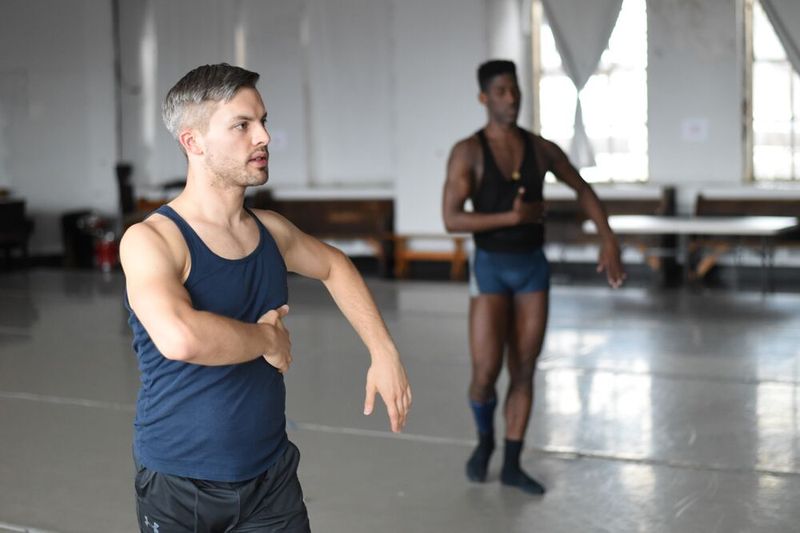
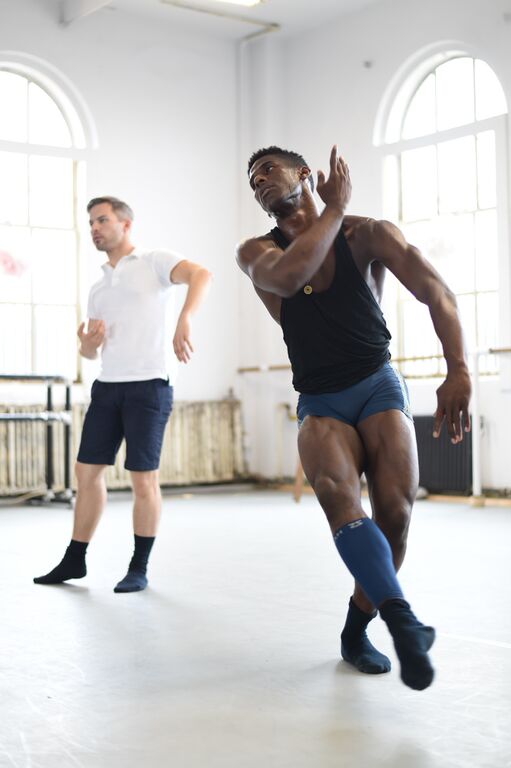
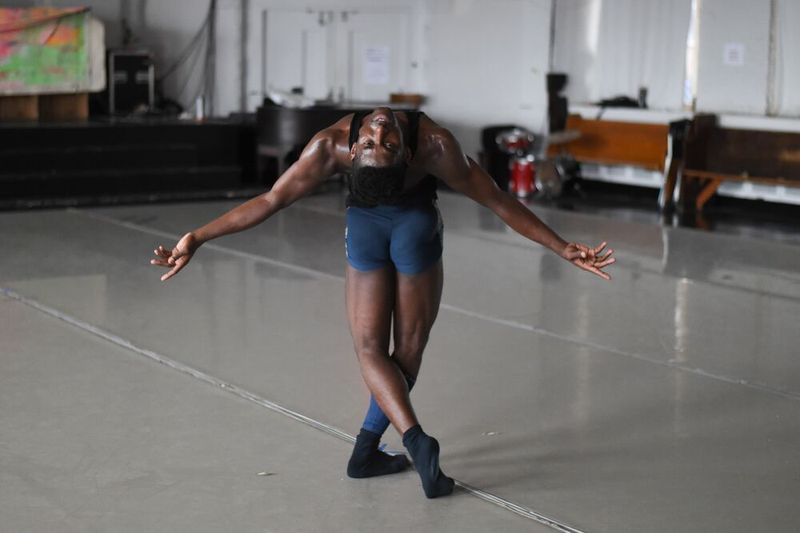
    Above: Lloyd Knight rehearsing a new Joshua Beamish solo, ‘Adoration‘, for the upcoming gala benefit DANCE FOR NEPAL; photo by Nir Arieli

    Saturday June 27th, 2015 – On Tuesday June 30th, 2015, DANCE FOR NEPAL will be presented at the Union Square Theatre. The program, conceived by Simona Ferrera, is under the artistic direction of Lloyd Knight, principal dancer of The Martha Graham Dance Company.  All proceeds from this gala performance will benefit the survivors of the devastating earthquake that struck Nepal on April 25th, 2015. A stellar group of dancers will perform; tickets and more information here.

    On an overcast afternoon, photographer Nir Arieli and I dropped in at the Martha Graham studios for a rehearsal/preview of the new Beamish solo work. The choreographer has chosen the adagio from Haydn’s concerto in C-Major for cello and orchestra: a perfect setting for his fluent and expressive choreography and for Lloyd Knight’s powerful, emotive dancing. Demanding in its physicality, the solo has a deeply spiritual quality which gives Lloyd a perfect impetus for his interpretation: a striking mixture of muscularity and grace. 

    TCR4KqNouwnDvDmxEFTFrhjmF-FbmRKr7P20ePSuMqI

    Joshua Beamish (above, with Lloyd), the Canadian dancer/choreographer and founder of MOVE: the company, was recently seen here in New York City as one of Wendy Whelan’s choreographer-cavaliers in her RESTLESS CREATURE presentation at The Joyce. In August 2015, Josh will be presenting MOVE: the company for two performances at The Joyce. Details here.

    The studio atmosphere today was paradoxically calm and intense; I could have gone on watching endlessly since the combination of the music, Josh’s mapping of the movement, and Lloyd’s inspiring dancing were a welcome balm to the spirit.

    Here’s a gallery of Nir Arieli’s images from this rehearsal; I have chosen quite a few since they really capture the atmosphere:

    8GZwnZiFpnA8OML-Pn8HNZhHGPDqmTZuchV4pMfnz3s

    0H2SF4HwRQwA0R7DnkafO-z7iuCoGVFsJJ92iICWsA8

    A85gt2XQQUUmZnzGgRt25eyTiKQhCQlUcwUChXyvOkM

    DCy8A44bjllEbSPubFFO4aKrulekbGxt0OdY8ibIKlQ

    J7BWpa-lUIn3Pu3As2Fw_lc2uPivLK2eNPxY9YwdgSY

    YWKMLoVR-hRpAeO7E7BBFN5HrSk0Idjm6H9Zj2eX0xU

    FzS_IKv-9glcZ6gZEOhlITmE-V65aEekhGWN_jdDydI

    Ud_M-qKWg4ZTdgq7zJzzZRbYHMcLOR7zEa0Msyr7zm4

    MxEmtICm8SL2ikzFKnKwl0A59IyBV5Wgcr_TovHheSw

    NcBQ_rJxbrPZLlO4vcgkhncqjmQpIkt2aqdruFMR9LE

    Click on each image to enlarge.