Tag: Lori Belilove

  • Lori Belilove ~ Isadora Duncan Dance Company

    Wj180622016-website-featured-image-2

    ~ Author: Oberon

    Thursday March 28th, 2019 – A studio performance by The Isadora Dance Company, founded by and under the artistic direction of Lori Belilove (above), presenting an evening of Duncan works in an intimate salon setting. At the piano, New York City Ballet’s Cameron Grant regaled us with his vibrant playing of works by Chopin, Brahms, Schubert, and Scriabin. 

    The room was packed to the bursting point as Lori greeted us, and then the dancing immediately commenced. A set of Duncan works set to music of Franz Schubert opened the evening, starting with dancers Hayley Rose and Faith Kimberling as light-hearted nymphs Moment Musical. Throughout the evening, the women wore classic Grecian-style tunics, iconic elements of the Duncan repertoire, in various hues. Emily D’Angelo, in pale blue, danced Lullabye, with the evocative Isadora motif of raising the arms heavenward. Becky Allen and Caroline Yamada, in pink with flowers in their hair, gave us Classical Duet, and then Lori Beliliove, in dark blue, spoke to us in Duncan’s striking gestural language in the waltz-like Water Study.

    The music by Frederic of Chopin – waltzes, etudes and mazurkas – came next, all of it immaculately played by Mr. Grant (I was seated just behind his right shoulder, and could follow along in his score). Nikki Poulos was the soloist in the joyous Grande Valse Brillante – a feel-good Isadora work to be savoured for its freshness and vitality. Mlles. Yamada, Allen, Kimberling, and Rose were the attractive ensemble here. Emily D’Angelo’s solo opened Prelude, with Becky Allen and Caroline Yamada transforming it into a trio; this very familiar music was most cordially played by Mr. Grant. Faith Kimberling – always such an appealing dancer to watch – then appeared for a second trio, Line Mazurka, with Becky and Caroline.

    In the solo Ballspiel, Hayley Rose used the space to fine advantage, her dancing responding ideally to the music’s shifting changes of pace. In the moody Slow Mazurka, Mlles. D’Angelo, Rose, Poulos, and Yamada took turns striking stylized poses on the floor – classic Isadora, this – whilst their companions danced. Becky Allen’s dancing of the immortal Minute Waltz was perfectly dovetailed to the playing of Mr. Grant: this was one of the evening’s many highlights.

    Hayley Rose, Nikki Poulos, and Faith Kimberling appeared as woodland sprites in Butterfly Etudes, employing scarves in a space-filling dance. Nikki Poulos gave a poignant performance of Death and The Maiden, her gestures indicating longing and then withdrawal, her expressive face beautifully mirroring the sorrowing music.
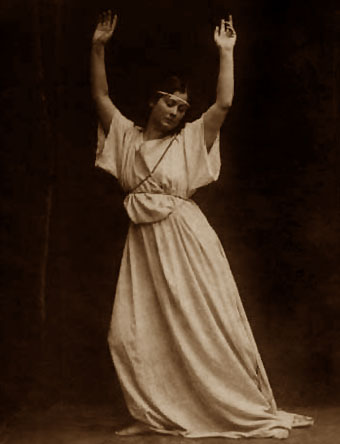
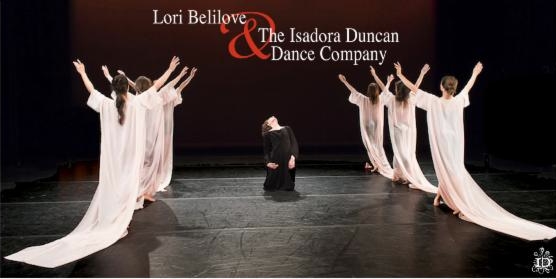
    Isadora’s suite of Brahms waltzes entitled The Many Faces of Love opened with Caroline Yamada’s cheerful energy in Greeting, followed by Faith Kimberling’s Frolic, with its folkish flavour, so lovely to watch. Lori Belilove performed Scarf Dance, a lilting, provocative piece, followed by Mlles. Rose, Yamada, and Poulos in the unison trio that opens Cymbals, with its accented music. Ms. Rose then gave Flames of The Heart a Romany flair: fast, passionate, with streaks of wildness. The lyrical, lovely Rose Petals was danced by Emily D’Angelo with cherishing grace; at the end of the dance, she slowly scatters the flowers about the floor.
     
    Two of Isadora Duncan’s great Scriabin solos were given exemplary performances by Lori Belilove: the deep melancholy of Mother, in which she comforts her ghostly children, and the madly passionate, red-clad  Revolutionary, with its silent screams.
     
    As a triumphant finale, honoring Women’s History Month and embracing the power of sisterhood, Nikki Poulos led Mlles. Yamada, Allen, Kimberling, and Rose in the bracing Military Polonaise of Chopin, thrillingly played by Cameron Grant. This made our spirits soar.
     
    ~ Oberon

  • Isadora: Lament, Hope, and Renewal

    Duncan_2

    Wednesday September 17th, 2014 – Lori Belilove and the Isadora Duncan Dance Company presented an evening of film, live performance and discussion in an intimate salon setting at the Company’s home space on West 26th Street. A few days after marking the anniversary of Isadora’s untimely death (on September 14th, 1927), Lori and her Company keep the spirit of ‘the mother of modern dance’ vividly alive.

    For me, this week brought the unusual happenstance of back-to-back evenings of Martha Graham and Isadora Duncan. These two pioneering forces on the frontiers of modern dance seem to me to be twin goddesses: from them, so many blessings flow – even onto the present day.

    Central to this Isadora evening was the showing of a silent film clip of brief fragments from Dance of the Priestesses, a ‘lost’ Duncan work. This film, made in 1963, features extremely rare footage of Anna Duncan, one of the original Isadorables. In the film,  Anna dances with Julia Levien and Hortense Kooluris, two women who were the teachers of Lori Belilove: thus the direct line of passing the torch from generation to generation is maintained. 

    The film was entrusted to Lori Belilove and it inspired her to embark on a restoration of Dance of the Priestesses which, until now, had been little more than a legend. The dance is set to music by Christoph Willibald von Gluck from his opera IPHIGENIE EN TAURIDE. In the film, Anna, Julia and Hortense show a wonderful weighted quality. Lori was able to impart this to the dancers of her current Company and, after viewing the film, we were treated to a beautiful live rendering of the piece. Lori has set it for five women (Isadora’s ensemble works can be danced by small or large contingents of dancers). The girls looked stately in their midnight-blue gowns, with Morgana Rose Mellett in a prominent role and Kim D’Agnese, Emily D’Angelo, Faith Kimberling, and Nicole Poulos as her sister/priestesses. Their performance evoked the ancient gods and the mythic rituals of times long vanished.

    686

    Also on film, we saw a full performance of Slow March (photo above) as performed by the Company last May.

    Isadora created danceworks in several moods, stemming from her mental state at the time of creation. Joyous, celebratory dances gave way to dark, lamenting themes following the death of her two children. Lori Belilove performed two of these despairing solos tonight: Death and The Maiden (set to Chopin) and Mother (set to Scriabin). The mood was brightened by two Chopin mazurkas danced by Mlles. D’Agnese, Mellett, Kimberling and D’Angelo in signature pink-and-white Grecian tunics. Lori and the four girls joined in an extended finale: Dance of the Blessed Spirits and Orpheus’ Lament, both drawn from themes from Gluck’s opera ORFEO ED EURIDICE

    Pianist Melody Fader played all the selections for the evening, an enhancement to the atmosphere of the performance. 

    Watching the dances this evening, I couldn’t help but think that today’s young choreographers could benefit greatly in studying Isadora’s work. In terms of musicality, structure and creation of mood, Isadora’s instincts always seem spot-on. As dancer Miki Orihara wrote in her notes for her recent solo concert, we may look into the future of dance by investigating the past.