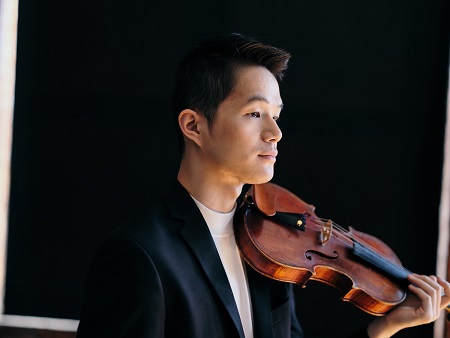
Tag: Lun Li

  • Violinist Lun Li @ The Morgan Library

    Lun Li

    ~ Author: Oberon

    Wednesday April 24th, 2024 matinee – This was my third time hearing the Chinese violinist Lun Li. My first encounter was at Merkin Hall when he gave his NY debut as a Young Concert Artist. Soon after, he played the Prokofiev second violin concerto – most impressively – with the Riverside Symphony at Alice Tully Hall.

    This afternoon, Lun Li offered a distinctive program at The Morgan Library, and he played thrillingly from start to finish. I very much liked his idea of having the house lights completely darkened throughout the concert; the only drawback to this was: it was impossible to take anything more than the most rudimentary notes. In the long run, though, notes became superfluous because this was some of the greatest violin playing I have ever heard. After a while, I stopped trying to write anything down and just let the music transfix me.

    Lun Li’s presentation was simple: clad all in black, he stood in a pool of light on the stage, casting a quadruple shadow. The darkness in hall seemed to make the audience more attentive and more focused on the music; there was a resolute stillness in the air, making the charismatic violinist’s extraordinary playing even more compelling.

    The program was devised in three segments followed by a sort of built-in encore. Each segment consisted of a short ‘prelude’, followed by a longer work.

    Music by Henry Eccles – his brief Prelude in A-minor – opened the concert, followed immediately by Nicola Matteis’ Alia Fantasia. The two pieces were written about fifteen years apart and are similar in feeling. Lun Li’s playing was elegant, and technically immaculate.

    Continuing in a Baroque mode, music by Giovanni Bononcini, came next: his Prelude in D-minor led on to the celebrated Chaconne from Partita No. 2 in D-minor, BWV 1004, by Johann Sebastian Bach. This long work offers endless opportunities for brilliant playing, and Lun Li gave as astounding, passionate performance, holding the audience under a spell with his virtuosity. The ensuing ovation was inevitable after such a glorious rendition.

    Following Philip Glass’s Book of Longing, which has a Baroque flavor, but with a tinge of timelessness, Lun Li gave a monumental performance of Béla Bartók’s Sonata for Solo Violin. The sonata was composed in 1944 on a commission from the American violinist Yehudi Menuhin; it was one of the composer’s last works. This solo sonata is in three – or maybe four – movements: Tempo di ciaccona, Fuga, Melodia, and Adagio – the last two being inseparable.

    The sonata places extraordinary demands on the violinist as the music veers from searing, to luminous, to poignant. The sheer number of notes is uncanny, and they were all sewn together in an intense, unforgettable musical experience by our remarkable soloist. If the reaction to the Bach seemed massive, the ovation after the Bartók was simply off the charts.

    Lun Li polished off his program with Tessa Lark’s Jig and Pop, a lively piece with a mile-a-minute swirls of notes. The violinist was called back for numerous bows.

    The near-total darkness in hall today certainly worked in this particular instance, but if it becomes a trend – it’s been that way for years at The Joyce – people like me will be out of a job.

    ~ Oberon
  • YCA Presents Violinist Lun Li ~ Debut Recital

    Lun li

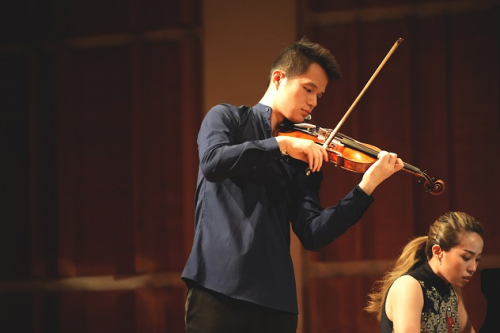
    Wednesday April 26th, 2023 – Young Concert Artists presenting the New York debut recital of violinist Lun Li (above) tonight at Merkin Hall. Pianist Janice Carissa shared the stage with the young violinist in a wide-ranging program which Lun Li described in a program note:

    My debut program explores the interplay between fantasy and reality through the works of Bartók, Messiaen, Schumann and others. I have chosen a set of repertoire that explores this blurred dimension, and more importantly, allows the listener to form sonic connections without needing extensive knowledge and context. I invite you to form your own personal narratives with this program.”

    In the program’s brief opening work, “Don Quixote” from 18 Miniatures by Giya Kancheli, both players showed themselves to be passionate and highly accomplished musicians. The music has a boisterous start, which develops into a strutting dance. Thereafter, extroverted phrases alternate with delicate, witty ones.

    Lun Li then spoke briefly, and asked that we withhold applause during the remainder of the program’s first half. He and Ms. Carissa then commenced on a marvelous performance of Francis Poulenc’s Violin Sonata.

    Poulenc originally wrote this sonata in 1942/1943, for the young French violinist Ginette Neveu, who perished in a plane crash in 1949 at the age of thirty. Thereafter, the composer revised the sonata, making several changes in the last movement. The work recalls the composer’s memories of the great Spanish poet Federico García Lorca (1899-1936); suspected of homosexuality, García Lorca was executed by the Fascists soon after the outbreak the of the civil war.

    The sonata’s opening Allegro con fuoco makes a frantic start before easing into a tango-like mood, which speeds up before halting for a long pause. A tender melody develops with great passion; alternating moods carry us to a fantastic finish.

    Poulenc headlined his second movement, an Intermezzo, with a quotation from García Lorca: “The guitar makes dreams weep,” alluding to the poet’s own guitar arrangements of Spanish songs. The music begins with a lulling piano motif accompanied by plucked violin notes. A subtle melody becomes rapturous, the piano lapses into a dreamlike state. Off-kilter harmonies sound before an upward violin glissando brings a quizzical end.

    The third movement’s title, Presto tragico, foreshadows the death of the poet: fast and urgent passages mesh with dancelike swirls of notes, climaxing with a violent chord. A searing violin theme jolts us, then the music subsides to a tragic, mournful conclusion.

    Honoring Lun Li’s request for “no applause” was difficult after such a thrilling performance, but the mood held and he commenced the high, soft agitato of Salvatore Sciarrino’s Per Mattia, a brief work that flowed seamlessly into the ensuing Schoenberg. 

    Janice carissa.

    Above: pianist Janice Carissa

    Arnold Schoenberg’s Phantasy, Op. 47, began life as a solo violin piece, to which the composer later added a separate piano accompaniment. Lun Li and Ms. Carissa here displayed the wonderful sense of teamwork that underlined their playing all evening. The pianist, whose gown was a work of art in and of itself, is wonderfully subtle, and she deftly handled the rhythmic shifts in which this music abounds. Together, the players veered from the ethereal to the drunken, dancing along thru stuttering, jagged passages which morphed, incredibly, into Fritz Kreisler’s Miniature Viennese March. This was a brilliant ending to the concert’s first half: jaunty, and impeccably played.

    Music of Olivier Messiaen, his Fantaisie, opened the evening’s second half; the composer is perhaps best remembered for his magnificent, poignant Quartet for the End of Time. The Fantaisie opens with Ms. Carissa delivering an emphatic statement from the piano. Dance-like passages are heard, and then Lun Li’s violin soars over gorgeous rippling figurations from the pianist. The music sails along, alternating rapid passages with thoughtful ones: mood swings that are relished by the players. From a high-velocity, tumultuous buildup, the music becomes cinematic. Animated/agitated music gives way to another high-flying, silken violin theme. The climax is reached, with the composer offering a swift, dazzling finish. 

    Robert Schumann’s quirky Bird as Prophet, arranged by Leopold Auer, comes next. Ascending violin phrases have a touch of irony, and then a lyrical song springs up, with a shimmering trill. The music features some wistful hesitations.

    4

    Lun Li and Ms. Carissa polished off the evening with a compelling performance of Béla Bartók‘s Violin Sonata No.2, Sz. 76. Lun Li aptly described this music as being “from a different planet”, and from its big, strange start it is indeed kozmic, weird, and wonderful. Passion and pensiveness send alternating currents thru the hall, sagging violin motifs develop into an epic expressiveness. As things simmered down, Lun Li remained unfazed by the ill-timed sound of a cellphone: he delivered a plucking ‘cadenza’ from which a dance emerged: cascades of notes from the violin over a pounding rhythm from the keyboard. Fabulous playing…they sounded like a whole orchestra! 

    Bartók offers a fantastical sonic variety in this piece in terms of tempi and dynamics: a piano solo of epic power gives way to a spidery violin motif. Lun Li becomes a veritable speed demon, playing fast and furious, and taking things to new heights. The music calms, and slows; the violin sighs, then starts plucking, and the music dances onward.

    2

    The audience hailed the musicians with a fervent ovation at the sonata’s end, and Lun Li graciously thanked us for having accompanied him on this musical journey. He then launched a performance of Schubert’s  Erlkönig that was an astounding demonstration not only of his virtuosity but of his unbounded passion and his heartfelt dedication to music.

    I look forward eagerly to hearing Lun Li again…and soon: on Friday May 5th, he will play the Prokofiev 2nd with the Riverside Symphony at Alice Tully Hall. Tickets and info here

    Performance photos courtesy of Young Concert Artists.

    ~ Oberon.