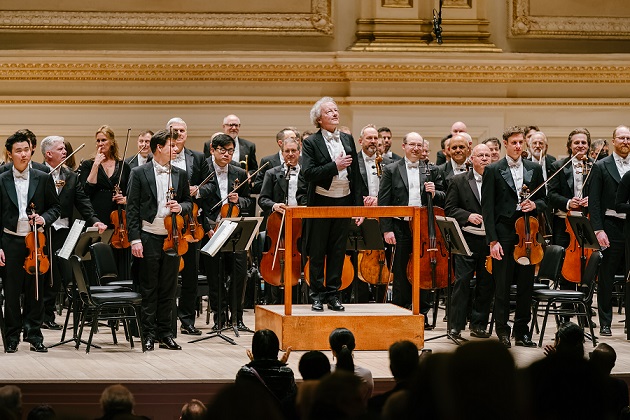
Above: Maestro Welser-Möst and the Cleveland Orchestra onstage at Carnegie Hall; photo by Fadi Kheir
~ Author: Lane Raffaldini Rubin
Tuesday March 18th, 2025 – Tuesday March 18th, 2025 – Franz Welser-Möst led The Cleveland Orchestra tonight in the first of two back-to-back Carnegie Hall performances. The second concert will feature music of Stravinsky and Tchaikovsky, but the Orchestra was forced to make a major change in the program of tonight’s concert after Asmik Grigorian announced her withdrawal for personal reasons. Ms. Grigorian, the Lithuanian soprano, was set to sing Richard Strauss’s Four Last Songs and the final scene from Puccini’s Suor Angelica with the Clevelanders.
Missing a chance to hear the Four Last Songs is a real shame, but Welser-Möst took this opportunity instead to make a timely political statement in what might be one of his last Carnegie Hall appearances before his retirement in 2027:
“This program change has given us a chance to say something important about our world today. As people fight for freedom everywhere, these pieces tell that same human story. Beethoven’s Fifth shows us the journey from darkness to light. Janáček’s From the House of the Dead reveals how human dignity survives even in the most desolate of circumstances. And the Leonore Overture is, to me, simply the greatest music about freedom ever written. These works together create a profound statement that I believe will resonate deeply with our audiences in both Cleveland and New York.”
The first notes of the performance were the V-for-victory theme of Beethoven’s Fifth Symphony. Besides being perhaps the world’s most famous four notes, this music represents Allied Europe’s victory over the Axis in World War II. (Russia, are you listening?)
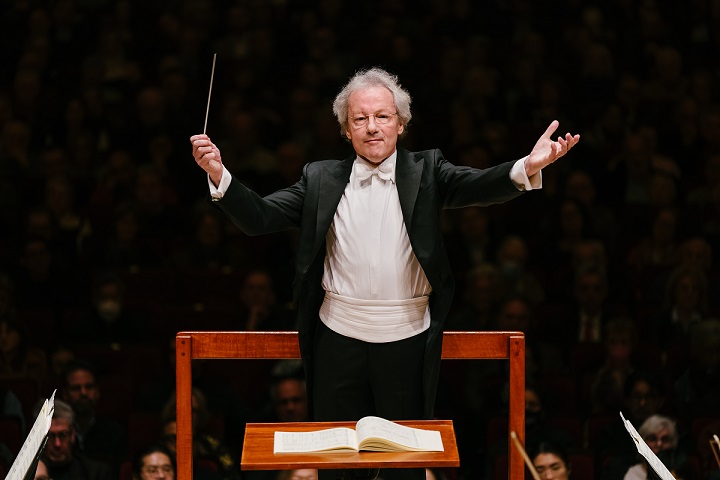
Maestro Welser-Möst (above, photo by Fadi Kheir) mobilized the full forces of the Cleveland Orchestra for the Fifth, making it an orchestra more than twice the size of that envisioned by Beethoven. The result was an impressive, explosive sonority at the expense of contrast and transparency. In the first movement the Clevelanders’ sound was burnished and energetic as it traversed Beethoven’s volatile landscape of darkness and light.
The second movement was beautifully elegant, with notable vibrato-less hushed passages and flawless string crossings throughout the later variations of the theme. The finale was brisk without being breathless and avoided the Indiana Jones clichés that this movement often receives.
The second half of the program featured the suite (arranged by František Jílek) from Leoš Janáček’s final opera From the House of the Dead as well as Beethoven’s Leonore Overture No. 3. These pieces both come from larger dramas about imprisonment and the liberation of the steadfast human body and spirit. If Beethoven’s Fifth Symphony lays out a hero’s abstract journey through conflict toward triumph, the latter two pieces give a much more visceral view into their protagonists’ struggles against adversity and fate.
Janáček’s suite is wonderfully off-kilter and begins with a herculean violin solo—a free-associating kind of playing that involves an almost desperate sawing away at the top of the instrument’s register. Chaotic passages of music played by smaller sections of instruments are interspersed between bursts of the full orchestra with towering clusters of sound, always grounded by the low strings and brass. Inventive sounds made by rachet noisemakers, wood clappers, percussively plucked strings, and relentless repetitive figures all have the effect of boring a hole into one’s skull, slipping toward madness.
Passages drawn from a scene in the opera in which the prisoners stage a play feature macabre oom-pah-pahs, vaudeville fragments, and whiffs of a klezmer band. The final movement of the suite is a fauvist palette of blurry chords, a luxuriously strange and gorgeously dissonant tableau that concludes too optimistically considering all that came before.
It seems odd, then, to conclude the concert with an overture. Rare, too, is the chance to hear Beethoven after Janáček. But the Leonore Overture—from the opera that would become Fidelio—is a concise encapsulation of Welser-Möst’s message for the evening.
This piece was better suited than the Fifth to the large orchestra, which was able to achieve subtle shades ranging from the bright fanfare of the full orchestra (in C-major, like the final movement of the Fifth) to the eerie distance in the flute after the portentous off-stage trumpet call.
Fidelio is ultimately about the triumph of enlightenment values over despotism. Although Welser-Möst’s program had the potential to come off as trite and facile, his linking of these two Beethoven scores to Janáček’s and his reversal of the obvious order of their performance charted an intelligent, moving, and novel course that he hopes—despite our current administration’s unenlightened displays of power—might be followed in Europe.
~ Lane Raffaldini Rubin
Performance photos by Fadi Kheir, courtesy of Carnegie Hall
 Oberon's Glade