Tag: Magic Flute

  • Mozart & Bartók @ The NY Philharmonic

    Week32-BrandonPatoc_0059

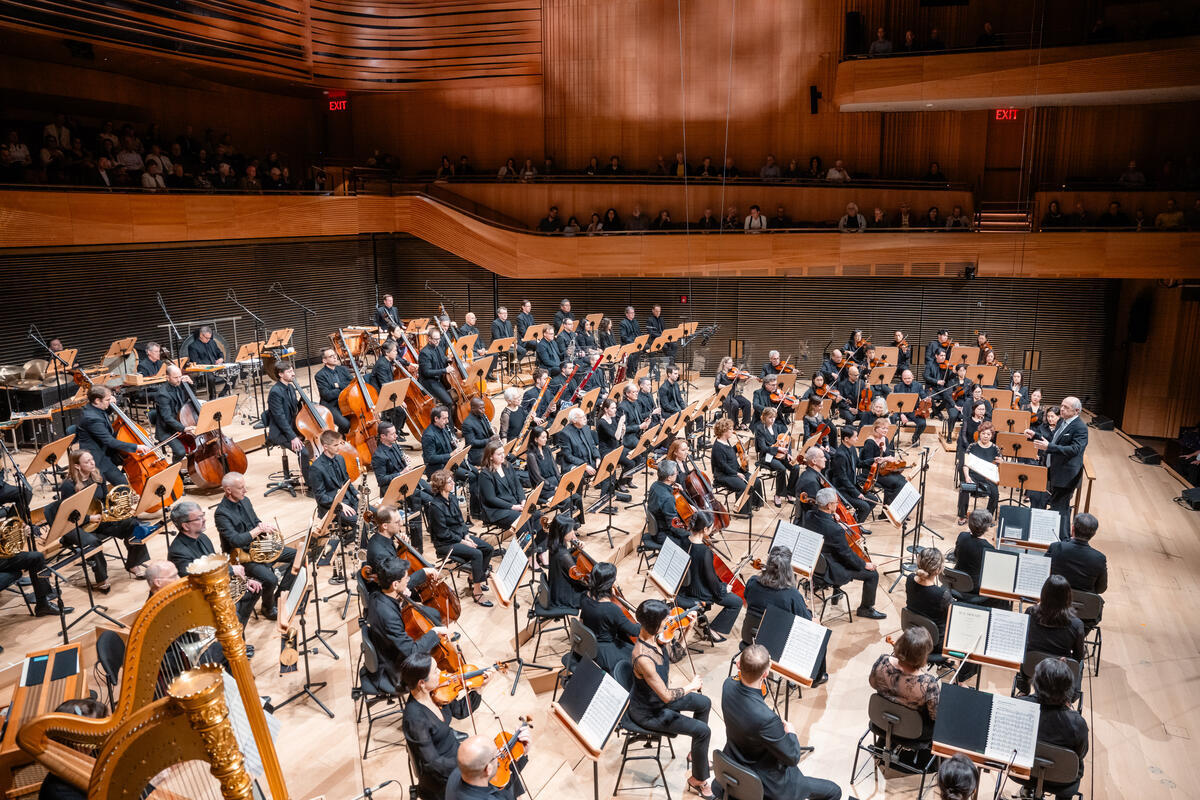
    Above: performance photo by Brandon Patoc

    ~ Author: Mark Anthony Martinez II

    Saturday April 26th, 2025 – The New York Philharmonic played a fantastically curated concert of Mozart and Bartók. Although the throughline of the pieces isn’t immediately apparent, the pairing of Mozart at his most theatrical — with the Magic Flute Overture and his Fifth Violin Concerto — with Bartók’s The Wooden Prince, originally written as music for a ballet, made for a fantastic night of music.

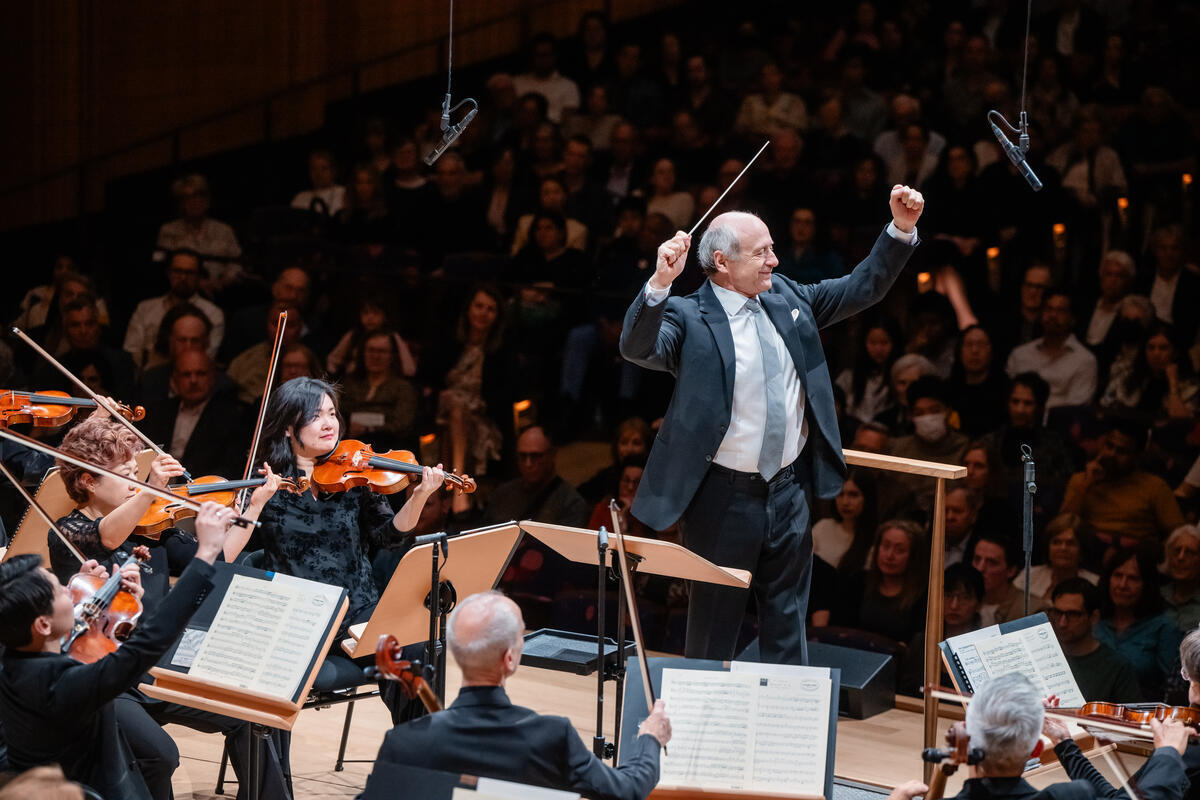
    The guest conductor was Iván Fischer, and he conducted marvelously: at ease in the music while simultaneously seeming to really have fun. Maestro Fischer appeared to conduct The Magic Flute Overture from memory at the podium, moving through the different sections of the piece with wide arm gestures.

    I had just recently seen The Magic Flute at the Metropolitan Opera the week before, so the piece was still fresh in my memory. Something very interesting was that, when I heard it that night at the Philharmonic, the overture seemed more like a symphonic suite than an overture to a stage play. It seemed more related to Mozart’s Jupiter Symphony somehow in this moment, rather than the opening to Così fan tutte. The music was played perfectly, with every dynamic crystal clear in execution. Maybe it was the perfection of how the piece was played that made it seem more symphonic and less like a piece written for the stage, where inevitably something new happens every night.
    Week32-BrandonPatoc_0013

    I particularly liked the restraint that Maestro Fischer (above, photo by Brandon Patoc) showed in the moments of the overture where silence mattered more than sound, such as the callback to the brass opening punctuated with long rests. The rests seemed longer than usual, but the impact was memorable because of it.

    The audience gave a very warm and deserved applause, after which the orchestra reduced in size to prepare for the violin concerto.

    Lisa b

    The soloist, Lisa Batiashvili (above), came out in a very memorable bright yellow dress with a baby blue sash around her waist. Normally, I don’t notice what soloists wear in performances, but this outfit seemed too intentional, almost as if it were making a statement. I thought that the color scheme seemed coincidentally similar to the Ukrainian flag until I saw a giant brooch of the U.S. Stars and Stripes cinching the sash onto her. So whatever the intent was, I’m sure it meant something to those more sartorially inclined.

    Batiashvili played the Mozart with clear familiarity with the style and music. Normally, I feel soloists tend to lean into the fiery, show-stopping nature of concertos, but Batiashvili tended toward austerity and restraint in her playing for the first two movements. The piece was played in a way that seemed courtly: certainly pleasant, but not too forward to draw attention to itself. Things changed when Batiashvili reached the cadenza of the first movement. The cadenza started out seeming to be in a Mozartian style, then veered into the chromatic and atonal. It wasn’t bad by any means, and certainly showcased Batiashvili’s virtuosity. It was just surprising to hear something so very non-classical in such a quintessentially classical piece. I read the program afterwards and saw that the cadenza was composed by a 15-year-old Georgian composer named Tsotne Zedginidze, which made quite a lot of sense in hindsight.

    I quite enjoyed the unconventional cadenza because it made me look forward to hearing the other cadenzas, which were also newly composed, one of them by the soloist herself. The other cadenzas were more traditional in nature though, which maybe was a good pairing with the one anachronistic one.

    The third movement was where Batiashvili took off and seemed to have the typical soloist verve. I had never heard the finale of this concerto before, and I loved the effects that gave the whole piece the moniker of “Turkish.” The sections where Batiashvili played the more exotic melody and the strings played col legno seemed like a vision into the future of where classical music would head with early Romanticism. The sections sounded more like Mendelssohn in one of his symphonic overtures rather than Mozart, and I was thrilled to hear it.

    After the concerto, Batiashvili gave several curtain calls, and it seemed like there was going to be an encore, but in the end, one didn’t come.

    Before the concert began, I overheard some audience members chatting and wondering why the screen normally used for super-titles for lyrics was open. Another audience member joked that it was just so they could make sure to tell people to silence their cell phones before the show.

    During intermission, the size of the orchestra ballooned, and it was almost impossible to fit more musicians on the stage. Before he started the Bartók piece, Maestro Fischer gave a short introduction. He told the audience that the piece was originally written for a short ballet, and — in an unconventional but amazing idea — had the original stage directions for the ballet projected onto the aforementioned screen while The Wooden Prince was being played.

    This piece was another first for me, and it was truly a masterpiece. The piece starts with a humming sound that almost feels like what you’d expect from a movie showing deep space.

    The story of The Wooden Prince follows a prince who falls in love with a princess, who is guarded by a fairy. The prince is blocked from being able to see the princess by the fairy, who enchants the forest in which they are to physically prevent the prince from reaching her.

    The stage directions were such a wonderful idea because they showed where Bartók’s mind went when he was creating the music for each physical gesture. At first, I thought there were going to be instruments tied to each of the characters, but in the end, the entire orchestra was involved in every scene to provide complete sonic storytelling.

    I found myself thinking about how The Wooden Prince compared with some of the other great ballets, like Tchaikovsky’s Swan Lake and Stravinsky’s Rite of Spring. The conclusion I came to was that The Wooden Prince was uniquely its own masterpiece.

    ~ Mark Anthony Martinez II

    (Performance photos by Brandon Patoc, courtesy of the NY Philharmonic)
  • Julie Taymor’s MAGIC FLUTE ~ 2023 #2

    Mozart jpg

    Author: Oberon

    Saturday December 30th, 2023 matinee – Back for a second performance of the Taymor abbreviated, English-language version of MAGIC FLUTE this afternoon. There were singers new to me in the cast, and also one of the brightest lights of the ‘now’ generation: soprano Liv Redpath, who I was keen to hear again after having very much enjoyed her singing at the Richard Tucker Gala at Carnegie Hall earlier this season, as well as her scintillating Oscar in BALLO IN MASCHERA at The Met.

    Gareth Morrell was on the podium this afternoon, pacing things perfectly and supporting the singers at every moment. It took a few moments for the Three Ladies to find their blend, but once they got going, their singing was appealing – though their role in the story is reduced by too much musical cutting in this version. Amanda Batista’s soprano is bright and clear, and Lindsay Ammann’s alto warm and dusky. As the 2nd Lady, Edyta Kulczak is always fun to hear, and her timbre is the most distinctive of the three. The Three Spirits were again weakly cast vocally. As the two Priests (essentially spoken roles), clear diction is key: Dylan Morrongiello and Paul Corona were spot on. And the duo of Guards – Daniel O’Hearn and Rocky Eugenio Sellers – helped make the Trial Scene a highlight of the show.

    Especially pleasing to hear this afternoon were Thomas Capobianco as Monastatos and William Guanbo Su as the Speaker. Mr. Capobianco seemed to favor a more ‘vocal’ approach to the slave’s music, rather than just going after comic effects. Mr. Su displayed a rich, imposing bass timbre and his excellent diction made his scene with Tamino (my favorite part of the opera) wonderfully understandable. At this, the turning point of the story, a round of applause covered the work’s most poetic moment: Tamino’s “O endless night!

    In the role of the questing Prince, Joshua Blue (who sang a very fine Verdi REQUIEM with Oratorio Society at Carnegie Hall in 2019), sang his ‘portrait aria’ persuasively, though the cuts in the music dampen the effectiveness of this paean to love. Mr. Blue’s voice falls pleasingly on the ear, with its sense of blooming lyricism;…he replied to Pamina’s radiant “Tamino mine!” with an ardent “Pamina mine!

    Liv_Redpath jpg

    Liv Redpath gave a sterling Pamina, her timbre having a nice sheen to it, and her dynamics wonderfully responsive to the princess’s moods. When Papageno, attempting to rescue Pamina, suggests that they lie to Sarastro to cover their subterfuge, Ms. Redpath responded with a heavenly “Be truthful!” and, as mentioned earlier, her “Tamino mine!” was simply gorgeous. She phrased the arching line of Pamina’s great aria perfectly, though an undercurrent of noise from the many children in the audience somewhat undermined the moment.

    Alexander-Elliot

    Alexander Birch Elliott (above) was a clear audience favorite – understandably so. His voice is robustly masculine and his diction clear as a bell: perfect delivery of line after line. He caught all the humor of the translation, and was truly hilarious as he employed an echo effect when trying to locate “Tamino…no…no…!” as darkness engulfed the scene. Mr. Elliott sealed his triumph with a terrific rendering of “Ein Mädchen oder Weibchen” (or whatever it is in translation) and enjoyed a lively ovation at his solo bow before calling forth his Papagena – Lindsay Ohse – who brought a nice touch of earthiness to her singing.

    At opposite ends of the opera’s vast span of vocal range, Jeni Houser (Queen of the Night) and James Creswell (Sarastro) both fared very well indeed. Ms. Houser’s a light-voiced Queen in the manner of Roberta Peters or Erika Köth; her first aria had some lovely delicacies of expression – as if to mask the Queen’s true intentions – and she spun out the coloratura of the concluding segment with aplomb. Her ‘vengeance aria’ was impressive in its agility and accuracy, and she summoned a nice dose of venom for her climactic command: “Swear…swear…swear!!!”  

    As the benevolent Sarastro, James Creswell’s spoken lines were vividly clear and finely inflected. In his two arias, he showed a bass voice suffused with a sense of compassion, true to his mission to save the world from encroaching darkness.

    If only we could find a Sarastro for our own time.

    ~ Oberon

  • MAGIC FLUTE @ The Met

    Joelle Harvey

    Above: soprano Joélle Harvey, this evening’s Pamina

    Monday December 26th, 2022 – The Met’s pared-down, English-language MAGIC FLUTE always offers a chance to hear interesting singers, from veterans to debutantes. Tonight’s cast featured a longtime favorite, Alan Held, as the Speaker, and the Polish soprano Aleksandra Olczyk as the Queen of the Night in her Met debut season.

    Under Duncan Ward’s baton, the opera flew by. A packed house gave only meager applause to the arias (Ms. Olczyk’s “wrath of hell” aria being the exception). But at the curtain calls, it was Joélle Harvey who received the greatest barrage of cheers…and rightly so, for she sang exquisitely.

    Ben Bliss was an excellent Tamino, finely shaping and enunciating his Portrait Aria (which is cruelly shortened in this production) and truly impressive at “O endless night…”, the opening phrase of Tamino’s great scene with The Speaker. For me, this is the pivotal passage of the opera, and Mr. Held’s responses to Mr. Bliss’s questions had gravity and meaning. Excellent, gentlemen!

    The Three Ladies (Jessica Faselt, Megan Marino, and Carolyn Sproule) sounded overly-vibrant at first, but soon smoothed things out and did some fine singing. I especially liked Ms. Sproule’s timbre: it is the lowest voice that gives the Ladies’ trios their moving parts.  The Three Spirits were rather weak at first, but they later perked up. I love their advice to the suicidal Papageno: “You have a life, so live it while you can!”

    Joshua Hopkins was again a very enjoyable Papageno, sure of voice and clear of diction. Soloman Howard sang Sarastro’s two great arias with nobility and rich tone, and – at the opposite end of the vocal spectrum – Aleksandra Olczyk tossed off the Queen of the NIght’s pyrotechnics successfully: the voice brightens at the top, making the high-Fs easy targets for her.  A bit of pitchiness did not deter from her success.

    Rodell Rosel repeated his crafty Monastatos, and Lindsey Ohse’s spirited Papagena showed her lustiness in the spoken dialogue: I think she will be wearing the pants in that marriage.

    Ms. Harvey walked away with top honors this evening; Pamina’s aria had a tonal shimmer that fascinated me, especially in the floated piani notes, which gave me goosebumps. The soprano’s luminous sound at “Be truthful…be truthful...” was matched soon after with her radiant “Tamino mine…”

    ~ Oberon

  • Rolando Villazón’s Papageno @ The Met

    Villazon papageno

    Above: Rolando Villazón rehearsing the role of  Papageno; a Met Opera photo

    Saturday December 18th, 2021 – Though I would like to have seen The Met’s Julie Taymor MAGIC FLUTE again, financial constraints decided me to get score desks for all but a couple of Met performances this season. One of the main draws for FLUTE this time around was to hear Rolando Villazón essaying the role of Papageno. When Villazón’s career as a primo tenore faltered a few years back, he shifted into different repertory. But I believe his taking on Papageno might be a first step towards joining the ranks of baritones

    In the event, though he was HUGELY cheered at his solo bow, Villazón’s Papageno didn’t really work in vocal terms. His voice is no longer very attractive, being a bit dry and lacking in resonance. Much of the time he semi-spoke his musical lines, whilst the actual spoken passages, charmingly accented, were not always understandable. He made bird noises from time to time; his rooster crow was hilarious. It struck me that Placido Domingo in his 80s has more voice at his disposal than Villazón, who is not yet 50.

    The remainder of the cast has its pluses and minuses. Outstanding were Matthew Polenzani’s beautifully turned phrases, exquisite piano notes, and clear diction as Tamino, and the rich and rolling sound of basso of Morris Robinson, whose diction was also superb, as Sarastro. Patrick Carfizzi’s Speaker, Rodell Rosel as Monostatos, and Ashley Emerson’s Papagena were excellent, making much of their roles. Daryl Freedman’s Third Lady and Adam Lau’s Second Guard stood out. 

    Kathryn Lewek dazzled with the Queen of Night’s first aria, climaxing with a sustained high-F; later, in her Vengeance aria, Ms. Lewek’s singing was not quite as impressive as she has been in previous seasons. Hera Hyesang Park’s attractive lyric timbre acquired an edgy quality when she put too much pressure on the tone higher up. Felicia Moore has impressed me on YouTube, but today as the First Lady she sang well but not memorably, though the voice blossomed more as the afternoon went on. Sarah Larsen was fine as the 2nd Lady, Matthew Burns and Mark Schowalter spoke clearly as the Priests, and Richard Trey Smagur was a forthright 1st Guard. The Three Spirits were under-powered and pitchy; I hope when The Met gets a new ZAUBERFLOETE, the music of these Three Spirits will once again be sung by petite women, of the same ilk as Suzanne Adams, Christine Weidinger, Frederica von Stade, Helen Vanni, and Joann Grillo, all of whom were Spirits at The Met over the years.

    Jane Glover’s conducting was well-nigh perfect, and the orchestra played well; Chelsea Knox’s flute solos fell gracefully on the ear.

    An annoying child in the Family Circle whined and muttered often throughout the opera, and the sound of moving sets around behind the drop curtain during “O Isis and Osiris” spoiled that beautiful passage. But…all’s well as ends well. As the Three Spirits remind Papageno – and us: “You have a life, so live it while you can!”

    Saturday December 18th, 2021 matinee
    THE MAGIC FLUTE}
    Wolfgang Amadeus Mozart

    Pamina.......................................Hera Hyesang Park
    Tamino.......................................Matthew Polenzani
    Queen of the Night...........................Kathryn Lewek
    Sarastro.....................................Morris Robinson
    Papageno.....................................Rolando Villazón
    Papagena.....................................Ashley Emerson
    Monostatos...................................Rodell Rosel
    Speaker......................................Patrick Carfizzi
    First Lady...................................Felicia Moore
    Second Lady..................................Sarah Larsen
    Third Lady...................................Daryl Freedman
    Genie........................................Julian Knopf
    Genie........................................Julian Fertel
    Genie........................................N. Casey Schopflocher
    Priest.......................................Ashraf Sewailam Priest.......................................Mark Schowalter
    Guard........................................Richard Trey Smagur
    Guard........................................Adam Lau
    Slave........................................Stephen Paynter
    Slave........................................Kurt Phinney
    Slave........................................Craig Montgomery
    Solo Dancer.......................................Maria Phegan

    Flute Solo...................................Chelsea Knox

    Conductor....................................Jane Glover

    ~ Oberon 

  • Unkindest Cut

    Flute4

    Just back from a Met matinee of the Julie Taymor MAGIC FLUTE. This season is reportedly the last in which this production will be given. I have enjoyed this 100-minute, English-language version many times over the years, but every time – and especially today – the cuts are painful, and none more so than that of the Chorus of the Priests. So I am posting this rendition in Hungarian (!) as compensation. 

    Chorus of the Priests ~ Die Zauberflote (Sung in Hungarian)

  • Met’s Holiday MAGIC FLUTE

    Zauberflote Marty Sohl

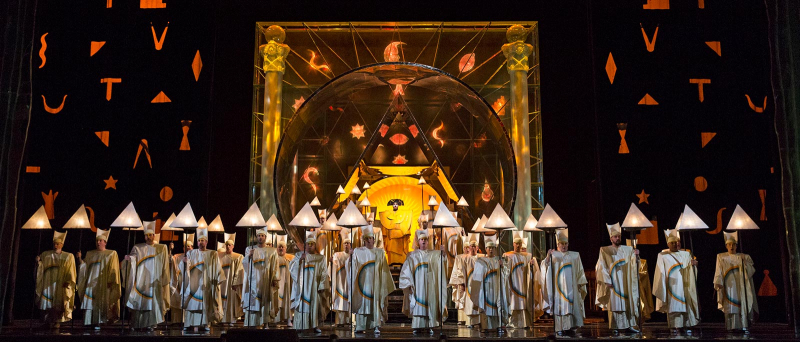
    Tuesday December 20th, 2016 – Julie Taymor’s inventive production of Mozart’s MAGIC FLUTE (above, in a Marty Sohl/Met Opera photo) is the Metropolitan Opera’s 2016 holiday season offering. In this pared-down version, sung in English, quite a bit of dialogue is cut, but – alas! – so are some of my favorite moments from the score. The overture is reduced to merely the opening chords; half of Tamino’s ‘portrait’ aria is sacrificed; and the loss of the enchanting “Bei Männern” duet and of the divine Chorus of the Priests are the unkindest cuts of all.

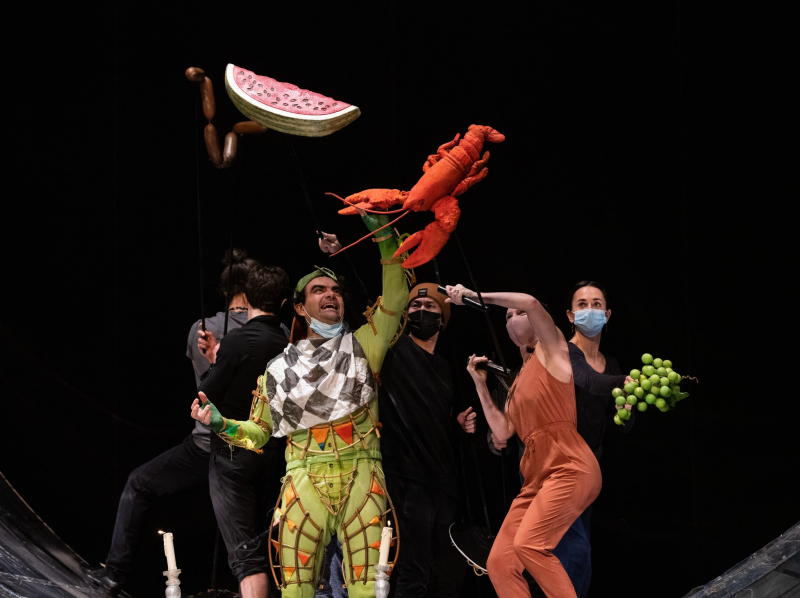
    The Taymor is the third Met production of FLUTE in my operatic career, following the dazzling Chagall and the vivid David Hockney. Ms. Taymor’s setting is a charmer, with a crew of black-clad deck-hands manipulating giant puppets, a huge pre-historic bird to carry the Three Genii aloft, and a bevy of colorful avian-ballerinas (led by Emery LeCrone) who are enchanted by Papageno’s bells. 

    Antony Walker led a finely-paced performance, where both the light-hearted and the profound aspects of the score were given due honor. The sound of Érik Gratton’s flute, playing from the pit, fell most graciously on the ear, especially in the Trial Scene.

    Brugger, Janai 2

    The Met put forth a very appealing cast this evening. Janai Brugger (above) as Pamina and Ben Bliss as Tamino sang so persuasively that the loss of half of Ben’s aria and of Janai’s duet with Papageno were to be all the more lamented. Mr. Bliss, who gave a lovely recital at Weill Hall earlier this season, was a tall and ardent Prince, his singing clear and stylish.

    Ms. Brugger’s Pamina was a revelation: her warm vibrato and delicious turns of phrase captivated me all evening. The voice is very ‘present’ in the big hall; her highest notes, often nuanced to a luminous piano, were exquisite. The great aria was a moving expression of feminine vulnerability wherein Pamina’s mistaken belief that Tamino no longer loves her was movingly conveyed. I’m very sorry now that I missed Ms. Brugger’s Liu at The Met; the role I most want to hear her in – soon – is Mimi in BOHEME.

    Headshot-watch02a

    Morris Robinson (above) was a majestic, vocally grand Sarastro. His voice spans the range with true command – the deep notes wonderfully resonant – and in matters of phrasing and diction he imbues the music with a rich sense of humanity. It’s always a great pleasure to hear Mr. Robinson at the Met, and tonight his performance was particularly impressive. 

    Christopher Maltman’s Papageno was a genuine joy, his singing robust and sprightly by turns, and his Brit accent adding an extra bit of charm. An agile actor, Mr. Maltman took the production’s pratfalls in stride. He made the birdcatcher a vivacious but never silly character, and we were all rooting for him to win his Papagena, played – with creaky quirkiness when old and blithe perkiness when young – by Dísella Lárusdóttir.

    As the Queen of the Night, Jessica Pratt was undaunted by this most difficult of debut roles. In two arias, touching on five high-Fs, the soprano is in a make-or-break situation; Ms. Pratt came thru with flying colours, bringing a striking sense of drama to her spoken instructions to Pamina (to commit murder) and with deft coloratura in the ensuing aria. In her final command: “Swear! Swear! Swear to avenge me!” Ms. Pratt latched onto a brilliantly sustained top note that rang splendidly into the hall.

    Shenyang played the all-too-brief role of The Speaker; his scene with Tamino outside the temple is actually my favorite part of the opera, wherein Tamino’s world is turned upside-down. Shenyang and Mr. Bliss were excellent here, and how I was wishing that the bass-baritone sang in New York far more frequently. 

    Robert Brubaker gave a brilliant performance as the duplicitous Monastatos, his singing strong and his diction clear. Making his exit after being repelled by Pamina, Mr. Brubaker casually tossed the line: “If I can’t have the daughter, I’ll try for the mother!” over his shoulder. I laughed out loud. 

    Wendy Bryn Harmer, Sarah Mesko (debut), and Maria Zifchak made a very fine trio of Ladies, vocally well-matched and carrying out all their stage business with aplomb. An especially impressive trio of Genii – Daniel Katzman, Misha Grossman, and Dylan Hansen Hamme – sang firmly and blended very well in music that is often delivered weakly and with unsure pitch. Good work, boys! Mark Schowalter and Scott Scully (Priests) and Noah Baetge and Rod Nelman (Guards) rounded out the evening’s cast.

    In the well-sold House were hundreds of children, and for the most part they were silent as mice. Of course the exception had to be sitting right next to us: she did some epic nose-blowing throughout the latter scenes of the evening. Step out to the hallway, dear!

    Then, on leaving the theatre, my friend Claudia and I were accosted by a deranged patron who was incensed and righteously offended that the opera had not been given complete and was not sung in German: somehow this became our fault. After a moment of being polite, I was overcome by his severe case of halitosis. He blustered on and on while we ignored him. Finally he rushed away, crashing into the revolving door. What a miserable bloke.

    But all’s well as ends better, as the hobbits say. We had a great time at the Met tonight.

  • Met’s Holiday MAGIC FLUTE

    Zauberflote Marty Sohl

    Tuesday December 20th, 2016 – Julie Taymor’s inventive production of Mozart’s MAGIC FLUTE (above, in a Marty Sohl/Met Opera photo) is the Metropolitan Opera’s 2016 holiday season offering. In this pared-down version, sung in English, quite a bit of dialogue is cut, but – alas! – so are some of my favorite moments from the score. The overture is reduced to merely the opening chords; half of Tamino’s ‘portrait’ aria is sacrificed; and the loss of the enchanting “Bei Männern” duet and of the divine Chorus of the Priests are the unkindest cuts of all.

    The Taymor is the third Met production of FLUTE in my operatic career, following the dazzling Chagall and the vivid David Hockney. Ms. Taymor’s setting is a charmer, with a crew of black-clad deck-hands manipulating giant puppets, a huge pre-historic bird to carry the Three Genii aloft, and a bevy of colorful avian-ballerinas (led by Emery LeCrone) who are enchanted by Papageno’s bells. 

    Antony Walker led a finely-paced performance, where both the light-hearted and the profound aspects of the score were given due honor. The sound of Érik Gratton’s flute, playing from the pit, fell most graciously on the ear, especially in the Trial Scene.

    Brugger, Janai 2

    The Met put forth a very appealing cast this evening. Janai Brugger (above) as Pamina and Ben Bliss as Tamino sang so persuasively that the loss of half of Ben’s aria and of Janai’s duet with Papageno were to be all the more lamented. Mr. Bliss, who gave a lovely recital at Weill Hall earlier this season, was a tall and ardent Prince, his singing clear and stylish.

    Ms. Brugger’s Pamina was a revelation: her warm vibrato and delicious turns of phrase captivated me all evening. The voice is very ‘present’ in the big hall; her highest notes, often nuanced to a luminous piano, were exquisite. The great aria was a moving expression of feminine vulnerability wherein Pamina’s mistaken belief that Tamino no longer loves her was movingly conveyed. I’m very sorry now that I missed Ms. Brugger’s Liu at The Met; the role I most want to hear her in – soon – is Mimi in BOHEME.

    Headshot-watch02a

    Morris Robinson (above) was a majestic, vocally grand Sarastro. His voice spans the range with true command – the deep notes wonderfully resonant – and in matters of phrasing and diction he imbues the music with a rich sense of humanity. It’s always a great pleasure to hear Mr. Robinson at the Met, and tonight his performance was particularly impressive. 

    Christopher Maltman’s Papageno was a genuine joy, his singing robust and sprightly by turns, and his Brit accent adding an extra bit of charm. An agile actor, Mr. Maltman took the production’s pratfalls in stride. He made the birdcatcher a vivacious but never silly character, and we were all rooting for him to win his Papagena, played – with creaky quirkiness when old and blithe perkiness when young – by Dísella Lárusdóttir.

    As the Queen of the Night, Jessica Pratt was undaunted by this most difficult of debut roles. In two arias, touching on five high-Fs, the soprano is in a make-or-break situation; Ms. Pratt came thru with flying colours, bringing a striking sense of drama to her spoken instructions to Pamina (to commit murder) and with deft coloratura in the ensuing aria. In her final command: “Swear! Swear! Swear to avenge me!” Ms. Pratt latched onto a brilliantly sustained top note that rang splendidly into the hall.

    Shenyang played the all-too-brief role of The Speaker; his scene with Tamino outside the temple is actually my favorite part of the opera, wherein Tamino’s world is turned upside-down. Shenyang and Mr. Bliss were excellent here, and how I was wishing that the bass-baritone sang in New York far more frequently. 

    Robert Brubaker gave a brilliant performance as the duplicitous Monastatos, his singing strong and his diction clear. Making his exit after being repelled by Pamina, Mr. Brubaker casually tossed the line: “If I can’t have the daughter, I’ll try for the mother!” over his shoulder. I laughed out loud. 

    Wendy Bryn Harmer, Sarah Mesko (debut), and Maria Zifchak made a very fine trio of Ladies, vocally well-matched and carrying out all their stage business with aplomb. An especially impressive trio of Genii – Daniel Katzman, Misha Grossman, and Dylan Hansen Hamme – sang firmly and blended very well in music that is often delivered weakly and with unsure pitch. Good work, boys! Mark Schowalter and Scott Scully (Priests) and Noah Baetge and Rod Nelman (Guards) rounded out the evening’s cast.

    In the well-sold House were hundreds of children, and for the most part they were silent as mice. Of course the exception had to be sitting right next to us: she did some epic nose-blowing throughout the latter scenes of the evening. Step out to the hallway, dear!

    Then, on leaving the theatre, my friend Claudia and I were accosted by a deranged patron who was incensed and righteously offended that the opera had not been given complete and was not sung in German: somehow this became our fault. After a moment of being polite, I was overcome by his severe case of halitosis. He blustered on and on while we ignored him. Finally he rushed away, crashing into the revolving door. What a miserable bloke.

    But all’s well as ends better, as the hobbits say. We had a great time at the Met tonight.