Tag: Marie McDermott

  • Mendelssohn Evening @ CMS

    F m

    Above: Felix Mendelssohn

    ~ Author: Oberon

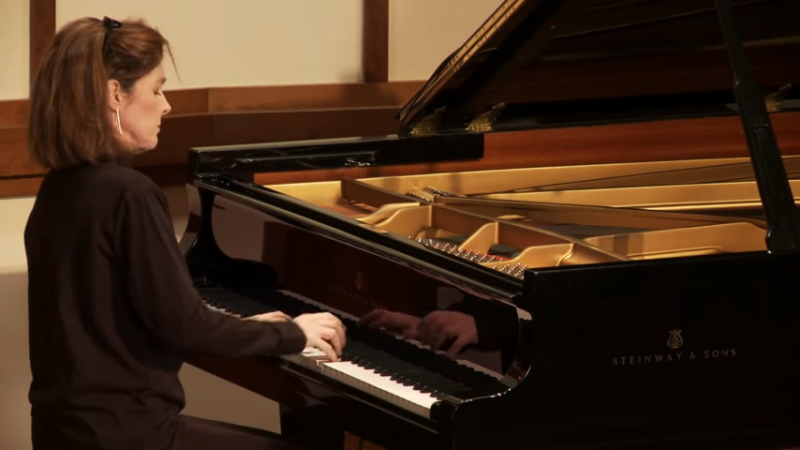
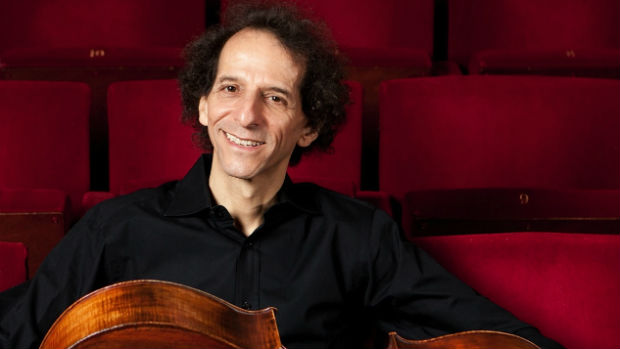
    Tuesday February 25th, 2025 – Chamber Music Society of Lincoln Center offering an all-Mendelssohn evening featuring a de luxe ensemble of musicians: pianist Anne-Marie McDermott, violinist Arnaud Sussmann, cellist Nicholas Canellakis, and the Escher Quartet.

    This concert was a much-needed lift of my spirits after weeks of unbearably frigid weather and a weekend of unsettling health issues. Just setting foot in Alice Tully Hall made me feel better; and then the music – and the musicians – provided just the right antidote to my malaise. By the end of the program, I was thoroughly rejuvenated. 

    20250225_CMS_Mendelssohn_DressRehearsal__Preview_045

    Mr. Canellakis and Ms. McDermott (above photo by Da Ping Luo) opened the program with the Sonata No. 1 in B-flat major, Op. 45. The sonata’s Allegro vivace commences with a unison passage; a rolling melody emerges, in which he cello’s lower range is explored. Moving into minor mode, the music becomes insistent. Arpeggios from the Canellakis cello turn into long tones sustained over a roaming piano. The music turns passionate, then grand, leading to a brisk finish full of Ms. McDermott’s marvelous playing.

    The winsome piano introduction to the Andante signals the appearance of a familiar theme. Nick’s melodious cello sings over elegant passages from the Steinway; Ms. McDermott then plays a delicate dance accompanied by plucked cello figurations. An increase of passion lasts only moments; the piano resumes its lightness and the music fades away.

    The concluding Allegro assai brings a flow of melody; things get more animated, sweeping forward with lyrical, haunting passages. An energetic ending looms, but Mendelssohn instead provides a peace-filled finish. 

    20250225_CMS_Mendelssohn_DressRehearsal__Preview_063

    Above, the Escher Quartet: Adam Barnett-Hart, Brendan Speltz, Brook Speltz, Pierre Lapointe; photo by Da Ping Luo

    The Eschers then took the stage for the Quartet in F-minor for Strings, Op. 80.

    Fanny Mendelssohn, Felix Mendelssohn’s beloved older sister, had died unexpectedly at the age of 41 in May of 1847. Felix, devastated, was unable to attend the funeral; he went to Switzerland to recover. There, he hiked and painted, and forced himself to compose, managing to compete his F-minor quartet. It would be one of his last completed works; he died on  November 4th at the age of 38.

    The Allegro vivace assai has an agitated feel: fast, fantastical music with sentimental pauses woven in. The Eschers’ trademark blend is at its most persuasive, viola and cello emerging with darker hues. Classic harmonies abound, and then the foursome become speed demons.

    Unison passages open the familiar Scherzo; while energetic, the music abounds in subtleties that hint at deeper underlying thoughts. Viola and cello sing in unison before the scherzo reaches what seems like a delicate finish, only to be extended by a sort of coda.

    Anguish overtakes the mood in the Adagio as Brook Speltz’s velvety cello sings a poignant melody. This is music full of longing. Themes are passed about, each of the four voices distinctively expressive. The quartet’s dynamic range is lovingly in evidence. Almost unbearably beautiful harmonies are set forth, with violist Pierre Lapointe in a lamenting passage before before Adam Barnett-Hart’s violin makes a final, poignant ascent.

    The minor mode feels ominous as the finale commences. The insistent cello carries the musicians to fresh themes, with shifts from major to minor seeming to evoke Mendelssohn’s struggle with his emotions in his mourning state. Mr. Barnett-Hart’s marvelous artistry shines in the work’s concluding measures. The Eschers, ever immaculate in their music-making, were warmly hailed by the packed house.

    Following the interval, the Eschers re-appeared for an Andante and Scherzo culled from Four Pieces for String Quartet, Op. 81, opening with an Andante sostenuto filled with courtly elegance. Mr. Lapointe savors a solo viola melody, and then things speed up. Sweet violin phrases are met by animation from the cello. Mr. Barnett-Hart’s cadenza leads to a da capo, and the music comes to a pretty finish.

    Next on offer was more music from Opus 81: a Scherzo in Midsummer Night’s Dream mode which introduces duetting from Mr. Barnett-Hart and his fellow violinist, Brendan Speltz. This is witty and wonderful music, thoroughly captivating.
    20250225_CMS_Mendelssohn_DressRehearsal__Preview_006

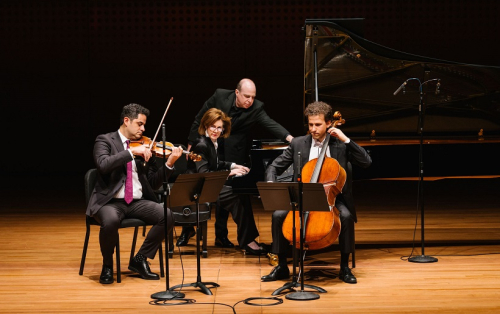
    Above: Arnaud Sussmann, Anne-Marie McDermott, and Nick Canellakis; photo by Da Ping Luo

    To conclude the evening, the Trio No. 2 in C-minor for piano, violin, and cello, Op. 66, was given a thrilling rendering by Ms. McDermott, joined by violinist Arnaud Sussmann and Mr. Canellakis.

    Rolling piano motifs and restless strings open the main theme of the first movement, in which melodious themes are passed among the three musicians. Ms. McDermott, in some of the most amazing playing I have ever heard from her, set forth cascading keyboard passages – filled with both passion and subtlety – to dazzling effect. The Canellakis cello has a tender melody, taken up by the Sussmann violin, with magical support from Ms. McDermott; her playing was epic, and the trio swept onward with interwoven harmonies from the gentlemen. Bravi, bravi, bravi!!

    The gentle Andante espressivo, with its nostalgic piano introduction, becomes waltz-like as the strings join lovingly. Piano interludes enchant; Mr. Canellakis delights with his poetic playing, while the sheer perfection of Mr. Sussmann’s artistry creates a simply gorgeous atmosphere in which we can linger and dream. Passion rises, only to settle into bliss. 

    Next, music that shows us why Mendelssohn is the King of the Scherzo…it’s swift and sure, the playing dazzling. The musicians seemed to be having a blast here.

    The cello, and then violin, set the mood of the concluding Allegro appassionato…and passion is indeed the byword here. Bending minor-key themes are intriguing; Ms. McDemott is simply sensational at every moment. Crazy fun! But then a reverential interlude suddenly emerges, Mr. Sussmann’s violin singing sweetly over the piano accompaniment. This introspection gives way to thrilling build-up of emotion, with Ms. McDemott’s keyboard on the verge of bursting into flame.

    As the last note sounded, the audience rose to salute the players with a roaring ovation that brought them forth for a second bow, much to everyone’s delight. I literally felt reborn. 

    ~ Oberon

  • The Soldier’s Tale @ Chamber Music Society

    McDermott_1600x660

    Above: pianist Anne Marie McDermott

    ~ Author: Oberon

    Sunday November 24th, 2019 – A thoughtfully-devised program this evening at Chamber Music Society of Lincoln Center gave prominence to the inspired – and inspiring – pianist Anne-Marie McDermott. Ms. McDermott has given me some of my happiest times at CMS, most memorably with her playing of Mozart’s K. 466 in May 2018: a performance which drew a vociferous ovation.

    Tonight, the pianist played in every work on the program, commencing with Beethoven’s Trio in B-flat major for Clarinet, Cello, and Piano, Op. 11 (1797) for which she was joined by the Spanish clarinetist Jose Franch-Ballester, and cellist Gary Hoffman, whose leap to prominence followed his 1986 win of the Rostropovich International Competition in Paris. Together, the three musicians filled Beethoven’s score with vibrant musicality.

    The timbres of the three ‘voices’ aligned perfectly, and rhythmic clarity was a hallmark of their performance. Dramatic accents cropped up in the opening Allegro con brio, to which a pensive interlude brings contrast.

    A waltz-like motif for the cello is taken up by the clarinet in the Adagio: a fine opportunity to savor the coloristic gifts of Mssrs. Franch-Ballester and Hoffman. Ms. McDermott brought gentley nuances to the mix, and, after a slightly darker passage, her delicacy of touch underscored Mr. Hoffman’s graciously expressive softness of melody.

    The trio’s finale is a theme-and-variations affair which gets off to a perky start. The first variation brings some elaborate piano passages, the second a cello/clarinet duo, and the third is fast and fun. After veering into minor mode for the fourth variation, the music proceeds to a passing about of the theme, a petite marche, some tickling trills from the keyboard, and a witty finish. 

    The concert’s centerpiece was a vivid performance of Igor Stravinsky’s L’Histoire du soldat (The Soldier’s Tale), in the trio version for violin, clarinet, and piano (1918, arranged 1919), Mr. Franch-Ballester brought two clarinets to the stage for this work, which commences with The Soldier’s March, filled with jaunty swagger and relentless piano. A bouncing piano figuration introduces The Soldier’s Violin, wherein Ida Kavafian’s bow dances across the strings, and the clarinet provides a sense of jollity. The music seems about to fade away until it hits a punctuating chord.

    A Little Concert brings swirls of notes, the piano rhythm pulsing along. The music has an ironic feeling, and turns insistent before its sudden end. A dance triptych (Tango, Waltz, Ragtime) finds Ms. Kavafian’s violin in waltzing mode, with rhythmic piano and commenting clarinet. The final movement of his colourful suite, The Devil’s Dance, has a wild streak. The three musicians seemed truly to enjoy playing this miniature masterpiece, which clocks in at a mere fifteen minutes but covers a lot of musical territory in its course.

    Following the interval, Ms. McDermott had the stage all to herself with some marvelous Mendelssohn: selections from Lieder ohne Worte (Songs Without Words). She chose numbers 1, 2, and 3 from the cycle which made for a nicely contrasted segment of the program. Her playing was both elegant and passionate, and her mastery of dynamics was very much to the fore.

    Bedřich Smetana’s Trio in G-minor for Piano, Violin, and Cello, Op. 15 (1855, revised in 1857) was written in memory of the composer’s four-year-old daughter Gabriela, who succumbed to scarlet fever in 1854.

    Thus, the work begins with Ida Kavafian’s playing of a violin solo of yearning tenderness, with a rise in passion which subsides to a cello theme and an ascending phrase for the violin. Suddenly, a forward impetus springs up, and the music gathers steam to a grand outburst. Following a brief violin cadenza, the string players introduce a buzzy agitato, over which Ms. McDermott plays some sparkling piano passages. The music grows rhapsodic, and grand passions burst forth before Mr. Hoffman’s lyrical cello and Ms. Kavafian’s shining violin conspire to play on our emotions. The Moderato assai comes to an emphatic, passionate conclusion.

    Bustling, almost furtive strings lend a scherzo-like feeling to the start of the second movement. Melodic motifs sing forth, building to grandeur before finding a quiet place to conclude. The three musicians dig in for the final Presto, for which Ms. McDermott sets a fast pace. In a reflective mood, Ms. Kavafian and Mr. Hoffman have appealing solo passages, and the pianist a thoughtful interlude.

    Now some fast plucking takes over, and the music dances along for a bit. But a calmer mood returns, with the music going deep. The trio ends grandly, with an affirmative air of hope springing from the ashes of tragedy.

    ~ Oberon

  • Concerto Night @ CMS

    A-M McDermott

    Above: Anne-Marie McDermott at the Steinway; she delivered a phenomenal Mozart K. 466 at Chamber Music Society of Lincoln Center‘s end-of-the-season performance at Alice Tully Hall tonight.

    Author – Oberon

    Sunday May 20th, 2018 – For the final offering of their 2017-2018 season, Chamber Music Society of Lincoln Center presented five concerti, each calling for a varied ensemble of players; an impressive group of artists came together to assure yet another great CMS evening of music-making. A surprise addition to the program, in the second half, was an added treat.

    Jean-Marie Leclair’s Concerto in B-flat major for Violin, Strings, and Continuo, Op. 10, No. 1 was a wonderful program-opener, bringing forth a sterling performance from violinist Bella Hristova. This was my second Leclair encounter this Spring: in April, the composer’s Sonata for Two Violins in E-minor was played by artists from the New York Philharmonic at a Merkin Hall matinee. Today, again, Leclair’s music seemed truly fresh and vivid.

    Bella

    Ms. Hristova (above, in a Lisa-Marie Mazzucco portrait) looked gorgeous in a gunmetal grey gown, styled à la Grecque. Gilles Vonsattel was ready to play at the harpsichord and, with an ensemble of string players – Aaron Boyd, Sean Lee, Mihai Marica, Paul Neubauer, and Timothy Cobb – ranged around her, Ms. Hristova and her colleagues created a picture that somehow represented everything I love about Chamber Music Society. And then they began to play. 

    Ms. Hristova has always played beautifully, but there was some intangible quality in her artistry tonight that gave her performance a special glow. In this elegant, cordial music, she sounded splendid in both the lyrical passages and in the abounding coloratura. The poignant melody of the Andante was particularly appealing, where Mr. Cobb’s genial and rich bass also made a fine impression. In the concluding Gigue, veering between major and minor, Ms. Hristova the capped her triumph. As waves of applause swept thru the hall, Ms. Hristova strode back onto the stage for a bow, assuming that her colleagues were right behind her. But the men had held back, so that she could bask in the warm reception that she so truly deserved.

    For Mozart’s Concerto in D minor for Piano and Strings, K. 466 – composed in 1785 and played tonight in Carl Czerny’s arrangement – Anne-Marie McDermott took her place at the Steinway, joined by Tara Helen O’Connor (flute), Sean Lee and Ms. Hristova (violins), Paul Neubauer (viola), Mihai Marica (cello), and Timothy Cobb (bass). The audience, poised to hear great music-making, experienced a revelatory performance from Ms. McDermott.

    The concerto’s opening Allegro has an almost sneaky start, and then proceeds thru alternating modes of storm and calm. From the piano’s first entrance in a solo passage, it was clear we were in for exceptional playing from Ms. McDermott. The movement has a da capo with added piano roulades and an exchange of phrases between Sean Lee’s violin and Ms. O’Connor’s flute. The piano part becomes increasingly prominent. After a second da capo, Ms. McDermott trilled her way into a big cadenza; then the music again moved thru major/minor variants.

    The Romance begins with the piano in straightforward phrases which develop over a gracious pulsing motif from the strings. Ms. McDermott’s gift for nuance, and her suave turns of phrase, were abundantly pleasing to hear. In the da capo, Ms. O’Connor’s flute adds a sparkle to the harmonies; modulations, masterfully handled by Mozart, carry thru to the finish.

    Agitated bowing sets up the Rondo-finale, and as Ms. McDermott sailed thru delicious virtuoso passages with technical dazzle and amazing grace. One could sense the audience’s pent up excitement was about to burst. And burst it did. Thunderous applause filled the hall, with the pianist’s colleagues joining in and refusing to stand until she had stepped forward for a bow. The delirium continued, everyone on their feet, as Ms. McDemott and her fellow artists returned for two more bows.

    VonSattelGilles_bio

    To open the evening’s second half, Gilles Vonsattel (above) treated us to an immaculate performance of the Bach Concerto in G minor for Keyboard, BWV 975 (after Vivaldi RV 316). The oldest music on the program (dating from 1713-14), it sounded brand new: so alive and clean. In the Largo, especially, Mr. Vonsattel’s hushed pianissimi phrases and his rippling figurations played over a gentle pulse made an enchanting impression. Pianist, piano, Bach…a wonderfully intimate performance, the audience keenly attentive and appreciative.

    Paul_neubauer

    Above: violist Paul Neubauer

    Still on a high from experiencing The New York Philharmonic’s extraordinary performance of the Shostakovich 5th under Semyon Bychkov’s baton a few days ago, I was happy to hear Wu Han announce a surprise addition to the scheduled program this evening. Recently when she was in Saint Petersburg, Wu Han heard that the manuscript of a very short Shostakovich piece for viola and piano had just been discovered. Somehow she managed to bring a copy of this two-page work back to New York City with her. Paul Neubauer learned it in a day, and – with Wu Han at the piano – gave us what was most likely the first public performance (and for sure the US premiere) – of Shostakovich’s Impromptu for Viola and Piano (1931).

    This Impromptu is in two movements, a sad and very Russian melody – soft and sorrowing – which displayed Mr. Neubauer’s finely-controlled tone – and then a lively, folk-like dance kicked off by Wu Han at the piano, her bright-red shoes tapping the floor. A little musical gem, this would seem a perfect encore piece for Mr. Neubauer in future.

    Leos Janáček’s Concertino for Clarinet, Bassoon, Horn, Two Violins, Viola, and Piano (1925) is a quirky delight of a piece. As if the unusual instrumentation was not enough on its own, the full complement of musicians do not play in the first and second movements. The opening Moderato involves only the piano and horn (Ms. McDermott and burnish-toned Stewart Rose), and for the second – Più mosso – only clarinet (Tommasso Lonquich) and piano are heard, until the strings add a couple of chords at the finish.

    Mr. Lonquich had brought three clarinets to the stage, switching from one to another as the music progressed. His lively trills danced the music on to a string finish. The Concertino moves on: a rocking, swaying mode, an off-kilter march, slashing bows, dancing or jogging along, vigorous plucking, extended string trills, a misterioso piano, a fast finale.  

    Bg01

    Above: percussionist Ayano Kataoka

    The evening closed with the most recently-written work on the bill: Micro-Concerto for Solo Percussion, Flute, Clarinet, Violin, Cello, and Piano, composed 1999 by Steven Mackey. Ayano Kataoka moved from place to place on the stage where her various percussion instruments were arrayed. A superb “supporting cast” had been assembled: Tara Helen O’Connor (flute, and piccolo), Tommaso Lonquich (clarinet, and bass-clarinet), Sean Lee (violin), Mihai Marica (cello), with Gilles Vonsattel at the Steinway. The musical ensemble has their work cut out for them, as the writing seemed quite tricky and they were sometimes called upon to make unusual sound effects.

    Ms. Kataoka played several ‘legit’ percussion instruments, plus a few that she and composer John Mackey apparently found under the proverbial kitchen sink, including whistles and clickers. Often she played two or three of these at a time. A petite woman with giant talent, Ms. Kataoka had choreographed herself to always be in the right place at the right time, and the audience seemed genuinely intrigued by her every move and by all the varied sounds she produced. 

    The work opens with an extra-terrestrial quality. Tara Helen O’Connor had 2 flutes and a piccolo at her fingertips; the composer calls on her for everything from low sputtering to piccolo pipings. Two passages have special appeal: one for bass clarinet (Mr. Lonquich) and Ms. Kataoka’s vibraphone, and a second where Mihai Marica’s expert cello playing meshed with the marimba to sensuous effect.  

    The composer bounded onto the stage for a bow at the end, thanking all the players, and embracing Ms. Kataoka. The percussionist’s frock was a contemporary take on traditional Japanese dress with a shortened skirt and a fanciful obi.  

    ~ Oberon

  • Fauré & Ysaÿe at Chamber Music Society

    AnneMarie-McDermott-Jan-2013-468x310

    Above: pianist Anne-Marie McDermott

    Sunday October 26th, 2014 – Works by the Belgian violinist/composer Eugène Ysaÿe and his better-known French contemporary Gabriel Fauré were on the bill at Alice Tully Hall as Chamber Music Society of Lincoln Center presented this dusk-hour concert on a cool Autumn day. My friend Monica Wellington and I are both very much admirers of the Fauré works used by George Balanchine in his poetic ballet EMERALDS, but neither of us were much familiar with the music of Ysaÿe.

    The opening work: why is it called the Dolly Suite? Excellent question, and one I’d never thought to delve into until now, when I’m hearing it played live for the first time. ‘Dolly’ was the affectionate nickname of Helene Bardac, the young daughter of Fauré’s long-time mistress, Emma Bardac. Fauré composed the brief works that comprise the suite between 1893 and 1896, to mark birthdays and other events in Helene’s life.

    The suite’s movements are:

    Berceuse (a lullabye), honoring Helene’s first birthday (Allegretto moderato).
    Mi-a-ou, which gently mocks Helene’s attempts to pronounce the name of her elder brother Raoul, who later became a pupil of Fauré’s.
    Le Jardin de Dolly (Andantino); this was composed as a present for New Year’s Day, 1895. It contains a quotation from Fauré’s first violin sonata, composed 20 years earlier.
    Kitty-valse: this is not about a cat, but rather about the Bardacs’ pet dog, named Ketty.
    Tendresse, an andante, was written in 1896 and presages the composer’s beloved Nocturnes.
    Le pas espagnol (Allegro) denotes a lively Spanish dance tune which brings the suite to its close.

    Cms_01

    The suite is set for piano four-hands, and as I watched Wu Han (above) and Anne-Marie McDermott together at the keyboard, I couldn’t help but think of them as the Dolly Sisters. In her opening remarks, Wu Han spoke of the intimate nature of chamber music and the fact that there’s nothing quite so intimate as playing piano four-hands. She and Ms. McDermott seemed to be having a grand time with this music. Their immaculate playing illuminated the six contrasted movements, which veer from boisterous to delicate, sometimes in the twinkling of an eye. The audience were as charmed by the work as by the players.

    Index

    Yura Lee (above) is a favorite with CMS audiences; she seems most often to be heard here as a violist, but tonight she had a lovely opportunity to bring forth her violin for a subtle and ravishing performance of Ysaÿe’s Rêve d’enfant (a CMS premiere) in which she played with clear lyricism and great control. Ms. McDermott at the Steinway underscored her colleague’s transportive musicianship with playing of calming refinement.

    Dautricourt

    In a rare performance of Ysaÿe’s Sonata in A minor for Two Violins (tonight marked the work’s CMS premiere), a duet sometimes deemed unplayable, Yura Lee and Nicholas Dautricourt (above) remained undaunted by the composer’s overwhelming technical demands, and they formed a spirited team, spurring one another on in a friendly atmosphere of “Anything you can play, I can play sweeter…softer…faster…” Mr. Dautricourt appeared for this piece in his shirtsleeves, tieless and untucked: clearly he meant business. The two virtuosos sailed on and on through the intricacies of this long duet, the audience with them every step of the way and saluting them sincerely at the end for having triumphed against improbable odds.

    Carr cellist

    After the interval, cellist Colin Carr (above) indeed charmed Monica and me with his gorgeous playing of Fauré’s Sicilienne; originally set for cello and piano, as we heard it performed tonight, this melodious gem was later re-worked by the composer into his score of incidental music for a production of Maeterlinck’s Pelléas et Mélisande; and from that incarnation, Balanchine plucked it to be part of his elegant ballet EMERALDS. Mr. Carr, with Wu Han’s polished support, brought his warm tone and a particularly nice, merlot-flavoured lower register to this evocative performance. As a contrast, cellist and pianist gave us another Fauré miniature: Papillon (‘Butterfly’) in which the cellist’s fingers flutter up and down the strings, twice pausing in more sustained passages.

    In Fauré’s Quartet No. 1 in C minor for Piano, Violin, Viola, and Cello, Op. 15 – the concluding work tonight – Ms. McDermott summoned up the rhapsodic qualites of the opening movement, then turned vividly playful in the scherzo which follows. Ms. Lee  – her viola really singing – along with Mssrs. Dautricourt and Carr treated us to some genuinely poetic playing, especially in the adagio where the three voices passed the melodies between themselves with playing of a satiny eloquence. Indeed, the level of playing throughout the evening left me yet again in awe of the Society’s unique roster of artists.

    The Program:

    Fauré Dolly Suite for Piano, Four Hands, Op. 56 (1894-96)

    Ysaÿe Rêve d’enfant for Violin and Piano, Op. 14 (1895-1900)

    Ysaÿe Sonata in A minor for Two Violins (1915)

    Fauré Sicilienne for Cello and Piano, Op. 78 (1898) 

    Fauré Papillon for Cello and Piano, Op. 77 (before 1885)

    Fauré Quartet No. 1 in C minor for Piano, Violin, Viola, and Cello, Op. 15 (1876-79)

    The Participating Artists