Tag: Marty Sohl

  • Dialogues des Carmélites @ The Met

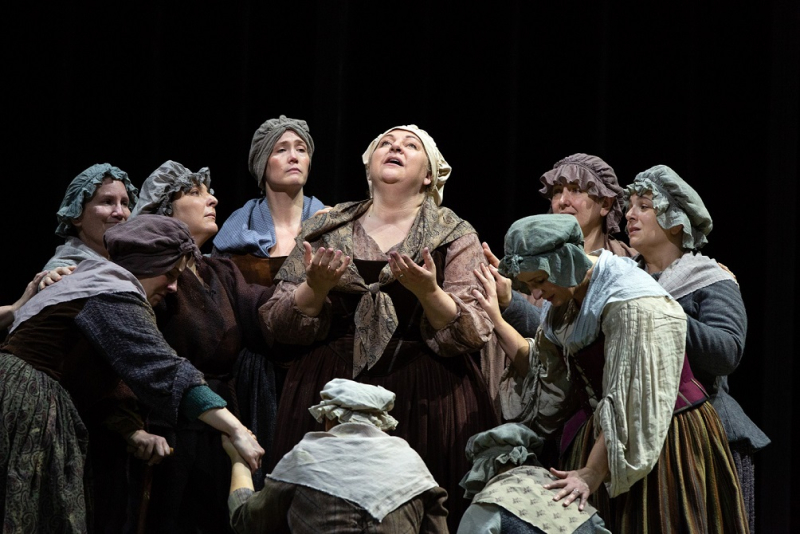
    Gigliotti goerke marty sohly

    Above: Christine Goerke as Mme. Lidoine with Eve Gigliotti as Mother Jeanne, and their sister-nuns; photo by Marty Sohl/Metropolitan Opera

    Saturday January 28th, 2023 matinee – An incredibly powerful performance of Francis Poulenc’s masterpiece, Dialogues des Carmélites, at The Met this afternoon. The John Dexter production, one of the treasures of the Company’s repertoire, never fails to move me with its utter simplicity and the clarity of its story-telling. It was lovely to see several small groups of nuns among the audience this afternoon.

    The performance was somewhat compromised by the conducting of Bertrand de Billy; though his tempi and feel for the music were spot-on, he too often allowed the orchestra to cover the voices. This seems to be a trend at the Met these days, for the recent RIGOLETTO(s) and TRAVIATA I saw, conducted by Speranza Scapucci and Marco Armiliato respectively, suffered from the same problem. As there are no huge voices around nowadays – no Nilsson, nor even a Grob-Prandl, and no Cossotto, del Monaco, or Norman Treigle either – such waves of sound rising from the pit cause singers to either force or simply be drowned out. The Met’s huge space is hard enough fill in and of itself; having to compete with mega-decibels of orchestral sound must be daunting indeed. Perhaps some people feel that a high-volume orchestra makes opera more “exciting”…? Well, it doesn’t.

    The cast today was peopled by expressive singing-actors, down to the smallest roles. Benjamin Taylor (Thierry), Paul Corona (Dr. Javelinot), Siphokazi Molteno (Sister Mathlde), and Jeongcheol Cha (Jailer) did well, though the last-named’s task – reading the names of the nuns condemned to death – was lessened in impact by the orchestra’s loudness; it’s an affecting moment, deserving to be better-handled.
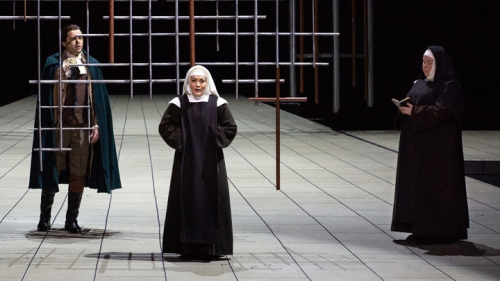
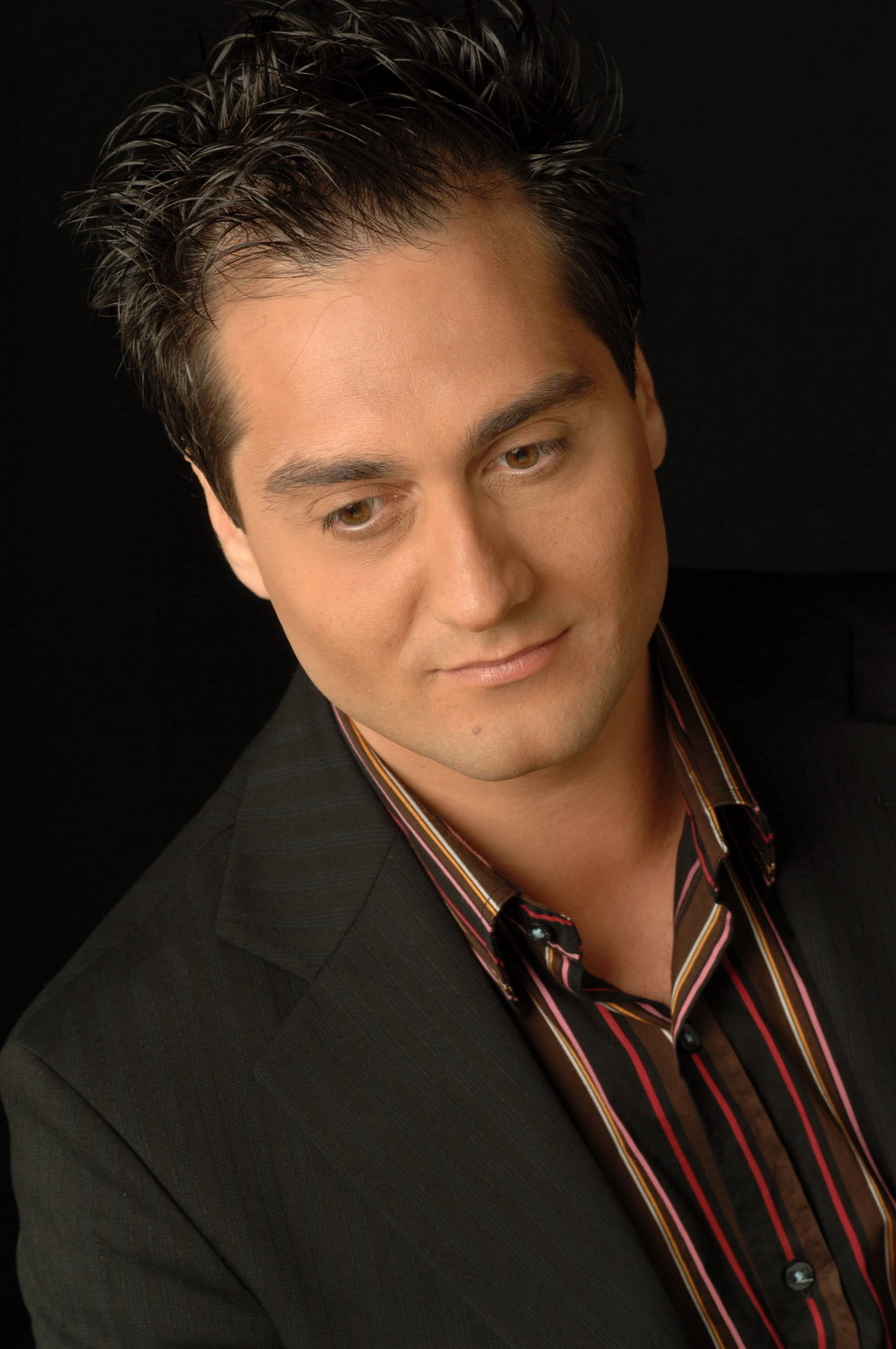
    Piotr Buszewski Perez Barton

    Above: Piotr Buszewski as Chevalier de la Force, Ailyn Perez as his sister Blanche, and Jamie Barton as Mother Marie; photo by Marty Sohl/MET Opera

    The Polish tenor Piotr Buszewski, in his Met debut role, displayed a handsome timbre and fine sense of nuance as the Chevalier de la Force. Laurent Nouri made his mark as the Marquis de la Force. Tony Stevenson was excellent as the Chaplain, and Eve Gigliotti made much of the moving role of Mother Jeanne. It is Mother Jeanne who brings forth the figurine of the Christ Child, the breakage of which seems to signify the breakup of the convent. In the end, Mother Jeanne, using her cane, walks with great dignity to the guillotine. Ms. Gigliotti made the character seem essential, and her warm, plush mezzo timbre is always appealing. Tenor Scott Scully and basso Richard Bernstein are the Commissioners who come to shut down the convent; Mr. Bernstein, ever the effective stage creature, eyed each nun with suspicion; his voice is strong and steady.

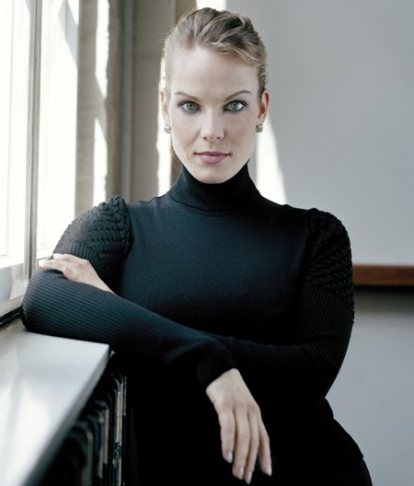
    Perez dialogues

    As Blanche de la Force, the opera’s central character, Ailyn Pérez (above, in a Marty Sohl photo) brought gleaming lyricism with a sense of fragility to her music. She forms a bond with the naive, optimistic young Sister Constance (Sabine Devieilhe); in their prayer following the death of the Old Prioress, their timbres meshed to magical effect. And in the scene where her brother visits her and asks her to return home, Ms. Pérez and Mr. Buszewski did some of the loveliest singing of the afternoon. Having fled the convert, Blanche seeks refuge, working as a maid in her old family home; but Mother Marie tracks her down and urges her to return to the fold. Here Ms. Pérez’s desperation becomes palpable. But at the end, stepping from the crowd to bid farewell to Sister Constance and to face her own death calmly, Blanche finds release. 
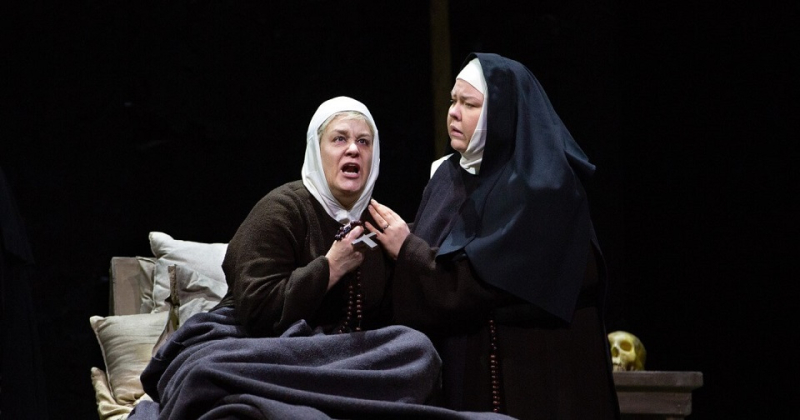
    Coote barton

    Above: Alice Coote as Madame de Croissy and Jamie Barton as Mère Marie; photo by Marty Sohl

    During the pandemic, I often turned to YouTube to keep music vividly in my life whilst live performances ceased, and I came upon a film of Alice Coote singing Mahler’s “Ich bin der welt abhanden gekommen” which moved so deeply. Watch and listen here.

    Today, as Madame de Croissy, Ms. Coote held the House under a spell as the character’s horrific death scene was played out. For a woman whose faith was always deep and seemingly unshakable, the Old Prioress finds herself terrified as she faces her end, wracked with pain. Ms. Coote, a wonderfully word-conscious singer, made the scene the centerpiece of the performance. Both vocally and dramatically, she was living the role: a riveting singer and personality. Rapturous applause greeted her at her solo bow at the opera’s end.

    Jamie Barton has a perfect role in Mother Marie, and she made a splendid vocal impression. Her wide-ranging voice, from dusky chest tones to searing top notes, was in peak form. She held the stage with authority, and finely captured the character’s desperation and guilt on having been separated from her sisters during their final hours on Earth.

    Devieilhe-Sabine-04[Caroline_Doutre]

    Above: Sabine Devieilhe, photo by Caroline Doutre

    How wonderful to see the French soprano Sabine Devieilhe on the Met stage! Having attended her Weill Hall recital in 2019, I have been hoping to see and hear her again…and now she is here with us. As Sister Constance, the petite and lovely Ms. Devieilhe was ideally cast. Her silvery, shimmering tones gleamed in the House, a contrast to the opera’s deepening darkness and sense of impending doom. In the end, her hope of seeing Blanche again gives her the courage to walk to the guillotine, her lone voice the expression of innocence and human fragility. Then the voice of Blanche is heard: she has stepped from the crowd to join her sisters in death. The two girls have a last moment together before fate overtakes them. Incredibly touching.  

    Goerke barton

    Above: Christine Goerke as Madame Lidoine and Jamie Barton as Mother Marie

    Towering, literally, over the sisterhood, Christine Goerke made a splendid impression as Madame Lidoine. If some of the highest notes did not bloom as one might wish, Ms. Goerke’s presence – and her vocal authority – gave the afternoon its center. Her portrayal, so dignified, so lovingly maternal, so…human…was touching to experience. It is Madame Lidoine who leads the procession to the guillotine, by which time I was already weeping.

    The audience, the quietest and most attentive to have been part of in recent seasons, hailed the singers with great affection and admiration at the end. I felt a desire to go to the stage door, where a large crowd had gathered; I particularly wanted to greet Ms. Coote, Mlle. Devieilhe. and Ms. Gigliotti.

    Carmelites 2-1 jpg

    The French soprano was in a rush, probably to catch a flight, but was very gracious and charming; she told me she is already booked for a return to The Met. Ms. Gigiotti signed my program in a distinctive way, matching her distinctive personality; I thanked her for some unique videos she has made (watch here) and for her past performances in works of Nico Muhly and Sergei Taneyev. Ms. Coote walked briskly thru the crowd; undoubtedly she had someplace she needed be.

    The story of the martyrdom of the Carmelite nuns becomes even more poignant when one realizes that their execution took place just ten days before the end of the Reign of Terror. The women were beatified in 1906; this plaque commemorates their deaths:
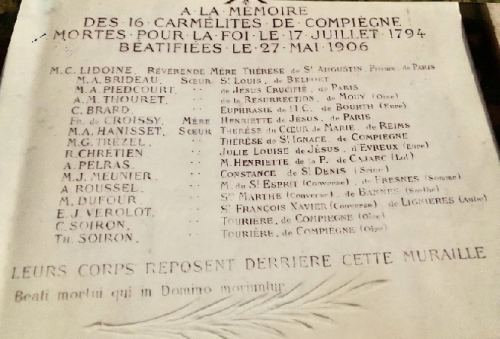
    Carmelites

    It is always difficult to return to the real world after a performance like this; there was so much to ponder after experiencing this opera about man’s inhumanity to man. What harm had these nuns done that merited a death sentence? Why is cruelty so rampant in the history of mankind?  Why do people feel a need to control the beliefs and lifestyles of others?

    ~ Oberon
  • MANON @ The Met

    72203039_2587859277931352_7352510735420751872_o

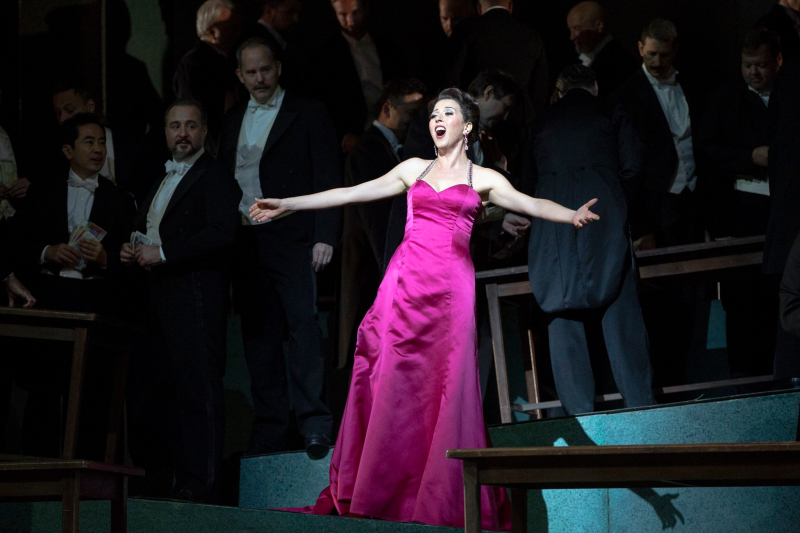
    Above: Lisette Oropesa as Manon in The Met’s production; a Marty Sohl/Met Opera photo

    Saturday matinee September 28th, 2019 – After a rather scrappy dress rehearsal on Friday September 20th, the Metropolitan Opera’s revival of their tedious Laurent Pelly production of Massenet’s MANON opened this past Tuesday. For today’s matinee, a group of friends who are admirers of Lisette Oropesa met up in the Family Circle boxes to see and hear the Cuban-American soprano in her latest new role. 

    Vocally, there are basically two types of Manons: the lyric-coloraturas and the full-fledged (and even slightly…beyond…) lyrics. The role was created by Marie Heilbronn, whose repertory included the coloratura roles of Marie (FILLE DU REGIMENT), Ophélie (HAMLET), Gounod’s Juliette, and Catherine in Meyerbeer’s ETOILE DU NORD. Massenet’s preferred Manon was Sibyl Sanderson, who created the high-flying title-role in his opera ESCLARMONDE. The light-voiced Brazilian soprano Bidu Sayão became a beloved Manon at The Met starting in 1937, and the tradition of coloratura-oriented Manons continued with Beverly Sills (perhaps her greatest role), Patricia Brooks, and Reri Grist.

    Sopranos with larger, richer voices have also taken on the role: Lucrezia Bori, Geraldine Farrar, Claudia Muzio (!), Victoria de los Angeles, Eleanor Steber, Anna Moffo, Virginia Zeani, Raina Kabaivanska, Jeannette Pilou, Catherine Malfitano, Carol Vaness, Renee Fleming, and Anna Netrebko. Some of these sopranos had to make adjustments in Manon’s coloratura set-pieces, and in dealing with (or omitting) the score’s high-Ds. And at times, the opera has seemed to take on a verismo tinge in these interpretations, as listening to their various recordings will show. 

    Lisette Oropesa’s Manon is in the lyric-coloratura vein, and it’s so enchanting to hear her intriguingly perfumed timbre in this music. This is a voice that draws us into the music, covering the wide range with that distinctive sound, rejoicing in the fiorature of the Cours la Reine arias, pinpointing those top-Ds, and seducing both the tenor and the audience with the serpentine vocal line of “N’est-ce plus ma main”: that passage which Beverly Sills knew was the key to the whole character. 

    To accomplish her success in the music of Manon, Lisette had to overcome a hideous production and an interpretation of the score by an out-of-touch conductor. As the opera progressed, we moved scenically from a dreary grey courtyard – surrounded by perched toy-town houses and cuckoo-clock windows that periodically opened and closed – to an ugly wheeled-out ‘garret’ for the lovers wherein the ‘petite table‘ seemed like an afterthought.

    The ridiculous ramps and metal dog-run fencing of the Cours la Reine deprived the setting of its glamour and left the bevy of ballerinas that Guillot had brought to cheer Manon up little space to execute some rather pointless choreography (the girls deserved better!) With the gaslights, Manon clad in a enormous feathered hat, boa, and ruffled gown, and the top-hatted men courting her in-sync, the scene recalled bad productions of HELLO DOLLY.

    Seeking out des Grieux at Saint Sulpice, Manon arrives in what looks like a long white slip. There’s a lot of stage business to this seduction, as compared to the Sills Manon who just stood there, enticing her lover with vocal allure until – at the right moment – she let her cape fall to reveal the diva’s legendary décolletage, to which her tenor immediately succumbed. In the Pelly production, a convenient bed (for the altar boys?) is where Lisette and Michael Fabiano end up in a bodice-ripping finale. It’s the tenor’s bodice that gets ripped.

    The gambling den in a drab basement room with more ramps, and with card tables wheeled busily on and off; the tension of the game between des Grieux and Guillot is minimized. The scene’s redeeming feature is the vision of Lisette in a stunning magenta gown.

    The opera’s final scene is misty and appropriately foreboding. Manon is beaten by the guards who are escorting her to the ship for deportation. She seems to die from this beating rather than from some infection she picked up in prison.

    Manon is one of the least appealing characters in all opera: selfish, willful, faithless, conniving. And those are her good qualities. But somehow, Lisette managed to be one of the very few Manons to make us feel sorry for her as the life ebbs out of her.

    Maurizio Benini on the podium seemed to have no feeling for the distinctive atmosphere of the score, redolent of a time and place that the production has simply glossed over; the large orchestra frequently unleashed Puccinian waves of passion. But the musicians did what they could, bringing forth the desired poetry: of particular appeal was the clarinet solo in the prelude, played with captivating tenderness and nuance by Inn-Hyuck Cho.  Mr. Cho also stayed in the pit thru much of the intermission, practicing various themes, much to my delight.

    The pairing of Lisette Oropesa and Michael Fabiano as the doomed lovers was not felicitous. They are a vocal mismatch, and though they went thru the motions of romance and seduction, it was only in a theatrical sense that they made it work. The tenor, who would seem better suited to the Puccini rather than the Massenet des Grieux, lacked the heady vocal elegance that Alfredo Kraus, Vinson Cole, and Enrico di Giuseppe have brought to this music. Mr. Fabiano managed his Dream aria nicely enough, seemingly employing falsetto, but a flattish start to “Ah, fuyez, douce image” led to what felt like a struggle thru this demanding aria. 

    Two excellent baritones enhanced the afternoon: Artur Ruciński as Lescaut and Brett Polegato as de Brétigny. Mr. Ruciński, who sang Enrico to Lisette’s Lucia at the Teatro Real in 2018, Madrid, and who is a very impressive Onegin in a DVD of the Tchaikovsky opera from Valencia, has sung Sharpless and Germont at The Met. He transforms Lescaut into a leading role, making his arias – which can in lesser hands devolve into character pieces – real vocal gems thru the beauty and colour of his timbre, whilst also creating a lively (and – eventually – moving) character. His curtain calls drew enthusiastic and well-deserved bravos.

    I first heard Canadian baritone Brett Polegato’s voice on a tape from the Cardiff Competition in 1995. He made a very fine impression, which was subsequently amplified by his wonderful 2001 recording (with Christine Goerke, conducted by Robert Spano) of Vaughan Williams’ A Sea Symphony for Telarc. Hailed upon its release as “…a Sea Symphony for the new century…”, this recording won a Grammy.

    It wasn’t until 2012 that I got to hear Mr. Polegato live: he sang Walton’s Belshazzar’s Feast with the Atlanta Symphony at Carnegie Hall. I sat in the front row and enjoyed his performance immensely, and I questioned at the time why he was not at The Met. And now here he is in his debut performances at The House, the voice very much at home in the big hall. As de Brétigny today, the baritone made the most of every line, especially in the garret scene quartet, and proved a wonderful support (literally) to Lisette’s Manon at the Cours la Reine. Had Manon only stuck with this well-to-do and dapper gentleman, she might have lived long…and prospered.

    Basso Kwangchul Youn brought warm, house-filling sound to the Comte de Grieux’s aria, in which he urges his son to forget about the priesthood and find a nice girl to marry, one worthy of himself and of the family. The Comte, his visit to Saint Sulpice having proved in vain, departs with the wistful farewell to his son – “Adieu … reste à prier!” – which was touchingly spoken by Mr. Youn.

    Carlo Bosi, a sensational Nick in FANCIULLA DEL WEST when it was last done at The Met, was equally high-profile this afternoon as Guillot, the man who destroys Manon and, consequently, des Grieux.

    In another example of how to make a smallish role resonate, Paul Corona as the Innkeeper was outstanding. He took a bow at the dress rehearsal, and I wish he had done so this afternoon so I could have given him a “bravo!“.

    Bidu_Sayao

    As a tease, the Met has installed Bidu Sayão’s Cours la Reine costume (above) in a glass display case on the Dress Circle level. This cloth-of-gold creation, incredibly detailed, served as a reminder of what MANON is all about. I hope one day that Lisette will have a production of this opera worthy of both herself and of the opera’s long traditions, with charming costumes, with a swing for Manon to sit on in the garden at Amiens for “Voyons, Manon“…and with de Brétigny bringing her an emerald necklace to dazzle her right after the kidnapping of her beloved chevalier.

    ~ Oberon

  • Matti Salminen as Hagen

    Gotterdammerung.0304.05

    On October 21st, 1988, basso Matti Salminen (in a Marty Sohl photo, above) enjoyed a huge personal triumph with his magnificent portrayal of Hagen at the Metropolitan Opera’s premiere performance of the Otto Schenk production of GOTTERDAMMERUNG, with James Levine on the podium. I was there, and it was one of the great nights in my opera-going career.

    This excerpt comes from the 1993 broadcast of the Wagner masterwork:

    Matti Salminen as Hagen – Met 1993

  • CLEMENZA DI TITO @ The Met

    Clemenza.0405.01

    Tuesday November 20, 2012 – The Metropolitan Opera’s current revival of their classic Jean-Pierre Ponnelle production of Mozart’s LA CLEMENZA DI TITO is a joy both to the ear and the eye. Marty Sohl’s production photo (above) illustrates the fantasy mixture of ancient Roman and baroque stylistic elements that give the sets and costumes their timeless visual appeal.

    Tonight, Harry Bicket led a sterling performance, with excellent continuo playing from Bradley Brookshire (harpsichord) and David Heiss (cello) as well as spectacular woodwind solos in two of the opera’s iconic arias: Andrew McGill (clarinet, in “Parto, parto”) and James Ognibene (basset horn, in “Non piu di fiori”). Mr. Bicket’s vivid pacing and his sense of the music’s flow put the singers in high relief; there were three outstanding vocal performances and overall it was one of the most satisfying evenings at The Met in recent seasons.

    Kate lindsey

    To think that I almost skipped this revival! But a chance to hear Kate Lindsey as Annio was not to be missed, and the beauteous young mezzo (above) gave an immaculate performance, her lithe figure and ease of movement onstage enhancing her interpretation at every turn. Like many of her predecessors in this fach, Kate spends a lot of her onstage time in trousers (she’ll debut at Glyndebourne as the Composer in ARIADNE AUF NAXOS in the coming year). Her singing tonight was pristine, with a particularly ravishing piano passage in “Tu fosti tradito” that would melt the coldest heart.  

    Gf

    With his noble and expressive face, Giuseppe Filianoti (above) made a splendid impression as Tito. His singing was clear and mellifluous, the words poetically delivered. The tenor finely delineated the emperor’s dilemma in dealing with his betrayal by his friend Sesto: should friendship trump justice? When I last heard Mr. Filianoti in the house, he was dealing with health issues, so it was really very pleasing to hear him on such beautiful vocal form tonight.

    Garanca

    Somehow I’ve managed not to encounter a live performance by the Latvian mezzo-soprano Elina Garanca (bove) up til now. I first heard her voice on a recording my friend Mollie sent me from the 2001 Cardiff Competition. Garanca has since developed into a world-class artist and after hearing her as Sesto tonight, she’s on my A-list of singers. Both in terms of vocal appeal and technical accomplishment, this was a stunning performance: Garanca’s voice is all of a piece, and she moves it thru the registers seamlessly. After a profoundly expressive rendering of the openng passages of the great aria “Parto, parto” Ms. Garanca sailed through the whirlwind coloratura flourishes of the aria’s later pages with nimble assurance. Later, as she knelt to invoke the strength to carry out her assassination of Tito, she summoned an amazing degree of projection, the voice sailing into the hall with startling force. In her second spectacular aria “Deh per questo istante solo”, the mezzo soprano coloured the voice movingly, reflecting the character’s anguish and also his stalwart refusal to implicate Vitellia in the crime. Ms. Garanca’s entire performance was a revelation.

    Barbara Frittoli, an unforgettable Desdemona at the Met in 1999, has more recently found considerable success in singing Mozart since she did her voice some damage during the first decade of the 21st century by singing music that was too heavy for her. Her canny manipulation of dynamics usually prevents her widening vibrato from becoming too prevelant. But for all her attractive qualities, Vitellia’s great aria “Non piu di fiori” simply lies too low for Ms. Frittoli to make her finest effect in the music. Vitellia in fact can be sung by a mezzo, except for that thorny top-D that Mozart threw into the act I trio, a note that eluded Ms. Frittoli tonight. Nevertheless, the soprano kept up her side of things all evening and the audience enjoyed her sometimes over-the-top dramatic portrayal.

    Lucy Crowe as Servilia is a pretty girl with luminous eyes and a pleasing lyric timbre. In his search for a wife, Tito’s first choice – Servilia – might have made him quite happy, especially with Ms. Crowe’s buxom grace and girlish smile.

    A wonderful Met evening, then, and there was every reason to stay to the end and shout’ bravi’ as the singers took their bows to sustained applause.

    Metropolitan Opera House
    November 20, 2012
    LA CLEMENZA DI TITO
    Mozart

    Tito.......................Giuseppe Filianoti
    Vitellia...................Barbara Frittoli
    Sesto......................Elina Garanca
    Servilia...................Lucy Crowe
    Annio......................Kate Lindsey
    Publio.....................Oren Gradus
    Berenice...................Toni Rubio

    Bradley Brookshire, Harpsichord Continuo
    Anthony McGill, Clarinet Soloist
    James Ognibene, Basset Horn Soloist
    David Heiss, Cello Continuo

    Conductor..................Harry Bicket