
Matthew Polenzani, tenor, and Hyung Yun, baritone, sing the great duet “Au fond du temple saint” from Georges Bizet’s Les Pêcheurs de Perles; Howard Watkins is the pianist.
Watch and listen here.
Matthew Polenzani, tenor, and Hyung Yun, baritone, sing the great duet “Au fond du temple saint” from Georges Bizet’s Les Pêcheurs de Perles; Howard Watkins is the pianist.
Watch and listen here.
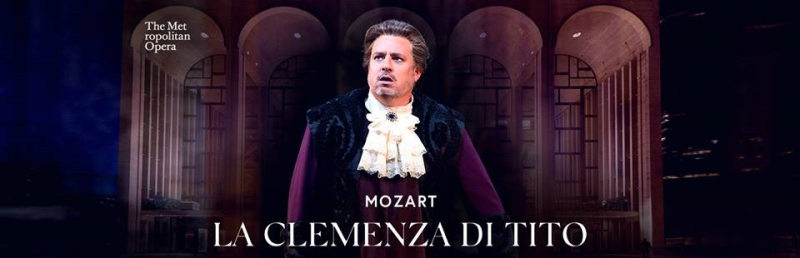
Above: Matthew Polenzani as Tito
~ Author: Oberon
Saturday April 20th, 2019 matinee – One of my favorites among the Mozart operas, LA CLEMENZA DI TITO is a melodious masterpiece. Though THE MAGIC FLUTE is considered the composer’s final opera, that work was largely complete when he set about writing CLEMENZA.
LA CLEMENZA DI TITO was something of a throw-back for Mozart: it was written in the old style of opera seria – in which a progression of set-piece (arias, duets, and small ensembles) are linked by brief passages of recitative – to celebrate the coronation of Austrian Emperor Leopold II as King of Bohemia in Prague in 1791.
This formality of structure is illuminated by some of Mozart’s most personal arias: Sesto’s “Parto, parto” and “Deh, per questo istante solo“, Tito’s “Se all’impero, amici Dei”, Annio’s “Tu fosti tradito“, Servilia’s “S’altro che lagrime“. and Vitellia’s “Non piu di fiori“, each of which ideally reflects the personality of the character singing it.
Giving the overture a nice, weighty feel, conductor Lothar Koenigs presided over a well-paced performance. A sterling continuo duo – Davis Heiss, cello, and Bryan Wagorn, harpsichord – added much to the afternoon’s pleasure, and thrilling playing from principal clarinetist Inn-Hyuck Cho (as both clarinet and basset horn soloist in “Parto, parto” and “Non piu di fiori” respectively) was a complete joy to experience.
In the title-role, Matthew Polenzani’s pliant and expressive singing flowed forth with Italianate lyricism, the voice clear and sure, etched in with detailed pianissimi along the way (most notably in “Del piu sublime soglio“) to keep the music fresh. The tenor – whose recent Zankel Hall concert was one of the highlights of the current season – showed great sensitivity in the recitatives, especially in the long scene where he weighs his feelings before passing judgement on Sesto. “Se fosse intorno al soglio” showed expert dynamic control, and the showpiece “Se all’impero, amici Dei” in Act II was triumphant.

Joyce DiDonato (above) has found a perfect role in Sesto, joining such marvels as Tatiana Troyanos , Lorraine Hunt Lieberson, and Elīna Garanča in the highest echelon of interpreters of this demanding part. Ms. DiDonato, ever alert to the words, sang with dazzling technique and a vibrant sense of dramatic urgency.
In the great aria, “Parto, parto“, Ms. DiDonato reveled in the vocal and expressive possibilities Mozart has afforded her. After displaying moving vulnerability – her hushed murmuring of “Guardami…!” was sublime – the mezzo was at her finest as she sailed thru neat-as-a-pin coloratura effortlessly (and perfectly matched by the clarinet), winning a big ovation.
Incredibly, Ms. DiDonato surpassed herself in the second act aria, “Deh, per questo istante solo” where, with touches of straight tone along the way, she sang with deep feeling, expressing the young man’s passion and remorse. In the second verse, tiny embellishments were woven in, and the aria’s fiery finish brought down the house.
Elza van den Heever is a puzzling singer: her broad repertoire – from bel canto to Strauss, Wagner and (next season), Berg – seems to indicate a soprano who has not settled on a fach. Which is fine, really, except that the varying demands of the roles she is singing seems to be affecting her tone at times, which can turn rather shrill.
As Vitellia, she was uneven in this role’s wide-ranging music, and though she touched on the high-D in Act I and successfully reached downward to the low-G in “Non piu di fiori“, the voice lacks sheer beauty and is not really all that fluent in fiorature. The highest notes – a brilliant top-B for one – popped out clearly, but seemed disconnected to the rest of the voice. I really didn’t know what to make of her performance. But for some reason, the audience – perhaps spurred on by the MetTitles – found Vitellia to be something of a comic figure; the soprano was well-received at her bows.
Emily D’Angelo as Annio seemed rather muted at first, and Ms. DiDonato simply drowned her young colleague out in their beautiful Act I duet. But Ms. D’Angelo soon made her mark on the performance, with a finely-rendered “Tu fosti tradito” capped by a nice top-A. The audience loved her.
Lovely, graceful Mozart singing from Ying Fang as Servilia, recalling Hei-Kyung Hong’s beautiful Met debut in this role. Ms. Fang, with sweet-toned lyricism, made “S’altro che lagrime” (perhaps the opera’s most attractive melody) a tender delight.
Christian van Horn was a superb vocal presence as Publio, showing the advantage of putting a stellar singer in a relatively small – but musically important – role. Bravo!
The houselights slowly came up during the opera’s finale: a celebratory touch. The singers were all warmly applauded as they took their bows on the classic Jean-Pierre Ponnelle set.
Metropolitan Opera House
April 20th, 2019 matinee
LA CLEMENZA DI TITO
Wolfgang Amadeus Mozart
Tito.......................Matthew Polenzani
Vitellia...................Elza van den Heever
Sesto......................Joyce DiDonato
Servilia...................Ying Fang
Annio......................Emily D'Angelo
Publio.....................Christian Van Horn
Berenice...................Anne Dyas
David Heiss, Cello
Bryan Wagorn, Harpsichord
Inn-Hyuck Cho, Clarinet and Basset Horn soloist
Conductor..................Lothar Koenigs

Intermissions at The Met these days can often put a damper on even the best of performances, but this afternoon’s single interval brought an unexpected treat: clarinetist Inn-Hyuck Cho (above) remained in the pit for the entire half-hour, practicing the basset horn part of “Non piu di fiori”. What a mesmerizing sound! The Met is so very fortunate to have this splendid musician in their orchestra.
~ Oberon

Above: tenor Matthew Polenzani, photographed by Fay Fox
~ Author: Oberon
Sunday February 24th, 2019 – This afternoon’s program by tenor Matthew Polenzani at Zankel Hall had been a red-letter date on my calendar ever since Carnegie Hall announced their 2018-2019 season nearly a year ago. To say that the performance surpassed my highest expectations would be an understatement.
Over the years since Mr. Polenzani first came on the New York operatic scene in 1997, he has given me some of my fondest musical memories. Of particular joy was his portrayal of David in Wagner’s DIE MEISTERSINGER, which I saw four times. Matching his sunny – and very human – portrayal of the young apprentice to his sweetly ingratiating lyrical singing, Mr. Polenzani won the hearts of audiences each time. Those performances, musically sublime under Maestro Levine’s heartfelt leadership, were some of my happiest times at the opera.
Since then, Mr. Polenzani has had great success in Mozart, bel canto, and French opera at The Met where his credentials are approaching the 400-performance mark; earlier this month, he produced a sonic miracle in his aria in Tchaikovsky’s IOLANTA. And we will soon hear him as Mozart’s Tito and Verdi’s Duke of Mantua. More red-letter dates!
Today’s recital opened with a selection of lieder by Franz Schubert in which Mr. Polenzani and the renowned pianist Julius Drake formed a treasurable musical alliance. The two men walked out onto the Zankel Hall stage to a truly warm and long-lasting applause.
From the opening “Nachtstück” – an old man’s acceptance of impending death – Mr. Polenzani showed himself to be among the most appealing and compelling interpreters of German lieder now before the public. The words flow beautifully, and without fussiness, whilst the multi-hued sound and the incredible skill with which he runs the gamut of the piano/pianissimo spectrum, make each song truly an absorbing experience.
Two Spring-songs follow: “Im Frühling” (with Mr. Drake’s dramatic piano intervention, and the singer’s incredibly sustained softness towards the end), and the familiar “Frühlingsglaube“. “Der Einsame” (The Recluse…it could be my theme song!) is somewhat jaunty in tone, and has an optimistic outlook. Then the well-beloved “Ständchen” so persuasively phrased by the tenor and finely articulated by the pianist. The concluding “Im Abendrot“, with its lovely piano introduction, sings like a prayer.
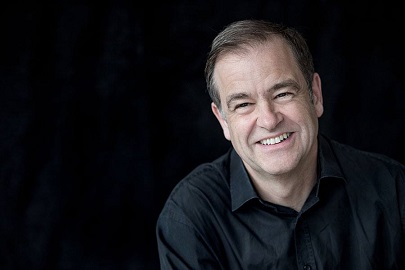
Beethoven’s An die ferne Geliebte, the composer’s only true song cycle, strings six poems by Alois Jeitteles together in an uninterrupted flow of song. Mssrs. Polenzani and Drake perfectly captured the songs’ many poetic references to the natural world, which the singer mentally relates to the finding and eventual loss of an idealized lover. Mr. Polanzani’s golden tone, the naturalness of his way with words, and the continuing enchantment of his softest notes kept us riveted; and Mr. Drake matched the singer, nuance for nuance, in their marvelous performance.
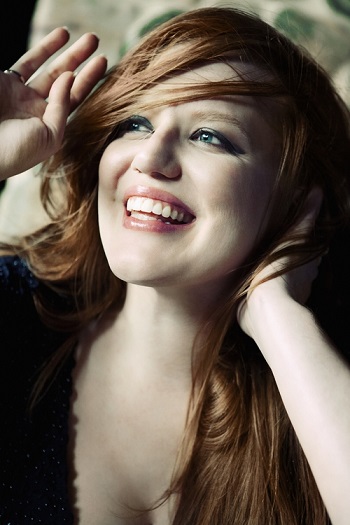
Johannes Brahms’ Zigeunerlieder, Op. 103, brought forth mezzo-soprano Jennifer Johnson Cano (above). This set of gypsy songs served the singer as a prologue to her role as the gypsy lass Zefka in Janáček’s The Diary of One Who Vanished. In a striking deep blue gown, Ms. Johnson Cano gave a vivid performance, in which Mr. Drake, at the Steinway, was a perfect accomplice.
Ms. Johnson Cano has the ideal voice, temperament, and personality for these songs; her gift for musical characterization is spot on, and is reflected in her stage manner: she plays the diva one moment and the loving lady the next. Singing with her warm, inviting mezzo timbre, Ms. Johnson Cano was particularly lovely in the cycle’s penultimate song, “Kommt der manchmal in den Sinn” where, at the words “Täusch mich nicht, verlass mich nicht…” the melody takes up an air of longing which the singer conveyed with expressive vocal colours. In the Brahms, as all evening, Julius Drake’s playing was so inviting.
Following the interval, Janáček’s The Diary of One Who Vanished, was given a mesmerizing performance by Mr. Polenzani, Ms. Johnson Cano, and three offstage singers: Kathleen O’Mara, soprano, and mezzo-sopranos Marie Engle and Megan Grey. At the piano, Julius Drake played this music – which might be described as a chamber opera – with a vast range of colour and brilliant rhythmic clarity.
This is the story of a young village boy who fell in love with a gypsy beauty and abandoned his safe and simple life to join her in her wanderings. Originally thought to have been drawn from the boy’s discarded diary, the story was eventually discovered to have been written by Josef Kalda, a accomplished author from Prague. In his 62nd year, Janáček himself fell under the spell of a much younger ‘gypsy’ woman; their relationship was revealed in a series of passionate letters, published in the 1980s.
Julius Drake’s phenomenal artistry was a key element in this fascinating work; one hardly needs an orchestra with this gentleman at the Steinway. His playing again superbly matched Mr. Polenzani’s singing: full of passion, poetry, intensity and natural beauty of expression.
The first several songs of The Diary of One Who Vanished are given over to the tenor: what a great pleasure to hear Mr. Polenzani and Mr. Drake here in a long stretch of music-making of such evocative qualities. Ms. Johnson Cano then appears, singing splendidly, with a bewitching, smouldering quality to her lower range. An offstage trio of voices – Mlles. O’Mara, Engle, and Grey – produced a lovely blend that sometimes brought to mind Wagner’s Rhinemaidens, or Strauss’s ARIADNE nymphs.
The finale is an extended sing for the tenor, again with Mr. Drake playing grandly. From lyrical outpourings, the music turns to a hymn of farewell sung by the boy about to take leave of his homeland. Here Mr. Polenzani unleashed hall-filling power; the audience could scarcely restrain themselves from applauding until the last echoes from the Steinway had faded.
At the end of the Janáček, the sold out hall was the scene of a tumultuous standing ovation. As the artists came forward to bow, the audience clearly wanted more music. But what sort of encore could follow such a performance? After a long delay, during which the applause redoubled, Mr. Polenzani and Mr. Drake came onstage again.
The tenor spoke of the difficulty of finding the right piece to sing after the drama of the Janáček. In the course of his travels, he said, the most-requested song was the universally beloved “O Danny Boy‘. Taking up the thrice-familiar melody, which has been sung by everyone from Ernestine Schumann-Heink to Johnny Cash, Mr. Polenzani gave the most ravishing performance of it I could ever hope to hear. The words – so simple and moving – came from the heart, and the colours of the voice were haunting. People around me were holding back tears as Mr. Polenzani took the final ascending phrase of the song to an exquisitely sustained final note than hung magically on the air.
~ Oberon
 Oberon's Glade