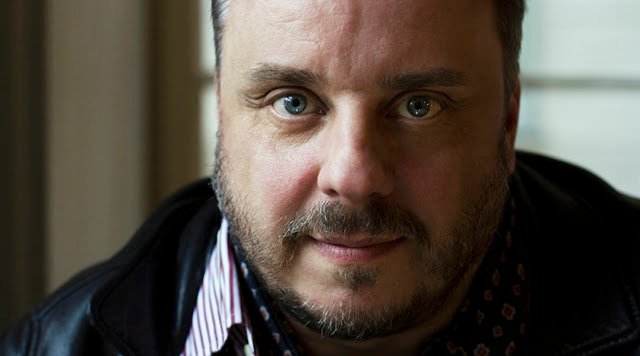
Above: baritone Matthias Goerne
~ Author: Oberon
Thursday March 21st, 2019 – This long-awaited concert featured The New York Philharmonic‘s Artist-in-Residence Matthias Goerne singing one of my favorite 20th-century vocal works: John Adams’ The Wound-Dresser. Music by Charles Ives and Johannes Brahms was also on the bill, with the orchestra’s Music Director, Jaap van Zweden, on the podium.
Charles Ives’ mysterious Central Park in the Dark made for a strangely fascinating program-opener. If you’ve ever walked across The Park at night, this atmospheric and slightly creepy music – which at first drifts by like a cool nocturnal mist – perfectly summons up the surreal feeling of being alone in the huge City.
The sound of Pascual Martínez-Forteza’s clarinet introduces a human element; the trumpet and a pair of pianos come into play, and there is a boisterous, off-kilter rendering of “My Ragtime Gal” and a noisy battering of percussion that makes you want to call 311. Then, slowly, the music fades into a dream.
Mr. Goerne then appeared for John Adams’ The Wound-Dresser. This work was composed for and premiered by the late, great American baritone Sanford Sylvan in 1989. The texts are from Walt Whitman’s poem of the same title. The poet took on the task of visiting the sick and dying soldiers in hospitals during the time of the Civil War.
Composer John Adams said of this poem: “…(it) is the most intimate, most graphic, and most profoundly affecting evocation of the act of nursing the sick and dying that I know of. It is also astonishingly free of any kind of hyperbole or amplified emotion, yet the detail of the imagery is of a precision that could only be attained by one who had been there.”
Mr. Goerne’s interpretation of this poignant work had an almost operatic feeling. One could say that his English diction had a ‘British accent’; for the most part, his enunciation was admirable, whilst overhead titles filled in any blanks. The sound of a dropped item in the audience at the very outset of the piece was the worst kind of intrusion, but Maestro van Zweden would not be deterred.
The music at first evokes the tread of the nurse, walking the wards. Mr. Goerne’s voice at the start was deep and dark; the baritone’s great gift of a vast dynamic range meant that he could bring a haunting, unexpected pianissimo into the turning of a phrase, At some moments, feelings of anger rose in the voice: a righteous anger over the death and despair of war.
The poignant descent of the basses before “I onward go“, the sheer lyric beauty of Goerne’s “One turns to me…”, and the unbearable tenderness of “…to die for you, if that would save you!“: these were but a few of the memorable moments in this moving performance. The singer’s powers of expression as he describes horrific afflictions, his passionate distress – leading to the haunting “Come, sweet death...” – and the miraculous sustained piano at “…in mercy…” draw us deeper and deeper into the poet’s thoughts.
The lamenting violins, the deep-purple basses, the celesta-like intimations of angel wings, the plaintive high trumpet as the wounds are described – from these the music builds to a flood of anguish, to be overtaken by the high violins and their vision of heavenly rest. Surrounded by suffering, the nurseman sings: “I am faithful. I do not give out.”
The music grows huge, the voice now with an almost demented quality. Mindy Kaufman’s flute sounds forth, and the woodwinds take on the aspect of a choir. Mr. Goerne’s singing, so perfectly modulated, is heartbreaking. The gleaming trumpet sounds, the music rises on high.
In the watches of the night, the poet/nurse sits by the dying men: “Some are so young. Some suffer so much.” And at the end, his story becomes personal: “Many a soldier’s loving arms about this neck have cross’d and rested. Many a soldier’s kiss dwells on these bearded lips.”
A long silence followed this most moving performance. The composer joined Mr. Goerne and Maestro van Zweden onstage, with Mr. Adams summoning the orchestra’s principal trumpet, Christopher Martin, to rise for a bow. As so often after a memorable musical experience, part of me wanted to leave and hold onto the memory of it.
But, following the interval, we heard a lustrous performance of Brahms’ Symphony No.1. It took Brahms nearly fifteen years to compose this, his his first symphony. He continually made revisions throughout this time-span, discarding pages, editing, and starting over from scratch. At the time of the premiere, Brahms worried whether anyone would like the finished work. But Hans von Bülow – a composer, conductor and pianist, just like Brahms – referred to the symphony as ‘Beethoven’s Tenth’. High praise indeed: and Brahms, now feeling confident after a positive public reception, wrote a second symphony the following year.
Another “dropped item” made an unwanted dent in the score as the symphony began; I notice that people are now allowed to bring water bottles into the hall, and possibly these are contributing to what seems to be an increasing annoyance of extraneous sounds spoiling the music we’ve all come to hear.
The first movement of the Brahms 1st was especially wonderful to experience tonight. Flautist Robert Langevin and clarinetist Anthony McGill were in for the concert’s second half, making beautiful music. The blended sound of the orchestra was so finely integrated, the horns sounded opulent, and the sense of longing in the music as the movement progressed was palpable.
The Andante sostenuto, with Sherry Sylar’s lovely oboe solo, the satiny sound of the rising violin theme, Mr. McGill’s pliant phrasing of the clarinet line, and Richard Deane’s velvety horn all highlighted the Autumnal beauty of the music. The ensuing Poco allegretto feels merely pleasant at first, but soon turns livelier. Again, Mr. McGill – and the Philharmonic’s grand bass players – gave much for us to enjoy.
Sneaky plucking made a delightful impression in the concluding movement, wherein the horn, flute, and a brass choir each have their say before the familiar tune commences, carrying us on to the work’s vibrant finish.
Under Maestro van Zweden’s leadership, The Philharmonic tonight played the Brahms as magnificently as I have ever heard them play anything – and that is saying a great deal. The sound was rich, profound, and heartfelt. The symphony unfolded naturally, unhurried but always alive, leading to a celebratory ovation at the end.
~ Oberon

 Oberon's Glade