
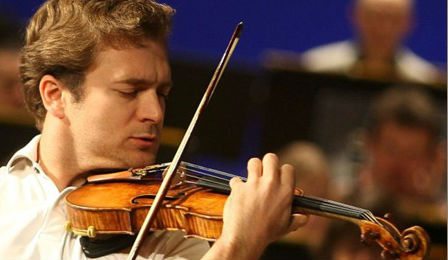
Above: composer Matthias Pintscher
~ Author: Brad S. Ross
Thursday March 21st, 2019 – Thursday was a unique night of sounds with the Chamber Music Society of Lincoln Center in the organization’s cozy and intimate Daniel & Joanna S. Rose Studio. The all-contemporary music program, featuring four works written between 1983 and 2013, ran the gamut of cutting-edge of sonorities, offering its refreshingly engaged audience a small cornucopia of contemporary classical music. It was also a heavily American program, featuring only a single piece by a European composer—something that can seldom be said of most music programmed at Carnegie Hall or the New York Philharmonic. Performing that night of the CMS players were the pianist Micheal Brown, violinist Bella Hristova, violist Richard O’Neill, and cellist Mihai Marica. Their playing was at such a high level of proficiency that one could be forgiven for scarily noticing the ease with which they navigated such technically demanding music.
The evening began with some academic and mercifully brief opening remarks by the CMS Director of Artistic Planning and Administration Elizabeth Helgeson about the composition of the first two pieces. Once finished, the players wasted no time diving into the first work of the evening: Alexandra du Bois’s L’apothéose d’un rêve for Piano, Violin, and Cello. L’apothéose d’un rêve, translated in English as “The Apotheosis of a Dream,” was originally commissioned by the pianist Menahem Pressler for the Beaux Arts Trio for the trio’s semicentennial in 2005. The work is cast in five movements played without pause and features a musical voice much befitting its decidedly ambiguous title.
Its tone is often longing and somber, lingering and dramatic—a stark contrast to the ferocity for which so many contemporary compositions have been known. Light on extended technique, but rife with developed thematic material, du Bois achieved an almost tragic beauty in L’apothéose d’un rêve, evoking the dreamlike imagery of its name. The third movement Molto vivo, with its arpeggiating piano lines, seemed almost to harken the swells of some discontented ocean. The closing movement Misterioso ended with haunting and almost funereal bell tones on the piano as the strings suspended an eternal minor third above them. Its beauty set a lofty standard for the works to come.
Next was the revered octogenarian Charles Wuorinen’s Trio for Piano Violin, and Cello. Composed in the summer of 1983, the piece was originally commissioned and performed by the Arden Trio. It is cast in a single movement over approximately ten minutes, making it handily the most concise work of the evening. Compared with the previous piece by du Bois, Wuorinen’s Trio was volatile and ferocious—rich with exquisite colors and textures that brought the most out of the ensemble. The players had their best work out here and effortlessly demonstrated their expert musicianship on its numerous intricate runs, tightly dissonant intervals, and relentless difficult counterpoint. It all culminated in an unsettling and richly dramatic ending that, in the best possible sense, left me wanting more.
Helgeson returned to the stage for a few more brief words about the program and the performers soon launched into the third work of the evening: Matthias Pintscher’s Janusgesicht for Viola and Cello. The German-born Pintscher, the sole aforementioned non-American on the program, composed Janusgesicht in 2001. Its title refers to the god of Roman mythology Janus, whose two faces stair simultaneously in opposing directions. Janusgesicht, as the composer writes, is “less about correspondence or communication among the two voices, but about the dissolution of one’s voice into the other.” For this piece, the players thus faced away from each other as the lights in the hall were near-completely darkened, minus some ambient blue lighting cast upon the back wall. Gimmicky as this setup may seem (I indeed had my doubts), it turned out to be one of the more interesting performances of the evening.
Janusgesicht was understandably the most dissonant and atonal work of the night—no tone center was to be found amidst its eerie scratchings and unholy strikes as these two string players weathered some of the most discordant sonorities of the evening. The work is characterized by myriad unnerving atmospheres, haunting silences, and arresting sonic textures, none of which ever outstayed their welcome. Following a lugubrious and tantalizing final decrescendo, the performers froze in place for what must’ve been half a minute before finally lowering their bows to receive a well-earned applause. Though it required patience and a mind considerably open to challenging music, Janusgesicht was well-worth the effort—the audience knew it, too.
The fourth and final piece of the night was David Serkin Ludwig’s Aria Fantasy for Piano, Violin, Viola, and Cello. Written in 2013, this quartet was the most recent composition of the program, though its roots stretched the furthest back of all. It was inspired, as the program indicated, by the opening and closing arias of Johann Sebastian Bach’s Goldberg Variations from 1741, but was pleasantly light on direct quotations. Ludwig, who was present for the night’s proceedings, was humorously short-winded in a pre-performance talk about the work, quipping that “a composer should never speak for longer than the duration of the piece.” What unfolded over the next sixteen minutes turned out to be a wild and adventurous combination of musical idea.
Aria Fantasy began on a lullaby-like piano line accompanied by almost science fiction-like glissandi in the strings. This unusual combination of pleasantly tonal melodies contrasted with obstinately discordant harmonies and modern musical techniques played like a dream that was equal parts pleasant and frightening. After this eerie opening came a dramatic and eventful middle section (andante–adagio), followed by a growing momentum that built to a grand final section (con moto). When the final diminuendo played the piece to its close (tempo di aria), the audience—including yours truly—was left wanting it to continue long after the piano’s final harmonic resolution.
This was a resounding finale to a night of superb contemporary music—music that should be performed as often and as widely as anything by the late masters. Other ensembles would do well to take their example and program more works by living composers. If Thursday night’s enthusiasm was any indication, audiences are itching to hear it.
~ Brad S. Ross

 Oberon's Glade