
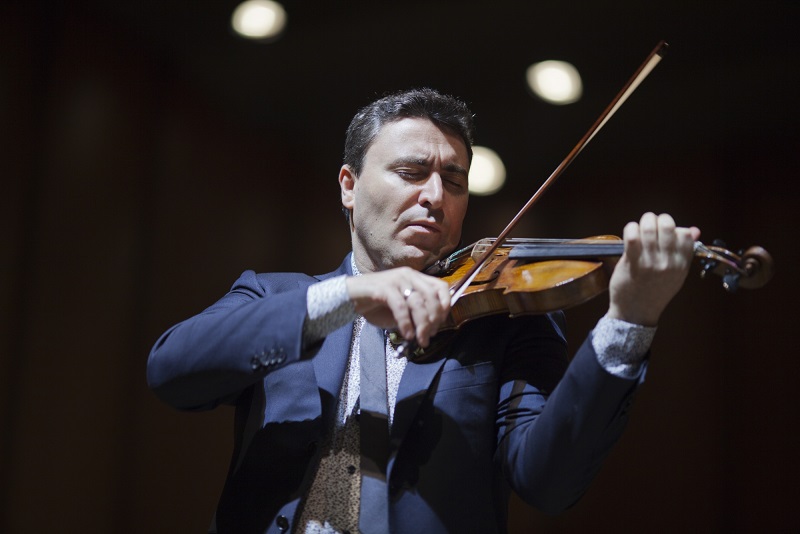
Above: Maxim Vengerov
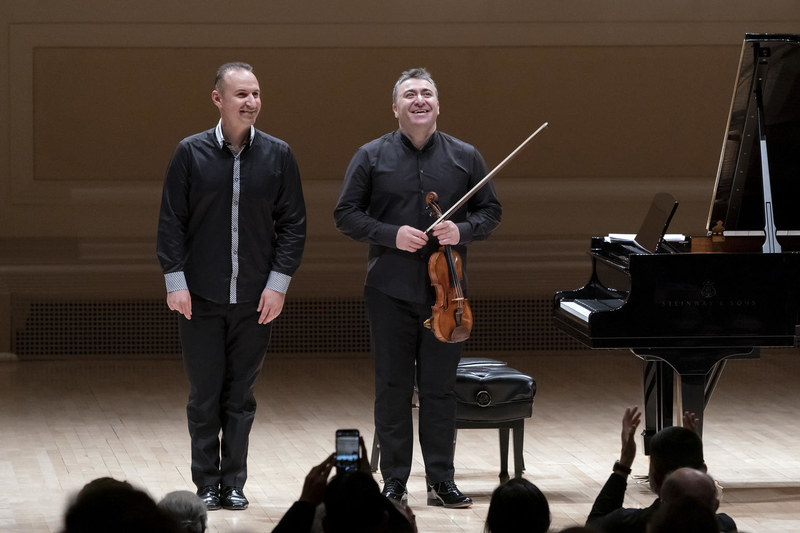
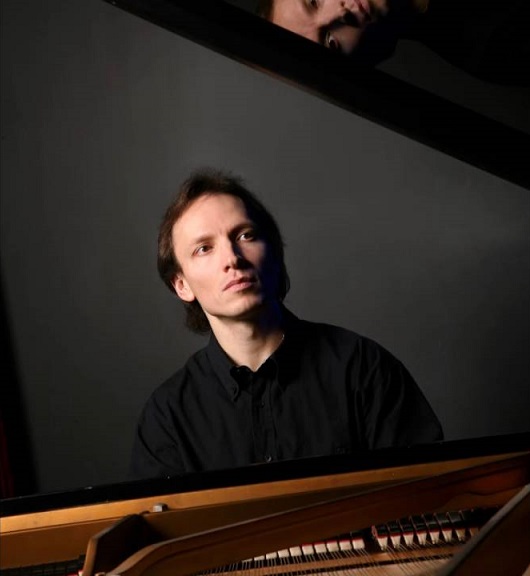
Thursday October 20, 2022 – In February 2020, just days before life-altering pandemic commenced, Maxim Vengerov and Polina Osetinskaya gave a memorable recital at Carnegie Hall. This evening, they were back on the Carnegie stage with another enticing program.
But our evening did not quite go as planned. First, a 20-minute delay of the start of the concert caused the audience to become restless. Then, during the music, the women behind me chatted whilst a woman next to me fell asleep and snored lightly. Then, about 90 seconds before the end of the Kreutzer sonata, a woman stood up and struggled over the people in her row to get to the aisle. My friend Dima, who is Russian, always says ‘Russian audiences are the worst’; we decided to have a late supper rather than endure more distractions. It was kind of sad to leave, because Mr. Vengerov and Ms. Osetinskaya really were playing divinely.
The artists finally took the stage, Mr. Vengerov rather oddly clad in what appeared to be a bulky blue sweater and matching trousers. Ms. Osetinskaya on the other had was a vision of elegance in a black frock which perfectly showed off her lithe figure.
J. S. Bach Violin Sonata No. 1 in B-Minor, BWV 1014, is different from many other works for violin and harpsichord from this era, because the right hand of the harpsichord is fully written out by Bach. Up to this point in time, it had been customary for only the left hand and the chords for the keyboard to be specified. But BWV 1014 changed the relationship of the instruments: the harpsichord would now be equal to the violin, not merely an accompaniment. The harpsichord thus became a second melodic voice, changing the art of the violin sonata forever.
Of course, Ms. Osetinskaya was at the Steinway rather than a harpsichord; her playing of the Bach was simply exquisite, though – in fact – she surpassed herself in the ensuing Beethoven. It is the piano that opens the Bach sonata with a really gorgeous passage, and then the violin enters on a long, soft-suspended tone. Throughout the sonata, the two artists’ dynamic modulations were perfectly in sync.
The first Allegro is lively and charming, and the Andante – with its hushed, sustained start – has a fine, dignified feeling. The minor-key finale is fast and fun, with the two players keenly tuned into one another as the music hastens along.

The artists took only a momentary break – not leaving the stage – before commencing their luminous rendering of Beethoven’s immortal Violin Sonata No. 9 in A-Major, Op. 47, “Kreutzer“.
The sonata begins with a slow introduction played by the solo violin. The piano then responds, Ms. Osetinskaya displaying a gracious subtlety. Mood swings now come into play: passages of animation alternate with more pensive phrases. The music gets almost angry before the composer reverts to the calm of the sonata’s opening.
Ms. Osetinskaya launches the familiar theme of the Andante with a softly rippling motif. Now comes a delicious set of variations in which the ravishing sound of the piano sustains each mood and meshes with Mr. Vengerov’s sweetly turned phrases, his whisper-light top notes, and fabulous trills.
From its sprightly start, the third movement, a tarantella based on another familiar theme, calls for great virtuosity from both players: “Tons of notes!!”, I scrawled on my Playbill. The sonata ends with a celebratory final rush. The audience gave the musicians a resounding ovation though, in fact, they deserved even more.
Mr. Vengerov is scheduled to return to Carnegie Hall on Sunday May 21st, 2023, for a Concert in Honor of Andrei Sakharov. Gidon Kremer, Steve Isserlis, Evgeny Kissin, Lera Auerbach, and the Emerson String Quartet willm also take part.
Now if we could just get Ms. Osetinskaya here for a concerto evening, or – better still – a solo recital…!
We headed out, sorry to miss the arrangements of six songs from Dmitri Shostakovich’s marvelous song cycle, From Jewish Folk Poetry; these songs are so dear to me.
~ Oberon




 Oberon's Glade
