Tag: MESSA DA REQUIEM
-
Defiant Requiem
Author: Oberon
I’ve finally had an opportunity to watch the film DEFIANT REQUIEM, the story of performances of the Verdi MESSA DA REQUIEM that took place at Terezín during the darkest days of the Holocaust. I expected to be moved – deeply – but the effects of watching the film were truly profound.
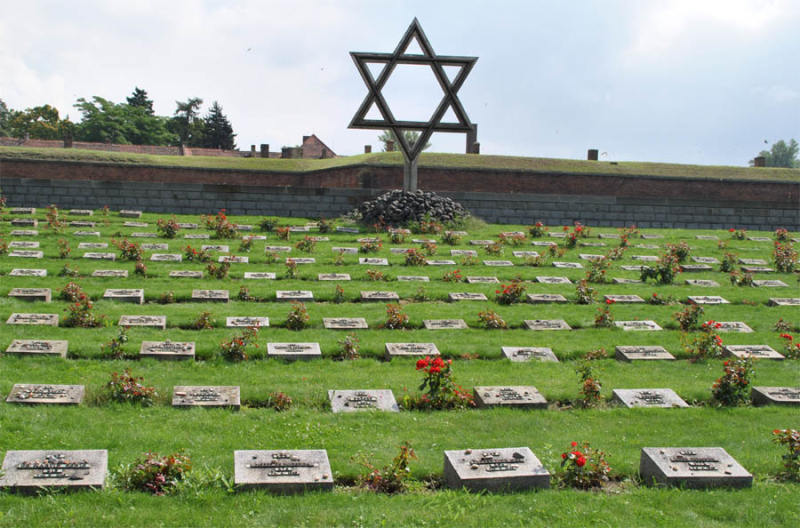
The ghetto at Terezín occupied an old fortress, ironically built in the shape of a six-pointed star. By 1943 it housed 60,000 Jews, roughly ten times the number the space might be reasonably thought to accommodate. There was little food, and no hope. Trains left Terezín on a regular schedule, carrying prisoners to their ultimate doom at Auschwitz.
In the dire living conditions of Terezín, one man had a vision: composer and conductor Rafael Schächter drew together a chorus from the many the singers who lived in the ghetto. Late at night, these musicians gathered around an old, abandoned upright piano which Schächter had discovered to learn Verdi’s MESSA DA REQUIEM. Schächter led more than a dozen performances of the REQUIEM over time at Terezín, but for each presentation, new choristers had to be found and trained to replaced those who had vanished into the cattle cars heading East.
In the Spring of 1944, the inmates of Terezín were suddenly assigned to new work details; their job: to spruce up the camp and make it look like a normal, thriving town. Fresh clothes were distributed, and suddenly food became more abundant. The reason for all this became evident when the SS brought in film crews, along with representatives from the International Red Cross, to show that the Jews were were being well-treated. The ruse worked.
As part of this deception, Rafael Schächter was ordered to gather his chorus together and give a performance of the REQUIEM for the visitors. This time, the singers privately relished the Mass’s prophesy of the Die Irae (‘Day of Wrath’) – the coming of Judgement Day – hurling the Latin words into the unsuspecting faces of their captors. And these lines from the Liber Scriptus stand yet as a warning to all oppressors:
“A written book will be brought forth,
which contains everything
for which the world will be judged.Therefore when the Judge takes His seat,
whatever is hidden will be revealed:
nothing shall remain un-avenged.”The date of the Red Cross visit to Terezín – June 23rd,1944 – apparently marked the last time the REQUIEM was sung in the ghetto. Soon after, the transports to Auschwitz were resumed, and Rafael Schächter and most of his chorus went to meet their fate.
Some seventy years later, conductor Murry Sidlin paid tribute to Rafael Schächter and honored all the lives lost or damaged during the Holocaust by leading a performance of the Verdi REQUIEM at Terezín. Since then, the DEFIANT REQUIEM has been performed worldwide more that 40 times.
The DVD tells the sad tale of Terezín, and of Raphael Schächter’s development of the defiant REQUIEM against all odds. It also features excepts from the Sidlin “revival” and interviews with some of the few survivors who sang in Schächters’ choir.

One of the many stories we hear is that of Edgar Krasa (above, as a young man), a cook and welder who was Schächter’s bunk-mate in the ghetto. Krasa sang in all sixteen REQUIEM performances that Schächter led at Terezín; he was later shipped to Auschwitz and, in January 1945, miraculously escaped while on a death march. Krasa met and married his wife Hana in 1949; though they had both been at Terezín at the same time, they had never met while there. Edgar Krasa died in 2017.

Edgar and Hana Krasa (Matthew Lutch photo, above) were guests of honor at Murry Sidlin’s Terezín performance of the REQUIEM…
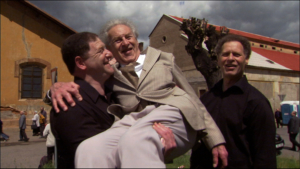
…and both of their sons (above, with Edgar) sang in the chorus.
For me, the most touching moments in the film come when Murry Sidlin summons his chorus to the very subterranean chamber where Raphael Schächter held his secret rehearsals. Packed into the small space, the singers – many of them very young – sing the Requiem Aeternam. They sing thru their tears.
-
Verdi REQUIEM @ Carnegie Hall
Tuesday October 23, 2012 – I’d been looking forward to this performance for weeks; the Verdi MESSA DA REQUIEM is one of my favorite pieces of music, glorious from first note to last. I have experienced some thrilling live performances over the years, including three superb evenings at Tanglewood. Great conductors, great soloists and top-notch choral groups have placed their stamp on this grandiose and poignant score.
Tonight’s performance will not fall in the memorable category, although the playing of the Philadelphia Orchestra was thrilling, and the singers of the Westminster Symphonic Choir gave their hearts and souls to the work’s resplendent choral passages.
Opening the work with an achingly slow and very inspiring rendering of the score’s first pages, conductor Yannick Nézet-Séguin went on to a very impressive performance of the entire work. He moulded the great arcs of music with a fine sense of grandeur and he and his players shone in the more introspective moments. Only his rather pretentious holding of the applause by not lowering his baton after a reasonable pause at the end seemed off-kilter; it wasn’t that profound of a performance.
The REQUIEM is sometimes referred to as a ‘sacred opera’; it is so very operatic by nature that, as with all operas, performances of it tend to stand or fall by its principal vocalists. Tonight we had an even split of a surprisingly excellent mezzo-soprano and a very fine basso, aligned with a soprano who seemed sometimes on the verge of distress and a tenor who labored valiantly to make his once-generous voice flesh out Verdi’s magnificent melodies.

Christine Rice (above), a singer totally new to me, gave a very pleasing performance in every respect, Her timbre has a soprano feel to it, but she used a comfortably plush and resonant chest voice to make the most of her every phrase. In an evening of often wayward vocalism, I found myself sighing with relief whenever Ms. Rice stood up to sing. Basso Mikhail Petrenko might not have the sheer vocal heft of some of the singers who have preceded him in this music, but his sound is steady and warm and his vocalism is expressive. The opening pages of the Lacrymosa, where Ms. Rice and Mr. Petrenko joined forces, was the evening’s purest sonic pleasure.
Marina Poplavskaya’s opening phrase was painful to the ear; her voice sounded unsteady and ill-sorted. As the evening progressed, a feeling of lack of vocal support grew. Her voice often sounded pallid and tentative, and she used a piano approach to high notes to cover a spreading quality that emerged when she sang full-out. Shortness of breath was worrisome, as were vagaries of pitch here and there; her lower-middle register did not always speak. And some of the most thrilling moments of the REQUIEM, when the soprano voice should sail out over the massed choral and orchestral forces, went for naught tonight as Ms. Poplevskaya’s sound was erased by the sopranos of the chorus.
Opera lovers can’t help but be aware of Rolando Villazon’s vocal struggles in recent seasons. This very likeable singer tried to sing with his usual generosity and passion, but the sound now is smallish and grey. The top does not bloom, but narrows instead. And he has a very strange method of attacking notes with a biting huskiness. Attempting to make the music interesting, he drew down the tone to a thread at times but it did not sound well-supported; and a patch of off-pitch singing in the Hostias was disconcerting.
It was a sad night for the soprano and tenor though the audience, typically, did not seem to notice anything was amiss. I wonder how much more impressive the evening would have been if different vocalists had taken on these roles. It was a squandered opportunity, in my view.
- The Philadelphia Orchestra
Yannick Nézet-Séguin, Music Director - Marina Poplavskaya, Soprano
- Christine Rice, Mezzo-Soprano
- Rolando Villazón, Tenor
- Mikhail Petrenko, Bass
- Westminster Symphonic Choir
Joe Miller, Conductor
- The Philadelphia Orchestra


 Oberon's Glade