
Above, today’s BOHEME cast: Anthony Clark Evans, Gabriella Reyes, Dmytro Popov, Sean Michael Plumb, Corinne Winters, and Alexander Köpeczi; a MET Opera photo
~ Author: Oberon
Sunday May 25th, 2025 matinee – A cast largely new to me brought me to the Met this afternoon for yet another BOHEME. It proved to be one of the most moving BOHEMEs I have ever experienced, and it brought us the Mimi of an extraordinary soprano, Corinne Winters.
Opening my Playbill today, I was surprised to find that Yannick Nézet-Séguin was listed as the conductor. I was quite certain that he had not originally been scheduled, and sure enough – in checking the season brochure – it was to have been Riccardo Frizza. I was annoyed at the prospect of Y N-S ruining the afternoon with his tendency to overwhelm the singers with volume from the pit. There were passages where this happened today, but to me he was more attentive than usual to the voices. (Chatting with folks at the stage door after the show, the general feeling was that the orchestra was often too loud.)
The quartet of Bohemians today was exceptionally pleasing. Tenor Dmytro Popov as Rodolfo had made a very fine impression in this role last season, and he was equally appealing today. The two excellent young baritones in the cast were Anthony Clark Evans as Marcello and Sean Michael Plumb as Schaunard.
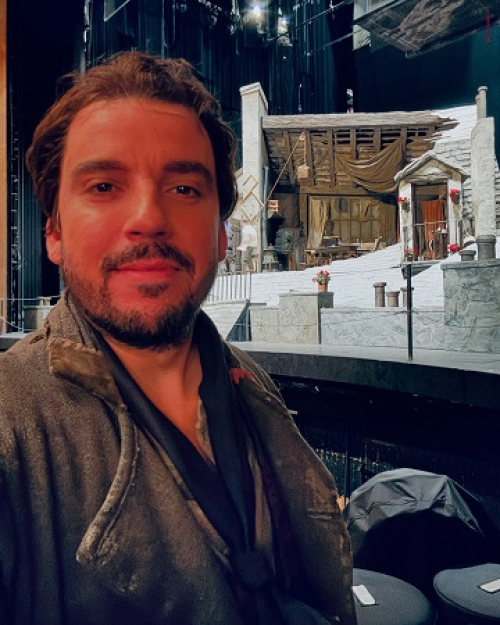
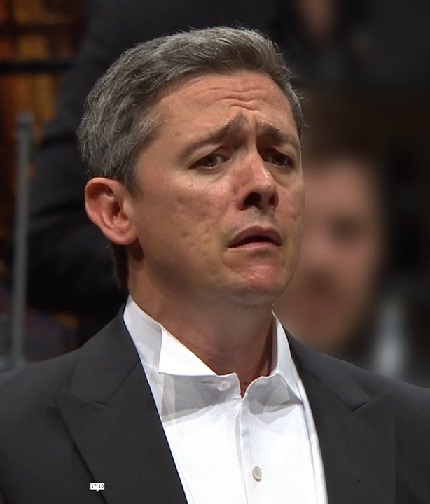
And the Hungarian-Romanian basso Alexander Köpeczi (above) was making Met debut this afternoon as Colline; I’d lately read about him and have watched some of his video clips on Facebook….very impressive!
A favorite with Met audiences, Gabriella Reyes, was a warm-toned, lively Musetta, and in Corinne Winters we had one of the most moving Mimis of my (extensive) experience; she had first appeared at the Met in 2011 as Countess Ceprano in RIGOLETTO, but today really felt like a Met debut – and an extraordinary one at that.
Curtain up, and Mr. Evans’ rich tone gets the singing off to a great start; Mr. Popov immediately shows off a finely-projected lyric tenor. They are joined by Mr. Köpeczi, his darkish, handsome timbre will keep the music gorgeously anchored all afternoon. And then Mr. Plumb makes his mark with a voice that will bring Schaunard to prominence as the opera unfolds. Evans/Marcello baits the Met’s go-to Benoit – Donald Maxwell – and then he and his pals head out to Cafe Momus, leaving Mr. Popov momentarily alone. A knock at the door brings Corinne Winters’ Mimi onto the Met stage: the beginning of a captivating performance from this fascinating singer. Her sound and style are Italianate, and the voice carries beautifully in the big space.
Mr. Popov’s “Che gelida manina” is lovingly phrased, with persuasive dynamics and a true sense of the poetry. The conductor is not really supportive, but the tenor fares very well anyway, with a nice top-C. Then Ms. Winters commences Mimi’s narrative, in the course of which both Rodolfo and myself will fall in love with her. Clear-toned lyricism is a Winters trademark; her lower range distinctive, her word-colourings always fresh and appealing. The orchestra is much too loud at the start of the love duet – and must the audience laugh at every single title as love blooms between poet and seamstress? But the singing is so convincing as the couple experience the delight of new-found happiness. The act ends on a long-held, harmonized note. Magic!
The scene-change lasts so long, they might as well make it an intermission: the mood has been shattered anyway. Mr. Popov makes the most of every note and word as he introduces Mimi to his friends…and the tenor makes something special out of “…sbaccio l’amor!” The children’s chorus have fun with their calls of “Parpignol…Parpignol!” and Mssrs. Evans, Plumb, and Köpeczi seize upon every note to keep their characters engaging us in this crowded staging.
Musetta arrives in the person of Gabriella Reyes, and, as she settles in after some initial commotion, Ms. Winters and Mr. Popov have a lovely exchange. Then Ms. Reyes launches the waltz, full of allure and insinuation. The soprano shines in this aria, capping it with a house-filling top-B. Anthony Clark Evans then encores the melody with baritone-power, leading to a massive climax. The parade passes thru: the last joyous moment of the opera.
Following an endless interval, the prelude to Act III was nicely and subtly played by the Met orchestra. Ms. Reyes’s sweet lyricism recalls her waltz, and then the hapless Mimi appears. From her first hesitant line, Corinne Winters captures every nuance of Mimi’s plight with her touching, expressive singing. Finding Marcello/Evans, the soprano and baritone are simply wonderful in their duet: clear, emotionally-charged singing from both. The soprano is spectacular here, her timbre and way with the words would make you swear you’re listening to an Italian prima donna.
As Mimi hides, Mssrs. Popov and Evans have a telling exchange, superbly voiced despite some over-playing from the pit. Then the tenor confesses his fears about Mimi’s health with “Mimi a tanto malata…” which continues to his outpouring of truth at “Una terrbil tosse“. Mr. Popov saturates these passages with passionate despair…bravissimo!
Mimi steps forward to the sound of a theme full of heartbreak, and Ms. Winters is infinitely touching in Mimi’s farewell, “Donde ieta usci...”, so beautifully phrased and coloured, her lower range so evocative, her crushing final words gorgeously intoned, with a lingering last note that vanished into the air like a whispered goodbye.
Rodolfo/Popov seeks to mend things; the couple remind one another of the things they love – and hate – about each other. Meanwhile, Musetta and Marcello are having their own battle royale. In the ensemble, the sopranos pour out vibrant sounds. Then, alone again, Mimi and Rodolfo resolve to stay together: Mr. Popov’s ravishing “…stagion di fior...” true poetry.
After a pathetic second intermission wherein most of the audience stayed in their seats, twiddling their thumbs, we have the reminiscing duet of Rodolfo and Marcello, recalling happier days: wonderful singing from the Popov/Evans team; and though the orchestra encroached for a spell, it ended with soft musing. Bravi, gentlemen!
Now the four Bohemians reunite; recalling past good times together, they party, all singing lustily. Mr. Plumb again impresses here. They dance, and duel, until suddenly Musetta bursts in, bringing with her the dying Mimi. In this heart-stopping moment, time seems to stand still. Ms. Winters brought forth a wealth of detail in her singing here, from the outpouring of “Si rinasce…” to her wistful greeting of each of the Bohemians: “Tutti qui...”
Mr. Köpeczi sings Colline’s wrenching farewell to his old coat, hauntingly recalling it as his longtime companion thru good times and bad…the basso’s resonant voice, loaded with emotion, sounds marvelous in the big house. Bravissimo!
Finally left alone with Rodolfo, Ms. Winters seals her fascinating performance with her heart-rending singing of “Sono andanti…?” Pure poetry here, her lower range battering my heart with its unique incandescence.
The mood was somewhat spoilt by audience members laughing at the title/translations…they should by turned off by this point. But Ms. Winters restores proper dignity when she finds Mimi’s pink bonnet under the pillow, inducing a flow of memories. And then she sleeps away.
The curtain calls were lovely today, each singer warmly greeted as he/she stepped before the gold curtain in this, one of the last two Met productions wherein curtain calls involve an actual curtain. Ms. Winters was deservedly cheered for her engrossing performance.

Above: a sizeable crowd gathered at the stage door to greet the singers, and I was very happy to re-connect with tenor and voice teacher Jason Ferrante, who I’d met when he was at Julliard and I worked at Tower Records. Ms. Winters is one of Jason’s longtime students. I met Ms. Reyes, and Mssrs. Evans, Plumb, and Köpeczi (how Mr. Popov managed to slip by me I am not sure). And Ms. Winters’ personality is as lovely as her voice; she seemed genuinely moved by the audience’s response to her performance this afternoon.
All in all, a wonderful afternoon at The Met…an afternoon that recalled another such day – many, many seasons ago – when I fell in love with Jeannette Pilou. Today, Corinne Winters cast a similar spell over me. She was so kind as I tried – so clumsily – to express my admiration.
~ Oberon










 Oberon's Glade