Tag: Met Opera

  • The Marcella Sembrich Museum

    Sembrich museum-1 jpg

    In the summer of 1963, my parents took me to see an English-language production of Rossini’s BARBER OF SEVILLE given by the Lake George Opera Company; this was my third live opera performance. I still remember how cold it was in the small theater, how much I liked the Berta (played by Ellen Berse, who later joined the short-lived Metropolitan Opera National Company), and that my favorite part of the opera was the “Frigid and motionless” ensemble. 

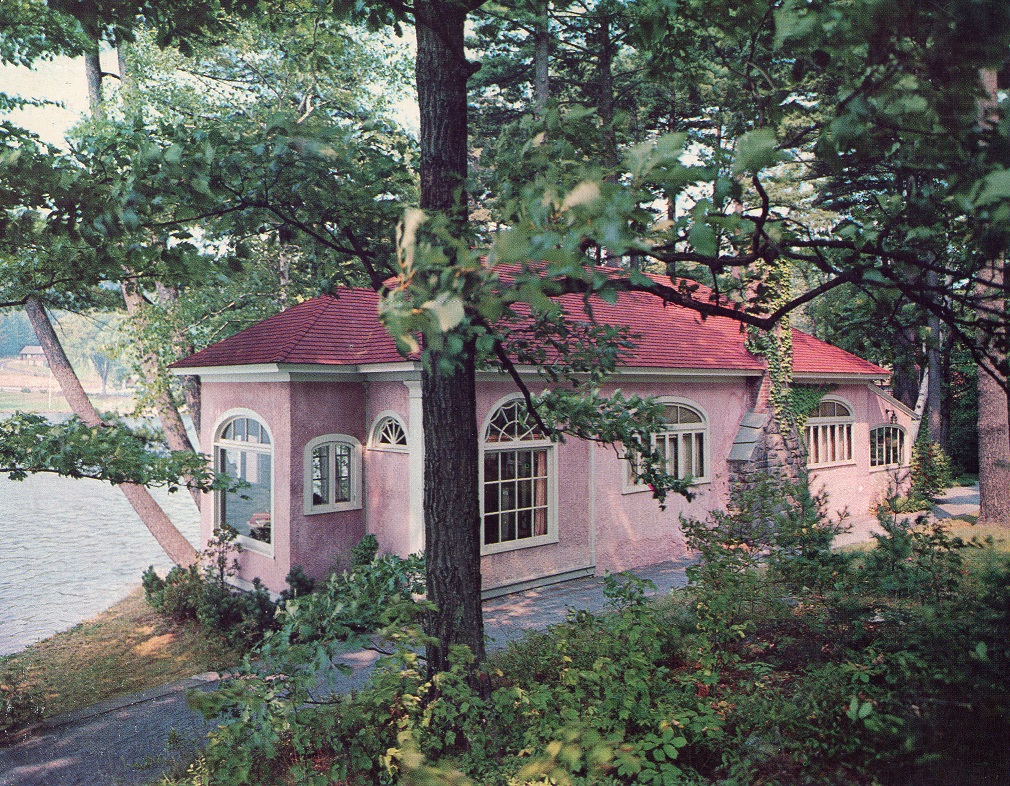
    We spent an extra day on Lake George, which included a visit to the Marcella Sembrich Museum; this was housed in a pink cottage at Bolton’s Landing, NY, where the legendary Polish soprano spent her off-seasons from The Metropolitan Opera, giving voice lessons.

    The main thing I remember about our time at the museum was that it was far briefer than I had anticipated. Although I was fascinated by all the opera artwork, old photographs, scores, even some of Sembrich’s costumes and accessories, my parents seemed oddly tense. It took me a few minutes to realize that the middle-aged man who was overseeing the place was subtly eyeing me; whenever I stopped to examine a particular photo or artifact, he would hover nearby and comment on whatever it was I was looking at. My mother would then materialize out of nowhere.  

    We’d only been there for 15 minutes when my father announced that it was time to go; I was not anywhere near done looking around, and I had also wanted to ask if I could play the piano (I was sure it was forbidden) and then sit outside the cottage, enjoying the sun and the lake view. The man then suggested that my parents leave me there and come back and pick me up in an hour. My mother turned frosty, and we left a few seconds later. Once in the car, I complained that there was so much I hadn’t gotten to see. They quickly changed the subject: where should we have lunch?

    Of course. I knew perfectly well what was going on: they viewed the man as a predator and me as an innocent victim. I wasn’t exactly innocent anyway; I’d been fooling around with one of the neighbor boys for a while. But I sometime think back on that afternoon; it would be another ten years, filled with fantasies and frustrations, before I took the leap. 

  • @ My Met Score Desk for FIDELIO

    Fidelio tk and ld

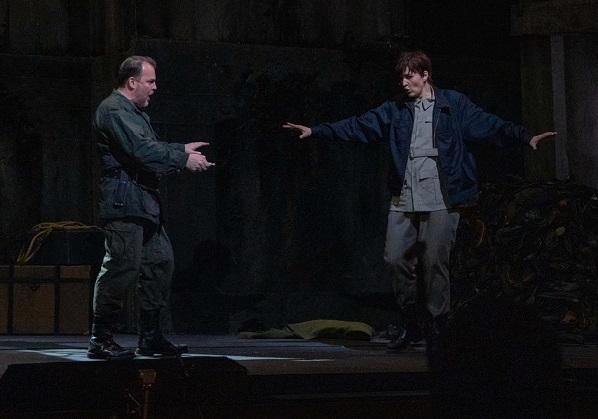
    Above: Tomasz Konieczny and Lise Davidsen in Act II of FIDELIO; a MET Opera photo

    ~ Author: Oberon

    Saturday March 15th, 2025 matinee – I’ve never really been drawn to Beethoven’s FIDELIO. I’ve only seen it a few times; my first Leonore was Shirley Verrett (!), later followed by Hildegard Behrens, Karita Mattila, and  Waltraud Meier in the title-role. I love the drama of Leonore’s rescue of her beloved Florestan, but I don’t like the ‘operetta’ couple who are quite silly; they hold up the action in what could otherwise be a potent drama.

    This afternoon’s performance of the Beethoven opera was sold out, and overall it was a good FIDELIO. Susanna Mälkki’s conducting seemed on the fast side, and at times she seemed to succumb to the current Met trend of swamping the singers. The orchestra were on peak form, with excellent work from the horns. The chorus likewise excelled.

    In the briefest roles, tenor Jonghyun Park’s sweet lyricism made his mark as the First Prisoner; Jeongcheol Cha was equally fine as the Second Prisoner, though he has less to sing. Ying Fang as Marzelline and Magnus Dietrich as Jaquino both sang beautifully, but their characters are cardboard…and if they were absent from the narrative, it wouldn’t matter. 

    Milling fidelio

    The impressive Danish basso Stephen Milling (above, in a MET Opera photo) is ever welcome at The Met. Today he had the brief but pivotal role of Don Fernando, and he sang with authority; I look forward to his Sarastro later in the season.

    Rene Pape, who turned 60 last Autumn, retains the power and firmness of his cherished voice; he has given me so many wonderful memories in my opera-filled lifetime, and he sang handsomely and effortlessly today. His Act I aria, and his scene with Leonore as they prepare for their gruesome task, were highlights of the afternoon.

    Tomasz Konieczny was a vivid Don Pizarro; his first spoken lines had a sense of urgency, and he displayed the meanness of the character in his sinister inflections. Joining Mr. Pape in duet, the sheer amplitude of their sound defined the description “Met-sized…”. Later, Mr. Konieczny’s taunting of the hapless Florestan was unsettling. 

    Following a superb prelude to Act II from the MET Musicians under Ms. Mälkki’s baton, tenor David Butt Philip emitted an uncanny, sustained tone with his opening “Gott!” The intensity of Florestan’s suffering was strikingly voiced by the English tenor, who has an impressive list of European achievements to his credit. His trio with Ms. Davidsen and Mr. Pape had a palpable feeling of terror. Rescued by his wife’s cry “Töd’ erst sein Weib!” as she holds Pizarro at gunpoint, Florestan joins Leonore in the blazing “O namenlose Freude!”  But I did miss hearing Florestan’s haunting spoken line, “Was hast du für mich getan?” 

    Lise Davidsen was the star of the afternoon, just as Leonore is the heroine of the story. The tall Norwegian soprano is pregnant with twins, and this run of FIDELIO at the Met will be her last performances until after the babies arrive. She was in excellent voice today, and her strikingly clear and shining top notes seemed truly to stun the audience. Her singing of the great aria “Abscheulicher!” had remarkable power but also some incredible subtleties, and the prayerful passage “Komm, Hoffnung” moved me deeply.  The soprano then went on to a blazing, prolonged top B at the aria’s climax, drawing cries of brava! from the Hall. In the opera’s finale, more of the soprano’s high notes lit up the afternoon. 

    Following a benedictive passage from Mr. Milling’s Don Fernando, the minister then asks Leonore to remove her husband’s shackles. In this moving moment, I glanced up at the sculpture that hangs over the Met’s proscenium; created by American sculptor Mary Callery, it was described at the time the House opened in 1966 as having been inspired by the opened shackles of Florestan, rescued by his devoted wife. 

    ~ Oberon

  • Gihoon Kim at The Met

    Gihoon & sophia

    Above: Korean baritone Gihoon Kim with Met Opera fan Sophia Cerovsek

    ~ Author: Oberon

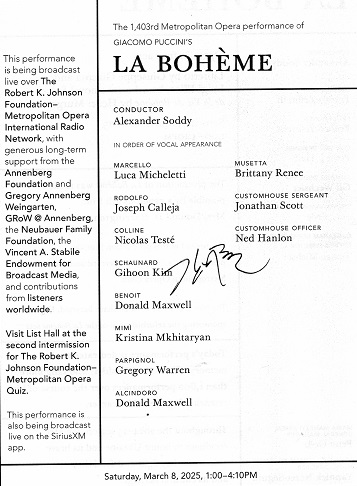
    Saturday March 8th, 2025 matinee – I wanted to catch Gihoon Kim’s Schaunard in the Met’s BOHEME a second time. Since watching the Korean baritone take the title Cardiff Singer of the World at the 2021 competition, where his Tanzlied from Korngold’s DIE TOTE STADT brought the beloved soprano Roberta Alexander (one of the judges) to tears, I have followed Gihoon’s career, and even befriended him on Facebook. He has a wonderful voice and a sunny, life-embracing personality.

    Although I was at a score desk, I’d heard about Gihoon’s dance routine (and the ensuing duel) in Act IV, so this time I stood up and took in all the action. Hilarious! Later in the act, it is Schaunard who first realizes that Mimi has breathed her last: “…è spirata…” , which Gihoon spoke in a hushed voice. After the performance, I went to say hello to him at the stage door.

    Gihoon-1 jpg

    Aside from Gihoon, the only singers in the cast whose work I was familiar with were Joseph Calleja (Rodolfo) and Kristina Mkhitaryan (Mimi, who I’d previously seen as Musetta). Brittany Renee (Musetta), Luca Micheletti (Marcello), and Nicolas Testé (Colline) took the other leads today, and the British conductor Alexander Soddy was on the podium.

    Although there was sometimes a feeling that the cast was under-rehearsed, overall the performance came off quite well; Maestro Soddy did cover the voices at times (a trend at the Met these days), but his tempi were nice, and I liked the energy he developed as the military parade passes by the Café Momus.

    I had not heard Joseph Calleja (Rodolfo) in the House since his 2019 Pollione. The voice has always had a fast but fascinating vibrato, and that was in play today; for me, it adds a special appeal to his singing. Today, his highest range seemed somewhat compromised; he may have been ill, or perhaps this is how he sounds now, after having sung, in recent years, some roles that stretched his essentially lyrical voice. Whatever the trouble, he managed to find a work-around, keeping the higher notes brief, or trying a headier resonance. At the end of the love duet, he at first harmonized with the soprano, but then went for the concluding top note which was a bit husky but which his Mimi’s clear note helped to masque. Thereafter, Mr. Calleja was a truly poetic Rodolfo; his singing has a vulnerable trace that is most appealing. His most magical moment came at the end of Act III when he produced a gorgeous falsetto tone on “…la stagione dei fiori…”  Really exquisite. Earlier, at the end of “Che gelida manina…” he had created the same intimate atmosphere with his delicate “Via piaccia dir?“, sustained down to a whisper.  

    Today’s two sopranos both have vibrant voices, capable of filling the Met (so long as the Maestro kept the orchestra’s volume agreeable). Both Kristina Mkhitaryan and Brittany Renee have a bit more vibrato in their tone than I could wish, but other opera friends of mine feel this is a trend nowadays, and they are not bothered by it.

    Ms. Mkhitaryan’s Mimi made her entrance after a lovely flute solo; oddly, for the first time, I sensed that a shadow of doom lies over the seamstress right from her hesitant “Scusi…”. As her narrative-aria unfolded, the vibrato became less intrusive; her singing was poetic. The orchestra slowed a bit, so she could make the most of the lyrical Ma, quando vien lo sgelo...”; and in the lingering phrases that follow, the soprano was most persuasive. In their classic duet, she and Mr. Calleja beautifully expressed their blooming love. The tenor’s haunting “Che m’ami, di...” was met by the soprano’s delicate “Io t’amo!“.  Nothing in the world compares to falling in love at first sight; I’ve done it hundreds of time thru the years…usually in vain.

    Ms. Mkhitaryan’s singing in the Act III duet with Marcello was tinged with desperation, and her Donde lieta usci...” was truly touching, especially her hushed “Bada, sotto il guanciale c’è la cuffietta rosa…” which made me choke back tears. The aria had a ravishing, sustained ending. In the final minutes of Mimi’s life, Ms. Mkhitaryan summoned a lovely palette of vocal pastels; she even introduced a touch of playfulness as she and Rodolfo recalled their first meeting. But then the fatal cough sets in, her final lines trailing off into eternity.

    Ms. Renee’s Musetta, like most takes on this role, is an extrovert. Her noisy disruption of the Momus party was laced with moments of shrill shrieking, but she settled in for the Waltz, especially nice in the insinuating subtleties of the second verse, and then capping off the ensemble with a bright top note. At the end of the third act, Musetta again gets shrewish as she and Marcello indulge in name-calling. Ms. Renee was at her most compelling when we see the other side of her as she prays for Mimi’s recovery, and she and Marcello comprehend the depth of their love for one another.

    From note one, Luca Micheletti was a superb Marcello; this can really be a star role – when it’s truly well sung and acted – and that’s what this baritone made it. Every note and line counted for something, so that even the big moments – like leading the Act II ensemble, singing the melody of Musetta’s waltz – are part of a grander scheme. In his Act III duet with Ms. Mkhitaryan, and again in his Act IV duet with Mr. Calleja, the singer sounded just the way you want an Italian baritone to sound: passionate, expressive, and assured. I will look for him in the future…bravissimo!

    No less impressive than his painter/colleague, Nicolas Testé as the philosopher Colline excelled. Taking every opportunity to make his mark, the French basso highlighted such moments as joining Micheletti/Marcello in a commanding “Abbasso, abbasso l’autore!” as they dismiss Rodolfo’s feeble effort to get a fire going in the stove of their frigid garret. His observations of the two ‘loving’ couples at Momus were spot on. But of course it was in the Coat Aria of Act IV that M. Testé (abetted by excellent horn playing from the pit) struck vocal gold. Really beautifully done…grand merci!! 

    It was not a perfect performance, but it was extremely moving; and sometimes that is all that matters. I found myself thinking of my sister’s passing last July; like Mimi, she slipped away quietly – with loved ones watching over her – at the end of her battle with cancer. Ironically, LA BOHEME was one of only two operas my sister ever saw – at the Old Met in her college days. I was always jealous that the cast she had seen included Dorothy Kirsten, Carlo Bergonzi, and Anneliese Rothenberger.

    Sitting at my score desk, people often come up to talk to me during intermission; they’ve spotted me from Family Circle, with my reading lamp on, my score open, and taking notes. Today, three young engineering students from Columbia University stopped by, each wearing a necktie and all looking very dapper. They were all seeing their first opera; they asked me many questions, and I found my usually-reticent self babbling away about how wonderful opera is, and how it changed my life (literally!). Once I get started on the topic, it’s impossible to shut me up.

    Earlier, I’d been chatting with the young woman seated in front of me; she was seeing her second opera this afternoon, and she asked for suggestions of what other operas she should try. In the course of our chat, she apologized for mispronouncing the names of the great operas, and of the characters in them. I assured her that all opera lovers start out that way; you can only imagine how I mangled the title of Leonora’s great aria “Pace! Pace, mio dio!” for several weeks before I heard the correct pronunciation. To this day, I still blush to myself when I think of it. 

    ~ Oberon

  • Amina Edris ~ “Dis-moi que je suis belle”

    Amina_edris_capucine_de_chocqueuse_0

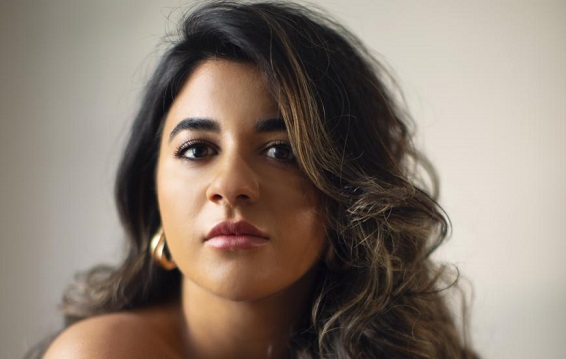
    Egyptian-born soprano Amina Edris (above, photo by Capucine de Chocqueuse) sings “Dis-moi que je suis belle” from Massenet’s Thaïs at a concert in Prague with the Prague Philharmonia, conducted by Lukasz Borowicz.

    Watch and listen here.

    Ms. Edris will be making her Metropolitan Opera debut in April 2025 as Mimi in La Boheme.

  • Orchestra of St. Luke’s ~ Bernstein’s ‘Kaddish’

    Samuel-pisar

    Above: Samuel Pisar

    ~ Author: Oberon

    Wednesday January 29th, 2025 – Carnegie Hall marked the 80th anniversary of the liberation of Auschwitz with a performance of Leonard Bernstein’s Symphony No. 3, “Kaddish.” A setting of ‘A Dialogue with God’ by the late Samuel Pisar – who had himself been a survivor of Auschwitz – was spoken tonight by Pisar’s wife, Judith Pisar, and their daughter Leah Pisar, with James Conlon leading the Orchestra of St. Luke’s. The Bard Festival Chorus, directed by James Bagwell, and the Brooklyn Youth Chorus, led by Dianne Berkun Menaker, made the choral passages an integral part of the evening’s performance.

    The reviews were quite harsh when the Boston Symphony Orchestra, conducted by Charles Munch, premiered this symphony on January 10, 1964; it is dedicated to the memory of President John F. Kennedy, who had been assassinated on November 22, 1963.

    Tonight was my first time hearing this work. In preparation, I read some articles and reviews of the piece; these seemed mostly to center on the narrative rather than on the musical setting. My idea was to focus on the music and let the narration flow, but that proved impossible: such is the power of Mr. Pisar’s writing.

    Former Secretary of State Antony Blinken, stepson of Samuel Pisar, made an eloquent introductory speech in which he drew a connection between the substance of Bernstein’s Kaddish and the current situation here in the USA. This of course was surely weighing on the minds of most everyone in the audience.

    Judith and Leah Pisar had taken their places next to the podium, and Maestro Conlon entered to a warm greeting. Most of my experiences with Mr. Conlon’s conducting have been at the Metropolitan Opera, where he debuted in 1976  and went on to preside over nearly 300 performances, the latest having been Shostakovich’s LADY MACBETH OF MTSENSK, more than ten years ago. I’d love to see him on the Met podium again.

    Low humming from the chorus opens the Kaddish, and then Judith Pisar, a petite woman, began to speak. Her voice is deep and profound as she talks of the Age of Anxiety, which seems to be having its second dawning. Leah Pisar’s speaking voice has a sense of passion and urgency which contrasted with Mme. Pisar’s more solemn tones.

    A high violin tone is sustained by concertmaster Krista Bennion Feeney until the xylophone sounds an alarm. A melancholy theme of unison celli turns anxious as the basses join. Following a resounding crash, the music gets wild and fast, with the crack of a horsewhip. The chorus’s rhythmic clapping gets a bit jazzy; their song is accented by the xylophone, and it moves to a big finish.

    Over quiet percussion and choral humming, Judith Pisar speaks long…and movingly; the essence of the work now becomes evident: where was god when these horrible things were happening to his people? What wrongs had they committed to merit such torment and anguish? Was god angry or simply indifferent?

    As questions are raised – “How did the Holocaust, the genocides, and the ethnic cleansings become acceptable?” – and as the spoken words become more haunting and horrifying, the actual music tends to feel less engrossing.

    But then, soprano Diana Newman’s high, sweet voice floats over an accompanying harp: clear and reassuring. The female choristers join, and the music turns grand, only to fade with the xylophone sounding. Ms. Newman resumes, supported by high, spun-out sounds of the violins. Angelic voices hum, whilst scurrying music underscores Leah Pisar’s speaking of “incendiary demagogues”.  

    The music turns delicate; Mme. Pisar speaks until a crescendo obliterates her voice; her daughter speaks of “chaos on Earth”. Aching celli and basses play deep and rich; the music swells with both choruses joining. Stabbing accents turn into an oddly merry passage for clarinet, flute, and bassoon. The Youth Chorus sings; the spoken description of “the warm embrace of democracy” seems ironic now.

    A postlude of strings and brass becomes a lament, with muted trumpet and oboe. The music hesitates; Leah Pisar speaks again, with Ms. Feeney’s violin as solo accompaniment. Now Mme. Pisar issues a plea for peace as horn and trumpet sound. There is a fast and jazzy chorus, which Ms. Newman joins. The finale feels a bit extended, but then a dramatic pause leads to a final Amen.

    Throughout the work, the eternal question hovers overall: why does god allow these things to happen? And why did he abandon the faithful in their hour of direst need? Another such test seems to loom before us now. Perhaps there are no gods, and we’re simply going to have to make it on our own.

    ~ Oberon

  • Voices from South Africa @ Weill Hall

    Siphokazi-Molteno jpg

    Above: Siphokazi Molteno

    ~ Author: Oberon

    Monday October 28th, 2024 – The Met Orchestra Chamber Ensemble presenting a program of classic and contemporary works at Weill Hall. I was very keen to hear mezzo-soprano Siphokazi Molteno. who represented South Africa at the 2023 Cardiff Singer of The World competition, and who made her Metropolitan Opera debut in 2022 as Flora in LA TRAVIATA.

    Ms. Molteno opened the evening with the Brahms “Viola songs”, a pair of lullaby-like solos accompanied by viola (Shmuel D. Katz) and piano (Thomas Lausmann). The Molteno voice has a marvelous contralto richness as well as a lyrical warmth; to say she put me in mind of the great Florence Quivar is the highest compliment I can give. It’s a voice full of ‘humanity’ and a voice I will hope to hear again…and soon. Her colleagues from the MET Orchestra played sublimely, setting the evening gorgeously on its way.  

    There was then a longish pause while the stage was set for the next work, which involved five musicians: Seth Morris (flute), Tal First (viola), Hannah Cope (harp), Gregory Zuber (marimba), and Jeffrey Irving (percussion). Ndodana-breen

    Above: composer Bongani Ndodana-Breen

    The composer’s choice of instrumentation for his Rain Making really drew me in: if there’s a marimba to be heard, I want to hear it…and likewise the harp. Mr. Ndodana-Breen composed this piece in memory of Queen Modjadi, one in a line of Rain Queens of the Balobedu people in the Limpopo province of South Africa. A Rain Queen is believed to have the power to control the rain and the winds. This mythic association made the music even more intriguing for me.

    The players made a wonderful blend and the evocative sounds included a rhythmical flute, a plucked violin, and a bean bag played by the percussionist. The flute and violin trade melodic phrases, the violin shivers, the melismatic marimba enchants. Then, to a big, pounding beat propelled by the bass drum, the storm comes: the Rain Queen’s magic has succeeded. I loved this music, and watching the musicians as they entered into the spirit of the ritual; my only complaint was that the piece is too short.

    Maurice Ravel’s sultry Chansons madécasses found a most congenial interpreter in Ms. Molteno. I first heard these songs in 1975 when New York City Ballet premiered a Jerome Robbins ballet of the same title; the singer was Lorna Myers. Since then, I have frequently listened to the songs on Mira Zakai‘s marvelous recording. 

    The first of the three songs, Nahandove, has a beautifully sultry feeling: it tells of the seduction of a native woman. Jerry Grossman’s cello opens the piece, and Ms. Molteno’s voice is at its most sumptuous as she begins this tale of longing and ecstasy. Jazzy piano rhythms from Mr. Lausmann and the sound of the piping flute (played by Maron Khoury) develop a rocking feeling; the music turns pensive and then caressive. With the song’s final strophe, “Tu pars...” the tryst ends, though it seems the lovers will meet again at sunset.

    The second song, Aoua!, opens with the singer screeching a warning: do not trust the white men! The piano takes up a swaying rhythm as Ms. Molteno continues with singing of great intensity. This is violent, angry music, though eventually the cello and flute sound forlorn.

    By contrast, the final song – Il est doux – is a languid reflection on the joys of resting the shade of a tree on a late afternoon, while a lover whispers in your ear. The sensuous flute, the eerie cello on high echoing the buzzing insects with a trill, the voice and the cello entwining, solitary notes from the piano…so atmospheric.  Ms. Molteno’s singing was evocative and so pleasing to experience. The song ends with the swiftly spoken dismissal: “Go and prepare the evening meal…” 

    Mvd2022 jpg

    Following a longish interval, an ensemble of eight instrumentalists took the stage for music by Matthijs Van Dijk (above): we heard his extraordinarily powerful oratorio Moments in a Life. I had previously heard one of this Cape Town-based composer’s works [(rage) rage against the] played by the Signum Quartet in this very hall. 

    Thus, I expected a lot from the composer’s Moments in a Life, composed in 2016 for string quintet, clarinet, percussion, piano, overtone singer & narrator. Could lightning strike twice in the same place? The answer is a resounding YES!…Moments in a Life is one of the most powerful works I have ever experienced.

    The oratorio is based on the writings of Denis Goldberg, a native of Cape Town whose parents were politically active. In 1957, Denis joined the (banned) Communist Party and he was arrested and jailed in 1960 for supporting strikers. In the mid-1960s he was with other freedom fighters who were arrested for illegal acts and jailed. He remained a prisoner for 22 years, constantly being tortured and threatened with death.

    Gareth-lubbe

    At this evening’s performance, Gareth Lubbe (above) was the narrator. Mr. Lubbe is also an overtone singer; this is a technique in which the resonance in the mouth and throat are combined with tongue, lip, and jaw movements which create a perception of overtones as being individual notes. It’s a sound that is eerie…and fascinating.

    Moments in a Life, conducted by William Long, gives us so much to take in in its 40-minute duration. Trying to follow the narrative whilst also listening to the music was a bit of a challenge for me, a dedicated note-taker: I filled three pages with notes which barely scratched the surface of the work.

    “I was sure we would not die in prison,” marks the oratorio’s opening line. As the narration moves forward, the writer recalls his first teacher, who he fell in love with. He speaks of not seeing his wife and children for more than two decades while imprisoned. A fellow freedom fighter, Looksmart Ngudle, was tortured to death. Freedom costs.

    Nelson Mandela defends the accused patriots: “An ideal for which I am prepared to die”. Sentenced to life in jail, they are moved to a harsher prison affectionately known as “Beverly Hills”: three thousand prisoners singing hymns as individuals are led away to be hanged. Ironically, a gorgeous musical theme underscores this tragedy.

    Periodically thru the work, Mr. Lubbe’s overtone singing makes a striking impression: an indescribable mixture of humming and whistling.

    As to the music, the opening measures are pensively played by clarinetist Jessica Phillips: a slow, wide-ranging solo, soon joined by piano and strings. Cellist Mariko Wyrick underscores the story of the teacher, Ms. Cook. Andrew Gantzer’s double bass, so impressive throughout the piece, tells of Looksmart’s ordeal.

    Mr. Lubbe’s voice growls deeply; percussionist Jeffrey Irving plays a rollicking ‘cadenza’. Beauteous strings, the clarinet sings again; here are glowering chords and a lament played by violist Shmuel D Katz. Mr. Lubbe has an unaccompanied solo.

    Pianist Katelan Trần Terrell and Mr. Gantzer’s bass establish a beat; Mr. Katz strums his viola. A sudden militant outburst forebodes the assassination of activist Chris Hani; a poignant violin passage (Yurika Mok and Yang Xu) underscores the narrator’s reflections on Chris’s death.

    “A petty exercise of power that harms our people.”

    At last, in the forced-labor setting of The Quarry, where Nelson Mandela and his brother freedom fighters languished, a glorious theme of hope develops: “Let Freedom Reign”. Mr. Lubbe’s otherworldly overtones are heard over a long, sustained chord.

    The audience, who had witnessed the performance is a state of awed silence, now gave the performers a fervent round of applause.  

    Back home, I went to YouTube to see what I could find about this powerful work and immediately discovered this incredible document: Moments in a Life, recorded live in concert in the Endler Hall at the Stellenbosch International Chamber Music Festival on July 16th, 2016. This, I believe, was the work’s world premiere, with Denis Goldberg – then aged 83 – reading the texts (drawn from his autobiography) himself. The great freedom fighter passed away in 2020. 

    The work is so timely right now, when our democracy stands on a precipice. If we falter, our country – and indeed the world – will be forever changed.

    ~ Oberon

  • Lucine Amara Has Passed Away

    Lucine

    Above: Lucine Amara as Aida; she signed the photo for me after a Met performance of PAGLIACCI

    The death of soprano Lucine Amara at the age of 99 has been announced. A native of Hartford, Connecticut, Ms. Amara was raised in San Francisco and sang with the San Francisco Opera chorus from 1944-1946; she made her professional concert debut in 1946.

    She made her Metropolitan Opera debut on November 6, 1950, as the Celestial Voice in Verdi’s DON CARLO, a performance that marked the start of Sir Rudolf Bing’s tenure as General Manager of The Met. From that date thru 1991, Ms. Amara sang 750 performances with The Met in New York City and on tour.

    The soprano’s vast repertoire included Wellgunde in the RING Cycle, Pamina, Liu, Nedda, Antonia in TALES OF HOFFMAN, both the Verdi Leonoras, Aida, Micaela, Contessa Almaviva, Eva in MEISTERSINGER, Alice Ford, Maddalena (and later, Madelon) in ANDREA CHENIER, Cio-Cio-San, Elsa in LOHENGRIN, Mimi, Donna Elvira, Amelia in BALLO IN MASCHERA, Tchaikovsky’s Tatyana, Ellen Orford, Tosca, Marguerite in FAUST, Fiordiligi, Luisa Miller, Mother Marie in DIALOGUES OF THE CARMELITES, Gertrude in HANSEL AND GRETEL, and Mascagni’s Santuzza.

    6a00d8341c4e3853ef022ad3e2833f200b-800wi

    My first experience of hearing Lucine Amara live was at the Old Met as Liu in TURANDOT in 1965. She sang gorgeously, with a lovely sense of lyricism and some finely-spun pianissimi. I met her after the performance (my only backstage visit at the Old House), and she was very happy to meet a young – but already very keen – opera enthusiast. (I was 16 at the time…)

    In the ensuing seasons at the New Met, I enjoyed Lucine’s Aida, Nedda, TROVATORE Leonora, and Cio-Cio-San. On April 22nd, 1972, she returned to her Met debut role as the Celestial Voice in DON CARLO to mark the final matinee broadcast of the Bing Era, which I attended. That evening, she sang the LOMBARDI trio at the Bing farewell gala. Her final Met appearance was as Madelon in 1991.

    The soprano left us some very fine recordings: the Verdi REQUIEM conducted by Eugene Ormandy, Musetta in the classic Beecham BOHEME, Nedda in PAGLIIACCI with Franco Corelli, and Elsa in LOHENGRIN under the baton of Erich Leinsdorf.  

    Here some samplings of Lucine Amara’s singing:

    As the TROVATORE Leonora:

    Lucine Amara – TROVATORE aria – Met 6~3~71

    Tatyana’s Letter Scene (in English) from EUGENE ONEGIN:

    Lucine Amara – Tatyana’s Letter Scene ~ ONEGIN – in English – Met 1957

    Duet from LA GIOCONDA from The Met’s 100th anniversary gala in 1983, with Bianca Berini:

    Lucine Amara & Bianca Berini – GIOCONDA ~ duet – Met Gala 1983

    And from her commercial recording of the Verdi REQUIEM:

    Lucine Amara – Requiem aeternam ~ Verdi REQUIEM

    Watch a video of the final scene of PAGLIACCI with Lucine and Richard Tucker from the Bell Telephone Hour, with Donald Voorhees conducting, here.

    One afternoon, while working in the opera room at Tower Records, I was playing the Leinsdorf LOHENGRIN on the overhead speakers. Four rather boisterous opera fans from Munich, who were in town for some Met performances, came in and were browsing the shelves while chatting away. As Lucine’s voice commenced Elsa’s ‘dream’ aria, the four fell silent. They stood listening as if under a spell. Then one of them came over to me and asked: “Who is this soprano?” They’d never heard of Lucine Amara. I told them of her Met career and her extensive repertoire. “This is a perfect Elsa voice! If we had had this singer in Europe, she would have been highly esteemed. It’s a heavenly sound.” 

    In the months that followed, I kept hoping Lucine might come in the store so I could tell her this story. But I never got the chance. 

  • Lando Bartolini Has Passed Away

    Lando

    The Italian tenor Lando Bartolini has passed away. A native of Prato, Italy, Lando started studying voice in Philadelphia at the Academy of Vocal Arts with Nicola Moscona. Soon after, also in Philadelphia, he made his operatic debut as Luigi in IL TABARRO in 1968. He enjoyed an early success in Mascagni’s IRIS at the Teatro Liceu in Barcelona, and became a member of the Saint Gallen Opera. 

    Lando joined the New York City Opera in 1976, appearing there until 1979. His Italian debut came in 1982 as Ernani at La Scala. He sang at the Teatro Colón, at the Arena di Verona, at Hamburg, Berlin, Chicago, Vienna, Munich, Naples, Lisbon, Tokyo, Catania, Parma, Turin, Firenze, San Francisco, Rome, Washington DC, at Covent Garden, and in Sydney.

    Bartolini made his debut with the Metropolitan Opera on tour in Boston in 1986, as Cavaradossi. He continued singing at The Met thru 1996, appearing as Manrico, Andrea Chenier, Calaf, and Radames. I saw him at The Met in AIDA opposite Leona Mitchell and Stefania Toczyska, and as Cavaradossi opposite Anna Tomowa-Sintow. He was a passionate singer, and his voice had real cutting power.

    Lando-822663

    My favorite memory of Lando Bartolini was in LA BOHEME at the New York City Opera in 1976, opposite a very young Catherine Malfitano. He was a handsome, ardent poet whose “Che gelida manina” won strong applause; then he sat on the floor at Mimi’s feet as she told her story in “Mi chiamano Mimi.” Their love duet was youthful and rapturous.

    Lando sings Andrea Chenier’s Improviso here, and Pinkerton’s “Addio, fiorito asilhere.

  • Zinka Milanov in LA FORZA DEL DESTINO

    Forza

    Zinka Milanov in one of her greatest roles – Leonora in Verdi’s LA FORZA DEL DESTINO – from a 1958 Metropolitan Opera broadcast. Flaviano Labo, Mario Sereni, and Cesare Siepi are Zinka’s co-stars, and Fritz Stiedry is wielding the baton.

    Listen here.

  • Sejong Soloists @ Zankel Hall

    240522 Sejong Here & Now Festival-5

    Above: Maestro Earl Lee, photo by Emilio Herce

    Author: Oberon

    Wednesday May 22nd, 2024 – Celebrating their 30th anniversary this evening at Zankel Hall, Sejong Soloists presented the US premiere of Unsuk Chin’s “Puzzles and Games” from Alice in Wonderland, and the world premiere of Texu Kim’s With/out book-ending a spectacular performance of Felix Mendelssohn’s Octet. It was one of most enjoyable concerts of the season, joining such Springtime delights as violinist Lun Li’s Young Concert Artists recital at the Morgan Library, the Orchestra of St. Luke’s splendid Brahms REQUIEM at Carnegie Hall, and Chamber Music Society of Lincoln Center’s thrilling program, Songs and Snow, on my list of musical events that have kept my spirits up in these chaotic times.
    240522 Sejong Here & Now Festival-13

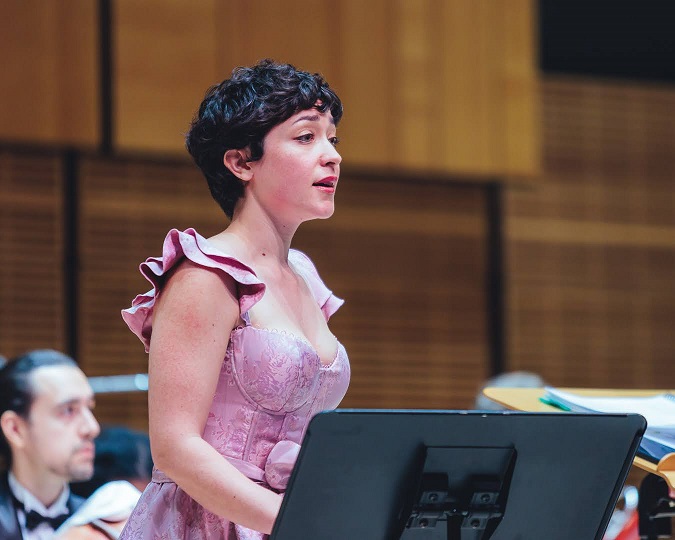
    Making her Carnegie debut tonight, soprano Juliana Zara (above, photo by Emilio Herce) was the soloist in the Unsuk Chin work, a daunting 20-minutes of singing which at times carries the singer into the highest range of the soprano voice. Ms. Zara never seemed daunted by the vocal writing: in fact, she seemed to revel in it. Conductor Earl Lee and his musicians gave the singer perfect support, whilst also seeming to savor the composers’ quirky and colorful writing for the ensemble.

    One by one, oboe, clarinet, flute, and bassoon join in the introductory phrases to Alice – Acrostic before Ms. Zara’s clear, lyrical voice is heard. This brief song ends with deep chords. Pizzicati are passed about in the introduction to If I Never Reach the Gardens, with gentle (slightly eerie) passages for the strings (and did I hear a harmonica?) before the music turns woozy; the soprano speaks much of the poem. The third and fourth songs, on the Curiouser and Curiouser theme, seem to run together. The music stays groggy, the words largely spoken, until a crashing chord is struck. Dotty rhythms and semi-singing in Who In The World Am I? are underscored by by insectuous strings and burbling winds before the flute has a final say.

    The piano introduces The Tale-Tail of the Mouse, with melodramatic sprechstimme from the soprano. Spaced-out harmonies and scurrying flutes lead to the final words: “Condemned to Death”. I thought I detected a musette in the atmospheric lullaby Sleep Tight My Ugly Baby, though my ears may have deceived me. The music is filled with droopy sighs; a sense of quietude settles in, and night chimes are heard. In Cat’s Aria, Ms. Zara ventured impressively into the upper extremes of the soprano range, lingering there is a series of amazing (and intentionally annoying) meows-in-alt.

    Twinkle, Twinkle Little Star has a delightful delicacy about it; then the music turned livelier and a catchy xylophone ‘cadenza’ established a playful mood. The music fades away at the end. The final song is Speak Roughly To Your Little Boy, introduced by a drum roll. A pulsing beat accompanies this mean mother’s lecture, with tambourine and bassoon interjecting. Now the vocal line goes completely bonkers – Ms. Zara didn’t simply manage it, she triumphed over it – as cymbal crashes bring this dazzling, quirky piece to a close. The soprano basked in a shouting ovation from the crowd, so truly deserved; she graciously signaled her thanks to the musicians and the Maestro.

    240522 Sejong Here & Now Festival-31

    Above: Ms. Zara, Maestro Lee, and the ensemble; photo by Emilio Herce

    The first time I heard the Mendelssohn Octet played live was at the New York City Ballet, where, in 2004, Peter Martins created a lovely ballet to this score, written by the composer at the ripe young age of 16. It is a veritable treasure chest of melodic and rhythmic felicities, and tonight it elevated my mood – constantly dragged down of late by the darkness that is spreading throughout the world – to one of great joy. 

    240522 Sejong Here & Now Festival-57

    An octet of prestigious string players (above photo by Emilio Herce) was led this evening by the Metropolitan Opera’s concertmaster David Chan, and the NY Philharmonic’s concertmaster, Frank Huang. From the Sejong Soloists’ roster, violinists Daniel Cho and Andrew Wan, violists Brian Chen and Paul Laraia, and cellists Ole Akahoshi and Jesús Castro-Balbi joined to create an ensemble alive with multi-hued timbres which created a very cordial blend.

    The Mendelssohn Octet is a four movements, with the opening Allegro moderato con fuocoin my opinion, one of the greatest movements in all the string quartet repertoire – being the longest by far. It opens with joyous arpeggios and vibrant accompaniments. A more lyrical second theme has an elegant feel. The Andante brings restfulness, but with a rather intense middle section that offers contrast. Mendelssohn is the King of Scherzi, and here we are offered a feast of trills and an ethereal lightness of textures. The concluding Presto is both deliciously agitated and cunningly witty. There were times when the piece seemed almost like a concerto, thanks to David Chan’s virtuosity. 

    240522 Sejong Here & Now Festival-69

    Above, taking a bow after the Octet; photo by Emilio Herce
    240522 Sejong Here & Now Festival-82

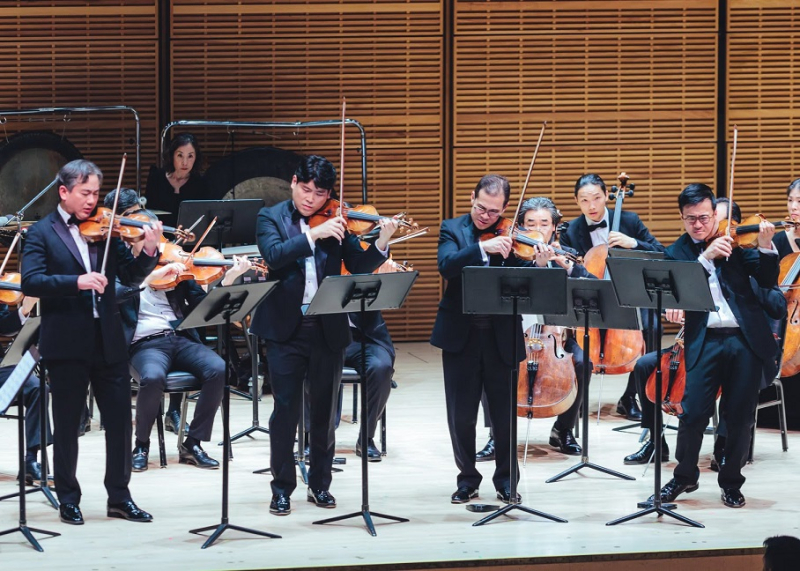
    Above, the soloists for the Texu Kim premiere: David Chan, Daniel Cho, Andrew Won, and Franck Huang; photo by Emilio Herce

    Violins remained in the spotlight for the world premiere of Texu Kim‘s With/out, which was positively brilliant. This is a concerto for four violinists, with string orchestra and a single percussionist. Frank Huang now took the lead, with Mssrs. Chan, Cho, and Wen again creating a stellar quartet. 

    The opening movement, lonesome and fluorescent, starts with a hesitant pulse; the musicians interject melodic fragments and quirky sighs. There are touches of humor, and a fresh bass beat is taken up. A short downward motif is passed among the four soloists (it will recur in the final movement), and the music becomes briefly grand, with repetitive pulsings. Then there’s a whirlwind…until a whip cracks, restoring order. A brief da capo leads to an other-worldly conclusion.

    The second movement, subdued and imploding, is darker and a bit eerie. The four violins play in unison, and then a shivering misterioso mood sets in. The basses strike up, again the whip cracks, and the beating timpani feels like a slow, swaying dance. The sound-textures are varied, holding our keen interest; each soloist shines in turn. After briefly turning epic, there is a passage of harmonizing for the orchestra’s violins. A sustained trill from Frank Huang leads to a sudden stop.

    The final movement, festive!!, has an oddly familiar start: an homage to Stravinsky with a brief quote from his Violin Concerto. This gave my companion and I a jolt, as we are both Balanchine fans. The timpani plays a role, setting up a forward impetus. There is an intermezzo, with the descending motif from the first movement popping up again. The music becomes cinematic and, after a lull, rebounds to a finale.

    240522 Sejong Here & Now Festival-90

    Above: composer Texu Kim joins the musicians for a bow following his with/out, photo by Emilio Herce

    The hall erupted in a lively ovation which doubled in intensity when the charming, youthful-looking composer (he’s 34) hoisted himself onto the stage as cries of bravo! rang out. A perfect end to a perfect evening. 

    ~ Oberon

    Performance photos by Emilio Herce, courtesy of Beverly Greenfield/Kirshbaum Associates