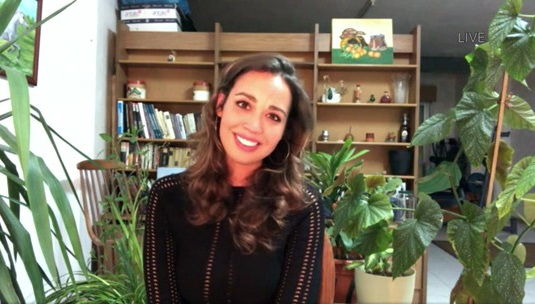
Nadine Sierra sang Mimi’s narrative “Mi chiamano Mimí” from LA BOHEME for the Metropolitan Opera’s At-Home Gala on April 25th, 2020. Watch and listen here.
Tag: Met Opera
-
Nadine Sierra @ The Met’s At-Home Gala

Nadine Sierra sang Mimi’s narrative “Mi chiamano Mimí” from LA BOHEME for the Metropolitan Opera’s At-Home Gala on April 25th, 2020. Watch and listen here.
-
Gianni Raimondi

Above: Gianni Raimondi as Rodolfo in LA BOHEME
Tenor Gianni Raimondi was born at Bologna in 1923. He made his operatic debut in 1947 as the Duke in RIGOLETTO and was soon singing in opera houses throughout Italy. His career expanded to Nice, Marseille, Monte Carlo, Paris, London…

…and La Scala, where, in 1956, Mr. Raimondi made his debut in Luchino Visconti now-legendary production of LA TRAVIATA starring Maria Callas.
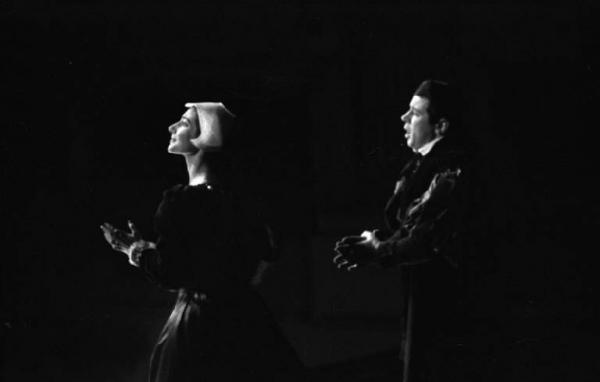
Callas and Raimondi (above) reunited the following year as Anna and Percy in Donizetti’s ANNA BOLENA. 1957 also marked the tenor’s debut at Vienna, where he was to appear regularly for twenty seasons.
In 1963, the Vienna State Opera’s production of LA BOHEME, under the direction of Herbert von Karajan, was filmed for posterity; Mirella Freni and Gianni Raimondi appeared as Mimi and Rodolfo. The performance is available on DVD.
Having debuted at San Francisco (1957) and the Teatro Colon (1959), Mr. Raimondi made his Metropolitan Opera debut as Rodolfo in BOHEME in 1965, opposite Ms. Freni.
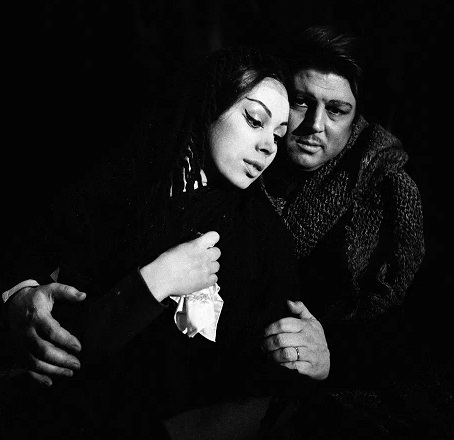
Above: Freni and Raimondi in BOHEME
BOHEME was the only opera I saw Raimondi in at The Met. The performance was in September 1968, and his Mimi was Teresa Stratas; they were among the most moving of all the many interpreters of these roles I have seen thru the decades. My diary says the tenor was “…terrific…great upper range…beautiful portrayal…”
Mr. Raimondi remained at the Met until 1969; his other roles there were Pinkerton, Donizetti’s Edgardo, Faust, the Duke of Mantua, and Mario Cavaradossi. In 1968, the tenor joined Regine Crespin and Gabriel Bacquier in a thrilling broadcast performance of TOSCA, with Zubin Mehta conducting.
In the 1970s, Raimondi took on the spinto tenor roles in NORMA, I MASNADIERI, I VESPRI SIVILIANI, and SIMON BOCCANEGRA.
Following his retirement from the stage, the tenor lived in his villa by the sea at Riccione. He passed away in 2008.
Here is a collection of arias sung by Gianni Raimondi…some of these take a few seconds to start:
Gianni Raimondi – GIOCONDA aria
Gianni Raimondi – Recondita armonia ~ TOSCA
Gianni Raimondi ~ Nessun dorma – TURANDOT
~ Oberon
-
Jeannette Pilou Has Passed Away
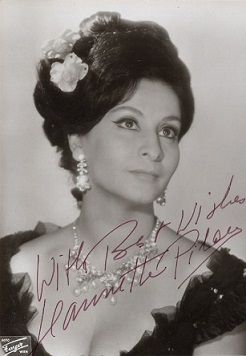
My beloved soprano Jeannette Pilou has passed away at the age of 83. By chance, I was at her last-minute Metropolitan Opera debut as Juliette on October 7, 1967, and it was love at first sight…and first hearing.
I have so many beautiful memories of Mlle. Pilou: not only of her expressive and wonderfully detailed portrayals of such iconic roles as Violetta, Mimi, Mélisande, and Mozart’s Susanna, but also of her great kindness to me as a young and ardent admirer.
In 2007, I wrote a long appreciation of Jeannette Pilou which includes details of her performances as well as many pictures – for she was a great beauty.
Her voice was a masterpiece of pastels, with a vein of stainless steel which allowed her to penetrate the orchestra in the heavier passages of FAUST and MADAMA BUTTTERFLY. She could turn the most familiar phrases in a role into something distinctly personal. Singing Mimi’s narrative in Act I of LA BOHEME, Jeannette sang: “Non vado sempre a messa, ma prego assai al Signor” (“I don’t always go to Mass, but I pray often to the Lord”), putting an emphasis on “assai” that gave the statement a charming tongue-in-cheek feeling. Over time, she developed a lovely gift for threading piani/pianissimi into a vocal line. Mlle. Pilou was a singer who could draw the listener in; this made her Mélisande a particular treasure.
Jeannette was extremely photogenic; I have a whole folder of photos of her. If she were singing today, everyone would want a selfie with her.
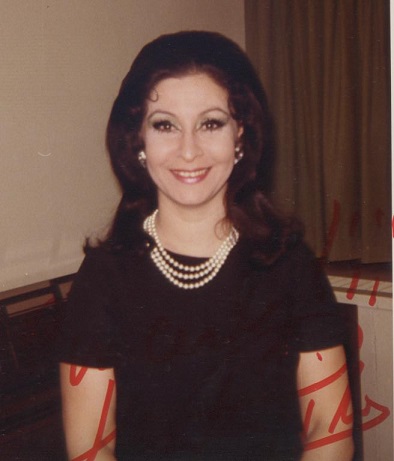
She especially loved the above photo that I took of her. After having it developed and blown up, I presented it to her to sign (you can see her exclamations marks), and she asked if I could send her a copy. I did, of course.
Despite my shyness, I managed to have several conversations with Ms. Pilou; her speaking voice was so enchanting, and so very intimate.
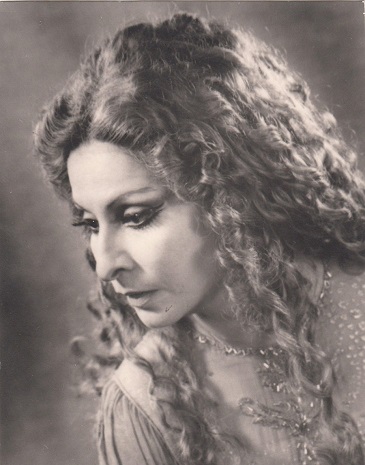
Above: Jeannette Pilou as Thaïs
~ Oberon
-
Lisette Oropesa @ The Met’s At-Home Gala

On April 24, 2020, Lisette Oropesa was one of several Met Opera stars to perform on a special webcast concert wherein everyone sang from their homes. Lisette sang an aria from Meyerbeer’s ROBERT LE DIABLE, live from her hometown: Baton Rouge, Louisiana. Michael Borowitz is the pianist.
Watch and listen here.
-
Joy Davidson
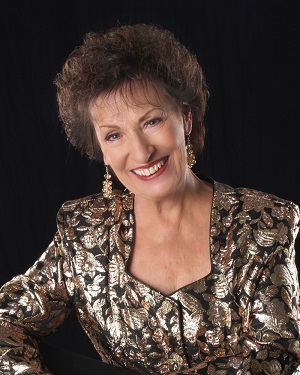
Mezzo-soprano Joy Davidson was born at Fort Collins, Colorado. She studied voice with Elena Nikolaidi at Florida State University and made her operatic debut at Miami as Rossini’s Cenerentola in 1965.
Ms. Davidson joined the short-lived Metropolitan Opera National Company from 1965-1967 where her roles included Britten’s Lucretia. She won the Sofia International Opera Singers Competition in 1967, and in 1969 made her debut at New York City Opera as Kontchakovna in PRINCE IGOR, a role in which I saw her three times..and met her after one of them:
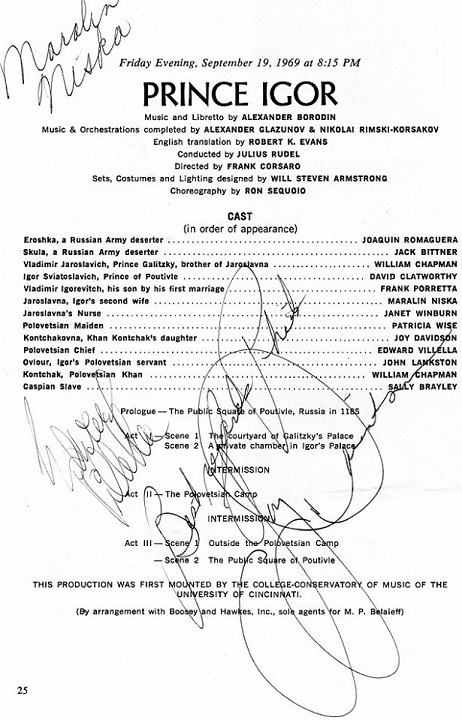
(Note: NYC Ballet star Edward Villella danced in the PRINCE IGOR production, and Maralin Niska had one of her best roles as Yaroslavna).
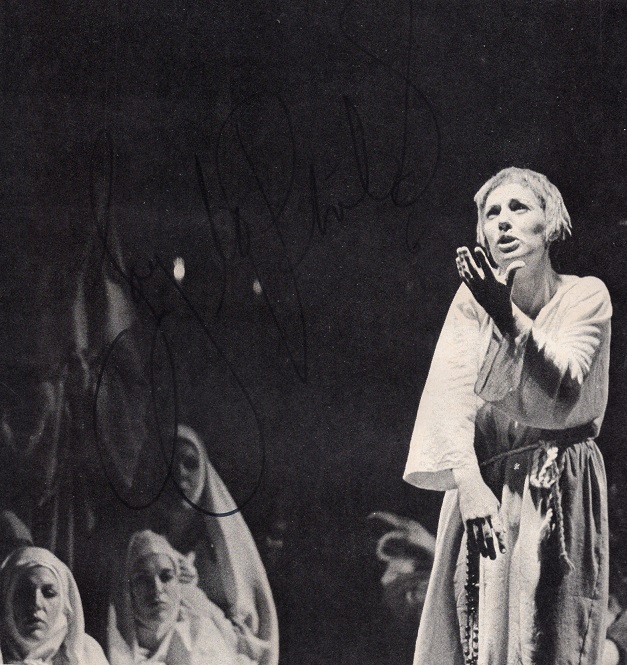
In 1969, Joy Davidson made her Santa Fe debut as Jeanne in Penderecki’s DEVILS OF LOUDON (above photo, which she signed for me), the opera’s US premiere performances. In the same year, she made her San Francisco Opera debut as the Secretary in Menotti’s THE COUNSEL, and in 1971 she made her La Scala debut as Dalila.
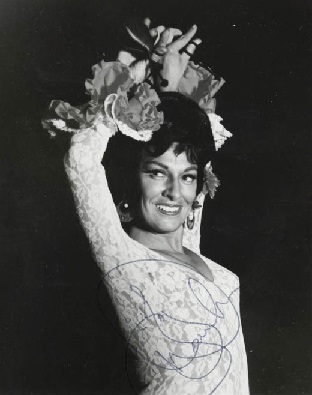
1971 also brought Joy Davidson back to the New York City Opera to star as Carmen (above) in a new production. In the ensuing seasons, she appeared in Vienna, Munich, Dallas, Barcelona, Turin, Lyon, at the Maggio Musicale and at the Spoleto Festival.
Joining the Metropolitan Opera on tour in 1976, Ms. Davidson sang Adalgisa opposite Shirley Verrett’s Norma in Boston and Cleveland. These were Verrett’s first Normas, and TJ and I traveled from Hartford to Boston for the occasion. Verrett had a great triumph; Ms. Davidson was taxed by some of the high notes in Act I, but fared much better in Act II. In 1978, the Joy Davidson was again cast as Adalgisa, in performances at the Bushnell in Hartford, opposite Cristina Deutekom’s Norma, which I attended. Here, Ms. Davidson enjoyed a thorough success.
There are very few recorded souvenirs of Joy Davidson, unfortunately. Here she is in a German-language DON CARLO from Munich, 1968:
Joy Davidson – O don fatale – DON CARLO – in German – Munich 1968
She sang Jane Seymour in Donizetti’s ANNA BOLENA at Santa Fe in 1970; here is Seymour’s great scene of remorse, with Donald Gramm as Henry VIII.
A rather remarkable document, which took me a great deal of searching to locate and verify, is a complete 1977 telecast of Massenet’s WERTHER from Teatro de la Zarzuela, Madrid. The mezzo’s name is listed as “Davison”, so this item does not readily appear in searches. Though the visuals are rather dated, it is a very attractive performance, and both Ms. Davidson and Alfredo Kraus give passionate portrayals. Watch it here, it’s really quite wonderful.
~ Oberon
-
Arlene Saunders Has Passed Away

Above: Arlene Saunders as Eva in DIE MEISTERSINNGER
It’s so sad to read of the death of soprano Arlene Saunders, who I saw in four different roles over the course of her career. She died on April 17th, 2020, of complications associated with COVID-19.
Just last Summer, I discovered a series of films made in the 1970s by the Hamburg State Opera and truly enjoyed watching Ms. Saunders as the Countess in NOZZE DI FIGARO, Agathe in FREISCHUTZ, and most especially her Eva in DIE MEISTERSINGER. The Hamburg film of the Wagner opera can in fact be watched in its entirety on YouTube here.
It was as Eva that Arlene Saunders sang her only performances with the Metropolitan Opera, in 1976. But I had the good fortune to see her on the Met stage earlier, when the Hamburg company brought Stravinsky’s RAKE’S PROGRESS to Lincoln Center in 1967. She was an ideal Anne Trulove.

In the years to come, I saw Ms. Saunders as the Marschallin (Opera Company of Boston), as Minnie in FANCIULLA DEL WEST (New York City Opera), and as Elsa in LOHENGRIN (at The Bushnell in Hartford). As each of these vastly different characters, she seemed perfect.In 2007, I attended a solo recital attended by a young American tenor; during the interval, a woman came over to speak to the people seated in front of me. I was pretty sure it was Arlene Saunders, and sure enough, the couple greeted her as “Arlene…!” I so wanted to speak to her and thank her for the wonderful performances I’d seen her give, but my innate shyness took over. I always regretted that missed opportunity…now, more than ever.
And here’s Ms. Saunders in music from my favorite opera, ARIADNE AUF NAXOS:
Arlene Saunders – Ariadne Monolog Part II ~ ARIADNE AUF NAXOS – Hamburg 1968
~ Oberon
-
Hertha Töpper as Octavian
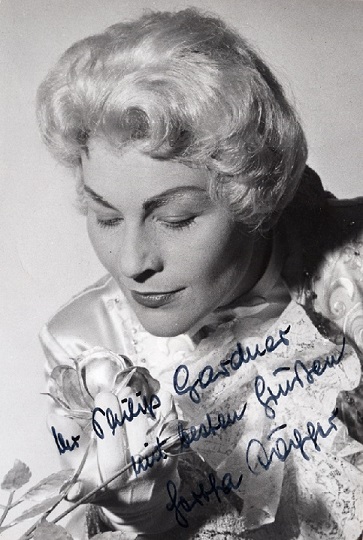
Above: Hertha Töpper as Octavian in DER ROSENKAVALIER
[Update: Hertha Töpper passed away on March 28th, 2020, at the age of 95]
I’ll never forget listening to Strauss’s DER ROSENKAVALIER for the first time: it was a Saturday matinee broadcast from the Old Met at Christmastime in 1962. I was 14 years old and had been in love with opera for three years.
At that time, the German operas were not easy for me; I had made it thru my first broadcast RING Cycle in 1961 and I seem to recall having been more thrilled by the story than by the music. ROSENKAVALIER, with its long conversational stretches, posed a challenge all its own. But the singing of the three female leads in the opera’s final scene moved me deeply, and when the broadcast ended I sat down and wrote fan letters to all three of them: Hertha Töpper (Octavian), Anneliese Rothenberger (Sophie), and Régine Crespin (the Marschallin). Within days I received replies from all three.
Metropolitan Opera House
December 22, 1962 Matinee/Broadcast
DER ROSENKAVALIER
Octavian.....................Hertha Töpper
Princess von Werdenberg......Régine Crespin
Baron Ochs...................Otto Edelmann
Sophie.......................Anneliese Rothenberger
Faninal......................Ralph Herbert
Annina.......................Rosalind Elias
Valzacchi....................Paul Franke
Italian Singer...............Sándor Kónya
Marianne.....................Thelma Votipka
Mahomet......................Marsha Warren
Princess' Major-domo.........Robert Nagy
Orphan.......................Loretta Di Franco
Orphan.......................Nadyne Brewer
Orphan.......................Dina De Salvo
Milliner.....................Lilias Sims
Animal Vendor................Frank D'Elia
Hairdresser..................Harry Jones
Notary.......................Gerhard Pechner
Leopold......................Erbert Aldridge
Lackey.......................Joseph Folmer
Lackey.......................John Trehy
Lackey.......................Lou Marcella
Lackey.......................Edward Ghazal
Faninal's Major-domo.........Andrea Velis
Innkeeper....................Charles Anthony
Police Commissioner..........Norman ScottConductor....................Lorin Maazel
Ms. Töpper sent me the gorgeous photo which appears at the top of this article. Ever since then, this has remained the quintessential image of Octavian for me. As it turned out, Octavian was Töpper’s only Met role, though she had an enormous career in Europe.
Here’s a sampling of the Töpper Octavian, with Erika Köth as Sophie:
Hertha Töpper & Erika Köth – Presentation of the Silver Rose ~ ROSENKAVALIER
Hertha Töpper was born in 1924 and made her operatic debut at Graz as Ulrica in BALLO IN MASCHERA in 1945. By 1951 she was singing at Bayreuth, and had debuted at Munich as Octavian. She went on to sing at all the major opera houses and festivals of Europe; among her most prominent roles were Brangäne, Carmen, Fricka, and Dorabella. She also was a well-loved recitalist and concert singer, specializing in the music of Bach.
A couple of years ago, by chance, I plucked Töpper’s recording of Bartok’s BLUEBEARD’S CASTLE (in German) from the library shelf; it proved to be a revelation, with fantastic singing from both the mezzo and the great Dietrich Fisher-Dieskau, and truly atmospheric conducting by Ferenc Fricsay.
~ Oberon
-
Clifford Harvuot

Above, finalists in the Metropolitan Opera’s 1941-42 Auditions of the Air: tenor Elwood Gary, soprano Frances Greer, the Met’s General Manager Edward Johnson, soprano Margaret Harshaw, conductor Wilfred Pellertier, and baritone Clifford Harvuot.
As a winner of the Auditions of the Air, Clifford Harvuot’s first appearance on The Met stage came at a Sunday Night Gala on March 15, 1942. He sang the Prologo from PAGLIACCI. From then until December 21, 1975, the baritone chalked up nearly 1,300 performances with the Company, in New York City and on tour.
Harvuot particularly excelled in two Puccini roles, both of which brought out a feeling of ‘humanity’ in his voice. One was Sonora, the miner in FANCIULLA DEL WEST who is hopelessly in love with Minnie. It is Sonora who, in Act III, persuades the other miners that they must set Minnie’s beloved Dick Johnson free. Clifford Harvuot sing Sonora nearly 30 times at The Met, his Minnies being Leontyne Price, Dorothy Kirsten, and Renata Tebaldi.
He was also a very sympathetic Sharpless in MADAMA BUTTERFLY, appearing in the role with the great Butterflies of the day: Tebaldi, Albanese, Stella, Kirsten, and Tucci.
Helen Vanni – Carlo Bergonzi – Clifford Harvuot – BUTTERFLY trio – Met 1962
Other frequent Harvuot roles:
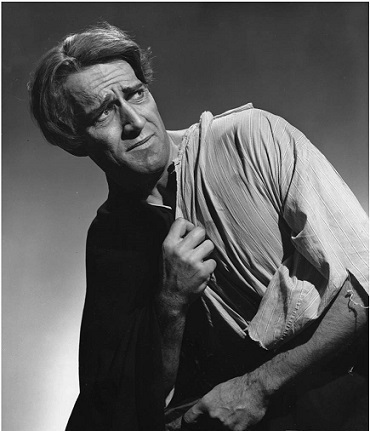
Angelotti in TOSCA
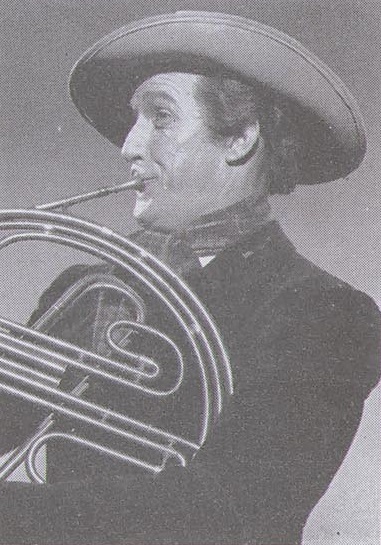
Schaunard in BOHEME
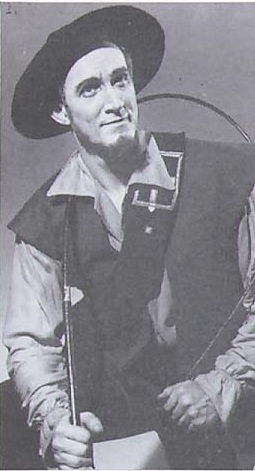
Alfio in CAVALLERIA RUSTICANA
Listen to Clifford Harvuot as Silvio in PAGLIACCI with Lucine Amara as Nedda here.
~ Oberon
-
Love Duet

On February 3rd, 1962, I tuned in to Texaco Metropolitan Opera Radio Network (as it was then called) and heard Puccini’s MADAMA BUTTERFLY sung live for the first time. Gabriella Tucci, who in my earliest years of opera mania was my favorite soprano, gave a magnificent performance. Carlo Bergonzi stepped in for the indisposed Sandor Konya, and this was a boon for me as Bergonzi was (and remains) my favorite tenor.
And so, the Tucci/Bergonzi rendering of the love duet from that matinee performance is very special to me:
Gabriella Tucci & Carlo Bergonzi – MADAMA BUTTERFLY ~ Love Duet – Met 1962
 Oberon's Glade