Tag: Met Opera

  • Janis Martin as Kundry

    Janis Martin

    The American soprano Janis Martin was my first Kundry; she was also my first Sieglinde and Marie in WOZZECK. She was a featured singer at the Bayreuth Festival from 1968 to 1989 where she appeared in nine different roles: Magdalene, Fricka, Eva, the Second Norn, Gutrune, Kundry, Freia, Sieglinde, and Brünnhilde. She returned in for the 1995 and 1997 festivals, again as Kundry.

    Janis Martin sang nearly 150 performances at the Metropolitan Opera, commencing in 1962 as Flora Bervoix in TRAVIATA. As a young opera-lover, I heard her many times on the Texaco broadcasts. She eventually progressed to “medium-sized” roles: Siebel, Nicklausse, Lola in CAVALLERIA RUSTICANA. Hearing her in these roles (in which she excelled), one would not have anticipated how her career would develop.

    Ms. Martin left The Met in 1965 to build a career abroad, moving into soprano territory. She returned to The Met from 1974 thru 1977, when I saw her as Kundry, Marie in WOZZECK, and Sieglinde. Following another hiatus, she was back at Lincoln Center from 1988-1992, singing the Witch in HANSEL & GRETEL, the Dyer’s Wife in FRAU OHNE SCHATTEN, Senta, the Foreign Princess in RUSALKA, and two performances of Tosca.

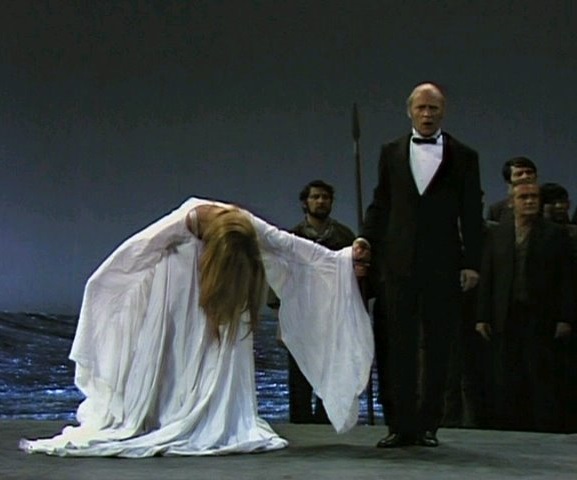
    Here is Ms. Martin as Kundry in a scene from the 1973 Bayreuth production of PARSIFAL; Jean Cox sings the title-role, with Eugen Jochum conducting:

    Janis Martin – Ich sah das kind ~ PARSIFAL – with Jean Cox – Bayreuth 1973

    ~ Oberon

  • GrahamDeconstructed: CIRCE

    StudioSeries_Circe_003

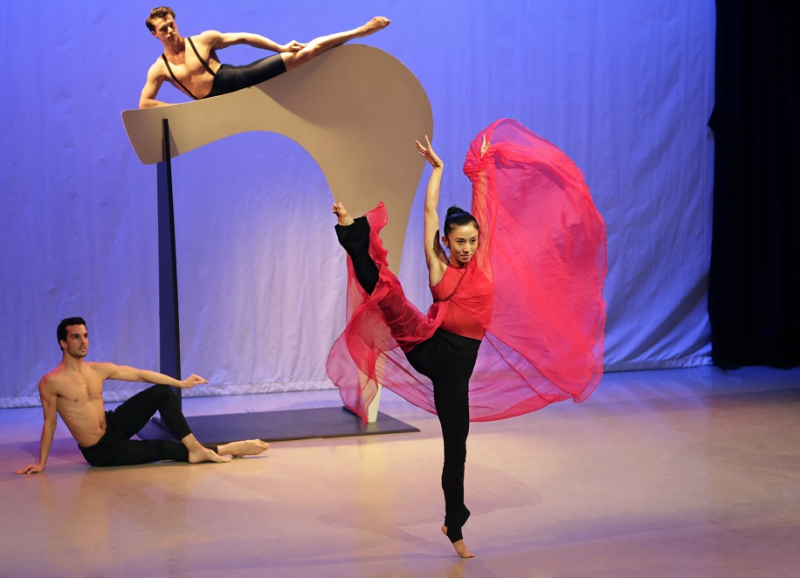
    Above: So Young An as Circe, with Lorenzo Pagano as The Snake and Lloyd Mayor, perched in Noguchi’s tree, as The Lion; photo by Melissa Sherwood

    ~ Author: Oberon

    Wednesday February 26th, 2020 – A revival of Martha Graham’s CIRCE will figure prominently in the Company’s 2020 season at New York’s City Center, which runs from April 22nd – 26th (details here).

    Premiered in 1963, CIRCE has not been performed for fifteen years. To a score by Alan Hovahness, and with settings designed by Isamu Noguchi, the ballet is inspired by the mythic Circe, a sorceress with a penchant for turning men into animals. 

    Circe – or characters modeled after her – has appeared in various theatrical representations over time. She is often given the name Alcina, as in Francesca Caccini’s opera LA LIBERAZIONE DI RUGGIERO (the first opera written by a woman that has come down to us in a performable version); dell’Arte Opera presented this work in 2019. Handel’s opera ALCINA is rumored to be having its first Metropolitan Opera production in the next two or three years. And Circe plays a part in the narrative of my favorite opera, Richard Strauss’s ARIADNE AUF NAXOS, although she never actually appears. The young god Bacchus has escaped Circe’s island domain, and as he sails towards Naxos – where he will rescue Ariadne – he chides the sorceress by calling out to her across the waves:

    Circe kannst du mich hören ~ ARIADNE AUF NAXOS – Ben Heppner & Deborah Voigt

    Tonight, at the Graham Company’s homespace at Westbeth, a full run-thru of the work – replete with the Noguchi sets – was presented, with So Young An in the title role and six of Martha’s Men as those who have fallen under her spell or those she would like to add to her menagerie. It was an exhilarating experience.

    Alan Hovanhess’s score is intriguing: by turns lyrical and dramatic, it also sometimes going off-kilter, indicating that things are far from normal in Circe’s realm. The composer makes fine use of solo instruments, notably the trumpet, horn, clarinet, and oboe. You can listen to the music here.

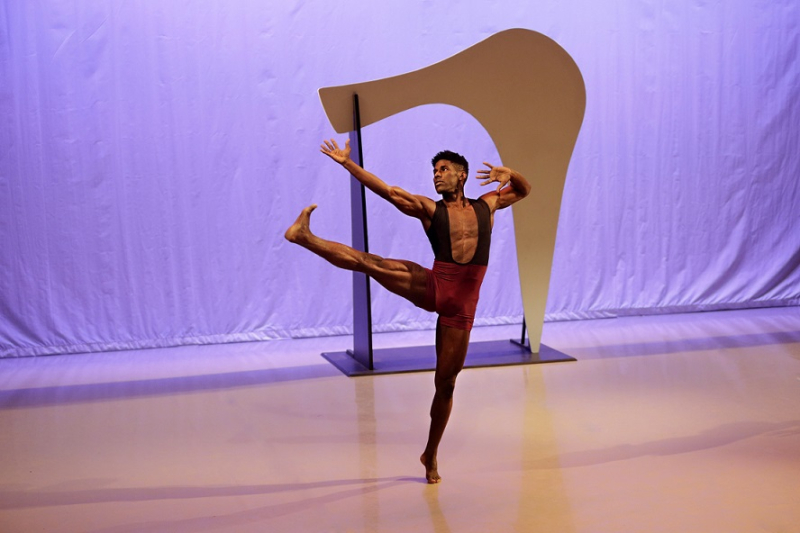
    The Noguchi setting features a small boat and an archway which might also be a tree. These were designed for an earlier Graham work, FRONTIER, which had fallen out of the repertoire. Ms. Graham kept the set pieces in storage until she found the perfect home for them on Circe’s island.

    So Young An was supple and tempting as Circe; the character’s magic resides in a flowing red scarf which she dons when it is seduction time. Ulysses (Lloyd Knight) and his Helmsman (Ben Schultz) arrive at the island in the very cramped boat. Circe observes them from her perch in the arch/tree.

    StudioSeries_Circe_004

    Above: Lorenzo Pagano (The Snake), Alessio Crognale (The Deer) So Young An (Circe), Lloyd Mayor (The Lion), and Jacob Larsen (The Goat). Photo by Melissa Sherwood.

    StudioSeries_Circe_002

    Above: Jacob Larsen as The Goat; photo by Melissa Sherwood

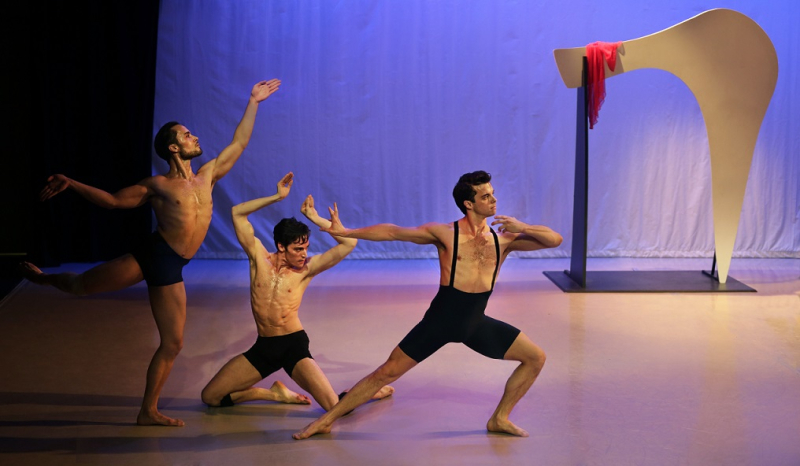
    Four men who have been transformed by Circe into animals now take an interest in the new arrivals: enslaved by the sorceress, they will aid her in bringing about the downfall of Ulysses and his comrade. Lorenzo Pagano as The Snake first appears dangling from the tree; Lloyd Mayor is The Lion, Alessio Crognale The Deer, and Jacob Larsen The Goat. All the men in this ballet wear very little; I think that’s the way Martha liked her men. These dancers dispatched the demanding choreography with élan.

    StudioSeries_Circe_001

    Above: Lloyd Knight as Ulysses, photo by Melissa Sherwood

    As the story unfolds, it comes down to a battle between Circe, bent on conquest, and the Helmsman, who wants to save Ulysses and get the hell out of there. The red scarf nearly works its magic: Ulysses is falling under Circe’s spell. Hunkered down in the boat, the Helmsman is attacked by the Snake and sinks into a stupor.

    StudioSeries_Circe_005

    Above, Deer, Goat, and Lion: Alessio Crognale, Jacob Larsen, and Lloyd Mayor, photo by Melissa Sherwood

    The other animals stalk and caper, driving the victim into the enchantress’s arms. Just as Ulysses is about the capitulate, the Helmsman revives, hauls his master into the boat, and they sail away. Circe and her pets must now wait for someone else to succumb to the lure of her siren song.

    Danced with the technical prowess and personal commitment that make the Graham dancers the best in the world, CIRCE truly does cast a spell. I look forward to seeing it again, often, and to having it become part of the Company’s permanent repertory.

    All photos by Melissa Sherwood.

     ~ Oberon

  • Franz Mazura Has Passed Away

    Mazura

    The great Austrian singing-actor Franz Mazura has passed away at the age of 96. Mazura made his operatic debut at Kassel in 1949, and went on to appear at numerous German theaters in a wide variety of roles. His career eventually took him to the great stages of Paris, Vienna, Bayreuth, and New York City.

    Mazura was a stalwart at the Bayreuth Festival for fifteen summers, beginning in 1971. His most frequent Wagnerian roles were Alberich in the RING Cycle and Klingsor in PARSIFAL, but he also sang the Wanderer and Gurnemanz at the Wagner shrine.

    Franz Mazura as Gurnemanz – Bayreuth 1973

    Cap189

    At Bayreuth, he appeared in 1976 as Gunther in the controversial Pierre Chéreau centennial production of the RING Cycle: photo above, with Dame Gwyneth Jones as Brunnhilde.

    In 1979, Mazura sang Doctor Schön and Jack the Ripper in the premiere of the completed version of Alban Berg’s LULU at the Paris Opéra, conducted by Pierre Boulez.

    After making his Metropolitan Opera debut in 1980 in the Berg double-role, Franz Mazura went on to appear on The Met stage 175 times. In 1989, he was a magnificent Alberich in the RING Cycle, my first experience of seeing the Cycle in the span of a week. Earlier, in 1987, he had stepped in as Wotan in WALKURE, a performance my friend Paul Reid attended; Paul described Mazura as “…a cantankerous god.”

    Franz Mazura’s final Met appearance was as Schigolch in LULU in 2002.

    Here is a sampling of his extraordinary portrayal of Klingsor:

    PARSIFAL – scene from Act II – Leonie Rysanek & Franz Mazura – Met bcast 1985(1)

    Among the many roles Franz Mazura sang in his long career was the Spirit Messenger in DIE FRAU OHNE SCHATTEN:

    Helga Dernesch & Franz Mazura – FRAU OHNE SCHATTEN ~ opening scene – C Perick cond – Met 1989

    He displayed his versatility in such roles as La Roche in CAPRICCO, Pizarro in FIDELIO, Scarpia in TOSCA, the Doctor in WOZZECK, Creon in OEDIPUS REX, and the Speaker in ZAUBERFLOETE. His final operatic appearance was at Berlin as Schwarz in MEISTERSINGER on April 21st, 2019…the eve of his 95th birthday.

    Franz Mazura appears in the film of Pierre Chéreau‘s 2013 production of ELEKTRA from the Aix-en-Provence Festival; he makes a touching effect as the Tutor of Orest.

    ~ Oberon

  • A Memorable ROSENKAVALIER

    E_Soderstrom_Grevinnan

    [Reviving this article, which has been updated with some audio clips]

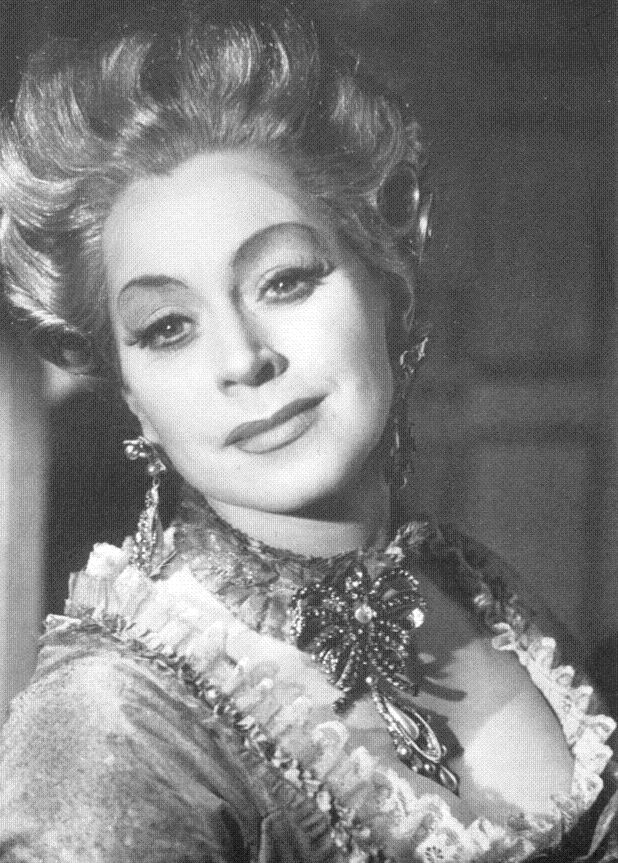
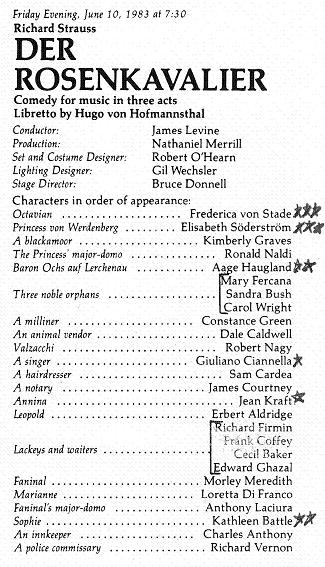
    In 1983, the Metropolitan Opera took DER ROSENKAVALIER on their annual Spring tour. James Levine was the conductor and the stellar cast was led by Elisabeth Söderström (above) as the Marschallin, Frederica von Stade as Octavian, Kathleen Battle as Sophie, and Aage Haugland as Baron Ochs. Interestingly, this particular alignment of stars never performed the Strauss opera at The Met. It was given in six cities on the tour, culminating with this performance…

    IMG
    …in Boston, which I was lucky enough to attend. Unfortunately one of my most vivid memories of the evening was the presence of some people sitting about six rows behind me who talked throughout the performance. Even though I had sprung for an orchestra seat – the better to concentrate on the array of vocal talent onstage – these people served notice that sitting in expensive seats doesn’t make you classy. They were continuously being shushed by people around them (as annoying as their talking, actually) and the usher came to admonish them at one point. Apparently they had some sort of clout that kept them from being ejected; at any rate, they spoiled a great performance. I’m sure they are all dead now, and good riddance.

    Despite this major distraction, the performance was extremely moving and superbly sung. Maestro Levine, whose 1976 ROSENKAVALIER broadcast had seemed sluggish and thick-textured orchestrally, was now fully in his element with the Strauss score. The towering Aage Haugland – a great favorite of mine during his Met career – was a grand Baron Ochs, and Miss Battle was a shimmering-voiced Sophie.

    It was the vocal and theatrical chemistry between Elisabeth Söderström and Frederica von Stade that gave this ROSENKAVALIER its unique appeal. Their older women/younger man romance was brilliantly portrayed, while their distinctive vocal timbres served their respective characters to perfection. By this point in time, the Söderström voice was an expressive rather than opulent instrument, but she truly knew her way around this music and her singing was so meshed with the character’s moods – it was simply all of a piece. In the monolog, she poked fun at herself as “die alte frau, die alte Marschallin“, sung with a crackly old-lady sound. Telling Octavian that he will soon tire of their romance, she seized von Stade by the shoulders, trying to shake some sense into him. The Söderström Marschallin was an unforgettable mixture of dignity, bitterness, and nostalgia: a woman who watches something cherishable slipping thru her fingers and finds the courage to let it go.

    Frederica von Stade, with her immaculately tailored sound, was boyish and impetuous in behavior. and her vocalism was always elegant and wonderfully personal. Other Octavians – Ludwig (my first!), Baltsa, Troyanos – have sung this music in grander style but no other Octavian of my experience has quite captured the coltish confusion of a boy on the brink of manhood who has a loving heart and a tender, noble young spirit…which von Stade showed us so memorably.

      Battle-Soderstrom

    While the Söderström/Battle/von Stade collaboration was never heard in a complete public performance of ROSENKAVALIER here in New York City, the three women did perform the opera’s Act III trio at the Met’s 100th anniversary gala. The day-long celebration was telecast live; I attended the matinee portion and can attest to the palpable atmosphere in the house as the three women sang this magical Strauss creation. You can listen to them here, with Levine on the podium.

    For years, I assumed this film clip was the only extant souvenir of this unforgettable convergence of voices – though I am sure someone recorded it someplace along the tour’s path – but recently my friend Ben Weaver surprised me with recordings of the first and third acts in very good sound from a rehearsal at the Met just before the tour commenced. Someone there had the presence of mind to realize that this was a rarity in the making and that Ms. Söderström’s Marschallin was a jewel worth preserving; and so this valuable sound document has come down to me, some thirty years after the event.

    Elisabeth Söderström – monolog from ROSENKAVALIER~Act I – Levine cond – Met stage rehearsal 1983

    Flicka octavian

    Frederica von Stade (above) regrettably never sang a complete Octavian at The Met – though she did sing a gorgeous Rose Presentation duet with Judith Blegen on the same gala programme as the filmed clip above.

    E S

    In 1987, Elisabeth Söderström made her ‘first’ Met farewell singing the Marschallin on a Saturday matinee which was broadcast. That was a very moving experience, yet it has always been the Boston performance that’s stayed so clearly in my mind. The magic of the Söderström Marschallin is so perfectly distilled in the closing moments of Act I, where her ‘silberne rosen‘ takes on a ghostly patina of lyrical regret and resignation.

    Elisabeth Söderström – Die silberne rose – 1st Met farewell 2~21~87

    ~ Oberon

  • Grimaud|Philadelphia Orchestra @ Carnegie Hall

    Default_4310-081

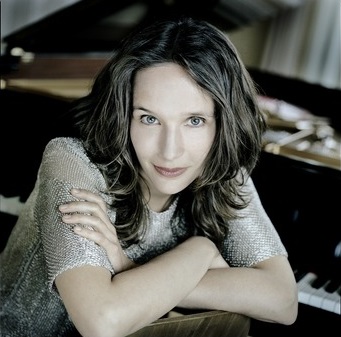
    Above: pianist Hélène Grimaud

    ~ Author: Ben Weaver

    Tuesday October 15th, 2019 – When The Philadelphia Orchestra premiered Valerie Coleman’s orchestral version of Umoja, Anthem for Unity last month, it was the first time the orchestra had played music by a living female African -American composer. Yes, there are still such firsts to be had in 2019. 

    Ms. Coleman’s work was originally written in 1997 for a female chorus, then arranged for a woodwind quintet (Coleman’s own acclaimed chamber ensemble, Imani Winds.) And now the full orchestral arrangement makes something clear: Ms. Coleman, born in Louisville, Kentucky, is a major voice in contemporary classical music and is a magnificent orchestrator.


    One thing I always note upon entering the concert hall where a contemporary piece is to be played is how big the percussion section is. Typically. it is large: everything and the kitchen sink. The problem, though, isn’t so much that there is more percussion than Mahler ever used, but that it is used as a crutch by so many contemporary composers; a crutch to transition from point A to point B to point C of the music. Unable to develop their material, too often composers rely on a few bangs and smashes from percussion to reset and change the subject. It’s lazy, it’s transparent and it’s bad music. And it is something Valerie Coleman notably does not do in her extraordinary orchestral version of Umoja, Anthem for Unity, a roughly 14 minute cinematic tone poem of shifting moods, sweeping melodies, surprising orchestral effects (the bowed vibraphone that opens the piece, for example) and undeniable joy.


    Thumbnail_6a00d8341c4e3853ef022ad378896b200c


    Ms. Coleman (above) explains in the Playbill that the work grew out of a simple, short melody. “Here the melody is sung sweetly in its simplest form and is reminiscent of Appalachian-style music. From there, the melody dances and weaves throughout the instrument families, interrupted by dissonant viewpoints led by the brass and percussion sections…” Someone described the work almost as a concerto grosso, where the music passes around, evolving and shifting from section to section. This gives many artists on stage to shine, notably the wind and the brass sections. Maestro Yannick Nézet-Séguin shaped the work expertly and the thunderous ovation that greeted Ms. Coleman on stage at the end, one hopes, sends a message to leaders of orchestras and opera houses. Tonight, the Metropolitan Opera’s  general manager Peter Gelb sat directly in front of me; did he realize that before us was an extraordinary composer, worthy of more commissions. Why not an opera, Mr. Gelb?


    Béla Bartók’s Piano Concerto No. 3 received a spectacular performance from Hélène Grimaud. The playful, spiky, percussive writing of the outer movements presented no challenges to Grimaud, her crystal clear playing etching each note as if out of marble. Yet the percussiveness was never mere banging on the keyboard either; Grimaud is too good of an artist for cheap tricks. But it is in the concerto’s slow movement, Adagio religioso, that Bartók’s soul and Grimaud’s musicality and artistry truly shone. Conductor and orchestra provided first rate support. 


    After intermission Richard Strauss’ last tone poem, Eine Alpensinfonie, received a thrilling, no holds-barred performance. Strauss began composing the work after years of putting it off after the death of Gustav Mahler in 1911. “Mahler’s death has affected me greatly,” Strauss wrote and set out to complete Eine Alpensinfonie, an unacknowledged tribute to Mahler. Certainly Mahler’s love of nature – which he attempted to capture in his music throughout his entire career – is here in spades as one travels through the Alps.


    Strauss divides the symphony into sections representing different parts of the region. Between the growling, dark Night that opens and closes the symphony, the wanderer observes a glorious Sunrise, a magnificent Waterfall, a treacherous Glacier, a horrifying Thunderstorm and chilling winds disappear with Sunset as Night returns. Strauss, of his many gifts, was an exceptional orchestrator. His command of large orchestral forces, of sound-painting has no betters. (Equals, maybe, but no betters.) The Philadelphians threw themselves into the music as if possessed, with Nézet-Séguin once again demonstrating that his grasp of the great Romantics is something of a specialty.


    ~ Ben Weaver


  • @ My Met Score Desk for ORFEO ED EURIDICE

    785x590_orfeo3

    Above: Hei-Kyung Hong as Euridice and Jamie Barton as Orfeo; a Met Opera photo

    ~ Author: Oberon

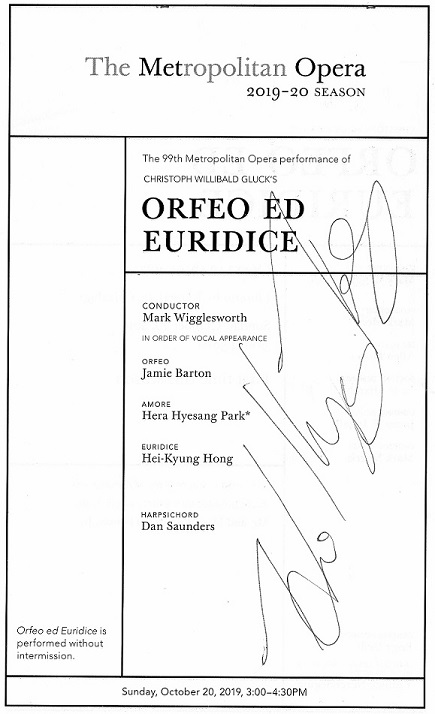
    Sunday October 20th, 2019 matinee – Not being a fan of Mark Morris, nor of Jamie Barton, I nevertheless went to The Met this afternoon to experience Gluck’s ORFEO ED EURIDICE live because Hei-Kyung Hong was singing Euridice. I saw this production when it was new, and hated almost everything about it; so today, all I needed was a score desk to hear Ms. Hong. 

    It was nice to see a substantial audience for this Sunday matinee, which for some reason started 15 minutes late. The opera is given as a single act, lasting about 90 minutes. The story unfolds almost too quickly until the interminable never-ending ending.

    The Met is probably too big of a place to best experience this music. Orchestra and chorus fared well under Mark Wigglesworth’s baton, though there were times when the noise of the dancing intruded.

    From the Met’s Young Artist program, soprano Hera Hyesung Park was a pretty-voiced, incisive Amor. In the large space, Jamie Barton’s voice was wonderfully present in the music of Orfeo; she uses chest voice constantly when venturing below F whilst the upper notes sound a bit tense. Her singing was impressive in its way, but she never moved me.

    Hei-Kyung Hong’s touchingly clear, expressive singing had an insistently plaintive quality that finally induces her husband to look at her, causing her second death. I’ve never heard Euridice’s “you-don’t-love-me-anymore” guilt trip so persuasively laid on. Hei-Kyung’s curtain call was lovely: she came out in her white gown and was greeted by a barrage of bouquets sailing over the footlights.

    I have many fond memories of Hei-Kyung, going back to her days singing Woglinde and Servilia, and then becoming a peerless Mimi and Liu. One of my favorite conversations with her, while I was working at Tower, came on the day James Levine had asked her to sing Eva in DIE MEISTERSINGER. She was a bit panicked by the offer, and wanted a recording to listen to before she committed. I handed her Helen Donath’s, and told her not to worry. She had a beautiful success in the role.

    Scanned Section 4-1

    Today, realizing that over all the many times I have seen her onstage and met her face-to-face, I’d never asked Hei-Kyung for her autograph. I waited for her for over an hour at the stage door. Finally, she came out with family and friends and gave me a kiss, and her signature.

    ~ Oberon

  • MANON @ The Met

    72203039_2587859277931352_7352510735420751872_o

    Above: Lisette Oropesa as Manon in The Met’s production; a Marty Sohl/Met Opera photo

    Saturday matinee September 28th, 2019 – After a rather scrappy dress rehearsal on Friday September 20th, the Metropolitan Opera’s revival of their tedious Laurent Pelly production of Massenet’s MANON opened this past Tuesday. For today’s matinee, a group of friends who are admirers of Lisette Oropesa met up in the Family Circle boxes to see and hear the Cuban-American soprano in her latest new role. 

    Vocally, there are basically two types of Manons: the lyric-coloraturas and the full-fledged (and even slightly…beyond…) lyrics. The role was created by Marie Heilbronn, whose repertory included the coloratura roles of Marie (FILLE DU REGIMENT), Ophélie (HAMLET), Gounod’s Juliette, and Catherine in Meyerbeer’s ETOILE DU NORD. Massenet’s preferred Manon was Sibyl Sanderson, who created the high-flying title-role in his opera ESCLARMONDE. The light-voiced Brazilian soprano Bidu Sayão became a beloved Manon at The Met starting in 1937, and the tradition of coloratura-oriented Manons continued with Beverly Sills (perhaps her greatest role), Patricia Brooks, and Reri Grist.

    Sopranos with larger, richer voices have also taken on the role: Lucrezia Bori, Geraldine Farrar, Claudia Muzio (!), Victoria de los Angeles, Eleanor Steber, Anna Moffo, Virginia Zeani, Raina Kabaivanska, Jeannette Pilou, Catherine Malfitano, Carol Vaness, Renee Fleming, and Anna Netrebko. Some of these sopranos had to make adjustments in Manon’s coloratura set-pieces, and in dealing with (or omitting) the score’s high-Ds. And at times, the opera has seemed to take on a verismo tinge in these interpretations, as listening to their various recordings will show. 

    Lisette Oropesa’s Manon is in the lyric-coloratura vein, and it’s so enchanting to hear her intriguingly perfumed timbre in this music. This is a voice that draws us into the music, covering the wide range with that distinctive sound, rejoicing in the fiorature of the Cours la Reine arias, pinpointing those top-Ds, and seducing both the tenor and the audience with the serpentine vocal line of “N’est-ce plus ma main”: that passage which Beverly Sills knew was the key to the whole character. 

    To accomplish her success in the music of Manon, Lisette had to overcome a hideous production and an interpretation of the score by an out-of-touch conductor. As the opera progressed, we moved scenically from a dreary grey courtyard – surrounded by perched toy-town houses and cuckoo-clock windows that periodically opened and closed – to an ugly wheeled-out ‘garret’ for the lovers wherein the ‘petite table‘ seemed like an afterthought.

    The ridiculous ramps and metal dog-run fencing of the Cours la Reine deprived the setting of its glamour and left the bevy of ballerinas that Guillot had brought to cheer Manon up little space to execute some rather pointless choreography (the girls deserved better!) With the gaslights, Manon clad in a enormous feathered hat, boa, and ruffled gown, and the top-hatted men courting her in-sync, the scene recalled bad productions of HELLO DOLLY.

    Seeking out des Grieux at Saint Sulpice, Manon arrives in what looks like a long white slip. There’s a lot of stage business to this seduction, as compared to the Sills Manon who just stood there, enticing her lover with vocal allure until – at the right moment – she let her cape fall to reveal the diva’s legendary décolletage, to which her tenor immediately succumbed. In the Pelly production, a convenient bed (for the altar boys?) is where Lisette and Michael Fabiano end up in a bodice-ripping finale. It’s the tenor’s bodice that gets ripped.

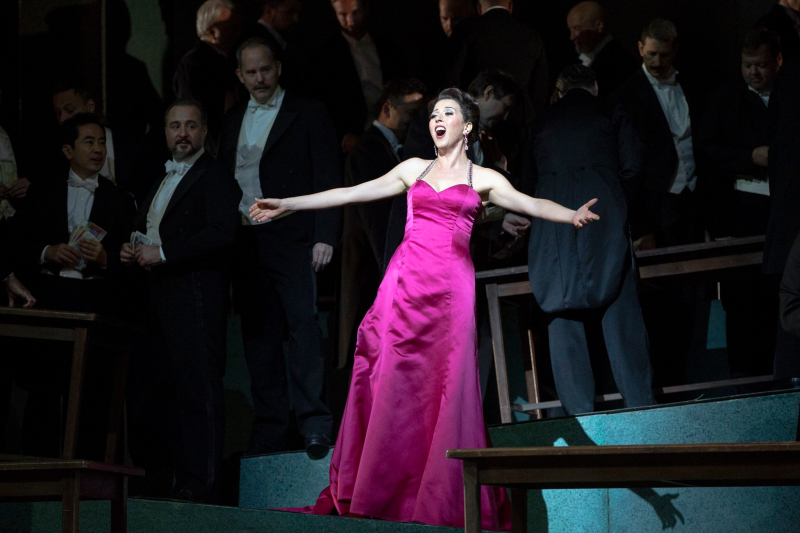
    The gambling den in a drab basement room with more ramps, and with card tables wheeled busily on and off; the tension of the game between des Grieux and Guillot is minimized. The scene’s redeeming feature is the vision of Lisette in a stunning magenta gown.

    The opera’s final scene is misty and appropriately foreboding. Manon is beaten by the guards who are escorting her to the ship for deportation. She seems to die from this beating rather than from some infection she picked up in prison.

    Manon is one of the least appealing characters in all opera: selfish, willful, faithless, conniving. And those are her good qualities. But somehow, Lisette managed to be one of the very few Manons to make us feel sorry for her as the life ebbs out of her.

    Maurizio Benini on the podium seemed to have no feeling for the distinctive atmosphere of the score, redolent of a time and place that the production has simply glossed over; the large orchestra frequently unleashed Puccinian waves of passion. But the musicians did what they could, bringing forth the desired poetry: of particular appeal was the clarinet solo in the prelude, played with captivating tenderness and nuance by Inn-Hyuck Cho.  Mr. Cho also stayed in the pit thru much of the intermission, practicing various themes, much to my delight.

    The pairing of Lisette Oropesa and Michael Fabiano as the doomed lovers was not felicitous. They are a vocal mismatch, and though they went thru the motions of romance and seduction, it was only in a theatrical sense that they made it work. The tenor, who would seem better suited to the Puccini rather than the Massenet des Grieux, lacked the heady vocal elegance that Alfredo Kraus, Vinson Cole, and Enrico di Giuseppe have brought to this music. Mr. Fabiano managed his Dream aria nicely enough, seemingly employing falsetto, but a flattish start to “Ah, fuyez, douce image” led to what felt like a struggle thru this demanding aria. 

    Two excellent baritones enhanced the afternoon: Artur Ruciński as Lescaut and Brett Polegato as de Brétigny. Mr. Ruciński, who sang Enrico to Lisette’s Lucia at the Teatro Real in 2018, Madrid, and who is a very impressive Onegin in a DVD of the Tchaikovsky opera from Valencia, has sung Sharpless and Germont at The Met. He transforms Lescaut into a leading role, making his arias – which can in lesser hands devolve into character pieces – real vocal gems thru the beauty and colour of his timbre, whilst also creating a lively (and – eventually – moving) character. His curtain calls drew enthusiastic and well-deserved bravos.

    I first heard Canadian baritone Brett Polegato’s voice on a tape from the Cardiff Competition in 1995. He made a very fine impression, which was subsequently amplified by his wonderful 2001 recording (with Christine Goerke, conducted by Robert Spano) of Vaughan Williams’ A Sea Symphony for Telarc. Hailed upon its release as “…a Sea Symphony for the new century…”, this recording won a Grammy.

    It wasn’t until 2012 that I got to hear Mr. Polegato live: he sang Walton’s Belshazzar’s Feast with the Atlanta Symphony at Carnegie Hall. I sat in the front row and enjoyed his performance immensely, and I questioned at the time why he was not at The Met. And now here he is in his debut performances at The House, the voice very much at home in the big hall. As de Brétigny today, the baritone made the most of every line, especially in the garret scene quartet, and proved a wonderful support (literally) to Lisette’s Manon at the Cours la Reine. Had Manon only stuck with this well-to-do and dapper gentleman, she might have lived long…and prospered.

    Basso Kwangchul Youn brought warm, house-filling sound to the Comte de Grieux’s aria, in which he urges his son to forget about the priesthood and find a nice girl to marry, one worthy of himself and of the family. The Comte, his visit to Saint Sulpice having proved in vain, departs with the wistful farewell to his son – “Adieu … reste à prier!” – which was touchingly spoken by Mr. Youn.

    Carlo Bosi, a sensational Nick in FANCIULLA DEL WEST when it was last done at The Met, was equally high-profile this afternoon as Guillot, the man who destroys Manon and, consequently, des Grieux.

    In another example of how to make a smallish role resonate, Paul Corona as the Innkeeper was outstanding. He took a bow at the dress rehearsal, and I wish he had done so this afternoon so I could have given him a “bravo!“.

    Bidu_Sayao

    As a tease, the Met has installed Bidu Sayão’s Cours la Reine costume (above) in a glass display case on the Dress Circle level. This cloth-of-gold creation, incredibly detailed, served as a reminder of what MANON is all about. I hope one day that Lisette will have a production of this opera worthy of both herself and of the opera’s long traditions, with charming costumes, with a swing for Manon to sit on in the garden at Amiens for “Voyons, Manon“…and with de Brétigny bringing her an emerald necklace to dazzle her right after the kidnapping of her beloved chevalier.

    ~ Oberon

  • 20th Century Masterworks @ The NY Philharmonic

    _DSC9923

    Above: Katarina Karnéus in ERWARTUNG at The New York Philharmonic; photo by Chris Lee

    ~ Author: Oberon

    Thursday September 26th, 2019 – This long-awaited program by The New York Philharmonic paired Arnold Schoenberg’s monodrama ERWARTUNG with Béla Bartók’s expressionist opera BLUEBEARD’S CASTLE. The Philharmonic’s music director, Jaap van Zweden was on the podium, and a trio of esteemed singers took on the demanding vocal roles. The orchestra was simply splendid, from first note to last.

    In 1989, the Metropolitan Opera presented these two works on a double bill, conducted by James Levine. Jessye Norman sang both The Woman in the Schoenberg and Judith in the Bartók; Bluebeard was sung by Samuel Ramey. It was a magnificent evening musically, though the setting and direction for the Bartók left a lot to be desired. But the staging of the Schoenberg was unforgettable: just a grand piano, hundreds of white candles, and Ms. Norman. How I would love to see it again!

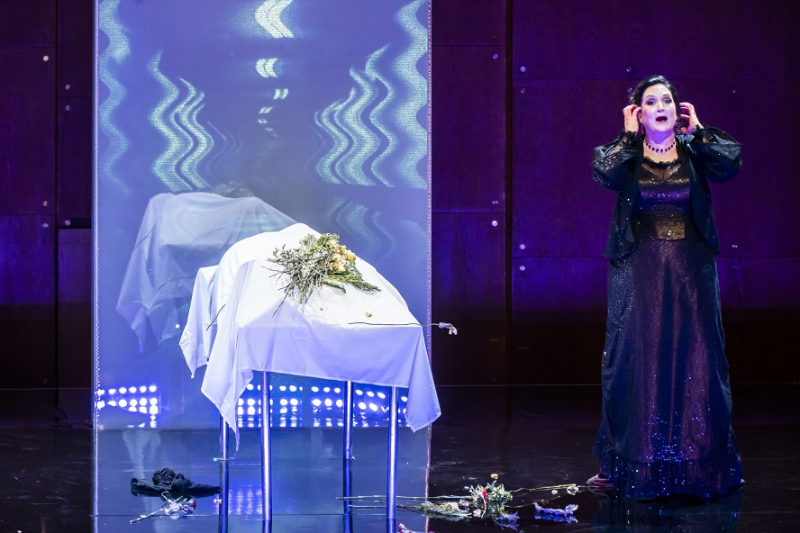
    The idea of presenting these two works in a semi-staged concert setting at Geffen Hall seemed intriguing on paper but was less successful in practice. The singers performed on a raised platform behind the musicians, who were seated in near darkness. The addition of silent actors – portraying medical staff and a crime-scene photographer in ERWARTUNG, and Bluebeard’s previous wives in the Bartók – neither added to nor distracted from the flow of the two works. From where we were sitting, we could not discern what was under the sheet of that autopsy table, which was revealed when they came to take The Woman away. One small screen sufficed for the projections, which were neither here nor there. The lighting effects, however, were well-integrated into the music, especially a blood-red drenching at one point.

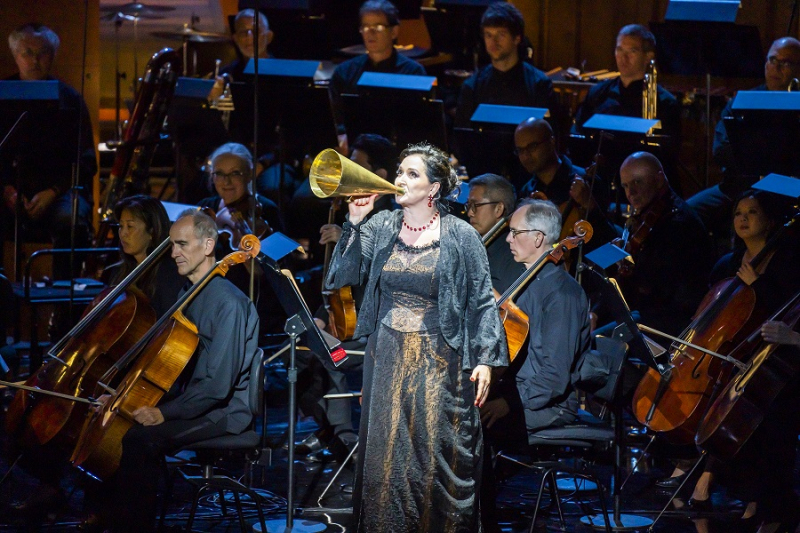
    The monodrama and the opera were linked theatrically by having Katarina Karnéus, who had just given a phenomenal performance in the Schoenberg, re-appear as the prologue to BLUEBEARD’S CASTLE. Here, Ms. Karnéus (using a megaphone) proved to be every bit as engaging as a speaker as she has been in her singing of The Woman. And while, in the end, the evening could have just as thrillingly been presented in straight-up concert form, that would have deprived us of Ms. Karnéus’s inspired acting of her role.

    The concert opened with a performance of the song Erwartung, from Schoenberg’s Vier Lieder, his opus #2, composed in 1899. This gorgeous piece of music, which I had never heard before, was originally written for voice and piano but was tonight performed in a setting for voice and harp. The Philharmonic’s harpist Nancy Allen played divinely, creating a poetic atmosphere. In a black gown shot with silver and holding a large bouquet, soprano Nina Stemme’s voice seemed beset by a wide tonal beat or fluctuation which rather undermined the strange beauty of the song. Ms. Stemme fared much better in BLUEBEARD, where she was fully warmed-up and with the voice profiting from the cushioning orchestra.

    Katarina Karnéus was the Cardiff Singer of the Year in 1995 and from there went on to a grand worldwide career. She came to The Met in 1999, debuting as Varvara in KATA KABANOVA and also appearing as Siebel, Olga in EUGEN ONEGIN, as Rossini’s Rosina, and as Cherubino. I had the pleasure of meeting her while I was working at Tower Records, and of attending a lovely recital she gave in 2001 with pianist Brian Zeger. She last sang at The Met in 2005; in the interim she has developed into a fascinating singing-actress.

    _DSC0141

    Above: Katarina Karnéus as The Woman in ERWARTUNG; photo by Chris Lee

    What a performance of ERWARTUNG Ms. Karnéus gave tonight! The voice encompasses an impressive vocal span, with a silvery sheen on the high notes and a dusky, dramatic throb in the lower range. Her wide-ranging singing is pointed and subtle in terms of word colourings, has a lovely vein of lyricism running thru it, and is possessed of striking power in the climactic moments. It’s an expressive, even bewitching, instrument. Beyond this, Ms. Karnéus is a compelling physical presence, and she captured the emotional state of The Woman with her vibrant and detailed physicality; at one point her entire body was overcome with trembling agitation. Mixed in with the madness were passages that were extraordinarily moving, as in the moment she tells her absent lover that he has “…not even the grace to let me die with you.”

    In recent years, only a handful of operatic performances have captivated me in the way Katarina Karnéus did tonight in ERWARTUNG. She is truly one of a kind.

    Here’s a sampling of the Karnéus voice:

    Katarina Karneus – Mahler ~ Ich bin der Welt abhanden gekommen

    _DSC0348

    Above: Katarina Karnéus in the spoken prologue to BLUEBEARD’S CASTLE at The New York Philharmonic; photo by Chris Lee

    After the interval, BLUEBEARD’S CASTLE commenced with a re-appearance of Ms. Karnéus in a speaking role; I must admit that I found myself wishing she was also singing Judith, for while there is no denying the power and commitment of Nina Stemme’s performance in that role, hers is a voice that has never reached me on a deeper level. That said, the soprano was in full-tilt form for the Bartók tonight and was much admired by the audience.

    In the role of Bluebeard himself, it gave me great pleasure to see onstage again the excellent baritone Johannes Martin Kränzle who, in 2014, was an ideal Beckmesser in his (to date) only Met appearances. We simply must have this man back at The Met, for he is a singing-actor (and an acting-singer) of the highest calibre. 

    _DSC0651

    Above: Johannes Martin Kränzle and Nina Stemme in BLUEBEARD’S CASTLE; photo by Chris Lee

    Ms. Stemme and Mr. Kränzle made the Bartók glow in all its dark radiance with their powerful vocalism and intense acting. They played beautifully off one another, seeming to feed off each others energy as well as off the astonishing sounds being produced by the artists of the Philharmonic.

    It was a performance to immerse oneself in totally, and by the time the harp and horns marvelously underscored Mr. Kränzle’s spectacular vocalism at the opening of the fourth door, I was thoroughly enthralled. Ms. Stemme’s blockbuster high-C at the opening of the fifth door was followed by simply mind-bogglingly impressivel singing from the baritone. Ever a compelling mover, Mr. Kränzle even executed a little dance, and then led his soprano is a waltz.

    Responding to Judith’s questions about the mysterious white lake, Mr. Kränzle was hauntingly moving as he replied: “…tears, Judith…tears!” And then – incredibly – he took his performance to an even higher level with his gorgeous singing of the passage where Bluebeard describes how he met his previous wives and what they mean to him: morning, noon, and evening have been personified for him by these women, and with Judith joining them, his world is complete. “Now it will be night forever!”

    _DSC1438

    Above: from BLUEBEARD’S CASTLE, photo by Chris Lee

    Throughout the evening, the playing of The New York Philharmonic was darkly dazzling, glorious, sublime. Maestro van Zweden reigned over the music with a sure sense of its enormous emotional range, from eerie piani to unfettered, magnificent fortes. The musicians played their hearts out, creating sonic textures that sent chills thru me time and again, and the numerous solo passages were given extraordinary clarity by these remarkable artists.  

    ~ Oberon

  • Leonie Rysanek as Lady Macbeth

    Scanned Section 13-1

    A year before her Met debut in the same role, Leonie Rysanek made her New York debut as Verdi’s Lady Macbeth in a concert performance with The Little Orchestra Society. Overall, she gave an exciting (if somewhat uneven) performance; she galvanized the audience with her thrilling singing of “La luce langue“.

    Leonie Rysanek – La luce langue ~ MACBETH – Little Orchestra Society 1958

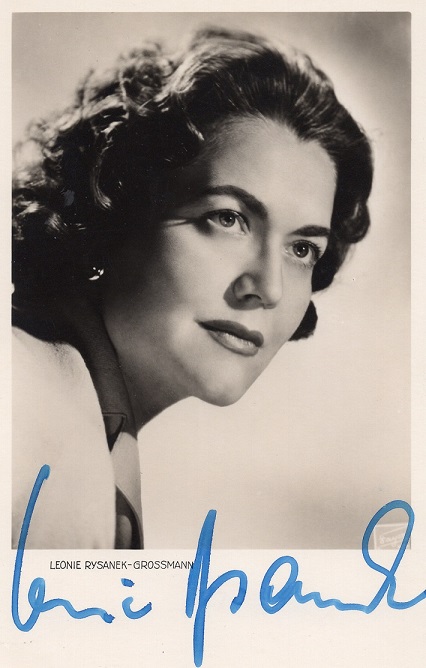
    After hearing Leonie Rysanek’s voice for the first time on a Texaco/Metropolitan Opera broadcast of BALLO IN MASCHERA, I wrote to her and received the photo (at the top of this article) a few days later. She became one of the most potent forces in my enduring obsession with opera. I saw her many times at The Met, including her unforgettable 25th anniversary gala. She was my first Senta, Ariadne, Kaiserin, and Salome; her Met 25th anniversary gala in 1984 was one of the greatest thrills of my opera-going career.

    ~ Oberon

  • Birgit Nilsson ~ Liebestod

    Snapshot

    In 1971, Birgit Nilsson was my first Isolde, in a new production at the Metropolitan Opera. For several years after seeing her in the role, I did not want to see the opera again. When I finally did  – in 2008 (!) – I realized what I’d been missing. TRISTAN UND ISOLDE now holds a high place in my list of favorite operatic works.

    Birgit Nilsson – Liebestod ~ TRISTAN UND ISOLDE – Knappertsbusch conducting