Tag: Met Opera

  • Aase Nordmo-Løvberg & Kolbjørn Høiseth

    Aase-nordmo-lvberg-6d8aba9d-d166-4244-b6c9-58dc451cbbf-resize-750

    Above: soprano Aase Nordmo-Løvberg

    Ms. Nordmo-Løvberg spent most of her career at Oslo and Stockholm. She was a highly-regarded soprano who worked with top conductors (such as Karajan and Solti). She sang at the Vienna State Opera, and gave a dozen performances at The Met in 1959-1960 singing Elsa, Eva, Sieglinde, and Beethoven’s Leonore.

    HOISETH Kolbjorn

    Above: the Norwegian tenor Kolbjørn Høiseth

    Mr. Høiseth’s career took him to London, Berlin, Stockholm, Lyon, and Bordeaux as well as numerous German houses. He specialized in Wagner and Verdi, also appearing in WOZZECK, FIDELIO, and ELEKTRA.

    In 1975, the tenor sang Froh in RHEINGOLD (in which role I saw him twice) at The Metropolitan Opera, where he also appeared as Siegmund in a single performance of WALKURE. His voice had a lyric quality, but also ample power when needed.

    Aase Nordmo Løvberg & Kolbjørn Høiseth – WALKURE – ACT I scene – Stockholm 1963

  • Paolo Washington

    A-1726033-1532529259-1673.jpeg

    Basso Paolo Washington (above) was a featured artist at the major opera houses of Italy, beginning with his professional debut at the Teatro Comunale, Florence, in 1958. He subsequently appeared at La Scala, Rome, and Naples, and participated in broadcasts by the RAI.

    Chicago Lyric Opera was Washington’s home base in the United States. From 1968 thru 1997, he appeared in 14 roles for a total of 101 performances with the Company He sang in operas by Donizetti and Bellini, as well as in Stravinsky’s LE ROSSIGNOL and OEDIPUS REX. He was particularly admired for his moving portrayals of Colline in LA BOHEME and Timur in TURANDOT.

    Washington was heard throughout Spain, and also at Geneva, Marseille, Nice, Toulouse, and Lisbon, and at the Salzburg and Bregenz festivals. His wide repertory extended from Handel to the 20th century works by Prokofiev and Hans Werner Henze. He appeared only twice at the Metropolitan Opera, in the title role of DON PASQUALE in 1979.

    He passed away in 2008 at the age of 75.

    Paolo Washington – Nabucco ~ Tu sul labbro

  • Blanche Thebom

    51J27V3W9WL

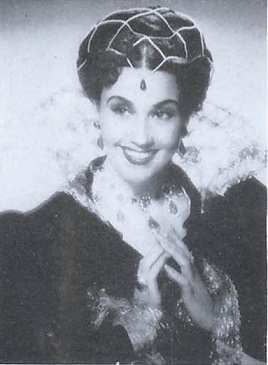
    Blanche Thebom (above), the glamorous mezzo-soprano whose career at The Met lasted over 30 years, was as well-known for her magnetic stage presence and her sensationally long hair as for her singing.

    She made her debut with the Metropolitan Opera Company in 1944 as Brangaene in TRISTAN UND ISOLDE in a performance at Philadelphia, Pennsylvania; two weeks later, she sang Fricka in DIE WALKURE at The Met. These performances drew rave reviews for Ms. Thebom, both for her singing and for her distinctive beauty and dramatic flair.

    Ms. Thebom went on to sing more that 360 performances with the Metropolitan Opera Company, in New York and on tour. She was a much-admired Carmen and Dalila, and in Verdi she made a regal impression as Amneris and Princess Eboli. She seemed capable of singing anything, from Adalgisa in NORMA to Venus in TANNHAUSER, while – in a lighter vein – she appeared as Prince Orlofsky and as Dorbella in COSI FAN TUTTE.

    Thebom Eboli

    Above: Blanche Thebom as Princess Eboli

    Blanche Thebom – O don fatale ~ DON CARLO

    Ms. Thebom appeared in the US premieres of two important works at The Met: as Baba the Turk in Stravinsky’s RAKE’S PROGRESS in 1953, and as Adelaide in Strauss’s ARABELLA in 1955. In the 1960s, she undertook what might be called “principal character” roles such as Genevieve in PELLEAS ET MELISANDE, Magdalene in MEISTERSINGER, and the Old Baroness in VANESSA. Her last role was that of the Countess in Tchaikovsky’s QUEEN OF SPADES – performed in English, at the New Met – in which she appeared opposite Teresa Stratas and Jon Vickers.

    After retiring from the Met, Blanche Thebom taught singing and also served on the Metropolitan Opera’s Board of Directors until 2008. She passed away in 2010, at the age of 94.

    AR-311309810

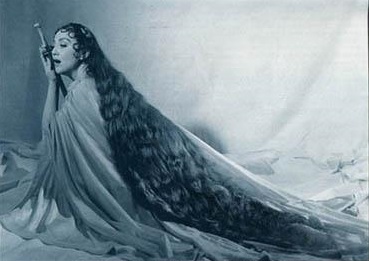
    In my earliest days of opera-loving, Blanche Thebom was already spoken of in our house. My father, who had seen her on TV, referred to her as ‘Blanche the Bomb’ due to her physical allure. And my grandmother told me about Thebom’s legendary hair, which had been used as a dramatic device when she sang Berlioz’s Dido at Covent Garden in 1957 (photo above).

    I finally heard Thebom’s voice on the radio in 1962:

    Metropolitan Opera House
    December 29th, 1962 Matinee/Broadcast

    PELLÉAS ET MÉLISANDE

    Pelléas.................Nicolai Gedda
    Mélisande...............Anna Moffo
    Golaud..................George London
    Arkel...................Jerome Hines
    Geneviève...............Blanche Thebom
    Yniold..................Teresa Stratas
    Physician...............Clifford Harvuot
    Shepherd................William Walker

    Conductor...............Ernest Ansermet

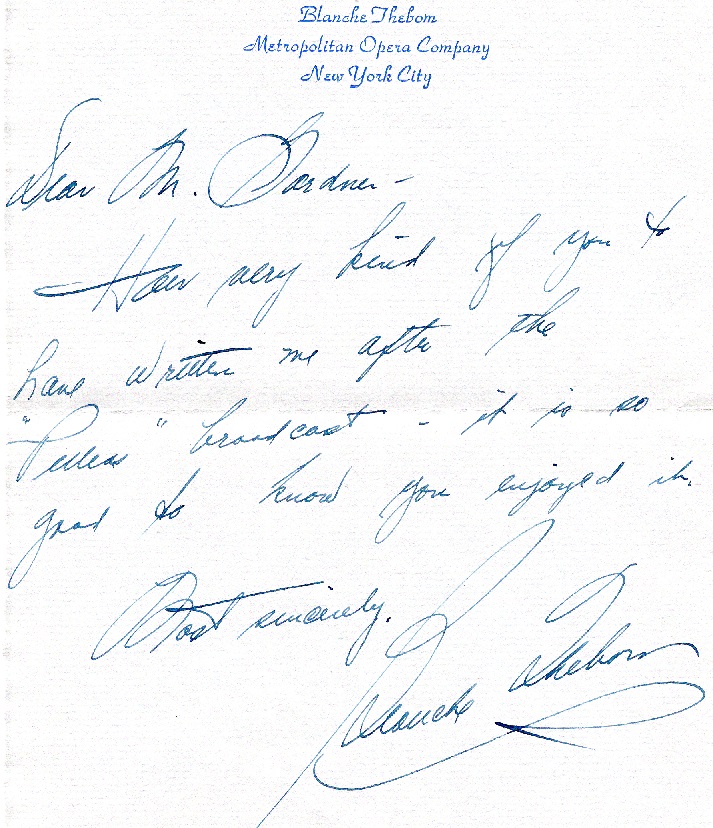
    Listening to her sing Debussy’s  Genevieve on a Texaco broadcast of PELLEAS ET MELISANDE, I was well-prepared to like her. And like her I did, so much so that I wrote her a letter; soon after, I received this elegant reply:

    Scanned Section 14-1

    More samplings of Blanche Thebom’s singing below. In RHEINGOLD, her usual role was Fricka, but I’m partial to her recording of Erda’s Warning:

    Blanche Thebom – Weiche Wotan weiche! ~ RHEINGOLD

    Blanche Thebom – Mon coeur s´ouvre a ta vois ~ SAMSON & DALILA

    Blanche Thebom – Wolf ~ Um Mitternacht

    ~ Oberon

  • Beatrice Rana|Philadelphia Orchestra @ Carnegie Hall

    Thumbnail_rana_beatrice_1920

    Above: pianist Beatrice Rana

    ~ Author: Ben Weaver

    Friday June 7th, 2019 – Yannick Nézet-Séguin – music director of the Metropolitan Opera – led his other ensemble, The Philadelphia Orchestra – in an exciting Carnegie Hall concert tonight. The all-Russian program opened with a recently discovered curiosity: Stravinsky’s Funeral Song, Op. 5, written for the memorial of his teacher, Nikolai Rimsky-Korsakov, in 1908. The 12 minute work, in which Stravinsky has different sections of the orchestra take turns “laying down its own melody as its wreath against a deep background of tremolo murmurings,” was lost until 2015 when a St. Petersburg Conservatory’s librarian discovered the complete orchestral parts in the mess of the Conservatory’s renovations. Musicologists long lamented the lost manuscript as the link between Stravinsky’s early works and The Firebird. Its discovery revealed not only the links in Stravinsky’s own development, but his links to Rimsky-Korsakov’s late compositional style, which Stravinsky, late in life, tried to downplay.

    Sergei Prokofiev’s popular Piano Concerto No. 3 came next on the program with the exciting pianist Beatrice Rana at the piano. This was my first time hearing Ms. Rana in a live performance, but I have admired several of her recordings for some time. What struck me about her recorded performances – and what was confirmed live – is her deeply felt, yet honest and unaffected musicality. Prokofiev’s “devilishly difficult” (Prokofiev’s own words) writing presented no technical challenge to Rana’s nimble finger work. The often spiky writing can easily become a “pound on the keyboard” type of evening. That is not Rana: her light – but never weak – touch made the pounding Prokofiev requires sound effortless and graceful. Both of those words were also true about the encore: Chopin’s Etude in A-flat major, Op. 25, No. 1 showed off the more lyrical side of Rana’s artistry.

    Thumbnail_young_rachmaninoff2

    Above: the young Sergei Rachmaninoff

    The premiere of Sergei Rachmaninoff’s Symphony No. 1, Op. 13 in 1897 is one of the most famous musical disasters in Western art music. Composer and conductor Alexander Glazunov appears to have been drunk on the podium and unprepared to conduct the difficult score. The reaction from the public and the critics was savage: composer and critic César Cui wrote that the symphony “would have delighted the inhabitants of Hell” and that the “music leaves an evil impression.” The young composer was so devastated by the reception that he quit composing and needed a therapist (and hypnosis) to recover from the trauma. When he fled Russia during the 1917 Revolution, the score of the symphony was lost in the chaos. Interestingly, although the symphony caused him a lot of pain, it appears to have been on Rachmaninoff’s mind for the rest of his life: he quoted its dark opening theme in the first movement of his last work, the Symphonic Dances, in 1940. Since the score of the symphony was lost and no one had heard it in more than 40 years, Rachmaninoff knew the quote would be unknown to anyone but himself. He died in 1943 and two years later orchestral parts of the symphony were discovered after all, in the St. Petersburg Conservatory (again), presumably as everyone returned home after the War. A performance was quickly arranged in Moscow (US premiere was given by The Philadelphia Orchestra and Eugene Ormandy) and finally the public was able to judge this extraordinary composition. We can safely say that César Cui’s deranged opinion was garbage; indeed, history itself has given its verdict on Cui vs. Rachmaninoff’s Symphony No. 1. Cui is nothing but footnote.

    One thing that may have confused so many listeners in 1897 was the dark and violent tone of the work; Rachmaninoff’s vivid quotations of the Dies irae may have upset some sensitive constitutions. But the Dies irae would become a common motif in all of Rachmaninoff’s major orchestral works. In the 1st Symphony, even the haunting slow movement is more sinister than calming. Cui may have been correct that the work “would have delighted the inhabitants of Hell,” except any person of taste would have seen that as a positive. Rachmaninoff’s most famous works, Piano Concerto No. 2 and Symphony No. 2, are steeped in romanticism, their flowing, endless melodies unrolling with shameless abandon. The very different tone of the 1st Symphony, however, reveals fascinating depths.

    There are few orchestras with a stronger personal and professional connection to a major composer than Philadelphia Orchestra’s is to Rachmaninoff. For a few decades Rachmaninoff played with and conducted them regularly, and he chose them when he recorded his own orchestral works. His last composition, the Symphonic Dances, were dedicated to the Philadelphia Orchestra and Eugene Ormandy led the world premiere performance. This is music they have in their blood the way Bayreuth Orchestra has Wagner and the NY Philharmonic has Mahler. With Maestro Nézet-Séguin on the podium, this Carnegie Hall performance of Rachmaninoff’s 1st Symphony was perhaps the most thrilling and hair-raising I’ve ever heard. Nézet-Séguin’s unflagging energy perhaps a taste for the macabre was the perfect approach to this dark and sprawling work. The Philadelphians responded with a fearlessness that shook the concert hall to the rafters. Is César Cui heard this performance, he might have had a heart-attack. 

    Thumbnail_yannick-hans-van-der-woerd

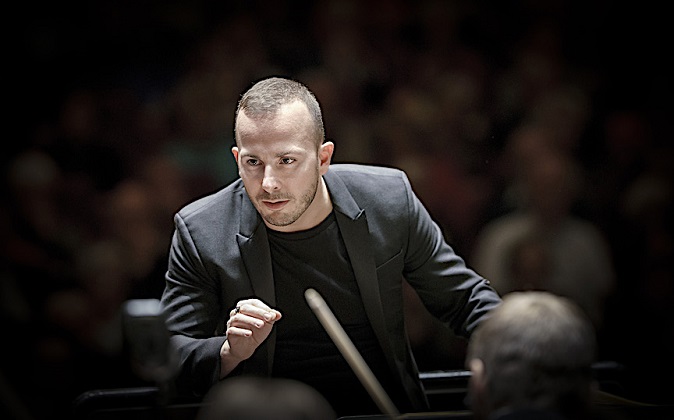
    Maestro Nézet-Séguin (above, in a Hans Van Der Woerd photo) is currently recording Rachmaninoff’s complete piano concertos with Daniil Trifonov and the Philadelphia Orchestra. Based on this coruscating performance of the 1st Symphony, it may be time for this group to record Rachmaninoff’s complete orchestral works. The Concertgebouw seems to do a complete Mahler traversal every few years (though the last one, with Daniele Gatti, was abandoned part-way for stupid reasons). Surely the Philadelphians and Rachmaninoff have earned a similar right? Deutsche Grammophon, are you paying attention?

    ~ Ben Weaver

  • Ballets Russes @ Chamber Music Society

    Photo nicolas dautricourt 74

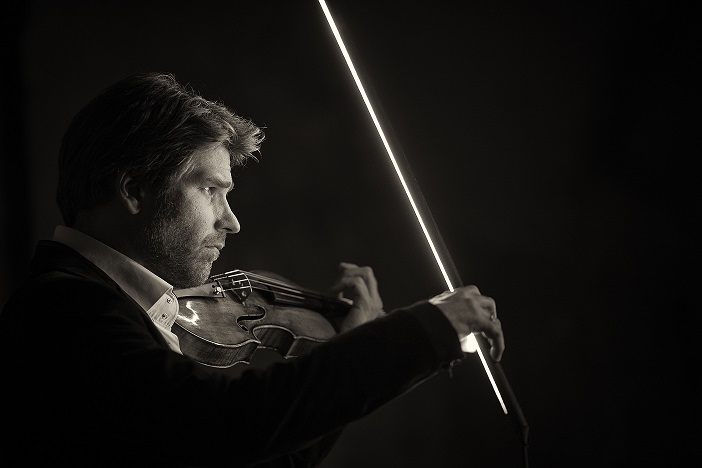
    Above: violinist Nicolas Dautricourt, photographed by Bernard Martinez

    ~ Author: Oberon

    Sunday May 19th, 2019 – For their final concert of the 2018-2019 season at Alice Tully Hall, Chamber Music Society of Lincoln Center offered a program of works by composers associated with Serge de Diaghilev’s Ballets Russes. It was a long program, full of rewards.

    Jennifer Johnson Cano, the Metropolitan Opera mezzo-soprano who in February shared a memorable program with tenor Matthew Polenzani at Zankel Hall, sang works by Manuel de Falla and Maurice Ravel, and a septet of marvelous musicians were heard – in varying configurations – in these, plus music by Debussy, Prokofiev, and Stravinsky. 

    JJC

    Ms. Cano (above, in a Matthu Placek portrait) opened the concert with Manuel de Falla’s Psyché in which she was joined by Tara Helen O’Connor (flute), Nicolas Dautricourt (violin), Yura Lee (viola), David Finckel (cello), and Bridget Kibbey (harp). Composed in 1924, as a setting of a poem by Georges Jean-Aubry, this is the awakening song of Psyché, a mortal woman whose beauty has caught the eye of Cupid, god of Love, who she will eventually marry.

    The flûte enchantée of Tara Helen O’Connor opens the work; the addition of M. Dautricourt’s ethereal violin and Ms. Kibbey’s delicate harp create an exotic atmosphere. Ms. Cano’s singing – clear, warm, and wonderfully nuanced –  was vastly pleasing; in her unaccompanied opening passage, the sheer beauty of her tone and its evenness throughout the registers marked her as a singer of exceptional natural gifts.

    Adding depth and colour to the enticing ‘orchestration’ were Ms. Lee’s viola and Mr. Finckel’s cello; overall the five instrumentalists created an impression of a larger ensemble thru the richness of their individual timbres. The music becomes urgent, and Ms. Cano’s singing golden, as flute trills and harp melismas lure the ear.  Psyché this evening was an intoxicating delight.

    For Maurice Ravel’s chamber arrangement of Shéhérazade, Ms. Cano and Ms. O’Connor returned, along with pianist Alessio Bax. It’s Mr. Bax’s delicate, silvery playing that sets the mood of the opening song, Asie. At “Je voudrais voir des assassins souriant“, passion builds: Ms. Cano brought an operatic quality to her performance at this point, rising to her steady and blooming upper range to fine effect. Asie has a little pendant at the end, full of lovely mystery. It ends on an exquisitely tapered note.

    La flûte enchantée brings forth limpid, entrancing sounds from Ms. O’Connor’s flute, and the weaving together of voice, flute, and piano is hypnotic. The concluding song, L’indifferent, begins with a calm lullabye played by Mr. Bax. Ms. Cano’s beguiling singing, sometimes bringing straight tone into play, was a marvel of expressiveness.

    Infringing on our enjoyment of the Ravel was the sound of text booklets dropping onto the floor, and a crash of something falling in the outside corridor. But Ms. Cano held to her course; this is a truly wonderful voice that I would love to hear in the music of Massenet’s Charlotte.

    Maxresdefault

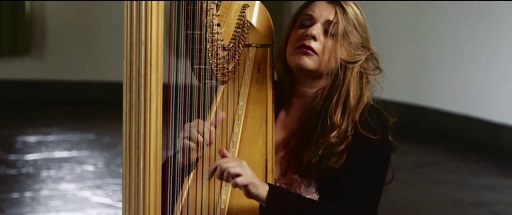
    Above: harpist Bridget Kibbey

    Mlles. O’Connor, Lee, and Kibbey then offered a sublime performance of Claude Debussy’s Sonata for Flute, Viola, and Harp, written in 1915. In an evening filled with marvelous sounds, the opening sustained flute tone of this sonata – taken up by the viola – sent chills thru me at the start of the Pastorale. The blend these three remarkable musicians produced was exceptional. A gentle animation arose – soft and merry – only to subside. Mlles. Lee and O’Connor duet, the viola deep and buzzy. Swirls of notes from the harp – and then from the flute – lingered on the air.

    The Interlude commences with a viola melody underpinned by the harp, After a sprightly interjection, viola and flute play in unison, and the harp tapers to pianissimo.The viola is plucked, the music soft and swift. A percolating motif opens the Finale, like the break of dawn on a sunny day; after a momentary slowing down, the piece ends abruptly.

    Prokofiev’s Sonata in D-major for Violin and Piano, Op. 94a, brought together Mssrs. Dautricourt and Bax for a fabulous performance that sparked a shouting, standing ovation from the crowd. Though the piece was composed in 1943 as a flute sonata, Prokofiev later obliged the great violinist David Oistrakh by creating a violin version, which premiered in 1944.

    Mr. Dautricourt launched the sonata with a high sweet/melancholy song. As the music becomes increasingly animated, an ultra-familiar theme is heard, which will crop up several times along the way. Vibrant, agitated, march-like music ensues; Mr. Bax displays magic tricks of his own, and the movement has a lovely ending.

    In the Scherzo, Mr. Dautricourt’s virtuosity is astounding. A demented, off-kilter dance commences, then slows to a high-lying interlude before resuming. The music, and the playing of it, are thrilling…and then it comes to a sudden halt.

    The audience, who all evening applauded between movements, prompted the violinist to declare “Two more!” before commencing the Andante: a sorrowful song which tends to meander a bit over time, with a hint or two of of jazz thrown in; in the end it becomes high and eerie. 

    The concluding Allegro con brio dances along, with some respite for a poignant interlude before dancing on again. Moodiness briefly takes over, and then a rush to the finish. The applause began before the music stopped: Dautricourt/Bax are a winning team.

    Alessio-600

    Lucille Chung and Alessio Bax (above, photographed by Lisa-Marie Mazzucco) joined together for the evening’s Fokine finale, saluting Diaghilev’s ground-breaking choreographer with a piano-four-hands arrangement of Igor Stravinsky’s Petrushka.

    Despite more intrusions – a loud clang from the balcony, and the sound of something (or someone) falling – Stravinsky’s brilliance prevailed. For 40-minutes, the outstanding Bax/Chung duo sustained the vibrancy of a theatrical presentation; everything felt so alive – with dazzling rhythms and infinite colours – that the entire ballet danced in the mind. For their brilliant and generous playing, the couple were rewarded with hall-filling, joyous applause. What a way to end the season!

    ~ Oberon

  • @ My Met Score Desk for GOTTERDAMMERUNG

    1600x685_gotter

    Above: the Norn Scene from the Lepage/Met Opera production of GOTTERDAMMERUNG

    ~ Author: Oberon

    Saturday April 27th, 2019 matinee – The best thing about today’s matinee of Wagner’s GOTTERDAMMERUNG at The Met was the Norn Scene. With a mood of mystery and doom evoked by Maestro Philippe Jordan and the Met Orchestra in the prelude, the three singers who were weaving the ‘Rope of Destiny’ today were Ronnita Miller, Elizabeth Bishop, and Wendy Bryn Harmer. Each sounded splendid in her own way.

    Ms. Miller has a rich, deep contralto timbre; Ms. Bishop a brighter quality with a strong feeling for lyricism; and Ms. Harmer an authentic Wagnerian soprano voice: house-filling, with an ample high range. Each has a prolonged solo passage, describing much that has transpired in the first three operas of the RING Cycle.

    From her lush “Dammert der Tag?“, Ms. Miller had me in her thrall: such a dusky, abundant sound. She continued to fascinate me with “Die Nacht Weicht…” and concluded the scene with a deep plunge on “Hinab!” that had an other-worldly resonance.

    Ms. Bishop, who has been an excellent Dido and Iphigénie at The Met, was likewise in excellent voice today, and she brought subtlety and point to the words. Ms. Harmer’s singing was huge and grandly styled, her high notes gleaming.

    As the Norns descended to their mother, Erda, my hopes were high that the vocal standard they had set would be upheld as the afternoon progressed. In the interlude before the Dawn Duet, the noble horns and the Met’s fabulous clarinetist Inn-Hyuck Cho gave a sublime build-up to the entrance of Christine Goerke and Andreas Schager as Brünnhilde and Siegfried, the latter making his Met debut today.

    Ms. Goerke got off to a fine start, but – later in the prologue – her notes around G above the staff seemed a bit sour, and the high-C was there – and long – but a shade flat. Mr. Schager has a voice of helden-power, with some brassiness cropping up, and a steady beat to the tone. 

    The Rhine Journey was light and lively at first, and then turned epic. At the Gibichung Hall, we meet Gunther (Evgeny Nikitin, darkish of timbre and firm-toned), Gutrune (Edith Haller, debuting in a role Ms. Harmer might have doubled), and Hagen (Eric Owens, somewhat lacking in the monumental power of a Salminen or a König). The conductor tended to cover Mr. Owens at times, but the bass-baritone was chilling as he described in whispers the potion with which he would ensnare Siegfried.

    Siegfried arrives at the Gibichung Hall to the sound of bungled horn calls; blood-brotherhood is sworn, and the hero’s fate is sealed. Left alone, Mr. Owens in Hagen’s Watch sang well, but seemed more efficient than thrilling, and was unaided by the conductor.

    The clarinets depict a return to Brünnhilde’s Rock, where Ms. Goerke impresses as she welcomes her sister Waltraute, sung by Michaela Schuster – the mezzo whose Klytemnnestra last season was so impressive.  Ms. Schuster brought a wealth of nuance to her narrative, which had a sense of intimacy as well as urgency: doom is at hand, she warns.  Bringing a spine-tingling sense of introspection to her description of the resigned, weary Wotan, Ms. Schuster’s singing seemed truly personal, showing great vocal control; telling Brünnhilde that their father had spoken wistfully of her, the mezzo’s low notes were so alive. And she was simply glorious at “Erlöst warGott und Welt…” Her plea to Brünnhilde to abandon the ring causes the final rift between the two sisters: with a desperate cry, Waltraute rushes away.

    The excitement as Brünnhilde senses Siegfried’s return was somewhat dulled by Ms. Goerke’s non-blooming top range. But in the final moments of the act, Mr. Schager suddenly sounded like the tenor we’d been reading about.

    I would have liked to have heard Tomasz Konieczny’s Alberich in his scene with Hagen that opens Act II, but decided instead that the RING was over for me this season, and I headed home. The good has been very good, but there’s also been quite a lot of singing that left me feeling indifferent. It’s not a matter of how these operas should sound, but how they can sound.

    ~ Oberon

  • @ My Met Score Desk for TRAVIATA

    Domingo hartig ken howard met opera

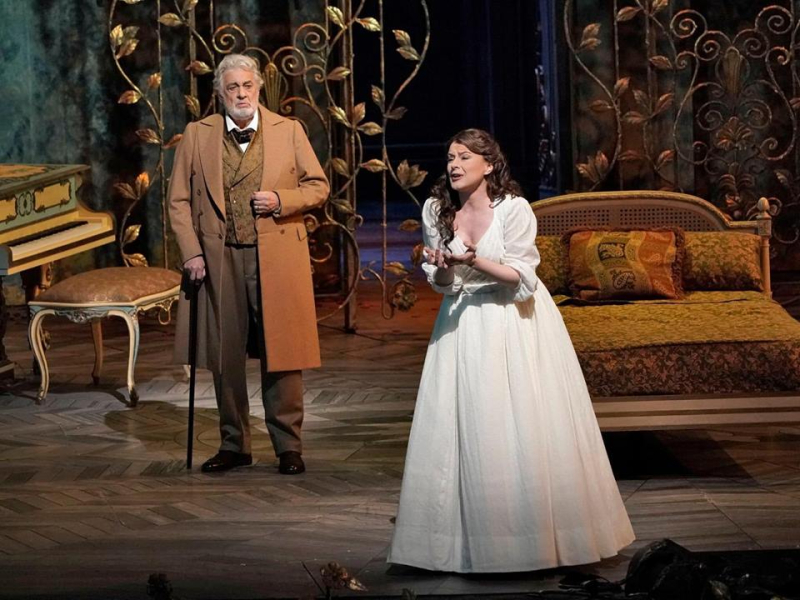
    Above: Placido Domingo and Anita Hartig in LA TRAVIATA; a Ken Howard/Met Opera photo

    ~ Author: Oberon

    Wednesday April 24th, 2019 – TRAVIATA is the opera I’ve seen more than any other. Along with Tosca and Turandot, Violetta is my idea of a test role; I’ll go to see almost anyone who tries it. From A to Z – from Licia Albanese to Teresa Zylis-Gara, from Ainhoa Arteta to Virginia Zeani – I’ve experienced every kind of Violetta: good, bad, or indifferent. Patricia Brooks, Anna Moffo, and Diana Soviero remain among the most memorable in the role; and in recent seasons, Hei-Kyung Hong and Marina Rebeka have struck gold in the part. Inexplicably, I missed seeing Tucci, Sutherland, Lorengar, Scotto, and Sills as the fragile courtesan. But as Lois Kirschenbaum always said: “You can’t go to everything!”…a notion she herself seemed to disprove.

    Knowing I’ll be seeing the Met’s current TRAVIATA (which some have described as Disneyesque) next season, when Lisette Oropesa takes on the role of Violetta at The Met, I took a score desk for tonight; my main reason for being there was to hear Anita Hartig, whose Mimi and Liu in recent season captivated me.

    Ms. Hartig’s voice, with a mixture of enticing vibrato and curiously effective straight tone, was sadly beset by pitch problems tonight (and, from comments I have read, throughout her run here as Violetta). The voice was annoyingly sharp, at times excruciatingly so. The allure of her timbre, her sense of lyricism, and her brightish upper range should have made her a fascinating Violetta; instead, it became something of a trial to listen to her.

    Stephen Costello’s Alfredo has improved considerably since I last heard him in the part, though he too showed some vagaries of pitch during the evening. I sometimes feel that Mr. Costello doesn’t sense the heartbeat of the music, but tonight he sounded like an ardent, passionate young man with reckless streak.

    Hearty applause greeted the entrance of Placido Domingo, the beloved tenor-turned-baritone, as Germont. After sorting out the voice for a bit, he settled in at “È grave il sacrifizio…” and thereafter sang quite beautifully, finding a nice emotional connection to Ms. Hartig’s Violetta in the great duet “Dite alla giovine“, which is the very heart of the opera. Some small chokes or sobs, perhaps to indicate empathy, were unnecessary; but Domingo impressed by singing the phrase “Dio mi guido…dio mi guido…” in his big aria without breaking for breath. 

    In comprimario roles, so important in the opera, the male contingent excelled: Scott Scully (Gastone), Jeongcheol Cha (D’Obigny), Paul Corona (Dr. Grenvil), the characterful singing of Dwayne Croft (Baron Douphol), and even – in the very brief role of Giuseppe – tenor Marco Antonio Jordão, each made an impression.

    Maestro Nicola Luisotti’s TRAVIATA was overall on the fast side, which is fine. He suddenly sped up the final reprise of the Brindisi, which felt exhilarating in a way, and he took “Di Provenza” at a fast clip: maybe that’s what Mr. Domingo wanted. I could have done without that aria’s cabaletta, though.

    The ballet music had gypsy charm at first, and vigor as the matador theme took over. I was recalling the many times I heard it at New York City Opera, when the incredible Esperanza Galán transformed this scene with her Flamenco flair, castanets blazing.

    Listening to Violetta’s touching reply to Alfredo’s public insult, “Alfredo, Alfredo, di questo core…”, I was yet again reminded of one of the most painful things in life: living with remorse.  

    ~ Oberon

  • @ My Met Score Desk for CLEMENZA DI TITO

    54523905_663524600746741_7864682115135176704_n

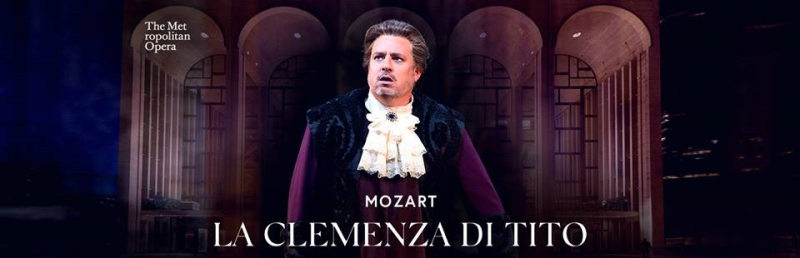
    Above: Matthew Polenzani as Tito

    ~ Author: Oberon

    Saturday April 20th, 2019 matinee – One of my favorites among the Mozart operas, LA CLEMENZA DI TITO is a melodious masterpiece. Though THE MAGIC FLUTE is considered the composer’s final opera, that work was largely complete when he set about writing CLEMENZA.

    LA CLEMENZA DI TITO was something of a throw-back for Mozart: it was written in the old style of opera seria – in which a progression of set-piece (arias, duets, and small ensembles) are linked by brief passages of recitative – to celebrate the coronation of Austrian Emperor Leopold II as King of Bohemia in Prague in 1791.

    This formality of structure is illuminated by some of Mozart’s most personal arias: Sesto’s  “Parto, parto” and “Deh, per questo istante solo“, Tito’s “Se all’impero, amici Dei”, Annio’s “Tu fosti tradito“, Servilia’s “S’altro che lagrime“. and Vitellia’s “Non piu di fiori“, each of which ideally reflects the personality of the character singing it. 

    Giving the overture a nice, weighty feel, conductor Lothar Koenigs presided over a well-paced performance. A sterling continuo duo – Davis Heiss, cello, and Bryan Wagorn, harpsichord – added much to the afternoon’s pleasure, and thrilling playing from principal clarinetist Inn-Hyuck Cho (as both clarinet and basset horn soloist in “Parto, parto” and “Non piu di fiori” respectively) was a complete joy to experience.

    In the title-role, Matthew Polenzani’s pliant and expressive singing flowed forth with Italianate lyricism, the voice clear and sure, etched in with detailed pianissimi along the way (most notably in “Del piu sublime soglio“) to keep the music fresh. The tenor – whose recent Zankel Hall concert was one of the highlights of the current season – showed great sensitivity in the recitatives, especially in the long scene where he weighs his feelings before passing judgement on Sesto. “Se fosse intorno al soglio”  showed expert dynamic control, and the showpiece “Se all’impero, amici Dei” in Act II was triumphant.

    Maxresdefault jdd

    Joyce DiDonato (above) has found a perfect role in Sesto, joining such marvels as Tatiana Troyanos , Lorraine Hunt Lieberson, and Elīna Garanča in the highest echelon of interpreters of this demanding part. Ms. DiDonato, ever alert to the words, sang with dazzling technique and a vibrant sense of dramatic urgency.

    In the great aria, “Parto, parto“, Ms. DiDonato reveled in the vocal and expressive possibilities Mozart has afforded her. After displaying moving vulnerability – her hushed murmuring of “Guardami…!” was sublime – the mezzo was at her finest as she sailed thru neat-as-a-pin coloratura effortlessly (and perfectly matched by the clarinet), winning a big ovation.

    Incredibly, Ms. DiDonato surpassed herself in the second act aria, “Deh, per questo istante solo” where, with touches of straight tone along the way, she sang with deep feeling, expressing the young man’s passion and remorse. In the second verse, tiny embellishments were woven in, and the aria’s fiery finish brought down the house. 

    Elza van den Heever is a puzzling singer: her broad repertoire – from bel canto to Strauss, Wagner and (next season), Berg – seems to indicate a soprano who has not settled on a fach. Which is fine, really, except that the varying demands of the roles she is singing seems to be affecting her tone at times, which can turn rather shrill.

    As Vitellia, she was uneven in this role’s wide-ranging music, and though she touched on the high-D in Act I and successfully reached downward to the low-G in “Non piu di fiori“, the voice lacks sheer beauty and is not really all that fluent in fiorature. The highest notes – a brilliant top-B for one – popped out clearly, but seemed disconnected to the rest of the voice. I really didn’t know what to make of her performance. But for some reason, the audience – perhaps spurred on by the MetTitles – found Vitellia to be something of a comic figure; the soprano was well-received at her bows. 

    Emily D’Angelo as Annio seemed rather muted at first, and Ms. DiDonato simply drowned her young colleague out in their beautiful Act I duet. But Ms. D’Angelo soon made her mark on the performance, with a finely-rendered “Tu fosti tradito” capped by a nice top-A. The audience loved her.

    Lovely, graceful Mozart singing from Ying Fang as Servilia, recalling Hei-Kyung Hong’s beautiful Met debut in this role. Ms. Fang, with sweet-toned lyricism, made “S’altro che lagrime” (perhaps the opera’s most attractive melody) a tender delight.

    Christian van Horn was a superb vocal presence as Publio, showing the advantage of putting a stellar singer in a relatively small – but musically important – role. Bravo!

    The houselights slowly came up during the opera’s finale: a celebratory touch. The singers were all warmly applauded as they took their bows on the classic Jean-Pierre Ponnelle set.

    Metropolitan Opera House
    April 20th, 2019 matinee

    LA CLEMENZA DI TITO
    Wolfgang Amadeus Mozart

    Tito.......................Matthew Polenzani
    Vitellia...................Elza van den Heever
    Sesto......................Joyce DiDonato
    Servilia...................Ying Fang
    Annio......................Emily D'Angelo
    Publio.....................Christian Van Horn
    Berenice...................Anne Dyas

    David Heiss, Cello
    Bryan Wagorn, Harpsichord

    Inn-Hyuck Cho, Clarinet and Basset Horn soloist

    Conductor..................Lothar Koenigs

    Static1.squarespace.com a

    Intermissions at The Met these days can often put a damper on even the best of performances, but this afternoon’s single interval brought an unexpected treat: clarinetist Inn-Hyuck Cho (above) remained in the pit for the entire half-hour, practicing the basset horn part of “Non piu di fiori”. What a mesmerizing sound! The Met is so very fortunate to have this splendid musician in their orchestra. 

    Oberon

  • @ My Met Score Desk for WALKURE

    54727491_10161727100955533_4208711738377371648_n

    Above: Stuart Skelton and Eva-Maria Westbroek as Siegmund and Sieglinde/a Met Opera photo

    ~ Author: Oberon

    Saturday March 30th, 2019 matinee – I admit that I am not feeling excited about the Met’s current RING Cycle performances. Much as I have been starved for Wagner in recent Met seasons, and despite the RING being very high on my list of favorite works, a lot of the casting this time around is uninspiring. And, if the free-standing RHEINGOLD I saw recently was any indication, Philippe Jordan’s Wagner conducting doesn’t really send me. So I went to this afternoon’s WALKURE simply because it’s WALKURE.

    En route to the theater, I encountered Michael Volle, the alternate Wotan, heading for the Met’s stage door in the passageway under Lincoln Center. I wondered if there would be a cast change, but – after a delayed start of fifteen minutes – the performance commenced with the announced cast.

    I did not stay for the third act; after debating with myself, I decided to leave before enduring another prolonged intermission. Then on the train going home, I thought: “What if that was your last WALKURE…ever?”

    Blasts of frigid air (common up in the Family Circle boxes) continued throughout the performance; whilst waiting for the House to go dark, we heard a gorgeous cacophony of Wagnerian leitmotifs from the musicians warming up.

    The singers today ranged from stellar to acceptable, but Maestro Jordan seemed far more impressive here than in the RHEINGOLD, and the orchestra playing was – for the most part – thrilling, both in its overall resonance and in the many featured opportunities; the cello (especially before “Kühlende Labung gab mir der Quell“), the clarinet (as the mead is tasted, and later in the prelude to the Todesverkundigung ), the somber horns and heartbeat timpani in that magnificent Annunciation of Death…and countless other phrases.

    Stuart Skelton’s Siegmund seemed to me to stand firmly in the top echelon of the role’s interpreters of the last half-century, alongside Jon Vickers and James King. Both musically and as a character, this role suits Mr. Skelton far better than Otello. His Siegmund has both power and poetry. The son of a god, he is deeper and more thoughtful than he might seem on the surface; for, in his own way, Siegmund has great nobility…and great humanity. In finding and liberating Sieglinde, he finds a joy and purpose in life hitherto denied him; that it will last less than a day makes him all the more poignant. His overwhelming tenderness towards his sister-bride, his awe in encountering Brunnhilde, and his helpless rage at his father’s deceit are all vividly expressed in his music. And Mr. Skelton took all of this to heart: with generous lyricism, warmth of tone, and vivid declamation, he brought Siegmund palpably to life, making him the central figure of the opera.

    Mr. Skelton’s Sword Monolog in Act I was among the very finest I have ever heard. But even before that, he had so many wonderful passages of clear-voiced, expressive singing: ” Kühlende Labung…”, and the great subtlety and feeling of resignation he brought to “Nun weißt du, fragende Frau, warum ich Friedmund nicht heiße!” 

    The mysterious, uneasy orchestral prelude to the Monolog set the mood for our tenor, who caught every nuance of the text and brought vocal colors into play with masterful modulations of dynamic. Sublime tenderness at “…ein Weib sah’ ich, wonnig und hehr...” was followed moments later by Mr. Skelton’s phenomenal sustaining of the cries of ” Wälse! Wälse!“, so tonally steady and true, whilst the orchestra generated white heat. The trumpet then rang out with the Sword Motif. Magnificent moments! 

    The tenor’s energy seemed to flag momentarily after these arduous pages of dramatic singing, but he quickly attained peak level again with a beautifully poetic “Winterstürme“.  From thence, Mr. Skelton and his Sieglinde, Eva-Maria Westbroek, gave a strikingly passionate account of the final pages of Act I, from the growing excitement as they begin to realize who they are, (Skelton’s “Du bist das bild das ich in mir barg” – “Yours is the image I held in my heart!”…yet another perfect moment) thru the drawing of the sword from the tree, and their escape into the night.

    Ms. Westbroek’s singing overcame the distractions of a widening vibrato and insecurity at the top of her range by sheer willpower: her passionate commitment to the music and to the character made her vocal flaws seem irrelevant. The soprano’s rendering of the narrative “Der Männer Sippe” had its vocal ups and downs, but underlying her singing was this deep raging fire: a hope for freedom…and love. This more than compensated for a lack of ‘ring’ in her upper notes. “Du bist der Lenz” likewise had many lovely touches along the way: and then the A-flat loomed. She got it.

    Sieglinde describes the sensation of having heard Siegmund’s voice before, as a child; and then, at “Doch nein! Ich hörte sie neulich” (“But no, I heard it of late…”) Ms. Westbroek suddenly cut loose vocally, as if liberated. This launched a magnificent outpouring of emotion and song from both singers as the sibling-lovers surrendered to the inevitable. The soprano staked out a long, resounding top-A as she named Siegmund. And the music rolled on, in an unstoppable flood of hope and desire. 

    A titanic ovation rocked the house and, as has long been a tradition at this point, the two singers – Ms. Westbroek and Mr. Skelton – stepped out for a bow as the crowd went wild. Günther Groissböck, our excellent Hunding, joined them and the applause re-doubled. It seemed like old times.

    G groissbock

    Mr. Groissböck (above) is not a cavernous-toned basso in the manner of Martti Talvela or Matti Salminen; the Groissböck Hunding is leaner and meaner. His voice has power, authority, and insinuation. Having patiently listened to Siegmund’s tale of woe, the basso kicks out the blocks with “Ich weiß ein wildes Geschlecht!” and delivers a knockout punch with “Mein Haus hütet, Wölfing, dich heute…”  Bravissimo! 

    Jamie Barton’s Fricka was prodigiously sung; the top notes sometimes have a slightly desperate feel, and to me her over-use of chest voice runs counter to the character: she is the queen of the gods, not a desperate, ex-communicated Sicilian peasant. Barton’s parting lines to Brunnhilde were more to the point: a self-righteous woman calmly dealing from a position of power; a wife who has the upper hand.  

    Greer Grimsley’s voice is now rather time-worn, but he knows the role of Wotan inside-out and makes a vibrant impression through his deep understanding of the character, using the words as a dramatic springboard, and hurling vocal thunderbolts at just the right moments. His long monolog in Act II was rich in detail and feeling, and his dismissal of Hunding was a memorable moment: “Geh!” first as a quiet command, then in a snarling fit of rage.

    A lot of water has flowed under the bridge of time since Christine Goerke gave her revelatory performances of the Dyer’s Wife in FRAU OHNE SCHATTEN at The Met in 2013. At that time, the huge Met contract she was offered following her triumph seemed both exciting and amply justified. But the ensuing seasons, during which Goerke has put her voice to unstinting use in the most demanding repertory, have taken a toll: notes above the staff are thinned out and approximated now, the power of the voice has lessened, and today there were passing pitch difficulties in the mid-range. Perhaps to compensate, the soprano seemed to be over-enunciating the text, spitting out and biting off her words.

    The soprano got off to a rocky start with a helter-skelter Battle Cry. But Ms. Goerke settled in for the opera’s heart and soul: the Todesverkundigung (Annunciation of Death), where the music lies very much in her comfort zone. Maestro Jordan took this scene a bit faster than I’d have liked, and sometimes let the voices be covered. The music is full of foreboding as Brunnhilde tells Siegmund he will die in the coming fight against Hunding, after which she will bear him to Valhalla; there, as Ms. Goerke beautifully tells him, he will be greeted by Wish-Maidens who will serve and delight him.

    When Siegmund asks if Sieglinde can come with him into the afterlife, Brunnhilde/Goerke replies – meltingly lovely of tone – “Erdenluft muß sie noch athmen” (“Earthly air must she keep breathing…”). Siegmund then rejects the bliss of Valhalla. When Brunnhilde chides him for placing his love for this “poor, ailing woman” above the glory of immortality, Siegmund’s reply is one of the great crushing dismissals in all opera:

    “So young and fair you shine before me,
    yet how cold and hard is your heart!
    If you can only mock me,
    then take yourself hence,
    you cruel, merciless maid!
    Or if you hunger for my distress,
    then freely feast on my woe;
    let my grief quicken your envious heart:
    But of Valhalla’s loveless raptures
    speak no more to me!”

    No mortal has ever answered Brunnhilde thus; now, moved by Siegmund’s plight and her eyes opened to her father’s deceit, Brunnhilde vows that Siegmund shall win the coming fight.

    This leaves the stage now to Mr. Skelton’s Siegmund. Gearing up for the battle, he looks upon the sleeping Sieglinde and sings – with infinite tenderness: “So slumber on, till the fight be fought, and we find our  peace and joy!”

    The ominous blaring of Hunding’s hunting horns is heard. And the fight is on! The voices of Skelton and Groissböck – so alive in the House – threaten one another. The orchestra storms wildly. Brunnhilde shields Siegmund, but Wotan suddenly appears out of nowhere, shatters Siegmund’s sword, and Hunding slays his enemy with a spear thrust. Pausing only to dispatch Hunding, Wotan/Grimsley turns his wrath on his disobedient daughter, who has fled with Sieglinde and the pieces of the shattered sword:

    “But Brünnhilde! Woe to that traitor!
    Dearly shall she pay for her crime,
    if my steed o’ertakes her in flight!” 

    Metropolitan Opera House
    March 30th, 2019 matinee

    DIE WALKÜRE
    Richard Wagner

    Brünnhilde..............Christine Goerke
    Siegmund................Stuart Skelton
    Sieglinde...............Eva-Maria Westbroek
    Wotan...................Greer Grimsley
    Fricka..................Jamie Barton
    Hunding.................Günther Groissböck
    Gerhilde................Kelly Cae Hogan
    Grimgerde...............Maya Lahyani
    Helmwige................Jessica Faselt
    Ortlinde................Wendy Bryn-Harmer
    Rossweisse..............Mary Phillips
    Schwertleite............Daryl Freedman
    Siegrune................Eve Gigliotti
    Waltraute...............Renée Tatum

    Conductor...............Philippe Jordan

    ~ Oberon

  • Irene Dalis as Fricka

    Walkure6465.05

    The great dramatic mezzo-soprano Irene Dalis in the scene of confrontation between Fricka and Wotan from Act II of Wagner’s DIE WALKURE:

    Irene Dalis as Fricka – WALKURE – w Birgit Nilsson & Otto Edelmann – Leinsdorf cond – Met bcast 1961

    From her 1957 debut there, Irene Dalis sang some 275 performances with the Metropolitan Opera Company – in New York City and on tour – during her twenty-year Met career. Her greatest roles were The Nurse in DIE FRAU OHNE SCHATTEN and Amneris in AIDA. In 1969, her electrifying performance of Verdi’s Egyptian princess at a concert performance at the Sheep Meadow, Central Park, drew an estimated  crowd of 50,000; Dalis’s super-charged singing in the Judgement Scene evoked a thunderous ovation.

    6a00d8341c4e3853ef00e54f20ad648833-800wi

    Following her retirement from singing, Irene Dalis founded Opera San Jose, which she ran with great success for over two decades.

    In August 2007, I wrote an appreciation of Irene Dalis, which she eventually found and read; she sent me a lovely message of thanks.

    ~ Oberon