Tag: Metropolitan Opera

  • Arlene Saunders Has Passed Away

    Eva

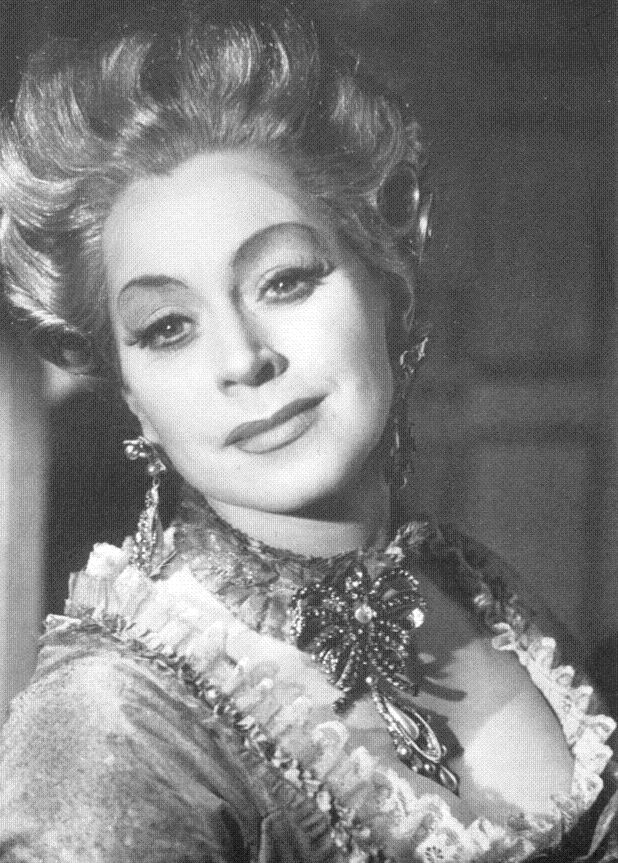
    Above: Arlene Saunders as Eva in DIE MEISTERSINNGER

    It’s so sad to read of the death of soprano Arlene Saunders, who I saw in four different roles over the course of her career. She died on April 17th, 2020, of complications associated with COVID-19.

    Just last Summer, I discovered a series of films made in the 1970s by the Hamburg State Opera and truly enjoyed watching Ms. Saunders as the Countess in NOZZE DI FIGARO, Agathe in FREISCHUTZ, and most especially her Eva in DIE MEISTERSINGER. The Hamburg film of the Wagner opera can in fact be watched in its entirety on YouTube here.

    It was as Eva that Arlene Saunders sang her only performances with the Metropolitan Opera, in 1976. But I had the good fortune to see her on the Met stage earlier, when the Hamburg company brought Stravinsky’s RAKE’S PROGRESS to Lincoln Center in 1967. She was an ideal Anne Trulove. 

    69137360_10216986454667603_1711224264759181312_n
    In the years to come, I saw Ms. Saunders as the Marschallin (Opera Company of Boston), as Minnie in FANCIULLA DEL WEST (New York City Opera), and as Elsa in LOHENGRIN (at The Bushnell in Hartford). As each of these vastly different characters, she seemed perfect.

    In 2007, I attended a solo recital attended by a young American tenor; during the interval, a woman came over to speak to the people seated in front of me. I was pretty sure it was Arlene Saunders, and sure enough, the couple greeted her as “Arlene…!”  I so wanted to speak to her and thank her for the wonderful performances I’d seen her give, but my innate shyness took over. I always regretted that missed opportunity…now, more than ever.

    And here’s Ms. Saunders in music from my favorite opera, ARIADNE AUF NAXOS:

    Arlene Saunders – Ariadne Monolog Part II ~ ARIADNE AUF NAXOS – Hamburg 1968

    ~ Oberon

  • Clifford Harvuot

    1942AuditionsWinners

    Above, finalists in the Metropolitan Opera’s 1941-42 Auditions of the Air: tenor Elwood Gary, soprano Frances Greer, the Met’s General Manager Edward Johnson, soprano Margaret Harshaw, conductor Wilfred Pellertier, and baritone Clifford Harvuot.

    As a winner of the Auditions of the Air, Clifford Harvuot’s first appearance on The Met stage came at a Sunday Night Gala on March 15, 1942. He sang the Prologo from PAGLIACCI. From then until December 21, 1975, the baritone chalked up nearly 1,300 performances with the Company, in New York City and on tour.

    Harvuot particularly excelled in two Puccini roles, both of which brought out a feeling of ‘humanity’ in his voice. One was Sonora, the miner in FANCIULLA DEL WEST who is hopelessly in love with Minnie. It is Sonora who, in Act III, persuades the other miners that they must set Minnie’s beloved Dick Johnson free. Clifford Harvuot sing Sonora nearly 30 times at The Met, his Minnies being Leontyne Price, Dorothy Kirsten, and Renata Tebaldi.

    He was also a very sympathetic Sharpless in MADAMA BUTTERFLY, appearing in the role with the great Butterflies of the day: Tebaldi, Albanese, Stella, Kirsten, and Tucci.

    Helen Vanni – Carlo Bergonzi – Clifford Harvuot – BUTTERFLY trio – Met 1962

    Other frequent Harvuot roles:

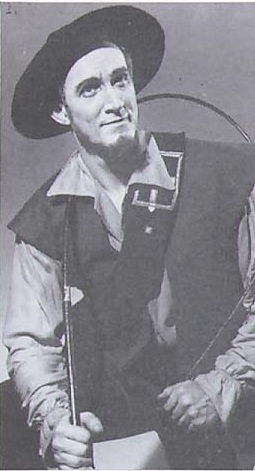
    HarvuotTosca

    Angelotti in TOSCA

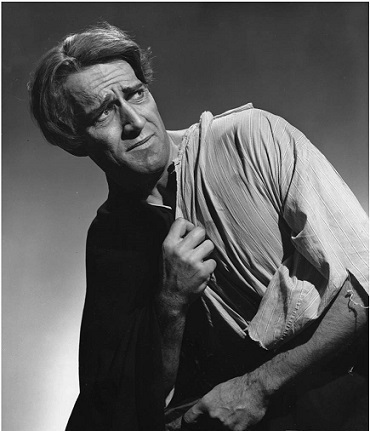
    Schaunard

    Schaunard in BOHEME

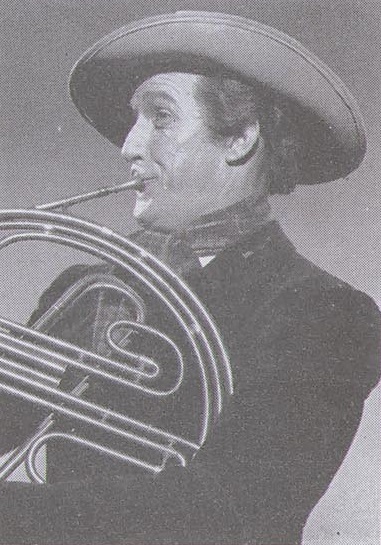
    Alfio

    Alfio in CAVALLERIA RUSTICANA

    Listen to Clifford Harvuot as Silvio in PAGLIACCI with Lucine Amara as Nedda here.

    ~ Oberon

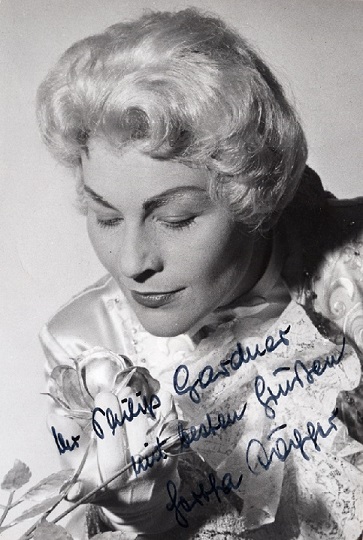
  • Hertha Töpper as Octavian

    6a00d8341c4e3853ef01bb09c7e9c1970d-800wi

    Above: Hertha Töpper as Octavian in DER ROSENKAVALIER

    [Update: Hertha Töpper passed away on March 28th, 2020, at the age of 95]

    I’ll never forget listening to Strauss’s DER ROSENKAVALIER for the first time: it was a Saturday matinee broadcast from the Old Met at Christmastime in 1962. I was 14 years old and had been in love with opera for three years.

    At that time, the German operas were not easy for me; I had made it thru my first broadcast RING Cycle in 1961 and I seem to recall having been more thrilled by the story than by the music. ROSENKAVALIER, with its long conversational stretches, posed a challenge all its own. But the singing of the three female leads in the opera’s final scene moved me deeply, and when the broadcast ended I sat down and wrote fan letters to all three of them: Hertha Töpper (Octavian), Anneliese Rothenberger (Sophie), and Régine Crespin (the Marschallin). Within days I received replies from all three.

    Metropolitan Opera House
    December 22, 1962 Matinee/Broadcast

    DER ROSENKAVALIER

    Octavian.....................Hertha Töpper
    Princess von Werdenberg......Régine Crespin
    Baron Ochs...................Otto Edelmann
    Sophie.......................Anneliese Rothenberger
    Faninal......................Ralph Herbert
    Annina.......................Rosalind Elias
    Valzacchi....................Paul Franke
    Italian Singer...............Sándor Kónya
    Marianne.....................Thelma Votipka
    Mahomet......................Marsha Warren
    Princess' Major-domo.........Robert Nagy
    Orphan.......................Loretta Di Franco
    Orphan.......................Nadyne Brewer
    Orphan.......................Dina De Salvo
    Milliner.....................Lilias Sims
    Animal Vendor................Frank D'Elia
    Hairdresser..................Harry Jones
    Notary.......................Gerhard Pechner
    Leopold......................Erbert Aldridge
    Lackey.......................Joseph Folmer
    Lackey.......................John Trehy
    Lackey.......................Lou Marcella
    Lackey.......................Edward Ghazal
    Faninal's Major-domo.........Andrea Velis
    Innkeeper....................Charles Anthony
    Police Commissioner..........Norman Scott

    Conductor....................Lorin Maazel

    Ms. Töpper sent me the gorgeous photo which appears at the top of this article. Ever since then, this has remained the quintessential image of Octavian for me. As it turned out, Octavian was Töpper’s only Met role, though she had an enormous career in Europe.

    Here’s a sampling of the Töpper Octavian, with  Erika Köth as Sophie:

    Hertha Töpper & Erika Köth – Presentation of the Silver Rose ~ ROSENKAVALIER

    Hertha Töpper was born in 1924 and made her operatic debut at Graz as Ulrica in BALLO IN MASCHERA in 1945. By 1951 she was singing at Bayreuth, and had debuted at Munich as Octavian. She went on to sing at all the major opera houses and festivals of Europe; among her most prominent roles were Brangäne, Carmen, Fricka, and Dorabella. She also was a well-loved recitalist and concert singer, specializing in the music of Bach.

    A couple of years ago, by chance, I plucked Töpper’s recording of Bartok’s BLUEBEARD’S CASTLE (in German) from the library shelf; it proved to be a revelation, with fantastic singing from both the mezzo and the great Dietrich Fisher-Dieskau, and truly atmospheric conducting by Ferenc Fricsay.

    ~ Oberon

  • Love Duet

    6a00d8341c4e3853ef025d9b3f78e1200c-800wi

    On February 3rd, 1962, I tuned in to Texaco Metropolitan Opera Radio Network (as it was then called) and heard Puccini’s MADAMA BUTTERFLY sung live for the first time. Gabriella Tucci, who in my earliest years of opera mania was my favorite soprano, gave a magnificent performance. Carlo Bergonzi stepped in for the indisposed Sandor Konya, and this was a boon for me as Bergonzi was (and remains) my favorite tenor. 

    And so, the Tucci/Bergonzi rendering of the love duet from that matinee performance is very special to me: 

    Gabriella Tucci & Carlo Bergonzi – MADAMA BUTTERFLY ~ Love Duet – Met 1962

  • Janis Martin as Kundry

    Janis Martin

    The American soprano Janis Martin was my first Kundry; she was also my first Sieglinde and Marie in WOZZECK. She was a featured singer at the Bayreuth Festival from 1968 to 1989 where she appeared in nine different roles: Magdalene, Fricka, Eva, the Second Norn, Gutrune, Kundry, Freia, Sieglinde, and Brünnhilde. She returned in for the 1995 and 1997 festivals, again as Kundry.

    Janis Martin sang nearly 150 performances at the Metropolitan Opera, commencing in 1962 as Flora Bervoix in TRAVIATA. As a young opera-lover, I heard her many times on the Texaco broadcasts. She eventually progressed to “medium-sized” roles: Siebel, Nicklausse, Lola in CAVALLERIA RUSTICANA. Hearing her in these roles (in which she excelled), one would not have anticipated how her career would develop.

    Ms. Martin left The Met in 1965 to build a career abroad, moving into soprano territory. She returned to The Met from 1974 thru 1977, when I saw her as Kundry, Marie in WOZZECK, and Sieglinde. Following another hiatus, she was back at Lincoln Center from 1988-1992, singing the Witch in HANSEL & GRETEL, the Dyer’s Wife in FRAU OHNE SCHATTEN, Senta, the Foreign Princess in RUSALKA, and two performances of Tosca.

    Here is Ms. Martin as Kundry in a scene from the 1973 Bayreuth production of PARSIFAL; Jean Cox sings the title-role, with Eugen Jochum conducting:

    Janis Martin – Ich sah das kind ~ PARSIFAL – with Jean Cox – Bayreuth 1973

    ~ Oberon

  • GrahamDeconstructed: CIRCE

    StudioSeries_Circe_003

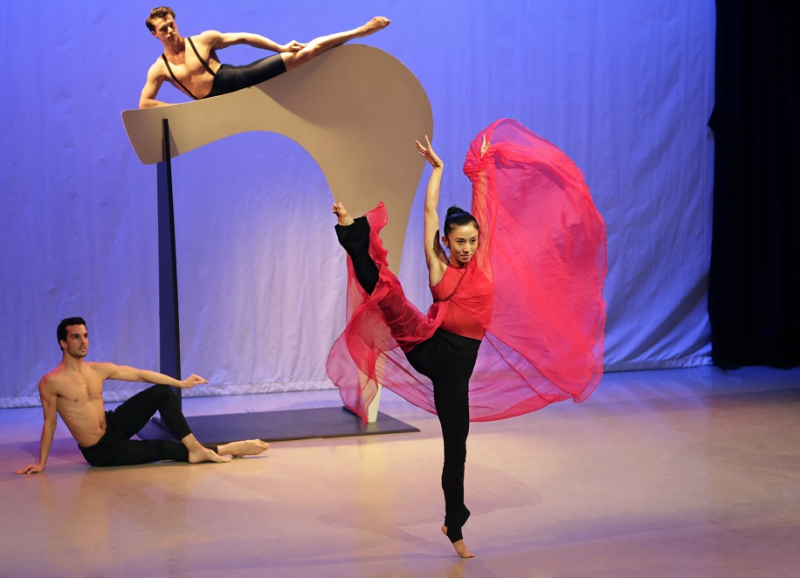
    Above: So Young An as Circe, with Lorenzo Pagano as The Snake and Lloyd Mayor, perched in Noguchi’s tree, as The Lion; photo by Melissa Sherwood

    ~ Author: Oberon

    Wednesday February 26th, 2020 – A revival of Martha Graham’s CIRCE will figure prominently in the Company’s 2020 season at New York’s City Center, which runs from April 22nd – 26th (details here).

    Premiered in 1963, CIRCE has not been performed for fifteen years. To a score by Alan Hovahness, and with settings designed by Isamu Noguchi, the ballet is inspired by the mythic Circe, a sorceress with a penchant for turning men into animals. 

    Circe – or characters modeled after her – has appeared in various theatrical representations over time. She is often given the name Alcina, as in Francesca Caccini’s opera LA LIBERAZIONE DI RUGGIERO (the first opera written by a woman that has come down to us in a performable version); dell’Arte Opera presented this work in 2019. Handel’s opera ALCINA is rumored to be having its first Metropolitan Opera production in the next two or three years. And Circe plays a part in the narrative of my favorite opera, Richard Strauss’s ARIADNE AUF NAXOS, although she never actually appears. The young god Bacchus has escaped Circe’s island domain, and as he sails towards Naxos – where he will rescue Ariadne – he chides the sorceress by calling out to her across the waves:

    Circe kannst du mich hören ~ ARIADNE AUF NAXOS – Ben Heppner & Deborah Voigt

    Tonight, at the Graham Company’s homespace at Westbeth, a full run-thru of the work – replete with the Noguchi sets – was presented, with So Young An in the title role and six of Martha’s Men as those who have fallen under her spell or those she would like to add to her menagerie. It was an exhilarating experience.

    Alan Hovanhess’s score is intriguing: by turns lyrical and dramatic, it also sometimes going off-kilter, indicating that things are far from normal in Circe’s realm. The composer makes fine use of solo instruments, notably the trumpet, horn, clarinet, and oboe. You can listen to the music here.

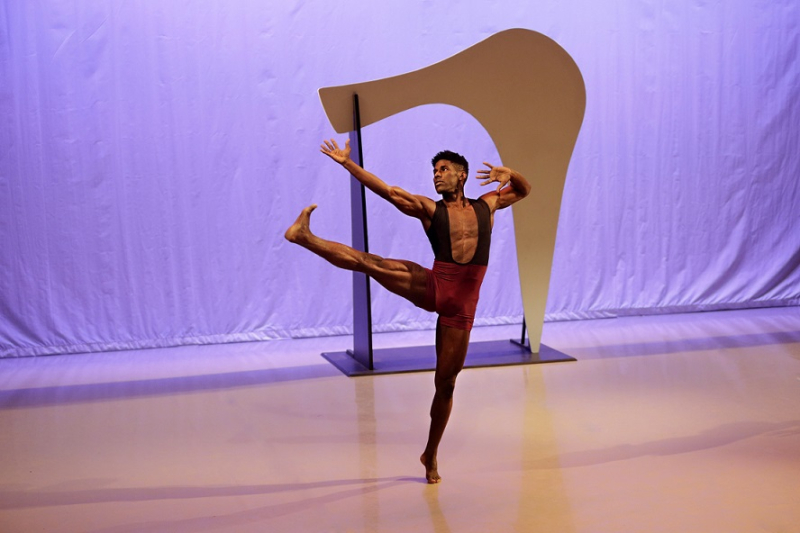
    The Noguchi setting features a small boat and an archway which might also be a tree. These were designed for an earlier Graham work, FRONTIER, which had fallen out of the repertoire. Ms. Graham kept the set pieces in storage until she found the perfect home for them on Circe’s island.

    So Young An was supple and tempting as Circe; the character’s magic resides in a flowing red scarf which she dons when it is seduction time. Ulysses (Lloyd Knight) and his Helmsman (Ben Schultz) arrive at the island in the very cramped boat. Circe observes them from her perch in the arch/tree.

    StudioSeries_Circe_004

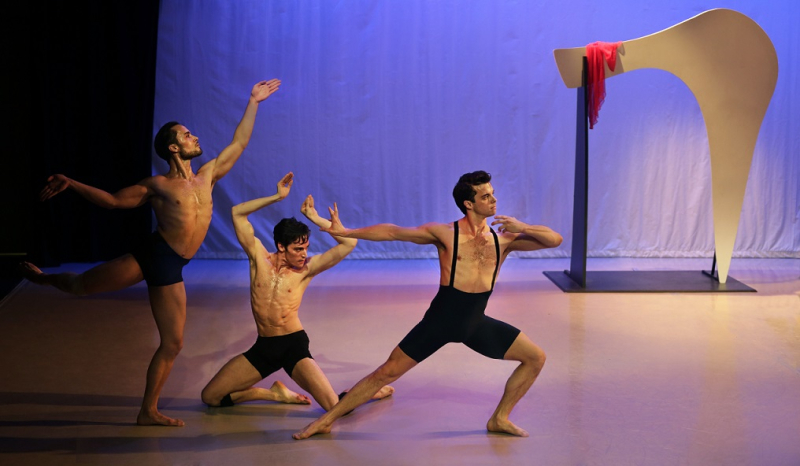
    Above: Lorenzo Pagano (The Snake), Alessio Crognale (The Deer) So Young An (Circe), Lloyd Mayor (The Lion), and Jacob Larsen (The Goat). Photo by Melissa Sherwood.

    StudioSeries_Circe_002

    Above: Jacob Larsen as The Goat; photo by Melissa Sherwood

    Four men who have been transformed by Circe into animals now take an interest in the new arrivals: enslaved by the sorceress, they will aid her in bringing about the downfall of Ulysses and his comrade. Lorenzo Pagano as The Snake first appears dangling from the tree; Lloyd Mayor is The Lion, Alessio Crognale The Deer, and Jacob Larsen The Goat. All the men in this ballet wear very little; I think that’s the way Martha liked her men. These dancers dispatched the demanding choreography with élan.

    StudioSeries_Circe_001

    Above: Lloyd Knight as Ulysses, photo by Melissa Sherwood

    As the story unfolds, it comes down to a battle between Circe, bent on conquest, and the Helmsman, who wants to save Ulysses and get the hell out of there. The red scarf nearly works its magic: Ulysses is falling under Circe’s spell. Hunkered down in the boat, the Helmsman is attacked by the Snake and sinks into a stupor.

    StudioSeries_Circe_005

    Above, Deer, Goat, and Lion: Alessio Crognale, Jacob Larsen, and Lloyd Mayor, photo by Melissa Sherwood

    The other animals stalk and caper, driving the victim into the enchantress’s arms. Just as Ulysses is about the capitulate, the Helmsman revives, hauls his master into the boat, and they sail away. Circe and her pets must now wait for someone else to succumb to the lure of her siren song.

    Danced with the technical prowess and personal commitment that make the Graham dancers the best in the world, CIRCE truly does cast a spell. I look forward to seeing it again, often, and to having it become part of the Company’s permanent repertory.

    All photos by Melissa Sherwood.

     ~ Oberon

  • A Memorable ROSENKAVALIER

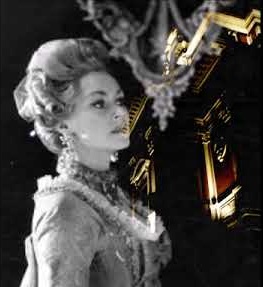
    E_Soderstrom_Grevinnan

    [Reviving this article, which has been updated with some audio clips]

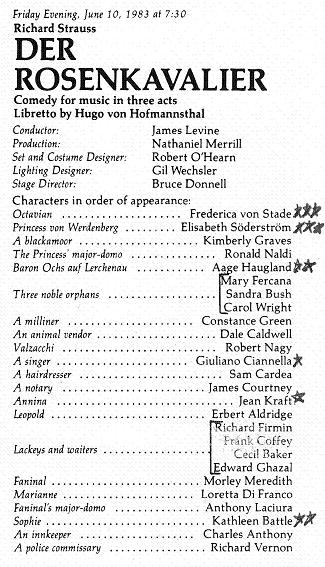
    In 1983, the Metropolitan Opera took DER ROSENKAVALIER on their annual Spring tour. James Levine was the conductor and the stellar cast was led by Elisabeth Söderström (above) as the Marschallin, Frederica von Stade as Octavian, Kathleen Battle as Sophie, and Aage Haugland as Baron Ochs. Interestingly, this particular alignment of stars never performed the Strauss opera at The Met. It was given in six cities on the tour, culminating with this performance…

    IMG
    …in Boston, which I was lucky enough to attend. Unfortunately one of my most vivid memories of the evening was the presence of some people sitting about six rows behind me who talked throughout the performance. Even though I had sprung for an orchestra seat – the better to concentrate on the array of vocal talent onstage – these people served notice that sitting in expensive seats doesn’t make you classy. They were continuously being shushed by people around them (as annoying as their talking, actually) and the usher came to admonish them at one point. Apparently they had some sort of clout that kept them from being ejected; at any rate, they spoiled a great performance. I’m sure they are all dead now, and good riddance.

    Despite this major distraction, the performance was extremely moving and superbly sung. Maestro Levine, whose 1976 ROSENKAVALIER broadcast had seemed sluggish and thick-textured orchestrally, was now fully in his element with the Strauss score. The towering Aage Haugland – a great favorite of mine during his Met career – was a grand Baron Ochs, and Miss Battle was a shimmering-voiced Sophie.

    It was the vocal and theatrical chemistry between Elisabeth Söderström and Frederica von Stade that gave this ROSENKAVALIER its unique appeal. Their older women/younger man romance was brilliantly portrayed, while their distinctive vocal timbres served their respective characters to perfection. By this point in time, the Söderström voice was an expressive rather than opulent instrument, but she truly knew her way around this music and her singing was so meshed with the character’s moods – it was simply all of a piece. In the monolog, she poked fun at herself as “die alte frau, die alte Marschallin“, sung with a crackly old-lady sound. Telling Octavian that he will soon tire of their romance, she seized von Stade by the shoulders, trying to shake some sense into him. The Söderström Marschallin was an unforgettable mixture of dignity, bitterness, and nostalgia: a woman who watches something cherishable slipping thru her fingers and finds the courage to let it go.

    Frederica von Stade, with her immaculately tailored sound, was boyish and impetuous in behavior. and her vocalism was always elegant and wonderfully personal. Other Octavians – Ludwig (my first!), Baltsa, Troyanos – have sung this music in grander style but no other Octavian of my experience has quite captured the coltish confusion of a boy on the brink of manhood who has a loving heart and a tender, noble young spirit…which von Stade showed us so memorably.

      Battle-Soderstrom

    While the Söderström/Battle/von Stade collaboration was never heard in a complete public performance of ROSENKAVALIER here in New York City, the three women did perform the opera’s Act III trio at the Met’s 100th anniversary gala. The day-long celebration was telecast live; I attended the matinee portion and can attest to the palpable atmosphere in the house as the three women sang this magical Strauss creation. You can listen to them here, with Levine on the podium.

    For years, I assumed this film clip was the only extant souvenir of this unforgettable convergence of voices – though I am sure someone recorded it someplace along the tour’s path – but recently my friend Ben Weaver surprised me with recordings of the first and third acts in very good sound from a rehearsal at the Met just before the tour commenced. Someone there had the presence of mind to realize that this was a rarity in the making and that Ms. Söderström’s Marschallin was a jewel worth preserving; and so this valuable sound document has come down to me, some thirty years after the event.

    Elisabeth Söderström – monolog from ROSENKAVALIER~Act I – Levine cond – Met stage rehearsal 1983

    Flicka octavian

    Frederica von Stade (above) regrettably never sang a complete Octavian at The Met – though she did sing a gorgeous Rose Presentation duet with Judith Blegen on the same gala programme as the filmed clip above.

    E S

    In 1987, Elisabeth Söderström made her ‘first’ Met farewell singing the Marschallin on a Saturday matinee which was broadcast. That was a very moving experience, yet it has always been the Boston performance that’s stayed so clearly in my mind. The magic of the Söderström Marschallin is so perfectly distilled in the closing moments of Act I, where her ‘silberne rosen‘ takes on a ghostly patina of lyrical regret and resignation.

    Elisabeth Söderström – Die silberne rose – 1st Met farewell 2~21~87

    ~ Oberon

  • Grimaud|Philadelphia Orchestra @ Carnegie Hall

    Default_4310-081

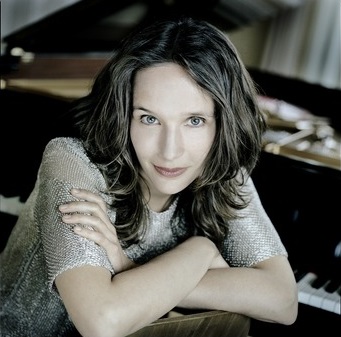
    Above: pianist Hélène Grimaud

    ~ Author: Ben Weaver

    Tuesday October 15th, 2019 – When The Philadelphia Orchestra premiered Valerie Coleman’s orchestral version of Umoja, Anthem for Unity last month, it was the first time the orchestra had played music by a living female African -American composer. Yes, there are still such firsts to be had in 2019. 

    Ms. Coleman’s work was originally written in 1997 for a female chorus, then arranged for a woodwind quintet (Coleman’s own acclaimed chamber ensemble, Imani Winds.) And now the full orchestral arrangement makes something clear: Ms. Coleman, born in Louisville, Kentucky, is a major voice in contemporary classical music and is a magnificent orchestrator.


    One thing I always note upon entering the concert hall where a contemporary piece is to be played is how big the percussion section is. Typically. it is large: everything and the kitchen sink. The problem, though, isn’t so much that there is more percussion than Mahler ever used, but that it is used as a crutch by so many contemporary composers; a crutch to transition from point A to point B to point C of the music. Unable to develop their material, too often composers rely on a few bangs and smashes from percussion to reset and change the subject. It’s lazy, it’s transparent and it’s bad music. And it is something Valerie Coleman notably does not do in her extraordinary orchestral version of Umoja, Anthem for Unity, a roughly 14 minute cinematic tone poem of shifting moods, sweeping melodies, surprising orchestral effects (the bowed vibraphone that opens the piece, for example) and undeniable joy.


    Thumbnail_6a00d8341c4e3853ef022ad378896b200c


    Ms. Coleman (above) explains in the Playbill that the work grew out of a simple, short melody. “Here the melody is sung sweetly in its simplest form and is reminiscent of Appalachian-style music. From there, the melody dances and weaves throughout the instrument families, interrupted by dissonant viewpoints led by the brass and percussion sections…” Someone described the work almost as a concerto grosso, where the music passes around, evolving and shifting from section to section. This gives many artists on stage to shine, notably the wind and the brass sections. Maestro Yannick Nézet-Séguin shaped the work expertly and the thunderous ovation that greeted Ms. Coleman on stage at the end, one hopes, sends a message to leaders of orchestras and opera houses. Tonight, the Metropolitan Opera’s  general manager Peter Gelb sat directly in front of me; did he realize that before us was an extraordinary composer, worthy of more commissions. Why not an opera, Mr. Gelb?


    Béla Bartók’s Piano Concerto No. 3 received a spectacular performance from Hélène Grimaud. The playful, spiky, percussive writing of the outer movements presented no challenges to Grimaud, her crystal clear playing etching each note as if out of marble. Yet the percussiveness was never mere banging on the keyboard either; Grimaud is too good of an artist for cheap tricks. But it is in the concerto’s slow movement, Adagio religioso, that Bartók’s soul and Grimaud’s musicality and artistry truly shone. Conductor and orchestra provided first rate support. 


    After intermission Richard Strauss’ last tone poem, Eine Alpensinfonie, received a thrilling, no holds-barred performance. Strauss began composing the work after years of putting it off after the death of Gustav Mahler in 1911. “Mahler’s death has affected me greatly,” Strauss wrote and set out to complete Eine Alpensinfonie, an unacknowledged tribute to Mahler. Certainly Mahler’s love of nature – which he attempted to capture in his music throughout his entire career – is here in spades as one travels through the Alps.


    Strauss divides the symphony into sections representing different parts of the region. Between the growling, dark Night that opens and closes the symphony, the wanderer observes a glorious Sunrise, a magnificent Waterfall, a treacherous Glacier, a horrifying Thunderstorm and chilling winds disappear with Sunset as Night returns. Strauss, of his many gifts, was an exceptional orchestrator. His command of large orchestral forces, of sound-painting has no betters. (Equals, maybe, but no betters.) The Philadelphians threw themselves into the music as if possessed, with Nézet-Séguin once again demonstrating that his grasp of the great Romantics is something of a specialty.


    ~ Ben Weaver


  • 20th Century Masterworks @ The NY Philharmonic

    _DSC9923

    Above: Katarina Karnéus in ERWARTUNG at The New York Philharmonic; photo by Chris Lee

    ~ Author: Oberon

    Thursday September 26th, 2019 – This long-awaited program by The New York Philharmonic paired Arnold Schoenberg’s monodrama ERWARTUNG with Béla Bartók’s expressionist opera BLUEBEARD’S CASTLE. The Philharmonic’s music director, Jaap van Zweden was on the podium, and a trio of esteemed singers took on the demanding vocal roles. The orchestra was simply splendid, from first note to last.

    In 1989, the Metropolitan Opera presented these two works on a double bill, conducted by James Levine. Jessye Norman sang both The Woman in the Schoenberg and Judith in the Bartók; Bluebeard was sung by Samuel Ramey. It was a magnificent evening musically, though the setting and direction for the Bartók left a lot to be desired. But the staging of the Schoenberg was unforgettable: just a grand piano, hundreds of white candles, and Ms. Norman. How I would love to see it again!

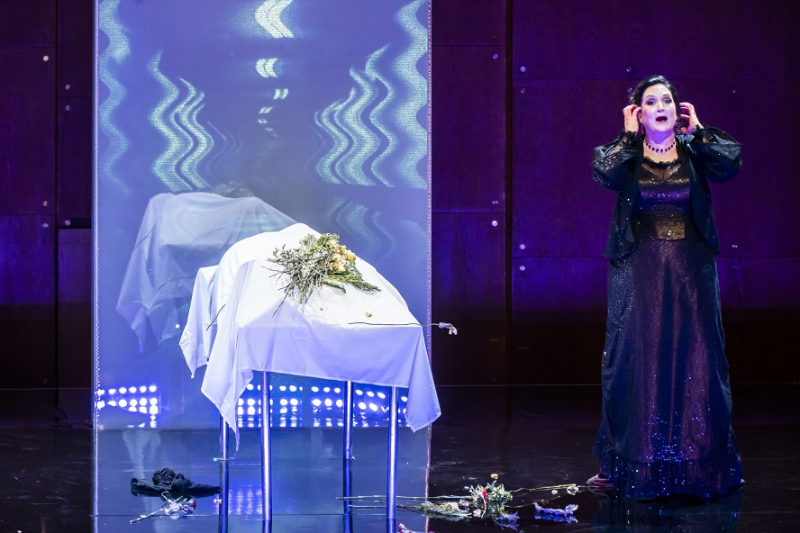
    The idea of presenting these two works in a semi-staged concert setting at Geffen Hall seemed intriguing on paper but was less successful in practice. The singers performed on a raised platform behind the musicians, who were seated in near darkness. The addition of silent actors – portraying medical staff and a crime-scene photographer in ERWARTUNG, and Bluebeard’s previous wives in the Bartók – neither added to nor distracted from the flow of the two works. From where we were sitting, we could not discern what was under the sheet of that autopsy table, which was revealed when they came to take The Woman away. One small screen sufficed for the projections, which were neither here nor there. The lighting effects, however, were well-integrated into the music, especially a blood-red drenching at one point.

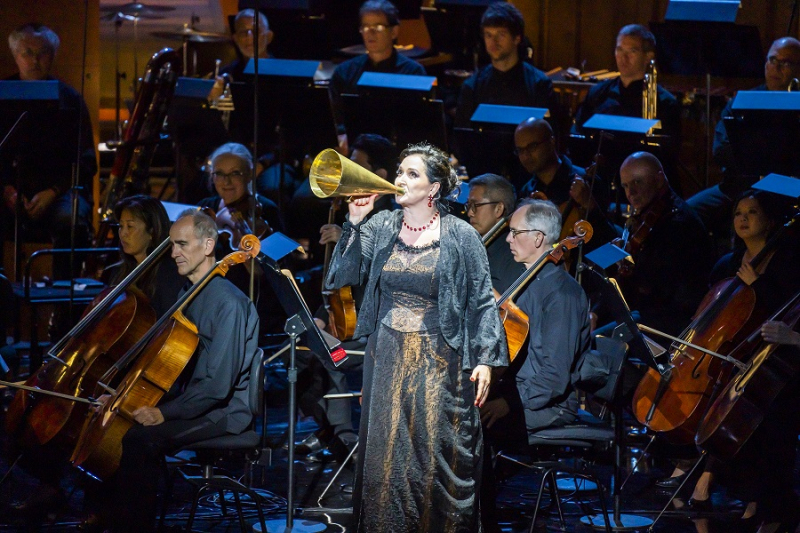
    The monodrama and the opera were linked theatrically by having Katarina Karnéus, who had just given a phenomenal performance in the Schoenberg, re-appear as the prologue to BLUEBEARD’S CASTLE. Here, Ms. Karnéus (using a megaphone) proved to be every bit as engaging as a speaker as she has been in her singing of The Woman. And while, in the end, the evening could have just as thrillingly been presented in straight-up concert form, that would have deprived us of Ms. Karnéus’s inspired acting of her role.

    The concert opened with a performance of the song Erwartung, from Schoenberg’s Vier Lieder, his opus #2, composed in 1899. This gorgeous piece of music, which I had never heard before, was originally written for voice and piano but was tonight performed in a setting for voice and harp. The Philharmonic’s harpist Nancy Allen played divinely, creating a poetic atmosphere. In a black gown shot with silver and holding a large bouquet, soprano Nina Stemme’s voice seemed beset by a wide tonal beat or fluctuation which rather undermined the strange beauty of the song. Ms. Stemme fared much better in BLUEBEARD, where she was fully warmed-up and with the voice profiting from the cushioning orchestra.

    Katarina Karnéus was the Cardiff Singer of the Year in 1995 and from there went on to a grand worldwide career. She came to The Met in 1999, debuting as Varvara in KATA KABANOVA and also appearing as Siebel, Olga in EUGEN ONEGIN, as Rossini’s Rosina, and as Cherubino. I had the pleasure of meeting her while I was working at Tower Records, and of attending a lovely recital she gave in 2001 with pianist Brian Zeger. She last sang at The Met in 2005; in the interim she has developed into a fascinating singing-actress.

    _DSC0141

    Above: Katarina Karnéus as The Woman in ERWARTUNG; photo by Chris Lee

    What a performance of ERWARTUNG Ms. Karnéus gave tonight! The voice encompasses an impressive vocal span, with a silvery sheen on the high notes and a dusky, dramatic throb in the lower range. Her wide-ranging singing is pointed and subtle in terms of word colourings, has a lovely vein of lyricism running thru it, and is possessed of striking power in the climactic moments. It’s an expressive, even bewitching, instrument. Beyond this, Ms. Karnéus is a compelling physical presence, and she captured the emotional state of The Woman with her vibrant and detailed physicality; at one point her entire body was overcome with trembling agitation. Mixed in with the madness were passages that were extraordinarily moving, as in the moment she tells her absent lover that he has “…not even the grace to let me die with you.”

    In recent years, only a handful of operatic performances have captivated me in the way Katarina Karnéus did tonight in ERWARTUNG. She is truly one of a kind.

    Here’s a sampling of the Karnéus voice:

    Katarina Karneus – Mahler ~ Ich bin der Welt abhanden gekommen
    _DSC0348

    Above: Katarina Karnéus in the spoken prologue to BLUEBEARD’S CASTLE at The New York Philharmonic; photo by Chris Lee

    After the interval, BLUEBEARD’S CASTLE commenced with a re-appearance of Ms. Karnéus in a speaking role; I must admit that I found myself wishing she was also singing Judith, for while there is no denying the power and commitment of Nina Stemme’s performance in that role, hers is a voice that has never reached me on a deeper level. That said, the soprano was in full-tilt form for the Bartók tonight and was much admired by the audience.

    In the role of Bluebeard himself, it gave me great pleasure to see onstage again the excellent baritone Johannes Martin Kränzle who, in 2014, was an ideal Beckmesser in his (to date) only Met appearances. We simply must have this man back at The Met, for he is a singing-actor (and an acting-singer) of the highest calibre. 
    _DSC0651

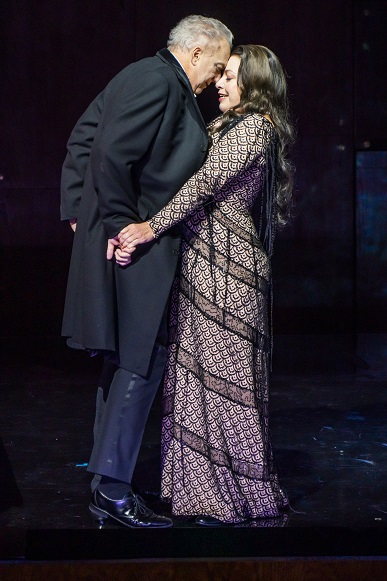
    Above: Johannes Martin Kränzle and Nina Stemme in BLUEBEARD’S CASTLE; photo by Chris Lee

    Ms. Stemme and Mr. Kränzle made the Bartók glow in all its dark radiance with their powerful vocalism and intense acting. They played beautifully off one another, seeming to feed off each others energy as well as off the astonishing sounds being produced by the artists of the Philharmonic.

    It was a performance to immerse oneself in totally, and by the time the harp and horns marvelously underscored Mr. Kränzle’s spectacular vocalism at the opening of the fourth door, I was thoroughly enthralled. Ms. Stemme’s blockbuster high-C at the opening of the fifth door was followed by simply mind-bogglingly impressivel singing from the baritone. Ever a compelling mover, Mr. Kränzle even executed a little dance, and then led his soprano is a waltz.

    Responding to Judith’s questions about the mysterious white lake, Mr. Kränzle was hauntingly moving as he replied: “…tears, Judith…tears!” And then – incredibly – he took his performance to an even higher level with his gorgeous singing of the passage where Bluebeard describes how he met his previous wives and what they mean to him: morning, noon, and evening have been personified for him by these women, and with Judith joining them, his world is complete. “Now it will be night forever!”

    _DSC1438

    Above: from BLUEBEARD’S CASTLE, photo by Chris Lee

    Throughout the evening, the playing of The New York Philharmonic was darkly dazzling, glorious, sublime. Maestro van Zweden reigned over the music with a sure sense of its enormous emotional range, from eerie piani to unfettered, magnificent fortes. The musicians played their hearts out, creating sonic textures that sent chills thru me time and again, and the numerous solo passages were given extraordinary clarity by these remarkable artists.  

    ~ Oberon

  • Leonie Rysanek as Lady Macbeth

    Scanned Section 13-1

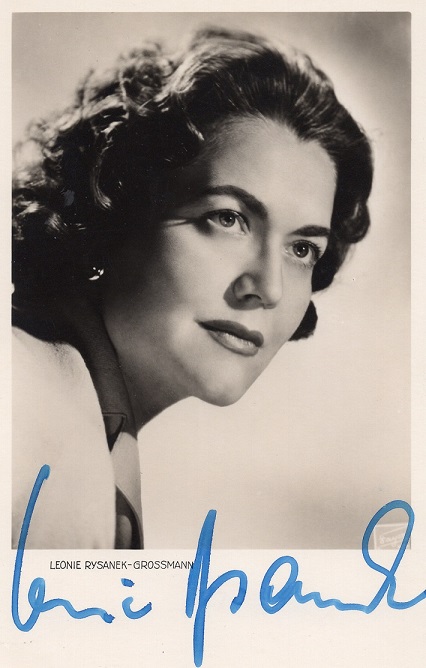
    A year before her Met debut in the same role, Leonie Rysanek made her New York debut as Verdi’s Lady Macbeth in a concert performance with The Little Orchestra Society. Overall, she gave an exciting (if somewhat uneven) performance; she galvanized the audience with her thrilling singing of “La luce langue“.

    Leonie Rysanek – La luce langue ~ MACBETH – Little Orchestra Society 1958

    After hearing Leonie Rysanek’s voice for the first time on a Texaco/Metropolitan Opera broadcast of BALLO IN MASCHERA, I wrote to her and received the photo (at the top of this article) a few days later. She became one of the most potent forces in my enduring obsession with opera. I saw her many times at The Met, including her unforgettable 25th anniversary gala. She was my first Senta, Ariadne, Kaiserin, and Salome; her Met 25th anniversary gala in 1984 was one of the greatest thrills of my opera-going career.

    ~ Oberon