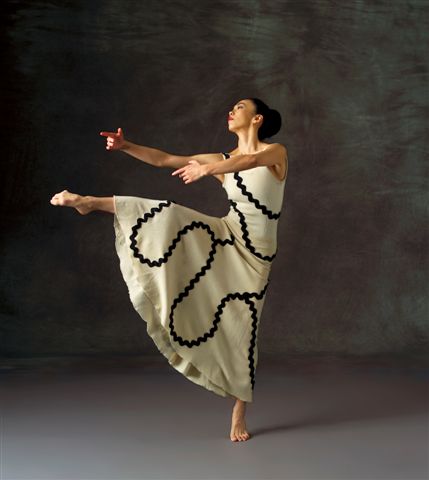
Tag: Miki Orihara

  • ONOKORO ~ creations/beginnings

    Miki 2

    Author: Oberon

    Sunday September 24th, 2023 – This evening at Westbeth, dancers Miki Orihara and Ghislaine van den Heuvel joined a fantastic ensemble of musicians in a program entitled ONOKORO – creations/beginnings. The production, Tokyo to New York, is under the artistic direction of Thomas Piercy; the performance took place at the Martha Graham Studios.

    Onokoro comes from the ancient Kojiki, Japan’s oldest mythology; it was the name of the first island formed by the gods Izanagi and Izanami when they were creating Japan. The evening’s program took us on a musical and spiritual journey from “Ryoanji” (the first sounds) to “Netori, Netori” (the emergence of organized sound and music), and onward thru to “Onokoro” (which combines the Eastern and Western styles of music and movement).

    The Graham space at Westbeth was the perfect setting for this production. As the house lights went out and silence fell over the space, the studio’s large windows created a feeling of l’heure bleue, that fleeting time when day yields to night. In the darkness, the musicians took their places to perform John Cage’s 1985 work “Ryoanji”. The only source of light in the room was the tablets from which the musicians read their scores. The piece opens with a kneeling percussionist, Marina Iwao, striking a bell; this summons is repeated insistently throughout the piece. Thomas Piercy plays the hichikiri, a small double-reed Japanese instrument which seems like a cross between flute and oboe. Mr. Piercy is joined by two other hichikiri players: Lish Lindsey and James Joseph Jordan. The sound of their instruments veers from sighs and whispers to squawking and whining. The audience seemed intrigued by the music.

    Mr Piercy now took up his clarinet for Bin Li‘s clarinet concerto “Netori, Netori”. A seated Gagaku ensemble – Ms. Lindsey and Mr. Jordan joined by Harrison Hsu (sho) and Masayo Ishigure (koto) – create fascinating, otherworldly musical colours which are plucked or piped. As Mr. Piercy begin to play, dancer Maki Yamamae appears, dressed as a young warrior and carrying a ceremonial spear. The space is illuminated in golden light as the the slow ritual dance evolves in a series of poses. Mr. Piercy illuminates the music with soft trills and warblings, and the sound of escaping air; his dynamic control is uncanny. There are silent pauses in the music, and eventually the ensemble rejoins. Following the dancer’s exit, there is a quirky coda for the clarinet.

    Two works having their world premieres at these concerts came next. The first, Gilbert Galindo‘s “Primordial” for clarinet, cello, and piano, opened with a somber cello passage, introducing us to an extraordinary cellist: Daniel Hass. Mr. Piercy again took up his clarinet for this work, and Ms. Iwao was at the keyboard. Galindo’s pensive music is hauntingly beautiful, bringing us a magical mixing of timbres. Mr. Hass produced shivering tremolos while Ms. Iwao found poetic depths in the piano’s lower octaves, and Mr. Piercy’s lambent tone and dynamic variety made for an engrossing experience.

    After the briefest of pauses, the players proceeded to the second premiere, Miho Sasaki’s “黎明 – reimei – Dawn”. Here Mr. Piercy traded his clarinet for the ohichiriki. This music is intense, with threads of melody woven in amidst jarring harmonies. From this emerges high, delicate figurations from Ms. Iwao’s keyboard, while Mssrs. Piercy and Hass create a very distinctive tonal blend. The music, veering from disturbing to reassuring along the way, was very impressively served by these three musicians. And both the Galindo and the Sasaki works seemed to me ideal candidates for choreography.
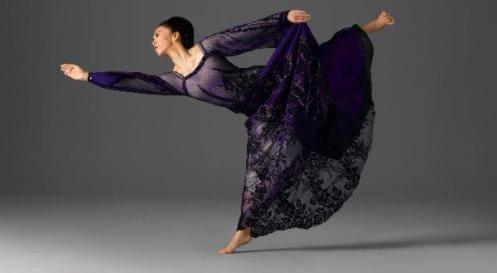
    For the program’s concluding work, Masatora Goya‘s “Onokoro” Concerto for hichiriki and strings, Mr. Piercy was joined by a string ensemble: violinists Sabina Torosjan and Lara Lewison, violist Laura Thompson, bassist Pablo Aslan, with Mr. Hass’s cello  and Ms. Iwao at the piano.
    Isolated notes from Mr. Aslan’s double bass set the mood as the space becomes fully lit. Mr. Piercy’s hichiriki seems to sigh before taking up a mournful (and vaguely jazzy!) passage. To quirky rhythms, the strings vibrate and the hichiriki wails. Mr. Hass’s cello introduces the dancers: Miki Orihara and Ghislaine van den Heuvel. Gorgeous string harmonies emerge as the dancers remain still. Playing over plucked string motifs, Mr. Piercy’s hichiriki urges the women forward; Miki Orihara is wearing a cape with an extraordinarily long train (costume design by Karen Young). For a fleeting moment, Mr. Piercy veers into a bluesy phase.
    Seated on the floor, the dancers commune with flowing port de bras. The train is briefly passed to Ms. van den Heuvel but then returned to Ms. Orihara. The music takes on a chorale-like feeling; the dancers rise, as if transfixed. Mr. Hass’s cello sounds gorgeously while the women kneel and arrange the cape between them, placing on it a beautiful mask, ‘Tuskiyom‘ (on loan from the Theatre of Yugen, in San Francisco). Their ritual complete, the dancers part and slowly back away. Mr. Piercy then embarks on a grand cadenza before the music fades with tremolo strings.
    The evening ended with warm applause from the audience, who had experienced the performance in a spellbound state, as if in church. While I wished on one hand that a large crowd could see this work, it was exactly the intimacy of the presentation that made it so meaningful.
    My thanks to Miki Orihara for alerting me to this engrossing production; it reminded me at times of Miki’s fascinating  2014 solo presentation, Resonance, which created the same kind of hallowed atmosphere. And how wonderful to see Ms. van den Heuvel again, after watching her magnetic dancing in a Graham 2 performance in 2022.
    To Mr. Piercy and everyone involved in ONOKORO, my deepest thanks for a truly inspired – and inspiring – evening.
    ~ Oberon

  • Martha Graham’s ‘Hérodiade’

    Miki herodiade

    Above: Miki Orihara in Graham’s Hérodiade

    Wednesday November 20, 2013 – Two of today’s foremost interpreters of the works of Martha Graham – Miki Orihara and Katherine Crockett – appeared tonight in a studio showing of the great choreographer’s 1944 work Hérodiade. As a splendid prelude, Ms. Crockett also danced Spectre-1914. It was an evening that resonated for me in so many different ways.

    Martha Graham Dance Company‘s artistic director Janet Eilber welcomed an overflow crowd to this second of three presentations of this programme. The Company’s spacious studio/theater on the eleventh floor of the Westbeth complex had been hung with black drapes, and after Ms. Eilber’s brief remarks, the majestic Katherine Crockett appeared to dance Spectre-1914, the opening solo from Martha Graham’s Chronicle.

    6a00d8341c4e3853ef0168eb764f31970c-800wi

    Above: Katherine Crockett, photographed by Matt Murphy

    Chronicle, dating from 1936, is Graham’s powerful statement on the devastation and futility of war; it is a great masterwork for female ensemble and it opens with a magnificent solo in which the dancer manipulates a voluminous skirt lined in red fabric to evoke both the bloodshed and the flames of war.

    Spectre-1914 had all but passed from memory until 1994 when it was researched and reconstructed by Terese Capucilli and Carol Fried, using film clips and still photos by Barbara Morgan. May Terpsichore bless these women for their efforts, for Spectre-1914 is as powerful a dancework as may be found, and it was danced tonight with marvelous amplitude and a deep sense of consecration by the marvelous Katherine Crockett. The audience beheld the dance in an awed state of pin-drop silence.

    Noguchi herodiade set

    Above: the Isamu Noguchi set pieces for Martha Graham’s Hérodiade

    After the Noguchi setting had been swiftly installed in the space, we watched a full performance of Graham’s ballet Hérodiade. Set to music by Paul Hindemith and commissioned by Elizabeth Sprague Coolidge for the Library of Congress, the ballet was originally called Mirror Before Me, and was first seen on October 30, 1944, at the Elizabeth Sprague Coolidge Auditorium, Library of Congress, Washington, D.C. Writing of that performance for the New York Times (November 1, 1944), critic John Martin said: “Miss Graham has created a powerful study of a woman awaiting a ‘mysterious destiny’ of which she has no knowledge…into it she has poured a somber tension that is relentless and altogether gripping. The music is rich and dark in color and the action on the stage meets it magnificently on its own terms.”

    That music, scored for chamber orchestra, was written by Paul Hindemith, a composer perhaps best-loved in the dance world for his superb Four Temperaments, choreographed by Balanchine.

    When I received the announcement that Hérodiade would be performed this evening, I suppose my natural reaction as an opera-lover was that it would be a dance about the Biblical princess Herodias and her daughter Salome and their conspiracy to have the prophet John the Baptist executed. But that is not the case: there are no allusions to either the Strauss or Massenet operas, nor to the Bible, nor to Oscar Wilde who penned the famous play Salome – Salome does not figure in the Graham work at all.

    Martha Graham had been interested in the poem Hérodiade by Stephane Mallarmé and in creating her ballet, the choreographer eschewed a specific narrative and instead turned to an abstraction of the character. Herodias is never named; she is simply referred to as ‘A Woman’. In Graham’s description, we see “a glimpse into the mirror of one’s being,” and she refers to this Woman as ‘doom-eager’, going forth with resolve to embrace her destiny.

    The Hindemith score is in eleven short movements, and we watch with intense interest as the radiant Miki Orihara, as the Woman in a deep violet gown, and the more austere Ms. Cockett, her Attendant in simple grey, move about the space. The choreography is restless and urgent, the Woman clearly obsessed with whatever fate awaits her while the Attendant seeks to comfort or forestall her mistress. The two dancers were simply engrossing to behold: Miki often in rapid, complex combinations moving swiftly about the stage while Katherine deployed her uncanny extension with mind-boggling expressiveness.

    In the end, Miki steps out of her rich gown and is revealed in virginal white; the Attendant withdraws and the Woman, taking up a black veil, contemplates her destiny. Mysterious, and all the more powerful for the unanswered questions it raises, Hérodiade is breath-taking.

  • Martha Graham: Myth & Transformation I

     ErrandMikiSideLegFnl

    Above: Miki Orihara in the original costume for Graham’s ERRAND INTO THE MAZE; photo by John Deane.

    Saturday evening February 22, 2013 – The Martha Graham Dance Company are at The Joyce thru March 3rd with three programmes centering on themes of myth and transformation, as well as a special gala. Details of the performances and ticket information here.

    Tonight’s bill consisted of three Graham masterworks, each with an iconic principal female role – and each of those roles performed by one of the Graham goddesses of the 21st century: Blakeley White-McGuire as Medea in CAVE OF THE HEART, Miki Orihara as Ariadne in ERRAND, and Katherine Crockett as Jocasta in NIGHT JOURNEY. The musical scores are by three of the 20th century’s leading composers: Samuel Barber, Gian Carlo Menotti, and William Schuman.

    In Martha Graham’s CAVE OF THE HEART, the choreographer distills the story of Medea, her betrayal by Jason, and her subsequent destruction of Jason’s young bride into a powerfully compact dancework. As Medea, Blakeley White-McGuire, a brilliant red-haired sorceress, gave a compelling performance – whether moving about the space with restless passion or laying in utter stillness waiting to play out her revenge, Blakeley is a riveting presence. Her marvelously spastic solo as the piece moves towards its inevitable denouement was something to behold. Tadej Brdnik’s boyish handsomeness underscored Jason’s ambitious heartlessness, and his striking musculature propelled him boldly thru the athletics of the choreography and the demands of the partnering. Xiaochuan Xie was a vision of loveliness as the Princess, her dancing spacious and light-filled, blissfully unaware of her impending doom. Powerful presence and physical suppleness marked the performance of Natasha Diamond-Walker as the Chorus, majestic in her black and red striped gown.

    The collaboration between Martha Graham and sculptor/designer Isamu Noguchi created the look we associate with these Graham ballets. In both CAVE OF THE HEART and NIGHT JOURNEY, Noguchi’s set pieces evoke a feeling of familiarity – of being in a space we have been in before. But the damage to the Company’s sets and costumes caused by Storm Sandy left the decor for ERRAND INTO THE MAZE beyond repair. The sets will be re-created in time, but for the current season an alternative solution for presenting this important Graham work was needed. Choreographer Luca Veggetti, working with Miki Orihara, devised a stripped-down version of the piece, now referred to as ERRAND. Martha Graham’s original choreography remains intact, but the work is presented on a bare stage, reaching to the exposed brick wall at the rear of the space. Miki, as the heroine, wears a long plain white skirt with a ‘nude’ leotard white Ben Schultz as the Minotaur wears only his tattoos and white briefs. The effect is absolutely stunning.

    Graham’s choreography feels utterfly fresh, and Miki’s vulnerable qualities have never seemed so touching as here, menaced by the ominous man-bull of Ben’s splendid physique. The illusions of near-nudity gave the piece a timeless, mythic quality. Miki was ravishing, the poetic expressiveness of her body illuminating the smallest nuances of gesture and movement. Ben stalked about the set like a gladiator awaiting his chances in the arena; even standing still, he posed a threat. At the end, having conquered the monstrous symbol of her fear, Miki’s stance of quiet victory and her feeling of wonderment were poignantly expressed.

    During the intermission I caught bits of several conversations among the crowd; people seemed to be saying that this new look at ERRAND had lifted the piece out of a somewhat dated context they’d experienced in CAVE OF THE HEART. Much as I admire Noguchi’s work – and if you haven’t been to the Noguchi museum in Queens you owe it to yourself – and the Graham-designed costumes, I have to say that Mr. Veggetti’s take on ERRAND is a revelation. I’ve often wondered how Balanchine’s ORPHEUS, for which Noguchi designed both sets and costumes, would look as an unadorned black-and-white ballet. In presenting this ERRAND, the Graham Company took a chance – and in my view it paid off handsomely.

    In its full Noguchi-Graham decor, NIGHT JOURNEY is theatrically satisfying, yet I did find myself thinking it would hold up very well in a bare-stage-and-leotard configuration. The choreography, especially for the female ensemble (led by the beauteous and triumphant Mariya Dashkina Maddux) is striking in any event. And it did cross my mind how forceful the athletic movements of the blind seer Tiresias – a marvelous role for Abdiel Cedric Jacobsen – would seem if he was to be divested of his bulky garments. But, we’re getting ahead of ourselves here: NIGHT JOURNEY is perfect as it stands, and Katherine Crockett is beyond perfect in the role of the devastated Jocasta who strangles herself on discovering she has been married to her own son, the man who killed her first husband. (“The killer of the King is a King.”) Ms. Crockett, a luminous gift to the world of dance, is thrilling to behold – as much for her beauty and intensity as for her exalting extension and the evocative flow of her arms and hands. Ben Schultz polished off his demanding, two-ballet evening with a majestically tragic portrayal of the ill-fated Oedipus, the dancer’s godlike physique taking on an assailable aspect as his world collapsed.

    And how does the Graham repertory strike a young person today who has never experienced any of it, except for tidbits on YouTube? My twenty-something dancer-friend Alejandro was quite taken with the evening, with a special affinity for ERRAND. I’ll be seeing the other two programmes of the current season, each with a “Graham virgin” as my companion. It will be interesting to see what they think.