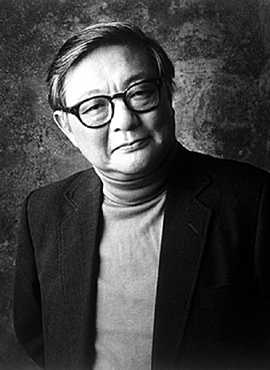
Tag: Ming Cho Lee

  • Ming Cho Lee Has Passed Away

    Ming cho lee

    I was very sorry to read this morning of the passing of the great scenic designer Ming Cho Lee. A native of Shanghai, he died on October 23rd, 2020, at the age of 90.

    He designed award-winning sets for dozens of operas and plays, including eight productions for the Metropolitan Opera. Among his Met credits were his classic BORIS GODUNOV (1974); the Sutherland/Pavarotti PURITANI (1976), a controversial but often striking LOHENGRIN (1976), and the 1985 KHOVANSCHINA with it’s stunning final tableau.

    Ming Cho Lee also designed thirty productions for Joseph Papp at The Public Theatre. A wonderful article about his life and work, with images of his designs, may be found here.

    During the years that I worked in the opera room at Tower Records, Ming Cho Lee was a frequent (and favorite) customer. Upon coming into the room, he would bow to me – and I to him – and then he would spend an hour or more browsing the shelves. We hardly ever spoke, but he would sometimes hold up a disc and I would shake my head, “yes” or “no”. He would stack up his selections on the counter, one by one, and when the piles got teeteringly high, he would do a sort-thru. I would then help him carry his purchases to the cashier. I always stood by until he left, so that we could bow to one another – “…until next time!” he would say quietly. I will always remember his twinkling eyes and wry smile.

    One winter day, a couple of years after Tower closed, I took the train to New Haven to meet friends for lunch. Coming out of Union Station, I saw Ming Cho Lee, all bundled up, hailing a cab (he had taught at Yale for several years). I greeted him, and after a moment he remembered me. Surprisingly, as we had always been bowing acquaintances, he extended his hand and shook mine cordially.

    Ming Cho Lee was such a calm, dignified gentleman; it was an honor and pleasure for me to have known him in this rather formal capacity.

  • Meeting Gian Carlo Menotti

    Photo menotti

    Above: Gian Carlo Menotti

    A day at work in the opera room at Tower Records could veer, in the twinkling of an eye, from the accustomed drudgery of a job in retail to memorable encounters with artists from the world of classical music and dance.

    Over the nine years that I worked in that now-forgotten space, it sometimes felt like the center of the world. Singers – from Juilliard hopefuls to retired divas – came in on a daily basis. Conductors (Ehrling, Levine, and Conlon, among others) and designers (Ming Cho Lee was a lovely regular), and even famous fans (Mayor Giuliani – hate him if you want, but he was a true opera-lover…), all made their way to 66th and Broadway.

    One day in November of 2001, a very elegantly dressed older gentlemen stepped into my small domain. It took me only a moment to recognize Gian Carlo Menotti. Mr. Menotti was in New York City for events surrounding the 50th anniversary of his “TV opera”, AMAHL AND THE NIGHT VISITORS; but he did not mention that at all in the course of our chat. He was wearing a light grey suit, immaculately tailored, and his noble posture was that of a much younger man (he was 90, I believe, at the time). His Old World manners and the delightful cordiality of his speaking voice put me at ease.

    Peters last savage

    Above: Roberta Peters as Kitty in Mr. Menotti’s opera THE LAST SAVAGE

    We talked, surprisingly enough, about his comic opera THE LAST SAVAGE, which had had its US premiere at the Old Met in 1964. I mentioned that I would love to see the opera performed again, and he smiled and said: “You remember the music, then? Which parts did you most enjoy?” (I think he doubted that I could actually recall anything specific from the piece.)

    Since the voices of George London, Roberta Peters, Nicolai Gedda, and Teresa Stratas are indelibly linked in my mind to their arias from THE LAST SAVAGE, I began to ‘sing’ little snatches for him. By the time I got to Kitty’s line, “Let me explain to you the how and the why: no anthropologist is braver than I!”, he was smiling. “Oh…wonderful! You must tell the people at The Met to revive it!”

    Mr. Menotti found the recording he’d been looking for; we shook hands and bowed to one another as he departed.

    25-Gian-Carlo-Menotti-and-Barber-in-the-summer-of-1936

    Gian Carlo Menotti was the lover and domestic partner of Samuel Barber, a relationship that was sustained for forty years. Above, a photo from 1936 shows what a handsome couple they were.

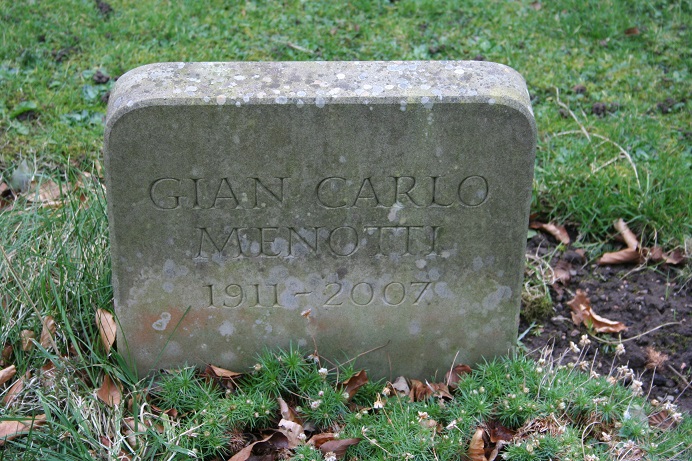
    In 2007, I read of Mr. Menotti’s death at Monte Carlo. Although there was a place reserved for him next to Samuel Barber’s grave at West Chester, Pennsylvania, Menotti was buried in Gifford, East Lothian, Scotland, beneath the simplest of stone markers:

    Menotti grave - Copy

    If AMAHL is probably Menotti’s most widely-known opera, and if THE LAST SAVAGE still sings in my mind, it’s with Magda’s aria “To this we’ve come...” from THE CONSUL that the composer made his most enduring statement. Desperate to get a visa so that her husband can escape persecution by the secret police, Madga Sorel fights a losing battle against bureaucratic indifference to her plight.

    Watch Patricia Neway’s incredible performance of this scene here.

    Magda’s aria opens with these chillingly timely lines:

    “To this we’ve come:
    that men withhold the world from men.
    No ship nor shore for him who drowns at sea.
    No home nor grave for him who dies on land.
    To this we’ve come:
    that man be born a stranger upon God’s earth,
    that he be chosen without a chance for choice,
    that he be hunted without the hope of refuge.
    To this we’ve come.

    And you, you too shall weep!”

    ~ Oberon