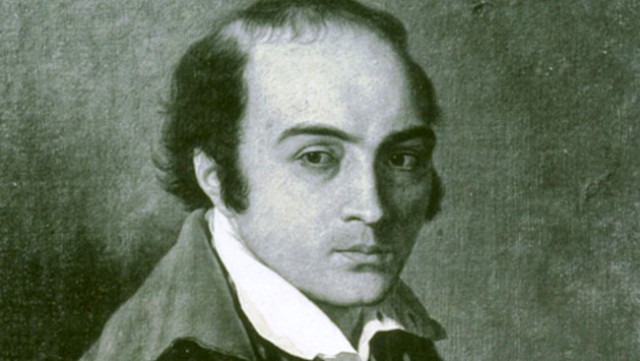
Above: the poet André Chénier
Monday March 24th, 2014 – Seeing the vast numbers of empty seats at The Met’s season premiere of ANDREA CHENIER tonight was disheartening. In my view, The Met has been in saturation mode since Gelb took over; there is just too much Met opera available in movie theaters and via Sirius, costing little or nothing to experience.
Add to this the incredible operatic treasures to be found on YouTube these days – hundreds of complete operas from all over the globe and thousands of samples of great singers from all eras since the dawn of recording – to say nothing of CDs and DVDs, and it’s no wonder people are content to avoid paying Met prices and making an effort to get to the opera house.
But of course getting your opera via a cinema or the Internet or other reproduction removes the key element of what makes live opera so thrilling: the sound of unamplified voices being projected into the vast, darkened space of the opera house. Once you compromise that, opera’s magic is diluted. Yes, it’s lovely for people who live in East Nowhere to be able to go to an HD performance, but it’s nothing like being in the opera house.
And the once-sacred twenty Saturday matinee radio broadcasts per season have been expanded to three or four times that many performances available thru Sirius all week, every season, many of them available free via live-stream. The old Texaco broadcasts – back in the heyday of Sutherland, Nilsson, Corelli and Tucker – would make people want to go to The Met; those broadcasts hooked thousands of people on opera for life. By their very rarity they were an enticement. Now, with so many broadcasts, often featuring less-than-fabulous singing, the lure to actually go to The Met is less powerful.
But, to the matter at hand: tonight’s CHENIER featured basically lyric voices – those of Patricia Racette and Marcelo Alvarez – in the main roles. Thus one would need a very considerate conductor to assure a successful performance; Gianandrea Noseda seemed to heedlessly swamp the two singers at the climaxes, forcing them to force. Mr. Alvarez emerged from this more successfully than his soprano colleague.
In fact it was because of Ms. Racette that I nearly wrote off seeing CHENIER this season. She used to be one of my favorite sopranos: her Emmeline, Ellen Orford, Mimi and Violetta were all spectacular, and I liked her first foray into heavier territory – Elisabetta in DON CARLO – very much. Then she just seemed to go off, singing everything everywhere. The voice took on a wobbly quality, the vibrato becoming over-prominent and flatness creeping in. But when I heard her in a concert performance of Dallapiccola’s IL PRIGIONIERO in June 2013, I was quite taken with her way of handling verismo-style parlando so I thought she might be good in much of Maddalena’s music. And she was, up to a point.
Racette’s first act tonight was lovely, she sounded youthful and vibrant. But then as the role progresses, spinto power is needed and when Racette turns to pressuring her voice, things go sour. Her ‘Eravate Possente!’ in Act II was finely rendered, and Mr. Alvarez replied with a honeyed ‘Ora soave’; but as the duet surged to its climax, Racette sounded strident above F and the duet’s final note was painful. Striving for vocal drama in Act III, Racette tried to beef up her chest voice. In the opening narrative of ‘La mamma morta’ she was really pushing things; as the line went higher, she sounded stressed and the climactic high-note was pretty painful. In the opera’s great concluding duet, both Racette and Alvarez were tested by the orchestra’s enthusiastic volume (where is Joseph Colaneri when we need him?). Racette’s tone was spreading as she pushed on, ending the opera on a desperate, flattish top B. Why she wanted to sing this role at this point in her career is a puzzlement; she simply put more wear and tear on an already weary voice.
No one expected ringing top notes a la Corelli or Tucker from Mr. Alvarez, but the Argentine tenor would surely have had a better time of it with a more simpatico conductor. Alvarez’s voice is clear and warm, and he introduced many poetic effects into the music, magically at ‘O giovinetta bella’ in the Improviso, at ‘Tu sarai poeta’ and ‘Io non ho amato ancor’ and throughout the ‘Ora soave’ duet in Act II. His farewell to life, ‘Come un bel di di maggio’ in the final scene, was the tenor’s finest work of the evening. Overall, it was a thoughtful, passionate traversal of the role, un-aided by his conductor.
Zeljko Lucic as Gerard had nothing to fear from the waves of sound rising from the pit: the louder the orchestra played, the louder Lucic sang. It’s such a big, bold, authentic sound and I always want to love him, but enjoyment of his singing is compromised by his tendency to go flat. Thus it was an uneven and often maddening experience to hear him in this role that basically suits him very well. After some pitch straying in ‘Nemico della patria’, Lucic rose to a marvelous climax to the aria, and his narrative which follows where he tells Maddalena of his secret passion for her was superb. He won the evening’s loudest cheers at curtain call. If only…
Of the many smaller roles in this opera, Margaret Lattimore stood out for her strong and melodious vocalism as the Countess de Coigny: expressive singing and a juicy chest voice. Tony Stevenson really sang L’Incredibile, and John Moore (Fleville), Dennis Petersen (Abbe), Jennifer Johnson Cano (Bersi), Robert Pomakov (Mathieu) and Dwayne Croft (Roucher) all fared well. Veterans James Courtney and Jeffrey Wells presided at the Tribunal wth chilling effect. In her Met debut, Olesya Petrova opened her Act III scene – so touching – with a sustained and beautifully tapered final note of the line ‘Son la vecchia Madelon’ and later she took a very fine soft top-G, as marked dolce in the score, at ‘Puo combattere e morire’. She deserved a round of applause – and bravas – but didn’t get it.
CHENIER is a short opera, dragged long by two extended intermissions that drained the life out of it. In an odd moment, the applause after Act III had totally stopped and people were heading out when the bow lights came on and the singers trooped out for obligatory bows. It was just a little embarrassing.
Metropolitan Opera House
March 24, 2014
ANDREA CHÉNIER
Umberto Giordano
Andrea Chénier..........Marcelo Álvarez
Maddalena...............Patricia Racette
Carlo Gérard............Zeljko Lucic
Bersi...................Jennifer Johnson Cano
Countess di Coigny......Margaret Lattimore
Abbé....................Dennis Petersen
Fléville................John Moore
L'Incredibile...........Tony Stevenson
Roucher.................Dwayne Croft
Mathieu.................Robert Pomakov
Madelon.................Olesya Petrova [Debut]
Dumas...................James Courtney
Fouquier Tinville.......Jeffrey Wells
Schmidt.................David Crawford
Major-domo..............Kyle Pfortmiller
Conductor...............Gianandrea Noseda

Above: a plaque at the Cimetière de Picpus honors the poet André Chénier








 Oberon's Glade