
Friday September 16th, 2016 – A sold-out house this evening as Miro Magloire’s New Chamber Ballet presented their season-opening program. At a time when I am covering far less dance than in the past, Miro’s work – his choreography, his musical choices, and the dancers and musicians who bring the ballets to life – continues to draw me to his performances and rehearsals. Tonight’s program was one of the finest I have experienced at New Chamber Ballet: wonderfully diverse in the music presented, expertly danced by a quintet of distinctive ballerinas, and played by a violinist and pianist who seem to thrive on the stylistic range and technical challenges of the music Miro selects.
Variety is the spice of life, and it is also – from a musical point of view – an essential element in putting together an evening of dance. Miro will sometimes provoke New Chamber Ballet‘s faithful followers with the thorniness of a score he has decided on; inevitably, his rightness of judgment wins out. These contemporary pieces are counter-balanced by more ‘accessible’ music – tonight, Tartini and Ravel – thus turning the evening into a audio roller coaster. We are along for the ride, which can be quite exhilarating, and the NCB musicians make it all so rewarding.
Opening the evening was a trio, Silk, which premiered in 2006. Doori Na’s playing of the Sonata VII for solo violin by Giuseppe Tartini was stunningly virtuosic. The violinist had a long evening ahead of him, playing in all four works; in the Tartini, he poised himself at a very high level of technique and artistry, and then incredibly soared upward from there. The Ravel that ended the evening was – to use a 60s phrase – mind-blowing.
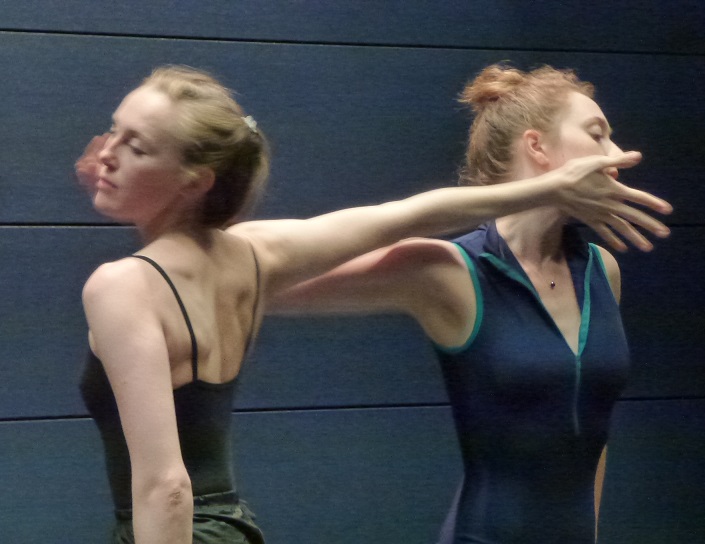
In Silk, the three dancers – Elizabeth Brown,Traci Finch, and Cassidy Hall – appear in Candice Thompson’s ice-blue, skirted leotards. They commence with slow ‘plastique’ port de bras and poses that might have been inspired by a Grecian urn. A sense of calm pervades their unison trio. There’s a silence as things are re-set for a charming, light-filled allegro.
Striking poses in unison, the girls commence an andante which features a simply gorgeous Tartini melody, superbly intoned by Doori. Cassidy Hall has a long solo, danced beautifully, while Traci and Elizabeth stand back-to-back, swaying gently, and curling their hands in a subtly expressive motif.
Elizabeth and Cassidy sit in a stylized pose as Traci dances an impressive solo with lots of intricate pointe work and a sense of urgency. In a striking passage, Traci balances on both pointes as her upper body sways and angles itself off-kilter. Doori hones his tone down to a thread before it goes deep: this music is so demanding!
Elizabeth Brown, a dancer of unique qualities, has solo passages laced into a spacious trio; as the pace of the music slows and then revs up again, Elizabeth executes lyrical turns and unusual, quirky footwork. The three girls dance in unison, with fast moves to slow music. Silk goes on to a sprightly conclusion.

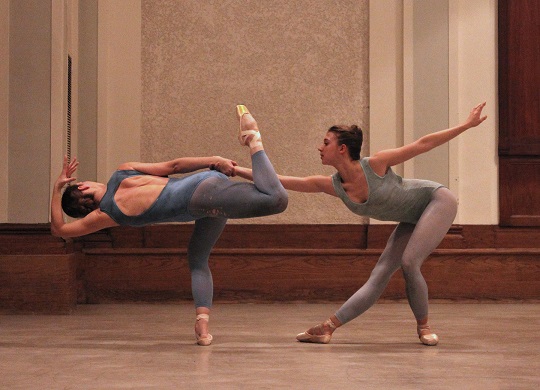
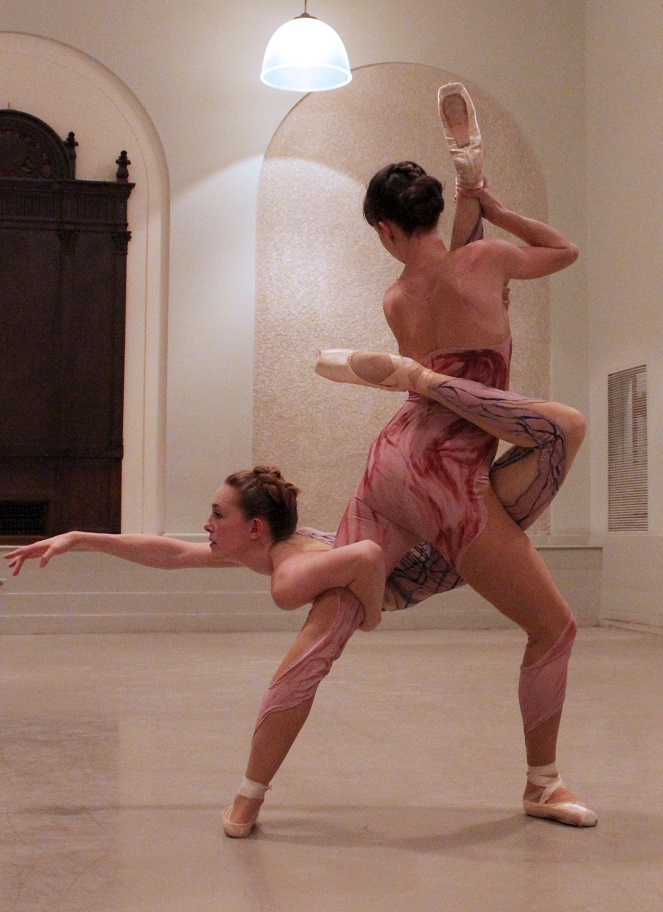
Above: Cassidy Hall and Sarah Atkins in Upon My Wings; photo by Amber Neff
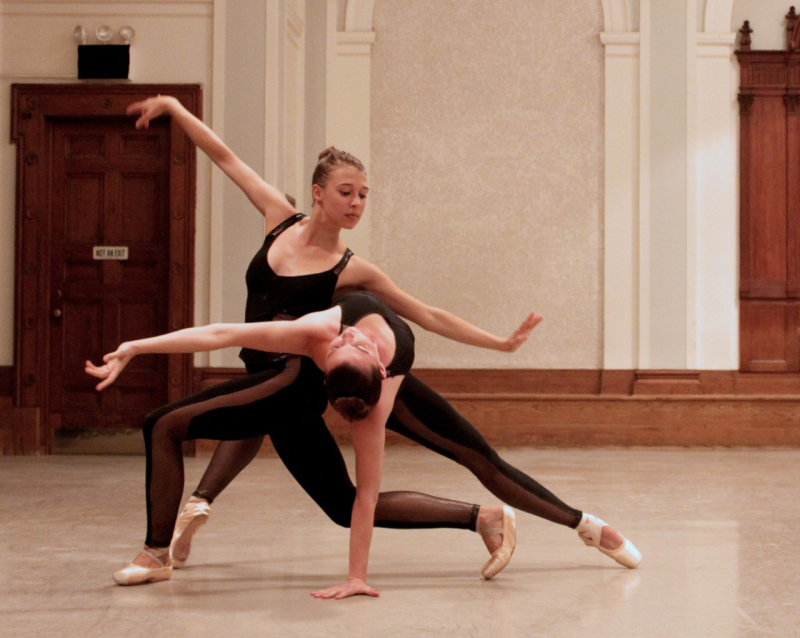
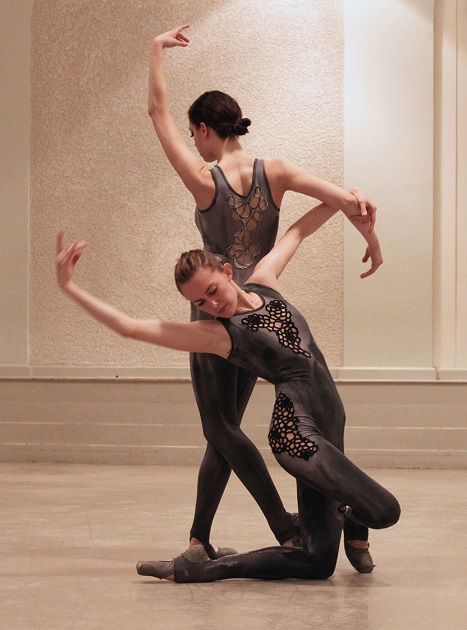
In the first of the evening’s two premieres, Upon My Wings, Doori Na again made a vivid impression in the music of Reiko Fueting: tanz.tanz was composed for solo violin as an homage to Bach’s famous Chaconne. This ballet, originally entitled Tanz Tanz, was commissioned by the Columbia Ballet Collaborative, where it premiered in 2014. For his own company, Miro has distilled the dancing to a duet for Sarah Atkins and Cassidy Hall.
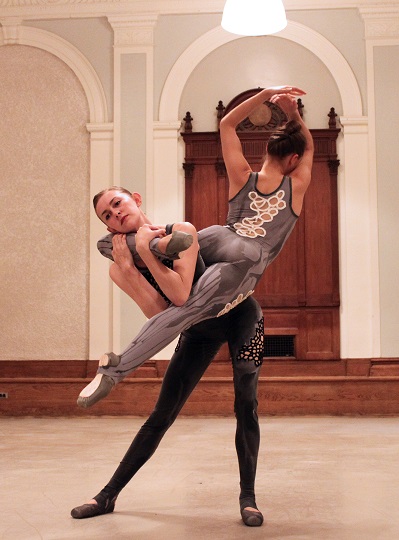
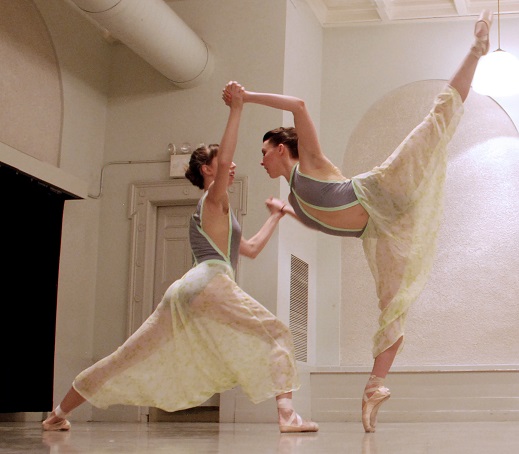
Skittering sounds from Doori’s violin find the two dancers balancing against one another’s bodies. They kneel and sway. The choreography features the intimate and physically taxing same-sex partnering that Miro has been exploring of late: for example, Sarah being rotated by Cassidy in an off-center balance.
The violin stutters and buzzes, and Doori shows his mastery with some ultra-soft playing, so subtle and shining. The girls echo one another in turns as the music goes Bachian; the ballet ends in silence.
Yellow-Rose-Red-Blue, the evening’s second premiere, marks Miro’s third collaboration with composer Michel Galante; the work is made possible by a grant from the O’Donnell-Green Music and Dance Foundation.

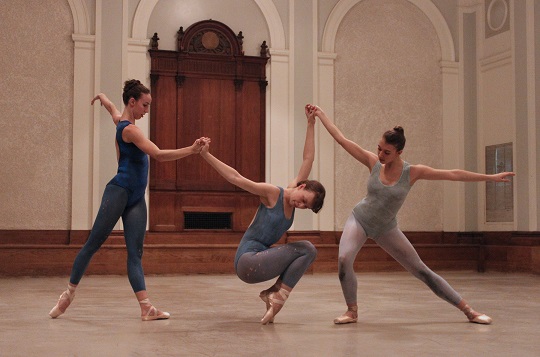
Above: Amber Neff, Cassidy Hall, and Traci Finch in Yellow-Rose-Red-Blue; photo courtesy of New Chamber Ballet
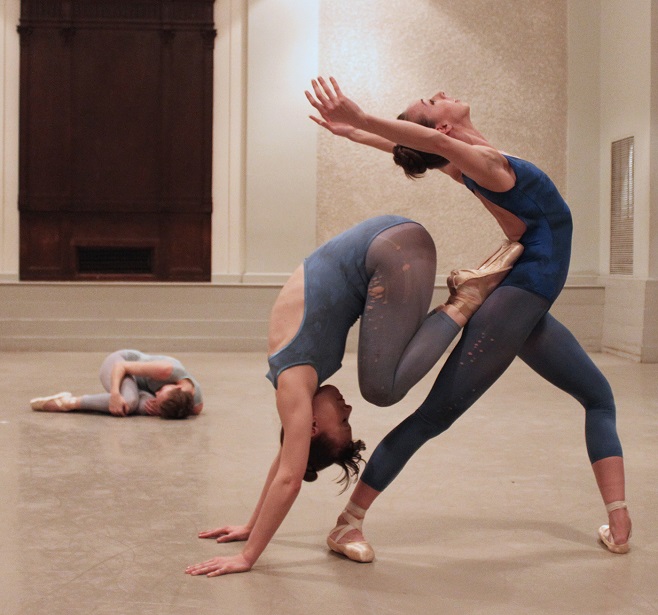
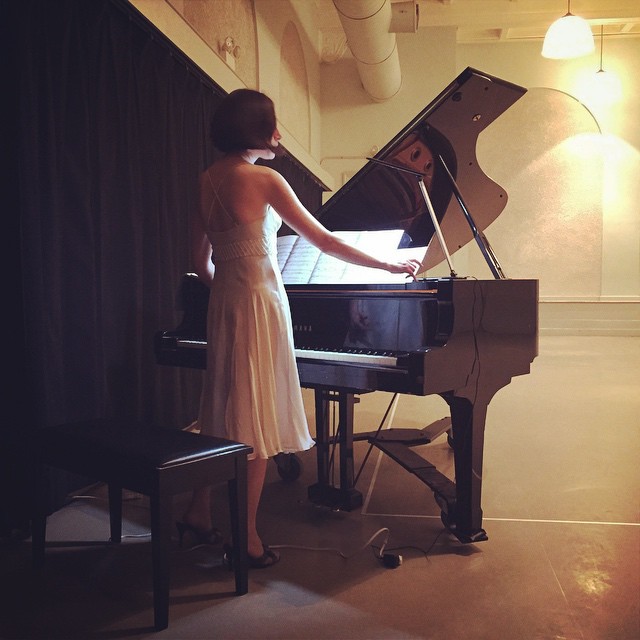
The ballet’s title derives from the colours of Sarah Thea’s stylish and usual costumes: mock-turtle-neck designs with long, gossamer slit-skirts. These elegant frocks add to the airy feeling of the space-filling choreography. Pianist Melody Fader joins Doori Na to play Galante’s very demanding score.
As Amber Neff and Cassidy Hall engage in more of Miro’s intense partnering, the music is almost immediately fiendish: deep piano and growling violin. Things turn waltzy, and the girls pair off and circle the stage in a movement motif that is half-waltz and half-galop. The music continues to engage us: somehow, Doori is able to produce a deep, gritty sound as if he was drawing his bow across sandpaper. The dancers gather in a circle, raising their arms in a reverential gesture.
Amber and Cassidy, standing back-to-back, wrap one another en attitude, and bend apart. The four dancers form a chorus line; the music grows agitated, and the girls rush off into a space-filling chase-about. Their paths cross; poses are struck while the others dance on. They re-form the celebratory circle, reaching for heaven. In an allegro rush, the dancers conjure up a galloping pace, drawing from a repeated note on Melody’s keyboard.
Yellow-Rose-Red-Blue: it’s complicated, both musically and choreographically. It will take further viewings to delve into its riches, and I feel certain we’ll be seeing it again soon. Tonight’s premiere certainly was provocative, and I look forward to this ballet’s future evolution.
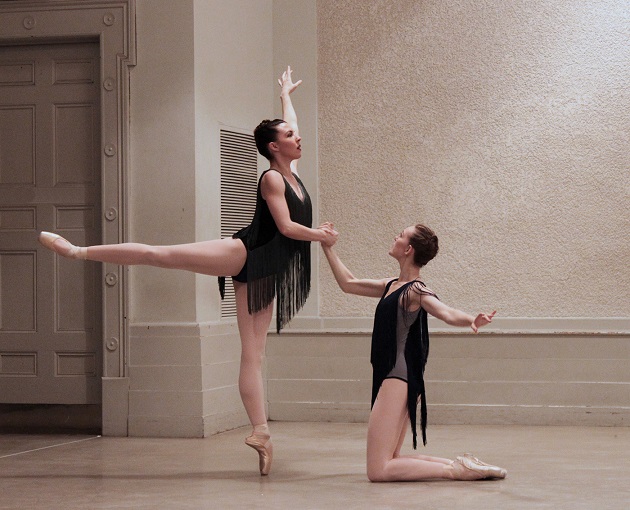
Concluding the evening was Djazz. Set to Maurice Ravel’s sonata #2 for violin and piano, the ballet was commissioned by Leslie and Richard Curtis. Here designer Sarah Thea had the three dancers – Sarah Atkins, Traci Finch, and Amber Neff – in dark-coloured leotards to which long fringes have been attached. This gave the girls a “flapper” look which meshed well with Ravel’s jazz-tinted score; when doing fast turns, the fringe flared out, giving an added air of animation.
Sarah Atkins leads off the dancing, soon joined by Traci Finch and Amber Neff; their contrasting personalities are engaging. Miro’s choreography here again calls for tricky partnering, as well as jazz-inspired swaying and sauntering. At the end of the first movement, the dancers wilt; at the end of the second, they sleep. In the finale, the dancing becomes very animated, with high-kicking extensions on display and brisk steps woven into the pulsating music.
In the Ravel, the musical achievement of Doori Na and Melody Fader was extraordinary; I can honestly say I’ve never heard this piece played better. It’s such incredible music: rhythmically captivating, veering from assertive to misterioso, and rich in irony. Doori and Melody were rightly cheered by the full house as the evening drew to its close.
Dancers: Sarah Atkins, Elizabeth Brown, Traci Finch, Cassidy Hall, and Amber Neff
Musicians: Melody Fader, piano & Doori Na, violin


























 Oberon's Glade