Tag: New Music

  • New Music for Percussion, Piano, and Strings

    S swartz

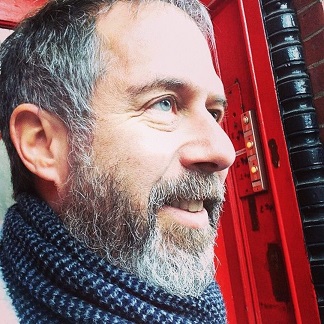
    Above: composer Steven Swartz

    ~ Author: Lili Tobias

    Thursday April 24th, 2025 –  It was unexpectedly difficult to get to the location of the New Music for Percussion, Piano, and Strings concert, performed at NYU. After waiting in the lobby for half an hour and being ushered towards the elevators with no other directions, the other audience members and I finally arrived at Room 620 shortly before the music began. Composer Steven Swartz, who had an exciting premiere on the program, described the feat as “breaching the walls of the castle.” But fortunately, all the music on last night’s program was entirely worth the struggle of getting there!

    The program began with two pieces for piano trio, each made up of a handful of very short movements. These were Miu Sato’s Threads of Belonging and Takashi Yoshimatsu’s Atom Hearts Club Suite No. 1. Despite the brevity of the music, both composers packed an incredibly diverse array of sounds into each piece, from lush, pianistic arpeggios that filled out the space around the violin and cello’s melodies to energetic syncopated rhythms in odd meters. The three performers, Angel Guanga (violin), Noelia Carrasco (cello), and Malka Bobrove (piano) are all currently undergraduate students at NYU, but their sound as an ensemble was nothing short of professional, playing with an incredible level of confidence and precision.

    I was also impressed with pianist Miles Avery’s performance of …couple égyptienne en route vers l’inconnu… by György Kurtàg. The music featured pointillistic collections of notes, connected together through the overtones left behind by the sustain pedal. Avery played every single note with such intention that each sound that emanated from the piano seemed to have an entirely different character from the last.
     

    Soundcheck - MN + JH


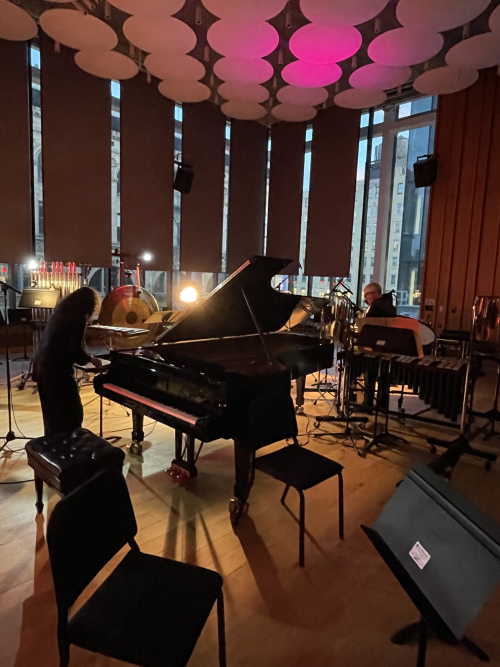
    Above: pianist Marilyn Nonken and percussionist Jonathan Haas do a soundcheck before the world premiere of Steven Swartz’s When the horizon has a mind of its own.


    I was absolutely mesmerized by the fragments of sound that emerged just to trail off again, reminding me of light refracted through glass. Swartz’s inspiration for this piece came from a light source as well—he observed the intricacies and ever-changing motion of the sunset and aimed to capture the elusiveness of those moments in this piece. I certainly felt that ephemeral nature: The music felt aimless in an entirely good way, the sort of aimlessness you might have when you’re walking through nature on a summer afternoon without being in a hurry to get anywhere in particular. I also felt an all-encompassing sense of serenity in the moments of silence between the notes, especially in the silences after the deep rumble of the bass drum or passages in the very lowest register of the piano. This piece of music is certainly one of those pieces that I want to listen to over and over again!


    The program ended with two pieces by Jacob Druckman, Reflections on the Nature of Water  (Shiqi Zhong, marimba) and Animus II (Bowen Zheng, mezzo-soprano, Natalie North, percussion, Zhaoxuan Song, percussion). Animus II was certainly the most eclectic music of the night: The colorful lighting, unintelligible singing, and bubbly electronic noises turned the room into an extraterrestrial landscape. As I was heading out, I caught a glimpse of one of the percussion scores, which was one of those half traditional notation, half graphic scores that bridges the gap between a useful tool and visual art. I also spoke with percussionist Natalie North, who told me that they had been working on this piece for the whole semester and had never performed from a score like that before. It certainly looked like they knew what they were doing though!


    Swartz mentioned in the program notes the playful nature of a sunset, and his music was equally playful. In fact, all the pieces on this program were exceptionally playful, each in their own unique ways, which made for such a joyful evening. I hope that When the horizon has a mind of its own has the opportunity to be performed many more times going forward!

    Lili Tobias

  • New Music @ Rose Studio

    ~Author: Scoresby

    Thursday April 26 2018 – At the Chamber Music Society of Lincoln Center’s last New Music concert of the season, the Schumann Quartet and pianist Gloria Chien gave a wide-ranging performance. The first piece on the program was the last movement of Swiss composer Helena Winkelman‘s Quadriga Quartet for Strings titled “Sleipnir the eight-legged” based on the eponymous horse in Norse mythology. While only the last movement of the quartet, Ms. Winkleman is open to it being played alone. It is a rollicking piece that includes references to Bartok, jazz, metal, and Swiss folk music all in a contemporary idiom.

    The Schumann Quartet played through the virtuosic material with enthusiasm, indulging in all the fun timbres Ms. Winkleman imbeds in the score and still able to bring out the lyricism that punctuates the more cacophonous moments. In fact, violist Liisa Randalu and cellist Mark Schumann seemed to blend incredibly well as duo – matching each other to create a delicious backdrop for first violinist Erik Schumann and second violinist Ken Schumann’s lyrical melodies. Through the work, the rhythmic pulse sounds like a frenetic horse stomping through – it is a shame we only got to hear one movement of this quartet. I look forward to hearing more of Ms. Winkleman’s music soon.

    Screen Shot 2018-05-01 at 5.25.18 PM

    Above: Schumann Quartet; Photo Credit: Kaupo Kikkas

    The second work on the program was Timo Andres’s five continuous movement work Quintet for Piano, Two Violins, Viola, and Cello. The aptly named first movement Cannons and Fables, sounds like an upbeat riff on minimalist Schumann. The most interesting was the second movement, which is based on large dusty tremolos in all of the instruments. The quartet’s tight and structured sound contrasted the more rustic sounding piano part. While interesting to listen to – this doesn’t seem to Mr. Andres’s most interesting work.

    Henze’s brief “Sonatina for Violin and Piano” seemed highly structured and a completely different sound world than the earlier Andres. Second violinist Ken Schumann and Ms. Chien presented the work based off of themes from one of his operas. The Allegretto has an active piano work full of counterpoint and dissonance, with what seem to be quotes from Messiaen’s Quartet for the End of Time. Mr. K Schumann captured the almost romantic nostalgia in the second movement, his mute letting him produce a supple ghostly sound and his phrasing emphasizing the lyrical quality of the music. Ms. Chien in the last movement embraced the drama in the piano part and gave heft to the huge chords that end the piece below Mr. K Schumann’s highpitched violin.  

    After the rigidly structured world of Henze, the program moved into two selections from “Piano Etudes” by Augusta Read Thomas. The first (etude 3), titled Cathedral Waterfall – Homage to Messiaen, is a spacious work that uses the extreme reaches of the piano and heavy use of pedal to evoke a large cathedral. Ms. Chien let the piano boom in these chords, making the small space seem like an echo chamber. She managed to let the color of each chord be clear without blending into the next – thus producing a chiming sound. This effect sounded at once like Feldman’s sparse tone mixed with the large spaciousness that Crumb’s Makrosomos evoke. The second work (etude 2) called “Fire Waltz – Homage to Bartók” is a thrillingly fun Ligeti-esque work. Ms. Chien seemed to stick to its incisive rhythm and sound like a machine that kept getting interrupted. It was a fun reading that seemed to relish in Ms. Thomas’s jazzy composition style.

    Screen Shot 2018-05-01 at 5.22.19 PM

    Pianist: Gloria Chien

    The most well-known piece on the program was Arvo Pärt’s Fratres. Mr. Pärt originally composed the work in 1977 and has rearranged it over 15 times for different instrument combinations. While all share a structural chord sequence and something percussive, each one has a slightly different sound. In her speech beforehand, Ms. Randalu shared that Mr. Pärt thought of his music as existing not for a particular timbre or instrument, but in absolute forms – structural music. All four members of the quartet gave a dedicated performance. 

    Mr. K Schumann held the same note for all 10 minutes of the performance, letting everyone blend around and atop his drone. This version of Fratres is more spiritual and less earthy than other versions of the piece. They took the chords slowly, the instruments started in the high harmonics and over the course of the piece moved to the lowest notes through the chord sequence – Mr. M Schumann’s warm cello pizzicato breaking up the sequence. The lack of contrast in this version of the work, makes it much more sparse – perhaps intentional to evoke a choir. While certainly a beautiful work and given a detailed rendering here, it seemed like an odd way to end such an exciting program – perhaps it would have been better served an opener? Nonetheless, it capped another great performance in the CMS New Music Series.