Tag: New York

  • Singers: Maralin Niska

    (This article about the great singing-actress first appeared on Oberon’s Grove in 2008; it included many more photos, but for this revival, I’ve chosen a few special favorites.)

    maralin fave

    Back in 1968, I was at a performance of CAV/PAG at NYCO and the soprano singing Nedda caught my fancy, not just because she was slender and sexy and moved with a natural command of the stage, but also that at one point she stamped out a cigarette with her bare foot. I could not think of many divas who would do that.

    I could write a book about Maralin Niska; her performances are among the most potent memories I have of that heady time in the 1960s-1980s when so many great singers played nightly at both of New York’s opera houses.

    Her voice was unconventional; an enigma, really. I would not call it beautiful though she could convince you that it was utterly gorgeous in certain phrases. Her technique was based very much on a chest resonance which gave her unusual power; while the timbre of her voice was dark, the thrust of it was very bright. When I think of other great singing-actresses I have seen – Rysanek, Silja, Behrens – Niska stands firmly in their company and she was the most versatile of them all. She was a striking woman; I remember her being referred to as the Rita Hayworth of opera.

    In 1969, while the Met was closed due to a strike, Maralin was alternating Mozart’s Countess Almaviva with the role of Yaroslavna at NYCO. Two more dissimilar roles would be hard to imagine but she was utterly at home in both. Her Countess had an almost tragic dimension as she suffered the indignations her husband heaped on her; she used her perfectly supported piano technique to great effect in Mozart’s music. As Yaroslava, left by Prince Igor to run the unruly kingdom while he is off fighting Khan Kontchak, Niska sang a hauntingly hushed lament for his absence. But when the rebels set fire to the palace, Maralin, surrounded by the thundering chorus of boyars, let fly with an unscripted high-D which was as thrilling as any note I’ve ever heard in an opera house.

    As Marguerite in FAUST, Niska was anything but a shrinking violet. Faust was the key to her sexual awakening and when he bade her adieu in the Garden Scene, Niska broke into sobs of frustrated passion. Her overwhelming power in the final trio, and her devastating rejection of Faust at the end literally ring in my ears even today.

    The vocal and dramatic strokes Niska used in her canvas remain vividly alive for me all these years later. In BUTTERFLY, kneeling with Suzuki and Trouble with backs to the audience as the Humming Chorus is intoned and evening falls, Niska slowly looked over her shoulder to the audience with an expression of quiet fear: Butterfly’s unshakable faith would not pass the test. In TRAVIATA, having been asked by Germont pere to give up his son, Niska sustained the opening of “O, dite alla giovine” with a remarkable hushed tone and drew no breath before continuing. With that phrase, Violetta’s fragile world comes undone. No other soprano has done it quite the same way. But I went backstage afterwards and said, “Maralin! That NOTE!” “Which note?” “The note before “Dite alla giovine!” “Um…yes?”  “You held it so long and so quietly and then went into the phrase without breathing!” “I did?”

    She sang Tosca, her contempt for Scarpia expressed with icy power. After she had murdered him, she knelt by his corpse and sang “E morto…or gli perdono!’ and with a swift stroke buried the blade of the knife into the stage about an inch from the baritone’s head. Then she sang Mimi, and I thought she’d be way too cold for that. But she told an interviewer: “I put on the costume and I became Mimi.” Using portamenti and her miraculous piano, Niska did indeed become the pathetic seamstress.

    Niska was also singing at the Met by now, in VESPRI and TOSCA among other operas. She was wonderful and wove her own magic into the existing stagings.
    niska medea

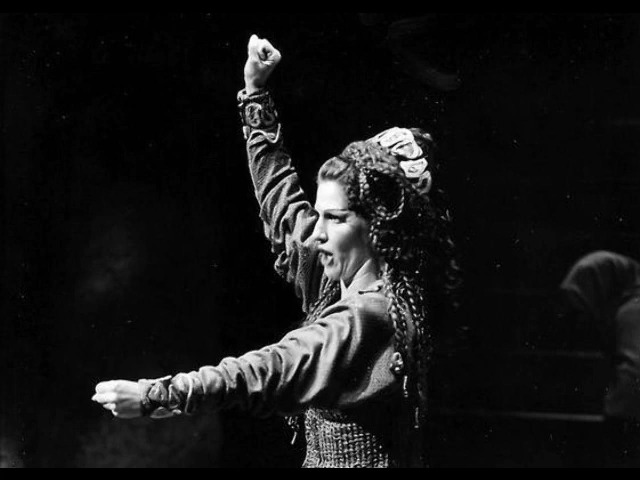
    Above: Maralin as Medea

    NYCO mounted Cherubini’s MEDEA for her. This complex role, sometimes sung as a verismo shrew, was more classically structured by Niska who seemed to realize that vocally Medea is more akin to Donna Anna than anything else. Moreover, she convinced me that Medea was “right” and that her horrific murders of Glauce and of her children were perfectly natural. I never saw Callas in opera, but it would be hard to imagine she was any more potent a Medea than Niska.

    At NYCO she continued in her Mimi mode with a beautifully expressive Manon Lescaut.  Then she took on Salome, having just the ideal combination of silver & blood in the voice. I was dazed by the mesmerizing, obsessive power of both her singing and her portrayal. The art deco sets were superb, and Niska ended her dance in a shimmering body stocking. In the end, as the soldiers crushed her, Maralin let out a chesty groan and writhed for a moment before death took her.

    Then came one of her most delightful and unexpected triumphs: the Composer in ARIADNE AUF NAXOS. This is my favorite opera and I just loved NYCO’s production which seemed to capture the two colliding worlds to perfection. Maralin sang the idealistic Composer, who is finally forced to deal with the realities of life in the theatre, with a flood of dark, soaring tone and vivid dynamic control. The Composer disappears at the end of the Prologue, but in this production, Niska entered the pit and “conducted” the opening of the opera; then Julius Rudel, already seated next to the podium, took over after several measures.

    TJ and I had moved to Hartford and were stunned one night when we went to see TRAVIATA at the Bushnell to find that Maria Chiara had cancelled and Maralin was replacing her. “Let’s go leave her a note!” suggested TJ. Rushing to the stage door, we came upon Maralin pounding on the “wrong” door, trying to get into the theatre where she’d never performed before. She was thrilled to see us, not least because we were able to show her the right door.

    FANCIULLA DEL WEST was another perfect Niska creation; she seemed just to “become” this unpretentious, good-hearted Wild West woman…not above cheating at cards to win her man.

    TURANDOT was a role we never got to see her do; apparently NYCO asked Maralin to learn it for the LA tour, promising her performances in NYC afterwards. The promise was broken. But I have a tape of the LA performance and it’s pretty impressive.

    Maralin sang the unlikely role of Rosalinda in FLEDERMAUS and, at Carnegie Hall, the Latvian national opera BANUTA in which her steely top notes and powerful chest voice were thrillingly on display.

    maralin em

    Above: Maralin as Emilia Marty

    Niska’s greatest triumph, though, was in the Frank Corsaro production of Janacek’s MAKROPOULOS AFFAIR. This fascinating story of a 342-year-old woman who has spanned the decades under various names (always using the initials E.M.) thanks to her alchemist father’s potion for eternal life has been fashioned by Janacek into a vivid drama which centers on Elina’s need to find the lost prescription: she needs a dose to extend her life another 300 years. Ruthlessly manipulative, she manages by seduction to attain the formula only to decide in the end that she is weary of life. Corsaro told the story of the opera onstage while overhead, films of episodes from EM’s past are shown on multiple screens. Maralin appears in the films in various period costumes, using and abusing her sexual fascination to get what she wants from her various lovers. Onstage there is a nude scene where EM removes her dressing gown to show Baron Prus the scars inflicted by one of her sadistic lovers; few divas besides Niska have the body to appear nude onstage. It seemed entirely natural. In the end, Elina offers the magic formula to the young Christa who burns it; spontaneously all the screens burst into flame and out of the darkness, EM’s enigmatic chauffeur comes to bear her away into the smoke. The ovations Maralin received for these performances rivalled any I have encountered in the theatre.

    I saw her onstage for the last time as Elisabetta in MARIA STUARDA; she was still singing with amazing force but NYCO had decided they didn’t need her – even though the latest revival of the Janacek had been even more powerful than the original run. But she threw herself into the Donizetti, brazenly sailing in and out of registers and treating Maria (Ashley Putnam) with palpable disdain. After signing Maria’s death warrant, Elizabetta turns on the hapless Leicester and orders him to be witness to Maria’s execution. Launching her final stretta with almost gleeful vengeance, Niska propelled the scene to its climax and struck a brazen high E-flat which rang into the house (and onto my tape recorder!)

    She moved to Santa Fe and we kept in touch. Then one year my Christmas card came back marked “No such number”. I wrote again: same thing. I feared we had lost contact.

    I thought about her all the time; and the power of thought worked. Shortly after I moved to NYC, I was working one morning and down the aisle Maralin came walking. She was in town with her husband Bill Mullen for a NYCO “family reunion”. We had the most amazing conversation and established why my letters hadn’t reached her. Three years later she was in town again and came in expressly to say hello.

    Now I’m re-reading what I’ve written. How feeble it sounds; I don’t think l’ve begun to express the impact of her performances. My diaries have much more detail, but even they seem very pallid. It’s the impressions she made on my mind or my…soul…that can’t be defined. The diaries, the old tapes, the photos, the programmes, notes she sent me. No one could grasp from any of this what Maralin Niska really meant to me. But I wanted to try to express it anyway.

    niska
    niska derksen wozzeck

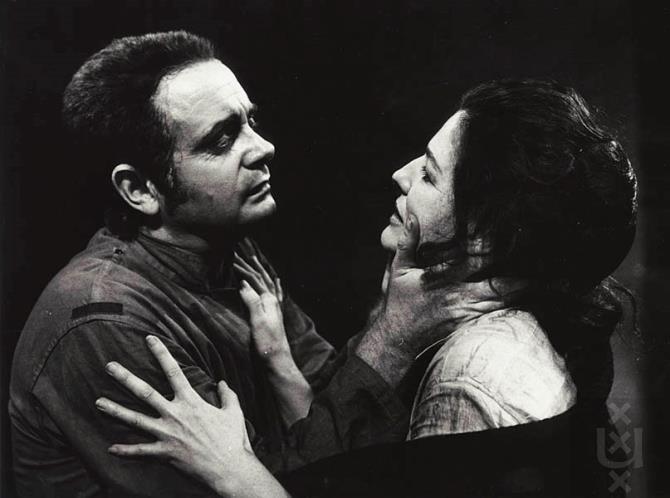
    Above: with baritone Jan Derksen in WOZZECK, one of Maralin’s European triumphs
    niska button
  • ONOKORO ~ creations/beginnings

    Miki 2

    Author: Oberon

    Sunday September 24th, 2023 – This evening at Westbeth, dancers Miki Orihara and Ghislaine van den Heuvel joined a fantastic ensemble of musicians in a program entitled ONOKORO – creations/beginnings. The production, Tokyo to New York, is under the artistic direction of Thomas Piercy; the performance took place at the Martha Graham Studios.

    Onokoro comes from the ancient Kojiki, Japan’s oldest mythology; it was the name of the first island formed by the gods Izanagi and Izanami when they were creating Japan. The evening’s program took us on a musical and spiritual journey from “Ryoanji” (the first sounds) to “Netori, Netori” (the emergence of organized sound and music), and onward thru to “Onokoro” (which combines the Eastern and Western styles of music and movement).

    The Graham space at Westbeth was the perfect setting for this production. As the house lights went out and silence fell over the space, the studio’s large windows created a feeling of l’heure bleue, that fleeting time when day yields to night. In the darkness, the musicians took their places to perform John Cage’s 1985 work “Ryoanji”. The only source of light in the room was the tablets from which the musicians read their scores. The piece opens with a kneeling percussionist, Marina Iwao, striking a bell; this summons is repeated insistently throughout the piece. Thomas Piercy plays the hichikiri, a small double-reed Japanese instrument which seems like a cross between flute and oboe. Mr. Piercy is joined by two other hichikiri players: Lish Lindsey and James Joseph Jordan. The sound of their instruments veers from sighs and whispers to squawking and whining. The audience seemed intrigued by the music.

    Mr Piercy now took up his clarinet for Bin Li‘s clarinet concerto “Netori, Netori”. A seated Gagaku ensemble – Ms. Lindsey and Mr. Jordan joined by Harrison Hsu (sho) and Masayo Ishigure (koto) – create fascinating, otherworldly musical colours which are plucked or piped. As Mr. Piercy begin to play, dancer Maki Yamamae appears, dressed as a young warrior and carrying a ceremonial spear. The space is illuminated in golden light as the the slow ritual dance evolves in a series of poses. Mr. Piercy illuminates the music with soft trills and warblings, and the sound of escaping air; his dynamic control is uncanny. There are silent pauses in the music, and eventually the ensemble rejoins. Following the dancer’s exit, there is a quirky coda for the clarinet.

    Two works having their world premieres at these concerts came next. The first, Gilbert Galindo‘s “Primordial” for clarinet, cello, and piano, opened with a somber cello passage, introducing us to an extraordinary cellist: Daniel Hass. Mr. Piercy again took up his clarinet for this work, and Ms. Iwao was at the keyboard. Galindo’s pensive music is hauntingly beautiful, bringing us a magical mixing of timbres. Mr. Hass produced shivering tremolos while Ms. Iwao found poetic depths in the piano’s lower octaves, and Mr. Piercy’s lambent tone and dynamic variety made for an engrossing experience.

    After the briefest of pauses, the players proceeded to the second premiere, Miho Sasaki’s “黎明 – reimei – Dawn”. Here Mr. Piercy traded his clarinet for the ohichiriki. This music is intense, with threads of melody woven in amidst jarring harmonies. From this emerges high, delicate figurations from Ms. Iwao’s keyboard, while Mssrs. Piercy and Hass create a very distinctive tonal blend. The music, veering from disturbing to reassuring along the way, was very impressively served by these three musicians. And both the Galindo and the Sasaki works seemed to me ideal candidates for choreography.

    For the program’s concluding work, Masatora Goya‘s “Onokoro” Concerto for hichiriki and strings, Mr. Piercy was joined by a string ensemble: violinists Sabina Torosjan and Lara Lewison, violist Laura Thompson, bassist Pablo Aslan, with Mr. Hass’s cello  and Ms. Iwao at the piano.
    Isolated notes from Mr. Aslan’s double bass set the mood as the space becomes fully lit. Mr. Piercy’s hichiriki seems to sigh before taking up a mournful (and vaguely jazzy!) passage. To quirky rhythms, the strings vibrate and the hichiriki wails. Mr. Hass’s cello introduces the dancers: Miki Orihara and Ghislaine van den Heuvel. Gorgeous string harmonies emerge as the dancers remain still. Playing over plucked string motifs, Mr. Piercy’s hichiriki urges the women forward; Miki Orihara is wearing a cape with an extraordinarily long train (costume design by Karen Young). For a fleeting moment, Mr. Piercy veers into a bluesy phase.
    Seated on the floor, the dancers commune with flowing port de bras. The train is briefly passed to Ms. van den Heuvel but then returned to Ms. Orihara. The music takes on a chorale-like feeling; the dancers rise, as if transfixed. Mr. Hass’s cello sounds gorgeously while the women kneel and arrange the cape between them, placing on it a beautiful mask, ‘Tuskiyom‘ (on loan from the Theatre of Yugen, in San Francisco). Their ritual complete, the dancers part and slowly back away. Mr. Piercy then embarks on a grand cadenza before the music fades with tremolo strings.
    The evening ended with warm applause from the audience, who had experienced the performance in a spellbound state, as if in church. While I wished on one hand that a large crowd could see this work, it was exactly the intimacy of the presentation that made it so meaningful.
    My thanks to Miki Orihara for alerting me to this engrossing production; it reminded me at times of Miki’s fascinating  2014 solo presentation, Resonance, which created the same kind of hallowed atmosphere. And how wonderful to see Ms. van den Heuvel again, after watching her magnetic dancing in a Graham 2 performance in 2022.
    To Mr. Piercy and everyone involved in ONOKORO, my deepest thanks for a truly inspired – and inspiring – evening.
    ~ Oberon

  • Norman Treigle Sings Carlisle Floyd

    N t

    The great American basso Norman Treigle (above) sings songs from Carlisle Floyd’s Pilgrimage. Listen here.

    Pilgrimage is described as a “solo cantata on Biblical texts, for low voice and piano or orchestra”; it was premiered by Mr. Treigle at Syracuse, New York, in 1960. Further information on this work may be found here.

  • YCA Presents Violinist Lun Li ~ Debut Recital

    Lun li

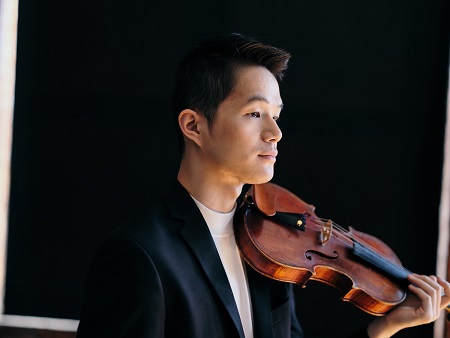
    Wednesday April 26th, 2023 – Young Concert Artists presenting the New York debut recital of violinist Lun Li (above) tonight at Merkin Hall. Pianist Janice Carissa shared the stage with the young violinist in a wide-ranging program which Lun Li described in a program note:

    My debut program explores the interplay between fantasy and reality through the works of Bartók, Messiaen, Schumann and others. I have chosen a set of repertoire that explores this blurred dimension, and more importantly, allows the listener to form sonic connections without needing extensive knowledge and context. I invite you to form your own personal narratives with this program.”

    In the program’s brief opening work, “Don Quixote” from 18 Miniatures by Giya Kancheli, both players showed themselves to be passionate and highly accomplished musicians. The music has a boisterous start, which develops into a strutting dance. Thereafter, extroverted phrases alternate with delicate, witty ones.

    Lun Li then spoke briefly, and asked that we withhold applause during the remainder of the program’s first half. He and Ms. Carissa then commenced on a marvelous performance of Francis Poulenc’s Violin Sonata.

    Poulenc originally wrote this sonata in 1942/1943, for the young French violinist Ginette Neveu, who perished in a plane crash in 1949 at the age of thirty. Thereafter, the composer revised the sonata, making several changes in the last movement. The work recalls the composer’s memories of the great Spanish poet Federico García Lorca (1899-1936); suspected of homosexuality, García Lorca was executed by the Fascists soon after the outbreak the of the civil war.

    The sonata’s opening Allegro con fuoco makes a frantic start before easing into a tango-like mood, which speeds up before halting for a long pause. A tender melody develops with great passion; alternating moods carry us to a fantastic finish.

    Poulenc headlined his second movement, an Intermezzo, with a quotation from García Lorca: “The guitar makes dreams weep,” alluding to the poet’s own guitar arrangements of Spanish songs. The music begins with a lulling piano motif accompanied by plucked violin notes. A subtle melody becomes rapturous, the piano lapses into a dreamlike state. Off-kilter harmonies sound before an upward violin glissando brings a quizzical end.

    The third movement’s title, Presto tragico, foreshadows the death of the poet: fast and urgent passages mesh with dancelike swirls of notes, climaxing with a violent chord. A searing violin theme jolts us, then the music subsides to a tragic, mournful conclusion.

    Honoring Lun Li’s request for “no applause” was difficult after such a thrilling performance, but the mood held and he commenced the high, soft agitato of Salvatore Sciarrino’s Per Mattia, a brief work that flowed seamlessly into the ensuing Schoenberg. 

    Janice carissa.

    Above: pianist Janice Carissa

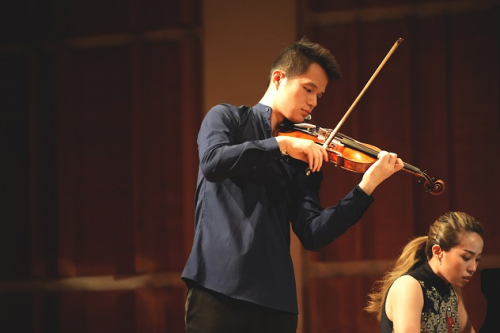
    Arnold Schoenberg’s Phantasy, Op. 47, began life as a solo violin piece, to which the composer later added a separate piano accompaniment. Lun Li and Ms. Carissa here displayed the wonderful sense of teamwork that underlined their playing all evening. The pianist, whose gown was a work of art in and of itself, is wonderfully subtle, and she deftly handled the rhythmic shifts in which this music abounds. Together, the players veered from the ethereal to the drunken, dancing along thru stuttering, jagged passages which morphed, incredibly, into Fritz Kreisler’s Miniature Viennese March. This was a brilliant ending to the concert’s first half: jaunty, and impeccably played.

    Music of Olivier Messiaen, his Fantaisie, opened the evening’s second half; the composer is perhaps best remembered for his magnificent, poignant Quartet for the End of Time. The Fantaisie opens with Ms. Carissa delivering an emphatic statement from the piano. Dance-like passages are heard, and then Lun Li’s violin soars over gorgeous rippling figurations from the pianist. The music sails along, alternating rapid passages with thoughtful ones: mood swings that are relished by the players. From a high-velocity, tumultuous buildup, the music becomes cinematic. Animated/agitated music gives way to another high-flying, silken violin theme. The climax is reached, with the composer offering a swift, dazzling finish. 

    Robert Schumann’s quirky Bird as Prophet, arranged by Leopold Auer, comes next. Ascending violin phrases have a touch of irony, and then a lyrical song springs up, with a shimmering trill. The music features some wistful hesitations.

    4

    Lun Li and Ms. Carissa polished off the evening with a compelling performance of Béla Bartók‘s Violin Sonata No.2, Sz. 76. Lun Li aptly described this music as being “from a different planet”, and from its big, strange start it is indeed kozmic, weird, and wonderful. Passion and pensiveness send alternating currents thru the hall, sagging violin motifs develop into an epic expressiveness. As things simmered down, Lun Li remained unfazed by the ill-timed sound of a cellphone: he delivered a plucking ‘cadenza’ from which a dance emerged: cascades of notes from the violin over a pounding rhythm from the keyboard. Fabulous playing…they sounded like a whole orchestra! 

    Bartók offers a fantastical sonic variety in this piece in terms of tempi and dynamics: a piano solo of epic power gives way to a spidery violin motif. Lun Li becomes a veritable speed demon, playing fast and furious, and taking things to new heights. The music calms, and slows; the violin sighs, then starts plucking, and the music dances onward.

    2

    The audience hailed the musicians with a fervent ovation at the sonata’s end, and Lun Li graciously thanked us for having accompanied him on this musical journey. He then launched a performance of Schubert’s  Erlkönig that was an astounding demonstration not only of his virtuosity but of his unbounded passion and his heartfelt dedication to music.

    I look forward eagerly to hearing Lun Li again…and soon: on Friday May 5th, he will play the Prokofiev 2nd with the Riverside Symphony at Alice Tully Hall. Tickets and info here

    Performance photos courtesy of Young Concert Artists.

    ~ Oberon.

  • CMS Brandenburgs ~ 2022

    Bach

    Tuesday December 20th, 2022 – Chamber Music Society of Lincoln Center‘s annual presentation of Bach’s Brandenburg Concertos is always a highlight of the New York concert season, and this year these immortal works maintained their ‘masterpiece’ status as the Society rounded up a spectacularly talented team of players. As is the CMS custom, the concertos are presented in a different order each year, and the program is given three times in order to accommodate all the music lovers who are craving a holiday alternative to the Messiah and the Nutcracker.

    This evening, a packed house enthusiastically responded to music-making of the highest level. As a special treat, the gentlemen of the Escher Quartet joined the lineup; I love these guys, both as musicians and as personalities. 

    The program opened with the 5th Brandenburg, which belongs to the harpsichordist. Shai Wosner played the long cadenza with striking clarity and elegance. Violinist Daniel Phillips and cellist Sihao He then joined Mr. Wosner for a gorgeous  rendering of the Affetuoso, Clad in a royal purple gown, flautist Sooyun Kim dazzled with her luminous tone and deft technique. The complimentary string trio of violinist Aaron Boyd, violist Paul Neubauer, and bassist Lizzie Burns were excellent. Ms. Burns and Mr, Wosner went on to be pillars of musical perfection as the evening flowed onward.

    Next up was the 2nd Brandenburg, with trumpet virtuoso Brandon Ridenour sailing superbly thru the music. Mssrs. He and Wosner were joined by violinist Brendan Speltz, flautist Demarre McGill, and oboist James Austin Smith in weaving a lovely tapestry of sound in the Andante. Adam Barnett-Hart, Aaron Boyd, and Pierre Lapointe formed an admirable string trio, and it is always wonderful to hear Peter Kolkay offering his mellow bassoon tone to the music. In the concluding Presto, Mr. Ridenour and Mr. Smith vied with one another as they traded phrases, much to our delight.

    In the 4th concerto (in G-major), violinist Adam Barnett-Hart was very much in his element, alternating sustained tones of gentle lustre and with passages of high-speed coloratura. Duetting flautists Demarre McGill and Sooyun Kim dazzled the ear with the swift surety of their playing in the outer movements, and tugged at the heartstrings with the poignant harmonies of the central Andante. Ms. Burns and cellist Brook Speltz brought just the right weightiness of sound to counter-balance the high voices of the flutes and violin. In the final Presto, Mr. Barnett-Hart displayed incredible virtuosity.

    Following the interval, the 1st concerto, brought forth two horn players, Michelle Reed Baker and Julia Pilant, festively gowned (respectively) in red and green. They sounded as fine as the looked, and their duetting harmonies drew plushy responses from a trio of oboists: Stephen Taylor, James Austin Smith, and Randall Ellis. Mr. Kolkay’s dulcet bassoon playing has a prominent role here. The horns are silent during the poignant Adagio, where Aaron Boyd and the oboe trio spun pleasing harmonies over velvety unison phrases from Mihai Marica’s cello and Ms. Burns’ bass. The high horns swing into the jaunty Allegro, after which a wave of applause greeted the players. But there’s still a fourth movement – a mix of minuet and polonaise – in which separate choirs of winds and strings alternated, keeping the musical textures fresh til the end.

    The 6th concerto features pulsing cello and bass figurations, and duetting violas (Mssrs. Neubauer and Phillips). Mr. Neubauer and cellist Sihao He (graciously accompanied by Ms. Burns’ bass) drew us in to the moving tenderness of the Adagio, Mr. He concluding with a brief cadenza. Then without pause, the sneaky start of the closing Allegro begins to sweep us along. Mr. He dazzled us with his swift, fluent playing, whilst the two violists had a field day with the fast-paced music. This Allegro induced fervent applause from the crowd.

    The evening’s finale, the 3rd concerto, is a particular favorite of mine; it calls for three violins (Mssrs, Boyd, Brendan Speltz, and Barnett-Hart), three violas (Mssrs. Lapointe, Phillips, and Neubauer) and three cellos (Mssrs. Marica, He, and Brook Speltz), whilst the dedicated Wosner/Burns duo kept everything merry and bright. This concerto is unusual in that its “phantom” Adagio movement consists only of a brief passage from Mr. Wosner’s keyboard. Bach immediately sends the players back into a swirling Allegro. The evening’s performance drew to an end, the audience rising to hail the players with great – and much-deserved – enthusiasm. A second bow was called for, and then we headed out into the chilly night air, our spirits fortified by glorious music of Bach.

    ~ Oberon

  • CMS Brandenburgs ~ 2021

    Bach

    Sunday December 19th, 2021 – Chamber Music Society of Lincoln Center‘s annual Yuletide performances of Bach’s immortal Brandenburg Concertos are always a highlight of the New York musical season. Music lovers turn out on droves for each of the program’s three presentations, giving themselves an early Christmas gift.

    One tradition at the CMS Brandenburgs is the annual reshuffling of the order in which the six concetros are played. This year, the odd-numbered concertos were played first, with the even-numbered ones coming after the interval.

    The 1st Brandenburg (in F-major) briought together the program’s largest ensemble of players, which produced a wonderful fullness of sound. The wind instrument lineup tonight was impressive indeed: there are three oboes, led by Stephen Taylor with Randall Ellis and Mr. Smith, two mellow horns (David Byrd-Marrow and Stewart Rose); and Marc Goldberg’s rich-toned bassoon. On the string team, led by violinist Daniel Philllips (excellent in the Adagio), Arnaud Sussmann and Sean Lee (violins) were joined by Che-Yen Chen (viola) and Dimitri Atapine (cello). The outstanding continuo duo – Kenneth Weiss (harpsichord) and Joseph Conyers (double bass)- made marvelous music all evening. Mr. Phillips made a lovely thing of the Adagio, where he and Mr. Taylor duetted cordially. The bustling Allegro drew a warm round of applause, but then comes a built-in ‘encore’, in which the wind players outdid themselves.

    The 3rd concerto, in G-major, is unique in that the anticipated central slow movement is replaced by a mere couple of chords and a violin flourish before going immediately on to the exhilarating Allegro. Bach calls for three trios of strings: violinists Sean Lee, Arnaud Sussmann, and Alexander Sitkovetsky gave us lively playing in the opening movement, whilst Mr. Phillips traded his violin for his viola to join Mr. Chen and Yura Lee. Add the cello trio of Timothy Eddy, Mr. Atapine, and Inbal Segev, and you have a veritable string-fest. My companion, Cherylyn Lavagnino and I were much taken with Mr. Conyers’ rich and nimble bass playing. The final Allegro sailed blithely onward: so many notes! 

    In the 5th concerto (in D-major), harpsichordist Kenneth Weiss mesmerized the crowd with his fantastic playing of the long cadenza; people stood up and cheered when he stepped forward for a bow at the end of the evening’s first half. From its familiar opening theme, the 5th concerto puts the violin (Sean Lee) and the flute (Ransom Wilson) in the spotlight; these two gentlemen played the central Affetuoso divinely, whilst Mr. Weiss’s harpsichord cunningly etched a filigree around their melodies. In the concerto’s light and lively final Allegro, Mssrs. Sitkovetsky, Phillips, Eddy, and Conyers were a top-class ensemble. 

    Following the interval, flautist Tara Helen O’Connor drew a warm welcome as she walked out onto the Tully Hall stage, goddess-like in a glimmering red gown. Yura Lee and Inbal Segev had also chosen red frocks for the evening, giving the scene a festive Yuletide glow.  In the 2nd concerto (in F-major), dazzling trumpet virtuosity from David Washburn set the hall alight, whilst Ms. O’Connor’s timbre had its familiar crystalline clarity.

    In the Andante, the quartet of Ms. O’Connor, James Austin Smith (oboe), Arnaud Sussmann (violin), and Timothy Eddy (cello) wove a tapestry of sound that warmed the soul: simply perfect. Then Mr. Washburn’s trumpet calls rang out, summoning us to revel in the concerto’s festive finale. A rock-star ovation saluted these extraordinary musicians as they returned for a bow.

    Yura Lee and Che-Yen Chen put us under a viola spell with their playing of the 6th concerto (B-flat major) – the one in which no violins are heard: a trio of cellists (Mr. Atapine, Ms. Segev, and Mr Eddy) and the continuo players are all Bach needed here. The Adagio – one of Bach’s most moving and melodious inventions – was entrancing as Ms. Lee and Mr. Chen exchanged phrases. This could have gone on and on – such a balm to the ear – but the closing Allegro sweeps us inexorably forward with its thrice familiar theme..

    The evening ended with the fourth concerto (in G-major), in which Alexander Sitkovetsky dazzled us with his silky tone and incredible dexterity. Duetting flautists Ransom Wilson and Tara Helen O’Connor displayed jewel-like qualities in their playing of the animated phrases of the outer movements, whilst bringing a sweet sadness to the harmonies of the central Andante. Mr. Conyers’ double bass and Ms. Segev’s cello provided a resonant counterpoise to the high voices of the flutes and violin. Then we are down to the final Presto: a fugue-like race in which Mr. Sitkovetsky’s fabulous virtuosity led his colleagues in a final sprint to a victorious finish. The audience saluted the musicians with a vociferous standing ovation, recalling them for a second bow.

    Leaving Alice Tully Hall, which has become dear to me over these past few years as a refuge of peace and beauty in an increasingly perilous world, we stepped out into the brisk evening air, feeling on top of the world. How wonderful to experience this concert with my friend Ms. Lavagnino, who is truly a kindred spirit.

    ~ Oberon

  • Budapest Festival Orchestra ~ All-Mahler Program

    Gerhild-romberger

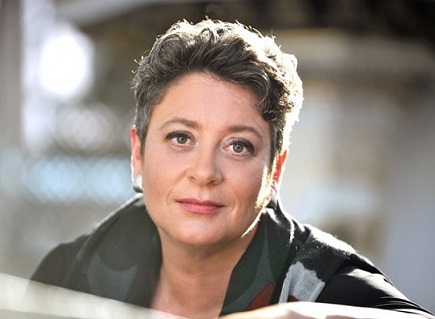
    Above: contralto Gerhild Romberger

    ~ Author: Oberon

    Monday February 24th, 2020 – The Budapest Festival Orchestra, conducted by Iván Fischer, offering Mahler’s 5th symphony, preceded by the Kindertotenlieder, sung by Gerhild Romberger, contralto, in her New York debut. The program was part of Lincoln Center’s Great Performers series.

    Ms. Romberger – previously unknown to me – was revelatory. This was my third experience of hearing the Kindertotenlieder (Songs of the Dead Children) in live performance: previously, the grand Polish contralto Ewa Podles and the inimitable Russian baritone Dmitri Hvorostovsky had given enthralling interpretations of these evocative songs, each taking a rather operatic point of view. Ms. Romberger, more intimate and poetic in her approach, was deeply moving…and the voice fascinated me.

    Handsomely coiffed, and clad in black, the contralto took up the opening song, “Nun will die Sonn’ so hell aufgeh’n” (Now Will the Sun Rise as Brightly) following its haunting introduction from the winds. Her sound is rich yet contained, projecting a sense of calm despite the bleakness of the knowledge that the sunrise can no longer bring comfort. The horn and harp add to the wistful atmosphere, and the singer’s dreamy softening of the upper notes at “…die sonne..” is indeed magical. Ambiguously, the music shifts between minor and major.

    In “Nun seh’ich wohl, warum so dunkle Flammen” (Now I See Well Why Such Dark Flames) with its gorgeously expressive start, Ms. Romberger’s beauteous palette of soft colours was at play as she described the eyes of the children, and the premonition of their death. There is a sense of consolation in the orchestral writing, but it’s the desolate feelings that of loss permeates in the singer’s touching turns of phrase. Her hands, meanwhile, communicated her emotions in gracefully-shaped gestures.

    Wenn dein Mütterlein” (When Your Dear Mother) commences with oboe and bassoon, sounding rather doleful in a motif of intervals. Here Ms. Romberger’s gifts as a storyteller are to the fore, and her sense of gentle restraint in the upper reaches of the voice is endlessly evocative. The deep, rich sound of the Budapest’s basses sustaining the final note sent a chill thru me.

    In “Oft denk’ ich, sie sind nur ausgegangen” (Often I Think They Have Only Gone Out). Mahler again allows the music to wander between major and minor, underscoring the illusion that the children have only gone out for a walk. With sweet lyricism in her upper range, the singer seeks to reassure herself – and us – that all is well. Her singing here is simply sublime. But at last comes acceptance that the children have gone to another place, wherein there is the hope of one day be reunited with their parents.

    In diesem Wetter, in diesem Braus” (In This Weather, in This Torrent) tells of the stormy weather on the day of the funeral: restless, aggressive music. In resignation, Ms. Romberger sings that the children have found rest, and her vocal control and the somber yet luminous expressiveness of her singing here reached me at the depths of my soul: so hauntingly and gently she sang as the harp sounded. A horn chorale seemed like a benediction.

    Ms. Romberger was given very warm and sustained applause following her poignant performance: returning for a solo bow, the entire orchestra joined in a moving tribute to this remarkable artist. She and Maestro Fischer were called out yet again, and while I cannot imagine an encore following the Kindertotenlieder, we can surely hope that she and the Maestro will return to New York City soon, bringing us the RückertLieder…or the Wesendonck. I can only imagine what that would be like!

    During the interval, I remained under a sort of spell from this cherishable performance: I even thought of leaving, and taking my memories of it with me to some solitary place where I could continue to meditate on what I had heard.

    Of his 5th symphony, Gustav Mahler famously said: “…a symphony must be like the world; it must embrace everything.” Mahler composed this sprawling work during the summers of 1901 and 1902, while on holiday from his job as director of the Vienna Court Opera. Prior to beginning his fifth symphony, Mahler had met the beauteous Alma Schindler, daughter of a famous landscape painter. The composer proposed to her in the Autumn of 1901, and the symphony seems to mirror Mahler’s journey from sorrow thru the dreamworld of the Adagietto to a triumphant state of happiness with his beloved.

    The symphony’s brilliant opening trumpet fanfare, played with summoning clarity and force by Tamás Pálfalvi, gave notice that a sonically vivid performance lay ahead of us. As the first two movements of this very long symphony progressed, Maestro Fischer drew inspired – and inspiring – playing from the artists of the Budapest Festival Orchestra.

    In the Scherzo, Horn soloist Zoltán Szöke came forward and was seated next to the podium. He played splendidly, sometimes raising the horn’s bell to project the music with sumptuous power. But I must admit that during this movement – with its endlessly repeated 6 note motif, played as a fugue – Mahler fatigue started to set in. It began to have the feeling of the music being too much of a good thing.  

    The classic Adagietto, sometimes considered Mahler’s “greatest hit”, features strings and harp. The conductor summoned luminous textures from the musicians, creating a depth of beauty in which we could – for a few minutes – forget the dark dangers of living in today’s uncertain world.

    In the symphony’s concluding Rondo-Finale, the Maestro and his musicians swept the celebratory feeling forward, pausing only for a couple of rather gratuitous detours, and on to its epic conclusion. The audience’s response was tumultuous.

    For all the 5th symphony’s marvels, it was – for me – the Kindertotenlieder that gave this evening its particular glow. 

    ~ Oberon

  • Leonie Rysanek as Lady Macbeth

    Scanned Section 13-1

    A year before her Met debut in the same role, Leonie Rysanek made her New York debut as Verdi’s Lady Macbeth in a concert performance with The Little Orchestra Society. Overall, she gave an exciting (if somewhat uneven) performance; she galvanized the audience with her thrilling singing of “La luce langue“.

    Leonie Rysanek – La luce langue ~ MACBETH – Little Orchestra Society 1958

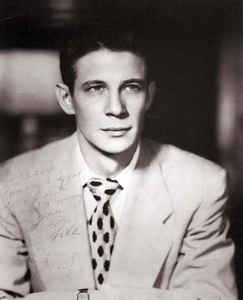
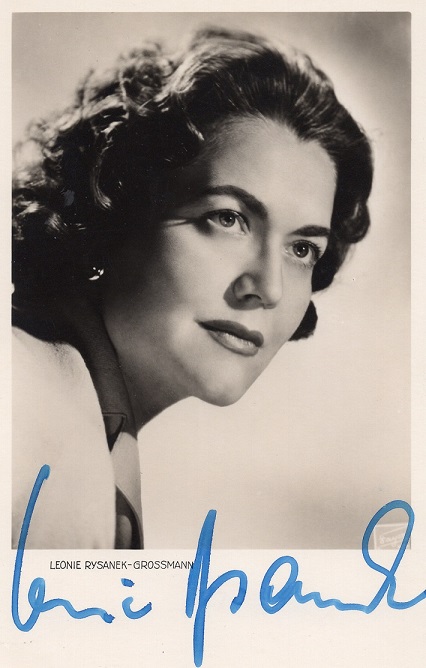
    After hearing Leonie Rysanek’s voice for the first time on a Texaco/Metropolitan Opera broadcast of BALLO IN MASCHERA, I wrote to her and received the photo (at the top of this article) a few days later. She became one of the most potent forces in my enduring obsession with opera. I saw her many times at The Met, including her unforgettable 25th anniversary gala. She was my first Senta, Ariadne, Kaiserin, and Salome; her Met 25th anniversary gala in 1984 was one of the greatest thrills of my opera-going career.

    ~ Oberon

  • Zlatomir Fung @ XVI Tchaikovsky Competition

    Zlatomir+Fung+1_Photo+by+MattDine+dmf

    Zlatomir Fung (above, in a Matt Dine photo) has won First Prize in the cello division at the 2019 Tchaikovsky Competition. Established in 1958, and held every four years in Moscow and St. Petersburg, the Competition has – over time – added categories of cello and voice to the initial competitions for pianists and violinists.

    Earlier this year, I had the great pleasure of attending Mr. Fung’s New York recital debut under the auspices of Young Concert Artists.  It was an outstanding evening of music-making, and it did not surprise me in the least to learn today that the young cellist has seized the top prize at the Tchaikovsky: he’s simply phenomenal.

    Mr. Fung and pianist Tengku Irfan played Gabriel Fauré’s Après un rêve as an encore at their Merkin Hall YCA recital in February of this year. Listen to it here.

    ~ Oberon

  • Oratorio Society: Sibelius ~ KULLERVO

    439px-Wettenhovi-Aspa _Kullervo_(Sibelius)

    Above: artwork by Georg Sigurd Wettenhovi-Aspa (1870-1946)

    ~ Author: Oberon

    Monday February 25th, 2019 -The Oratorio Society of New York presenting works by Berlioz, Debussy, and Sibelius at Carnegie Hall. The concert provided my first opportunity to experience Jean Sibelius’ epic choral symphony, Kullervo, live. The first half of the program was given over to two wonderfully atmospheric works featuring women’s chorus: Hector Berlioz’s “La mort d’Ophélie” from Tristia, and Claude Debussy’sSirènes from Nocturnes.

    Berlioz’s Tristia dates from 1842; the “Mort d’Ophélie” was written as a solo work, and later re-set for female chorus and orchestra. The attractive scoring of the 1849 version heard tonight brings thoughts of Les Troyens amd Les Nuits dété to mind; in fact, the composer seems to have anticipated the former and borrowed from the latter as certain motifs rise up. The women of the Oratorio Society Chorus harmonized lovingly, and the orchestra played to perfect effect.

    A song without words, the Debussy “Sirènes” (from 1899) evokes thoughts of the composer’s La Mer (of course) as well as of the haunting Pelléas et Mélisande, which the Met recently offered in a very fine performance.

    “Sirènes” surely cast a spell this evening, though the repeated themes made the piece stretch long after a bit. Still, there’s no denying the great appeal of this dreamy music. As the work moved towards its ending, a cellphone going off brought us back to reality all too abruptly.

    After a rather lengthy intermission, Jean Sibelius’ Kullervo received a superb performance under Kent Tritle’s baton. The male chorus of the Society was further fortified by the men of the Manhattan School of Music ‘s Symphonic Chorus: the combined choruses made an outstanding contribution to the performance, giving the audience cause to celebrate. The work calls for two vocal soloists, and both were marvelous: soprano Johanna Rusanen and baritone Takaoki Onishi.

    Composed in 1892, the five-movement work tells us of the mythic Kullervo, a complex, tragic figure from Finnish legend. The Introduction depicts the Finnish land and its people and introduces us to the main character. In the second movement, Kullervo’s childhood is evoked: haunted by tragedy from birth onwards, he spends his youth largely in slavery.

    The pivotal movement is the third, in which Kullervo meets and seduces (or rapes) a woman who is – unbeknownst to him – his own sister. When she learns the truth, the woman drowns herself. Kullervo laments his crime and his sister’s death; as atonement, he seeks death on the battlefield. But Death does not find him; he returns to the site where his sister died and, consumed by guilt, he falls on his sword.

    I must admit that the first two movements – very well played by the Society’s orchestra – left me with restless feelings. Full of themes, and finely orchestrated to boot, the music nonetheless seemed over-long; I kept eyeing that big chorus seated onstage, wanting them to burst into song. And when they did, the effect was thrilling: the signature choral motif – “Kullervo! Son of Kalervo!” – surges forth several times in the course of the work…and its every appearance makes the blood rush. This is, seemingly, the Scherzo of the piece.

    The two soloists have now taken their places onstage. Johanna Rusanen, a Finnish soprano who was a Young Artist at Berlin’s Deutsche Oper and has since made her mark in such roles as Venus, Ortrud, Isolde, and Marie in Wozzeck, is an intriguing stage presence with a clear-toned, full spinto sound that rang beautifully into the venerable Hall. Her long monologues were both vocally impressive and charged with dramatic accents as the character’s story unfolds. Ms. Rusanen’s voice struck me as one that should be heard at The Met. 

    The Japanese baritone Takaoki Onishi has fared well in several premiere vocal competitions. A Juilliard graduate, he was a member of the Ryan Opera Ensemble at Lyric Opera of Chicago for three seasons, where he sang several roles. His career mixes opera, concert, and recital, and I can’t wait to hear him again. A slender, handsome fellow who looks elegant in a tuxedo, Mr. Onishi possesses a baritone voice of fine quality, capable of expressive lyricism or of vivid declamation; the role of Kullervo demands both, and the baritone sang forth with distinction.

    Oratorio Society of NY at Carnegie Hall  2-25-19  photo by Anna Yatskevich  Manhattan School of Music 47166962492_8510b0d4bf_k

    During the long and loud ovation that followed, the soloists and Maestro Tritle were deservedly cheered, as were the the excellent singers and players of the Oratorio Society of New York. The above photo by Anna Yatskevich from the Manhattan School of Music captures the joy of the moment.

    Hearing the women sing Berlioz, and listening to the handsome voices of Ms. Rusanen and Mr. Onishi made me crave a concert performance of Berlioz’s Prise de Troie. How wonderful these two singers would be as Cassandra and Chorebus!

    ~ Oberon