Tag: New York City

  • Singers: Gilda Cruz-Romo

    (This paean to the Mexican soprano Gilda Cruz-Romo first appeared on Oberon’s Grove in 2008.)

    gilda 1

    In the Autumn of 1969 I decided to move to New York City; I withdrew all my savings from the bank and reserved a room at the Empire Hotel at a monthly rate. The plan, as I sold it to my parents, was that I would find a job and then an apartment. In actuality, all I really wanted to do was go to the opera every night. And that is exactly what I did, forgetting about job-hunting til my cash gave out and I returned home after a few weeks.

    Unfortunately for me, that was the year of the Met orchestra’s strike. But I was not to be deterred: I went to every single performance of the New York City Opera’s Autumn season. Standing room cost next-to-nothing and I already had some favorite singers there – people like Beverly Sills, Maralin Niska, Patricia Brooks, Enrico di Giuseppe, Dominic Cossa and Norman Treigle. Treigle was in fact the focus of that Autumn season since NYCO was mounting a production of Boito’s MEFISTOFELE for him. Carol Neblett was singing the dual role of Margherita and Helen of Troy; but for the final performance of the run a debut was announced: a Mexican soprano named Gilda Cruz-Romo.

    One never knows what to expect from a debut, and that was especially true back then when there was no Internet buzz, YouTube or Facebook that might have provided an inkling or an outright sample of a new singer’s work. In the weeks prior to her debut, I’d actually seen Gilda and her husband Bob Romo several times around Lincoln Center and at the Footlights Cafe; I’d even said hello to her and as a young, unknown singer she seemed genuinely thrilled to be recognized. But what – I kept wondering – does she sound like?

    Her performance was something of a revelation: it was a big, warm lyric voice bordering on spinto. Her tone had an unusual freshness and clarity, with a pliant technique and shining upper register, and the kind of vocal candor that one finds in a new singer who just sings without relying on artifice. The audience took to her at once – the fans sensing that here was an Italianate voice that had real potential in the Verdi & Puccini repertoire. After the great aria “L’altra notte”, Cruz-Romo was warmly applauded but it was in the Helen of Troy scene that she capped her success: in the great concertato “Amore mistero!” the voice sailed out over the ensemble with a gleaming quality and as the line soared up to its climatic top-B the sound seemed to blossom – and Cruz-Romo swept onwards to triumph. I met her after the performance; she and her co-stars Norman Treigle and Nicholas di Virgilio all signed my program:

    gilda 2

    The next afternoon at Footlights a small gathering of fans met and we played over and over again our house tapes of the performance; we must have listened to that ensemble about twenty times. People at neighboring tables were drawn to the sound of her voice. In those days, New York City Opera was a real Company: if you made a successful debut you were invited back and became part of the family and were cast in as much repertoire in your fach as was available. Obviously Julius Rudel knew a special voice when he heard it, so Gilda – as we were by now all calling her – sang there for the next 2 or 3 years until the Met snatched her away.

    And so I saw her in more performances of MEFISTOFELE, as a glowing-voiced Butterfly and a golden-toned Mimi (especially moving) and – in one of her first ventures into the heaviest rep – Amelia in BALLO IN MASCHERA. Of her City Opera performances, my very favorite was her Tosca in 1971:

    “…Gilda surpassed my highest expectations as Tosca. Rarely has this role had such a balanced combination of: a beautiful face, fine stage presence, sincere acting, fine diction and GORGEOUS spinto singing. In the first act, many phrases of great beauty. She looked lovely, young and excited. In Act II she sang superbly, her high Cs large and luminous. The dramatic utterances were all convincingly delivered. As she neared the end of her marvelously phrased “Vissi d’arte” tears welled up in her: one sob at the end, straight from the heart, was a perfect effect. She carried off the murder and the acting demands of the closing of Act II with excellent control. Maintaining her high level in Act III, Gilda ended the opera on a stentorian top-B and took a death-defying leap of ten feet! She was given a tumultuous ovation eminently deserved. Backstage she was literally mobbed – as big a crowd as I’ve seen at NYCO. After edging my way through the throng we hugged and she kissed me so many times. It took a few moments before either of us could speak…”
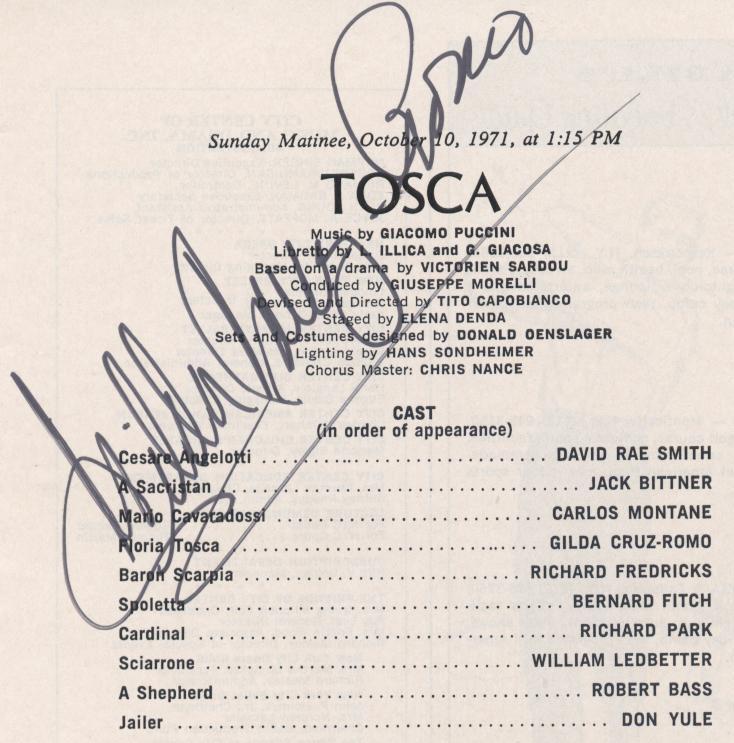
    gilda tosca

    When things calmed down and we got to discuss the performance, she told me how petrified she was of taking that final jump. The production was designed so that Tosca’s suicidal leap was visible to the audience as she fell about a dozen feet before a parapet blocked her landing-mattresses from view. She had not had a stage rehearsal and she said she got to the edge of the platform and realized in a split second how exposed her descent would be; she crossed herself and took the plunge.
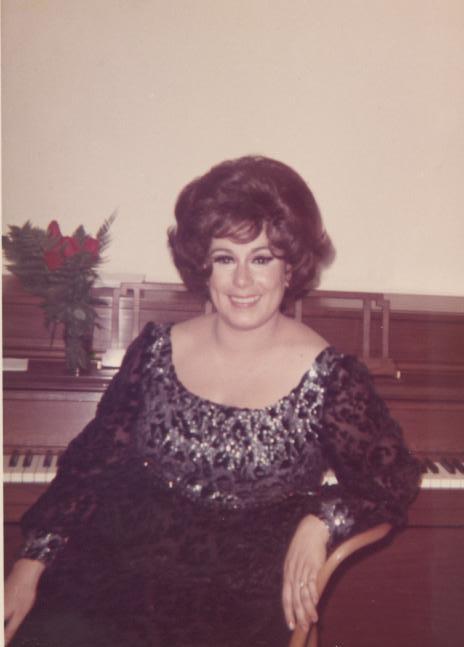
    gilda 4

    It was inevitable that a voice like Gilda’s would be both wanted and needed at the Met. In 1970 she entered the Met National Auditions and was a finalist, singing “La mamma morta” from ANDREA CHENIER. On May 8, 1970 she debuted with the Company on tour in Atlanta singing that same opera. In December of the same year she debuted at the Met proper as Butterfly, beginning a career there that stretched into the mid-1980s and encompassed over 160 performances.
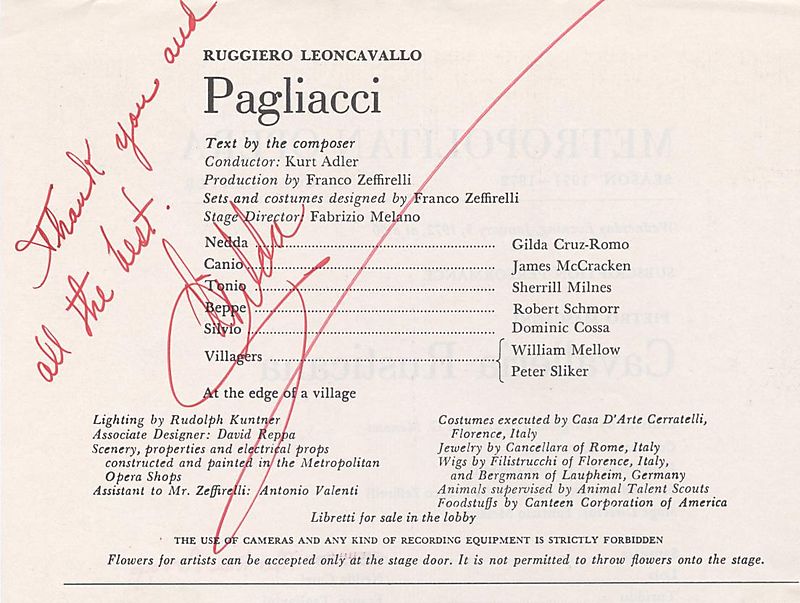
    gilda pag

    I saw her at the Met for the first time as Nedda in PAGLIACCCI opposite the frighteningly intense Canio of James McCracken. Gilda sang so beautifully, especially in the sensuous duet with Silvio (Dominic Cossa): “…great crescendos from tiny pianissimos...” It was after this performance that she and I were photographed together backstage. (OK, no comments about my tie…or my hair! Remember this was the 70s).
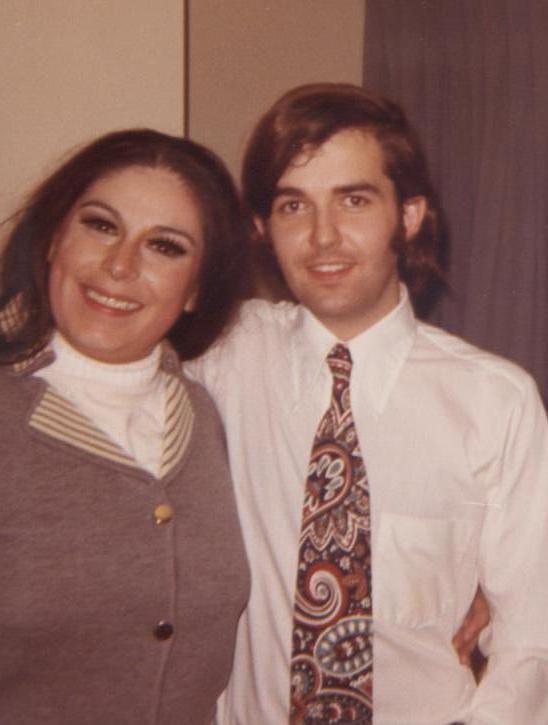
    gilda 3

    Then came a hiatus: I moved to Houston for a while and only kept tabs on her via the broadcasts. But after a while I was lured back to the Northwest and we had a beautiful reunion at a matinee of AIDA where she sang opposite Franco Corelli:

    …Gilda was in complete command of this arduous role every step of the way…there were phrases upon phrases of golden Verdi singing: her deeply-felt prayer at the end of ‘Ritorna vincitor’ and the miraculously spun high pianissimi in ‘O patria mia’ and even more incredibly on ‘Fuggiam, fuggiam…’ as she lured Corelli into her escape plan. She was able to healthily dominate the big ensembles and then turn around a float effortlessly in the tender ‘O terra addio…’  Really top-class Verdi singing!”

    Gilda also sang in a revival of MANON LESCAUT and sounded lovely despite being cast opposite a very mediocre tenor. Her ‘In quelle trine morbide’ was poignantly phrased, mirroring Manon’s longing for the simple, true love of her Chevalier des Grieux. (Photo: Bill Hendrickson).

    Gilda Cruz-Romo – In quelle trine morbide – MANON LESCAUT -Met dress rehearsal 1973

    Then several things happened which kept me from seeing her onstage at the Met; I moved to Hartford with TJ and for a couple years we were basically broke. Trips to New York were infrequent and most of the time ballet trumped opera.  Then too, Gilda’s international career was in full bloom; it seemed she sang everywhere and sang the most taxing repertoire – I think I once read that she ended up singing Aida five-hundred times! It seemed like whenever I was at the Met, she was somewhere else.

    gilda desdemona

    Thus it was a special pleasure when she came to Hartford and sang Desdemona in OTELLO (above), one of her most attractive roles. In 1979 she was Desdemona on a Met telecast opposite Placido Domingo and Sherrill Milnes.

    In 1987 I saw Gilda onstage for the final time, as Cherubini’s Medea at Bridgeport, Connecticut. The declamatory style of many of the character’s utterances didn’t suit her so well – she was always a melodic singer – but the voice was still powerful and expressive.

    I met her again a few years ago when she was honored by the Puccini Foundation. I handed her the photo of the two of us and it took her only a half-second to realize who I was…I have changed MUCH MORE than she has!  We keep in touch now; she lives in San Antonio and I was tickled to read recently that she keeps up her deep-sea fishing and is also active in a local Texas group which matches senior citizens with canine companions:
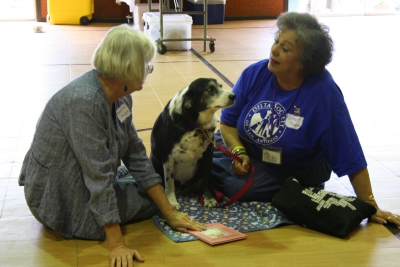
    gilda 5

    It’s been a long time since that day in Footlights soon after her NY debut that I pestered her with a million questions and she was unbelievably kind and patient. Once I wrote to her after she’d sung the title role in ANNA BOLENA in Dallas expressing my dismay that I couldn’t have been there; a few days later I was astounded to open the mailbox and find she had sent me a tape of the performance. That’s the generosity of spirit that Gilda always shows. So now, with love and gratitude, I’ve tried to put my admiration for her into words.

  • It’s All Because of Renata Tebaldi

    (One of my earliest long articles for Oberon’s Grove: the story of how my obsession with opera started.)

    tebaldi copy

    In a way, I could say that I am where I am today because of Renata Tebaldi. It’s simplistic, and of course there are a million things which influence our choices as time goes by. But it was Tebaldi who made me fall in love with opera; it was opera that brought me to New York City on my own for the first time in 1966;  it was in New York City that I – the proverbial small town boy – discovered that I was not the only male in the world attracted to other men; it was a fellow opera fan who introduced me to New York City Ballet; it was my devotion to opera and ballet that kept me coming to NYC from Connecticut for 22 years – and spending a fortune.  And finally it was the desire to have opera & NYCB at my fingertips that finally got me to move here in 1998. And once I did, I met Wei. So, I owe it all to Renata!

    It was on January 12, 1959 that I happened to watch the Bell Telephone Hour; Tebaldi sang excerpts from MADAMA BUTTERFLY. I know the exact date because the performance has been released on video. This was not my first exposure to operatic singing; my parents had some classical LPs in their collection and there were snippets of Flagstad and Lily Pons on these. But nothing that moved me or drew me in like watching Tebaldi’s Cio-Cio-San. That was the beginning.

    My parents bought me my first 2-LP set of opera arias; I found out about the Saturday afternoon Met broadcasts; I subscribed to OPERA NEWS; I wrote fan letters to singers I heard on the radio. I used my tiny earnings from my paper route and working in my father’s store to buy a few more LPs. I plastered a big bulletin board in my room with pictures of singers. My parents took me to my first opera at the Cincinnati Zoo. Then they took me to the Old Met.  But it was a lonely obsession; I had no one to share it with.

    In 1966 when the new Met opened, I was allowed (freshly out of high school) to make my first trip to NYC alone. I got a room at the Empire Hotel and timidly went across the street to Lincoln Center.

    tebaldi ticket line c

    There I found a group of people sitting outdoors along the North side of the Opera House. “Sign in and take a number,” said a girl who was minding the line. Somewhere I still have my tag; I think I was number 57. I sat down and soon people started talking to me; I suppose to the many gay men the sight of a novice seventeen-year-old must have been tantalizing even though I was pretty ordinary looking. But people were so nice: what operas did I want to see? What singers did I like? After 5 years of having no one to talk about opera to, I thought I was in heaven. I shyly mentioned liking Gabriella Tucci, who I had seen at the Old Met. So the Tucci fans gathered and we talked about her.

    I ended up not leaving the line for 3 days and 2 nights. The late summer air was comfortable; we slept (or stayed awake) on the pavement. We sang thru complete operas: we sang all of TOSCA and someone jumped into the (empty) fountain at the end. People gave me soda, a few of the girls brought home-made baked goods. Pizzas were ordered, and Chinese take-out. Someone smuggled out a recording of a rehearsal of FRAU OHNE SCHATTEN  – a work most of us were totally unfamiliar with. I was devastated hearing the voice of Rysanek in that music for the first time. Franco Corelli served coffee one night; Franco Zeffirelli came out and got in someone’s sleeping bag. News filtered out about the new productions that were being rehearsed. There was a flurry of excitement when Leonie Rysanek was spotted at the far end of the Plaza. The crowd, now hundreds strong, surged around her. In a panic, she gestured for security guards from the House to come to her aid. Once inside, she turned and waved to us.

    Finally the box office opened; I got my tickets: TURANDOT, TRAVIATA, GIOCONDA, ANTONY & CLEOPATRA, RIGOLETTO. I had made my first friends in NYC; I had addresses and phone numbers of people who would send me tapes and get more tickets for me.

    Grubby and ecstatic, I went back to the Empire. My pants were slipping down: I hadn’t been eating. I took the bus back to Syracuse, asleep. My parents picked me up and took me home. I fell asleep in the bathtub.

    Soon after, I was back in NYC for the performances I had bought. For some strange reason, I had also stopped by the New York State Theatre and bought a ticket for their Opening Night of Handel’s GIULIO CESARE. Beverly Sills was singing Cleopatra. I had heard her already when NYCO toured to Syracuse and she sang Rosalinda in FLEDERMAUS. The CESARE was of course Beverly’s “big bang”.

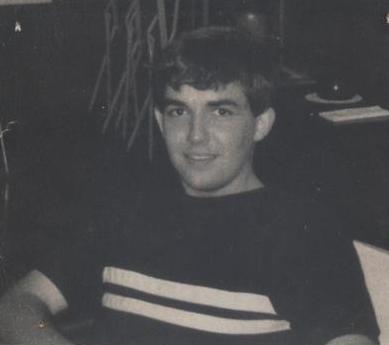
    This was what I looked like during that summer of 1966; I loved this t-shirt and wore it literally every day until it wore out. My sweet Jeanette says I was “embedded in it.”

    tebaldi me
  • Remembering Sixten Ehrling

    Ehrling

    When I had moved to New York City in 1998 and was working at Tower Records, Maestro Sixten Ehrling came in frequently. He was rather cranky the first time I met him: he did not guess that I knew who he was, and he barked at me that no one on the store staff had offered to help him. I let him cool down for a couple of seconds, then I made a small bow, and said: “You conducted my first RING operas, Maestro!”

    From then on, and for years to come, Maestro Ehrling was a customer I always looked forward to seeing. He had a million stories, including tales of how antagonistic the Met musicians were towards him during those RING performances. He taught me how to pronounce the names of the RING characters: “…say ZEEEG-lin-da, not See-GLIN-da!”)

    Then there was his tale of a recording session he had scheduled with Victoria de los Angeles on the day after her marriage. A couple of times, I forfeited my lunch hour just to stay and chat the Maestro up.

    Maestro Ehrling was married to a former ballerina, a very kind woman with Old World manners. As time went by, the Maestro became increasingly feeble and unsteady. He sometimes came in unshaven, wearing rumpled clothing. Then, for a while, Madame would come in alone to get CDs for him, saying he was under the weather but slowly on the mend. For a few weeks, she too stopped coming in. I sensed that Mr. Ehrling had taken a turn for the worse.

    The news came out that Maestro Ehrling had passed away. I wondered if Madame would remain in New York City (I believe they had a daughter living here). Then one day, she came in. She walked up to me with a gentle smile, saying, “I wanted to thank you for always being so kind to Sixten!”  I almost burst into tears. She became teary also. There was nothing more to be said. She held out her hand, which I kissed, and then she left.

  • 25 Years in Gotham

    Perry street

    Above: 118 Perry Street, my first NYC home; the building has been painted since we lived there

    March 28th, 2023 – Today marks the 25th anniversary of my move to New York City; after spending 22 years in Hartford, working at a thankless job with a bunch of wonderful people, I was ready to achieve my long-held goal of being a New Yorker before my 50th birthday.

    Me and wei-1

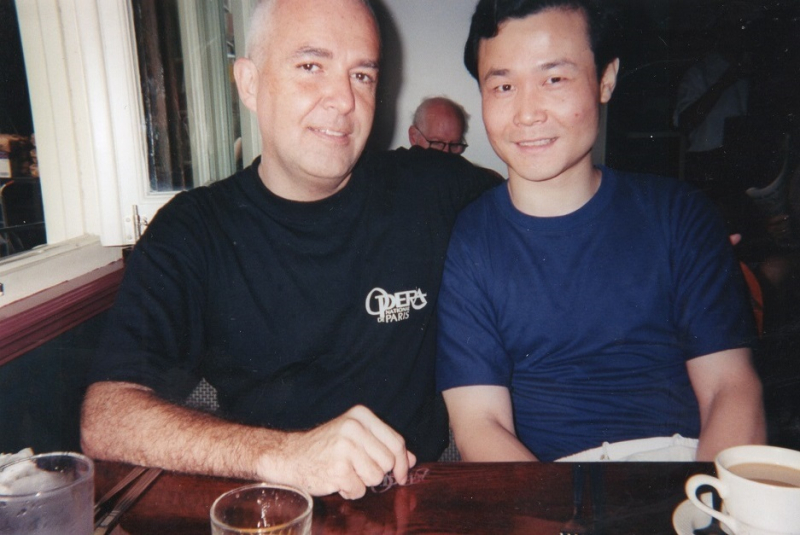
    Within two weeks of arriving in The City, I met Wei (above)…and I started a job in the opera room at Tower Records. My friends Paul and Tom had rented me their studio on Perry Street, and Wei and I were very cozy there for five years – a time period that included the 9/11 terrorist attack on the World Trade Center. I’ll never forget that morning, and rushing down to the street to see smoke pouring out of the Tower.

    15823701_10209672727348991_7172093874094922565_n

    My friend Richard (above) came down often during those years. and continued to do so until his untimely death in 2016.

    In 2003, Paul and Tom wanted their studio back, so Wei and I moved up to inwood. After a few weeks of feeling disoriented, I came to love it up here. Now, as the third act of my life/opera draws to a close, I keep wondering what the fourth act has in store for me. My friend Dmitry says, “The fourth act is the ballet!”

  • @ US Open Qualifiers ~ 2022

    Yy jpg

    Above: China’s Yue Yuan

    Tuesday  August 23rd, 2022 – Every Summer, since moving to New York City in 1998, I have gone to the US Open. For several years, we bought tickets and saw favorite players like Martina Hingis, Kim Clijsters  Paradorn Schrichaphan, and Richard Gasquet; but as tickets became increasingly expensive and audiences seemed to be there more for the event than the actual game of tennis, I started going to the qualifying tournament. For a few years, this was a perfect solution for me, since most attendees were very serious about tennis; but then one summer the NY Times ran an article about this fantastic, free, all-day tennis event in Queens, and the qualifying tournament became a destination.

    The qualifiers take place the week before the main tournament starts. Admission is free, and all day – and sometimes until late at night – you can move from court-to-court and see exciting newcomers as well as established players who – thru injury or just plain bad luck – have fallen down the rankings and who have come to the Tennis Center hoping to win a berth in the main draw. This year, such wonderful players as Fernando Verdasco, Gilles Simon, Andreas Seppi, and Pablo Cuevas were among those vying for a spot in the main draw line-up; unfortunately, none of them played today…they were all scheduled for Wednesday instead.

    ZacharySvajda

    Having missed 2 years of live tennis due to COVID, I truly enjoyed being back at the Open. The first match I watched today today was between two Americans: Zachary Svajda (above) and Aleksandar Vukic. This year, there were no lines-people on the courts: Hawkeye is now in charge of determining what’s in and what’s out. Still, from somewhere, cries of “out!” were heard throughout the day. During the Svajda/Vukic match, the scoreboard malfunctioned; a ball-boy took a bathroom break and wasn’t on court when he was needed. But the match proceeded, with the youthful Mr. Svajda cruising to an early lead. The taller and seemingly stronger Mr. Vukic pulled even at 4-all, but the cunning Mr. Svajda held fast and took the first set. Svajda pretty much dominated the second set, though Vukic had his moments.

    Over on court 17, a duel between big hitters – Ernesto Escobedo and Ethan Quinn – was great fun to watch: both players were simply pounding the ball, and Escobedo produced some brilliant aces. It was Escobedo who took the first set; but Quinn, who is 18 years old, seemed to have the audience’s backing, and he was relentless in the next two sets, claiming the win.

    After a walkabout, I circled back to Court 17 where the long-legged Chinese beauty Yue Yuan faced America’s Katie Volynets. Ms. Volynets could not seem to do anything against Yue Yuan’s onslaughts in the first set, but she stepped up her game considerably in the second set, which went to a tense tie-breaker, which Yue Yuan finally won. The Chinese player’s cracking serve was something to see, and she used it as a weapon in her march to victory.

    Thundershowers had been predicted, but none materialized: it was a simply perfect day. Despite the usual distractions – and the fact they wouldn’t take cash when I went to buy my humble lunch – I was very happy to be back at the US Open.  

    Go 2017

    Above: Go Soeda at the US Open Qualifiers in 2017

    Among the lesser-known players who I came to love over the years of watching the qualifying matches, I was sad – though not surprised – to see that the Japanese player Go Soeda was not participating this year. I think I have seen Go in more matches than any other player; he has a beautiful, classic game with deep shots, perfectly placed. He won almost every match I saw him play over the years, but I don’t remember him ever getting beyond the the first round of the main draw. Recently, I read that Go has become a father, and has retired from tennis. I certainly missed him at the Qualies this year.

    UPDATE: How did the players I saw on Tuesday fare in the rest of the qualifying tournament? Both Zachary Svajda and Ethan Quinn lost in their second-round matches, by Yue Yuan won both her second and third round matches, and she advances to the main tournament.

    Interestingly, two Chinese players – Wu Yibing and Zhang Zhizhen – prevailed in their three qualifying rounds, and they become the first Chinese men to enter the main draw at the US Open.

    ~ Oberon

  • Remembering Makiko Narumi

    With eve shapiro 2000

    Above: Makiko Narumi with director Eve Shapiro

    April 30th, 2022 – Twenty years ago on this date, my friend the Japanese contralto Makiko Narumi passed away at the age of 33. I first met Makiko soon after I moved to New York City in 1998; I had heard her singing Schumann’s Frauenliebe und -leben at a Juilliard liederabend and was simply blown away by the sound of her voice, and a few days later she came into the opera room at Tower Records where I was working; she was stunned when I addressed her by name.

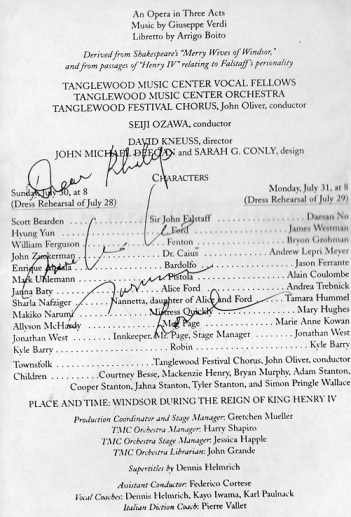
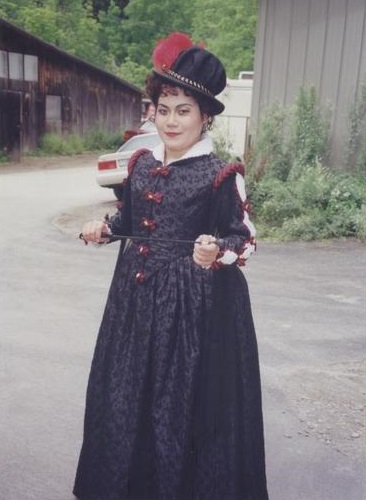
    We struck up a friendship and over the next 3 years I heard her many times at Juilliard (both in opera and lieder), in the semi-final and final rounds of the Met Auditions, at a Licia Albanese Foundation gala, at private concerts, singing the Rückert Lieder with the Juilliard Orchestra, and – in 2000 – at Tanglewood as Dame Quickly in FALSTAFF, conducted by Seiji Ozawa. Her last public appearance was singing the Mahler 2nd at Carnegie Hall just a few weeks before she passed away…a very emotional evening for both of us.

    I have some recordings of Makiko’s voice, but it’s always difficult for me to listen to them. Here she is singing at a house party at Aspen in 2000…

    Makiko Narumi – SAMSON ET DALILA ~ aria – Aspen 2000 – private recording

    …singing Brahms…

    Makiko Narumi – Von ewiger Liebe ~ Brahms

    …and singing Mahler at a Juilliard recital…

    Makiko Narumi – Mahler ~ Rückert Lieder – HoJeong Jeong piano

    …more Mahler: the Urlicht

    Mahler – Urlicht – Makiko Narumi – M Baitzer – 1999(1)

    One of the happiest days of our friendship: the Tanglewood FALSTAFF:

    1175885WOOzbiA

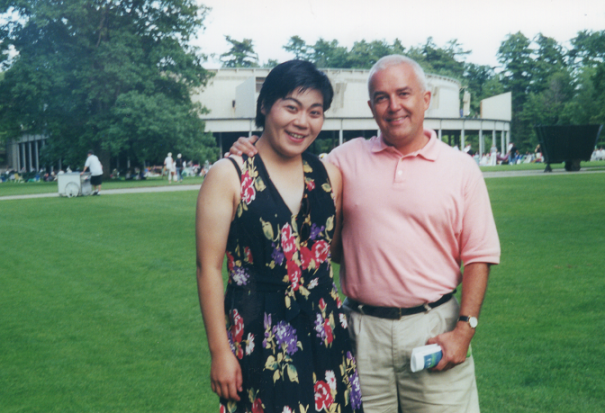
    Here we are on the lawn at Tanglewood after the performance in the Summer of 2000…

    118111jC9ldEDF

    …I even asked for her autograph!

    Makiko tanglewood falstaff

    Above: Makiko costumed as Dame Quickly…

    1185364kaB3O31

    …and here’s the entire cast of the Tanglewood FALSTAFF with Maestro Ozawa.

    I love to think of her now, bolstering the contralto section in the heavenly choir. 

    Makiko’s memorial:

    Makiko's memorial 2002-1 jpg

    A message from Makiko’s parents:

    Message from makiko's parents-1jpg

  • Samuel Hasselhorn ~ Erlkönig

    Hasselhorn

    Samuel Hasselhorn sings Franz Schubert’s Erlkönig with the Orchestre Régional de Normandie, conducted by David Wroe.

    Watch and listen here.

    I’ve had the pleasure of hearing Mr. Hasselhorn in two recitals here in New York City. As a Young Concert Artists winner, he sang at Merkin Hall in 2017, and at The Morgan Library in 2018.

  • Julius Huehn

    Huehn-Julius-03

    Born at Revere, Massachusetts in 1904, bass-baritone Julius Huehn’s career centered at the Metropolitan Opera, where he sang over 225 performances with the Company in New York City and on tour. He also appeared with the opera companies of San Francisco, Chicago, and Philadelphia.

    His Met debut took place in 1935, as the Herald in LOHENGRIN. His Met roles included Wagner’s Wotan/The Wanderer, Donner, Gunther, Wolfram, Amfortas, Kothner, Kurvenal, and Telramund; Strauss’s Orestes, Jochanaan, and Faninal; Pizarro in FIDELIO, Escamillo, Sharpless, and the High Priest in SAMSON ET DALILA.

    Huehn left the Met in 1944 to serve in the Marine Corps during the final year of World War II. He returned in 1946 for a single performance as Wolfram. He subsequently taught at the Eastman School for many years, and passed away at Rochester, New York, in 1971.

    Julius Huehn as Kurvenal, with Lauritz Melchior:

    Julius Huehn & Lauritz Melchior – TRISTAN UND ISOLDE ~ scene from Act III

    Listen to Julius Huehn sing Wotan’s Farewell from WALKURE here, and the duet of Telramund and Ortrud (with Kerstin Thorborg) from the opening of Act II of LOHENGRIN here.

  • Sabine Devieilhe as Olympia

    Snapshot sabine

    French soprano Sabine Devieilhe sings Olympia’s showpiece “Les Oiseaux dans la Charmille” from Offenbach’s CONTES D’HOFFMANN. Watch and listen here.

    In January 2019, Mlle. Devieilhe gave a recital at Weill Hall here in New York City that was simply delightful. 

  • Juan Pons sings “Nemico della patria!”

    Snapshot pons 2

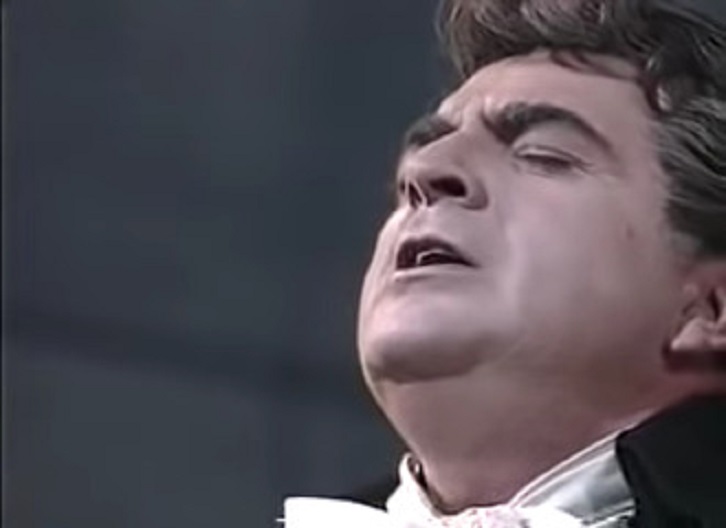
    Juan Pons sings the great aria “Nemico della patria!” from ANDREA CHENIER from a Met telecast in 1996. Watch and listen here.

    Pons, always such a generous singer, gave more than 300 performances at The Met in New York City and on tour. His name still crops up from time to time, singing character roles at Eurpoean houses.