Tag: New York City Opera

  • Singers: Gilda Cruz-Romo

    (This paean to the Mexican soprano Gilda Cruz-Romo first appeared on Oberon’s Grove in 2008.)

    gilda 1

    In the Autumn of 1969 I decided to move to New York City; I withdrew all my savings from the bank and reserved a room at the Empire Hotel at a monthly rate. The plan, as I sold it to my parents, was that I would find a job and then an apartment. In actuality, all I really wanted to do was go to the opera every night. And that is exactly what I did, forgetting about job-hunting til my cash gave out and I returned home after a few weeks.

    Unfortunately for me, that was the year of the Met orchestra’s strike. But I was not to be deterred: I went to every single performance of the New York City Opera’s Autumn season. Standing room cost next-to-nothing and I already had some favorite singers there – people like Beverly Sills, Maralin Niska, Patricia Brooks, Enrico di Giuseppe, Dominic Cossa and Norman Treigle. Treigle was in fact the focus of that Autumn season since NYCO was mounting a production of Boito’s MEFISTOFELE for him. Carol Neblett was singing the dual role of Margherita and Helen of Troy; but for the final performance of the run a debut was announced: a Mexican soprano named Gilda Cruz-Romo.

    One never knows what to expect from a debut, and that was especially true back then when there was no Internet buzz, YouTube or Facebook that might have provided an inkling or an outright sample of a new singer’s work. In the weeks prior to her debut, I’d actually seen Gilda and her husband Bob Romo several times around Lincoln Center and at the Footlights Cafe; I’d even said hello to her and as a young, unknown singer she seemed genuinely thrilled to be recognized. But what – I kept wondering – does she sound like?

    Her performance was something of a revelation: it was a big, warm lyric voice bordering on spinto. Her tone had an unusual freshness and clarity, with a pliant technique and shining upper register, and the kind of vocal candor that one finds in a new singer who just sings without relying on artifice. The audience took to her at once – the fans sensing that here was an Italianate voice that had real potential in the Verdi & Puccini repertoire. After the great aria “L’altra notte”, Cruz-Romo was warmly applauded but it was in the Helen of Troy scene that she capped her success: in the great concertato “Amore mistero!” the voice sailed out over the ensemble with a gleaming quality and as the line soared up to its climatic top-B the sound seemed to blossom – and Cruz-Romo swept onwards to triumph. I met her after the performance; she and her co-stars Norman Treigle and Nicholas di Virgilio all signed my program:

    gilda 2

    The next afternoon at Footlights a small gathering of fans met and we played over and over again our house tapes of the performance; we must have listened to that ensemble about twenty times. People at neighboring tables were drawn to the sound of her voice. In those days, New York City Opera was a real Company: if you made a successful debut you were invited back and became part of the family and were cast in as much repertoire in your fach as was available. Obviously Julius Rudel knew a special voice when he heard it, so Gilda – as we were by now all calling her – sang there for the next 2 or 3 years until the Met snatched her away.

    And so I saw her in more performances of MEFISTOFELE, as a glowing-voiced Butterfly and a golden-toned Mimi (especially moving) and – in one of her first ventures into the heaviest rep – Amelia in BALLO IN MASCHERA. Of her City Opera performances, my very favorite was her Tosca in 1971:

    “…Gilda surpassed my highest expectations as Tosca. Rarely has this role had such a balanced combination of: a beautiful face, fine stage presence, sincere acting, fine diction and GORGEOUS spinto singing. In the first act, many phrases of great beauty. She looked lovely, young and excited. In Act II she sang superbly, her high Cs large and luminous. The dramatic utterances were all convincingly delivered. As she neared the end of her marvelously phrased “Vissi d’arte” tears welled up in her: one sob at the end, straight from the heart, was a perfect effect. She carried off the murder and the acting demands of the closing of Act II with excellent control. Maintaining her high level in Act III, Gilda ended the opera on a stentorian top-B and took a death-defying leap of ten feet! She was given a tumultuous ovation eminently deserved. Backstage she was literally mobbed – as big a crowd as I’ve seen at NYCO. After edging my way through the throng we hugged and she kissed me so many times. It took a few moments before either of us could speak…”
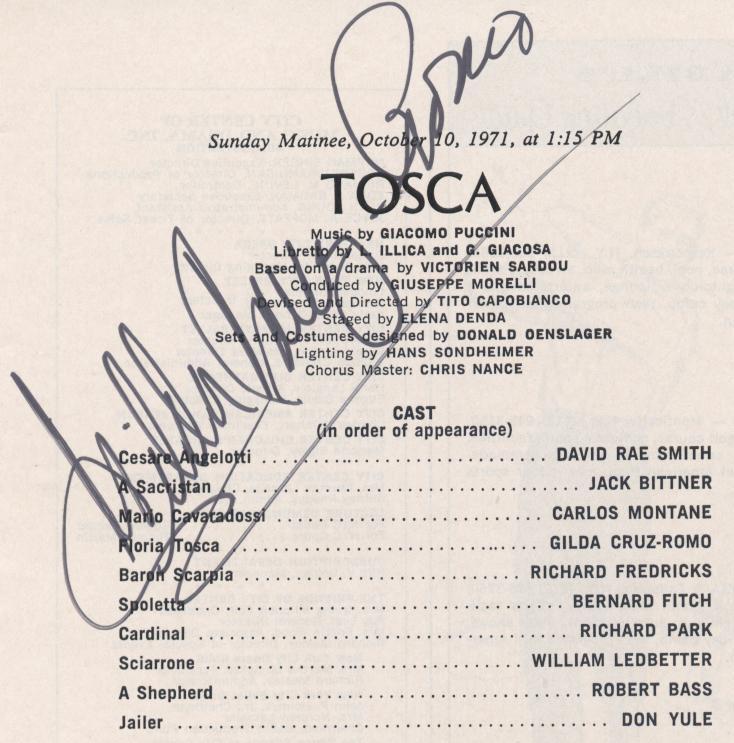
    gilda tosca

    When things calmed down and we got to discuss the performance, she told me how petrified she was of taking that final jump. The production was designed so that Tosca’s suicidal leap was visible to the audience as she fell about a dozen feet before a parapet blocked her landing-mattresses from view. She had not had a stage rehearsal and she said she got to the edge of the platform and realized in a split second how exposed her descent would be; she crossed herself and took the plunge.
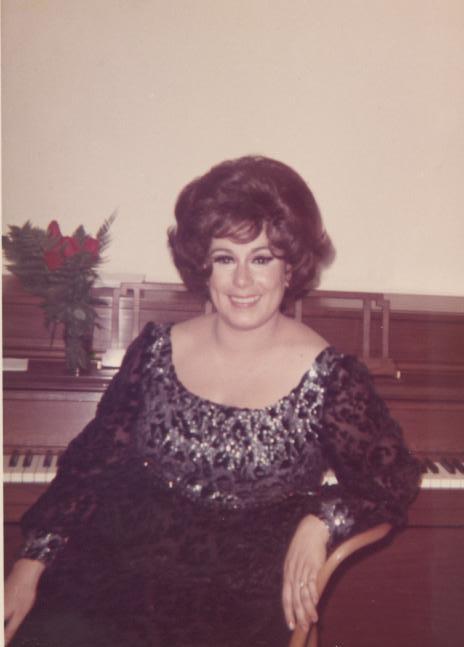
    gilda 4

    It was inevitable that a voice like Gilda’s would be both wanted and needed at the Met. In 1970 she entered the Met National Auditions and was a finalist, singing “La mamma morta” from ANDREA CHENIER. On May 8, 1970 she debuted with the Company on tour in Atlanta singing that same opera. In December of the same year she debuted at the Met proper as Butterfly, beginning a career there that stretched into the mid-1980s and encompassed over 160 performances.
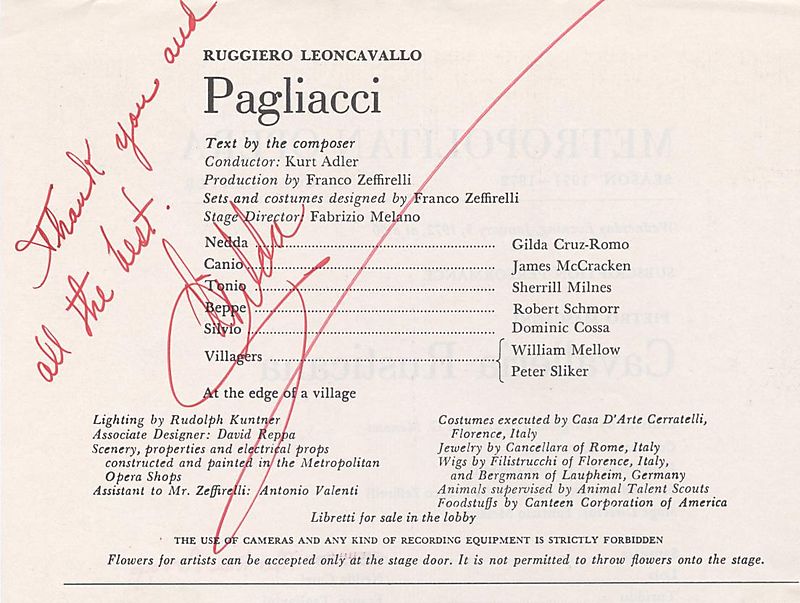
    gilda pag

    I saw her at the Met for the first time as Nedda in PAGLIACCCI opposite the frighteningly intense Canio of James McCracken. Gilda sang so beautifully, especially in the sensuous duet with Silvio (Dominic Cossa): “…great crescendos from tiny pianissimos...” It was after this performance that she and I were photographed together backstage. (OK, no comments about my tie…or my hair! Remember this was the 70s).
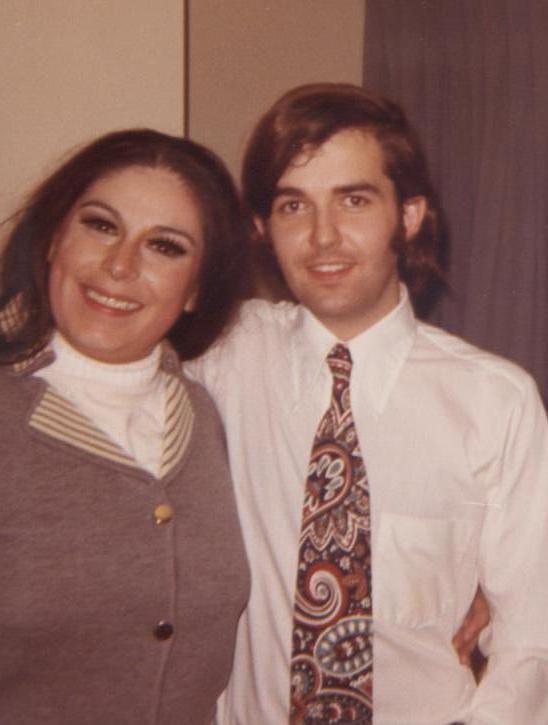
    gilda 3

    Then came a hiatus: I moved to Houston for a while and only kept tabs on her via the broadcasts. But after a while I was lured back to the Northwest and we had a beautiful reunion at a matinee of AIDA where she sang opposite Franco Corelli:

    …Gilda was in complete command of this arduous role every step of the way…there were phrases upon phrases of golden Verdi singing: her deeply-felt prayer at the end of ‘Ritorna vincitor’ and the miraculously spun high pianissimi in ‘O patria mia’ and even more incredibly on ‘Fuggiam, fuggiam…’ as she lured Corelli into her escape plan. She was able to healthily dominate the big ensembles and then turn around a float effortlessly in the tender ‘O terra addio…’  Really top-class Verdi singing!”

    Gilda also sang in a revival of MANON LESCAUT and sounded lovely despite being cast opposite a very mediocre tenor. Her ‘In quelle trine morbide’ was poignantly phrased, mirroring Manon’s longing for the simple, true love of her Chevalier des Grieux. (Photo: Bill Hendrickson).

    Gilda Cruz-Romo – In quelle trine morbide – MANON LESCAUT -Met dress rehearsal 1973

    Then several things happened which kept me from seeing her onstage at the Met; I moved to Hartford with TJ and for a couple years we were basically broke. Trips to New York were infrequent and most of the time ballet trumped opera.  Then too, Gilda’s international career was in full bloom; it seemed she sang everywhere and sang the most taxing repertoire – I think I once read that she ended up singing Aida five-hundred times! It seemed like whenever I was at the Met, she was somewhere else.

    gilda desdemona

    Thus it was a special pleasure when she came to Hartford and sang Desdemona in OTELLO (above), one of her most attractive roles. In 1979 she was Desdemona on a Met telecast opposite Placido Domingo and Sherrill Milnes.

    In 1987 I saw Gilda onstage for the final time, as Cherubini’s Medea at Bridgeport, Connecticut. The declamatory style of many of the character’s utterances didn’t suit her so well – she was always a melodic singer – but the voice was still powerful and expressive.

    I met her again a few years ago when she was honored by the Puccini Foundation. I handed her the photo of the two of us and it took her only a half-second to realize who I was…I have changed MUCH MORE than she has!  We keep in touch now; she lives in San Antonio and I was tickled to read recently that she keeps up her deep-sea fishing and is also active in a local Texas group which matches senior citizens with canine companions:
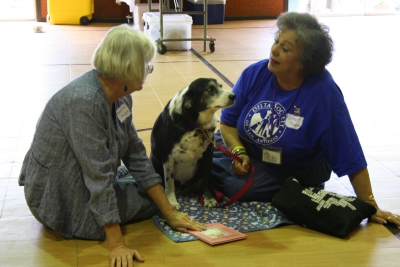
    gilda 5

    It’s been a long time since that day in Footlights soon after her NY debut that I pestered her with a million questions and she was unbelievably kind and patient. Once I wrote to her after she’d sung the title role in ANNA BOLENA in Dallas expressing my dismay that I couldn’t have been there; a few days later I was astounded to open the mailbox and find she had sent me a tape of the performance. That’s the generosity of spirit that Gilda always shows. So now, with love and gratitude, I’ve tried to put my admiration for her into words.
  • Jerry Hadley & Judith Haddon ~ BUTTERFLY Duet

    Butterfly h h

    Watch a video clip of Jerry Hadley and Judith Haddon singing the love duet from a 1982 New York City Opera performance of Puccini’s MADAMA BUTTERFLY here.

  • Patricia Brooks as Mélisande

    Brooks 2

    Above: Patricia Brooks

    One of my dearest memories from my early opera-going experiences is of my first PELLEAS ET MELISANDE, in a lovely production at New York City Opera in 1970. Debussy’s haunting score moved me, even though it was not always easy to comprehend. And the poetry of the words conveyed a sense of mystery; since I had studied French in high-school (with a native-born Frenchwoman as my teacher) it was engrossing to listen to the language being sung.

    One of the most memorable portrayals in the superb cast was that of the mysterious, fragile Mélisande by Patricia Brooks. Apart from her iconic Violetta, Mélisande was the Brooks role that I recall most vividly. I was so excited to find this recording on YouTube.

    Read more about this soprano here.

    Julius Rudel is the conductor, with the following cast:

    Arkel – Malcolm Smith; Geneviève – Francis Bible; Golaud – Louis Quilico; Pelléas – André Jobin; Mélisande – Patricia Brooks; Yniold – Robert Puleo; Physician – Don Yule; Shepherd – William Ledbetter

    The above names may be largely forgotten by now, some 55 years on. To me they were remarkable artists who played a part in my abiding passion for opera.

    If you are not familiar with the Brooks voice, this will give you an idea of her unique qualities as a singer:

    Patricia Brooks as Violetta – w Molese – NYCO – 9~28~69


  • Coming Out ~ 50 Years Ago Today

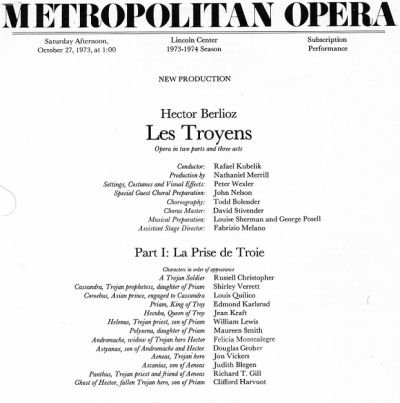
    Troyens jpg

    On October 27th, 1973, after spending a very long time in the closet, I had my first gay sexual experience. It was both thrilling and a bit frightening, but what I remember most was a great feeling of relief…and then wondering why it had taken me so long to do it.

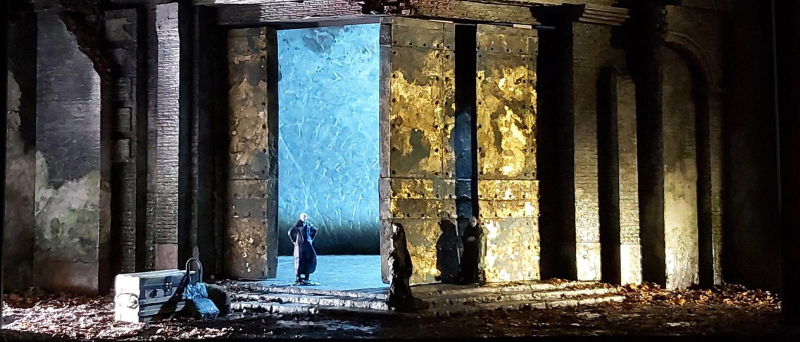
    That day, I had spent the long afternoon with several of my opera-friends at The Met watching LES TROYENS  It was my first time seeing this monumental work, and it was unbearably exciting. Among the group was Z, the boy I had set my sights on since moving back home from Houston earlier in the year.

    Looking back, it all seemed pre-arranged, but at the time it felt spontaneous. After the Berlioz matinee, our friends all went their separate ways. But Z and I had 5th Ring tickets for an evening performance of FAUST at the New York City Opera. He sat in front of me in the single seats, whilst I was aching with desire; at this point, nothing had been said about spending the night together. 

    After Marguerite had succumbed to Faust’s poetic charms in the Garden Scene, we mutually decided it was time to leave. Z looked at his watch and announced that he’d missed the “last bus” home. Haltingly I said, “You can stay with me at the hotel.”

    We walked over to the Henry Hudson; nothing much was being said. We stayed up for a while, talking opera, and then it was time. He sat on the twin bed, undressing. “Should I sleep in the chair?” he asked. “I’ve slept in smaller beds with bigger people…” I replied. (This was a lie; I had only ever slept with my girlfriend, and always in big beds).

    So, keeping our briefs on, we got under the covers and turned out the lights. For what felt like an eternity, nothing happened. I began to think that maybe I had mis-read the situation and that we were simply going to sleep together. He had his back to me; the warmth and smell of his body were killing me. Suddenly, I put my arms around him, and several wonderful things happened. 

    After a while, we grew drowsy. “I’ve never done this before,” I said sleepily. “Me neither!” he replied. Keeping him in my arms, we drifted off.

    Waking to daylight, I got quickly out of bed and got dressed: I was meeting friends for breakfast. Z was groggy; he dressed slowly. I assumed he would head home, but – without saying anything – he tagged along to the diner.

    Our friends were obviously intrigued when we showed up together, but nothing was said. Only the quiet, bookish TJ looked at me knowingly. The conversation turned to the inevitable topic – opera – and my magical “morning after” became just another day.

    The aftermath: in the ensuing weeks, whenever I was in New York City, Z was friendly on the surface, but evasive on a personal level. He stood me up for a couple of lunch dates. I was naive enough to think that, because we had shared a sweet experience, we would become lovers. I became distraught.

    Unhappy to the core, I confided in TJ. He listened to my story patiently, then told me that Z already had a boyfriend and that he was unlikely to become the lover I was looking for. TJ and I spent more and more time together, and I became very comfortable with him as my confidante. Finally, I invited him to visit me in the little town. Our first night was awkward: I was such a novice, but he – who was four years younger than me – was already pretty experienced, starting with having been raped by his college roommate. 

    Over time, TJ and I developed a deep relationship; he invited me to spend the summer of 1974 with him on Cape Cod, working for a small-time ballet company. At summer’s end, I drove him to Sarah Lawrence where his senior year was about to begin.

    Our unspoken plan was to resume our lives – he at school and me back in the little town – and see each other whenever I came to the City. As we sat in the car saying goodbye, he suddenly started crying; it was then that I realized how strong our attachment was. Instead of leaving, I spent the night in the dorm with him. I left the next morning, but a few days later I received a letter from him, asking me to come and live with him in the dorm.

    This was the beginning of my life, really. When TJ had finished school, we moved to Hartford, where I spent the next 22 years. After a year, our domestic life faltered when I became smitten with someone else. TJ and I had a bad break-up, and he never spoke to me again. I embarked on a long and promiscuous journey, having a strange tendency to fall in love with everyone I slept with. 

    Meanwhile, my ultimate goal – to be living in New York City before my 50th birthday – loomed before me. At times, I thought it would never happen; but by a simple twist of fate, I moved to My City three months before the date I had set for myself.

    ~ Oberon

  • @ The Met’s Opening Night ~ MEDEA

    Met medea

    Tuesday September 27th, 2022 – The Metropolitan Opera opened their 2022-2023 season this evening with the Met premiere of Cherubini’s MEDEA. Originally performed in French – the opera’s world premiere took place on March 13th, 1797, at the Théâtre Feydeau in Paris – MEDEA in its Italian version became one of Maria Callas’s greatest triumphs.

    This was my fourth time experiencing MEDEA in the theatre. In 1974, the New York City Opera staged the work for their premiere singing-actress, Maralin Niska, who was magnificent in the role. Incredibly, in 1982, the Company offered another new production of the work – somewhat more timeless in feeling – with Grace Bumbry very effective in the title-role. In 1987, the opera was given in Bridgeport, Connecticut, in a traditional setting; Gilda Cruz-Romo sang Medea. Gilda, a longtime favorite of mine, was not ideally suited to the role but she still had plenty of voice a her disposal; it was the last time I ever saw her onstage. 

    Met Opening Night tickets being prohibitively expensive, I took a score desk for this performance; I plan to go a second time to have a view of the sets and costumes. This evening was a huge personal triumph for Sondra Radvanovsky; singing to a sold out house – a real rarity at The Met in this day and age – she won a thunderous ovation of the kind singers like Tebaldi, Nilsson, Rysanek, and Dame Gwyneth Jones used to garner. Sondra deserved every decibel, for she threw herself into the difficult and demanding role with total commitment.

    The evening opened with the national anthem. I have always love singing it, but when we came to the words “…o’er the land of the free…” and was suddenly overcome with grief. We seem to be rushing headlong to our doom as a great democracy; I am hoping I won’t live long enough to experience the bitter end.

    MEDEA itself is maddeningly uneven: thrilling passages – mainly for the title-character – alternate with routine music; conductor Carlo Rizzi led a performance that was more dutiful than inspired. It was in the individual singers that the evening made its musical impact; chorus and orchestra played a vital role in keeping the opera afloat when the main characters were otherwise occupied.

    Matthew Polenzani’s Giasone is quite different from that of such earlier stalwarts in this music as Jon Vickers and James McCracken: more lyrical and thus more vulnerable. Polenzani sang beautifully, and his voice carried perfectly in the big hall. His expressive range veered from poetic (with his bride) to defiant (dealing with his ex-), to ultimate despair as he watched his entire world go up in flames. 

    Janai Brugger’s Glauce made much of what is a rather ungrateful role; Glauce has a very demanding aria early in the opera and thereafter is eclipsed both musically and dramatically by her rival, Medea. Ms. Brugger’s voice sails easily into the hall, and she combined full-toned lyricism with technical assurance.

    Michele Pertusi has had a long and distinguished career, and tonight, as Creon, he was most impressive. The voice is steady and sure, and it fills the house. It’s always wonderful to hear a native Italian making the most of the words. Pertusi’s Creon was outstanding, establishing real authority.

    I had previously experienced Ekaterina Gubanova as a powerful Cassandra in a concert performance of LES TROYENS, and as Brangaene in a concert version of Act II of TRISTAN UND ISOLDE where she sounded a bit taxed in her upper range. Tonight, as Medea’s faithful companion, Neris, Ms. Gubanova was superb. Her poignant aria, with its haunting bassoon accompaniment, was the musical centerpiece of the evening. The singer seemed to hold the house under a spell as she sang of her devotion to her mistress, winning warm applause at the aria’s end, and an enthusiastic round of bravas at her bows.

    Mille bravi! to Met principal bassoonist Evan Epifanio for his gorgeously mellow playing in Neris’s aria; he and Ms. Gubanova ideally complimented one another. 

    Witnessing the Radvanovsky triumph was vastly pleasing to me, as I have been a great admirer of the diva since her days as a Met Young Artist. In her many performances that I’ve experienced, she has always seemed to have a unique gift for making opera seem important. Sondra’s dynamic range is her greatest gift: the incredible focus and power of her highest notes can be followed moments later by a shimmeringly “alive” pianissimo. And she has an enthralling stage presence: a fearless actress, she seems to become the woman she is portraying. All this made her Medea a holy terror.

    Medea makes a sneaky entrance, and soon she is alone with her former lover/husband, to whom she pours out her emotions in the great aria “Dei tuoi figli la madre…“; here, the Radvanovsky voice ranges from extraordinary tenderness to blind fury. I might have wished for a more chesty expression at “Nemici senza cor!” (Sondra really opened the chest range in Act II!) but the soprano knew what she was about. Polenzani gave a powerful response, eliciting a blistering, sustained top note from the furious sorceress. They quarreled on, to brilliant effect.

    Act II commences without a break (thank god they didn’t bring up the houselights to quarter!) and Sondra, who had had a couple of throaty notes in Act I, was now blazing away on all cylinders, the voice fresh as can be, and the increasing use of chest voice adding to the thrills. Medea’s pleadings to Creon to be given one more day in Corinth cover a wide range of cajoling and deceit…Sondra and Mr. Pertusi were electrifying here. And when she won, Sondra celebrated her success: Medea now has time to work her destructive spells.

    Following Neris’s gorgeous aria, sounds of the wedding ceremony are heard, with the chorus invoking the gods to bless Glauce and Giasone. Medea counters this with diabolical mutterings of her own, cursing the crowd with a starkly chested “Rabia infernal!“. Then, suddenly, she sails up to a vibrant final phrase. I admit I was kind of hoping Sondra would “take the fifth” here, as Callas sometimes did, but that notion was lost in the barrage of applause.

    Act III is only about 30 minutes long, and is preceded by an over-long prelude. Sondra again stuns us with her powerful “Numi, venite a me!” and then gives us her finest, most magical singing of the evening with “Del fiero duol!” capped by en enormous high note. Polenzani, maddened by grief, assails her: “Our sons! What was their crime that they deserved to die?”…to which she answers, “They were your children!”

    I stood up from my desk to watch the finale: flames are licking at the walls of the temple; the corpses of the two boys are lying on the floor upstage. Medea delivers her final line to Giasone: Al sacro fiume io vo! Colà t’aspetta l’ombra mia!” (“I go to the sacred river…there, my shade will await you!”) and moves slowly to her dead sons. She settles herself between them, taking their bodies in her arms as the entire temple is engulfed in flames.

    There’s a video of tonight’s finale – and the curtain calls – that is a wonderful souvenir of the evening. However, having been recorded on a cellphone, it gives no idea of the sheer volume and depth of the sound of a full-house standing ovation at The Met. To Sondra, it must have felt like being hit by an avalanche of affection. Watch here.

    ~ Oberon

  • @ My Met Score Desk for LUCIA DI LAMMERMOOR

    Bloody_dagger_

    Saturday May 21, 2022 matinee – Having no interest in seeing the Met’s Rust-Belt setting of LUCIA DI LAMMERMOOR, I took a score desk for this afternoon’s performance. In the Playbill, there’s a long essay by the director of the production. I didn’t bother to read it. This succinct program note from Tito Capobianco’s production for Beverly Sills at New York City Opera in 1969 tells us all we to need to know:

    Lucia jpg
    I recently asked a longtime singer/friend of mine why singers who should know better agree to appear in these bizarre and unsuitable productions, and he said: “If you want to work in opera nowadays, this is what opera has become. Take it or leave it. If you start turning down productions that do not respect the composer or librettist, you will soon stop being asked.”

    So I sat with my score before me this afternoon, creating my own production in the theater of the mind. There were a lot of empty seats, more than usual for a matinee. And people laughed aloud at times: there is nothing very funny about LUCIA, really, but perhaps the libretto’s reference to Edgardo’s announced journey to the “friendly shores of France”, or Enrico telling Normanno to ride out “on the road to Scotland’s royal city” to greet Arturo, seemed out of place in the Rust Belt. It must always be a pesky thing to these cutting-edge directors to have to deal with references in librettos that deter them in their quest to make opera relevant to modern audiences.

    Maestro Riccardo Frizza conducted the opera as if it were early Verdi. He sometimes let the orchestra cover the singers. The harp solo that opens the opera’s second scene was sublimely played by Mariko Anraku, but she had to contend with stage noises caused by the moving set, and then – as the solo neared its end – a cellphone went off. 

    The vocal stars of the afternoon were Polish baritone Artur Ruciński – who scored a great personal success as Enrico – and Christian van Horn, stepping in for an ailing Matthew Rose and singing magnificently as Raimondo.

    In the opera’s opening scene, Mr. Ruciński’s voice showed its customary warmth and power; his extraordinary breath control allowed him to sail thru long phrases effortlessly, and he sustained the final note of his cabaletta throughout the musical postlude. In the duet where Enrico forcibly brings Lucia around to his was of thinking about her impending marriage, Ruciński sounded splendid, with an exciting mini-cadenza at “…insano amor!” And, as at the 2019 Richard Tucker Gala, he brought the baritone line in the sextet very much to the fore.

    Mr. van Horn made every word and note of Raimondo’s role count; his voice spans the music’s range comfortably, and has both strength and nuance. In the duet where the chaplain (do they have chaplains in the Rust Belt?) persuades Lucia to yield to her brother’s demand that she marry Arturo, Mr. van Horn’s sense of line had a wonderful rightness, and once he had secured Lucia’s agreement, he expressed the character’s joy and relief with some powerfully righteous vocalism. Another great moment in the van Horn Raimondo came as he stepped between the adversaries to prevent bloodshed at the wedding ceremony: 

    “Respect in me
    the awful majesty of God!
    In His name I command you
    to lay down your anger and your swords.
    Peace, peace!…
    He abhors
    murder, and it is written:
    He who harms another by the sword,
    shall perish by the sword.”

    This is one of the opera’s great moments, and Mr. van Horn sang it thrillingly.

    To hear this basso sing Raimondo’s announcement of the murder of Arturo almost persuaded me to stay to the end of the opera. If I say that Mr. van Horn was as thoroughly impressive and satisfying in this role as Robert Hale had been in the City Opera’s Sills production, that is very high praise.

    Had our Edgardo and Lucia attained the level as Mssrs. Ruciński and van Horn this afternoon, this would have been one of the great LUCIAs of my experience. But Javier Camarena’s voice, while clear and pleasing, seemed a size too small for this music in the big House. For the most part, the conductor did not push the tenor to extremes, but a bit more ring and vigor were wanting. Passing moments of flatting and throatiness could be forgiven at this, the final performance of the run. The popular tenor seemed to struggle at times in the Love Duet, which was spoilt anyway by the persistent cough of someone in the audience. But he did go for the high E-flat, despite the fact that he and Nadine Sierra sounded somewhat screamy at this tense moment.

    Ms. Sierra ‘s tone at first seemed to have a steady beat; this became less prominent as the afternoon wore on, though moments of slightly sharp singing came and went. It is a generic sound, and she does not put a personal stamp on the music as such memorable Lucias as Sutherland, Scotto, Sills, Gruberova, Devia, and Oropesa have done, but, for all that, she had some very exciting moments. For one thing, her top D-flat and D were spot on today, making for exciting ends to her Act I cabaletta, the sextet, and the Act II finale. However, I do not think the Sierra Lucia will be remembered for years to come as the ladies listed above have been and will continue to be. 

    As Normanno, tenor Alok Kumar was covered by the orchestra in the opening scene, but he was incisive later on. Deborah Nansteel fared very well as Alisa, and she handled the ‘high A’ moments in the Act II finale, which elude many mezzos, nicely. Eric Ferring sang the brief but demanding role of Arturo handsomely. 

    ~ Oberon

  • Johanna Meier Sings Strauss & Mahler

    Johanna meier

    I love finding any recordings by Johanna Meier. Despite the missing part of the first Strauss song, her vocalism is so pleasing in this 1982 recording from a concert by the Milwaukee Symphony conducted by Lukas Foss.

    Listen here.

    One of my all-time favorite sopranos, I saw Ms. Meier frequently at The Met and New York City Opera. She made a memorable impression in so many roles: as Puccini’s Musetta and Tosca, as Strauss’s Countess Madeleine, Marschallin, Ariadne, Kaiserin, Chrysothemis (both at The Met and at Tanglewood), as Rosalinda, Marguerite in FAUST, as Mozart’s Donna Anna, and Countess Almaviva, and as Wagner’s Elisabeth, WALKURE Brunnhilde, and – most especially – as Sieglinde.

  • ANDREA CHENIER ~ Final Duet

    Gilda-cruz-romo

    So thrilled to have found this souvenir of one of my favorite sopranos, Gilda Cruz-Romo, singing Maddalena in the final duet from Giordano’s ANDREA CHENIER. Tenor Ermanno Mauro is the poet Chenier in this performance from Tulsa 1981. I simply love the vast wave of applause that sweeps over the house after “Viva la morte insiem!”

    I met and befriended Gilda at the time of her New York City Opera debut in 1969. I saw her many times at both NYC Opera and The Met. We stayed in touch after she retired and settled in San Antonio, Texas. I shall never forget her great kindness to me.

  • Edward Pierson

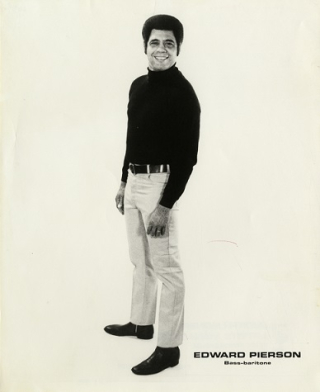
    Pierson

    Bass-baritone Edward Pierson, a stalwart of the New York City Opera for twelve years, was born in Chicago. A scholarship basketball player, he worked for a while as a public school music teacher before pursuing his operatic career.

    His performance of “Ol’ Man River” in several civic productions of SHOWBOAT in the mid-West put Mr. Pierson on the map. By chance, he stepped into a small role in PORGY AND BESS, and soon after made the jump to the role of Porgy himself. 

    At the New York City Opera, his roles included Scarpia, Jochanaan, and Wagner’s Dutchman. I’ll never forget hearing him in the title-role of the Company’s English-language production of Borodin’s PRINCE IGOR:

    Edward Pierson as Prince Igor – NYCO 1969

    Snapshot makropolous

    He also made a memorable impression as Dr. Kolenaty in Frank Corsaro’s multi-media setting of Janacek’s MAKROPOULOS AFFAIR. In the above photo are Maralin Niska (Emilia Marty), Chester Ludgin (Baron Prus), Harry Theyard (Albert Gregor), and Mr. Pierson.

    In concert repertoire, Edward Pierson was a frequent interpreter of Mendelssohn’s Elijah. And he appears on the Deutsche Grammophon recording of Scott Joplin’s TREEMONISHA:

    Edward Pierson – Good Advice ~ TREEMONISHA

    Watch a lovely interview with Mr. Pierson here.

  • Gianna Rolandi Has Passed Away

    Rolandi

    Gianna Rolandi has passed away at the age of 68. She studied at the Curtis Institute, and appeared in many productions at the New York City Opera, starting in 1975. I saw her there several times, her delightful voice sailing into the house effortlessly, tossing off scintillating roulades, and ascending with ease to the highest notes.  

    Roles in which Ms. Rolandi delighted me at New York City Opera were Adele in FLEDERMAUS, Gilda, Rosina, Lucia di Lammermoor, Zerbinetta, and Lakmé. She shone particularly as Handel’s Cleopatra, and she had a great personal success as Janacek’s Vixen Sharp-Ears.

    Ms. Rolandi was a Met Auditions winner in 1974, and she made her Met debut in 1979 as Sophie in DER ROSENKAVALIER; her Octavian was Agnes Baltsa, and they made beautiful music together. I also saw Gianna’s Zerbinetta at The Met.

    She appeared at Chicago Lyric Opera, San Francisco Opera, in Geneva and Turin, and at the festivals at Glyndebourne and Pesaro. She concertized with major orchestras, working with such conductors as Erich Leinsdorf, Leonard Bernstein, Bernard Haitink, James Levine, and Sir Andrew Davies, to whom she was married.

    Listen to Gianna Rolandi as Olympia here, and as Lucia here.

    And listen to her in a role I wasn’t aware she had performed – Oscar in BALLO IN MASCHERAhere.