~ Author: Brad S. Ross
Thursday January 24th, 2019 – Thursday evening at David Geffen Hall was one to behold as music director Jaap van Zweden led The New York Philharmonic in its most exhilarating performance of recent memory and more. The night’s all-American program included the New York premiere of a late master, an American repertory standard, and one of the most hotly anticipated world premieres of the entire U.S. concert season. One to behold, indeed.
The evening began with Elegy, an instrumental interlude from the oratorio August 4, 1964 by the late American composer Steven Stucky. Stucky, who died rather unexpectedly from brain cancer three years ago at the all-too-young age of 66, was one of America’s foremost contemporary composers, having written numerous concerti, one gorgeous symphony, an impressive opera, and two concerti for orchestra, the latter of which won him a long-overdue Pulitzer Prize for Music. As the title suggests, August 4, 1964 details one fateful day during the presidency of Lyndon B. Johnson, including fallout from the Gulf of Tonkin incident and news of the discovered bodies of the murdered civil rights activists Andrew Goodman, Michael Schwerner, and James Chaney in Mississippi. A Dallas Symphony Orchestra commission, the work was given its world premiere under the baton of van Zweden himself in September 2008.
Maestro van Zweden wasted no time at the podium before setting things into motion.
Elegy opened on a great crash—one that was sure to alert the senses of even the most droopy-eyed concert attendee. The piece then descended into more somber territory as a quiet oboe, horns, and strings set its decidedly hymn-like tone. The work possessed an almost filmic sense for drama, often building to thundering crashes followed by slow descents into haunting suspended dissonances. Stucky aptly captured the turmoil of his subject matter, which seemed a prophetic meditation upon much of our current political turmoil. Nevertheless, he ended the piece on a long-held major chord—one that seemed to offer a glimmer of hope in the face of uncertainty. van Zweden milked this finale to tremendous dramatic effect, only lowering his baton after every note had its chance to reverberate throughout the hall several times over.
Up next was Aaron Copland’s Concerto for Clarinet, Strings, and Harp. Originally commissioned and performed by the great jazz clarinetist Benny Goodman, the concerto was one of handful of Copland works that incorporates elements of jazz in its composition. It was written between 1947 and 1949, and went on to become one of the most-programmed clarinet concerti of the entire orchestral repertoire. Performing tonight was Anthony McGill, the Philharmonic’s principal clarinetist.
The piece began on a sorrowful elegy in the strings. Copland’s voice here was its most stubbornly tonal—his broad rhythmic intervals and warm orchestration evoking the great open spaces of North America. A lively and showy cadenza divided the work between its slow opening and an energetic climax, which Mr. McGill played with remarkable precision and zest. The pace was then quickened as the orchestra performed a lovely call and answer in typical Copland fashion. A final ascending glissando in the clarinet and upward rush in the strings brought the work to an animated close. This exuberant finale brought some much appreciated levity to an otherwise solemn musical evening.
If the program had ended here, it still would have easily been a great night at the Philharmonic. What followed, however, transported the merely beautiful to the realm of the sublime. This, of course, was the long-anticipated world premiere of Fire in my mouth by the celebrated American composer Julia Wolfe.
Ms. Wolfe, who co-founded the contemporary classical music organization Bang on a Can in 1987 with the fellow composers David Lang and her husband Michael Gordon, has steadily earned a reputation as one of the world’s finest living composers. Among her notable works are the concerto for string quartet My Beautiful Scream, the chamber/vocal work Steel Hammer, and her Pulitzer Prize for Music-winning oratorio Anthracite Fields. Fire in my mouth, a gargantuan work for girls’ choir, women’s choir, and orchestra, marks her largest composition to date.
A New York Philharmonic commission, the piece is based on the infamous Triangle Shirtwaist Factory fire that took the lives of 146 New York City garment workers, most of whom were young immigrant women, on March 25th, 1911. The owners had locked the doors factory doors to prevent theft, leaving the workers trapped inside when the fire broke out. They died of burns, smoke inhalation, or jumping to their deaths trying to escape the inferno. The political fallout and public outcry for change that followed was as much an inspiration for Wolfe as the tragedy itself. The work’s title, somewhat to my surprise, comes from a quote by the labor activist Clara Lemlich, who, reflecting on her years of activism, said, “Ah, then I had fire in my mouth.” The text of the piece was compiled from various interviews, speeches, and accounts of the event in addition to folk songs from the era. Spanning roughly one hour, the piece is cast in four movements.

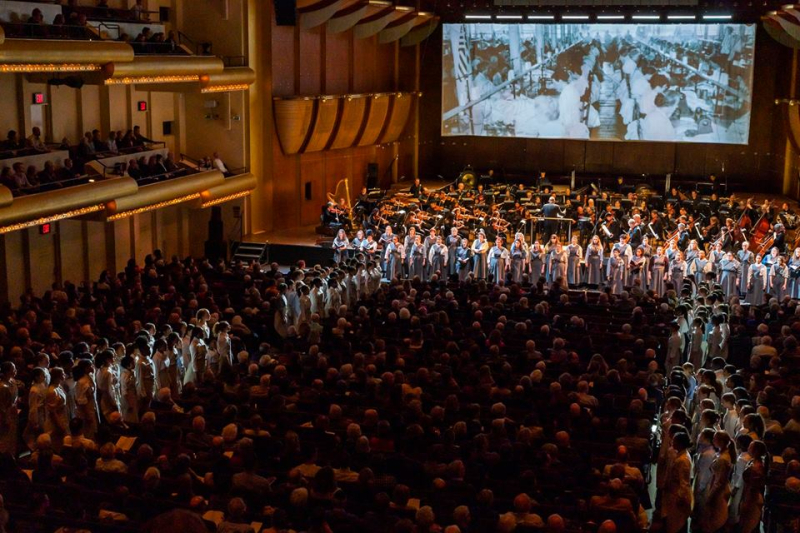
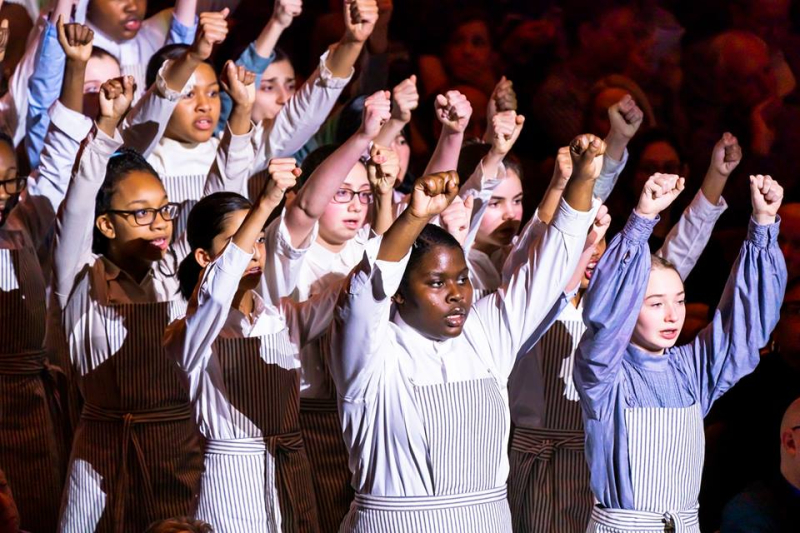
The orchestra was joined in performance by the Philadelphia-based choral ensemble The Crossing (above) and The Young People’s Chorus of New York City (below). The photos are by Chris Lee.
The text of the piece was compiled from various interviews, speeches, and accounts of the event in addition to folk songs from the era. Spanning roughly one hour, the work is cast in four movements.
The first movement “Immigration” began with chilling suspended high strings as the women’s chorus, decked in period regalia, began toning, “Without passports or anything we took a boat…” Blueprints of passenger ships overlaid with footage of foaming ocean waves were projected behind the ensemble as brass swells harkened to the rolling seas of the Atlantic as these young women made their voyage to America. Propulsive percussion and winds shifted under suspended vocal lines as familiar images of the Statue of Liberty and immigrants arriving to the United States were projected above. This built to a great crash and silence fell throughout the hall as the first movement came to a close.
The second movement “Factory” began to the sights and sounds of industry; images of machinery were cast on the screen above while the strings made eerie slaps that echoed the sounds of a sewing machine. A growing menace emerged from the lower voices of the orchestra as the threat of disaster grew. Splatting brass notes and unrelenting tremolo in the strings played on as the chorus mimed the actions of Sisyphean industrial labor. Grainy images of factory workers punching their cards were projected overhead while dissonant vocals, driving bass, and unnerving glissandi rose to a violent and tragic crescendo—the effect was genuinely terrifying. The chorus then used pairs of scissors to create a peculiar, yet distinct percussive beat as the work quietly transitioned into its third movement.
The women’s choir then descended to the front of the stage for the start of the third movement “Protest,” singing, “I want to talk like an American, I want to look like an American.” Rhythmic pulses in the strings played as newspaper headlines of protests and strikes were projected above. Among the cacophony could be hear the whistles of policemen trying to contain the disorder. The girls’ choir then emerged from the back of hall, marching and swaying in choreographed motion down the center aisle, as they sang in protest, “I want to say a few words. I am a working girl. One who is striking against intolerable conditions.” The women’s chorus professed, “Ah—then I had fire in my mouth!” as the girls hauntingly repeated, “fire fire fire”—a harbinger of the tragedy to come.
The girls’ choir joined the rest of the ensemble on stage as the final movement, “Fire”, began. The string players created the haunting sound of breath by swinging their bows through the air. Here Ms. Wolfe played up tragedy over terror as faded photographs of women interlaid with abstract images of smoke, fire, and rubble beamed overhead. Fierce crashes, perhaps the loudest thing I’ve ever heard in David Geffen Hall, deafened the auditorium as musical hellfire consumed the ensemble (“I see them falling, see them falling…”). A somber vocal line emerged, an indictment of social apathy, pronouncing, “I would be a traitor to those poor burned bodies if I were to speak of good fellowship. I have tried you good people of the public and found you wanting.” The chorus then sang the name of every soul who perished that day as Fire in my mouth quietly faded to silence; it was perhaps the greatest musical elegy since John C. Adams’s On the Transmigration of Souls.
The standing ovation that ensued lasted for several curtain calls as Ms. Wolfe, Maestro van Zweden, and company each had a chance to take their bows. No one, save a few wheelchair-bound patrons, was still seated by the time the applause finally died out, something I’ve never seen at David Geffen Hall and don’t expect to see again for some time. Indeed, it was the finest world premiere I’ve yet had the good fortune to attend. I can only hope that many other metropoles may be graced with its performances in the near future. Brava, maestro!
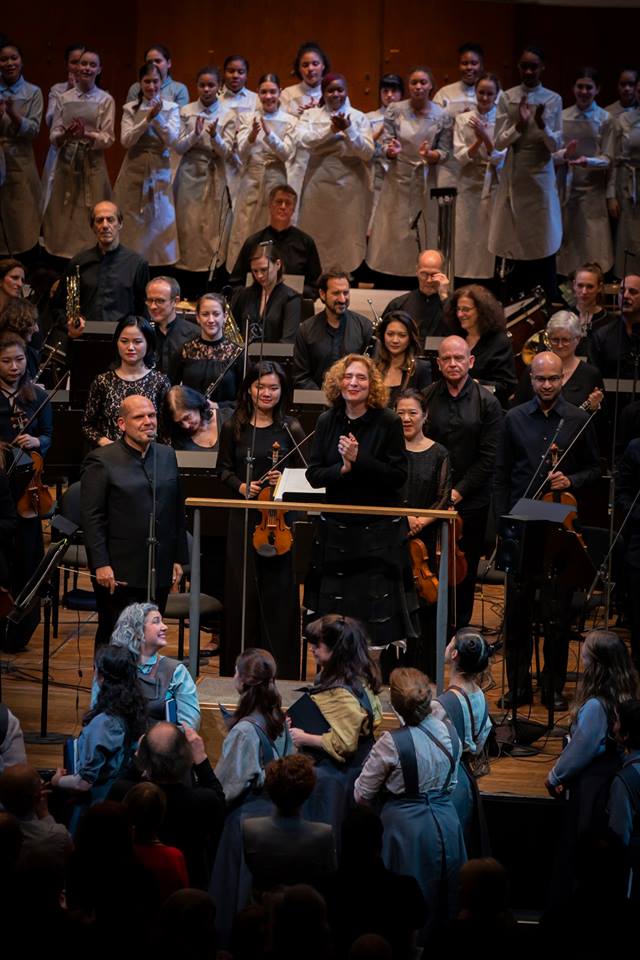
Above, the ovation: the conductor and composer onstage at the end of Fire in my Mouth. Photo by Chris Lee.
~ Brad S. Ross
 Oberon's Glade