Tag: NYCB

  • Bouder/Veyette SWAN LAKE @ NYCB

    C31750-6_Swan_BouderVeye (2)

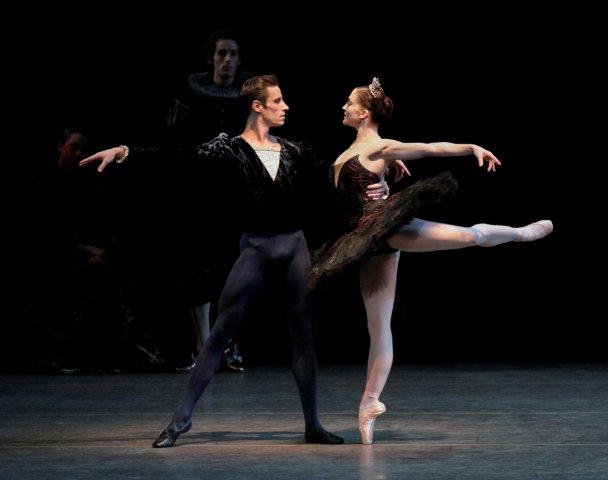
    Above: New York City Ballet principal artists Andrew Veyette and Ashley Bouder in SWAN LAKE; photo by Paul Kolnik

    Saturday evening September 21, 2013 – When New York City Ballet announced Peter Martins’ SWAN LAKE for their Autumn 2013 season I was hoping we’d have a 2-week run with some new Swan Queens; but instead there were only six performances (all, seemingly, sold out) and the dual role of Odette/Odile remained the property of three of the Company’s top interpreters: Sara Mearns, Teresa Reichlen, and Ashley Bouder.

    Tonight was an opportunity to re-visit the Bouder traversal of this very demanding dual role. In this video, Ashley speaks of her constant work in the studio, endeavoring to bring her interpretation of Odette up to the level of her Odile. Tonight she seemed to have reached – and even surpassed – her goal.

    A key element in making tonight’s performance so enjoyable was the lack of audience distractions, which so plagued the first half of the previous evening’s SWAN LAKE. Tonight we were seated amongst well-behaved folks who seemed keenly focussed on the stage throughout the performance; even the annoying late-seating was far enough away from us to be tuned out. It makes an enormous difference in one’s appreciation of the performance when there’s nothing to infringe on the powers of concentration.

    And so from the very first notes of the prelude to the final heart-rending departure of the doomed Odette, the evening was among the most enjoyable I have spent at NYCB in recent seasons.

    Clothilde Otranto paced the music beautifully: full-speed ahead when the drama called for propulsion; tenderness and a sense of lingering when love – or the loss of it – was the theme. The powerful ending of this SWAN LAKE – from both a visual and emotional standpoint – hits home every time, and Peter Martins’ remarkable vision of the ballet’s final moments tends to make me forgive some of his lapses in other productions.

    For people like me who simply adore the NYCB dancers, this ballet affords one of the most satisfying ways of savoring so many favorites all at once: from well-established principals to the newest apprentices, SWAN LAKE is a chance to revel in the enormous variety of faces, forms and personalities who make up this phenomenal Company. And so from curtain-up to curtain calls we are immersed in NYCB on a personal level.

    The sixteen corps dancers and the flock of small children who appear in the Prince’s Act I birthday festivities have plenty to dance, and they danced up a storm. As the opera glasses wander about the scene, you can pause anywhere and watch someone like Likolani Brown or David Prottas exuding their talents – both in terms of technique and stage-craft. This is not an anonymous bunch of automatons going thru the motions, but lively individual personalities doing what they love.

    Troy Schumacher gave a dazzling virtuoso display as the Jester – a demanding role in which the character, in this production, never overstays his welcome. Antonio Carmena as Benno danced with generous spirit and space-filling bravura: his jumps and turns clear and vivid. He shared the pas de trois with two of our recently-promoted soloists: Ashley Laracey and Lauren King, both dancing with sweet assurance. Marika Anderson’s Queen was excellent: her distinctive features reacting to the dramatic situation, her height and bearing setting her apart from her subjects.

    Andrew Veyette’s Siegfried was both impressively danced and instinctively well-acted; his portrayal of the lonely boy facing a destiny that doesn’t suit him was remarkably resonant. It’s no wonder that in his magical encounter with equally unhappy Odette he seems to have found his soulmate. That his love for her is her eventual undoing is the basis of the tragedy; his unwitting duplicity, concocted by Rothbart, leaves the bereft Prince on the brink of suicide at the end of the ballet. Andrew moved thru the events of the prince’s coming-of-age – his discomfort at having to choose a bride, his joy when his beloved suddenly appears in the ballroom, his desperation when Rothbart’s ploy is revealed – with a sense of natural nobility mixed with hapless naïveté; his final collapse in a state of deepest despair was so moving. All evening Andrew’s dancing – his lithe and effortless virtuosity – was aligned to his masculine grace and skillful partnering, making for a portrayal that was thoroughly satisfying in every way,

    Ashley Bouder’s technical sorcery and her sense of theatrical vitality have always made her Odile an exciting event. Not only is she undaunted by the role’s virtuoso demands, she simply revels in them – and she even adds her own flourishes. The character – sly, enticing, peerlessly confident – has always been a triumphant Bouder realization. Meanwhile, Odette – despite Ashley’s impeccable dancing – has seemed to just slightly elude the ballerina in terms of poetry and expressive nuance. Tonight she seemed to have moved deeper into Odette’s soul and found the needed resonance there: this seems to have come about both thru hard work and thru the natural virtue of the ballerina’s maturing into womanhood. Her Odette tonight was moving, passionate, tragic. Her performance of the iconic dual role is now a complete work of art, though I feel with certainty that she’s not one to rest on her laurels: I suspect the next time we see Ms. Bouder in this ballet she will have taken things to yet another level. But for now: a triumph.      

    As I remarked earlier, the evening was a feast for devotees of the Company: the Four Cygnets were especially well-matched and accomplished tonight: Sara Adams, Alexa Maxwell, Sarah Villwock and Kristen Segin were among the finest teams I’ve ever seen in this tricky piece.

    Presenting themselves as candidates for marriage to the Prince, six ballerinas dance a lovely set-piece in which each steps forward in turn to make her mark: Faye Arthurs, Likolani Brown, Meagan Mann, Jenelle Manzi, Mary Elizabeth Sell and Lydia Wellington all looked lovely in this piece, one of my favorite passages in the production. Faye, of the lyrical extension, was also seen as the Vision of Odette.

    Megan LeCrone looked superb in the pas de quatre, with Ana Sophia Scheller and Erica Pereira completing the trio of dark-haired beauties, and the amiable partnering and handsome virtuosity of Gonzalo Garcia making me wish he’d been cast as Siegfried this season (could we not have a Scheller/Garcia SWAN LAKE next time around?) 

    Georgina Pazcoguin gave off incredible star-power in the Hungarian dance, and the handsome and rather rare Craig Hall matched her for intensity and charisma. Janie Taylor’s intoxicating presence lured my opera glasses in the Russian dance, with Ask LaCour looming over her, part predator and part slave. In the Spanish quartet, Gretchen Smith and Gwyneth Muller imbued their steps wth a flamenco flourish, their yellow fans a decorative asset; Andrew Scordato and Taylor Stanley looked dashingly sexy. Allen Peiffer, always a handsome Neapolitan lad, now has a new village lass to charm: Kristen Segin was excellent and she and Allen are a delightful match-up.

    As the Black Swan pas de deux unfolded, brilliantly danced by Bouder and Veyette, a tall newcomer to the stage, Silas Farley, showed an already keen flair for stagecraft with his manipulative, faux-courtly Rothbart.

    And so we come to the end: at the lakeside where they had met, Odette and Siegfried are now torn asunder. The power of their love has vanquished Rothbart, but his curse endures. Odette vanishes amidst the swans, and Siegfried collapses in remorseful despair.
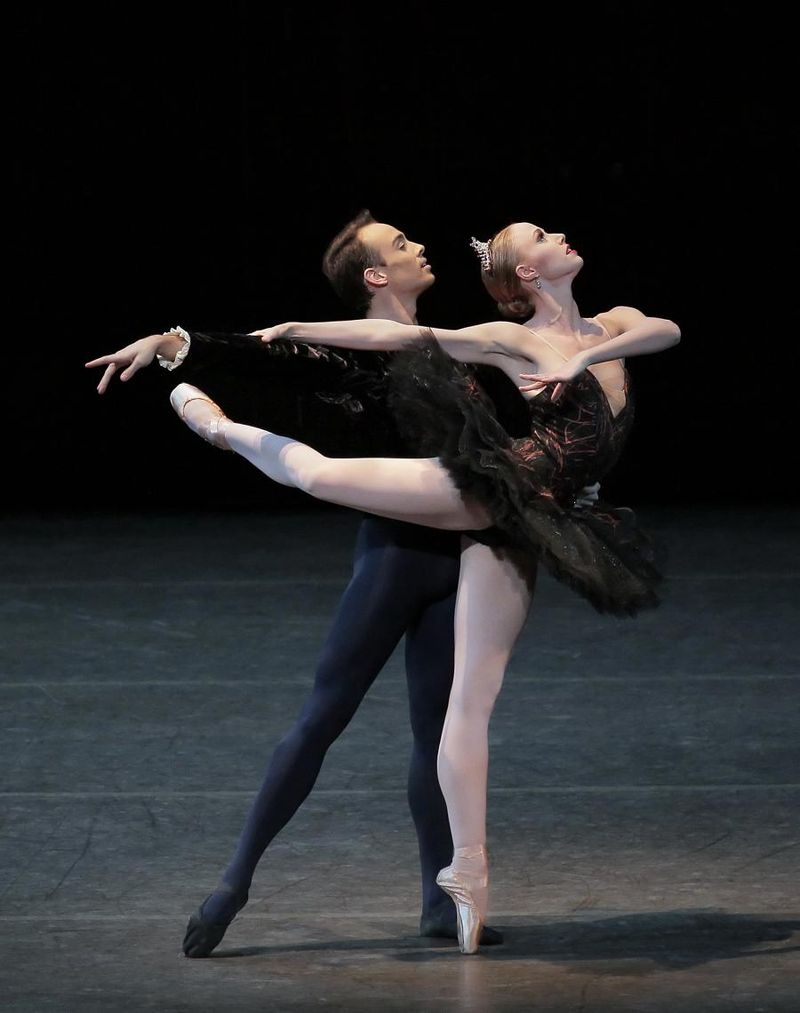
    ODETTE/ODILE: Bouder; SIEGFRIED: Veyette; VON ROTBART: Farley; QUEEN: Anderson; JESTER: Schumacher; BENNO: Carmena; PAS DE TROIS: Laracey, King; PAS DE QUATRE: LeCrone, Scheller, Pereira, Garcia; HUNGARIAN: Pazcoguin, Hall; RUSSIAN: Taylor, laCour; SPANISH: Smith, Stanley, Muller, Scordato; NEAPOLITAN: Segin, Peiffer; PRINCESSES: Manzi, Mann, Sell, Brown, Wellington, Arthurs

  • Reichlen/T Angle SWAN LAKE @ NYCB

    6a00d8341c4e3853ef014e5f6b6b16970c-800wi

    Above: New York City Ballet principal artists Tyler Angle and Teresa Reichlen in SWAN LAKE; photo by Paul Kolnik

    Friday September 20, 2013 – I’m an admirer of the New York City Ballet‘s Peter Martins production of SWAN LAKE, even though the first time I saw it (with Kyra Nichols in her only performance of it) I found it a great eyesore. I had vowed never to see it again but of course, this Company is my Company and how could I let anything deter me from seeing such Swan Queens as Miranda Weese, Wendy Whelan, Jenifer Ringer, Maria Kowroski, Jennie Somogyi and Sara Mearns? I soon made peace with the sets and costumes (basically by simply tuning them out), and on second seeing realized that there is no more potent ending for this ballet than that which Peter has crafted.

    Non-stop dancing and just enough mime propel the ballet forward. The familiar set-pieces are there, and Peter brings especial vitality to the villager’s dance in the opening scene and (truly lovely) the would-be-brides set piece which just precedes the arrival of Odile.

    This evening’s performance had its ups and downs. There was a bit of ragged playing from the pit here and there, and it seemed to me that Daniel Capps’ tempo for the White Swan pas de deux was just a bit too fast for Teresa Reichlen and Tyler Angle to make the maximum poetic effect. But much of the first lakeside scene was nullified for me by audience distractions (whispering mother and child behind me; a woman munching on cashews from a plastic cup; someone texting). I retreated to the 5th Ring for the second half of the evening and was far better able to concentrate there.

    The opening scene, where Siegfried’s friends from the village have come to celebrate his birthday with a party of the castle terrace (they’d never be allowed inside the royal residence per se) is one long dance-a-thon and the sixteen corps dancers were a pleasure to observe thru my opera glasses: corps-watching heaven. But apparently many in the audience had never seen chidren onstage so there was a lot of ooohing and aaaahing when the small fry appear (they danced very nicely).

    BallHarrison

    Harrison Ball (above, headshot by Paul Kolnik) scored a hit as the Jester; he was one of several dancers making role-debuts tonight. Lithe and agile, Harrison moved thru the virtuoso demands of the choreography with flair. Later, at the ‘official’ birthday party of his master, I very much liked Harrison’s facial acting throughout the Black Swan pas de deux: he seemed to be the only person at court to sense that something was amiss with this Odile woman and her sinister escort.

    Amanda Hankes, a natural aristocrat, made a youthful Queen. Taylor Stanley’s handsome Benno (debut) was another feather in this dancer’s cap; watching the vivacious Lauren Lovette in the pas de trois was a treat, and I liked the touch of rubato Ashly Isaacs brought to this attractive set piece.

    As the partiers went romping off, leaving the Prince, Benno and the Jester frozen in a gesture of farewell, the stage was set for the drama to begin. At this moment, NYCB decided it was time for a round of late seating, so we had the patter of feet, the urgent whispers, the bright glare of flashlights. The mood of the ballet was successfully broken.

    Teresa Reichlen’s opening jeté seemed to proclaim that the ballet could now move into the realm of poetry, but it was at this point that the distractions all around me commenced. Restive audience members are the bane of ballet-going: if you prefer to chat with your daughter, eat, or text, why did you come to the theatre?

    So despite being aware of Tess’s lovely attitude poses and deep back bends, and of Tyler’s pale and urgently tender personification of the Prince, much of this scene went for nought. I couldn’t wait to escape; I even thought of simply going home, but it seemed so unfair – this triumph of indifference – and there were dancers coming up in the second half that I really wanted to see.

    Tess was at her grandest as Odile, wonderfully predatory as she manipulates the hapless Tyler. Coached by the ultra-tall and sinister Ask LaCour as Rothbart, Tess used the role’s faux-Odette motifs with canny skill: a mistress of deceit. Her solo was gorgeously danced and she whipped off a blazing set of fouettés, followed by the sustained balances up the diagonal. Tyler’s solo was a beautiful paragraph of polished bravura. The pledge…the shock of  betrayal…the desperate rush to the lake…

    The final scene, built on the prince’s hopeless notion the damage could be repaired, was movingly played by Tess and Tyler. Odette knows her chance has been lost; when the Prince again raises his hand in pledge, she pulls his arm down and wraps it around her torso. This will be their last moment together. But now Rothbart must be defeated: in the brilliant coup de foudre the couple make a last stand for love and Rothbart is destroyed. But the curse has not been broken. In those last heart-rending moments, Siegfried tries in vain to forestall Odette’s transformation. But she vanishes among the ranks of the swans, leaving him to contemplate his failure. In this final parting, Tess and Tyler personified the despair of shattered hope.

    Back-tracking to the ballroom, there was lots of fine dancing – commencing with Harrison Ball’s playful number with three small jesters. The prospective brides arrive: in pastel frocks, the girls weave solo passages into a very charming ensemble: Sara Adams, Likolani Brown, Megan Johnson, Jenelle Manzi, mary Elizabeth Sell and Lara Tong each took the opportunity to shine. But despite this bevy of beautiful choices, the Prince demurs.

    The pas de quatre, a virtuosic set-piece, brought forth Savannah Lowery, Rebecca Krohn and Ashley Laracey each looking lovely and with accomplished dancing. But something was amiss: Chase Finlay, after squiring the girls thru the opening segment, did not perform his variation. And in the coda, Chase seemed to be marking. If Chase had sustained an injury, let’s hope it’s quickly remedied. I was left wondering how the conductor knew to skip the male variation music. 

    In the swirling Hungarian number, Gretchen Smith threw a dash of paprika into her role-debut dancing; Justin Peck was her rather somber and very impressive beau: now that Justin is taking the choreographic world by storm, we sometimes forget what a great presence he has as a dancer. Jennie Somogyi and Adrian Danchig-Waring (another newcomer to his role) were daringly provocative and physically fearless in the steamy Russian dance. New senoritas in Spanish – Meagan Mann and Lydia Wellington – vied for our attention with their footwork and their yellow fans; Daniel Applebaum and Zachary Catazaro (debut) were the dashing toreros, In a particularly appealing match up, Lauren Lovette and Devin Alberda (his debut) were the Neapolitan dancers, displaying Lauren’s piquant charm and a touch of devilry from Devin.

    The House was full to the rafters, and Tess, Tyler and Harrison were strongly cheered. Ask’s curtain call, drawing the villain’s booing, recalled Albert Evans in the same role: a glacial staredown, and a swirl of the cape. I ran into Albert during the intermission, handsome as ever.      

    ODETTE/ODILE: Reichlen; SIEGFRIED: T. Angle; VON ROTBART: la Cour; QUEEN: *Hankes; JESTER: *Ball; BENNO: *Stanley; PAS DE TROIS: *Lovette, Isaacs; PAS DE QUATRE: Laracey, Lowery, Krohn, Finlay; HUNGARIAN: *Smith, J. Peck; RUSSIAN: Somogyi, *Danchig-Waring; SPANISH: *Wellington, Applebaum, *Mann,*Catazaro; NEAPOLITAN: Lovette, *Alberda; PRINCESSES: Manzi, Sell, Johnson, Brown, Adams, Tong

  • Tom Gold Dance @ Bilbao

    TOM GOLD DANCE  Apollo with   Sara Mearns,  Adrian Danchig Waring, Abi Stafford

    On August 21st and 22nd, 2013 Tom Gold Dance performed at the Guggenheim Museum at Bilbao, Spain. The programme consisted of Tom’s ballet LA PLAGE, Balanchine’s APOLLO, Jerome Robbins’ CONCERTINO, and the pas de deux from FLOWER FESTIVAL AT GENZANO. In the top photo, Sara Mearns, Likolani Brown, Adrian Danchig-Waring and Abi Stafford in APOLLO.

    Click on each photo to enlarge.

    TOM GOLD DANCE   Flower Festival at Genzano  with  Devin Alberda and Abi Stafford

    Above: Devin Alberda and Abi Stafford in the FLOWER FESTIVAL pas de deux.

    TOM GOLD DANCE  Concertino, with  Stephen Hanna, Sara Mearns, Andrew Scordato

    Above: Stephen Hanna, Sara Mearns and Andrew Scordato in CONCERTINO.

    These images from the performance are courtesy of The Guggenheim Museum, Bilbao.

  • BalletCollective Studio Showing

    Home

    Above: BalletCollective dancer Taylor Stanley photographed by Christopher Starbody

    Thursday June 27th, 2013 – Today Troy Schumacher invited me to a special showing of his new work for BalletCollective, in preparation for the Company’s upcoming New York City performances.

    At the Ailey Citigroup Theater, friends and supporters of the Collective watched Troy working out some phrases with his exciting ensemble of dancers, all of whom are current or recent members of New York City Ballet. The work is accompanied by live music composed and conducted by Ellis Ludwig-Leone and played by ACME. During this preliminary tinkering session, lighting designer Brandon Baker tried out various effects. We were then shown a run-thru of the work-in-progress.

    The ballet, The Impulse Wants Company, takes wing on a poem by Cynthia Zarin, who was present for the showing. The music is both perfectly contemporary and beautifully melodic, with some interesting rhythmic figures; the musicians are expert.

    Ms. Zarin’s poem reflects on childhood visits to a beach, on nature, weather, on people and conversations recalled from the past. I didn’t read thru the poem until I’d seen the ballet, but the line “I was a water nymph” might have inspired the opening solo for Kaitlyn Gilliland, the tall ballerina who – with her poetic arabesque and arching back-bend – seems to conjure visions of Odette. David Prottas, a prince of a dancer, joins her. There is a trio of young women – Lauren King, Ashley Laracey and Meagan Mann – who remind me of Rhinemaidens or the nymphs on the lonely shore of Ariadne’s Naxos.

    Harrison Coll, a dynamic young dancer, joins Taylor Stanley in an off-kilter waltz, Taylor’s solo begins with him swaying like a tree in the breeze; later he travels up a diagonal in some skitteringly fast footwork before circling the space in a questing motif. 

    Troy Schumacher told us the that this ballet was created in ten days of studio time; in terms of both movement and imagination, it shows his distinctive choreographic style which uses the classic vocabulary of steps and port de bras with fresh, contemporary nuances. And he has the grest good fortune to be working with some of the best dancers in the world. 

    It was nice to see so many familiar faces from among New York City’s serious dance aficianados here supporting Troy today, and to greet the lovely former New York City Ballet ballerina Maya Collins, who now dances with Miami City Ballet.. 

    BalletCollective will be performing The Impulse Wants Company along with a re-working of their 2012 ballet Epistasis at The Joyce on August 14th and 15th. Information and tickets here.

    You can follow BalletCollective on Ashley Laracey’s blog: The Insider.

  • Haydn, Rouse & Gilbert’s Wagner

    Ax

    Above: pianist Emanuel Ax, soloist with the New York Philharmonic this evening

    Friday June 21st, 2013 – The New York Philharmonic‘s current Artist-in-Residence, Emanuel Ax, and Composer-in-Residence, Christopher Rouse, were both featured in the first half of this evening’s programme at Avery Fisher Hall.  After the intermission, the orchestra’s Music Director Alan Gilbert led a performance of his own RING JOURNEY: music drawn from Richard Wagner’s epic RING Cycle. 

    In the Playbill, Maestro Gilbert answers the “…terrible question: who is you favorite composer?” with the name ‘Haydn’. His admiration was evident in the joyous clarity of his shaping of the composer’s Piano Concerto No. 11 in D Major. Emanuel Ax’s playing had a youthful gleam, turning the melodic lines with elegance and the cadenzas with polished perfection, his trills lovingly defined. Pianist, players and conductor meshed their artistry in pure music-making that was deeply satisfying to experience.

    I first heard the music of Christopher Rouse from a Yo-Yo Ma recording of the composer’s Cello Concerto. At the New York City Ballet, Peter Martins has created two ballets to Rouse works: the 2002 INFERNAL MACHINE (seen earlier this year) and the 2006 FRIANDISES.

    In its New York première performances,
    Rouse’s Symphony No. 3 is a tribute to the Prokofiev 2nd symphony, the “symphony of iron and steel” (Prokofiev’s words). The orchestral forces are huge and the opening statements are a cacophonous but lucid fanfare, thunderous and epic. Later, in the more lyrical passages of the work, the composer finds unusual veins of beauty: a passage involving oboe and harp made me think of FIREBIRD. Throughout, the dense sound textures were vividly expressed by the orchestra’s super-human players, and Maestro Gilbert shaped the whole into a persuasive, and gigantic, statement.

    Alan Gilbert’s RING JOURNEY takes its inspiration from Erich Leinsdorf’s earlier arrangement of the Cycle’s immortal themes. RING fanatics (Mr. Gilbert is one, by his own description) draw their life blood from this music, and the standing ovation that greeted the conductor at the end of the evening seemed to me to indicate that people want to hear more of Gilbert’s Wagner.

    Alan Gilbert’s RING JOURNEY, which he rightly describes as a ‘suite’ rather than a ‘fantasy’, commences with the ‘Ride of the Valkyries’ and continues chronologically thru excerpts from WALKURE, SIEGFRIED and GOTTERDAMMERUNG. Gilbert shows a sure and steady hand at maintaining the flow of the music; some of the passages he chose to include are ‘transitional’ in the operatic sense, but they are gorgeous transitions and by exploring them here Gilbert steers clear of a ‘greatest hits’ feeling.

    The overall span of the piece was quite glorious, and the playing was simply superb: a special ‘bravo‘ to Philip Myers who stepped offstage to play Siegfried’s horn call with splendid warmth and amplitude.

    In view of such grandeur and musicality it seems selfish to ask for more; but I’d hoped to hear the Rhinemaidens’ trios, the Entry of the Gods into Valhalla, the Winterstürme theme, the Sword motif, and most especially Brunnhilde’s poignant “Ewig war ich”  – the core melody of the SIEGFRIED Idyll. The answer, dear Maestro Gilbert, is that you must program more of the RING in the next few seasons, especially in view of the fact that The Met can’t deliver it anytime soon.

    Hearing this music so spectacularly played and watching Mr. Gilbert’s loving sculpting of it from the podium, I couldn’t help but wish for voices. As the conductor built the introducton to the GOTTERDAMMERUNG prologue duet with breath-taking clarity and passion, I desperately wanted Christine Goerke or Lise Lindstrom to burst thru the door and launch into Zu neuen Taten!

  • Bountiful Balanchine @ New York City Ballet

    6a00e3982574bd8833013487f8adad970c-800wi

    Above: New York City Ballet principal ballerina Ashley Bouder in a Matt Murphy portrait

    Friday May 24th, 2013 – A panoramic vision of George Balanchine’s choreographic artistry was on display this evening at New York City Ballet: an iconic classic, a quirky and mysterious series of danced vignettes, a spirited showpiece pas de deux, and a masterwork set in a luminous Chagall decor.

    It must be a memorable landmark in a NYCB ballerina’s career to be cast in one of the principal roles in SERENADE. Sterling Hyltin, who recently took on the Russian Girl, was tonight making her debut as the Waltz Girl. Sterling has her own brand of youthful elegance and sophistication as well as the mature depth of artistry to bring something very personal to this role. As the inherent drama of the ballet evolved, Sterling’s sure sense of the music and her nuanced conveyance of its romantic beauty made a poetic impression, enhanced by the angelic fall of her hair. 

    Jared Angle was a perfect cavalier for Sterling in their Waltz, and his airy solo passage was beautifully crafted. Megan LeCrone’s unique persona and wonderfully fluid movement continually found inspiration in the Tchaikovsky score, and Adrian Danchig-Waring was again a marvel of physique and presence.

    I’ve seen Megan Fairchild as the Russian Girl many times and I felt that tonight she surpassed her own high standards in the role; every phrase had a serene quality and in matters of expressiveness she found the exact hues in her dancing to enhance the lyrical glow of the music. It was a very pleasing interpretation in terms of both technique and artistry.    

    C35663-8_Ivesiana_Laraceyrr

    Above: newly-promoted to soloist, Ashley Laracey – one of the Company’s most distinctive dancers – in IVESIANA; photo by Paul Kolnik. The opening section of this ballet, entitled In Central Park, commences with a convergence of almost zombie-like women wandering the park at night. Ms. Laracey, in virginal white, moves among them – a blind girl feeling her way in the darkness. She encounters the broodingly handsome Zachary Catazaro and falls prey to his sexual desire, but it’s all very subtly manifested.

    6a00d8341c4e3853ef017eeafd0416970d-800wi

    Above: Anthony Huxley and Janie Taylor in The Unanswered Question from IVESIANA; photo by Paul Kolnik. In this duet, the barefoot ballerina is borne aloft by unseen carriers while the desperate young man pursues her in vain. I’m reminded of a similar Balanchine duet, PORTE ET SOUPIR, in which the female character appears ever beyond reach. The two ballets end differently, but the mystery and allure evoked are provocative in both works. Anthony Huxley, beautifully vulnerable, gives a charismatic youthfulness to the questing boy and his thwarted desires, while the divine Janie Taylor, wrapped in an enigma, entrances with her pale skin and iconic hair. 

    In a sudden snap-out-of-it burst of reality, Teresa Reichlen and Amar Ramasar appear in a vaudeville-like duet. Playful and unromantic, they trade solo passages before shaking hands and going their separate ways. Confident and super-attractive, Tess and Amar give IVESIANA its only bright spot, for the ballet ends in deep twilight with the corps now walking about on their knees, downcast and anonymous.

    The programme then did a volte face and gave us Balanchine at his most witty and entertaining with TARANTELLA, a virtuoso courting duet with a Neopolitan flair. Daniel Ulbricht gave a dynamic and high-flying performance, the crowd with him every step of the way as he leapt and swirled about the stage in uncanny combinations. Not to be outdone, the charming Erica Pereira brought a delicate but spicy air to her performance: her fancy footwork matched Daniel’s, and she showed off some very pretty attitude turns. As the pas de deux sails forward, the zils started to fly off from Daniel’s tambourine causing much mirth in the audience. The two dancers swept offstage after Daniel’s victorious kiss, then returned to an avalanche of applause. They were called out four times by the delighted crowd.

    It’s not often we see a fourth curtain call after a ballet at NYCB, but it happened a second time tonight as Ashley Bouder delivered a brilliant Firebird to end the evening. Ashley’s boundless technique is matched by her insightful dramatic interpretation, filled with subtle detail and highly personal musicality. She created a vibrant and magical atmosphere, topped off by a striking manege of full-stretched jetes. But then she also summoned up the gentle rapture needed in the whispering bourees of the Berceuse. Fortunate ballet-goers to have experienced two superb Firebirds – Ashley’s and Maria Kowroski’s – in a single week. They are as different as two birds of a feather could be, yet each seems perfect.

    Justin Peck was the wide-eyed and courtly Prince and Gwyneth Muller the willowy, enchanting Princess. Blessings on my lovely girls in the Dance of the Captive Maidens. Conductor Leif Bjaland and the NYCB players gave a jewel-like rendering of this fascinating Stravinsky score.  

    SERENADE: Hyltin, M. Fairchild, LeCrone, J. Angle, Danchig-Waring  [Guest Conductor: Bjaland]
    IVESIANA: Laracey, Catazaro, Taylor, Huxley, Reichlen, Ramasar  [Conductor: Sill]
    TARANTELLA: Pereira, Ulbricht  [Conductor: Sill, Solo Piano: Chelton]
    FIREBIRD: Bouder, J. Peck, Muller, Scordato  [Guest Conductor: Bjaland]

  • Somogyi’s Back! @ NYC Ballet

    6a00d8341c4e3853ef0153941ab8d8970b-800wi

    Above: NYCB‘s Jennie Somogyi in a Henry Leutwyler portrait

    Tuesday May 21st, 2013 – Principal dancer Jennie Somogyi has returned to New York City Ballet after being sidelined with an injury for several months. Tonight was my first chance to see her since her return and she gave a super-charged performance in Ulysses Dove’s RED ANGELS. NYCB cognoscenti scatttered throughout the house gave her a hearty cheer when she stepped out for her bows. It’s wonderful to have her back.

    The house was fairly full tonight – including about half of the Fourth Ring – though I know there were people outside who really wanted to come in but who could not afford the available tickets. I’m going far less often myself, because it’s just out of comfortable reach financially.

    Guest conductor Leif Bjaland opened and closed the evening conducting two great scores: Tchaikovsky’s Serenade for Strings and Stravinsky’s Firebird. In the Tchaikovsky, he gave a somewhat more spacious feeling to the music than we’ve heard here in recent seasons: the fast passages were lively but not frantic, and he was adept at bringing out the inner voices that intertwine in the serenade’s melodic arcs.

    Curtain-rise for SERENADE still puts a lump in my throat; despite a couple of tiny faux pas tonight the ballet was beautifully danced, and of course it’s a corps watcher’s paradise. The recent promotion of some of the Company’s loveliest ballerinas to soloist means that we’ll see these girls less frequently onstage; but tonight three of them – Ashley Laracey, Lauren King and Georgina Pazcoguin – retained their familiar places in this Balanchine masterpiece.  The entire ballet was a feast for my opera glasses as one appealing vision after another moved across the stage in their swirling pale plue tulle.

    Sara Mearns danced with silken beauty, handsomely partnered by Jonathan Stafford. Ashley Bouder’s marvelous sense of the music allows her to sail on the score’s melodic ebb and flow, pausing here and rushing forward impetuously there; her peerless technique and expressive face invest the role with many felicitous details. Rebecca Krohn gave a radiant performance, her lyricism at full-flight and so attractive to behold. It seems to me that both Ashley and Rebecca would be ideal in the ‘waltz girl’ role, and I’m hoping they’ll each have the opportunity soon. Adrian Danchig-Waring made a striking impression both in physique and face; his deep immersion in the ballet’s unspoken drama was spell-binding.

    So exciting to see RED ANGELS again; it’s a favorite ballet of my friend Arlene Cooper, and I was glad to spot her from above this evening. Mary Rowell has played every performance of this ballet that I have ever experienced and she’s phenomenal, turning her electric violin into both a percussive and melodic vessel. In sleek physique-defining red body tights, the four dancers appear in introductory solos, then in duets, second solos, and a brief coda for all.

    Amar Ramasar gave a magnificent, stellar performance of expansive and space-filling dance wedded to undeniable sex appeal. Jared Angle has followed in the footsteps of Peter Boal as the Company’s most poetic male dancer; in this case it’s poetry with an edge and Jared reads it with power and clarity. Teresa Reichlen’s long-limbed amplitude and cool allure are perfect here, dancing with sharp attack and soaring extension. Ms. Somogyi, her body in Olympian condition, was intense and keenly aware of the sensual energy that pulses thru the Einhorn score. Throughout, the four dancers communicate in a rich gestural dialect. Mark Stanley’s lighting is a major factor. The audience whooped it up for these exciting dancers and their vivid one-woman rock band.

    Clothilde Otranto took up the baton for a definitive change of pace with the Tchaikovsky Pas de Deux. Andrew Veyette stepped in for Joaquin de Luz and won continuous rounds of applause for his swift and scintillating turns and leaps while the charm and delicacy of Megan Fairchild’s dancing exuded lyric grace, reaching an apex in a set of delicious fouette turns in the coda. The audience loved them, and rightly so.

    Maria Kowroski’s imperial Firebird was the perfect finale for this parade of super-dancers. The elegant ballerina shaped the elusive avian creature into a poetic statement, creating a compelling reverie in the haunting Berceuse. Earlier, her fluttery evasions and eventual taming were finely wrought in gesture and expression and – needless to say – her long legs are an exceptional asset. I love Jon Stafford in this ballet (he replaced Ask LaCour tonight) for his sense of wonderment and almost naive heroism. He and Savannah Lowery as the captive princess gave a charming account of their courtship, surrounded by a bevy of maidens consisting of some of my favorite ballerinas. The girls – I know – take this scene with a tongue-in-cheek quality. For me it’s quite beautiful, as is the Stravinsky score – his finest in my view, and wonderfully played tonight under Mr. Bjaland’s baton.

    SERENADE: Mearns, Bouder, Krohn, J. Stafford, Danchig-Waring [Guest Conductor: Bjaland]
    RED ANGELS: Reichlen, Ramasar, Somogyi, J. Angle  [Solo Violin: Rowell]
    TSCHAIKOVSKY PAS DE DEUX: M. Fairchild, Veyette   [Conductor: Otranto]
    FIREBIRD: Kowroski, J. Stafford, Lowery, Catazaro [Guest Conductor: Bjaland]

  • Deborah Wingert @ Lydia Johnson Dance

    IMG_2986 copy

    Above: dancers Sarah Pon and Anthony Bocconi of Lydia Johnson Dance being coached by Deborah Wingert; photo by Melissa Bartucci

    Deborah Wingert, one of New York City’s foremost ballet teachers, has been working in the studio with the dancers of Lydia Johnson Dance, coaching them particularly in the nuances of partnering in the works that Lydia is preparing to show in her June 2013 performances.

    Deborah Wingert, a former New York City Ballet dancer and presently one of an elite group of stagers of Balanchine repertoire for the Balanchine Trust, is deeply involved as an instructor, choreographer and mentor for the young dancers of Manhattan Youth Ballet. Her depth of knowledge and her understanding of dance from both a technical and an emotional point of view make her a priceless treasure. 

    I asked photographer Melissa Bartucci to document Deborah’s first day in the studio with Lydia Johnson Dance; then, a week later, I was able to get to the studio myself and observe the process first- hand. It didn’t surprise me to find that Lydia and Deborah were very much on the same wave-length, since for both of them their work in dance stems from a spiritual connection with music and movement.

    It was hard to imagine that someone could make Lydia’s beautiful troupe of dancers look even better, but in the most subtle ways – and often in an expressive rather than a technical context – that is what Deborah was able to accomplish.

    Here are some of Melissa Bartucci’s images:

    IMG_2835 copy

    Lydia Johnson, Deborah Wingert

    IMG_2702 copy

    Dancers Kerry Shea and Eric Williams

    IMG_2908 copy

    Anthony Bocconi and Sarah Pon

    IMG_3007 copy

    Lydia observing Sarah and Anthony

    IMG_2957 copy

    Anthony Bocconi

    IMG_3048 copy

    The dance is in the details

    IMG_3057 copy

    Lydia, Kerry, Eric and Deborah

    IMG_3056 copy

    Eric and Kerry watched by Deborah and Lydia

    Lydia Johnson Dance will have their New York season on June 6th, 7th and 8th, 2013 at the Ailey Citigroup Theater. Works set to music of Gorecki, Golijov, Schubert and Bach will be performed. Details will be forthcoming.

  • Paul Taylor @ Lincoln Center 2013 #4

    SpeakinginTonguesRobert

    Above: Robert Kleinendorst of Paul Taylor Dance Company in SPEAKING IN TONGUES. Photo by Paul B Goode. Click on the image to enlarge.

    Thursday March 21st, 2013 – Paul Taylor Dance Company have been celebrating Johann Sebastian Bach throughout their current Lincoln Center season: there’s been a Bach ballet on every programme and today – the actual birthdate of the peerless composer – the dancers gave a glorious performance of ESPLANADE, seeming to up their ‘normal’ level of energy, musicality, passion and sheer daring to a breathtaking point.

    The programme opened with SPEAKING IN TONGUES, a complex work which always leaves me with mixed feelings. Matthew Patton’s score does not seem strong enough to sustain a ballet which lasts almost an hour, and to my aging ears the interjections of spoken word no longer have the clarity needed to make a dramatic impact. The work stretches long, but there is no part of it that seems expendable: it is what it is, and perhaps best viewed with a focus on individual dancers.

    Surely there are few dance experiences today to equal the thrill of watching Michael Trusnovec onstage. This dancer with his taut, slender muscularity and singular artistry gave a transfixing rendering of the preacher-man’s opening solo and then moved thru the rest of the ballet with compelling dramatic intensity. Likewise Robert Kleinendorst as the Odd Man Out struck a vibrant note as his open, innocent personality is slowly dismantled by the holier-than-thou congregation; he’s literally beaten into submission, and at last taken into the cult. Also making a strong impact in this work were Amy Young, Laura Halzack, James Samson, Sean Mahoney, Jamie Rae Walker, Aileen Roehl, Heather McGinley, Michael Novak and Michael Apuzzo. Those sumptuous beauties Parisa Khobdeh and Michelle Fleet were outstanding in their prominent solo passages.

    My companion for the evening, choreographer Lydia Johnson, helped me to see this work in a somewhat different light than I had previously, and to understand why the dancers love dancing SPEAKING IN TONGUES.

    Seeing Taylor’s ESPLANADE on Balanchine’s stage made for a joyful experience: the two great masters of modern and ballet choreography each turned to the same Bach music and thus ESPLANADE reminds us of CONCERTO BAROCCO, as different as they are in style and setting. And one of my favorite BAROCCO ballerinas, Teresa Reichlen, was sitting a few rows behind us.

    In ESPLANADE the sense of dynamism and physical risk play high, and the superb collective of Taylor dancers went at it with unfettered vitality: Amy Young, Laura Halzack, Eran Bugge, Parisa Khobdeh, Jamie Rae Walker, Robert Kleinendorst, Francisco Graciano and George Smallwood all looked smashingly beautiful and grand, and if it was Michelle Fleet who ended up stealing our collective hearts, that too was part of Taylor’s plan. The audience, psyched by the fantastic performance, erupted in a massive ovation when the choreographer appeared onstage for a bow.

  • Dance Against Cancer 2013

    Maria k

    Above: Maria Kowroski, principal ballerina of New York City Ballet, is among the roster of danceworld luminaries who will appear in the third annual Dance Against Cancer gala performance on
    Monday, May 6, 2013. Photo of Ms. Kowroski by Matt Furman.

    The evening kicks off with cocktails at 6:00 PM (VIP ticket only) with a
    performance at 7:00  PM, to be followed by a reception at 8:30 PM. It all happens at the AXA Equitable
    Theater
    , 787 Seventh Avenue here in New York City. Tickets are $150 ($300 for VIP) and are available at dacny.org.

    The performance,  jointly produced by New York City Ballet’s Daniel
    Ulbricht and Manhattan Youth Ballet‘s Erin Fogarty, will feature NYCB‘s Tyler Angle, Robert Fairchild, Maria Kowroski, Lauren
    Lovette, Tiler Peck, Daniel Ulbricht, and Wendy Whelan,  ABT‘s Misty
    Copeland and Herman Cornejo, Alvin Ailey‘s Matthew Rushing, Martha
    Graham Dance Company
    ‘s Katherine Crockett and Lloyd Knight,  Lar Lubovitch Dance
    Company
    ‘s Clifton Brown and Attila Csiki,  San Francisco Ballet’s  Maria Kochetkova, and Joan Boada, and the sensational  Charles “Lil
    Buck” Riley.

    Among the special treats in this gala evening  will be a sneak peek at Christopher Wheeldon’s Cinderella
    performed by Maria Kochetkova and Joan Boada of San Francisco Ballet, as
    well as world premieres by both Herman Cornejo and Charles “Lil Buck”
    Riley.