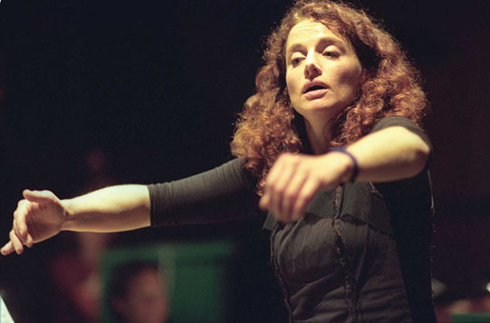
Above: Emmanuelle Haïm
~ Author: Oberon
Wednesday November 21st, 2018 – Music of Handel and Rameau was on this evening’s bill as Baroque specialist Emmanuelle Haïm made her New York Philharmonic debut. Neither composer’s name is really associated with the orchestra (MESSIAH of course being the exception), but their music was most welcome tonight, following in the wake of a pair of less-than-enjoyable ‘contemporary’ works we’d just recently heard at Carnegie Hall.
From first note to last, the music offered this evening – and the Philharmonic’s playing of it – seemed truly fresh and vital. And Ms. Haïm is so engaging to watch: her deep affection for the music is evident at every turn, and her conducting has an embracing style which drew superb playing from the orchestra. On Thanksgiving eve, we wondered how big of a crowd might turn out, but the house was substantially full. It was the most attentive audience of the classical music season to date – always a good sign.
It was fun to enter the auditorium this evening and see two harpsichords parked on the Geffen Hall stage, one for Ms. Haïm, the other for Paolo Bordignon. Handel’s Concerto Grosso, Op. 6, No. 1, calls for a relatively small ensemble of musicians, with Sheryl Staples as concertmaster.
From her first downbeat, Ms. Haïm’s conducting had a choreographic feeling. Swaying with the music, her gestures resonated like balletic port de bras. One could imagine her, gorgeously gowned and bejeweled, leading the dancing at Versailles in another lifetime. What a marvelous presence!
In the Concerto Grosso, violinists Sheryl Staples and Qian Qian Li along with cellist Carter Brey, form a musical sub-set, playing trio motifs with elegance and verve. The Allegro movements sparkled, the Adagio soothed and charmed, the exhilarating finale was full of life.
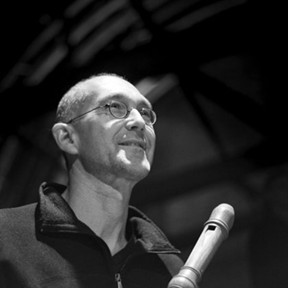
Two of Handel’s Water Music suites were performed. In the first, No. 3 in G-minor, the tall and slender Sébastien Marq (above) brought his polished recorder tone and technique to the mix. Switching from alto to soprano after the suite’s first movement, Mssr. Marq piped away to captivating effect. Oboes, bassoon, bass, and theorbo add textures that constantly lure the ear, and a violin solo in the Minuet was graciously played by Ms. Staples. The familiar tunes of the final Gigues made for a happy ending.
Philharmonic horn players Richard Deane and Allen Spanjer joined the ensemble for the Water Music Suite #1 in F-major; they were seated on the highest riser alongside oboist Sherry Sylar, a second young oboist I didn’t recognize, and bassoonist Kim Laskowski. These five artists made musical magic as the suite sailed forward.
Ms. Sylar’s plangent playing of a solo in the Adagio was pure beauty, and the two hornsmen reveled in the harmonized coloratura passages of the second Allegro. The woodwind trio blended lovingly in the Andante, and then the noble horns graced the Minuet. In the Air, our string trio from the Concerto Grosso emerged again, to lovely effect, as the horns sustained long notes in support. Horn calls open the Minuet, and then the suite dances on with a Bourrée-Hornpipe-Bourrée combination: swift and light to start, with a woodwind trio intervention, and then a fast finale that tripped the light fantastic.
Applause filled the hall; Ms. Haïm came out for a bow, but made a bee-line for the upper riser, where she drew the horn players from their chairs, then had Ms. Sylar take a solo bow (to warm shouts of ‘brava!‘), and then had the mystery oboist and Ms. Laskowski rise. What a fine gesture!
Selections from Rameau’s opera Dardanus, arranged as a suite by Ms. Haïm, made a splendid effect as the program’s second half. The opera, a classic five-act Tragédie en musique which premiered in 1739, follows Dardanus – the son of Zeus and Electra – in his feud with King Teucer. Their eventual pact of peace is reached as Dardanus marries Teucer’s daughter Iphise, who he’d met through the intervention of the sorcerer Isménor.
If the plot sounds unlikely, the score is enchanting. An enlarged ensemble tonight brought abounding grace and drama to music which covers an extraordinary range of rhythms and textures. Among the many sonic treats are the sound of a repeatedly dropped chain in the “Entry of the Warriors“, a delicate blend of flutes and triangle in the Air, and the suggestive shaking of the tambourine.
Ms. Haïm’s Philharmonic debut was a sure success; she passed among the musicians, greeting them individually as the applause rolled on. I hope she will come back to the Philharmonic in the future, bringing more Baroque gems with her. And what might she do with Gluck, Mozart, or Berlioz?
~ Oberon
 Oberon's Glade