Tag: Opera

  • Antonín Švorc

    B2baebce2c7e431084e2cf604d2c62cf

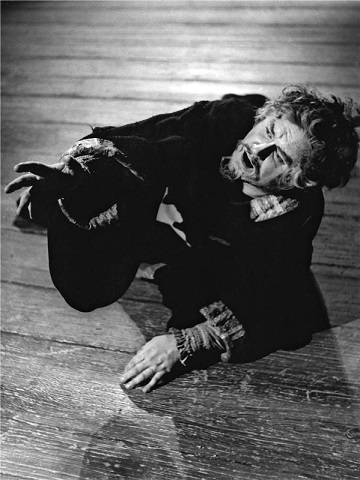
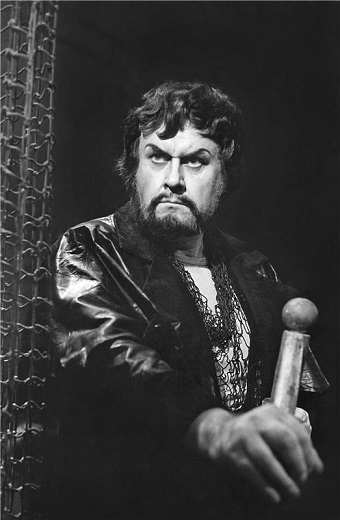
    Above: Antonín Švorc as the Flying Dutchman; photo by Oldrich Pernica

    Antonín Švorc was a Czech operatic bass-baritone. He studied at the Prague Conservatory, making his professional opera debut in 1955, and joined the roster of principal artists at the National Theatre in Prague in 1956. In 1962, Švorc debuted with the Prague State Opera where he performed for the next several decades. In 1985 he was named a People’s Artist of Czechoslovakia. After retiring from the stage, he taught at the Prague Conservatory. He passed away in 2011.

    Antonín Švorc’s repertory was vast indeed. In addition to singing in many Czech operas (including those of Dvořák and Smetana), his oles in the standard repertory included Verdi’s Amonasro, Iago, Nabucco, and Simon Boccanegra, Wagner’s Dutchman, Hans Sachs, Wotan, Kurvenal, Telramund, and Donner; Strauss’s Jochanaan, Orest, and Barak, as well as Scarpia, Alfio, Don Pizarro, Prince Igor, and Boris Godunov.

    0f0c8d9970fb434791822b37f285442a

    Above: Antonín Švorc as Simon Boccanegra; photo by Jaromir Svoboda

    Czech soprano Ludmila Dvořáková joins her compatriot, Antonín Švorc, in a recording of the final scene of DIE WALKURE (sung in Czech) here.

    Švorc gives a dramatic reading of the opening portion of the Dutchman’s monolog….

    Antonín Švorc – Flying Dutchman ~ monolog

    …and in Berlin in 1967, he sang Orestes opposite Ingrid Steger’s Elektra, conducted by Otmar Suitner. Here is part I of the Recognition Scene from that performance:

    Ingrid Steger & Antonín Švorc – ELEKTRA – Recognition Scene ~ Part I – Berlin 1967

    ~ Oberon

  • Janis Martin as Kundry

    Janis Martin

    The American soprano Janis Martin was my first Kundry; she was also my first Sieglinde and Marie in WOZZECK. She was a featured singer at the Bayreuth Festival from 1968 to 1989 where she appeared in nine different roles: Magdalene, Fricka, Eva, the Second Norn, Gutrune, Kundry, Freia, Sieglinde, and Brünnhilde. She returned in for the 1995 and 1997 festivals, again as Kundry.

    Janis Martin sang nearly 150 performances at the Metropolitan Opera, commencing in 1962 as Flora Bervoix in TRAVIATA. As a young opera-lover, I heard her many times on the Texaco broadcasts. She eventually progressed to “medium-sized” roles: Siebel, Nicklausse, Lola in CAVALLERIA RUSTICANA. Hearing her in these roles (in which she excelled), one would not have anticipated how her career would develop.

    Ms. Martin left The Met in 1965 to build a career abroad, moving into soprano territory. She returned to The Met from 1974 thru 1977, when I saw her as Kundry, Marie in WOZZECK, and Sieglinde. Following another hiatus, she was back at Lincoln Center from 1988-1992, singing the Witch in HANSEL & GRETEL, the Dyer’s Wife in FRAU OHNE SCHATTEN, Senta, the Foreign Princess in RUSALKA, and two performances of Tosca.

    Here is Ms. Martin as Kundry in a scene from the 1973 Bayreuth production of PARSIFAL; Jean Cox sings the title-role, with Eugen Jochum conducting:

    Janis Martin – Ich sah das kind ~ PARSIFAL – with Jean Cox – Bayreuth 1973

    ~ Oberon

  • Jean Cox ~ Heldentenor

    Jean Cox

    A native of Alabama, tenor Jean Cox studied with Marie Sundelius at the New England Conservatory and made his operatic debut at Spoleto as Rodolfo in LA BOHEME. In the early 1950s, Cox built his repertory and reputation at Kiel and Mannheim.

    The tenor made his Bayreuth debut in 1956 as the Steersman in FLIEGENDE HOLLANDER; he returned to the Festival as Lohengrin in 1967 and went on to sing there until 1984, taking on the Siegfrieds, Erik in HOLLANDER, Parsifal, and Walther in MEISTERSINGER.

    At other major opera houses, Cox sang Otello, Herod in SALOME, Bacchus in ARIADNE AUF NAXOS, Max in DER FREISCHUTZ, Gherman in PIQUE-DAME, and Captain Vere in BILLY BUDD. In 1976, Jean Cox made his Met debut as Walther von Stoltzing in a series of performances of DIE MEISTERSINGER in New York City and on tour. This was the sum total of his Met career.

    Jean Cox was married to the British mezzo-soprano Anna Reynolds, a noted interpreter of Bach and Wagner, and one of my very favorite singers. Following their retirement from the stage, the couple opened a vocal academy where they trained singers from all over the world. While I was working at Tower Records in the early 2000s, I met two students from this academy. I asked them to give  Ms. Reynolds a message from me; I wonder if they ever did.

    Jean Cox passed away in 2012 at Bayreuth; he was 90 years old. Ms. Reynolds died two years later.

    Enjoy this rare film clip of Jean Cox and the great basso Gottlob Frick in excerpts from Smetana’s BARTERED BRIDE and Weinberger’s SCHWANDA THE BAGPIPER.

    And here are some audio samplings of Jean Cox singing at the Bayreuth Festival.

    Jean Cox – Die Meistersinger ~ Prize Song

    Jean Cox as Parsifal – finale of the opera – Bayreuth 1973

    ~ Oberon

  • GrahamDeconstructed: CIRCE

    StudioSeries_Circe_003

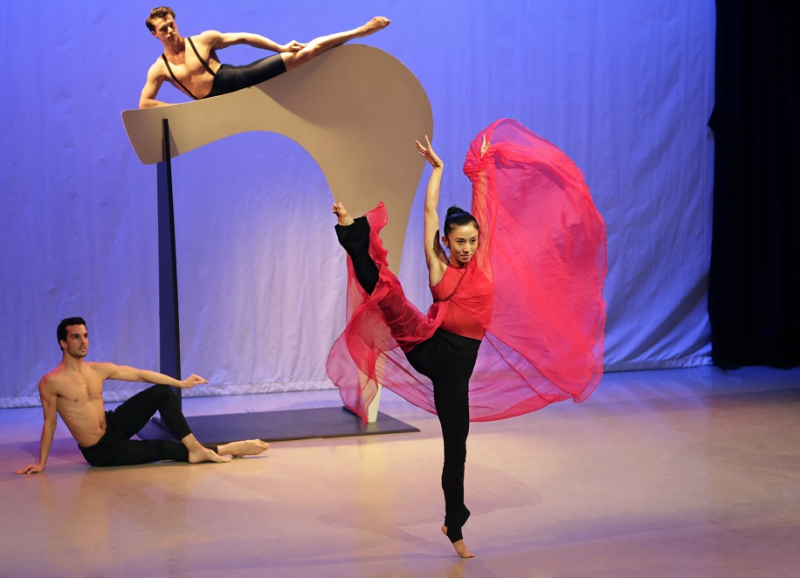
    Above: So Young An as Circe, with Lorenzo Pagano as The Snake and Lloyd Mayor, perched in Noguchi’s tree, as The Lion; photo by Melissa Sherwood

    ~ Author: Oberon

    Wednesday February 26th, 2020 – A revival of Martha Graham’s CIRCE will figure prominently in the Company’s 2020 season at New York’s City Center, which runs from April 22nd – 26th (details here).

    Premiered in 1963, CIRCE has not been performed for fifteen years. To a score by Alan Hovahness, and with settings designed by Isamu Noguchi, the ballet is inspired by the mythic Circe, a sorceress with a penchant for turning men into animals. 

    Circe – or characters modeled after her – has appeared in various theatrical representations over time. She is often given the name Alcina, as in Francesca Caccini’s opera LA LIBERAZIONE DI RUGGIERO (the first opera written by a woman that has come down to us in a performable version); dell’Arte Opera presented this work in 2019. Handel’s opera ALCINA is rumored to be having its first Metropolitan Opera production in the next two or three years. And Circe plays a part in the narrative of my favorite opera, Richard Strauss’s ARIADNE AUF NAXOS, although she never actually appears. The young god Bacchus has escaped Circe’s island domain, and as he sails towards Naxos – where he will rescue Ariadne – he chides the sorceress by calling out to her across the waves:

    Circe kannst du mich hören ~ ARIADNE AUF NAXOS – Ben Heppner & Deborah Voigt

    Tonight, at the Graham Company’s homespace at Westbeth, a full run-thru of the work – replete with the Noguchi sets – was presented, with So Young An in the title role and six of Martha’s Men as those who have fallen under her spell or those she would like to add to her menagerie. It was an exhilarating experience.

    Alan Hovanhess’s score is intriguing: by turns lyrical and dramatic, it also sometimes going off-kilter, indicating that things are far from normal in Circe’s realm. The composer makes fine use of solo instruments, notably the trumpet, horn, clarinet, and oboe. You can listen to the music here.

    The Noguchi setting features a small boat and an archway which might also be a tree. These were designed for an earlier Graham work, FRONTIER, which had fallen out of the repertoire. Ms. Graham kept the set pieces in storage until she found the perfect home for them on Circe’s island.

    So Young An was supple and tempting as Circe; the character’s magic resides in a flowing red scarf which she dons when it is seduction time. Ulysses (Lloyd Knight) and his Helmsman (Ben Schultz) arrive at the island in the very cramped boat. Circe observes them from her perch in the arch/tree.

    StudioSeries_Circe_004

    Above: Lorenzo Pagano (The Snake), Alessio Crognale (The Deer) So Young An (Circe), Lloyd Mayor (The Lion), and Jacob Larsen (The Goat). Photo by Melissa Sherwood.

    StudioSeries_Circe_002

    Above: Jacob Larsen as The Goat; photo by Melissa Sherwood

    Four men who have been transformed by Circe into animals now take an interest in the new arrivals: enslaved by the sorceress, they will aid her in bringing about the downfall of Ulysses and his comrade. Lorenzo Pagano as The Snake first appears dangling from the tree; Lloyd Mayor is The Lion, Alessio Crognale The Deer, and Jacob Larsen The Goat. All the men in this ballet wear very little; I think that’s the way Martha liked her men. These dancers dispatched the demanding choreography with élan.
    StudioSeries_Circe_001

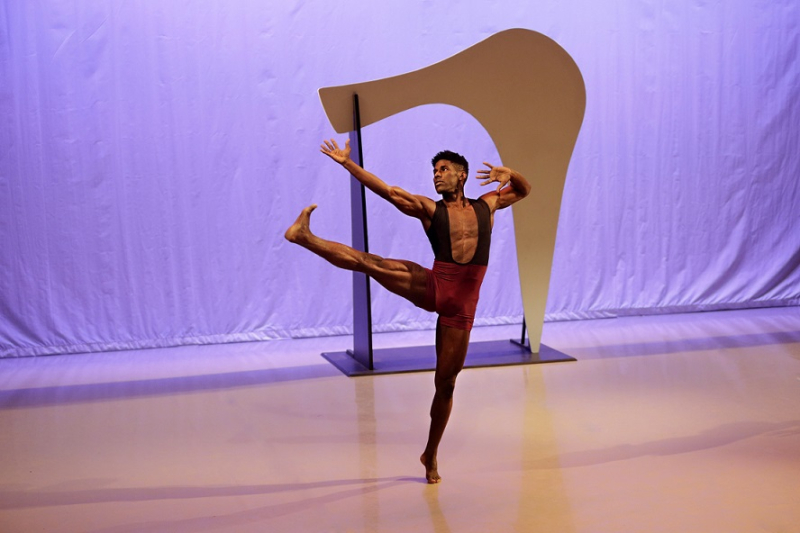
    Above: Lloyd Knight as Ulysses, photo by Melissa Sherwood

    As the story unfolds, it comes down to a battle between Circe, bent on conquest, and the Helmsman, who wants to save Ulysses and get the hell out of there. The red scarf nearly works its magic: Ulysses is falling under Circe’s spell. Hunkered down in the boat, the Helmsman is attacked by the Snake and sinks into a stupor.
    StudioSeries_Circe_005

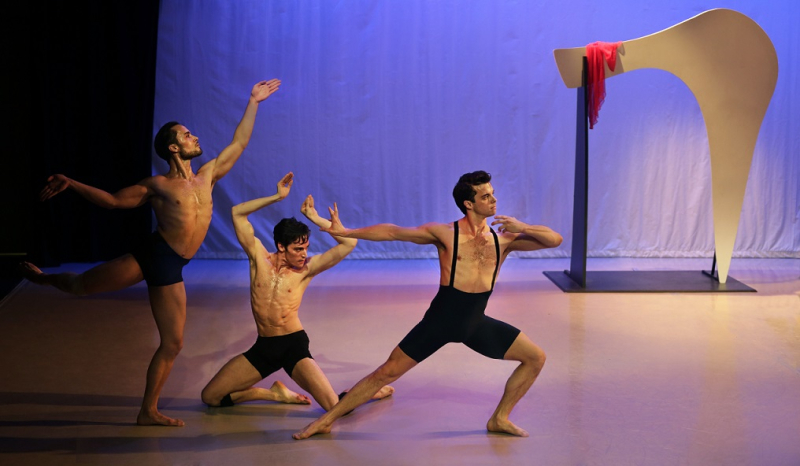
    Above, Deer, Goat, and Lion: Alessio Crognale, Jacob Larsen, and Lloyd Mayor, photo by Melissa Sherwood

    The other animals stalk and caper, driving the victim into the enchantress’s arms. Just as Ulysses is about the capitulate, the Helmsman revives, hauls his master into the boat, and they sail away. Circe and her pets must now wait for someone else to succumb to the lure of her siren song.

    Danced with the technical prowess and personal commitment that make the Graham dancers the best in the world, CIRCE truly does cast a spell. I look forward to seeing it again, often, and to having it become part of the Company’s permanent repertory.

    All photos by Melissa Sherwood.

     ~ Oberon
  • Compagnie Hervé KOUBI @ The Joyce ~ 2020

    F751b7faaa4d48cf814701ab186c45bf

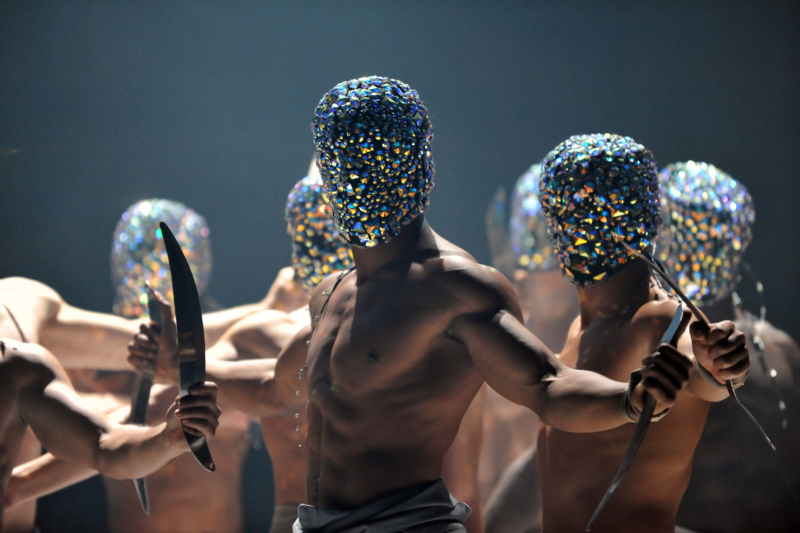
    Above: Compagnie Hervé KOUBI, photo by Frédérique Calloch

    ~ Author: Oberon

    Thursday February 20th, 2020 – Celebrating their 20th anniversary season, Compagnie Hervé KOUBI returned to The Joyce with Les nuits barbares ou les premiers matins du monde. I loved this Company when they appeared at The Joyce in 2018, and when I saw that they were returning to Gotham, I knew I’d want to be there.

    Performed by an all-male cast of dancers from the countries along the shores of the of the Mediterranean – from Algeria, Morocco, France, Burkina Faso, Italy, Israel, and Palestine – the work explores the human desire for belonging: an idea that harks back to ancient times, before the birth of nations.

    B66a9f62ccd24199abcd0119aec4dba6

    Above: photo by Frédéric de Faverney

    The visually engrossing production features evocative lighting by Lionel Buzonie, and costumes by Guillaume Gabriel that include mask-like headgear adorned with Swarovski crystals which catch the light, adding to the mystique of the ballet’s darkish opening passages. The dancers appear first in long skirts, which are later shed in favor of fitted trousers. To say that these men are incredibly sexy is an understatement: they are also fearlessly committed to the work, and to the brotherhood.

    To sounds of primeval winds and waves, the dancers emerge from the shadows. They huddle together, earthbound, as the opening music of Wagner’s DAS RHEINGOLD speaks to us of beginnings. The community is restless, wary. They awaken in a brief passage of unison gestures.

    Knives are drawn, and an alarm sounds…but fades to mere tinkling sounds. There is a bathing ritual to the sounds of an antique flute, then the men take their places in a striking lineup across the rim of the stage, superbly lit.

    A tapping sound develops into vibrant drumming as the men compete in fantastic feats of tumbling, flipping, spinning on their hands or on their heads. The helmet-masks come off, the drumming gets wild. Then deep tones emerge from the sonic glow, alive with the exotic sound of finger cymbals.

    A respite, and then a whirring sound spins into a song – are the men actually singing? I was to far away to tell. Now the tribe begin tossing one another into the air; they soar with electifying bravura before being caught by their comrades. After circling in backbends, they cut loose to do more leaping and flipping: mind-boggling athleticism. The music turns metallic as the dancers again engage in uncanny break-dancing spins. Then they slowly disperse to music from the Mozart REQUIEM, only to return, engaging in ever more daring spinning and tossing.

    86734724_10218458400185321_4811273668363550720_n

    Suddenly one man is targeted and threatened with knives. Stripped of his skirt, and inverted, he performs a spectacular solo, spinning on his head as knife blades fan out from his whirling torso. The men – some on their knees like supplicants – return with metal poles; to the sound of distant voices, the poles become canes of props. Later they are tossed from man to man with amazing accuracy, and still later held aloft in cruciform.

    Now there evolves a big-beat, swirling tribal dance; the skirts have all been sheds. After more athletic feats and some spear-tossing, there is an intense run-about. To the sound of the deep chanting of Et lux perpetua, the men again line up along the edge of the stage: they seem to silently be bidding us farewell. Then they back into the shadows and begin to slowly exit – pairs or alone – heading into the unknown. As the last man vanishes from sight, one sensed the welling up of a great emotional force in the house. The audience, who have beheld this great human spectacle in awed silence, are ready to unleash a tremendous wave of applause.

    But…no: the men now return and, in a rather prolonged coda, continue to perform many of the same moves and feats we’ve already seen. As this coda brings nothing fresh to the piece, either choreographically or musically, it seemed expendable.

    At last, the packed house got their chance to hail Mssr. Koubi and his courageous dancers with waves of fervent applause and cheers.

    Efeeb7ea1079465dbd24d15aa611cea0

    Above: photo by Pierangela Flisi

    ~ Oberon

  • Franz Mazura Has Passed Away

    Mazura

    The great Austrian singing-actor Franz Mazura has passed away at the age of 96. Mazura made his operatic debut at Kassel in 1949, and went on to appear at numerous German theaters in a wide variety of roles. His career eventually took him to the great stages of Paris, Vienna, Bayreuth, and New York City.

    Mazura was a stalwart at the Bayreuth Festival for fifteen summers, beginning in 1971. His most frequent Wagnerian roles were Alberich in the RING Cycle and Klingsor in PARSIFAL, but he also sang the Wanderer and Gurnemanz at the Wagner shrine.

    Franz Mazura as Gurnemanz – Bayreuth 1973

    Cap189

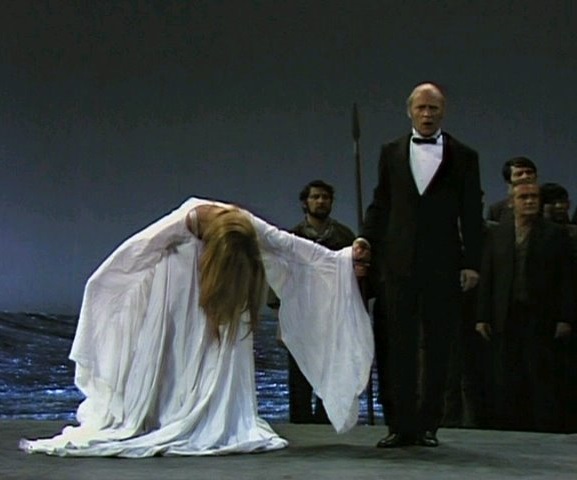
    At Bayreuth, he appeared in 1976 as Gunther in the controversial Pierre Chéreau centennial production of the RING Cycle: photo above, with Dame Gwyneth Jones as Brunnhilde.

    In 1979, Mazura sang Doctor Schön and Jack the Ripper in the premiere of the completed version of Alban Berg’s LULU at the Paris Opéra, conducted by Pierre Boulez.

    After making his Metropolitan Opera debut in 1980 in the Berg double-role, Franz Mazura went on to appear on The Met stage 175 times. In 1989, he was a magnificent Alberich in the RING Cycle, my first experience of seeing the Cycle in the span of a week. Earlier, in 1987, he had stepped in as Wotan in WALKURE, a performance my friend Paul Reid attended; Paul described Mazura as “…a cantankerous god.”

    Franz Mazura’s final Met appearance was as Schigolch in LULU in 2002.

    Here is a sampling of his extraordinary portrayal of Klingsor:

    PARSIFAL – scene from Act II – Leonie Rysanek & Franz Mazura – Met bcast 1985(1)

    Among the many roles Franz Mazura sang in his long career was the Spirit Messenger in DIE FRAU OHNE SCHATTEN:

    Helga Dernesch & Franz Mazura – FRAU OHNE SCHATTEN ~ opening scene – C Perick cond – Met 1989

    He displayed his versatility in such roles as La Roche in CAPRICCO, Pizarro in FIDELIO, Scarpia in TOSCA, the Doctor in WOZZECK, Creon in OEDIPUS REX, and the Speaker in ZAUBERFLOETE. His final operatic appearance was at Berlin as Schwarz in MEISTERSINGER on April 21st, 2019…the eve of his 95th birthday.

    Franz Mazura appears in the film of Pierre Chéreau‘s 2013 production of ELEKTRA from the Aix-en-Provence Festival; he makes a touching effect as the Tutor of Orest.

    ~ Oberon

  • Met’s MAGIC FLUTE – Saturday Matinee

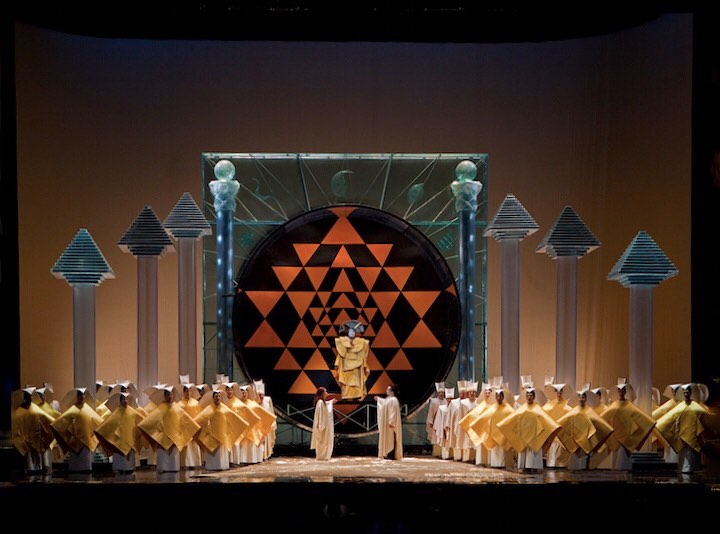
    Taymor Flute

    ~ Author: Oberon

    Saturday December 21st, 2019 matinee – The Met’s shortened, English-language version of Mozart’s DIE ZAUBERFLOETE may not be as musically fulfilling as hearing the original, but it does afford an opportunity to hear lots of voices – from Met veterans to newbies – in one fell swoop, and thus I am likely to go two or three times each season that it is on offer. Although the cuts are irksome, and Papageno is too much the center of attention, there’s still enough opportunities for the singers to make their mark.

    The House was full of children today, and with people who’d forgotten to turn off their cellphones. The kids were receptive during the music, but some longish stretches of dialogue prompted then to have audible monologues of their own. Is it really necessary, in a 100-minute reduction, to bring up the Seven-fold Shield of the Sun? I suppose it really doesn’t matter, since apparently this is the last season we’ll see this production. (Or might they have a new ZAUBERFLOETE, and keep this Taymor holiday season specialty around?)

    Lothar Koenigs was on the podium this afternoon; his tempi were mostly spot-on, but there were some places where stage and pit were not totally in-sync. The Three Genii were unfortunately a weak trio vocally, and at times sounded a little like The Chipmunks. The Three Ladies – Gabriella Reyes, Megan Esther Grey, and Renee Tatum – sounded good individually, but did not always mesh well; the conductor seemed at times to leave them adrift. (Is Megan Esther Grey related to the great Wagnerian soprano, Linda Esther Grey? I will try to find out.)

    Ashley Emerson’s Papagena managed to get the words across when doing her “old lady” voice: no mean feat. Once transformed, she sang brightly. Rodell Rosel was an audience favorite as the crafty Monastatos. The Priests (Christopher Job and Scott Scully) and Guards (Arseny Yakovlev and Jeremy Galyon) did well.

    Joshua Hopkins sang excellently as Papageno, and the audience loved him; his referring to the Priests as “coneheads” was priceless. David Portillo’s attractive tone and appealing lyricism made his Tamino a winning vocal presence, with a nice feeling of tenderness. In his scene with Patrick Carfizzi’s Speaker, to my mind the key to the whole opera, both singers were clear of diction and dramatic intent. Mr. Portillo’s “O endless night!” was moving; and later, his “Music is the heart’s true home…” seemed to express what this opera is all about.

    Joelle Harvey’s vocal shimmer at “Be truthful!” was engaging, as was her self-defense to Sarastro. She made a lovely, vulnerable impression in Pamina’s aria with her expressive dynamic palette and persuasive phrasing. At her “Tamino mine!” a sense of radiance was met by Mr. Portillo’s ardent response. The two sang gently and sweetly in the quartet with the Two Guards.

    Kathryn Lewek’s Queen of the Night gave the afternoon its spark; after swirling thru the coloratura of her first aria, she sustained the high-F: an exciting moment. Her “Wrath of Hell” had great accuracy and brilliance, the high-Fs slightly metallic but hitting the bullseye each time. On her final command, “Swear!”, the soprano took a soft attack and then swelled the note to white-heat. She won vociferous applause here, and again at her solo bow. She has amply proven herself in this demanding role several times; I hope now we can hear her as Lucia or Constanze. 

    Morris  r jpg

    Spectacularly anchoring the performance was Morris Robinson’s Sarastro: generous of tone, crystal clear of diction, and benevolent by nature. A grand performance from this formidable basso. Bravo!

    All afternoon, much of the spoken dialogue seemed over-wrought and campy; Papageno tended to shriek at the least provocation. David Portillo as Tamino spoke with a slight, charming accent: not amiss, as this prince has come from afar.

    ~ Oberon

  • A Memorable ROSENKAVALIER

    E_Soderstrom_Grevinnan

    [Reviving this article, which has been updated with some audio clips]

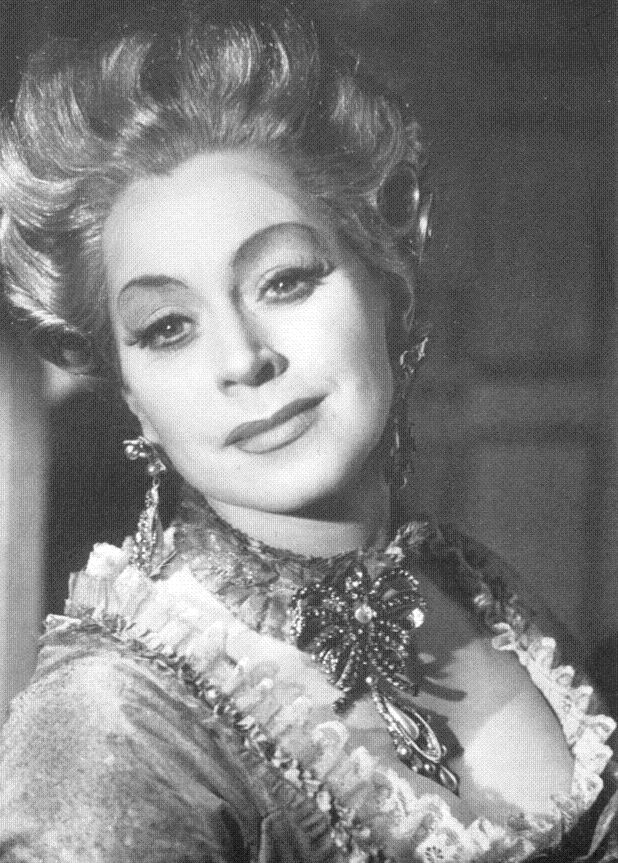
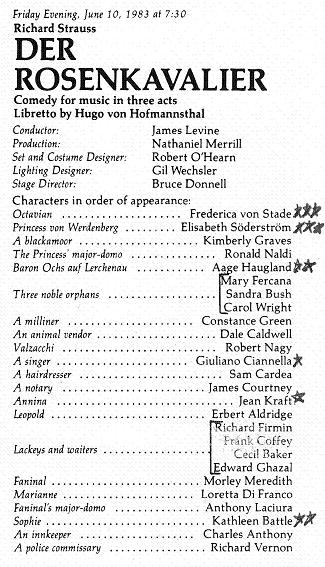
    In 1983, the Metropolitan Opera took DER ROSENKAVALIER on their annual Spring tour. James Levine was the conductor and the stellar cast was led by Elisabeth Söderström (above) as the Marschallin, Frederica von Stade as Octavian, Kathleen Battle as Sophie, and Aage Haugland as Baron Ochs. Interestingly, this particular alignment of stars never performed the Strauss opera at The Met. It was given in six cities on the tour, culminating with this performance…

    IMG
    …in Boston, which I was lucky enough to attend. Unfortunately one of my most vivid memories of the evening was the presence of some people sitting about six rows behind me who talked throughout the performance. Even though I had sprung for an orchestra seat – the better to concentrate on the array of vocal talent onstage – these people served notice that sitting in expensive seats doesn’t make you classy. They were continuously being shushed by people around them (as annoying as their talking, actually) and the usher came to admonish them at one point. Apparently they had some sort of clout that kept them from being ejected; at any rate, they spoiled a great performance. I’m sure they are all dead now, and good riddance.

    Despite this major distraction, the performance was extremely moving and superbly sung. Maestro Levine, whose 1976 ROSENKAVALIER broadcast had seemed sluggish and thick-textured orchestrally, was now fully in his element with the Strauss score. The towering Aage Haugland – a great favorite of mine during his Met career – was a grand Baron Ochs, and Miss Battle was a shimmering-voiced Sophie.

    It was the vocal and theatrical chemistry between Elisabeth Söderström and Frederica von Stade that gave this ROSENKAVALIER its unique appeal. Their older women/younger man romance was brilliantly portrayed, while their distinctive vocal timbres served their respective characters to perfection. By this point in time, the Söderström voice was an expressive rather than opulent instrument, but she truly knew her way around this music and her singing was so meshed with the character’s moods – it was simply all of a piece. In the monolog, she poked fun at herself as “die alte frau, die alte Marschallin“, sung with a crackly old-lady sound. Telling Octavian that he will soon tire of their romance, she seized von Stade by the shoulders, trying to shake some sense into him. The Söderström Marschallin was an unforgettable mixture of dignity, bitterness, and nostalgia: a woman who watches something cherishable slipping thru her fingers and finds the courage to let it go.

    Frederica von Stade, with her immaculately tailored sound, was boyish and impetuous in behavior. and her vocalism was always elegant and wonderfully personal. Other Octavians – Ludwig (my first!), Baltsa, Troyanos – have sung this music in grander style but no other Octavian of my experience has quite captured the coltish confusion of a boy on the brink of manhood who has a loving heart and a tender, noble young spirit…which von Stade showed us so memorably.

      Battle-Soderstrom

    While the Söderström/Battle/von Stade collaboration was never heard in a complete public performance of ROSENKAVALIER here in New York City, the three women did perform the opera’s Act III trio at the Met’s 100th anniversary gala. The day-long celebration was telecast live; I attended the matinee portion and can attest to the palpable atmosphere in the house as the three women sang this magical Strauss creation. You can listen to them here, with Levine on the podium.

    For years, I assumed this film clip was the only extant souvenir of this unforgettable convergence of voices – though I am sure someone recorded it someplace along the tour’s path – but recently my friend Ben Weaver surprised me with recordings of the first and third acts in very good sound from a rehearsal at the Met just before the tour commenced. Someone there had the presence of mind to realize that this was a rarity in the making and that Ms. Söderström’s Marschallin was a jewel worth preserving; and so this valuable sound document has come down to me, some thirty years after the event.

    Elisabeth Söderström – monolog from ROSENKAVALIER~Act I – Levine cond – Met stage rehearsal 1983

    Flicka octavian

    Frederica von Stade (above) regrettably never sang a complete Octavian at The Met – though she did sing a gorgeous Rose Presentation duet with Judith Blegen on the same gala programme as the filmed clip above.

    E S

    In 1987, Elisabeth Söderström made her ‘first’ Met farewell singing the Marschallin on a Saturday matinee which was broadcast. That was a very moving experience, yet it has always been the Boston performance that’s stayed so clearly in my mind. The magic of the Söderström Marschallin is so perfectly distilled in the closing moments of Act I, where her ‘silberne rosen‘ takes on a ghostly patina of lyrical regret and resignation.

    Elisabeth Söderström – Die silberne rose – 1st Met farewell 2~21~87

    ~ Oberon

  • Preislied

    Alexkim2

    Above: tenor Alex Kim

    I like this Korean tenor’s lyrical rendering of the Prize Song from Wagner’s DIE MEISTERSINGER.

  • Julia Fischer|Philippe Jordan @ The NY Phil

    Fischer_J

    Above: violinist Julia Fischer

    ~ Author: Oberon

    Wednesday October 30th, 2019 – Philippe Jordan was on the podium at Geffen Hall this evening as The New York Philharmonic presented their program of Prokofiev, Mendelssohn, and Beethoven: an ideal mix, in my opinion. The comely and compelling violinist Julia Fischer was the guest soloist for Mendelssohn’s violin concerto, the orchestra’s stellar woodwind soloists were all present and accounted for, and the entire evening had a special glow about it.

    Prokofiev’s Symphony No. 1, Classical, strikes me as a perfect piece of music. At a running time of just 15 minutes, the symphony is a compact delight, abounding in rhythmic variety and appealing themes. The opening Allegro con brio is in the traditional sonata form, but the composer keeps throwing us curve balls: witty bits crop up out of nowhere. Maestro Jordan and the Philharmonic artists seemed truly to enjoy playing this music, which, in the flashing leaps and zesty grace notes of the second theme made me smile to myself.

    A gentle melody on high for the violins is the key feature of the Larghetto, with pizzicati, treading basses, and colourful bassoons all part of the composer’s scheme. The Gavotte makes me think of the composer’s ROMEO AND JULIET, while the ebullient finale sounded wonderfully clear and alive. Throughout, flautist Robert Langevin, clarinetists Anthony McGill and Pascual Martínez-Forteza, oboist Sherry Sylar, bassoonist Judith LeClair, and their woodwind-section colleagues charmed the ear with their polished playing; when Maestro Jordan asked them to stand for a bow, the audience responded warmly.

    Violinist Julia Fischer then joined the orchestra for Mendelssohn’s Violin Concerto in E-minor. This was my first opportunity to hear Ms. Fischer playing live; she sounded marvelous and looked fetching is a deep grey gown shot thru with glimmering silver. There’s shining silver in her sleek tone as well.

    The first movement’s marking of Allegro molto appassionato derives from the composer’s premonition of writing “…[A concerto] in E-minor running through my head, the beginning of which gives me no peace.” With splendid support from the orchestra, Ms. Fischer displayed her expressive gifts, lovely feeling for dynamics, and exquisite control of pianissimo. In the cadenza, her soft playing in the stratosphere was remarkable; this she followed with a rocking motif as the ensemble take up the theme. The music becomes very animated as the Allegro moves to its finish.

    A sustained bassoon tone carries the music directly into the Andante wherein the glowing melody is given a tender, haunting quality as Ms. Fischer’s playing moves serenely from piano to pianissimo: simply breathtaking

    Following a brief interlude, the violinist embarks on festoons of fiorature – played with sparkling surety – in the concerto’s concluding movement. Passages of Mendessohnian ‘faerie music’ are heard, and then Ms. Fischer revels in the rapid-bowing of the effervescent finale. With the final note of the concerto still hanging on the air, the audience unleashed a tumultuous applause, and everyone stood up to cheer. Ms. Fischer and Maestro Jordan are clearly simpatico, and their performance was thrilling. The crowd clearly wanted an encore, but none was forthcoming.

    Philippe-jordan

    Above: Maestro Philippe Jordan

    The concluding work, Beethoven’s 7th symphony, was magnificently shaped by the Maestro, who dips and bends into the music, eliciting splendid playing from the orchestra. This symphony has a dance-like sense of forward momentum upon which Mssr Jordan built his interpretation. His pacing – on the fast side – was so vital, and the textures of the music so lovingly layered, with the wind soloists again producing magical effects. 

    Swept along by the music, I put away my pen and indulged myself in forty minutes of pure selfish enjoyment. One small and intriguing motif in this symphony that always captures my imagination is a seeming “preview” of six-note passage from the Grail knights’ march in Wagner’s PARSIFAL music. Did Wagner openly borrow this from Beethoven, or is it a subconscious association? Either way, it played over and over in my mind during the train ride home. 

    This has so far been a particularly impressive and satisfying season for classical music here in Gotham, and tonight’s concert was yet another edifying experience.

    ~ Oberon