Tag: Opera

  • Matthew Polenzani @ Zankel Hall

    Polenzani ~ Fay Fox

    Above: tenor Matthew Polenzani, photographed by Fay Fox

    ~ Author: Oberon

    Sunday February 24th, 2019 – This afternoon’s program by tenor Matthew Polenzani at Zankel Hall had been a red-letter date on my calendar ever since Carnegie Hall announced their 2018-2019 season nearly a year ago. To say that the performance surpassed my highest expectations would be an understatement.

    Over the years since Mr. Polenzani first came on the New York operatic scene in 1997, he has given me some of my fondest musical memories. Of particular joy was his portrayal of David in Wagner’s DIE MEISTERSINGER, which I saw four times. Matching his sunny – and very human – portrayal of the young apprentice to his sweetly ingratiating lyrical singing, Mr. Polenzani won the hearts of audiences each time. Those performances, musically sublime under Maestro Levine’s heartfelt leadership, were some of my happiest times at the opera. 

    Since then, Mr. Polenzani has had great success in Mozart, bel canto, and French opera at The Met where his credentials are approaching the 400-performance mark; earlier this month, he produced a sonic miracle in his aria in Tchaikovsky’s IOLANTA. And we will soon hear him as Mozart’s Tito and Verdi’s Duke of Mantua. More red-letter dates!

    Today’s recital opened with a selection of lieder by Franz Schubert in which Mr. Polenzani and the renowned pianist Julius Drake formed a treasurable musical alliance. The two men walked out onto the Zankel Hall stage to a truly warm and long-lasting applause.

    From the opening “Nachtstück” – an old man’s acceptance of impending death – Mr. Polenzani showed himself to be among the most appealing and compelling interpreters of German lieder now before the public. The words flow beautifully, and without fussiness, whilst the multi-hued sound and the incredible skill with which he runs the gamut of the piano/pianissimo spectrum, make each song truly an absorbing experience.

    Two Spring-songs follow: “Im Frühling” (with Mr. Drake’s dramatic piano intervention, and the singer’s incredibly sustained softness towards the end), and the familiar “Frühlingsglaube“. “Der Einsame” (The Recluse…it could be my theme song!) is somewhat jaunty in tone, and has an optimistic outlook. Then the well-beloved “Ständchen” so persuasively phrased by the tenor and finely articulated by the pianist. The concluding  “Im Abendrot“, with its lovely piano introduction, sings like a prayer.
    Julius+Drake
     
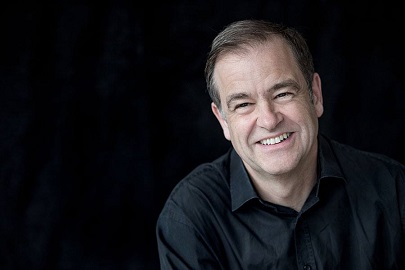
    Above: pianist Julius Drake

    Beethoven’s An die ferne Geliebte, the composer’s only true song cycle, strings six poems by Alois Jeitteles together in an uninterrupted flow of song. Mssrs. Polenzani and Drake perfectly captured the songs’ many poetic references to the natural world, which the singer mentally relates to the finding and eventual loss of an idealized lover. Mr. Polanzani’s golden tone, the naturalness of his way with words, and the continuing enchantment of his softest notes kept us riveted; and Mr. Drake matched the singer, nuance for nuance, in their marvelous performance.
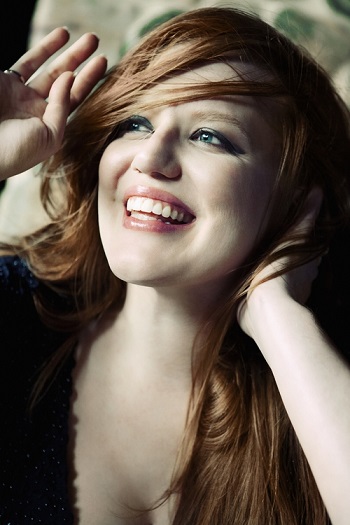
    Cano

    Johannes Brahms’ Zigeunerlieder, Op. 103, brought forth mezzo-soprano Jennifer Johnson Cano (above). This set of gypsy songs served the singer as a prologue to her role as the gypsy lass Zefka in Janáček’s The Diary of One Who Vanished. In a striking deep blue gown, Ms. Johnson Cano gave a vivid performance, in which Mr. Drake, at the Steinway, was a perfect accomplice.  

    Ms. Johnson Cano has the ideal voice, temperament, and personality for these songs; her gift for musical characterization is spot on, and is reflected in her stage manner: she plays the diva one moment and the loving lady the next. Singing with her warm, inviting mezzo timbre, Ms. Johnson Cano was particularly lovely in the cycle’s penultimate song, “Kommt der manchmal in den Sinn” where, at the words “Täusch mich nicht, verlass mich nicht…” the melody takes up an air of longing which the singer conveyed with expressive vocal colours. In the Brahms, as all evening, Julius Drake’s playing was so inviting.

    Following the interval, Janáček’s The Diary of One Who Vanished, was given a mesmerizing performance by Mr. Polenzani, Ms. Johnson Cano, and three offstage singers: Kathleen O’Mara, soprano, and mezzo-sopranos Marie Engle and Megan Grey. At the piano, Julius Drake played this music – which might be described as a chamber opera – with a vast range of colour and brilliant rhythmic clarity.

    This is the story of a young village boy who fell in love with a gypsy beauty and abandoned his safe and simple life to join her in her wanderings. Originally thought to have been drawn from the boy’s discarded diary, the story was eventually discovered to have been written by Josef Kalda, a accomplished author from Prague. In his 62nd year, Janáček himself fell under the spell of a much younger ‘gypsy’ woman; their relationship was revealed in a series of passionate letters, published in the 1980s.

    Julius Drake’s phenomenal artistry was a key element in this fascinating work; one hardly needs an orchestra with this gentleman at the Steinway. His playing again superbly matched Mr. Polenzani’s singing: full of passion, poetry, intensity and natural beauty of expression.

    The first several songs of The Diary of One Who Vanished are given over to the tenor: what a great pleasure to hear Mr. Polenzani and Mr. Drake here in a long stretch of music-making of such evocative qualities. Ms. Johnson Cano then appears, singing splendidly, with a bewitching, smouldering quality to her lower range. An offstage trio of voices – Mlles. O’Mara, Engle, and Grey – produced a lovely blend that sometimes brought to mind Wagner’s Rhinemaidens, or Strauss’s ARIADNE nymphs.

    The finale is an extended sing for the tenor, again with Mr. Drake playing grandly. From lyrical outpourings, the music turns to a hymn of farewell sung by the boy about to take leave of his homeland. Here Mr. Polenzani unleashed hall-filling power; the audience could scarcely restrain themselves from applauding until the last echoes from the Steinway had faded.

    At the end of the Janáček, the sold out hall was the scene of a tumultuous standing ovation. As the artists came forward to bow, the audience clearly wanted more music. But what sort of encore could follow such a performance? After a long delay, during which the applause redoubled, Mr. Polenzani and Mr. Drake came onstage again.

    The tenor spoke of the difficulty of finding the right piece to sing after the drama of the Janáček. In the course of his travels, he said, the most-requested song was the universally beloved “O Danny Boy‘. Taking up the thrice-familiar melody, which has been sung by everyone from Ernestine Schumann-Heink to Johnny Cash, Mr. Polenzani gave the most ravishing performance of it I could ever hope to hear. The words – so simple and moving  – came from the heart, and the colours of the voice were haunting. People around me were holding back tears as Mr. Polenzani took the final ascending phrase of the song to an exquisitely sustained final note than hung magically on the air.

    ~ Oberon

  • Irene Dalis as Fricka

    Walkure6465.05

    The great dramatic mezzo-soprano Irene Dalis in the scene of confrontation between Fricka and Wotan from Act II of Wagner’s DIE WALKURE:

    Irene Dalis as Fricka – WALKURE – w Birgit Nilsson & Otto Edelmann – Leinsdorf cond – Met bcast 1961

    From her 1957 debut there, Irene Dalis sang some 275 performances with the Metropolitan Opera Company – in New York City and on tour – during her twenty-year Met career. Her greatest roles were The Nurse in DIE FRAU OHNE SCHATTEN and Amneris in AIDA. In 1969, her electrifying performance of Verdi’s Egyptian princess at a concert performance at the Sheep Meadow, Central Park, drew an estimated  crowd of 50,000; Dalis’s super-charged singing in the Judgement Scene evoked a thunderous ovation.

    6a00d8341c4e3853ef00e54f20ad648833-800wi

    Following her retirement from singing, Irene Dalis founded Opera San Jose, which she ran with great success for over two decades.

    In August 2007, I wrote an appreciation of Irene Dalis, which she eventually found and read; she sent me a lovely message of thanks.

    ~ Oberon

  • Forgotten Voices: Rudolf Ritter

    5ab02691af300

    I came upon the voice of Rudolf Ritter by chance while sampling recordings of different tenors in the music of Verdi’s Otello.

    Rudolf Ritter – Otello’s Death ~ OTELLO – in German

    Following service in the Austro-Hungarian army (1898-1908), Rudolf Ritter studied singing at the Vienna Music Academy. In 1910 he made his debut at the Volksoper in Vienna, where he sang until 1913; he then joined the Hofoper in Stuttgart, where he made a name for himself as a leading artist for twenty years, singing in world premieres by Braunfels and Zemlinsky as well as the standard repertory.

    Ritter joined a touring group, the German Opera Company, in 1923. In North America, he sang at Chicago and in Kienzl’s Der Evangelimann in New York City. He appeared at the Bayreuth Festival from 1924-1930 as Siegfried and Tannhäuser, and in 1926 he scored a major success with performances in South America.

    From 1929-1931 season, Ritter was again touring North America with the German Opera Company, along with soprano Johanna Gadski.  He made guest appearances at London’s Covent Garden, the Paris Opéra, Vienna Staatsoper, and Zurich. In 1927 at the Zoppot Festival, he sang Siegfried in Götterdämmerung.

    Rudolf Ritter retired from the stage in 1933, settling at Stuttgart where he taught and coached. He was married to the pianist Gret Hein. He passed away in 1966.

    Ritter’s rounded, steady tone sounds really good in Wagner:

    Rudolf Ritter – Allmächtǵer Vater ~ RIENZI

    Rudolf Ritter – Winterstürme wichen dem Wonnemond ~ WALKURE

    ~ Oberon

  • Licia’s Last Butterfly

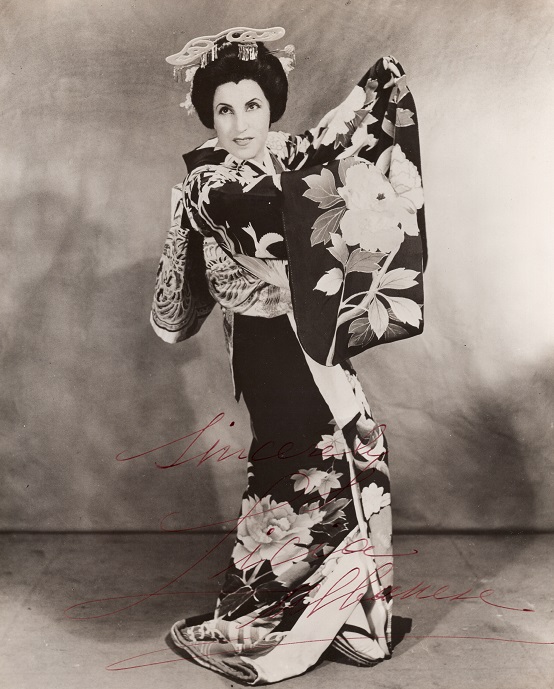
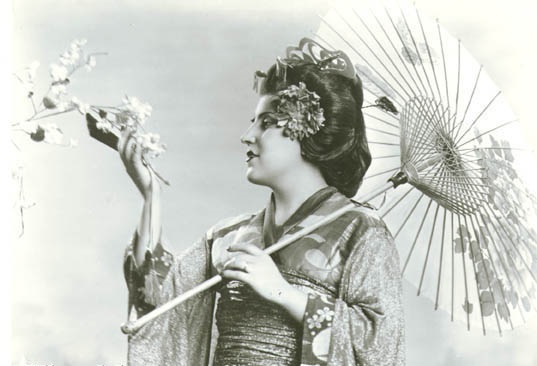
    Albanese

    On Friday, November 26, 1965, I went to a performance of MADAMA BUTTERFLY at the Metropolitan Opera House. On the following day, I had an operatic double-header: a matinee of ELISIR D’AMORE and an evening performance of FAUST. That Saturday marked the last time I ever set foot in the Old Met. The venerable theatre had been marked for demolition, while a New Met was rising at Lincoln Center.

    The eight performances I saw at the Old House are very special memories for me. The singers I saw there had become gods and goddesses to me thru their singing on the Texaco Metropolitan Opera radio broadcasts; I was now experiencing ‘live‘ the rituals Milton Cross described each week over the airwaves: the house lights going down, the applause greeting the conductor, the great gold curtain being drawn back for the curtain calls. It was like a dream come true.

    Licia Albanese’s was one of the first operatic voices I became familiar with. She was one of the singers on the first 2-LP set of opera arias and duets that I owned. She sang Liu on a memorable Met broadcast of TURANDOT in 1962, opposite Nilsson and Corelli. And my parents had taken me to see her as Violetta (her 100th performance of the role) at the Cincinnati Zoo Opera in 1963.

    In all honesty, Albanese’s voice was never really among my favorites; it was more her expressive intensity of communication and her endearing persona that I found appealing. But I understood her importance as a singer in the grand tradition, and if her singing of the Violetta and Butterfly that I saw could turn dry and almost ghostly, I can still vividly recall her stage presence and her instinctive if Olde School acting.

    What I did not realize as I watched Licia Albanese taking her bows after that 1965 Butterfly was that it was the final time she ever sang the role. After playing Cio-Cio-San some eighty times on that stage, this was to be the last. Like many performances I have experienced, the evening became iconic over time when measured as part of the singer’s career.

    I met La Licia after the performance – I was one of a sizeable group of admirers who had waited for her – and she was of course elegantly gowned and coiffed, chattering away to her fans in Italian. She signed my program with a flourish: 

    Scanned Section 7-1

    It was a happy crowd of fans and friends, and no mention was made of it being “her last Butterfly”. She did sing one more complete role at The Met: Manon Lescaut; and the following Summer she sang Mimi in LA BOHEME with Barry Morell in a concert presented by The Met at the Newport Festival. 

    A few days after the performance, I sent her a fan letter and received this photo in return, along with her calling card:

    Scanned Section 11-1

    Licia Albanese – Ancora un passo or via ~ MADAMA BUTTERFLY

    There were two further memorable moments related to the Old Met and to MADAMA BUTTERFLY in Albanese’s extraordinary life: at the gala farewell concert that marked the closing of the Old Met on April 16th, 1966, Licia sang the aria “Un bel di” and, during the applause, she knelt to place a kiss on the stage where she had appeared so frequently since her debut in 1940:

    Old met farewell

    Once the demolition of the ‘old yellow brewery’ began, Licia donned her kimono and sang “Un bel di” one last time amid the ruins.

    But my connection with the legendary diva was not over. One evening during the first season at the New Met, I saw her among the audience on the Grand Tier during intermission. She was talking with another elegantly-gown lady as I approached them hesitantly. The other woman gave me an encouraging smile, so I took Madame Albanese’s hand and awkwardly told her of having seen her Violetta and Butterfly. She thanked me quietly, but kept hold of my hand. Then she turned to her friend and said, in her charming accent: “It is so wonderful to be remembered! He’s so young, he will tell people about me many years from now.”

    Then, some thirty-five years on, I was holding down the fort in the opera room at Tower Records one dreary afternoon when Licia Albanese came in with a companion; the soprano was rather feeble by that point in time, but when I greeted her, she smiled silently. I said to her, “I saw your one hundredth Violetta at the Cincinnati Zoo Opera!” She was silent for a moment, and I thought my remark had not registered. Her friend gave me a look as if to say that Madame’s mind might not be perfectly clear.

    “The Zoo!” said the diva firmly. Then she began to roar like a lion and sing little birdcalls and make noises like chattering monkeys. Anyone who has ever attended a performance at the Cincinnati Zoo will know that these sounds were always a continuous obbligato to the opera being performed. We all laughed. And then I bade the two women goodbye, thinking to myself – as I have so often – “What a life I am living!”

    920x920

    Above: Licia Albanese at age 93; she passed away in 2014 at the age of 105. 

    ~ Oberon

  • Licia’s Last Butterfly

    Albanese

    On Friday, November 26, 1965, I went to a performance of MADAMA BUTTERFLY at the Metropolitan Opera House. On the following day, I had an operatic double-header: a matinee of ELISIR D’AMORE and an evening performance of FAUST. That Saturday marked the last time I ever set foot in the Old Met. The venerable theatre had been marked for demolition, while a New Met was rising at Lincoln Center.

    The eight performances I saw at the Old House are very special memories for me. The singers I saw there had become gods and goddesses to me thru their singing on the Texaco Metropolitan Opera radio broadcasts; I was now experiencing ‘live‘ the rituals Milton Cross described each week over the airwaves: the house lights going down, the applause greeting the conductor, the great gold curtain being drawn back for the curtain calls. It was like a dream come true.

    Licia Albanese’s was one of the first operatic voices I became familiar with. She was one of the singers on the first 2-LP set of opera arias and duets that I owned. She sang Liu on a memorable Met broadcast of TURANDOT in 1962, opposite Nilsson and Corelli. And my parents had taken me to see her as Violetta (her 100th performance of the role) at the Cincinnati Zoo Opera in 1963.

    In all honesty, Albanese’s voice was never really among my favorites; it was more her expressive intensity of communication and her endearing persona that I found appealing. But I understood her importance as a singer in the grand tradition, and if her singing of the Violetta and Butterfly that I saw could turn dry and almost ghostly, I can still vividly recall her stage presence and her instinctive if Olde School acting.

    What I did not realize as I watched Licia Albanese taking her bows after that 1965 Butterfly was that it was the final time she ever sang the role. After playing Cio-Cio-San some eighty times on that stage, this was to be the last. Like many performances I have experienced, the evening became iconic over time when measured as part of the singer’s career.

    I met La Licia after the performance – I was one of a sizeable group of admirers who had waited for her – and she was of course elegantly gowned and coiffed, chattering away to her fans in Italian. She signed my program with a flourish: 

    Scanned Section 7-1

    It was a happy crowd of fans and friends, and no mention was made of it being “her last Butterfly”. She did sing one more complete role at The Met: Manon Lescaut; and the following Summer she sang Mimi in LA BOHEME with Barry Morell in a concert presented by The Met at the Newport Festival. 

    A few days after the performance, I sent her a fan letter and received this photo in return, along with her calling card:

    Scanned Section 11-1

    Licia Albanese – Ancora un passo or via ~ MADAMA BUTTERFLY

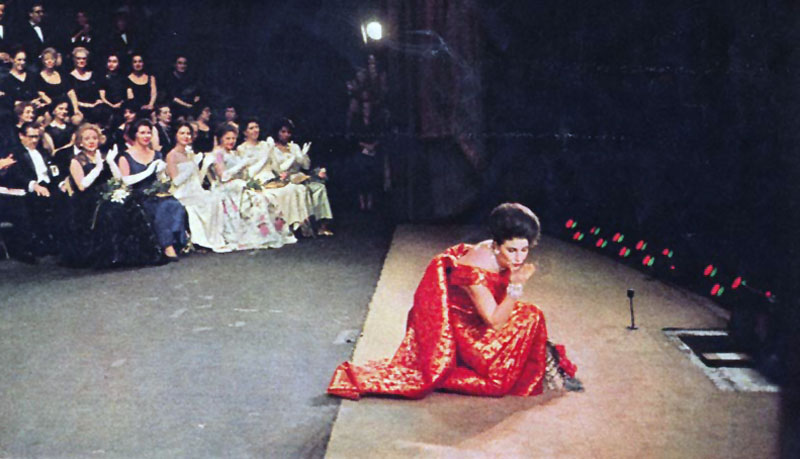
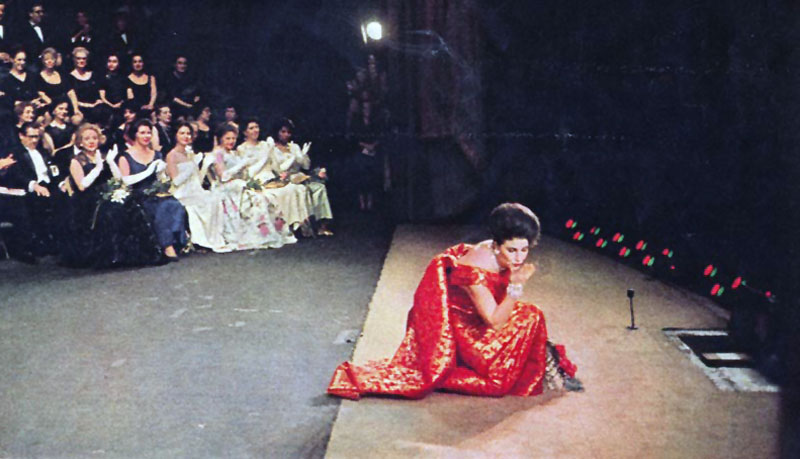
    There were two further memorable moments related to the Old Met and to MADAMA BUTTERFLY in Albanese’s extraordinary life: at the gala farewell concert that marked the closing of the Old Met on April 16th, 1966, Licia sang the aria “Un bel di” and, during the applause, she knelt to place a kiss on the stage where she had appeared so frequently since her debut in 1940:

    Old met farewell

    Once the demolition of the ‘old yellow brewery’ began, Licia donned her kimono and sang “Un bel di” one last time amid the ruins.

    But my connection with the legendary diva was not over. One evening during the first season at the New Met, I saw her among the audience on the Grand Tier during intermission. She was talking with another elegantly-gown lady as I approached them hesitantly. The other woman gave me an encouraging smile, so I took Madame Albanese’s hand and awkwardly told her of having seen her Violetta and Butterfly. She thanked me quietly, but kept hold of my hand. Then she turned to her friend and said, in her charming accent: “It is so wonderful to be remembered! He’s so young, he will tell people about me many years from now.”

    Then, some thirty-five years on, I was holding down the fort in the opera room at Tower Records one dreary afternoon when Licia Albanese came in with a companion; the soprano was rather feeble by that point in time, but when I greeted her, she smiled silently. I said to her, “I saw your one hundredth Violetta at the Cincinnati Zoo Opera!” She was silent for a moment, and I thought my remark had not registered. Her friend gave me a look as if to say that Madame’s mind might not be perfectly clear.

    “The Zoo!” said the diva firmly. Then she began to roar like a lion and sing little birdcalls and make noises like chattering monkeys. Anyone who has ever attended a performance at the Cincinnati Zoo will know that these sounds were always a continuous obbligato to the opera being performed. We all laughed. And then I bade the two women goodbye, thinking to myself – as I have so often – “What a life I am living!”

    920x920

    Above: Licia Albanese at age 93; she passed away in 2014 at the age of 105. 

    ~ Oberon

  • Met Opera All-Stars

    Thumbnail_image

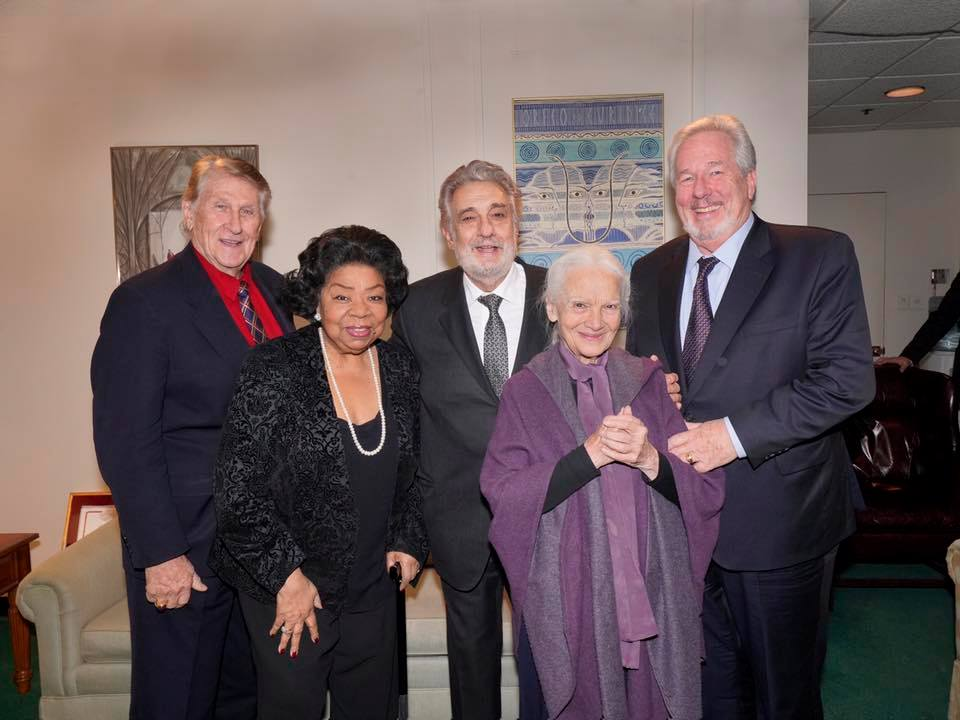
    Helping Placido Domingo celebrate the 50th anniversary of his Met debut, four great stars who sang with him often came backstage to greet the “tenoritone” after his prima of GIANNI SCHICCHI. Above: Sherrill Milnes, Martina Arroyo, Placi, Teresa Stratas, and James Morris in a Met Opera photo.

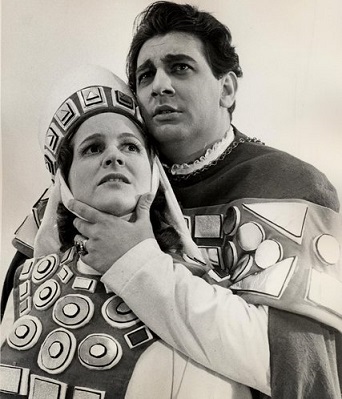
    Having already seen him several times at New York City Opera, I was at Placido Domingo’s Met debut – the night he stepped in (on very short notice) for Franco Corelli – as Maurizio in Cilea’s ADRIANA LECOUVREUR:

    6a00d8341c4e3853ef00e554b71cce8833

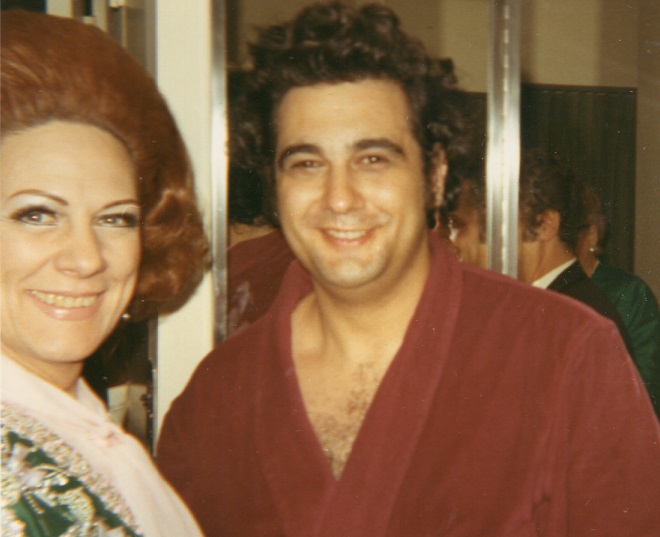
    My fondest memory of that evening was of Renata Tebaldi, as Adriana, turning her back on the audience so that Placi could look over her shoulder to watch conductor Fausto Cleva during his Act I aria, “La dolcissima effigie“. During the ensuing ovation, Renata kept patting Domingo’s shoulder and saying “bravo! bravo!” They went on to be good colleagues and friends:

    Renata & Placi Met June 1970

    While that ADRIANA was Domingo’s first performance from the Met stage, he had sung a single concert performance of CAV & PAG with the Company at Lewisohn Stadium in August, 1966:

    Metropolitan Opera @ Lewisohn Stadium
    August 9th, 1966
    In Concert

    CAVALLERIA RUSTICANA
    Mascagni

    Santuzza................Irene Dalis
    Turiddu.................Plácido Domingo [First appearance]
    Lola....................Joann Grillo
    Alfio...................Russell Christopher
    Mamma Lucia.............Carlotta Ordassy

    Conductor...............Kurt Adler

    Sherrill Milnes had made his Met debut during the final season at the Old Met (in the same performance of FAUST that Montserrat Caballé made hers); Martina Arroyo and Teresa Stratas had already established themselves at the Old Met by the time the Company moved to Lincoln Center. James Morris made his Met debut in 1971, and I saw him there in one of his very first performances, as Raimondo in a student matinee of LUCIA DI LAMMERMOOR.

    Now let’s hear from each singer in the “reunion” photo at the top:

    Martina Arroyo – Ritorna vincitor! – AIDA – Buenos Aires 1968

    GHOSTS OF VERSAILLES ~ final scene – Teresa Stratas & Hector Vasquez – Met bcast 1995

    James Morris – RHEINGOLD ~ Abendlich Strahlt Die Sonne – w M Lipovsek

    Sherrill Milnes joins Domingo on the final note of their OTELLO duet…such an exciting moment:

    Domingo & Milnes – OTELLO duet – Met bcast – 2~2~85

    To finish this reminiscence, here’s Domingo in a opera The Met could/should have staged for him, Meyerbeer’s L’AFRICAINE:

    Placido Domingo – O Paradis! – L’AFRICAINE

    ~ Oberon

  • Jeannine Crader

    Crader Domingo Ginastera's DON RODRIGO Fred Fehl

    Above: Jeannine Crader and Placido Domingo in Ginastera’s DON RODRIGO; photo by Fred Fehl

    Soprano Jeannine Crader was a member of the San Francisco Opera’s Merola Program in the late 1950s, and sang Magda Sorel in Menotti’s THE CONSUL with the San Francisco Opera’s Spring Program in 1969.

    Crader-beni-baldwin

    She performed with the Metropolitan Opera Studio Company (above, in COSI FAN TUTTE, with Gimi Beni and Marcia Baldwin) before joining New York City Opera where she sang in the US premiere of Alberto Ginastera’s DON RODRIGO, opposite Placido Domingo, in 1966. 

    I saw Ms. Crader only once – as Donna Elvira at New York City Opera in 1966. With the Company, she also sang Tosca, Butterfly, and Giorgetta in IL TABARRO. In 1967, she and Domingo sang in ANDREA CHENIER together at the Cincinnati Opera.

    Ms. Crader appears on Maurice Abravanel’s recording of the Mahler 8th, and there is a complete recording of DON RODRIGO available from Opera Depot. Beyond that, I can only find two Puccini souvenirs, both with Mr. Domingo:

    Jeannine Crader & Placido Domingo – E Ben Altro Il Mio Sogno ~ TABARRO – NYCO 1968

    Jeannine Crader & Placido Domingo – TOSCA scene ~ Act III – NYC Opera

    Jeannine Crader sings a William Mayer duet, “Barbara, What Have You Done?” with Dorothy Renzi (audio only) on YouTube. I like it a lot. 

    Ms. Crader taught at the University of North Texas from 1970-1997.

    ~ Oberon

  • @ My Met Score Desk For PEARL FISHERS

    Pearl fishers

    ~ Author: Oberon

    Saturday November 24th, 2018 matinee – The New York City Opera used to perform Georges Bizet’s Pêcheurs de Perles fairly often, and I saw it there four times in the 1980s with such sopranos as Diana Soviero, Carol Vaness, Diana Walker, and the enchanting Rachel Rosales; tenors Barry McCauley and Jerry Hadley; and baritones Dominic Cossa, William Stone, and Robert McFarland. During that time of my life, I really liked this melodious opera, with its enchanting soprano aria, a poetic (and difficult) tenor aria, and – of course – a beloved duet for tenor and baritone: “Au fond du temple saint“.

    But there’s also a lot of filler, atmospheric in its way yet in the long run just…filler. Pêcheurs was not on my initial list of operas to see/hear at The Met this season;  but as I was tallying up my score desk order, I added a couple of operas just to see if they’d still be of interest to me. Pêcheurs, as it turns out, isn’t.

    I had skipped this Met production of Pêcheurs when it was new, because I’d taken a strong dislike to Diana Damrau. This season, Pretty Yende is singing Leïla, a part which I imagined would suit her voice far better than Donizetti’s Lucia had. “O Dieu Brahma!” is not the easiest way to start your afternoon. Ms. Yende’s florid singing was not always fluent, and at times her pitch was a shade off; counter-balancing this were an ethereal high B-flat and a gorgeous high-D. I imagine her “Comme autrefois” would have been quite fine, but I couldn’t outlast the intermission to find out.

    Alexander Birch Elliott had stepped into the role of Zurga midway thru the season prima of Pêcheurs, replacing Mariusz Kwiecien, who has now withdrawn from the production due to illness. Mr. Elliott has a handsome lyric baritone voice, and he blended perfectly with Javier Camarena in their famous duet, which drew sustained applause.

    Mr. Camarena’s singing of the dreamy aria “Je crois entendre encore” was lovingly phrased, with exquisite piano effects. His voice is a bit light for this role in the big house, but it’s wonderfully present and expressive.

    On the podium, Emmanuel Villaume did what he could with this perfumed score, giving an atmospheric prelude (twice interrupted by applause); he sometimes let his orchestra cover the voices, however.

    Hearing this opera again had the effect of finding a disintegrating, powdery rose pressed in the pages of a book you haven’t opened in decades. You can’t remember who gave you the flower or why it was significant enough to save, but you feel a twinge of regret that something that once meant something to you no longer does.

    Metropolitan Opera House
    November 124th, 2018 matinee

    LES PÊCHEURS DE PERLES
    Georges Bizet

    Léila...................Pretty Yende
    Nadir...................Javier Camarena
    Zurga...................Alexander Birch Elliott
    Nourabad................Nicolas Testé

    Conductor...............Emmanuel Villaume 

    ~ Oberon

  • van Zweden’s Bruckner 8th @ The NY Phil

    JaapVanZweden

    Above: Jaap van Zweden, Musical Director of The New York Philharmonic

    ~ Author: Oberon

    Friday September 28th, 2018 – This evening was our first opportunity to hear Jaap van Zweden lead The New York Philharmonic since he officially took up the position of Musical Director. My friend Ben Weaver and I splurged and bought tickets to this concert because Bruckner is always on our must-hear list. In 2014, I had my first live encounter with the composer’s 8th in this very hall, under Alan Gilbert’s baton. It was a revelation.

    Tonight, Jaap van Zweden offered Conrad Tao’s Everything Must Go as a prelude to the Bruckner 8th. Does this massive symphony need a prelude? No. As with many ‘new’ works we’ve encountered over the past few seasons, Everything Must Go is expertly crafted but it sounds like so much else: by turns spare and noisy, with frequent percussive bangs and pops, this eleven-minute piece (it felt longer) passed by without providing any sense of the composer’s individual voice. Perhaps hearing more of Mr. Tao’s work – music not yoked to an existing masterpiece that employs the same orchestral forces – will lead us to discover who he is.

    Since there was no pause between the Tao and the Bruckner, the audience’s response to Everything Must Go could not be gauged. I wonder if the young composer took a bow at the end; we had headed out as the applause commenced.

    For the first two movements of the Bruckner, I was enthralled. The orchestra sounded truly superb, and Maestro van Zweden held sway with a perfect sense of the music’s architecture. It was a tremendous relief and balm to emerge from the day’s madness (the Kavanaugh hearings) into Bruckner’s vibrant world.

    The Philharmonic musicians offered rich tone and marvelous colours, the brass sounding grand and the violins singing lyrically in their big theme. The music has a Wagnerian sense of the monumental, and a ceaseless melodic flow. Among the solo moments, Sherry Sylar’s oboe stood out. At one point there’s an almost direct quote from Tchaikovsky’s SLEEPING BEAUTY. During a respite/interlude, softer themes mingle before a splendid onslaught from the brass turns grandiose. The movement ends on a murmur.

    The Scherzo has as its main and oft-repeated theme a churning 5-note figure that has worked its way into the soundtrack for GAME OF THRONES. As the movement progresses, the harp makes a lovely effect, as do the entwining voices of solo woodwinds. Textures modify seamlessly, sustaining our pleasure.

    A deep sense of longing suffuses the opening of the Adagio, with its rising passion. Again the harp glimmers magically. The rise and fall of great waves of sound bring passages of almost unbearable beauty; there’s a spectacular build-up to music of searing passion which evaporates into soft halo of solo winds. As the music re-builds, a Tchaikovskian glory permeates. It seems, though, that Bruckner cannot quite decide how to end this epic movement.

    Pulsing, march-like, and majestic, the Finale leads us onward. A big swaying rhythm from the timpani leads into a huge tsunami of sound. The work began to feel like a series of climaxes, though, and traces of brass fatigue started to crop up. The Maestro and the musicians were engulfed by gales of applause and cheers at the end. 

    I’m probably in a minority in feeling that Alan Gilbert’s 2014 rendering of the Bruckner 8th with the Philharmonic reached me on a deeper level, as well as being more exhilarating. “Well, it was faster!”, Ben Weaver would say. À chacun son goût…

    ~ Oberon

  • van Zweden’s Bruckner 8th @ The NY Phil

    JaapVanZweden

    Above: Jaap van Zweden, Musical Director of The New York Philharmonic

    ~ Author: Oberon

    Friday September 28th, 2018 – This evening was our first opportunity to hear Jaap van Zweden lead The New York Philharmonic since he officially took up the position of Musical Director. My friend Ben Weaver and I splurged and bought tickets to this concert because Bruckner is always on our must-hear list. In 2014, I had my first live encounter with the composer’s 8th in this very hall, under Alan Gilbert’s baton. It was a revelation.

    Tonight, Jaap van Zweden offered Conrad Tao’s Everything Must Go as a prelude to the Bruckner 8th. Does this massive symphony need a prelude? No. As with many ‘new’ works we’ve encountered over the past few seasons, Everything Must Go is expertly crafted but it sounds like so much else: by turns spare and noisy, with frequent percussive bangs and pops, this eleven-minute piece (it felt longer) passed by without providing any sense of the composer’s individual voice. Perhaps hearing more of Mr. Tao’s work – music not yoked to an existing masterpiece that employs the same orchestral forces – will lead us to discover who he is.

    Since there was no pause between the Tao and the Bruckner, the audience’s response to Everything Must Go could not be gauged. I wonder if the young composer took a bow at the end; we had headed out as the applause commenced.

    For the first two movements of the Bruckner, I was enthralled. The orchestra sounded truly superb, and Maestro van Zweden held sway with a perfect sense of the music’s architecture. It was a tremendous relief and balm to emerge from the day’s madness (the Kavanaugh hearings) into Bruckner’s vibrant world.

    The Philharmonic musicians offered rich tone and marvelous colours, the brass sounding grand and the violins singing lyrically in their big theme. The music has a Wagnerian sense of the monumental, and a ceaseless melodic flow. Among the solo moments, Sherry Sylar’s oboe stood out. At one point there’s an almost direct quote from Tchaikovsky’s SLEEPING BEAUTY. During a respite/interlude, softer themes mingle before a splendid onslaught from the brass turns grandiose. The movement ends on a murmur.

    The Scherzo has as its main and oft-repeated theme a churning 5-note figure that has worked its way into the soundtrack for GAME OF THRONES. As the movement progresses, the harp makes a lovely effect, as do the entwining voices of solo woodwinds. Textures modify seamlessly, sustaining our pleasure.

    A deep sense of longing suffuses the opening of the Adagio, with its rising passion. Again the harp glimmers magically. The rise and fall of great waves of sound bring passages of almost unbearable beauty; there’s a spectacular build-up to music of searing passion which evaporates into soft halo of solo winds. As the music re-builds, a Tchaikovskian glory permeates. It seems, though, that Bruckner cannot quite decide how to end this epic movement.

    Pulsing, march-like, and majestic, the Finale leads us onward. A big swaying rhythm from the timpani leads into a huge tsunami of sound. The work began to feel like a series of climaxes, though, and traces of brass fatigue started to crop up. The Maestro and the musicians were engulfed by gales of applause and cheers at the end. 

    I’m probably in a minority in feeling that Alan Gilbert’s 2014 rendering of the Bruckner 8th with the Philharmonic reached me on a deeper level, as well as being more exhilarating. “Well, it was faster!”, Ben Weaver would say. À chacun son goût…

    ~ Oberon