Tag: Opera

  • Amina Edris ~ “Dis-moi que je suis belle”

    Amina_edris_capucine_de_chocqueuse_0

    Egyptian-born soprano Amina Edris (above, photo by Capucine de Chocqueuse) sings “Dis-moi que je suis belle” from Massenet’s Thaïs at a concert in Prague with the Prague Philharmonia, conducted by Lukasz Borowicz.

    Watch and listen here.

    Ms. Edris will be making her Metropolitan Opera debut in April 2025 as Mimi in La Boheme.

  • Wagner: Siegfried Idyll ~ Toronto Symphony Orchestra

    Snapshot si 2

    A performance of Richard Wagner’s SIEGFRIED IDYLL by the Toronto Symphony Orchestra conducted by Peter Oundjian.

    Watch and listen here.

  • Boulez Conducts TRISTAN & ISOLDE

    Pierre-boulez

    Above: Pierre Boulez

    In April of 1967, the Bayreuth Festival’s Wieland Wagner production of TRISTAN UND ISOLDE was brought to Osaka, Japan, for three performances, featuring a stellar cast: Wolfgang Windgassen (Tristan), Birgit Nilsson (Isolde), Hertha Töpper (Brangäne), Frans Andersson (Kurvenal),  Hans Hotter (King Marke), Sebastian Feiersinger (Melot), Georg Paskuda (Young Sailor/Shepherd), and Gerd Nienstedt (Steersman).

    These performances marked the only time Pierre Boulez conducted this Wagner masterpiece.

    Watch and listen here.

    For me, this recording captures, perhaps more truly than any other, the way Birgit Nilsson sounded live in the performances of hers that I heard at The Met.

  • Scenes from a Munich WALKURE

    Scanned Section 15-1

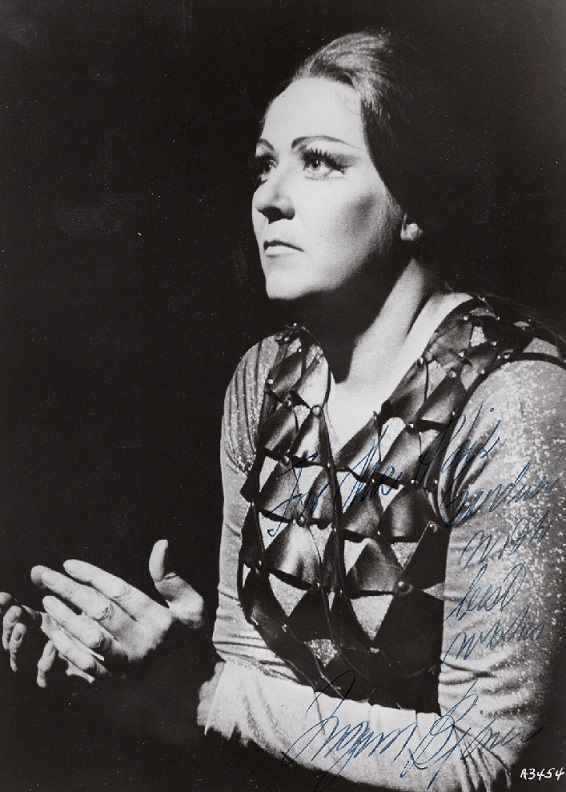
    Ingrid Bjoner (above) is Brünnhilde in these scenes from a performance of Wagner’s DIE WALKURE from Munich, 1972. The in-house sound quality leaves much to be desired, but I’ve always loved this rendering of the Todesverkündigung as sung by Bjoner and James King.

    There are also three brief excerpts from Act III, with Claire Watson as Sieglinde and Heinz Imdahl as Wotan joining Ingrid Bjoner. Rudolf Kempe’s conducting strikes me as just about ideal.

    WALKURE exc – Munich 1972 – Bjoner King Watson Imdahl – Kempe cond

  • Dances We Dance @ Graham Studio Theatre

    DWD_FS-20241121-DSC00027

    Above: dancer Kathleen Caragine in Water Study, photo by Steven Pisano

    ~ Author: Oberon

    Sunday November 24th, 2024 matinee – Francesca Todesco’s company Dances We Dance presenting ACQUA, a program of danceworks inspired by water. This evening’s afternoon’s was a performance that celebrated sisterhood and helped ease the after-effects of a painful recent election, in which women’s causes that seemed set to flourish under a Harris administration now seem destined for setbacks in the years ahead.
    DWD_FS-20241121-DSC00973

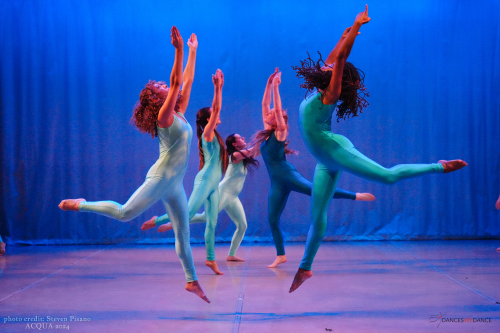
    Above: the ensemble in Water Study, photo by Steven Pisano

    The program presented a set of dances inspired by or alluding to themes relating to water, which – since the earliest beginnings of dance –  have evoked or reveled in this essential element. From the rain dances of the ancient tribes to Chris Wheeldon’s After The Rain… and Caterina Rago’s Alta Marea, water has been a constant source of inspiration in the dance community.

    As part of this exploration, the audience today experienced the re-staging of Doris Humphrey’s renowned 1928 choreography Water Study, performed by a cast of 11 dancers under the direction of master teacher Gail Corbin. This was preceded by a showing of Isadora Duncan’s 1905 piece Water Study, which has an improvisational feeling. As staged by Francesca Todesco, this opens to the sound of dripping water.

    As music of Schubert sounds, the lights slowly come up to reveal the dancers prone on the floor. Wearing blue/green costumes, they slowly rise and – as projections of the sea appear on screen – they come and go, executing fleeting steps and creating waves of movement suggesting the ebb and flow of the sea. A Schubert waltz sounds, and the dancers assume an ecstatic pose.

    DWD_FS-20241121-DSC01346

    Above: the dancers in Doris Humphrey’s Water Study; photo by Steven Pisano

    Silence falls as the Humphrey piece commences: the kneeling dancers awaken, the sound of their breathing hangs gently on the air. One by one they rise. Forming opposing lines, they race towards each other like tempest-tossed waves converging. They run en masse from corner to corner, as if crashing against sea walls. Standing, they sway from side to side to the sounds of their own breath. Then they fold into kneeling poses and the ballet ends as it began. Kudos to Ms. Corbin for bringing the fascinating work to currency. 

    DWD_FS-20241121-DSC01850

    Above: from Catherine Gallant’s Wave; the dancers are Colleen Edwards, Rosey Gentle, and Kathleen Caragine; photo by Steven Pisano

    The next three works were finely contrasted but they had one thing in common: each was so visually and musically enjoyable that they felt too short!     

    Wave, a 2001 work choreographed by Catherine Gallant, is an homage to Isadora with a contemporary touch. Three dancers – Kathleen Caragine, Colleen Edwards, and Rosy Gentle – are posed in a pool of light at the start. To the sounds of a Chopin mazurka, these beauties dance nobly and expressively in tunic-like costumes. They collapse and rise, evoking visions of Wagner’s Rhinemaidens, their faces are at once youthful and ancient: a sisterhood of goddesses. As the light fades, they return to their opening pose.

    Gallant

    Above: choreographer Catherine Gallant in an iconic photo

    I was ever so happy to see Catherine this evening; I felt reassured after speaking with her: now more than ever we must be there for one another. I told Catherine of the beautiful “Isadora” photo I have of her on my bookcase shelf (above); I can look up from my desk all thru the day and see her in that ecstatic pose.
    DWD_FS-20241121-DSC02476

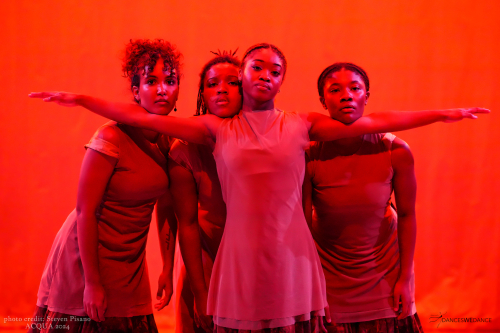
    Above: from Crosscurrents; the dancers are Jada Alfred, Marley Poku-Kankam, Autumn Rodrigue, and Alana Averett; photo by Steven Pisano

    Crosscurrents, choreographed by Hannah Howell, brought forth four lovely young ladies, each with a distinctive personality. To a wonderfully weird and quirky score by Angel Bat David, the dancers create movement patterns and dance in diagonal formations. The sound of the clarinet takes over – I love it! – and standing in a line up, each dancer has a brief solo. The music is incredibly evocative, it sings of solidarity. The stage becomes sun-drenched as the dancers fall and then resume their initial pose. 
    DWD_FS-20241121-DSC03010

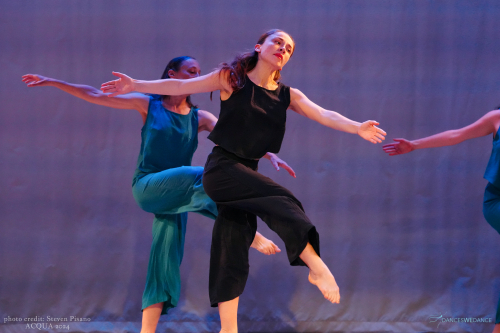
    Above: Lana Hankinson in Tidal Pool; photo by Steven Pisano

    Tidal Pool, set to deeply lyrical music by Yumira and choreographed by Rae Ballard, was danced by a quintet that featured Mlles. Caragine, Edwards, and Gentle joined by guest dancers Lana Hankinson and Lauren Naslund. The gentle flow of the dance created a sense of quiet serenity whilst the music evokes a luxuriant feeling of peace. Nearing the end, Ms. Naslund walks slowly forward center-stage while one by one the other dancer cross her path and depart, leaving her alone onstage with an expression of quiet wonderment. I’ve always been an admirer of Ms. Naslund, more so today than ever. Her calm beauty has the enviable gift of timeless grace. 

    DWD_FS-20241121-DSC03607

    Following the interval, Francesca Todesco’s brand new Cherchez La Femme (above photo by Steven Pisano) was danced by Mlles. Edwards, Gentle, and Caragine.These three women have developed into artists of high quality, thoroughly comfortable and assured onstage. Each has something personal to say, making their dancing really fascinating to watch.

    DWD_FS-20241121-DSC04519

    Colleen Edwards (above, photo by Steven Pisano), so impressive in the Gallant piece earlier in the program, was riveting here. As the Todesco trio commenced against a golden backdrop, the white-clad Ms. Edwards stood in the light, casting her shadow. She is joined by the other two, and shadow-play becomes a part of their movement.

    Ms. Edwards has the first solo: each character has a name, and she is Simonetta. To softly cascading piano motifs, her dancing is truly mesmerizing. She rushes about the space and finally withdraws as Ms. Gentle, clad in red as Camille, enters frantically, as if being pursued…she immediately collapses. A questing search and a plea reveal her desperation. Rising, she appears hesitant, as if seeking something…or someone. To music of Chopin, the search becomes a plea. Ms. Gentle’s dancing seemed to reveal her heart and soul to us.

    Now we meet Artemisia: fair of face, Ms. Caragine’s black hair sets off her expressive eyes; she moves beautifully, with a ballerina’s poise, as the steps and gestures flow on the music. The trio re-unite, Ms. Gentle now back in her white frock, as the dance moves to its finish.

    Here are more images from Cherchez la femme, photos by Steven Pisano:

    DWD_FS-20241121-DSC04747

    Rosy Gentle

    DWD_FS-20241121-DSC05113

    Kathleen Caragine

    DWD_FS-20241121-DSC03930

    Mlles. Edwards, Gentle, and Caragine in Cherchez La Femme 

    DWD_FS-20241121-DSC05679

    Above: Francesca Todesco in Memories; photo by Steven Pisano

    Ms. Todesco then took the stage alone to premiere a new solo choreographed by Rae Ballard to the always welcome music of Astor Piazzolla. Entitled Memories, this solo finds the dancer clad in severe black with black pumps; she seems like a widow, alone in her grief, recalling happier times The music has a lamenting feeling and becomes quite lush; a hint of a tango is woven in. Francesca’s innate musicality, with her expressive hands and face, creates a mood of longing. At times, she seemed to be dancing just for me.
    DWD_FS-20241121-DSC06615

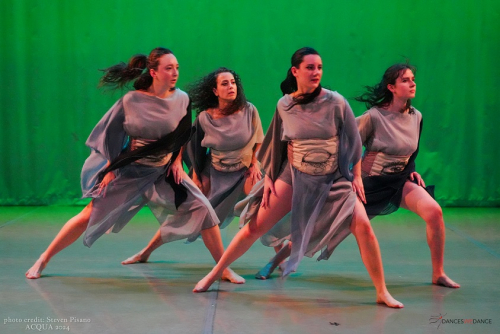
    Above, the sirens of Haunted Echoes: Colleen Edwards, Margherita Tisato, Kathleen Caragine, and Rosy Gentle; photo by Steven Pisano

    Closing the program was a newly commissioned work choreographed by the beloved former Paul Taylor star Annmaria Mazzini. This is Haunted Echoes, set to musical collage which propels a dance of the sirens – bewitching creatures all in sea-green. Drifting about the space, they pause to sing their alluring song. A big beat springs up and the dancing turns wild. And then the music becomes a bluesy lullaby, and the dancers drift off, a sisterhood lost at sea.

    On an evening that meant a lot to me, it was especially nice to greet the inimitable Jim May, who I’d only met once before, many, many moons ago at a Sokolow rehearsal. Tonight, it felt like a reunion of long-lost brothers.

    Performance photos by Steven Pisano.

    ~ Oberon
  • Lucine Amara Has Passed Away

    Lucine

    Above: Lucine Amara as Aida; she signed the photo for me after a Met performance of PAGLIACCI

    The death of soprano Lucine Amara at the age of 99 has been announced. A native of Hartford, Connecticut, Ms. Amara was raised in San Francisco and sang with the San Francisco Opera chorus from 1944-1946; she made her professional concert debut in 1946.

    She made her Metropolitan Opera debut on November 6, 1950, as the Celestial Voice in Verdi’s DON CARLO, a performance that marked the start of Sir Rudolf Bing’s tenure as General Manager of The Met. From that date thru 1991, Ms. Amara sang 750 performances with The Met in New York City and on tour.

    The soprano’s vast repertoire included Wellgunde in the RING Cycle, Pamina, Liu, Nedda, Antonia in TALES OF HOFFMAN, both the Verdi Leonoras, Aida, Micaela, Contessa Almaviva, Eva in MEISTERSINGER, Alice Ford, Maddalena (and later, Madelon) in ANDREA CHENIER, Cio-Cio-San, Elsa in LOHENGRIN, Mimi, Donna Elvira, Amelia in BALLO IN MASCHERA, Tchaikovsky’s Tatyana, Ellen Orford, Tosca, Marguerite in FAUST, Fiordiligi, Luisa Miller, Mother Marie in DIALOGUES OF THE CARMELITES, Gertrude in HANSEL AND GRETEL, and Mascagni’s Santuzza.

    6a00d8341c4e3853ef022ad3e2833f200b-800wi

    My first experience of hearing Lucine Amara live was at the Old Met as Liu in TURANDOT in 1965. She sang gorgeously, with a lovely sense of lyricism and some finely-spun pianissimi. I met her after the performance (my only backstage visit at the Old House), and she was very happy to meet a young – but already very keen – opera enthusiast. (I was 16 at the time…)

    In the ensuing seasons at the New Met, I enjoyed Lucine’s Aida, Nedda, TROVATORE Leonora, and Cio-Cio-San. On April 22nd, 1972, she returned to her Met debut role as the Celestial Voice in DON CARLO to mark the final matinee broadcast of the Bing Era, which I attended. That evening, she sang the LOMBARDI trio at the Bing farewell gala. Her final Met appearance was as Madelon in 1991.

    The soprano left us some very fine recordings: the Verdi REQUIEM conducted by Eugene Ormandy, Musetta in the classic Beecham BOHEME, Nedda in PAGLIIACCI with Franco Corelli, and Elsa in LOHENGRIN under the baton of Erich Leinsdorf.  

    Here some samplings of Lucine Amara’s singing:

    As the TROVATORE Leonora:

    Lucine Amara – TROVATORE aria – Met 6~3~71

    Tatyana’s Letter Scene (in English) from EUGENE ONEGIN:

    Lucine Amara – Tatyana’s Letter Scene ~ ONEGIN – in English – Met 1957

    Duet from LA GIOCONDA from The Met’s 100th anniversary gala in 1983, with Bianca Berini:

    Lucine Amara & Bianca Berini – GIOCONDA ~ duet – Met Gala 1983

    And from her commercial recording of the Verdi REQUIEM:

    Lucine Amara – Requiem aeternam ~ Verdi REQUIEM

    Watch a video of the final scene of PAGLIACCI with Lucine and Richard Tucker from the Bell Telephone Hour, with Donald Voorhees conducting, here.

    One afternoon, while working in the opera room at Tower Records, I was playing the Leinsdorf LOHENGRIN on the overhead speakers. Four rather boisterous opera fans from Munich, who were in town for some Met performances, came in and were browsing the shelves while chatting away. As Lucine’s voice commenced Elsa’s ‘dream’ aria, the four fell silent. They stood listening as if under a spell. Then one of them came over to me and asked: “Who is this soprano?” They’d never heard of Lucine Amara. I told them of her Met career and her extensive repertoire. “This is a perfect Elsa voice! If we had had this singer in Europe, she would have been highly esteemed. It’s a heavenly sound.” 

    In the months that followed, I kept hoping Lucine might come in the store so I could tell her this story. But I never got the chance. 

  • Jaap van Zweden ~ PARSIFAL Act III

    Parsifal chorus

    Jaap van Zweden conducts the Netherlands Radio Philharmonic Orchestra and Chorus in a concert performance of Act III of Wagner’s PARSIFAL given at the Concertgebouw, Amsterdam, in 2010. Klaus Florian Vogt is Parsifal, Falk Struckmann is Amfortas, Robert Holl is Gurnemanz, and Katarina Dalayman is Kundry.

    Watch and listen here.

  • Jard van Nes: Wagner ~ Wesendonck Lieder

    Jard van nes

    The Dutch mezzo-soprano Jard van Nes (above) sings Wagner’s Wesendonck Lieder with the Northern Symphony conducted by Richard Hickox.

    Listen here.

  • Lando Bartolini Has Passed Away

    Lando

    The Italian tenor Lando Bartolini has passed away. A native of Prato, Italy, Lando started studying voice in Philadelphia at the Academy of Vocal Arts with Nicola Moscona. Soon after, also in Philadelphia, he made his operatic debut as Luigi in IL TABARRO in 1968. He enjoyed an early success in Mascagni’s IRIS at the Teatro Liceu in Barcelona, and became a member of the Saint Gallen Opera. 

    Lando joined the New York City Opera in 1976, appearing there until 1979. His Italian debut came in 1982 as Ernani at La Scala. He sang at the Teatro Colón, at the Arena di Verona, at Hamburg, Berlin, Chicago, Vienna, Munich, Naples, Lisbon, Tokyo, Catania, Parma, Turin, Firenze, San Francisco, Rome, Washington DC, at Covent Garden, and in Sydney.

    Bartolini made his debut with the Metropolitan Opera on tour in Boston in 1986, as Cavaradossi. He continued singing at The Met thru 1996, appearing as Manrico, Andrea Chenier, Calaf, and Radames. I saw him at The Met in AIDA opposite Leona Mitchell and Stefania Toczyska, and as Cavaradossi opposite Anna Tomowa-Sintow. He was a passionate singer, and his voice had real cutting power.

    Lando-822663

    My favorite memory of Lando Bartolini was in LA BOHEME at the New York City Opera in 1976, opposite a very young Catherine Malfitano. He was a handsome, ardent poet whose “Che gelida manina” won strong applause; then he sat on the floor at Mimi’s feet as she told her story in “Mi chiamano Mimi.” Their love duet was youthful and rapturous.

    Lando sings Andrea Chenier’s Improviso here, and Pinkerton’s “Addio, fiorito asilhere.

  • Zinka Milanov in LA FORZA DEL DESTINO

    Forza

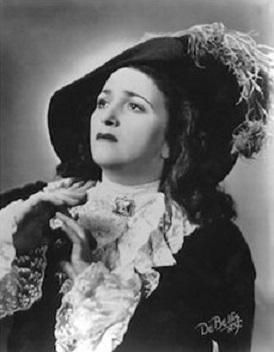
    Zinka Milanov in one of her greatest roles – Leonora in Verdi’s LA FORZA DEL DESTINO – from a 1958 Metropolitan Opera broadcast. Flaviano Labo, Mario Sereni, and Cesare Siepi are Zinka’s co-stars, and Fritz Stiedry is wielding the baton.

    Listen here.