Tag: Opera

  • 50 Years Ago Today: My First PARSIFAL

    Parsifal - 1st time-1 jpg

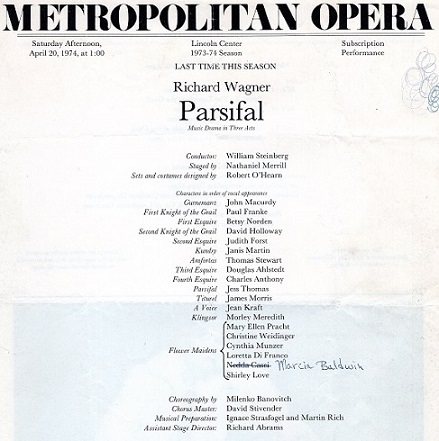
    Fifty years ago today, on April 20th, 1974, I saw my first performance of Wagner’s PARSIFAL  I was in my twelfth year of being an opera-lover, and I understood the importance of seeing this opera for the first time. I’d heard it twice already on Met Texaco Saturday broadcasts: the first in 1966 with Régine Crespin, Sándor Kónya, Walter Cassel, and Jerome Hines, conducted by Georges Prêtre, and the second in 1971, with Irene Dalis, Mr. Kónya, Thomas Stewart, and Cesare Siepi, conducted by Leopold Ludwig. The music seemed way beyond me at the first hearing, though – having been raised in a devout Christian household – I found a lot of it very moving; in fact, I was sometimes moved to tears, though I was not sure why. By 1971, the music seemed much more immediate and the characters – and their stories – began to seem more meaningful. 

    A lot had happened to me between that 1971 broadcast and the afternoon in 1974 that I walked into The Met for my first live performance of this mythic opera. I was, in fact, pretty down at the time. I’d had my first gay sexual experience in October 1973, only to be dumped by the object of my affection soon after. We’d been friends up until our night together, and it wasn’t until a few weeks after that I found out he already had a serious relationship going.

    Uncharacteristically, I stayed away from Gotham for a while, but I kept in touch with another boy in our group, TJ. I had turned to him for solace, and we grew very close, though our ‘first night’ was a disaster. But we really liked each other, so we eventually got on the same groove. As I recall, it was the day after the PARSIFAL that we went to The Frick and it was there, in the Atrium, that we revealed our feelings and decided to make a go of it. A few weeks later, I went up to The Cape to spend the Summer with him. At the end of the Summer, we tried to resume our lives apart, but we missed each other so much that I moved down to live with him in his dorm room at Sarah Lawrence College.

    Anyway, my diary entry about my first PARSIFAL is much briefer than my usual performance notes. As a rule, my diary was hand-written; I am not sure why I typed this entry: Parsifal 2-1 jpg

    I should perhaps clarify that Ms. Martin soon found the ‘staircase’ to her upper register and went on to be a very fine Sieglinde, Ortrud, Dyer’s Wife, and Tosca. Mr. Thomas, who had been my first Calaf and Tristan, went on singing for another eight seasons, with mixed results. Mr. Macurdy continued to develop and refine his Gurnemanz, and it became one of his greatest roles. 

    15747816_10209586751519649_7050039478046055439_n

    The next opera I saw came five months later; by then, I was happily living on campus at Sarah Lawrence with my bookish boyfriend, and posing as a student. Photo by TJ.

    ~ Oberon

  • @ My Met Score Desk for CARMEN

    Aigul

    Above: Aigul Akhmetshina

    ~ Author: Oberon

    Saturday January 27th, 2024 matinee – Feeling no need to see a 6-ton tractor trailer on the stage of the Metropolitan Opera House, I took a score desk for today’s matinee of the Met’s new production of CARMEN. I wasn’t feeling my best this morning as I prepared to leave for Lincoln Center, and even considered staying home. But once the house lights dimmed, my spirits perked up, CARMEN is an opera I had not heard for a very long time, and the music seemed truly fresh to me today.

    The main draw of the day was Aigul Akhmetshina, the gorgeous Russian mezzo-soprano, in the title-role. I fell under she spell when she sang Maddalena in Verdi’s RIGOLETTO here last season, which I saw three times.

    Maestro Daniele Rustioni got the opera off to a fast start, setting a brisk tempo with the start of the prelude. Unlike some of the other conductors the Met favors these days, Rustioni is not a volume freak; the voices were – for the most part – clearly audible throughout the opera, and his tempi always felt right. I especially like his accelerations as each repeat of the theme of the Act II Danse Bohème sped up: exhilarating! The preludes to the four acts were beautifully played, particularly the touching music that introduces Act III. All the choral work was super as well, notably the lovely smoking chorus in Act I.

    The first solo voice we hear is that of Morales, sung very impressively today Benjamin Taylor; it’s a Met-sized voice of handsome timbre. Equally striking was the singing of Wei Wu as Zuniga. Both these gentlemen deserve more opportunities at The Met.

    Carmen’s friends – Frasquita (Sydney Mancasola), Mercedes (Briana Hunter), Dancairo (Michael Adams), and Remendado (Frederick Ballentine) – joined Ms. Akhmetshina for the quintet in Act II, excelling at the quick repartee. Ms. Mancasola popped off some bright top notes at the end of the Toreador Song and at “La Liberté!” to end the third act.  

    Micaela is the first principal character to appear, in the person of Angel Blue. This role suits Ms. Blue far better than Violetta did last season. She sounded warm and lyrical in the duet with Don José, etching in some appealing piano effects. And her aria in Act III – with its finely-played horn introduction – was a vocal highlight of the afternoon; Ms. Blue’s rich voice could be tapered smoothly to a sweet softness, making for a spine-tingling finish. Her final plea, with its stunning drop at “Ah, José!“, was beautifully handled.

    Maestro Rustioni provided a whiplash start to the famous Toreador Song; Kyle Ketelsen sang the familiar tune engagingly, and he was excellent in his ‘fight’ duet with José in Act III. Later – before the bullfight commences – he and Ms. Akhmetshina shared a lyrical moment. 

    Beczala 2

    Above: Piotr Beczala

    Piotr Beczała’s bio says he is 57 years old, but he certainly doesn’t sound it…nor look it, when I chatted him up at the stage door after the performance: he’s a very handsome guy, with an easy-going charm. His singing today as was most impressive, covering a wide dynamic range, from passionate, house-filling outpourings to ravishingly heady tones.  He and Angel Blue blended voices perfectly in their Act I duet, trading phrases persuasively, and finishing off with Piotr’s amazingly hush-toned “Souvenirs du pays…” 

    Chez Lillas Pasta, after Carmen upbraids José for abandoning her when the trumpets summon him back to the barracks, Mr. Beczala gave us his poetic Flower Song, so ardently voiced…and with a fascinating pianissimo climax to the final phrase. 

    When the music turns darker and the menacing edge of jealousy overtakes Don José, Mr, Beczala unleashed the power of his voice to thrilling effect. The character’s descent into madness was set forth in vocal terms, with a manic desperation in his singing of the final, deadly encounter with Carmen.

    Aigul Akmenshina established herself as one of the finest Carmens imaginable. Introducing herself with a sultry Habanera – the second verse sung with enticing subtlety – the comely mezzo displayed a warm, dusky timbre with a plushy low range and smooth forays to the top. Aigul’s Seguidilla put both the tenor and the audience under her spell with her creamy, gorgeous voice, topping it off with sustained final note. 

    Her singing of the the Chanson Bohème in the tavern scene veered from subtle to triumphant, but the fact that her later castanet song was not working on José as she’d expected unleashes her temper.  After listening patiently to José’s love plea, Carmen returns to enticement. Zuniga’s arrival causes José to capitulate, and he joins the smugglers. My feeling here is that Carmen already hates him.

    At the smugglers’ den, Aigul’s reading of the tarot cards was sung with doom-ladened low notes and a sense that time was running out for her. Her final meeting with Mr. Beczala’s José was fiery, their exchanges quickly descending to threats and taunts. In this production, José kills Carmen with a baseball bat, which I am glad I could not see; the audience gasped.

    Ms. Akhmetshina’s is a welcome voice and presence on the Met stage, and I will always look forward to her performances; I also hope to one day hear her in Chausson’s Poème de l’amour et de la mer, for which I think she has the perfect voice. 

    The few times I glimpsed the the stage setting today, it looked cheap and junky. A real eyesore.

    After the performance, I went to the stage door where I met Aigul and Piotr; they are such kind and lovely people.

    Carmen met-1jpg

    ~ Oberon

  • Ewa Podleś Has Passed Away

    Podles jpg

    The magnificent Polish contralto Ewa Podleś (above) passed away on January 19, 2024, at the age of 71. Hers was one of the most remarkable voices I ever heard, but ironically I only saw her live one time: she sang Mahler’s Kindertotenlieder with the American Symphony Orchestra under Leon Botstein’s baton at a concert given at Alice Tully Hall in 1999. 

    That evening, the Mahler cycle was the last thing on the program. Ms. Podleś walked onstage, a short and rather plump woman. She took a stance on the stage and, as, the music commenced, she tipped her head back slightly and began to pour the music forth as if from the depths of her soul. The richness of the voice, with its cavernous lower register, was like nothing else I had ever heard. For one magical half-hour, she had the audience completely under her spell. A the end, she took a couple of bows, nodding to us slightly.

    Back in those days, Alice Tully Hall still had its cozy greenroom, and I went there to greet Maestro Botstein and the evening’s two soloists: soprano Edith Wiens, and Ms. Podleś. Of course, I was too shy to say anything, so Ms. Podleś signed my program, and nodded to me with a slight smile. I will always recall that evening as one of the most profound musical experiences of my life.

    Aso 1999-1 jpg

    You can read all about the Podleś career here, and listen to her unique voice in Wagner…

    The Norns~GOTTERDAMMERUNG – Eva Podles – Stephanie Blythe – Margaret Jane Wray – Seattle 2006

    …and Rossini: 

    Ewa Podles – scena d’Arsace – SEMIRAMIDE

    And her monumental rendering of “Cara sposa” from Handel’s RINALDO can be savored here.

    Spoczywaj w pokoju, beloved Ewa.

  • My 1st Time Hearing DIE WALKURE

    Nilsson

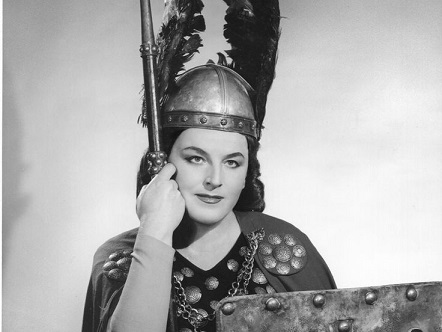
    Above: Birgit Nilsson as Brunnhilde

    The Met’s 1961 broadcast of Wagner’s DIE WALKURE marked the first time I ever heard this opera which became, over time, my favorite of the composer’s operas. A recording of the broadcast was recently posted on YouTube. Listen here.

    I remember that some scenes seemed endless to me, and that while the music was at times very exciting, it was the story that most intrigued me…especially the ending, where Brunnhilde was left sleeping in the middle of a ring of magic fire.

    We had had a substantial snowfall the night before, and I went out to the field behind our house with the sound of the feuerzauber alive in my head. I made a circle of all the empty packing boxes and other trash from my father’s drugstore and set it afire. It was then that I realized I was in the center of the circle and would have to wait until the flames died down before I could escape. At supper, my mother scolded me for bringing a smokey smell into the house. It took a few days for the odor to dissipate.

    Metropolitan Opera House ~ December 23,1961

    Cast: Brünnhilde: Birgit Nilsson; Siegmund: Jon Vickers; Sieglinde: Gladys Kuchta; Wotan: Otto Edelmannl Fricka: Irene Dalis; Hunding: Ernst Wiemann; Gerhilde: Carlotta Ordassy; Grimgerde: Mary MacKenzie; Helmwige: Heidi Krall; Ortlinde: Martina Arroyo; Rossweisse: Margaret Roggero; Schwertleite: Gladys Kriese; Siegrune: Helen Vanni; Waltraute: Mignon Dunn

    Conductor: Erich Leinsdorf

  • Eduardo Villa Has Passed Away

    Villa

    Tenor Eduardo Villa, a native of Santa Barbara, California, has passed away at the age of 70. Originally interested in musicals, he appeared in productions of Oliver!, West Side Story, and Paint Your Wagon before deciding to develop his voice further by studying at the University of Southern California, where his teachers included such luminaries as Martial Singher and Margaret Harshaw.

    Upon winning the Metropolitan Opera Auditions in 1982, alongside Hei-Kyung Hong, Sylvia McNair, and Nancy Gustafson, Villa departed for Switzerland, where sang with Basel Opera Theater between 1983 and 1987. In 1986, he made his debut at the Paris Opéra as Verdi’s Don Carlo, and from 1987 to 1991 he appeared at the Munich State Opera.

    When Villa began getting offers in the USA and Canada, he left Munich. Among his many contracts were appearances with Connecticut Opera at The Bushnell in Hartford, where I first heard his warm, passionate singing in BALLO IN MASCHERA, and later as an ardent suitor to Mary Dunleavy’s captivating Lucia di Lammermoor.

    In 1992, Eduardo sang Jacopo in a concert performance of Verdi’s I DUE FOSCARI given by Eve Queler’s Opera Orchestra of New York. It was a very exciting evening, with soprano Martile Rowland and baritone Vladimir Chernov sharing enthusiastic ovations with the tenor.

    Mr. Villa joined the Metropolitan Opera in 2002, debuting as Don Carlo and going on to make two dozen Met appearances (thru 2008) as Pinkerton, Don Jose, Calaf, Turiddu, Rodolfo in LUISA  MILLER, Cavaradossi, Enzo Grimaldi, and Ernani.

    I saw him at The Met as Radames in 2002 opposite Michelle Crider, and he was really impressive: a Met-sized voice with a nice Italianate ring to the tone. In my diary, I praised his vocal generosity, his ability to cut thru ensembles, and his sustained “Sacerdote! Io resto a te!!” at the end of the Nile Scene. 

    There is not a lot of Eduardo Villa’s singing on YouTube but there is an OTELLO duet with baritone Mark Rucker that gives a you a good idea of what kind of singer Mr. Villa was…watch and listen here.

    ~ Oberon

  • Dever/Domingo SAMSON ET DALILA ~ 1998

    Dever domingo

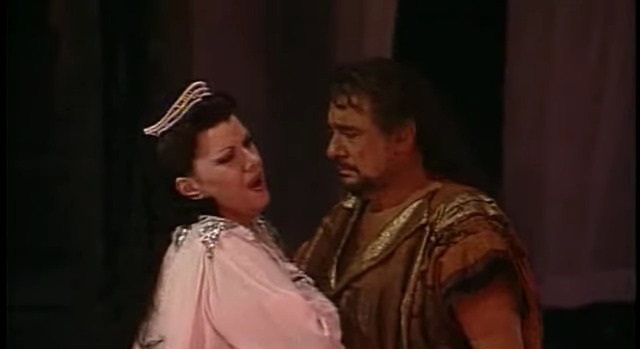
    From the Palacio de Bellas Artes in Mexico City comes a 1998 performance of Camille Saint-Saëns’ SAMSON ET DALILA starring Barbara Dever and Placido Domingo. Genaro Sulvaràn is the High Priest, and Guido Guida conducts.

    Watch and listen here.

    Between 1992 and 2014, Barbara Dever sang nearly 100 performances with the Metropolitan Opera; I saw her excellent Amneris and Ulrica there. Genaro Sulvaràn sang the role of Count de Luna at he Met in 1999 and made a vivid impression. 

  • Stephen Gould Has Passed Away

    Stephen gould

    It is very sad to read of the death of the American tenor Stephen Gould. Earlier in the summer, he had been diagnosed with bile duct cancer, and his demise was swift. 

    Born in 1962 in Virginia, Mr. Gould graduated from Olivet Nazarene University with a Bachelor of Arts in 1984.

    He first made a name for himself in music theatre, singing some 3,000 performances in Andrew Lloyd Webber’s musical, PHANTOM OF THE OPERA. Turning to opera, he developed into a formidable heldentenor.

    Among his signature Wagnerian roles were Siegfried, Tristan, Tannhäuser, and Parsifal; he also took on the arduous roles of Florestan, the Emperor in FRAU OHNE SCHATTEN, Bacchus, and Otello.

    Mr. Gould performed at the major opera houses of the world, including the the Wiener Staatsoper, the Bayreuth Festival, Bayerische Staatsoper, Teatro Massimo di Palermo, Berlin State Opera, and the Teatro dell’Opera di Roma.

    I first heard Stephen Gould on a radio broadcast of Wagner’s RING Cycle from the 2006 Bayreuth Festival. He was truly impressive, and his was the outstanding performance in the Cycle, conducted by Christian Thielemann.

    Finally, in November 2019, I had the chance to experience Mr. Gould’s singing live, when the National Symphony Orchestra offered a concert performance of Act II of TRISTAN UND ISOLDE under the baton of Gianandrea Noseda at Devid Geffen Hall. This was my reaction:

    “Veteran heldentenor Stephen Gould, now 57 years old and with years of singing opera’s most demanding tenor parts behind him, displayed a voice of prodigious power and tonal steadiness. He knows Tristan’s music so well, and he lives it fully. While his clarion singing rang amply thru the hall, he also has the tenderness of expression for “O sink hernieder, nacht der liebe…”  And as the act moves towards its devastating ending, Mr. Gould’s magnificent singing of the moving passage “Wohin nun Tristan scheidet,willst du, Isold’, ihm folgen?” (“Where Tristan now shall go, will you, Isolde, follow?”) carried us to that exalted place where a great Wagnerian singer can take us.”

    My friends who were at that performance with me were equally thrilled by Mr. Gould’s performance, and in the ensuing years his name would come up when we spoke of great performances we had witnessed. It speaks volumes when a singer can make such a memorable impression in a concert setting of single act of an opera.

    Listen to Stephen Gould in the final minutes of Act II of TRISTAN UND ISOLDE here.

    ~ Ruhe jetzt, geliebter Held.

  • TRISTAN UND ISOLDE ~ Chicago 1979

    Knie vickers

    Above: Roberta Knie as Isolde & Jon Vickers as Tristan; photo by Tony Romano

    A performance of Wagner’s TRISTAN UND ISOLDE given by Lyric Opera of Chicago in 1979. Franz-Paul Decker conducts, with the following cast:

    Tristan – Jon Vickers
    Isolde – Roberta Knie
    Brangaene – Mignon Dunn
    Marke – Hans Sotin
    Kurwenal – Siegmund Nimsgern
    Melot – Richard Versalle
    Shepherd – Gregory Kunde
    Steersman – Daniel McConnell
    Voice of a Young Sailor – William Mitchell

    Listen here.

  • Haitink Conducts DIE WALKURE ~ Act I

    Snapshot haitink

    Sir Bernard Haitink (above) conducts the first act of Wagner’s DIE WALKURE at a concert given by the Royal Concertgebouw Orchestra at Amsterdam on February 24th, 2008. The soloists are Eva-Maria Westbroek, Clifton Forbis, and Sir John Tomlinson.

    Watch and listen here.

  • Eve Gigliotti ~ Waltraute’s Narrative

    Eve g

    Mezzo-soprano Eve Gigliotti sings Waltraute’s Narrative from Wagner’s GOTTERDAMMERUNG with Kevin Korth, pianist.

    Watch and listen here.

    Ms. Gigliotti’s YouTube page includes several interesting items from her wide-ranging repertoire.