Tag: Opera

  • Milanov~Bergonzi~Sereni CHENIER – Atlanta 1960

    Zinka

    Above: Zinka Milanov

    A performance of Giordano’s ANDREA CHENIER given in 1960 by The Met on tour in Atlanta has just popped up on YouTube. Listen here.

    This was at the time when I was just falling in love with opera, though I had not yet discovered the Met Texaco broadcasts. Zinka was on the very first opera LP that my parents gave me; Bergonzi was Pinkerton on the first complete opera set I ever bought (the ‘second’ Tebaldi Cio-Cio-San); and not long after, I bought the de los Angeles TRAVIATA on which Sereni sang Germont.

    One of the things I loved most about finding this Atlanta CHENIER was that the cast includes three mezzo-sopranos who – over time – were to give me so many wonderful memories: Belén Amparán, Helen Vanni, and Mignon Dunn. And just look at the Met stalwarts cast in the supporting male roles:

    Atlanta, Georgia (Metropolitan Opera on tour)
    May 2nd, 1960

    ANDREA CHÉNIER

    Andrea Chénier..........Carlo Bergonzi
    Maddalena...............Zinka Milanov
    Carlo Gérard............Mario Sereni
    Bersi...................Helen Vanni
    Countess di Coigny......Mignon Dunn
    Abbé....................Gabor Carelli
    Fléville................George Cehanovsky
    L'Incredibile...........Alessio De Paolis
    Roucher.................Clifford Harvuot
    Mathieu.................Ezio Flagello
    Madelon.................Belén Amparan
    Dumas...................Osie Hawkins
    Fouquier Tinville.......Norman Scott
    Schmidt.................Louis Sgarro
    Major-domo..............Lloyd Strang

    Conductor...............Fausto Cleva

    So, despite the sometimes wonky sound quality, this recording is such a treasure to me. 

  • FLIEGENDE HOLLANDER ~ NYCO 1977

    Sarabia

    Above: Guillermo Sarabia as the Dutchman

    Audio-only performance of Wagner’s Der Fliegende Holländer performed at The New York City Opera in 1977, conducted by Julius Rudel, with the following cast:

    Holländer – Guillermo Sarabia
    Senta – Johanna Meier
    Daland – Ara Berberian
    Erik – Richard Taylor
    Mary – Diane Curry
    Steuermann – Jerold Siena

    Listen here.

    Ms. Meier, Ms. Curry, and Mr. Berberian were all great favorites of mine, and I saw Mr. Sarabia’s Dutchman twice: once in Houston and later in Springfield, Massachusetts. Mr. Siena sings the Steersman beautifully.

  • Graham Classics + New Works ~ 2023

    Rigney

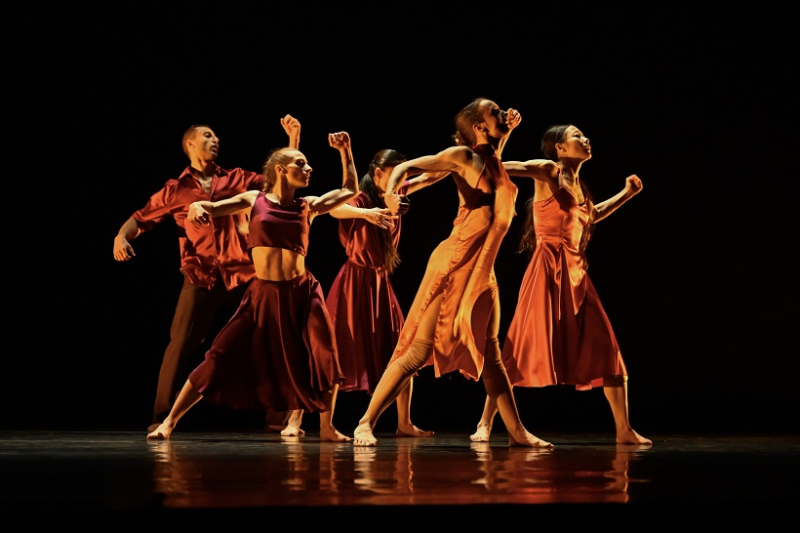
    Above: from Annie Rigney’s new work for the Martha Graham Dance Company, GET UP, MY DAUGHTER

    Sunday April 23rd, 2023 matinee – Two Graham masterpieces and two recently-premiered works new to the Graham Company repertoire held the stage at the Joyce Theater this afternoon.

    DARK MEADOW SUITE, one of Graham’s most beautiful works (with an equally beautiful Carlos Chávez score) opened the performance. At curtain-rise, the women are posed like icons, with Anne Souder slightly removed from the others. They begin stamping their feet. A plaintive violin theme is heard, joined by the cello. The women move with classic Graham steps and gestures; Ms. Souder is simply sublime.
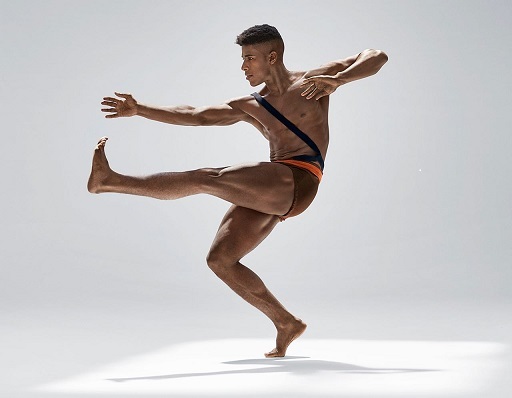
    Lloyd dark meadow

    Now Lloyd Knight (above) appears, striking poses in a spellbinding opening solo which develops into a stage-filling dance. Ms. Souder joins him for a duet in which an electric current seems to pass between them; their intimate partnering is at once sensual and ritualistic.

    The kneeling men hold the women in a uniquely lovely leaning, questing pose, symbolic of seeking or longing; Ms. Souder and Mr. Knight continue to reign in duet and solo phrases: unbearably tender and heartfelt.

    Aside from the principal couple, the cast for MEADOW today featured Leslie Andrea Williams, Laurel Dalley Smith, Marzia Memoli, Devin Loh, Kate Reyes, Jacob Larsen, Richard Villaverde, and new-to-Graham James Anthony.

    MGDC2023_Steven-Pisano-44

    Above: Marzia Memoli and So Young An in Annie Rigney’s GET UP, MY DAUGHTER; photo by Steven Pisano

    Ms. Rigney’s debut piece for Graham opened earlier in the week. It is a harrowing work, set to a thrilling score by Marco Rosano which incorporates Bulgarian folk music with original themes by the composer, and with stunning lighting by Yi Chung-Chen. It tells a story similar to one that I heard long ago from my high-school girlfriend.

    A quartet of young women in satiny frocks – So Young An, Anne O’Donnell, Anne Souder, and Marzia Memoli – dance together to chanted harmonies. They seem wary, full of angst and longing.

    MGDC_Get-Up-My-Daughter_MSherwood_07

    Above, in a Melissa Sherwood photo: Richard Villaverde makes a disturbingly powerful impression as the man of the house, who singles out So Young An as his partner of the moment in a dramatic duet of control, resistance, and resignation. The music is solemn, with the haunting voice of the great counter-tenor Andreas Scholl bringing a timeless feel. 

    Ying Xin joins the sisterhood, who have apparently been drugged into near stupor; while heavenly harmonies are heard, they seem to plan an escape but lack the strength to attempt it. The organ joins the musical soundscape, lending a curiously religious air. Mr. Villaverde returns; the women tremble in fear. Drums thunder forth, and the piece ends suddenly.

    MGDC2023_Steven-Pisano-47

    Above: Ying Xin, Marzia Memoli, and So Young An in GET UP, MY DAUGHTER; photo by Steve Pisano

    Why this work affected me so deeply lies in recalling my girlfriend’s experience, of which I was unaware at the time. For three years, her father routinely raped her, her two older sisters, and her younger brother. I was aware of the extreme tension she endured living in a home with a drunken father, but I never knew about the sexual side of it until a few years later, after she had escaped and moved to Washington DC. I only knew how she clung to me in our tender, juvenile – but curiously “knowing” – love-making. Her father eventually blew his brains out.

    Cortege 1

    Above: from CORTEGE 2023, with Ruchard Villaverde kneeling; photo by Steve Pisano

    Equally thought-provoking this afternoon was the second darkly powerful new work, CORTEGE 2023, set to a score by Aidan Elias and choreographed by Baye & Asa. This piece spoke of the dangerous world in which we now live: scenes of violence, torture, and isolation alternate with depictions of mourning and consolation.

    Chimes sound at curtain-rise as a diagonal of dancers are seen covered by a shroud, which is slowly pulled away as the dancing starts. The lighting (again by Yi-Chung Chen) flashingly isolates various tableaux of people under duress: prisoners, the interrogated, the isolated, the bereaved.

    MGDC_Cortege-2023_MSherwood_7944

    Lloyd Knight’s solo (above photo by Melissa Sherwood), set to sinister music, is riveting. Rhythmic variety, and ritualistic acts, carry the piece eerily forward. Anne O’Donnell’s solo is so expressive, and James Anthony has an opportunity to shine.

    MGDC2023_Steven-Pisano-32

    Above: Lorenzo Pagano and the ensemble; photo by Steve Pisano

    Violence has become a fact of life, as indicated by a cataclysmic buildup of brass in the score. An animated quartet become a hypnotic sextet: the movement is non-stop. Deep chords invoke feelings of doom; and then, as silence falls, the vast shroud is used as a cover-up. 

    The afternoon ended with a spectacular performance of Martha Graham’s take on the Medea story: CAVE OF THE HEART. The Metropolitan Opera’s 2022-2023 season opened with the Met’s first-ever performance of Cherubini’s MEDEA starring the inimitable Sondra Radvanovsky, so the story is fresh in the memory.
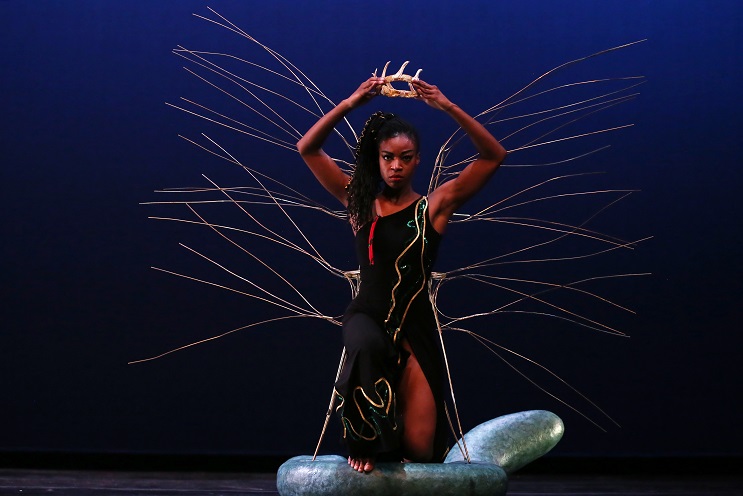
    MGDC_Cave-of-the-Heart_LAW_MSherwood-24

    Leslie Andrea Williams (above, in a Melissa Sherwood photo) radiated her distinctive star-power in a performance that brought the character’s double personality – abandoned lover and conniving sorceress – vividly to life. When she is not doing, she is always thinking; Leslie’s expressive face, and her eyes – ever scanning the scene for what damage she can do – are as vital to her playing of the role as her dancing. 
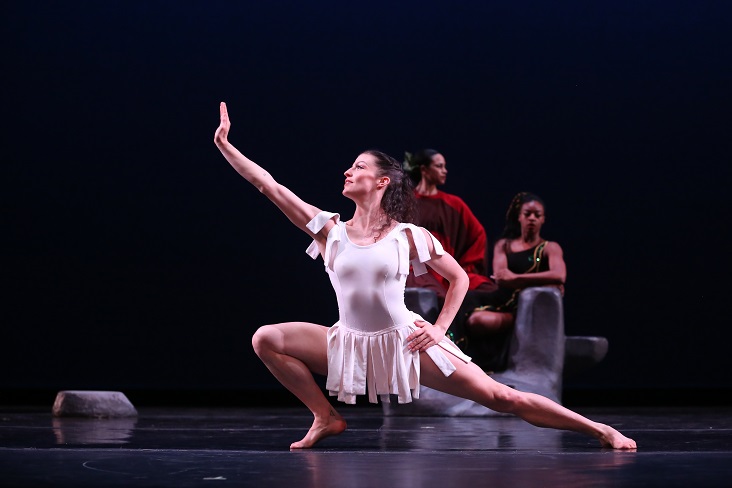
    MGDC_Cave-of-the-Heart_LAW_MSherwood-16

    Laurel Dalley Smith (photo above by Melissa Sherwood) gave a dazzling performance as the naive bride, basking in Jason’s attentive courting, unaware of the doom that awaits her.
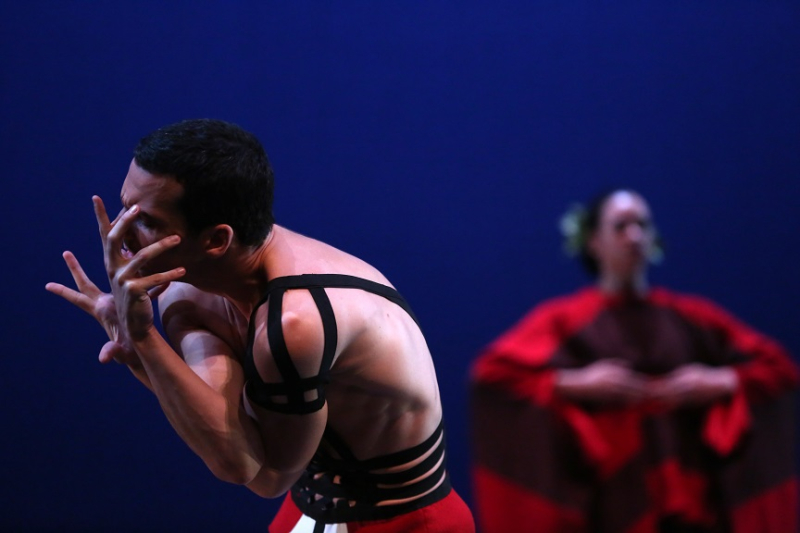
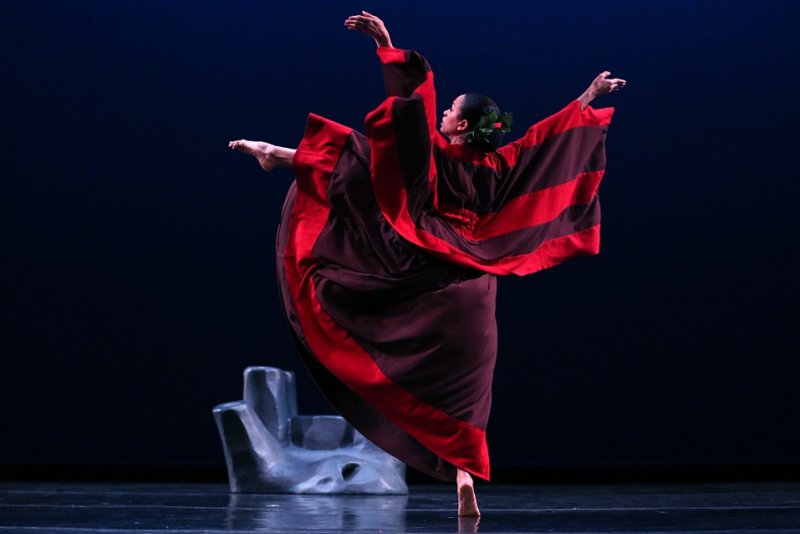
    MGDC_Cave-of-the-Heart_LAW_MSherwood-44

    Lorenzo Pagano as the proud Jason, looking to be King of Corinth whilst scorning the woman who made it all possible, pays the cost of his betrayal. His earlier show of pride, taunting Medea with his worshipful wooing of the young princess, plunges him headlong into disaster. (Photo above by Melissa Sherwood).
    MGDC_Cave-of-the-Heart_LAW_MSherwood-03

    Presiding overall, and striving in vain to prevent the ultimate catastrophe, the marvelous Natasha S. Diamond-Walker – a Graham goddess if ever there was one – conveyed both the dignity and the anxiety of the all-knowing Chorus in perfect measure. (Photo above by Melissa Sherwood). 

    It surprises me that Martha Graham did not bring the children of Medea and Jason into her telling of the story. The two young boys are a key element in the Cherubini opera, wherein Medea surpasses the cruelty of murdering Jason’s betrothed by knifing the youths. She flings their bloody corpses at Jason’s feet; aghast, he asks her: “What was their crime??” to which she calmly replies: “They were your children…”

    Following the performance, I went downstairs to greet and thank the dancers, and was thrilled to see again – after waaaay too long – two of my Graham idols, Blakeley McGuire and Carrie Ellmore-Tallitsch.

    ~ Oberon
  • Bach’s Matthäus-Passion @ The NY Philharmonic

    Bach

    Author: Ben Weaver

    Saturday March 25th, 2023 – J.S. Bach’s Matthäus-Passion, composed around 1724-27 (and revised through 1742), is arguably Bach’s greatest composition. Personally, I’d place it in the top ten greatest works of Western music. The NY Philharmonic performs it infrequently; the last time was in 2008 under the baton of Kurt Masur. Running at roughly 2:45 hours, the Matthäus-Passion is a work filled with passion and drama…more drama than most church music. Anyone mocking Verdi’s Requiem as being more opera than mass perhaps should take a closer look Bach’s greatest work. Verdi was following in Bach’s mighty footsteps. I was very glad to see it on the program this year, finally! I quite literally got chills as the work started and the chorus (Musica Sacra) sang the opening words: “Kommt, ihr Töchter, helft mir klagen.” Alas, the thrills did not last; I was sadly disappointed with tonight’s performance.

    Tenor Nicholas Phan sang the very difficult part of the Evangelist, who narrates the story of Jesus’ arrest, the debate over what his fate should be, his execution, and its immediate aftermath (the Passion ends before the resurrection.) Much of the drama of the work flows through the Evangelist’s words. Mr. Phan managed the difficult music very admirably, but the part can be a trap dramatically: there are many proclamations like “And Jesus said unto him.” How does one make each one sound fresh? I don’t have a clear answer. I suppose if it was easy, anyone would be able to do it. 

    Bass-baritone Davóne Tines’ Jesus (Mr. Tines was the only person on stage wearing a costume: a white, sleeveless robe) possesses a large voice; but it’s a voice with a guttural quality, which seldom opens or blooms.

    Mezzo-soprano Tamara Mumford, a favorite at the Metropolitan Opera across the Plaza, sang nicely. “Buß und Reu” in Part I was vocally steady and clear. But in Part II, Maestro Jaap van Zweden robbed Ms. Mumford and concertmaster Frank Huang of an opportunity to give their all in “Erbarme dich”, perhaps  the Passion’s most famous aria; certainly its most emotional and devastating piece. Written for solo voice, solo violin, and orchestra, this breathtaking music has the ability to stop time. Alas, Maestro van Zweden took it at a preposterous Allegro tempo; he absolutely wrecked it by turning it into a cabaletta. If your tempo is faster than John Eliot Gardiner’s, Nikolaus Harnoncourt’s, Trevor Pinnock’s, and Gustav Leonhard’s – you may consider looking at the score again.

    Amanda forsythe

    Soprano Amanda Forsythe (above), making her Philharmonic subscription concert debut with these performances, was sublime. Her ability to float pianissimi high notes was indeed spine-tingling. The aria “Aus Liebe will mein Heiland sterben,” which also includes a flute solo by Robert Langevin, was the highlight of the evening. 

    The Philharmonic’s Principal Associate Concertmaster, Sheryl Staples, had a chance to shine in “Gebt mir meinen Jesum wieder,” with a difficult solo. Unfortunately, bass Philippe Sly, making his Philharmonic debut with these performances, had pitch difficulties which offset Ms. Staples fine playing. Tenor Paul Appleby was superb all evening, the high tessitura of the aria “Geduld” presenting no difficulties for him.

    The Choral group Musica Sacra was in excellent form all evening, from the Chorales to dramatic exchanges representing specific characters. The Brooklyn Youth Chorus sang the opening and closing choruses of Part I, but did not return for Part II. Can’t say if that was intentional or if something kept them from returning.

    I do hope the Matthäus-Passion returns to the Philharmonic again soon – under a more caring conductor.

    ~ Ben Weaver

  • Bach’s Matthäus-Passion @ The NY Philharmonic

    Bach

    Author: Ben Weaver

    Saturday March 25th, 2023 – J.S. Bach’s Matthäus-Passion, composed around 1724-27 (and revised through 1742), is arguably Bach’s greatest composition. Personally, I’d place it in the top ten greatest works of Western music. The NY Philharmonic performs it infrequently; the last time was in 2008 under the baton of Kurt Masur. Running at roughly 2:45 hours, the Matthäus-Passion is a work filled with passion and drama…more drama than most church music. Anyone mocking Verdi’s Requiem as being more opera than mass perhaps should take a closer look Bach’s greatest work. Verdi was following in Bach’s mighty footsteps. I was very glad to see it on the program this year, finally! I quite literally got chills as the work started and the chorus (Musica Sacra) sang the opening words: “Kommt, ihr Töchter, helft mir klagen.” Alas, the thrills did not last; I was sadly disappointed with tonight’s performance.

    Tenor Nicholas Phan sang the very difficult part of the Evangelist, who narrates the story of Jesus’ arrest, the debate over what his fate should be, his execution, and its immediate aftermath (the Passion ends before the resurrection.) Much of the drama of the work flows through the Evangelist’s words. Mr. Phan managed the difficult music very admirably, but the part can be a trap dramatically: there are many proclamations like “And Jesus said unto him.” How does one make each one sound fresh? I don’t have a clear answer. I suppose if it was easy, anyone would be able to do it. 

    Bass-baritone Davóne Tines’ Jesus (Mr. Tines was the only person on stage wearing a costume: a white, sleeveless robe) possesses a large voice; but it’s a voice with a guttural quality, which seldom opens or blooms.

    Mezzo-soprano Tamara Mumford, a favorite at the Metropolitan Opera across the Plaza, sang nicely. “Buß und Reu” in Part I was vocally steady and clear. But in Part II, Maestro Jaap van Zweden robbed Ms. Mumford and concertmaster Frank Huang of an opportunity to give their all in “Erbarme dich”, perhaps  the Passion’s most famous aria; certainly its most emotional and devastating piece. Written for solo voice, solo violin, and orchestra, this breathtaking music has the ability to stop time. Alas, Maestro van Zweden took it at a preposterous Allegro tempo; he absolutely wrecked it by turning it into a cabaletta. If your tempo is faster than John Eliot Gardiner’s, Nikolaus Harnoncourt’s, Trevor Pinnock’s, and Gustav Leonhard’s – you may consider looking at the score again.

    Amanda forsythe

    Soprano Amanda Forsythe (above), making her Philharmonic subscription concert debut with these performances, was sublime. Her ability to float pianissimi high notes was indeed spine-tingling. The aria “Aus Liebe will mein Heiland sterben,” which also includes a flute solo by Robert Langevin, was the highlight of the evening. 

    The Philharmonic’s Principal Associate Concertmaster, Sheryl Staples, had a chance to shine in “Gebt mir meinen Jesum wieder,” with a difficult solo. Unfortunately, bass Philippe Sly, making his Philharmonic debut with these performances, had pitch difficulties which offset Ms. Staples fine playing. Tenor Paul Appleby was superb all evening, the high tessitura of the aria “Geduld” presenting no difficulties for him.

    The Choral group Musica Sacra was in excellent form all evening, from the Chorales to dramatic exchanges representing specific characters. The Brooklyn Youth Chorus sang the opening and closing choruses of Part I, but did not return for Part II. Can’t say if that was intentional or if something kept them from returning.

    I do hope the Matthäus-Passion returns to the Philharmonic again soon – under a more caring conductor.

    ~ Ben Weaver

  • A New LOHENGRIN @ The Met

    Screenshot 2023-02-24 at 12-49-51 Videos

    Above: Piotr Beczala and Tamara Wilson in LOHENGRIN at The Met

    Author: Oberon

    Sunday February 26th, 2023 matinee – The premiere of a new production of Wagner’s LOHENGRIN at The Met; this marks the fourth production of this magnificent opera that I have experienced at The Met. My first encounter with the opera was in Wieland Wagner’s production in 1967 – a performance that featured the Met debut of the marvelous soprano Elisabeth Grümmer. In 1976, August Everding’s production – with designs by the great Ming Cho Lee – was first given; I saw it several times, with incredible singers like Rene Kollo, Placido Domingo, Pilar Lorengar, Mignon Dunn, Anna Tomowa-Sintow, Eva Marton, and Leonie Rysanek in the leading roles.

    In 1998, Ben Heppner and Deborah Voigt headlined the cast of Robert Wilson’s fascinating, stylized production; Karita Mattila and Rene Pape later sang Elsa and King Henry respectively in this production, and two very sharply contrasted but equally exciting tenors made their Met debuts in the title-role of the Wilson production: Johan Botha and Klaus Florian Vogt.

    This afternoon, director François Girard followed up his fascinating Met debut production of PARSIFAL with a LOHENGRIN that follows Parsifal’s son to the banks of the River Scheldt to protect the virtuous Elsa. With stunning sets by Tim Yip, this afternoon’s performance gathered together a strong cast whose hard work was sometimes nullified by Yannick Nézet-Séguin’s brassy conducting.

    In a large underground bunker in the ruins of a haunted castle near Antwerp, we find the people of Brabant huddled among the tree roots. Aside from the threat of the invading Hungarian forces, they are a community struggling with the disappearance of young Gottfried, whose sister Elsa is alleged to have killed the boy. In opposition to Elsa are Count Telramund and his sorceress-wife, Ortrud. The divided populace all wear black hooded cloaks which we soon find have colour-coded linings: green for the good guys, red for the baddies, and white for supporters of Elsa, who is either a murderess or a blameless virgin/victim. Throughout the opera, the populace open their capes to show where their loyalties lie; this unison ‘flashing’ gesture grew tiresome – even hilarious – over time.

    Joining the large Met chorus – who sang splendidly all afternoon – were a group of dance artists who performed in-sync stylized movements; among them, my beautiful friend Willy Laury brought his own personal magnetism to every gesture.

    LOHENGRIN is a big sing for the six principal artists; they need a very thoughtful and alert conductor at the helm to make the most of their magnificent music. But today, the singers were frequently jinxed by the blasts of sound coming up from the pit. In those climactic passages where the voices need cushioning support, the singers instead found themselves having to force their tone in order to stay afloat. This trend of ramping up the orchestral volume has been in frequent evidence this season where conductors like Armiliato, Rizzi, and Scapucci have sometimes seemed to have been on a joyride, using decibels to make the music more superficially “exciting”. In a Wagner opera, the balance between voices and orchestra is even more crucial; Nézet-Séguin should have learned this by now.

    Despite this imbalance, the orchestra played gorgeously, most especially in Elsa’s Procession to the Cathedral in Act II, where the featured wind soloists were especially lovely to hear. The prelude to Act III – where the orchestra has the music all to itself – was suitably grand; the director used this music for a solo pantomime for Christine Goerke’s vividly over-the-top (in a good way) Ortrud.

    Brian Mulligan’s noble, calming presence and expressive face, aligned to his warm and attractive voice, made the role of the Herald more prominent than is often the case. In this production, the character is not just an ‘announcer’ but also a confidante of the king. Mr. Mulligan was first-rate, despite having to cope with the onslaughts from the pit at times. 

    Günther Groissböck’s dignified King Henry was an excellent portrait of a leader who has come to this land with a purpose, only to find himself playing judge and jury in a local conflict. Mr. Groissböck is not a helden-basso, possessed, as he is, of a handsome lyrical timbre of ample power for this music…under normal circumstances. The brassy blasts arising from the pit did him no favors, but he held to his own, with much impressive vocalism.

    Yevgeny Nikitin as the sinister Telramund managed to out-shout the orchestra in a couple of spots, but it should not have been necessary; beyond that, he offered many creepily subtle passages. Sparks flew in his scene with Ortrud at the start of Act II, which was one of the highlights of the afternoon…in part because the orchestra playing here was thoroughly supportive. Later in the act, as the wedding procession began to move onward, Nikitin’s Telramund stepped out of the crowd and menaced Elsa to striking effect.

    Having seen several marvelous Elsas in my day – in addition to those named above, there were Sabine Hass and Arlene Saunders – this afternoon I was happy to add Tamara Wilson to the list. This soprano, whose Met debut as Aida in 2014 was superb, should be singing here far more frequently. She has a house-filling sound, grounded in lyricism, with an appealing vulnerable streak to her timbre, and high notes that can soar or float at will. Her ‘dream’ aria in Act I and her Song to the Breezes in Act II were vocal highlights of the afternoon, and in her Act II confrontation with Ortrud, Ms. Wilson and Christine Goerke made sparks fly. Ms. Goerke first backed her victim all the way across the stage, taunting the would-be bride menacingly. But Ms. Wilson summoned Elsa’s courage, and turned the tables: soon it was Goerke who was retreating as Wilson advanced. The agitated strings that provide the undercurrent for this encounter gave perfect support. Tamara Wilson went on to sing thrillingly in the bridal chamber scene, and she was given a spirited ovation at her bows. 

    Goerke ortrud

    You’ve got to love Christine Goerke’s Ortrud. Although in recent seasons her top register has become unreliable, the sheer force of her personality and the inherent power of her singing can work wonders. In the span of a few weeks, she has given us an incredibly touching Madame Lidoine in DIALOGUES DES CARMELITES and has now turned in an epic Ortrud, suitably grand-scale theatrically, and vocally firing on all cylinders, despite the random stray note.

    In this production, Ortrud appears during the prelude: a silent and imposing figure with red hair, clad all in blood-red and gold. The character has little to sing in Act I, but Goerke made Act II all about Ortrud. First comes the tremendous duet with Telramund, in which the Goerke voice simply dripped with evil intent and conniving insinuation; this is followed soon enough by her deceitful, servile plea to Elsa to grant her amnesty. Waiting for Elsa to descend from her balcony, Goerke launches Ortrud’s diabolical invocation to the pagan gods. Sung with blistering passion and commitment, Goerke made a meal out of it, sustaining the climatic passage with fierce intensity. In the ensuing duet, Ortrud eventually wins Elsa over, and they harmonize in an almost bel canto passage, leaving the orchestra to take up the gorgeous melody (my favorite part of the entire score) as they enter the castle. In the later confrontation between the two women before the wedding ceremony, mentioned above, Goerke showed off some chesty resonances.

    Ms. Goerke entered spiritedly into M. Girard’s somewhat hokey mime scene for Ortrud at the start of Act III: preening herself whilst casting spells to destroy the marriage of Elsa and Lohengrin, Goerke seemed larger than life.

    Enjoying a huge and well-deserved triumph, the Polish tenor Piotr Beczala was everything you want in a Lohengrin, and more. As if arriving out of a time warp, the character is clad in contemporary style: white shirt and black trousers. From note one, Mr. Beczala’s expressive singing seemed made for role of the mysterious visitor. Hauntingly lyrical, with refined piano turns of phrase woven in, he put me in mind of Nicolai Gedda’s only Wagnerian excursion. Every word and note seemed to mean something to the tenor, and his handsome presence made him as appealing to watch as to hear. Especially pleasing was his singing in the bridal chamber scene, blending timbres luminously with Ms. Wilson. Mr. Beczala then rose beautifully to the demands of the opera’s finale, where “In fernem land” and the poignant tenderness of “Mein lieber Schwan!” were so beautifully voiced. It was a thrill to hear (and to be part of) the massive wave of applause and cheers that greeted the tenor’s solo bow.

    As the ovation continued, there were boos for the production team; this was understandable – even inevitable – I suppose, yet overall it was an inoffensive and at times engaging take on the opera.

    Watch the final ovation and curtain calls here.

    ~ Oberon

  • Stutzmann/Weilerstein/NY Philharmonic

    Stutzmann

    Author: Ben Weaver

    Thursday February 23rd, 2023 – For many years,  Nathalie Stutzmann (photo above) has been a highly accomplished singer, with numerous operatic and lieder recordings under her belt, and many awards, too. In recent years she has begun to spend more time on the conductor’s podium. I am always skeptical of performers transitioning to conducting because these are all highly specialized crafts. There have, certainly, been many extremely successful switch-overs, but mostly coming from the instrumentalist sides (people like Vladimir Ashkenazy and Christoph Eschenbach come to mind). It’s rare for singers to make the jump, and while someone like Plácido Domingo has conducted many operas over decades, he has never become more than passable in the pit. Which brings me back to Nathalie Stutzmann, who made her New York Philharmonic debut with these concerts, conducting a varied program of Wagner, Prokofiev, and Dvořák. Based on what I heard, Maestro Stutzmann is a phenomenal musician and she would have been a far more interesting new Artistic Director for the Philharmonic than the flashy but vapid Gustavo Dudamel.

    The concert opened with a superb overture to Wagner’s Tannhäuser – an opera Stutzmann will conduct at the Bayreuth Festival this summer. The mournful strings that open the work were lovingly molded as the drama built, the Philharmonic’s wonderful string section matching Stutzmann’s passion at every step. The rock solid wall of horns, trombones, and tuba was heavenly. Appearance of Venus had a magical, light sound that – perhaps for the first time for me – sounded like a Mendelssohn fairy got lost in Wagnerland. The explosive, thrilling climax of the work brought down the house. I suspect Maestro Stutzmann’s Tannhäuser in Bayreuth will be very special indeed.

    Weilerstein jpg

    Above: Alisa Weilerstein

    One of my favorite musicians, cellist Alisa Weilerstein (in a glorious red pantsuit) played Prokofiev’s Sinfonia concertante, Op. 125. Composed for (and with the help of) a very young Mstislav Rostropovich, this is a supremely difficult piece, which posed no difficulties for Weilerstein. The playful opening – like a ticking clock – is echt Prokofiev, and the cello enters almost immediately. Weilerstein’s gorgeous, mellow, glowing tone is always a balm to the ear. Even the crazed, breathless opening of the second movement sounded like the most romantic love song. Weilerstein’s passion and commitment never wavered; even when not playing, she gently swayed to the music. Prokofiev’s kaleidoscopic music – sweepingly romantic one moment, mockingly blowzy the next – can be tricky to navigate, but Weilerstein and Stutzmann had a deep connection and made everything whole. Stutzmann’s history of singing for conductors no doubt make her deeply sensitive to her soloists. She was careful to let Weilerstein room to breathe and to never let the orchestra overpower the cello. I hope Weilerstein and Stutzmann enjoyed working together because they make wonderful, deeply sympathetic music together; may their partnership continue and grow.

    Antonin Dvořák’s Symphony No. 9 in E-minor, Op. 95 (subtitled hastily by the composer “From the New World” as he handed the score off to be copied for the world premiere performance by the NY Philharmonic in 1893) is easily one of the most standard works in the classical repertoire: a warhorse as popular as Beethoven’s  5th and Tchaikovsky’s Nutcracker. It’s easy to get jaded and cynical, and roll our eyes when another performance is on the program. These works can be played by any orchestra with their eyes closed, and the audience will dutifully applaud. But sometimes you hear a performance that makes you sit up and rethink your cynicism, and reevaluate why these works are warhorses in the first place. It’s not pure chance that some of these compositions have been played more than others, and will continue to be played.

    This evening’s performance of Dvořák’s 9th was such a performance: Maestro Stutzmann led a revelatory, fresh, thrilling interpretation of a work we’ve all heard countless times. She struck a perfect balance between embracing the familiarity of the melodies while not lingering on them for their own sake. Harking back to Mendelssohn’s fairies dropping in on Wagner’s Tannhäuser, many moments of Dvořák symphony sounded like his beloved Slavonic Dances of decades earlier, effortlessly swirling and swaying. The second movement was perhaps the most wonderful music making of the evening from all involved. It’s chamber music-like orchestration, with small sections of the orchestra handing off music to one another, was wondrously coordinated. I was reminded of that famous speech Salieri delivers in Peter Shaffer’s “Amadeus” about Mozart’s Serenade for Thirteen Wind Instruments: “A single note, hanging there, unwavering. Until a clarinet took it over, sweetened it into a phrase of such delight!” That’s what the entire Largo felt like tonight: every note being sweetened into phrases of delight. The opening notes of the final movement have never sounded more like the theme from “Jaws” (wouldn’t be even a little bit surprised if that’s where John Williams got the idea considering how many of his ideas were directly lifted from existing works). The swirling rhythms and melodies have seldom sounded this fresh and exhilarating.

    The ovation that greeted the performance was huge, people leaving the theater were buzzing about the debuting conductor. I hope we see and hear much more of Maestro Stutzmann at David Geffen Hall.

    ~ Ben Weaver

  • Dialogues des Carmélites @ The Met

    Gigliotti goerke marty sohly

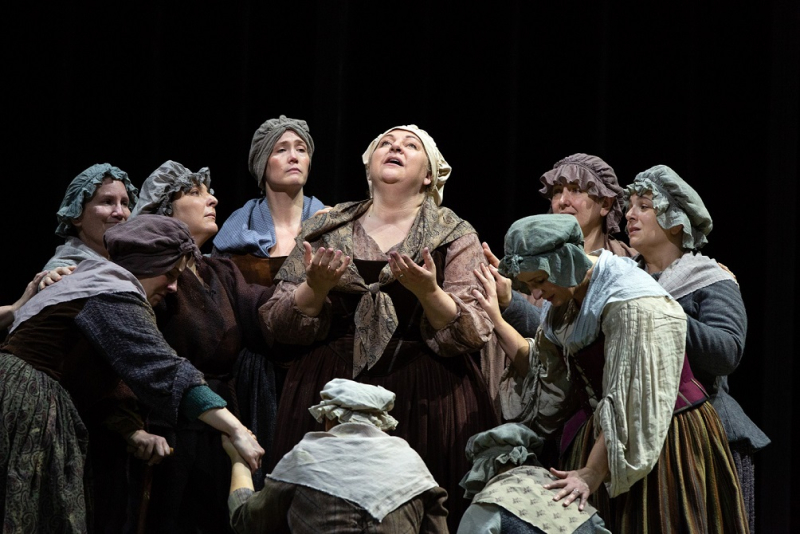
    Above: Christine Goerke as Mme. Lidoine with Eve Gigliotti as Mother Jeanne, and their sister-nuns; photo by Marty Sohl/Metropolitan Opera

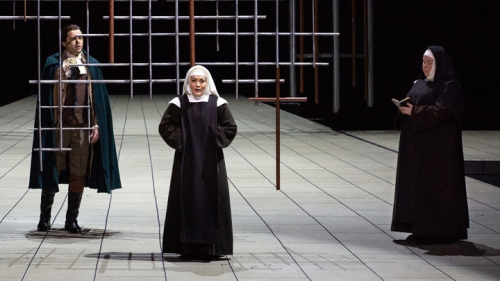
    Saturday January 28th, 2023 matinee – An incredibly powerful performance of Francis Poulenc’s masterpiece, Dialogues des Carmélites, at The Met this afternoon. The John Dexter production, one of the treasures of the Company’s repertoire, never fails to move me with its utter simplicity and the clarity of its story-telling. It was lovely to see several small groups of nuns among the audience this afternoon.

    The performance was somewhat compromised by the conducting of Bertrand de Billy; though his tempi and feel for the music were spot-on, he too often allowed the orchestra to cover the voices. This seems to be a trend at the Met these days, for the recent RIGOLETTO(s) and TRAVIATA I saw, conducted by Speranza Scapucci and Marco Armiliato respectively, suffered from the same problem. As there are no huge voices around nowadays – no Nilsson, nor even a Grob-Prandl, and no Cossotto, del Monaco, or Norman Treigle either – such waves of sound rising from the pit cause singers to either force or simply be drowned out. The Met’s huge space is hard enough fill in and of itself; having to compete with mega-decibels of orchestral sound must be daunting indeed. Perhaps some people feel that a high-volume orchestra makes opera more “exciting”…? Well, it doesn’t.

    The cast today was peopled by expressive singing-actors, down to the smallest roles. Benjamin Taylor (Thierry), Paul Corona (Dr. Javelinot), Siphokazi Molteno (Sister Mathlde), and Jeongcheol Cha (Jailer) did well, though the last-named’s task – reading the names of the nuns condemned to death – was lessened in impact by the orchestra’s loudness; it’s an affecting moment, deserving to be better-handled.

    Piotr Buszewski Perez Barton

    Above: Piotr Buszewski as Chevalier de la Force, Ailyn Perez as his sister Blanche, and Jamie Barton as Mother Marie; photo by Marty Sohl/MET Opera

    The Polish tenor Piotr Buszewski, in his Met debut role, displayed a handsome timbre and fine sense of nuance as the Chevalier de la Force. Laurent Nouri made his mark as the Marquis de la Force. Tony Stevenson was excellent as the Chaplain, and Eve Gigliotti made much of the moving role of Mother Jeanne. It is Mother Jeanne who brings forth the figurine of the Christ Child, the breakage of which seems to signify the breakup of the convent. In the end, Mother Jeanne, using her cane, walks with great dignity to the guillotine. Ms. Gigliotti made the character seem essential, and her warm, plush mezzo timbre is always appealing. Tenor Scott Scully and basso Richard Bernstein are the Commissioners who come to shut down the convent; Mr. Bernstein, ever the effective stage creature, eyed each nun with suspicion; his voice is strong and steady.

    Perez dialogues

    As Blanche de la Force, the opera’s central character, Ailyn Pérez (above, in a Marty Sohl photo) brought gleaming lyricism with a sense of fragility to her music. She forms a bond with the naive, optimistic young Sister Constance (Sabine Devieilhe); in their prayer following the death of the Old Prioress, their timbres meshed to magical effect. And in the scene where her brother visits her and asks her to return home, Ms. Pérez and Mr. Buszewski did some of the loveliest singing of the afternoon. Having fled the convert, Blanche seeks refuge, working as a maid in her old family home; but Mother Marie tracks her down and urges her to return to the fold. Here Ms. Pérez’s desperation becomes palpable. But at the end, stepping from the crowd to bid farewell to Sister Constance and to face her own death calmly, Blanche finds release. 

    Coote barton

    Above: Alice Coote as Madame de Croissy and Jamie Barton as Mère Marie; photo by Marty Sohl

    During the pandemic, I often turned to YouTube to keep music vividly in my life whilst live performances ceased, and I came upon a film of Alice Coote singing Mahler’s “Ich bin der welt abhanden gekommen” which moved so deeply. Watch and listen here.

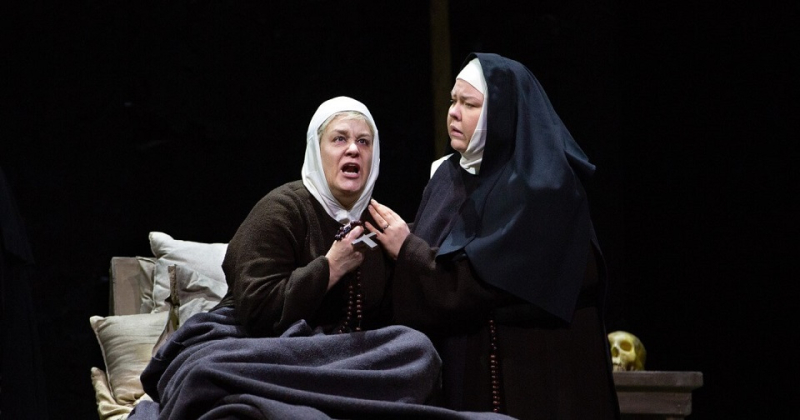
    Today, as Madame de Croissy, Ms. Coote held the House under a spell as the character’s horrific death scene was played out. For a woman whose faith was always deep and seemingly unshakable, the Old Prioress finds herself terrified as she faces her end, wracked with pain. Ms. Coote, a wonderfully word-conscious singer, made the scene the centerpiece of the performance. Both vocally and dramatically, she was living the role: a riveting singer and personality. Rapturous applause greeted her at her solo bow at the opera’s end.

    Jamie Barton has a perfect role in Mother Marie, and she made a splendid vocal impression. Her wide-ranging voice, from dusky chest tones to searing top notes, was in peak form. She held the stage with authority, and finely captured the character’s desperation and guilt on having been separated from her sisters during their final hours on Earth.

    Devieilhe-Sabine-04[Caroline_Doutre]

    Above: Sabine Devieilhe, photo by Caroline Doutre

    How wonderful to see the French soprano Sabine Devieilhe on the Met stage! Having attended her Weill Hall recital in 2019, I have been hoping to see and hear her again…and now she is here with us. As Sister Constance, the petite and lovely Ms. Devieilhe was ideally cast. Her silvery, shimmering tones gleamed in the House, a contrast to the opera’s deepening darkness and sense of impending doom. In the end, her hope of seeing Blanche again gives her the courage to walk to the guillotine, her lone voice the expression of innocence and human fragility. Then the voice of Blanche is heard: she has stepped from the crowd to join her sisters in death. The two girls have a last moment together before fate overtakes them. Incredibly touching.  

    Goerke barton

    Above: Christine Goerke as Madame Lidoine and Jamie Barton as Mother Marie

    Towering, literally, over the sisterhood, Christine Goerke made a splendid impression as Madame Lidoine. If some of the highest notes did not bloom as one might wish, Ms. Goerke’s presence – and her vocal authority – gave the afternoon its center. Her portrayal, so dignified, so lovingly maternal, so…human…was touching to experience. It is Madame Lidoine who leads the procession to the guillotine, by which time I was already weeping.

    The audience, the quietest and most attentive to have been part of in recent seasons, hailed the singers with great affection and admiration at the end. I felt a desire to go to the stage door, where a large crowd had gathered; I particularly wanted to greet Ms. Coote, Mlle. Devieilhe. and Ms. Gigliotti.

    Carmelites 2-1 jpg

    The French soprano was in a rush, probably to catch a flight, but was very gracious and charming; she told me she is already booked for a return to The Met. Ms. Gigiotti signed my program in a distinctive way, matching her distinctive personality; I thanked her for some unique videos she has made (watch here) and for her past performances in works of Nico Muhly and Sergei Taneyev. Ms. Coote walked briskly thru the crowd; undoubtedly she had someplace she needed be.

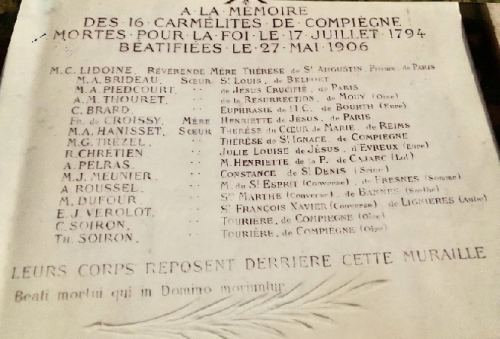
    The story of the martyrdom of the Carmelite nuns becomes even more poignant when one realizes that their execution took place just ten days before the end of the Reign of Terror. The women were beatified in 1906; this plaque commemorates their deaths:

    Carmelites

    It is always difficult to return to the real world after a performance like this; there was so much to ponder after experiencing this opera about man’s inhumanity to man. What harm had these nuns done that merited a death sentence? Why is cruelty so rampant in the history of mankind?  Why do people feel a need to control the beliefs and lifestyles of others?

    ~ Oberon

  • Ronnita Miller

    Ronnita Miller

    Above: mezzo-soprano Ronnita Miller; photo by Fadi Kheir

    I was bowled over by Ronnita Miller’s singing as the 1st Norn in Wagner’s GOTTERDAMMERUNG at The Met in 2019. Soon I’ll have a chance to see Ms. Miller onstage again: she will sing the role of Gaea in a concert performance of Richard Strauss’s DAPHNE with the American Symphony Orchestra at Carnegie Hall on March 23, 2023. Details here.

    Sample Ms. Miller’s singing here.

  • Oberlin Orchestra & Choral Ensembles/Carnegie Hall

    001-CHR-OC-Carnegie-012023

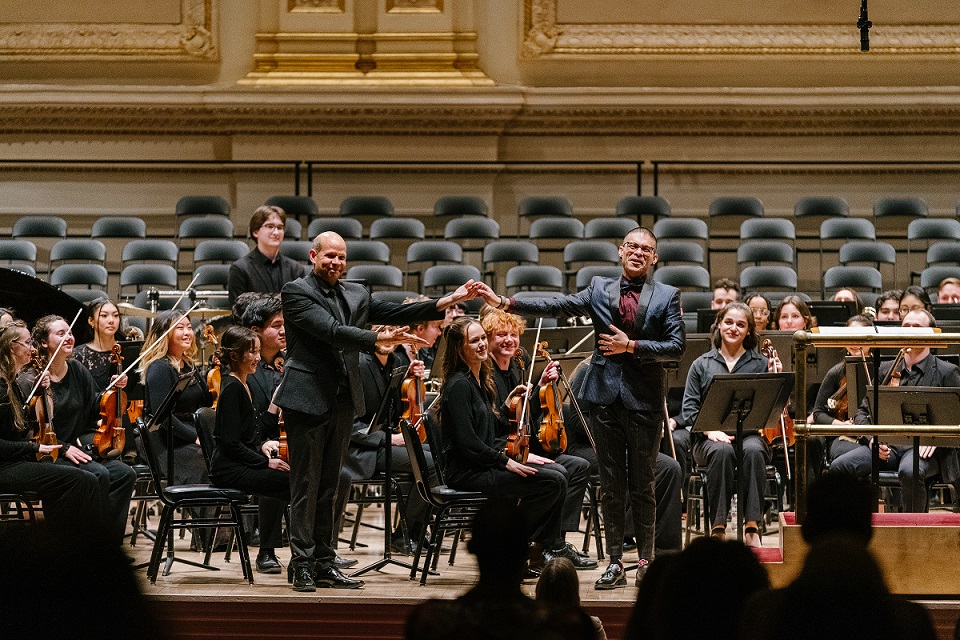
    Above: Maestro Raphael Jiménez with the Oberlin Orchestra at Carnegie Hall; photo by Fadi Kheir

    Author: Brad S Ross

    Friday January 20th, 2023 – On Friday evening, New York audiences were once again treated to a fine performance by the Oberlin Orchestra and Choral Ensembles as they returned to Carnegie Hall for the first time (publicly, anyway) since January 19, 2019. They were conducted by Oberlin Orchestras Director Raphael Jiménez, who led the performers in a unique program that included one repertory standard, one New York City premiere, and one buried gem.

    The evening began with long—very long—opening remarks by Oberlin College and Conservatory President Carmen Twillie Ambar and Oberlin Conservatory Dean William Quillen.

    Ambar’s remarks focused on two of the evening’s headlining pieces having been written by minority composers and therefore made all the requisite extollations about the need for representing historically marginalized groups. As important as this message is, it would be nice to hear the music of under-appreciated composers like Will Marion Cook, William Dawson, Florence Price, George Walker, etc., without this ever-obligatory preamble. My continued hope is that someday we will be able to let their music simply speak for itself.

    Quillen’s remarks, while less political, were a seemingly endless list of “thank you”s, not unlike an Oscar acceptance speech—only this time, there was no hope of the music playing him off. All the parents and staff in attendance no doubt appreciated the acknowledgements, but after a full quarter hour of talking I was getting pretty antsy for things to move along.

    Nevertheless, once the opening remarks concluded, the Oberlin musicians were finally able to grace the Isaac Stern Auditorium with their abilities—and what a pleasure they were to hear!

    First on the program was Johannes Brahms’s Tragic Overture, Op. 81, from 1880. There’s not much one can say about this work that hasn’t already been expressed over the last one hundred and forty years, so I won’t labor on it here. It’s a pleasant and undemanding symphonic poem, lasting about fourteen minutes and chock-full of the lyrical gestures typical of that Romantic master. Needless to say, the Oberlin musicians tackled the piece expertly, but it did leave me wanting to hear more of their technical skills.

    I was not left wanting for long, however, as the second work of the evening—the New York premiere of Iván Enrique Rodríguez’s A Metaphor for Power—immediately livened up the proceedings.

    Written in 2018, A Metaphor for Power is a single-movement essay for orchestra lasting about thirteen minutes. Rodríguez—a 32-year-old Puerto Rican native—composed the piece as a comment on the turbulence and inequalities of contemporary life in the United States, despite the promise of its founding (the title, indeed, comes from a quote by James Baldwin). His use of social commentary through music was much more subtle than that of other recent protest works, however (Anthony Davis’s quite overt You Have the Right to Remain Silent comes to mind), making for a composition that was both cleverly referential and electrifying to hear.

    The music opened with a bang before quickly diminuendoing into dream-like textures, complete with harp, mallets, and woodwind writing that sounded as though they had descended straight from Maurice Ravel’s Daphnis et Chloé. A contemplative middle section featured, among other memorable effects, distorted quotations from “America the Beautiful” and unsettling vocalizations from the orchestra as they recited overlapping lines from the Declaration of Independence. A great crescendo announced the beginning of the third, final section, which was marked by dramatic gestures that were almost filmic in execution. It all came to an energetic and wickedly engaging ending that lit up the room with excitement.

    002-CHR-OC-Carnegie-012023

    Above: Maestro Jiménez and composer Iván Enrique Rodríguez take a bow; photo by Fadi Kheir

    The composer practically leapt from his seat and ran to the stage to share an emotional embrace with Jiménez before they took their bows together. The moment was as touching as it was well-earned. The composer having been unknown to me until that evening, I must say that I look forward to hearing much more from him in the future.

    003-CHR-OC-Carnegie-012023

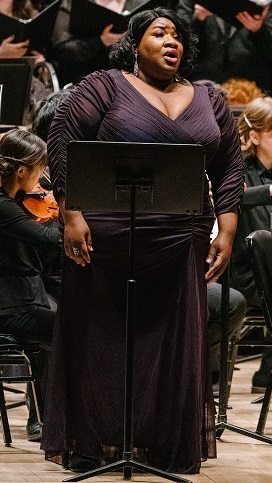
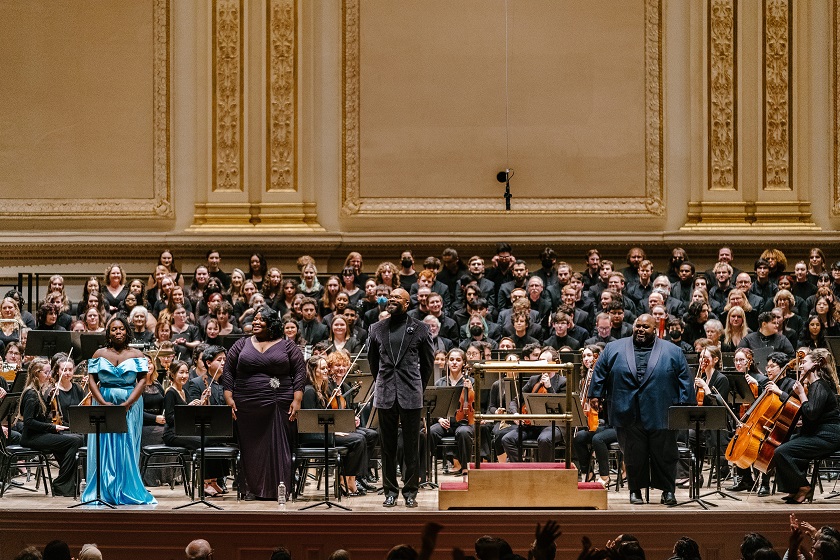
    Above: the vocal soloists for the Dett oratorio: Chabrelle Williams, Ronnita Miller, Limmie Pulliam, and Eric Greene; photo by Fadi Kheir

    The final and most substantial work of the evening was Robert Nathaniel Dett’s oratorio The Ordering of Moses. Dett, a Canadian-born American composer of the early 20th century, became the first black man to graduate with a double major from the Oberlin Conservatory in 1908. He initially wrote The Ordering of Moses as a thesis project while completing his Masters of Music from the Eastman School of Music in Rochester in 1932. Dett later revised and expanded the work, however, and it was premiered in its final form by the Cincinnati Symphony Orchestra under Eugene Goosens in 1937.

    Clocking just under an hour, the oratorio is divided into nine sections and is cast for orchestra, chorus, and four vocal soloists. Joining the Oberlin musicians for this performance were soprano Chabrelle Williams, mezzo-soprano Ronnita Miller, tenor Limmie Pulliam, and baritone Eric Greene.

    020-CHR-OC-Carnegie-012023

    Above: soloists Ronnita Miller and Eric Greene; photo by Fadi Kheir

    The first section opened on warm instrumentation that favored the lower voices of the orchestra. A lone cello voice emerged for an occasional solo before Greene’s sonorous tones took center stage as “The Word,” describing the bondage of the Israelites under the Pharaoh. He was joined briefly by Miller, who cried out for mercy as the voice of the Israelites. The music was rather languid here, until a great exclamation of “Mercy, Lord” announced an upbeat transition into the second section, “Go Down Moses.”

    010-CHR-OC-Carnegie-012023

    A recent last-minute Metropolitan Opera debutant, tenor Limmie Pulliam (above, in a Fadu Kheir photo) then entered as the voice of the reluctant Moses, who is given the famous command by God, “Go down Moses, way down in Egypt’s land; tell Pharaoh: ‘Let my people go!’” (this section featured a particularly cheeky musical joke where Moses sings “I am slow of tongue!” at the most sluggish pace imaginable). The drama then moved fairly seamlessly into the third section “Is it not I, Jehovah!” as God affirms his edicts to Moses.

    This was followed by a mostly uneventful instrumental interlude as the story was transported forward to Moses’s parting of the Red Sea (“And When Moses Smote the Water”). This exuberant, celebratory section was followed by two more instrumental interludes: “The March of the Israelites through the Red Sea” and “The Egyptians Pursue.” The former was an almost jaunty affair, complete with military snare and wordless chorus, while the latter featured brassy blasts and dramatic descending runs as the crashing waters swept away the pursuers.

    021-CHR-OC-Carnegie-012023

    Above: soprano Chabrelle Williams; photo by Fadi Kheir

    Ms. Williams’s soaring vocals finally entered the proceedings in the waltz-like “The Word,” as the Israelites jovially sang praises to Jehovah. All forces joined for the triumphant finale “Sing Ye to Jehovah,” as the oratorio built to a final satisfying tutti instrumental blast.

    Everyone performed splendidly throughout and the piece was met with one of the most enthusiastic standing ovations I’ve seen in a while, yet I couldn’t help feeling slightly underwhelmed by the music itself. Considering the scale of forces at work, the writing was not terribly economical. The instrumentation was often sparse and seldom were all of the elements brought together for fuller effect. The solo parts also heavily favored the male voices, leaving Williams and Miller very little to do for most of its duration.

    This isn’t to say it was bad—far from it—, but it did leave me wanting a little bit more. Had Dett not died of a heart attack at the relatively young age of 60 in 1943, one cannot help but wonder what other and more exciting large scale works he might have brought to the concert hall. Nevertheless, it was exciting as always to hear a buried musical gem such as this get dusted off and given new life. It was a grand conclusion to another memorable concert by the Oberlin Conservatory musicians, who will hopefully return again soon to grace New York City audiences with another memorable program.

    014-CHR-OC-Carnegie-012023

    All performance photos by Fadi Kheir.

    ~ Brad S Ross