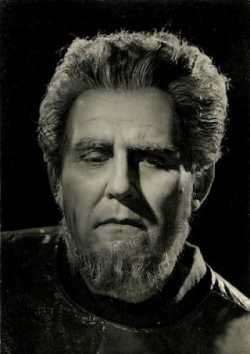
Above: basso Otto von Rohr
From 1952 comes this performance of Act I of Wagner’s DIE WALKURE with Gunther Treptow, Hilde Konetzni, and Otto von Rohr, with the RAI-Rome Orchestra conducted by Wilhelm Furtwängler.
Listen here.
Above: basso Otto von Rohr
From 1952 comes this performance of Act I of Wagner’s DIE WALKURE with Gunther Treptow, Hilde Konetzni, and Otto von Rohr, with the RAI-Rome Orchestra conducted by Wilhelm Furtwängler.
Listen here.

Above: Eva Randová as Kundry
Horst Stein conducts Wagner’s PARSIFAL at the Bayreuth Festival 1981. Watch and listen here.
Cast:
Amfortas: Bernd Weikl ~ Titurel: Matti Salminen ~ Gurnemanz: Hans Sotin ~ Parsifal: Siegfried Jerusalem ~ Klingsor: Leif Roar ~ Kundry: Eva Randová ~ 1st Knight of the Grail: Toni Krämer ~ 2nd Knight of the Grail: Heinz Klaus Ecker ~ 1st Squire: Marga Schiml ~ 2nd Squire: Hanna Schwarz ~ 3rd Squire: Helmut Pampuch ~ 4th Squire: Martin Egel ~ Flower Maidens: Norma Sharp, Carol Richardson, Hanna Schwarz, Mari-Anne Häggender, Marga Schiml, and Margit Neubauer ~ Alto Solo: Hanna Schwarz

Above: Alma Maria Mahler Gropius Werfel
Wednesday, May 18th, 2022 – Aspect Chamber Music Series presenting works by Alma and Gustav Mahler, Korngold, and Zemlinsky at the Italian Academy. In the days leading up to this concert, I watched again the remarkable film Bride of the Wind; read about it here.
I had not realized that this evening would include a lecture; I generally avoid such events, though tonight’s commentary was not overly long. However, it was not until the lights went down and an announcement was made that wearing masks during the performance was “optional” that I realized how many people around us did not have masks on. Had I known this in advance, I would never have attended. But the lights were down and it would have been impossible to exit without disturbing people. So we stayed for the first half, feeling quite uncomfortable.
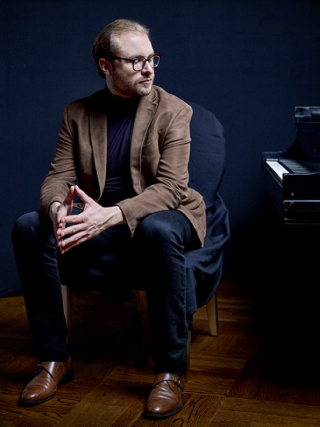
As a sort of unannounced prelude to the evening, pianist Adam Golka (above) played a Chopin nocturne with ravishing finesse. This established a beautiful musical atmosphere which was sustained throughout the performance.
A screen was then lowered and musicologist Nicholas Chong spoke of Alma’s famed beauty and of the many men in her life, while photos of the lady and her suitors were shown. What a life she led! Of course, many of her adventures are spoken of in the film Bride of the Wind. It might have been illuminating to hear more about her musical education and of her small catalog of surviving works, though.
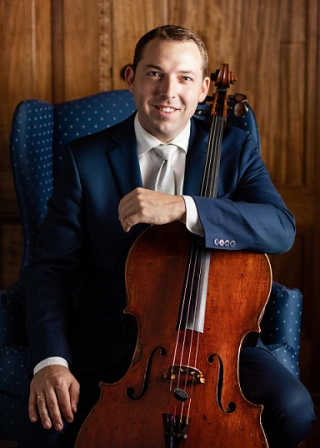
Alexander Zemlinsky was Alma’s music teacher…and her lover. Tonight, Zemlinsky’s Three Pieces for Cello and Piano were performed for us by the Escher Quartet’s marvelous cellist Brook Speltz (photo above, by Anna Kariel), with Mr. Golka at the keyboard. The first of these, Humoreske, is a folkish piece that turns lyrical. Then comes Lied, a song of poignant beauty which expresses a sense of longing. The third piece, Tarantella, is a lively dance. To each of the three, Mr. Speltz brought his trademark warmth and expressiveness, well-matched by Mr. Golka’s sensitive and rhythmically deft playing.

Two sets of songs, four by Gustav Mahler and five by Alma Mahler, brought forth mezzo-soprano Rebecca Ringle Kamarei (above) and the Canadian pianist Brian Wagorn. Ms. Kamarei, a comely woman with a unique voice and a sure sense of feminine power, looked striking in a black gown trimmed with golden vine-like appliqué.
From Gustav Mahler’s vast song repertoire, Ms. Kamarei opened her set with the dramatic “Wenn mein Schatz Hochzeit macht“; her voice instantly captivated me with its distinctive colour-palette, size, a compelling command of dynamics, and a thoughtful way with words. Continuing with the familiar “Rheinlegendchen“, the singer was sailing along beautifully when she had a momentary memory lapse and needed a re-set…this was charmingly handled, and she and the pianist resumed their music-making. In two of my most beloved songs from the Rückert-Lieder, “Ich atmet’ einen linden Duft” and “Liebst du um Schönheit”, Ms. Kamarei and Mr. Wagorn wove their spell thru the dreamy passages of the first song to the wryly romantic sensibilities of the second.
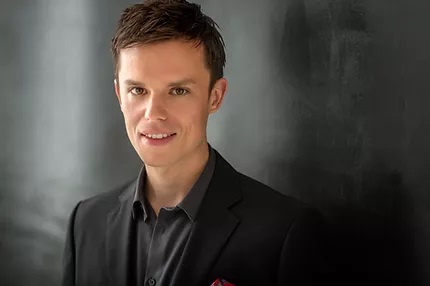
Above: pianist Bruce Wagorn
The five Alma Mahler songs drew my companion and me into even higher regard for Ms. Karamei and Mr. Wagorn. In “Die stille stadt“, the singer gave the signature descending phrases a nice sense of quiet drama; an unfortunate cellphone intrusion did not deter her from her poetic path: she displayed the great power of her voice, then reined it in to an impressive piano with complete control The pianist’s lovely postlude gave the song a perfectly polished end.
During “Laue Sommernacht“, the singer’s expressive hands were captivating to watch. Again, her assurance of dynamic ‘rightness’ found her skillfully pulling back from forte to piano, making an exciting effect. This songs ends quietly; throughout, Mr. Wagorn was the ideal collaborator. In “Bei dir ist es traut“, lyrical expressiveness and finely-shaded vocal colours kept us riveted to the music; and the gentle sway of the song’s central section had its own allure.
Mr. Wagorn’s gently restless piano figurations created the right summertime mood for “Ich wandle unter Blumenen“; but the singer cannot suppress a sudden burst of drama when she feels the desperate need for her lover’s embrace: her ardour creates a touch of witty irony.
Finally came “Lobgesang”, a song of praise. Introspective at the start, the music becomes quite grand. By now we are under Ms. Kamarei’s spell, and wanting to hear her in…some Wagner: Fricka and Waltraute came immediately to mind, as did – of course – the Wesendonck Lieder.
Meanwhile, our desire to escape became more urgent as the unmasked couple in front of us began coughing the moment the music ended. We left hastily, regretting that we were missing the concert’s Korngold finale.
~ Oberon

Above: Montserrat Caballé
On April 22nd, 1972, fifty years ago today, a matinee of Verdi’s DON CARLO was the final opera performance of Sir Rudolf Bing’s reign at The Metropolitan Opera. That evening, a gala concert featuring many great artists of the day paid tribute to the departing general manager.
I attended the matinee, and I tried to get a ticket for the evening’s farewell concert, but none were to be had. Here’s what I wrote in my diary about the afternoon’s DON CARLO:
“In spite of a few shortcomings, this was for the most part a superb and highly enjoyable performance; the opera itself is magnificent. Francesco Molinari-Pradelli’s conducting was dutiful, and not very inspired. I found myself wishing for a different maestro.
All the singers were perfectly suited to their roles. Two fine tenors – Leo Goeke as Count Lerma and Rod MacWherter as the Herald – sounded wonderful in their brief musical moments. Lucine Amara and Frederica von Stade graciously took on small roles in honor of Mr. Bing: Ms. Amara repeated her 1950 Met debut role as the Celestial Voice to lovely effect, whilst Ms. von Stade stepped back from such roles as Nicklausse, Hansel, and Cherubino to make a sensational Theobald, the queen’s page. What a voice this mezzo has, and how boyish and alert her acting was! Paul Plishka was amply resonant as the mysterious Friar (aka Charles V).
John Macurdy sang very well as the Grand Inquisitor, joining the great Cesare Siepi’s Philip II to make the confrontation of church and state a chilling scene. The Siepi voice remains impressive, giving us a wonderfully personal “Ella giammai m’amo“; his acting and bearing left nothing to be desired. Bravo!
Grace Bumbry as Eboli gave one of the finest performances I have heard from her. A couple of snags in the Canzone del Velo were quickly forgotten as she swept thru the fiery Garden Scene trio and on to a striking “O don fatale” which elicited great applause. Bumbry looks sensational onstage, though her acting is sometimes mannered.
Franco Corelli did not seem as vocally secure in the title-role as is the 1970 performances with Raina Kabaivanska, but still quite exciting. His singing was sustained and well-modulated, and of course he looks great onstage, though as an actor he sometimes went overboard. Still, Corelli always ignites the crowd. Sherrill Milnes sounded better today than he did earlier in the season; his Posa is a masculine, commanding figure, and he makes you care about the character’s fate.
Standing head and shoulders vocally above her colleagues, Montserrat Caballé was a sublime Elisabetta. Her regal bearing and innate sense of nobility made her physical stature irrelevant: she in unquestionably a queen in every sense of the word. She looked magnificent in the costumes, especially the rich red gown of the Auto da Fé scene. Ms. Caballé’s singing was thrilling from first note to last, and it is a pleasure to watch her sing: she expends no evident effort, whether producing an ensemble-topping forte or a shimmering pianissimo. Her farewell to the Countess of Aremberg (both verses) was a poised moment of poetic beauty. All afternoon, the diva seemed to inspire her colleagues, especially in the Closet Scene quartet which was a highlight of the performance. And in the great aria “Tu che le vanita“, Ms. Caballé rose to spectacular heights, pouring out the queen’s despair rich-toned phrases, and weaving in uncanny pianissimi of spine-tingling delicacy. The aria won a huge ovation. And then La Caballé ended the evening by holding the opera’s final note FOREVER! Her Elisabetta ranks with the greatest operatic interpretations I have experienced to date. Bravississima!!!“
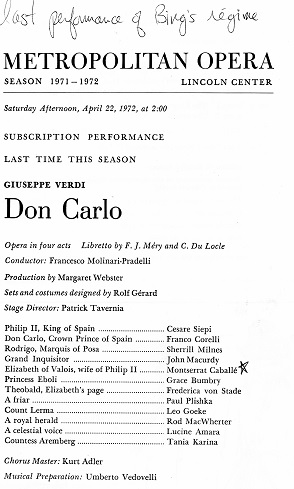
Montserrat Caballé’s sensationally sustained final note at this performance is preserved on this recording of the opera’s ending from the broadcast: Cesare Siepi is Philip II, John Macurdy is the Grand Inquisitor, Placido Domingo is Don Carlo, and Paul Plishka’s is the Voice of Charles V. Listen here.
~ Oberon

Above: Maestro Donald Runnicles
Saturday April 16th, 2022 matinee – Feeling no need to again see Patrice Chéreau’s intimate staging of Strauss’s ELEKTRA in the vast space of The Met, I took a score desk this afternoon to hear my ‘second favorite’ opera (my #1 opera remains the same composer’s ARIADNE AUF NAXOS). While the Chéreau production is a misfit at The Met, it is fascinating to watch on DVD: look for it here.
Today, The Met Orchestra under the baton of Donald Runnicles was the main attraction. They played Strauss’s astounding score for everything it’s worth: from the massive onslaughts of sound to those spine-tingling subtleties that the composer introduces at just the right moments. For the most part, Maestro Runnicles maintained a perfect balance between the orchestra and the voices, though – inevitably in this gruesome score – there were times when the voices were covered; and that might be what Strauss wanted all along. Mr. Runnicles also did everything he could to support soprano Nina Stemme, who was announced to be experiencing the effects of “seasonal allergies”.
If a singer needs to have an announcement made before the opera starts to the effect that she/he is suffering from some physical malady and asks our indulgence, this comes off as a cop-out. If said singer then goes on to give an abysmal performance, she/he has covered her/his ass, and the audience will be forgiving.
Today’s pre-curtain announcement of Nina Stemme’s allergy problem was not unexpected: she had been replaced (with success) by the debuting Rebecca Nash at the previous performance. But really, such announcements are unfair to the audience, who have paid good money to attend and who deserve to hear singers in their best of health. Ms. Stemme’s struggle today was palpable, and disturbing to hear. To me, it seemed like a simple case of taking on a role that is beyond her present capabilities. Signs of her vocal decline were evident in her 2016 performances here as Turandot and Isolde, and now – nearing the age of 60 – she has even less to work with. The result this afternoon was singing that was painful to the ear.
Lise Davidsen was a thrilling Ariadne earlier this season, and her soaring top notes were amazing in the music of Chrysothemis today: high B-flat is definitely her “money note”. But the rest of the voice is not all that alluring, as her Four Last Songs at the Met’s Gala for Ukraine in March hinted at: the sound can get lumpy and inexpressive. I am wondering if she is really the new goddess of sopranos, or just another flash in the pan. Time will tell.

Overall, top honors today went to Michaela Schuster (above, in a Met Opera photo) for her vivid and subtle singing of Klytemnestra’s music. The mezzo-soprano illuminated the terror and insinuation of the character’s music with her great verbal clarity, making her long narrative the most engrossing scene in the opera.
Greer Grimsley’s dark, growling sound was ominously powerful in the music of Orest; his “Laß den Orest…” was very impressive, and indeed it was he, rather than Ms. Stemme, who made the Recognition Scene – the heart of the opera – so riveting this afternoon.
Stefan Vinke did what he could with the brief, demanding, and thankless role of Aegisth. Harold Wilson made his mark as the Guardian, and the lively singing of Thomas Capobianco, set against the world-weariness of the inimitable Richard Bernstein, made the scene of the Young and Old Servants a perfect vignette.
Speaking of inimitable, Tichina Vaughn wonderfully chesty “Wo bleibt Elektra?” got the opera off to a perfect start. Her sister-Serving Women – Eve Gigliotti, Krysty Swann (interesting timbre indeed), and Alexandra Shiner – did much with their quick exchanges of lines. And the beloved Korean soprano Hei-Kyung Hong, as the valiant Fifth Maid who suffers a whipping for her brave defense of Elektra, sang poignantly, with a crystalline top note to climax the opera’s opening scene.
Metropolitan Opera House

Saturday April 16th, 2022 ~ matinee
ELEKTRA

Richard Strauss
Elektra………………..Nina Stemme
Chrysothemis……………Lise Davidsen
Klytämnestra……………Michaela Schuster
Orest………………….Greer Grimsley
Aegisth………………..Stefan Vinke
Overseer……………….Alexandra LoBianco
Serving Woman…………..Tichina Vaughn
Serving Woman…………..Eve Gigliotti
Serving Woman…………..Krysty Swann
Serving Woman…………..Alexandria Shiner
Serving Woman…………..Hei-Kyung Hong
Confidant………………Alexandra LoBianco
Trainbearer…………….Krysty Swann
Young Servant…………..Thomas Capobianco
Old Servant…………….Richard Bernstein
Guardian……………….Harold Wilson
Conductor………………Donald Runnicles
~ Oberon

Above: Sir Geraint Evans and Renata Tebaldi in FALSTAFF
February 23, 2022 – Fifty years ago this evening, the Metropolitan Opera presented a memorable performance of Verdi’s FALSTAFF. The evening marked the first time Renata Tebaldi sang Alice Ford in New York City; beloved Met luminaries Regina Resnik and Sir Geraint Evans sang Dame Quickly and Sir John Falstaff, and Christoph von Dohnanyi made his Met debut on the podium. Of key interest for me was the beauteous Jeannette Pilou, a great favorite of mine, in the role on Nannetta.
This was my diary entry, written right after the performance:
“A great performance in every way. Christoph von Dohnanyi’s Met debut was a success, despite some moments that seemed under-rehearsed. When the curtain rose on the opera’s second scene and the audience caught sight of La Tebaldi, a sustained round of applause caused the opera to come to a halt. For a moment, no one seemed quite sure what to do, til someone yelled “Start over!”, and that’s what Maestro von Dohnanyi did.
The cast was incredibly good. Two de luxe character tenors – Paul Franke (Dr. Caius) and Andrea Velis (Bardolfo) – scored numerous verbal points at the opera progressed. And…they can sing! Richard Best was a sturdy-voiced Pistola and Joann Grillo a comely, warm-toned Meg Page.
Kostas Paskalis sang splendidly as the jealous Master Ford, his monolog being one of the vocal highlights of the performance. His voice is huge, with a darkish tint. Luigi Ava was a sweetly lyrical Fenton, and he played the role of the love-struck youth well. Regina Resnik was a fabulous, genuinely funny Dame Quickly. The voice is not really very attractive these days, but she knows how to sing, and she uses her voice as a dramatic instrument. She is, in every respect, a great Dame.

Jeannette Pilou (above, as an enchanting Nannetta) seemed so alive, so real, no mannerisms. Her voice is so pretty and clear, and she brought some very appealing pianissimo effects to her Act III aria. Pilou is such a beautiful woman; her arrival on a white Shetland pony as Hearne’s Oak was a lovely moment. Bravissima!
Renata Tebaldi enjoyed an immense success in her first Met appearance as Alice Ford. The voice seemed fresher than in recent seasons: very sweet and warm. Her high notes came quite easily tonight. On the last top-C, she really sailed, whilst Pilou tossed her head back and joined her, bringing this romp of an opera to a joyous end. Tebaldi’s sensational good looks, her charm and humor, and her lively entrance into the spirit of the evening made for another triumph for the great diva. Bravissima!
Towering above all others was that magnificent singing-actor, Sir Geraint Evans, as Sir John Falstaff. In his revelatory portrayal, one sees every aspect – the comic and the tragic – of this incredible character. So pompous at first, so funny and full of himself at Alice’s, so frighteningly degraded as he runs to the Garter Inn at the start of Act III, so touchingly terrorized at Hearne’s Oak, and so human in the opera’s final moments. I’ve heard the role sung with more sheer voice, but never with such flair and nuance. Bravissimo, Sir Geraint: you are Falstaff!

The final ensemble was so much sheer fun: the singers lined up along the footlights and mocked the audience…and themselves. And then that great dual-high-C. The curtain calls were numerous, with everyone staying on, and a big gathering at the orchestra rail where flowers were thrown and we all yelled ourselves hoarse.”

Above: Jeannette Pilou with New York’s most famous opera fan, Lois Kirschenbaum
~ Oberon

February 23rd, 2022 – I have just read of the death of the Italian soprano Antonietta Stella; she passed away on this date at the age of 92.
In 1950, she made her operatic debut at Spoleto as Leonora in TROVATORE and soon after was singing at the opera houses of Rome, Florence, Naples, Parma, Turin, Catania, Venice, and the Arena di Verona.

Above: Antonietta Stella as Leonora in TROVATORE
In 1954, Ms. Stella debuted at the Teatro alla La Scala in Milan as Desdemona in OTELLO; she continued to sing at La Scala thru 1963 in the great soprano roles of Verdi and Puccini, and as Maddalena in ANDREA CHENIER. In 1955, she made debuts at the Wiener Staatsoper, the Royal Opera House in London, the Paris Opera, La Monnaie, and the Lyric Opera of Chicago.
She came to the Metropolitan Opera in 1956 as Aida, and went on to sing there thru 1960 as Cio-Cio-San, Violetta, Tosca, Elisabetta in DON CARLO, Leonora in TROVATORE,and Amelia in BALLO IN MASCHERA.
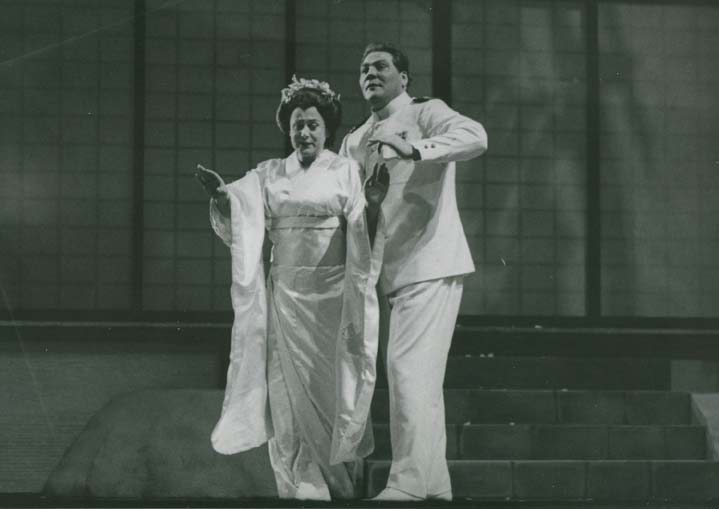
Above: Antonietta Stella and Eugenio Fernandi in the Aoyama BUTTERFLY at The Met
In 1958, Ms. Stella portrayed the title-character in Yoshio Aoyama’s classic production of MADAMA BUTTERFLY; the production remained in the Met repertoire thru the 1990s.
Antonietta Stella – Un bel di – BUTTERFLY – Met bcast 1958
Among Antonietta Stella’s commercial recordings, her DON CARLO (with Flaviano Labo, Fiorenza Cossotto, and Boris Christoff), her TROVATORE (with Cossotto and Carlo Bergonzi), and especially her ANDREA CHENIER (with Franco Corelliand Mario Sereni) are my special favorites. She is also heard on several “pirate” recordings.
Ms. Stella sang Minnie in the televised Japanese premiere performance of Puccini’s FANCIULLA DEL WEST (The Girl of the Golden West) given at Tokyo on November 2nd, 1963. The NHK Symphony Orchestra is conducted by Oliviero De Fabritiis.
Watch and listen here.
CAST:
Minnie: Antonietta Stella
Dick Johnson: Gastone Limarilli
Jack Rance: Anselmo Colzani
Nick: Mario Guggia
Ashby/Jake Wallace: Bruno Marangoni
Sonora: Arturo La Porta
Wowkle: Anna Di Stasio
Sid/Billy Jackrabbit/Jose Castro: Giorgio Onesti
Trin: Antonio Saba
Bello: Marco Scotti
Harry: Augusto Pedroni
Joe: Antonio Pirino
Happy: Paolo Mazzotta
Larkens: Mario Rinaudo
Postman: Takeshi Nakamura
And here is part of the Act II duet of Violetta and Germont from TRAVIATA with Ms. Stella and Tito Gobbi:
Antonietta Stella & Tito Gobbi – Dite alla giovine ~ TRAVIATA

Helen Traubel sings – magnificently – Isolde’s Narrative and Curse from the first act of Wagner’s TRISTAN UND ISOLDE.
Helen Traubel – Isolde’s Narrative and Curse – Rodzinski cond
“With the gleaming sword,
I stood over him,
Ready to avenge Morold’s death.
He looked up – not at the sword,
not at my hand –
he looked into my eyes.
His anguish
touched my heart.
The sword…I let it fall!
His wound I healed so that he could travel homeward…and no longer trouble me with his gaze.”

Above: Maria Agresta and Charles Castronovo in LA BOHEME; a MetOpera photo
Saturday January 22md, 2022 matinee – This performance had its ups and downs, The conducting of Carlo Rizzi was hit-or-miss; he sometimes allowed the orchestra to swamp the singers. But I did like his speedy take on the first several minutes of the Cafe Momus scene.
Charles Castronovo repeated his very persuasive Rodolfo from the November run. His singing is emotional without straying from the notes, and he has both power and subtlety in perfect measure. His Mimi this afternoon, Maria Agresta, sounded sadly out-of-sorts, her vibrato prominent, and her highest notes not entirely comfortable. Offsetting these reservations was her congenial phrasing and some lovely piano effects.

Lucas Meachem (above) was a magnificent Marcello, making every phrase count. The voice is large and warm, and he handily dominated the ensemble ‘reprise’ of the “Musetta Waltz” theme in Act II. His duet with Ms. Agresta in Act III was impressively sung. Gabriella Reyes screeched and shrilled Musetta’s lines at first, but settled in for a nice rendering of the Waltz; I feel that she might be better cast as Mimi.
Alexander Birch Elliott was a fine Schaunard, despite having to cope with lacklustre conducting from Mr. Rizzi. I liked Peter Kellner’s Colline very much, too, but the thought of enduring a second Gelb intermission caused me to head home without hearing his “Vecchia zimara“.
The House was substantially full, and there was surprise applause after the Bohemians dismissed Benoit in Act I. Lots of noisy chatter from the ceiling lighting bay during Act I was distracting, and the interminable first intermission simply killed whatever dramatic impetus the opera had going.
Metropolitan Opera House
Janaury 22nd, 2022 matinee
LA BOHÈME
Giacomo Puccini
Mimì....................Maria Agresta
Rodolfo.................Charles Castronovo
Musetta.................Gabriella Reyes
Marcello................Lucas Meachem
Schaunard...............Alexander Birch Elliot
Colline.................Peter Kellner
Benoit..................Donald Maxwell
Alcindoro...............Donald Maxwell
Parpignol...............Gregory Warren
Sergeant................Jonathan Scott
Officer.................Ned Hanlon
Conductor...............Carlo Rizzi
~ Oberon

Saturday November 20th, 2021 matinee – In 2016, Anita Hartig was a radiantly-sung Liu in TURANDOT at The Met. When her Violetta was announced in the 2018-2019 season, I was eager to hear her again, only to find that – at least at the performance I attended – she was having serious pitch problems. So this year, despite wanting to hear Charles Castronovo and Artur Ruciński in BOHEME, I hesitated to go because Ms. Hartig was the Mimi. Then I heard a clip from the prima of Mimi’s Act I narrative and the soprano sounded fabulous. So, there I was today, in a packed house, experiencing the Franco Zeffirelli BOHEME for the umpteenth time.
The afternoon started on a sour note: while waiting for the curtain to rise, the two women sitting next to me removed their masks, started eating crackers, called people on their phones, and even called each other! Seriously! I wasn’t about to let them ruin the performance for me, so I abandoned my seat with a view and went back to my more usual score desk.
I liked Eun Sun Kim’s conducting a lot. Her tempi felt just right, and she seemed to breathe with the singers, allowing them leeway with sustaining notes when they wished. The orchestra were in fine fettle, and I especially loved the harp passages at the opening of Act III.
BOHEME is a love story, and today’s lovers were excellently paired. Ms. Hartig’s “Mi chiamano Mimi” was gorgeously sung and phrased, and she turned on the power for the ecstatic cresting phrase of the love duet, and again for the climax of the ensemble following Musetta’s Waltz. Ms. Hartig’s sustained high-C at the end of Act I was handsomely harmonized by Charles Castronovo, today’s Rodolfo. The tenor’s Act I aria was particularly appealing in his way with the words; his top notes do not ‘bloom’ but they have ample power. In Act III, his anguish in telling Marcello the real reason he must break with Mimi was passionately expressed. Ms. Hartig’s “Addio senza rancor” was very moving, and she gave us an exquisite pianissimo on the final “…rancor!” A few moments later, having decided to stay with Mimi until the Spring, Mr. Castronovo ravished the ear with his own lovely pianissimo on “…alla stagion dei fior!“
Artur Ruciński’s Marcello was sung with power and warmth; he led the ensemble ‘reprise’ of Musetta’s Waltz in a commanding way, and was wonderful in his Act III duet with Mimi, and then in his conversation with Rodolfo. Fererica Lombardi was a bright-toned Musetta, making the most of her Waltz. Alexander Birch Elliott was an excellent Schaunard, and I very much liked Nicholas Brownlee’s voice as Colline – so much so that I regretted leaving before his Coat Aria (the thought of sitting thru another endless Gelb-Intermission sent me packing after Act III). The Scottish baritone Donald Maxwell, long a favorite at the Royal Opera, Covent Garden, doubled in the roles of Benoit and Alcindoro.
The Zeffirelli BOHEME has come in for some bashing of late. Some people feel it’s time for a change. But – like the Zeffirelli TURANDOT – it’s been a veritable cash cow for the Met, selling out (or selling “big”) no matter who is singing. Today’s nearly full house seemed attentive and appreciative. And of course they applauded the rise of the curtain on the Café Momus scene. Oh dear, people actually enjoying themselves at the opera! We can’t have that, now, can we?
Metropolitan Opera House
November 20th, 2021 matinee
LA BOHÈME
Giacomo Puccini
Mimì....................Anita Hartig
Rodolfo.................Charles Castronovo
Musetta.................Federica Lombardi
Marcello................Artur Rucinski
Schaunard...............Alexander Birch Elliot
Colline.................Nicholas Brownlee
Benoit..................Donald Maxwell
Alcindoro...............Donald Maxwell
Parpignol...............Marco Antonio Jordão
Sergeant................Tyler Simpson
Officer.................Ross Benoliel
Conductor...............Eun Sun Kim
~ Oberon
 Oberon's Glade