Tag: Opera

  • 40 Years Ago: Fracci & Nureyev ~ GISELLE

    Fracci nureyev gisells

    ~~~~ Note: I had originally planned to post this article on the 40th anniversary of my one-and-only experience of seeing the great Carla Fracci onstage. Today, news of the ballerina’s death has come, so I am posting it now, two months shy of the actual anniversary:

    Giselle La Scala-1jpg
    On this date, forty years ago, one of the greatest ballet performances of my experience took place at the Metropolitan Opera House, where the La Scala Ballet presented their production of GISELLE with Carla Fracci and Rudolf Nureyev in the leading roles.

    I had spent the afternoon at The Met watching GISELLE with an alternate cast; it was a very pleasing performance. But the undeniable star-power of Fracci and Nureyev made the evening performance unforgettable. 

    This is my diary entry from that magnificent evening:

    GISELLE – 2nd performance – with the assumption on the leading roles by two great dancers, the whole production took on a new dimension. The corps seemed better than at the matinee, though again Renata Calderini was not a particularly impressive Myrthe. There was a very exciting Peasant Pas de Deux with Anna Maria Grossi and a very exciting Davide Bombana; they roused the audience to cheers.

    But it was in the superstars that the real excitement lay – and that is why they are superstars! Rudolf Nureyev’s Albrecht was marred slightly by some rather ‘modern’ acting details in Act I where he failed to maintain the aura of manners of the period. But otherwise he caught the essence of the caddish young nobleman in Act I and the grief-stricken man of Act II. He danced with thorough command despite passing traces of stiffness. He interpolates many intricate steps and then challenges himself to bring them off…and always succeeds. His Albrecht was a full portrait – and it was very exciting.

    Fracci giselle

    In Carla Fracci we had the perfect Giselle. All this talk about her ‘capturing the essence of the Romantic Era’ felt absolutely true. There were times in Act II when she really did seem like the ghostly vision of another time and place. Here is a dancer so technically assured, so light yet bearing underneath great strength of character and of will. She was so charming in Act I, and her Mad Scene was brilliantly done – not overplayed but seemingly so real. Act II truly produced the feeling of seeing a phantom. Floating in her gossamer long tutu, Fracci evoked the remote mystique of the spectre. Her dancing throughout was so poised, with the steps always presented as a natural expression of the character and stemming completely from the drama. One had the feeling of really seeing Giselle herself, not of a ballerina portraying her.

    At the end there was a tremendous ovation (20 minutes) with roses being thrown and Fracci & Nureyev called out repeatedly…bravi!!!”  

    ~ Overon   

  • Christa Ludwig Has Passed Away

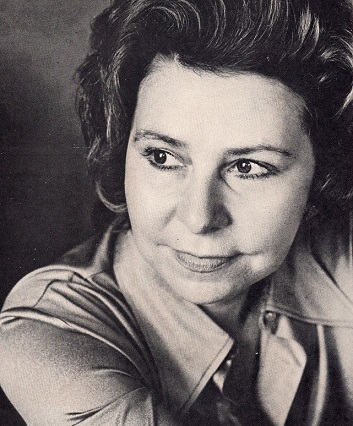
    C l

    April 25th, 2021 – Throughout the sixty years that I have been obsessed with opera, I have loved and admired many wonderful singers. But when people ask me, “Who was the greatest singer you ever heard?”, I must answer: “Christa Ludwig.” Today, news has come of her death at the age of 93.

    Christa Ludwig made her Vienna State Opera debut as Cherubino in Mozart’s NOZZE DI FIGARO in 1955. She went on to give 769 performances of 42 roles in Vienna. At the Metropolitan Opera, her 1959 debut (also as Cherubino) marked the start of a 38-year association with The Met, where she sang 119 performances of 15 roles.

    Christa Ludwig was my first Octavian, and also my first Dyer’s Wife in FRAU OHNE SCHATTEN (in a stellar cast with Leonie Rysanek, Irene Dalis, James King, and Christa’s then-husband, Walter Berry, with Dr. Böhm conducting), my first Dido in TROYENS, and my first Klytemnestra. Her other Met roles were Amneris, Brangaene, Ortrud, Fricka, Kundry, Charlotte in WERTHER, and Waltraute; and she gave a single performance as Leonore in FIDELIO.

    My first experience of seeing Christa Ludwig onstage was as the Dyer’s Wife; my first FRAU was part of a thrilling weekend in February 1969 that also included my very first RHEINGOLD (with Herbert von Karajan conducting) and the now legendary Nilsson/Caballe TURANDOT. Christa’s Dyer’s Wife was a blazing creation, her voice spanning the wide range with complete command, the highest notes sailing into the Big House with stunning clarity and power.

    From a commercial recording of the great Act III duet for Barak and his wife:

    FRAU OHNE SCHATTEN ~ scene from Act III – Christa Ludwig – Walter Berry – Sieglinde Wagner – Hollreiser cond
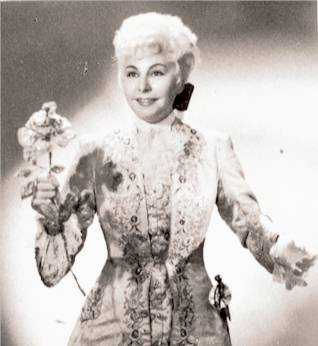
    C l octavian

    I next saw Ms. Ludwig onstage on Valentine’s Day, 1970, as Octavian in DER ROSENKAVALIER. Karl Böhm was again on the podium, and the cast further featured Marion Lippert, Reri Grist, and Mr. Berry. The sight of Ms. Ludwig as Octavian entering the hall of the Faninal mansion, bearing the silver rose, left an indelible impression on my romantic heart. Over time, it became for me the iconic image of everything I love about opera.

    TroyensVickers-Ludwig2

    Above: Nuit d’ivresse with Jon Vickers and Christa Ludwig; a Louis Melançon photo

    On October 27th, 1973 – a red-letter day in my personal life – I saw LES TROYENS for the first time. Shirley Verrett and Louis Quilico as Cassandra and Chorebus had given glorious performances in PRISE DE TROIE. Then, as the scene shifts to Carthage, Christa Ludwig and Jon Vickers sang so poetically the quietly rapturous love duet, Nuit d’ivresse.  Inspired by their ecstasy, I spent the night with Z – and I have ever since felt that life really began for me with that encounter.

    More than a decade was to pass before I saw Christa Ludwig on the Met stage again: in 1984, she was a fascinating Klytemnestra in my first-ever ELEKTRA. Ute Vinzing, Johanna Meier, and Simon Estes were her co-stars, with Maestro Levine presiding. Ms. Ludwig’s singing, with an undercurrent of creeping madness, bore the stamp of a great lieder singer; her characterization sometimes veered endearingly to the melodramatic.
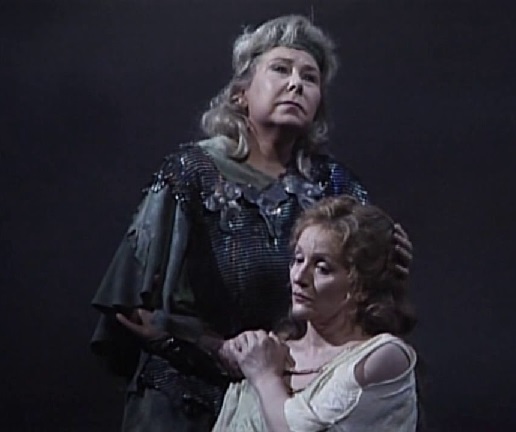
    Gotterdammerung

    Above: Ludwig and Behrens in GOTTERDAMMERUNG

    A four-year interval then passed before I saw Christa in opera again: the 1988 opening night of the Schenk/Levine GOTTERDAMMERUNG. This was a spectacular performance in every regard: Levine and his orchestra were on peak form, and Hildegard Behrens and Matti Salminen thrilled me to the core as Brunnhilde and Hagen. Christa, as Waltraute, looked spiffy in her Valkyrie gear – with black trousers and high black boots – and she moved about, restless as a caged panther, as she told her sister of their father’s frightening state of mind. Having failed in her mission, Waltraute rushes away. The curtain calls that night were fantastic: I think Ms. Ludwig truly didn’t expect the massive wave of applause and bravas that greeted her as she stepped out for a solo bow. It was so moving to watch her accept the audience’s loving appreciation.

    I saw Christa Ludwig on the Met stage for the last time in April 1989 as Fricka in WALKURE. It was a cast of titans: Hildegard Behrens, Jessye Norman, Gary Lakes, James Morris, and Kurt Moll were Christa’s colleagues, and again Levine and the Met orchestra were beyond the beyond. The tension in the great argument between Fricka and Wotan was palpable; then Christa – having won – gathered her dignity and took her final parting shot at Brunnhilde with barely disguised contempt.

    Christa Ludwig made her farewell appearance at The Met as Fricka in a Saturday matinee broadcast of WALKURE on April 3, 1993. Here is her scene from that performance, with Dame Gwyneth Jones as Brunnhilde, James Morris as Wotan, and James Levine conducting. I was listening at home, and as Ms. Ludwig exited the stage, I had a sense that the audience wanted desperately to burst into applause. 

    Christa Ludwig as Fricka ~ Met farewell performance with G Jones +J Morris – Levine cond – 4~3~93

    While Vienna and The Met loomed large in the Ludwig career, she also appeared at La Scala, Covent Garden, Chicago Lyric Opera, and at the festivals at Bayreuth and Salzburg. In addition, she sang the great concert works of Bach and Mahler.

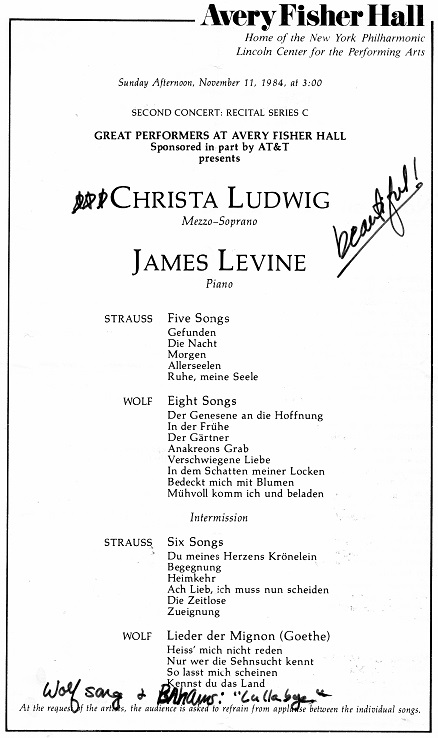
    Christa Ludwig was a beloved recitalist; in 1984, I had the great pleasure of hearing her at Avery Fisher Hall with James Levine at the piano. The program of Strauss and Wolf lieder ended with a marvelous encore: the Brahms “Wiegenlied”.
    Ludwig recital-1 jpg

    Ms. Ludwig left us with a large and lovely catalog of recordings; among my favorites are Bartok’s BLUEBEARD’S CASTLE, the Kempe LOHENGRIN, the Solti TANNHAUSER, the Böhm TRISTAN from Bayreuth with Nilsson and Windgassen, scenes from Strauss operas with Walter Berry…and her SAMSON ET DALILA with James King holds a special appeal for me. She created a stir in 1986 by recording Schubert’s Winterreise with James Levine; they had performed the great Schubert cycle together on the Met stage in 1983.
    Norma

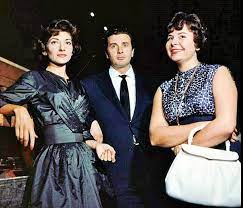
    Above: Christa in the recording studio with Maria Callas and Franco Corelli for the EMI NORMA

    Christa Ludwig sings Strauss’s “Morgen” with Charles Spencer at the piano. Watch and listen here.

    Listen to more from Christa Ludwig:

    Christa Ludwig – Es gibt ein reich – ARADNE AUF NAXOS

    Christa Ludwig – MACBETH – Act I scena – Vienna 1970

    Christa Ludwig – Liebestod ~ TRISTAN UND ISOLDE

    Christa Ludwig – Mahler ~ Ich bin der welt abhanden gekommen

    Christa Ludwig – Der Engel from Wagner’s Wesendonck Lieder

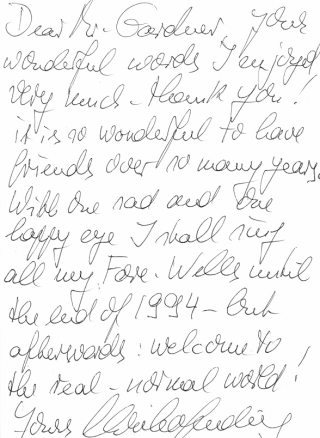
    A lovely note I received from Christa Ludwig after I wrote to her on the occasion of her Met farewell in 1993:
    C l note-1 jpg

    Christa Ludwig ~ An die Musik

    ~ Oberon

  • Alessandra Marc’s Met Debut ~ 1989

    Marc

    Alessandra Marc made her Metropolitan Opera debut on October 14th, 1989. My friend Paul and I were there. Soon after, another friend sent me a recording of parts of the performance.

    AIDA ~ duet – Alessandra Marc & Stefania Toczyska ~ Met 10-14-89

    Alessandra Marc – Met debut as Aida – excerpts – w Martinucci & Toczyska – 10~14~89

    Marc aiida-1

    Here’s my diary entry, written late on the evening of the date; despite the excitement of the Marc debut, Stefania Toczyska’s Amneris was the afternoon’s masterpiece:

    “Overall, a good performance and better-than-good much of the time. Audience most distracting (candy wrappers at their worst!). The settings are grand and it’s a Met-sized production, but very little happens dramatically – it falls to the individual singers to create theatrical sparks.

    Christian Badea favored slow tempi in general – but his support of the singers, in allowing them time to breathe and to sustain the vocal line, was admirable. The orchestra played very well, though there were times when their volume threatened to swamp even this big-voiced cast. The ballet was rather silly, though well-danced.

    While the Marc debut was the afternoon’s focal point, it was the superb Amneris of Stefania Toczyska who topped the cast. She sang with tremendous authority and passion, and she alone of the principals had a grasp of the drama. Her upper range has grown more secure over time, whilst maintaining a strong chest voice; her lovely entries in the opening passages of the Boudoir Scene were especially fine. And Toczyska is ever alert to the situation in every scene, creating a wonderfully feminine portrait of the ultimately distraught princess.

    The Judgement Scene was her crowning glory, a tremendously thrilling twenty minutes. After her beautifully sustained “Io stessa lo gettai…” the audience broke in with sustained applause. She concluded the scene with a fiery verbal assault in the priests, followed by a sustained final note before rushing off in a fury. Toczyska is a very attractive singer and her Amneris was deeply satisfying to experience. To top it off, she graciously pushed the debuting Aida, Alessandra Marc, forward during the group bow and started applauding her!

    Marc made a highly successful Met debut. Her voice has a curiously stimulating throb; at times it lacks resonance in the lower range, but the top has a lovely, almost girlish quality (such as we sometimes hear on recordings of sopranos from the early days of audio documentation): Marc’s voice blooms as it ascends. 

    Although lacking the ultimate cresting power in ensembles that some sopranos can muster, the soprano’s singing abounded in gorgeousness: starting with “Ritorna vincitor“, she won the audience with her opulent tone and marvelous turnings of phrase. The unaccompanied descending phrase in the Triumphal Scene was especially superb, and in the Nile Scene she proved herself with a splendid “O patria mia“, rising to a sustained, glowing high-C, and phrasing magically. 

    Marc did not make the most of the dramatic phrases of the duet with Amonasro, as some Aidas do, but in the seductive passages of the duet with Radames (“La tra foreste virgini…”) she sounded truly alluring. Likewise, the opera’s final duet showed the Marc voice at its distinctive best. Applause for the soprano was enthusiastic throughout the evening, and at the end the audience showered her with enthusiastic bravas

    Nicola Martinucci was a far more than capable Radames: his bronze-tinged voice has a nice metallic edge when needed, with strong tops – one or two of which were almost imperceptibly a hair’s breadth flat. Martinucci’s “Celeste Aida” went very well, with a sustained conclusion that won a vociferous response from the crowd. His voice cut thru the ensembles of the Triumphal Scene, and he found his lyric side in the Nile Scene before ending with a prolonged, ringing “Io resto a te!” Together with Toczyska, Martinucci made vocal sparks fly in the Judgement Scene, and he finished the opera strongly. Throughout, his slender, masculine figure looked great onstage, and his authentic Italian sound was more than welcome. 

    Juan Pons really sang Amonasro – no barking or hectoring. His warm sound and exemplary phrasing gave his singing a wonderfully noble sense of humanity…really impressive.

    Margaret Jane Wray sang beautifully as the Priestess, and Mark Baker strongly as the Messenger. Franco de Grandis sounded rough and effortful as the King, but even so he outshone the sadly out-of-voice Ramfis of Stephen Dupont.

    Despite the audience distractions, Paul and I were glad to have been there, and we enjoyed talking over the performance on the drive home.”

    ~ Oberon

  • Alessandra Marc’s Met Debut ~ 1989

    Marc

    Alessandra Marc made her Metropolitan Opera debut on October 14th, 1989. My friend Paul and I were there. Soon after, another friend sent me a recording of parts of the performance.

    AIDA ~ duet – Alessandra Marc & Stefania Toczyska ~ Met 10-14-89

    Alessandra Marc – Met debut as Aida – excerpts – w Martinucci & Toczyska – 10~14~89

    Marc aiida-1

    Here’s my diary entry, written late on the evening of the date; despite the excitement of the Marc debut, Stefania Toczyska’s Amneris was the afternoon’s masterpiece:

    “Overall, a good performance and better-than-good much of the time. Audience most distracting (candy wrappers at their worst!). The settings are grand and it’s a Met-sized production, but very little happens dramatically – it falls to the individual singers to create theatrical sparks.

    Christian Badea favored slow tempi in general – but his support of the singers, in allowing them time to breathe and to sustain the vocal line, was admirable. The orchestra played very well, though there were times when their volume threatened to swamp even this big-voiced cast. The ballet was rather silly, though well-danced.

    While the Marc debut was the afternoon’s focal point, it was the superb Amneris of Stefania Toczyska who topped the cast. She sang with tremendous authority and passion, and she alone of the principals had a grasp of the drama. Her upper range has grown more secure over time, whilst maintaining a strong chest voice; her lovely entries in the opening passages of the Boudoir Scene were especially fine. And Toczyska is ever alert to the situation in every scene, creating a wonderfully feminine portrait of the ultimately distraught princess.

    The Judgement Scene was her crowning glory, a tremendously thrilling twenty minutes. After her beautifully sustained “Io stessa lo gettai…” the audience broke in with sustained applause. She concluded the scene with a fiery verbal assault in the priests, followed by a sustained final note before rushing off in a fury. Toczyska is a very attractive singer and her Amneris was deeply satisfying to experience. To top it off, she graciously pushed the debuting Aida, Alessandra Marc, forward during the group bow and started applauding her!

    Marc made a highly successful Met debut. Her voice has a curiously stimulating throb; at times it lacks resonance in the lower range, but the top has a lovely, almost girlish quality (such as we sometimes hear on recordings of sopranos from the early days of audio documentation): Marc’s voice blooms as it ascends. 

    Although lacking the ultimate cresting power in ensembles that some sopranos can muster, the soprano’s singing abounded in gorgeousness: starting with “Ritorna vincitor“, she won the audience with her opulent tone and marvelous turnings of phrase. The unaccompanied descending phrase in the Triumphal Scene was especially superb, and in the Nile Scene she proved herself with a splendid “O patria mia“, rising to a sustained, glowing high-C, and phrasing magically. 

    Marc did not make the most of the dramatic phrases of the duet with Amonasro, as some Aidas do, but in the seductive passages of the duet with Radames (“La tra foreste virgini…”) she sounded truly alluring. Likewise, the opera’s final duet showed the Marc voice at its distinctive best. Applause for the soprano was enthusiastic throughout the evening, and at the end the audience showered her with enthusiastic bravas

    Nicola Martinucci was a far more than capable Radames: his bronze-tinged voice has a nice metallic edge when needed, with strong tops – one or two of which were almost imperceptibly a hair’s breadth flat. Martinucci’s “Celeste Aida” went very well, with a sustained conclusion that won a vociferous response from the crowd. His voice cut thru the ensembles of the Triumphal Scene, and he found his lyric side in the Nile Scene before ending with a prolonged, ringing “Io resto a te!” Together with Toczyska, Martinucci made vocal sparks fly in the Judgement Scene, and he finished the opera strongly. Throughout, his slender, masculine figure looked great onstage, and his authentic Italian sound was more than welcome. 

    Juan Pons really sang Amonasro – no barking or hectoring. His warm sound and exemplary phrasing gave his singing a wonderfully noble sense of humanity…really impressive.

    Margaret Jane Wray sang beautifully as the Priestess, and Mark Baker strongly as the Messenger. Franco de Grandis sounded rough and effortful as the King, but even so he outshone the sadly out-of-voice Ramfis of Stephen Dupont.

    Despite the audience distractions, Paul and I were glad to have been there, and we enjoyed talking over the performance on the drive home.”

    ~ Oberon

  • Cheryl Studer ~ “Dich, teure Halle”

    Studer

    Soprano Cheryl Studer sings “Dich, teure Halle” from Wagner’s TANNHÄUSER in a televised concert from Munich in 1988. Leopold Hager conducts.

    Watch and listen here.

  • Julius Huehn

    Huehn-Julius-03

    Born at Revere, Massachusetts in 1904, bass-baritone Julius Huehn’s career centered at the Metropolitan Opera, where he sang over 225 performances with the Company in New York City and on tour. He also appeared with the opera companies of San Francisco, Chicago, and Philadelphia.

    His Met debut took place in 1935, as the Herald in LOHENGRIN. His Met roles included Wagner’s Wotan/The Wanderer, Donner, Gunther, Wolfram, Amfortas, Kothner, Kurvenal, and Telramund; Strauss’s Orestes, Jochanaan, and Faninal; Pizarro in FIDELIO, Escamillo, Sharpless, and the High Priest in SAMSON ET DALILA.

    Huehn left the Met in 1944 to serve in the Marine Corps during the final year of World War II. He returned in 1946 for a single performance as Wolfram. He subsequently taught at the Eastman School for many years, and passed away at Rochester, New York, in 1971.

    Julius Huehn as Kurvenal, with Lauritz Melchior:

    Julius Huehn & Lauritz Melchior – TRISTAN UND ISOLDE ~ scene from Act III

    Listen to Julius Huehn sing Wotan’s Farewell from WALKURE here, and the duet of Telramund and Ortrud (with Kerstin Thorborg) from the opening of Act II of LOHENGRIN here.

  • Rosette Anday

    Anday-Rosette - Copy

    The Hungarian mezzo-soprano Rosette Anday made her Vienna State Opera debut in 1921 at the age of 18 as Carmen. Franz Schalk, the Company’s director, had first heard the young mezzo-soprano in Budapest, where she studied at the local conservatoire whilst also taking violin lessons. Schalk engaged her immediately, and following her highly successful debut, she went on to become one of Vienna’s most beloved stars. Richard Strauss – no less – was Ms. Anday’s accompanist when she gave her first lieder recital in the Grosse Musikvereinssaal in Vienna soon after her debut.

    Rosette Anday’s roles included Mozart’s Cherubino and Dorabella, Verdi’s Preziosilla, Amneris, and Azucena, Wagner’s Fricka, Erda, Waltraute, Brangane, and Adriano in RIENZI, Laura in GIOCONDA, Dalila, and Klytemnestra. She was one of the youngest singers ever to be named ‘Kammersängerin‘.

    Banned from the stage during the Nazi occupation of Austria, Ms. Anday was able to resume her career immediately after the war, joining the renowned ensemble at the Theater an der Wien. In 1961, she celebrated the 40th anniversary of her debut with a performance of Klytemnestra.

    Also beloved as a concert artist and recitalist, Rosette Anday toured North and South America and appeared in Berlin, Paris, and at the Salzburg Festival. She passed away in 1977.

    Rosette Anday – Erda’s Warning ~ RHEINGOLD – 1948 – with F Frantz

    Rosette Anday – Printemps qui commence ~ SAMSON ET DALILA

    Rosette Anday – Mahler’s Urlicht

  • My First TANNHAUSER ~ 1978 @ The Met

    ONTannhauser1984

    Above: Richard Cassilly as Tannhauser and Tatiana Troyanos as Venus

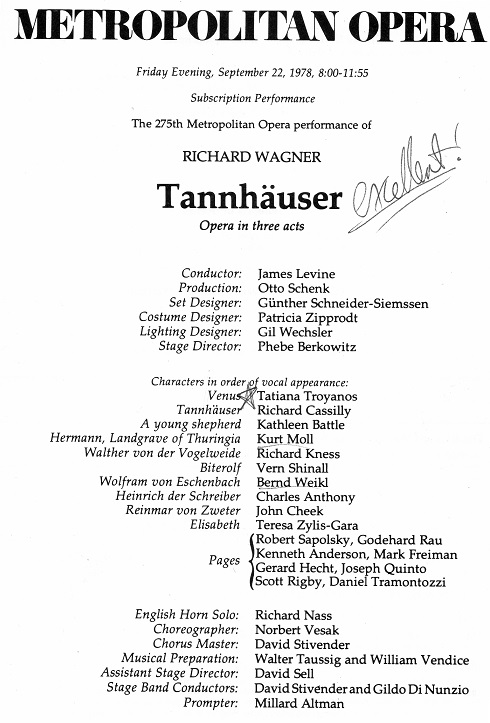
    I saw Wagner’s TANNHAUSER for the first time in 1978 in The Met’s classic Otto Schenk/Gunter Schneider-Siemssen production, conducted by James Levine. Here’s what I wrote in my opera diary the morning after:

    TANNHAUSER – first time – great!! Really a superb production (equal to the LOHENGRIN, but the opera is less exciting…) The sets, costumes, direction, and choral work were all excellent. Levine had some bombastic moments, and some places where he covered the singers, but his pacing was excellent and the orchestra played beautifully.

    Kathleen Battle was the very fine Shepherd – she sounds a bit like Reri Grist, which is a huge compliment. Vern Shinall made an exceptional impression as Biterolf, and Richard Kness (most likely the cover for the title-role) sang powerfully as Walther.

    Moll

    Kurt Moll, repeating his Met debut role as the Landgraf, brought his warm, velvety bass to the music – a great pleasure to hear his clear and steady tones, wonderfully resonant in the deep notes.

    Weikl

    Bernd Weikl as Wolfram (above) looked as handsome as he sounded. His voice is lyrical, and he projected superbly in the big hall. An outstanding performance! This was my first time hearing Weikl, and he immediately became a favorite. 

    Z-g

    As Elisabeth, Teresa Zylis-Gara (above) began with an exciting “Dich teure halle“, followed immediately by her thrilling singing in the duet with Tannhauser, wherein she conveyed subtle emotional changes convincingly. Zylis-Gara’s portrayal of the saintly woman as she searched desperately among the pilgrims for her beloved, and her subsequent downcast expression, were extremely poignant. She sang the Prayer with haunting expressiveness, and then walked slowly and sadly up the hill to her fate. It’s great to have Zylis-Gara moving into heavier German repertoire – the voice is satiny and strong; I would love to hear her as Elsa, Ariadne, Chrysothemis and, eventually, as Sieglinde.

    Richard Cassilly was a powerful, committed Tannhauser. His voice is not tonally beautiful, but he makes great use of it. The role is vocally grueling, almost sadistic in its demands. Cassilly was able to summon great reserves of sound, but he could also be subtle at need. He not only sang tirelessly, but made the character come vividly to life. His manic joy as he described the Venusberg to the stunned court, and later his crushed, agonized acting as a returning pilgrim were particularly well brought off. Cassilly’s potent rendering of the Rome Narrative, with his mocking of the Pope’s voice, was superb. He really deserved the huge ovation…bravo! 

    Tatiana Troyanos was electrifying as Venus, possibly her best role. She looked absolutely gorgeous, and her portrayal abounded in sensuous allure. Her wrath when she rejected Tannhauser was so intense, and her brief appearance in the opera’s final scene was simply spectacular. Her vocalism, which could smoulder alluringly one moment and blaze forth the next, was stunning. Troyanos was a stand-out in an outstanding cast.

    There were tumultuous ovations during the curtain calls, with the singers basking in the audience’s vociferous praise at the end of this glorious performance.”

    Tannhauser-1

    ~ Oberon

  • Ming Cho Lee Has Passed Away

    Ming cho lee

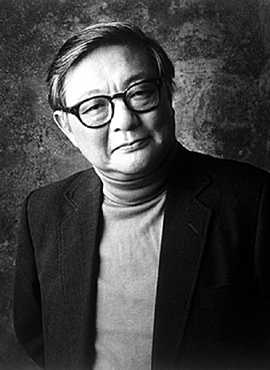
    I was very sorry to read this morning of the passing of the great scenic designer Ming Cho Lee. A native of Shanghai, he died on October 23rd, 2020, at the age of 90.

    He designed award-winning sets for dozens of operas and plays, including eight productions for the Metropolitan Opera. Among his Met credits were his classic BORIS GODUNOV (1974); the Sutherland/Pavarotti PURITANI (1976), a controversial but often striking LOHENGRIN (1976), and the 1985 KHOVANSCHINA with it’s stunning final tableau.

    Ming Cho Lee also designed thirty productions for Joseph Papp at The Public Theatre. A wonderful article about his life and work, with images of his designs, may be found here.

    During the years that I worked in the opera room at Tower Records, Ming Cho Lee was a frequent (and favorite) customer. Upon coming into the room, he would bow to me – and I to him – and then he would spend an hour or more browsing the shelves. We hardly ever spoke, but he would sometimes hold up a disc and I would shake my head, “yes” or “no”. He would stack up his selections on the counter, one by one, and when the piles got teeteringly high, he would do a sort-thru. I would then help him carry his purchases to the cashier. I always stood by until he left, so that we could bow to one another – “…until next time!” he would say quietly. I will always remember his twinkling eyes and wry smile.

    One winter day, a couple of years after Tower closed, I took the train to New Haven to meet friends for lunch. Coming out of Union Station, I saw Ming Cho Lee, all bundled up, hailing a cab (he had taught at Yale for several years). I greeted him, and after a moment he remembered me. Surprisingly, as we had always been bowing acquaintances, he extended his hand and shook mine cordially.

    Ming Cho Lee was such a calm, dignified gentleman; it was an honor and pleasure for me to have known him in this rather formal capacity.

  • Sir Simon Rattle conducts RHEINGOLD – 2004

    Snapshot anna l - Copy

    Above: Anna Larsson (Erda) gives a wonderfully subtle interpretation in this concert performance of Wagner’s DAS RHEINGOLD at Baden-Baden, 2004. Sir Simon Rattle conducts a very impressive cast.

    Watch and listen here.

    You’ll want to block the annoying ads.

    CAST:
    Sir Willard White – Wotan
    Oleg Bryjak – Alberich
    Kim Begley – Loge
    Yvonne Naef – Fricka
    Robbin Leggate – Mime
    Geraldine McGreevy – Freia
    Anna Larsson – Erda
    James Rutherford – Donner
    Timothy Robinson – Froh
    Peter Rose – Fasolt
    Robert Lloyd – Fafner
    Kate Royal – Woglinde
    Karen England – Wellgunde
    Christine Rice – Flosshilde

    Orchestra of the Age of Enlightenment
    Sir Simon Rattle

    Baden-Baden, 2004