Tag: Oratorio Society

  • Oratorio Society: Sibelius ~ KULLERVO

    439px-Wettenhovi-Aspa _Kullervo_(Sibelius)

    Above: artwork by Georg Sigurd Wettenhovi-Aspa (1870-1946)

    ~ Author: Oberon

    Monday February 25th, 2019 -The Oratorio Society of New York presenting works by Berlioz, Debussy, and Sibelius at Carnegie Hall. The concert provided my first opportunity to experience Jean Sibelius’ epic choral symphony, Kullervo, live. The first half of the program was given over to two wonderfully atmospheric works featuring women’s chorus: Hector Berlioz’s “La mort d’Ophélie” from Tristia, and Claude Debussy’sSirènes from Nocturnes.

    Berlioz’s Tristia dates from 1842; the “Mort d’Ophélie” was written as a solo work, and later re-set for female chorus and orchestra. The attractive scoring of the 1849 version heard tonight brings thoughts of Les Troyens amd Les Nuits dété to mind; in fact, the composer seems to have anticipated the former and borrowed from the latter as certain motifs rise up. The women of the Oratorio Society Chorus harmonized lovingly, and the orchestra played to perfect effect.

    A song without words, the Debussy “Sirènes” (from 1899) evokes thoughts of the composer’s La Mer (of course) as well as of the haunting Pelléas et Mélisande, which the Met recently offered in a very fine performance.

    “Sirènes” surely cast a spell this evening, though the repeated themes made the piece stretch long after a bit. Still, there’s no denying the great appeal of this dreamy music. As the work moved towards its ending, a cellphone going off brought us back to reality all too abruptly.

    After a rather lengthy intermission, Jean Sibelius’ Kullervo received a superb performance under Kent Tritle’s baton. The male chorus of the Society was further fortified by the men of the Manhattan School of Music ‘s Symphonic Chorus: the combined choruses made an outstanding contribution to the performance, giving the audience cause to celebrate. The work calls for two vocal soloists, and both were marvelous: soprano Johanna Rusanen and baritone Takaoki Onishi.

    Composed in 1892, the five-movement work tells us of the mythic Kullervo, a complex, tragic figure from Finnish legend. The Introduction depicts the Finnish land and its people and introduces us to the main character. In the second movement, Kullervo’s childhood is evoked: haunted by tragedy from birth onwards, he spends his youth largely in slavery.

    The pivotal movement is the third, in which Kullervo meets and seduces (or rapes) a woman who is – unbeknownst to him – his own sister. When she learns the truth, the woman drowns herself. Kullervo laments his crime and his sister’s death; as atonement, he seeks death on the battlefield. But Death does not find him; he returns to the site where his sister died and, consumed by guilt, he falls on his sword.

    I must admit that the first two movements – very well played by the Society’s orchestra – left me with restless feelings. Full of themes, and finely orchestrated to boot, the music nonetheless seemed over-long; I kept eyeing that big chorus seated onstage, wanting them to burst into song. And when they did, the effect was thrilling: the signature choral motif – “Kullervo! Son of Kalervo!” – surges forth several times in the course of the work…and its every appearance makes the blood rush. This is, seemingly, the Scherzo of the piece.

    The two soloists have now taken their places onstage. Johanna Rusanen, a Finnish soprano who was a Young Artist at Berlin’s Deutsche Oper and has since made her mark in such roles as Venus, Ortrud, Isolde, and Marie in Wozzeck, is an intriguing stage presence with a clear-toned, full spinto sound that rang beautifully into the venerable Hall. Her long monologues were both vocally impressive and charged with dramatic accents as the character’s story unfolds. Ms. Rusanen’s voice struck me as one that should be heard at The Met. 

    The Japanese baritone Takaoki Onishi has fared well in several premiere vocal competitions. A Juilliard graduate, he was a member of the Ryan Opera Ensemble at Lyric Opera of Chicago for three seasons, where he sang several roles. His career mixes opera, concert, and recital, and I can’t wait to hear him again. A slender, handsome fellow who looks elegant in a tuxedo, Mr. Onishi possesses a baritone voice of fine quality, capable of expressive lyricism or of vivid declamation; the role of Kullervo demands both, and the baritone sang forth with distinction.

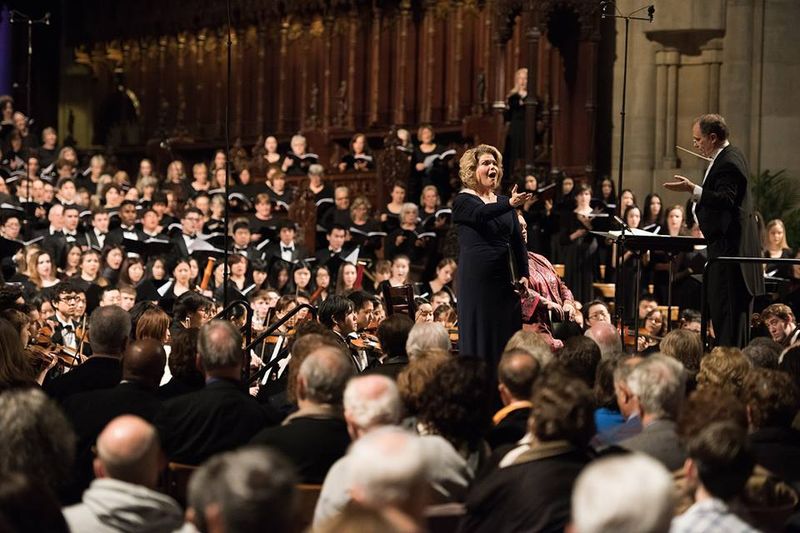
    Oratorio Society of NY at Carnegie Hall  2-25-19  photo by Anna Yatskevich  Manhattan School of Music 47166962492_8510b0d4bf_k

    During the long and loud ovation that followed, the soloists and Maestro Tritle were deservedly cheered, as were the the excellent singers and players of the Oratorio Society of New York. The above photo by Anna Yatskevich from the Manhattan School of Music captures the joy of the moment.

    Hearing the women sing Berlioz, and listening to the handsome voices of Ms. Rusanen and Mr. Onishi made me crave a concert performance of Berlioz’s Prise de Troie. How wonderful these two singers would be as Cassandra and Chorebus!

    ~ Oberon

  • Verdi REQUIEM at St John the Divine

    164572_1653439729885_6792945_n

    Thursday March 26th, 2015 – Oratorio Society of New York presenting the Verdi REQUIEM at the Cathedral of St John the Divine. This was my second experience of this magnificent work in a sacred setting: many years ago I attended a performance of it in the Chapel at Trinity College, Hartford CT. On that evening, an organ and a small ensemble of instrumentalists played in lieu of a full orchestra, but the work still made a vivid impression. Tonight we had the admirable young musicians of the Manhattan School of Music Orchestra (and their symphonic chorus) joining the Oratorio Society for a full-force rendering of Verdi’s ‘sacred opera’.

    A huge audience – an overflow crowd, actually – filled the cathedral and (except for one cellphone beeping at a particularly inopportune moment) they listened in reverential silence. It was overall a very fine performance of the REQUIEM but sonically it was problematic in that the reverberant echoing throughout the huge space often turned the music into a blur. Much of the music’s definition was lost, and much detail from the inner orchestral voices vanished in the clouds of echo. There was the illusion of notes being played twice, and the music sometimes seemed to be fighting itself.

    Kent Tritle conducted, and a strong quartet of soloists took part:

    Jennifer Check, soprano
    Sara Murphy, mezzo-soprano
    Alex Richardson, tenor
    Matthew Boehler, bass

    These four singers often seemed to me to be swamped by the sound of the orchestra and chorus flowing over them in both directions. How they managed to pick up their cues, I will never know. Nevertheless, there were many savorable vocal passages. Mr. Boehler, who made a fine impression recently in IOLANTA at The Met, projected the text with vivid dynamic detail, and Mr. Richardson sang musically and with passion.

    Sara Murphy, whose opulent mezzo made a marvelous impact when she sang Ligeti and Schnittke with the American Symphony Orchestra earlier this season, was very impressive tonight both for beauty of tone and clarity of projection. So much music I want to hear her sing! 

    11111962_913591532037896_5248156677226624389_n

    Jennifer Check (above, photo by Brian Hatton), who stepped in to the soprano part rather late in the day, sounded lovely. Her voice has power but also a silvery lyrical quality, and in the Offertorio she produced a spine-tingling sustained piano E-natural (which modulates magically to an E-flat…one of the most felicitous moments in this glorious work). For the great final ‘aria’, Requiem aeternam, Ms. Check closed her score and gave an intense, very personal performance of this prayerful solo; using her right hand in gently expressive gestures, she seemed to send forth a benediction of peace and tranquility.

  • Oratorio Society: Britten’s WAR REQUIEM

    White_dove.23095031_std

    Monday April 22nd, 2013 – The Oratorio Society of New York presented a performance of Benjamin Britten’s WAR REQUIEM at Carnegie Hall this evening. 

    One of the greatest and most meaningful choral works ever created, the WAR REQUIEM was commissioned for the re-dedication of Coventry Cathedral in 1962; the church had been almost totally destroyed by German bombs in 1940. Britten, a life-long pacifist, drew on the poetry of Wilfred Owen
    – who had been killed in 1918 (one week before the Armistice ended the war) at the age of 25 while fighting in France
    – as well as the texts of the Latin mass for the dead in setting his
    masterpiece. Though deeply spiritual in atmosphere, Britten intended the
    WAR REQUIEM to be a secular work.

    The Oratorio Society, one of New York City’s oldest cultural treasures, traces its history back to 1873. Founded by Leopold Damrosch, the Society presented their first concert on December 3,
    1873. One year later, on Christmas night, the Society began what has become an unbroken
    tradition of annual performances of Handel’s Messiah. In 1891, the Oratorio Society participated in the opening concert of what is now Carnegie Hall.

    The chorus and musicians of the Society under Kent Tritle’s baton tonight unfurled the sonic tapestry of Britten’s creation in a performance which greatly satisfied both the ear and the soul. In the composer’s structuring of the REQUIEM, the large chorus and orchestra – supporting a soprano soloist – sing the Latin texts of the mass while a chamber orchestra (led by David Rosenmeyer) accompanies the tenor and baritone soloists whose words come from the poetry of Wilfred Owen. From high up in a side balcony, the voices of children from the choir of Saint John The Divine (directed by Malcolm Merriweather) provide an angelic sound, accompanied by a small organ.

    Britten’s score, richly textured, amazes in its rhythmic and instrumental variety. Marked by off-kilter harmonies and shifting tonalities, the music is grand and theatrical one moment and poignantly stark and personal the next. The juxtaposition of public mourning and private grief – and of the liturgical and poetic texts – give the REQUIEM its unique resonance.

    Of the three vocal soloists, soprano Emalie Savoy (currently a Met Young Artist) revealed a sizeable lyric instrument with a blooming high register and a capacity to dominate the massed choral and orchestral forces. Tenor John Matthew Myers sang with a plaintive, clear and warm timbre while baritone Jesse Blumberg gave a wonderfully expressive rendering of the texts, his voice hauntingly coloured in his long final solo.

    At the close of the piece, all the participants were warmly lauded by the audience.

    “My subject is War, and the pity of War.
    The Poetry is in the pity…
    All a poet can do today is warn.” ~ Wilfred Owen

    Now, nearly a century after the poet’s warning, mankind continues to use war as a means of settling religious and ideological differences. This evening’s concert fell on Earth Day, reminding us of the fragility of the planet on which we all live. Only by turning away from gods and politics – those great dividing forces – can we hope to find a path into a safe and meaningful future. Like the poet’s two soldiers from opposing armies who find themselves dying side by side in a ditch far from their homes as the REQUIEM draws to a close, we must learn to embrace our common humanity before it’s too late.

    The evening’s participating artists will were:

    Kent Tritle, conductor
    David Rosenmeyer, chamber orchestra conductor
    Emalie Savoy, soprano
    John Matthew Myers, tenor
    Jesse Blumberg, baritone
    Choristers of the Cathedral of St. John the Divine,
    Malcolm Merriweather, conductor
    Chorus and Orchestra of the Society