Tag: Paola Prestini

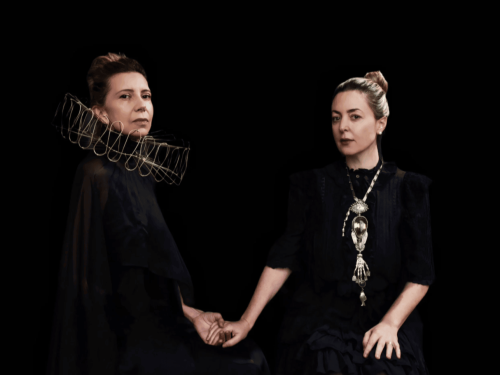
  • Paola Prestini/Magos Herrera ~ Primero Sueño

    Prestini herrera

    Above: Paola Prestini and Margos Herrera

    ~ Author: LiIi Tobias

    Friday, January 24th, 2025 – My evening began with a pilgrimage to the Met Cloisters to attend the world premiere of Paola Prestini and Magos Herrera’s opera Primero Sueño. After traveling for an hour and a half on the subway from Queens up to Washington Heights, I then trekked uphill along a perilously icy pathway into Fort Tryon Park. As I neared the museum, the stone towers emerged majestically above the bare treetops in the night sky. I had never been to the Cloisters at night, not to mention in the Winter either, and it was certainly an experience unlike any of my daytime, Summer excursions. But it was pleasantly warm inside, though dimly lit which created an air of mystery for the music to come….

    As the audience mingled in the entry room, we were greeted by a group of ghostly singers, draped in translucent white veils. These were the sjaella (sisters) – the nuns living in Sor Juana’s convent. The sisters sang on a sustained “ah,” the tones drifting to and fro, wavering gently between consonance and dissonance. They then beckoned us to walk up the stairs where they had first appeared and into the adjacent room, which bordered a candle-filled colonnade encircling a dark garden. 


    As a “procession opera,” this production gave prominence to the spatial aspect of sound. As we walked into this first room, the singing of the nuns faded as it was gradually overtaken by the gentle plucking of a harp and theorbo. Later in the opera too, we were separated into two groups and led by the nuns around the circumference of the colonnade, while they performed a processional chant. Their voices, singing the refrain “Santa Maria,” reverberated through the corridors and around the corners of the space, and their shadows were projected on the stone walls as they walked. I imagine it must have been an entirely different experience for almost every audience member,  just based on where they were standing within the group!
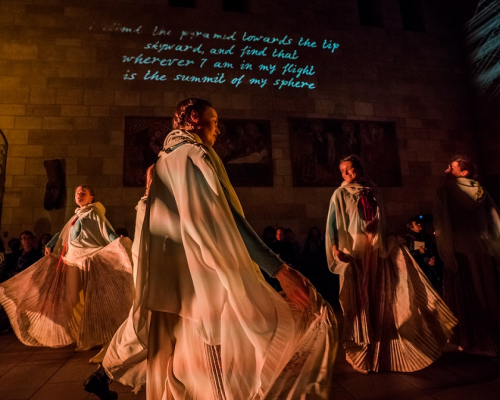
     

    Primero Sueño at The Cloisters_1049_


    Production photo by Jill Steinberg


    Movement and dance were both incredible forces of expression in this performance—just as important as the music. In the second room that the singers and musicians traveled to, Sor Juana (performed by co-composer and librettist, Magos Herrera), lead the other nuns in song and dance as she worked on writing her poem, “Primero Sueño.” The rhythmic nature, expressed through both the music and dance, created an exuberant atmosphere as the women worked together helping Sor Juana write. 


    However, their happiness and safety was suddenly challenged by the appearance of the god Morpheus (danced by Jorrell Lawyer-Jefferson), who struck fear in the nuns. He didn’t sing, but his unsettling movements, accompanied by a distorted recording, came across as otherworldly and dangerous. Lawyer-Jefferson appeared later in the opera as well, both as Quetzalcoatl and Phaeton – both much more positive and comforting mythical figures compared to Morpheus. The abundance of mythical figures in this opera was really interesting, given that Sor Juana and the sisters are nuns, so Christian figures such as Mary coexisted with the indigenous deity Quetzalcoatl, as well as with the Greek Nyctimene, Morpheus, and Phaeton. 


    Primero Sueño at The Cloisters_0599_


    Production photo by Jill Steinberg


    The juxtaposition of multiple very different religious and cultural traditions was just one of many intriguing juxtapositions in this production. The opera also created a space where music from many different traditions—classical choral, jazz, electronic, folk, etc.—could exist at the same time. While much of the time, the music felt extremely mystical and otherworldly, there were also many sudden shifts back to the mundane. Back in the first room, the sisters broke into song as they complete their daily tasks, such as sewing and gardening. Their simple call and response, accompanied by recorded birdsong, grounded the scene in the present world, rather than the mystical realm Sor Juana was inhabiting just a few moments before. The final number, when Sor Juana has ultimately returned to her poem is also a joyous return to the real world after her encounter with Phaeton in the cosmos. The music here has a folk-like feel, as Sor Juana recites the verses to the audience, performing her words like telling a story.


    PHOTO-2025-01-22-16-58-38


    Production photo by Jill Steinberg


    I was constantly captivated, surprised, and inspired by every aspect of Primero Sueño. The production worked so well in the Cloisters, and I hope that it can be performed there again, or even in another similarly gorgeous location. At the end of the production, all the performers, joined by Paola Prestini and who I believe was Louisa Prouske, the director, were celebrated with raucous applause and (literally!) danced their way out of the final room.

    ~ Lili Tobias
  • Paola Prestini’s SILENT NIGHT @ National Sawdust

    Prestini

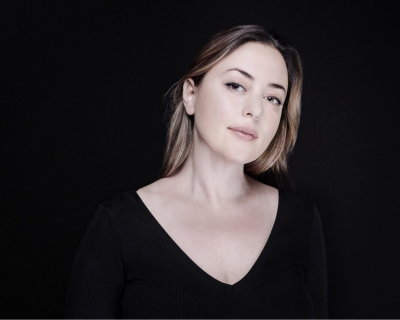
    Above: composer Paola Prestini; photo by Caroline Tompkins

    ~ Author: Lili Tobias

    Saturday October 28th, 2024 – I was lucky enough to have a front row seat to the world premiere of composer Paola Prestini’s new opera, Silent Light. I walked into National Sawdust on Saturday night to ambient insect noises mingling with the chatter of the audience finding their seats. As I looked out over the set of unfinished wood, I could smell the faint hint of bacon, eggs, and pancakes. And these things were just the beginning of how this production expanded not only my ears, but all of my senses!

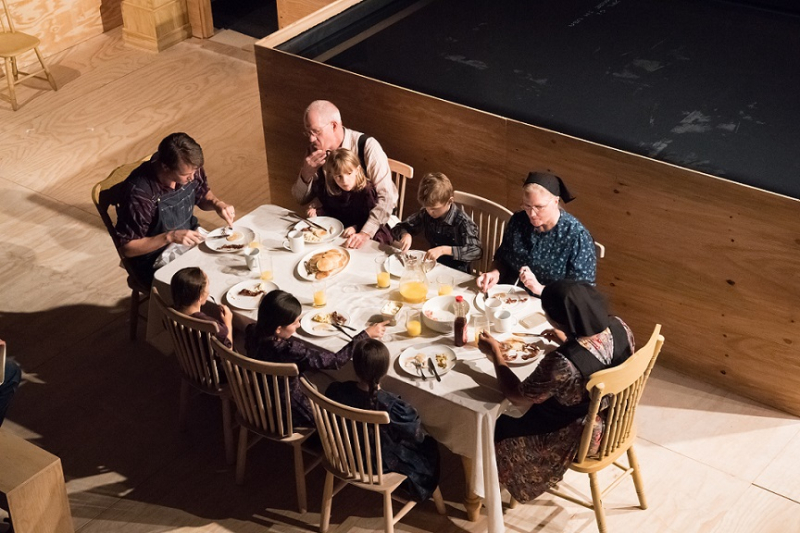
    The innovative ways Prestini played with the sounds, visuals, and physical objects on stage really made Silent Light stand out, though the plot stuck close to standard operatic tropes—love, infidelity, etc. One of the first aspects of this that caught my attention was how she used mundane sounds either by themselves or incorporated into the musical sounds. The opera gets underway with the loud tick-tock of a grandfather clock (seen in the back left corner of the stage) oscillating in volume. The louder it gets, the more surreal the set feels. As that first scene progresses, the women and children of the family come onstage to set the table for breakfast (cooked onstage!) and all begin eating. The natural clatter of plates and utensils mingling with the warm low brass and string instruments created a very fun and realistic soundscape. It truly felt like the audience members were invisible observers within the room with the characters.


    Silent Light performance at NS_0115_


    Above: the ensemble, photo by Jill Steinberg


    I was especially impressed with the transitions between scenes, both in terms of the music and the staging. As breakfast wraps up, a wave of construction sounds rise up from the left side of the stage as the chorus becomes a team of workers. There’s a large waft of dust, which visually separates the two halves of the stage between the men at work outside and the women at work in the house. There were also two wonderful moments of transition between diagetic and non-diagetic music. One occurred during this scene as the chamber ensemble begins playing what seemed to me a lively popular song and the chorus sings along, simultaneously moving the chairs and table to prepare for the next scene. And later on, a French ballad begins playing on a television in the kitchen, then becoming the background for the characters Johan and Marianne to meet up in a hotel room. Both transitions were executed so seamlessly and really helped push the the flow of action forward.


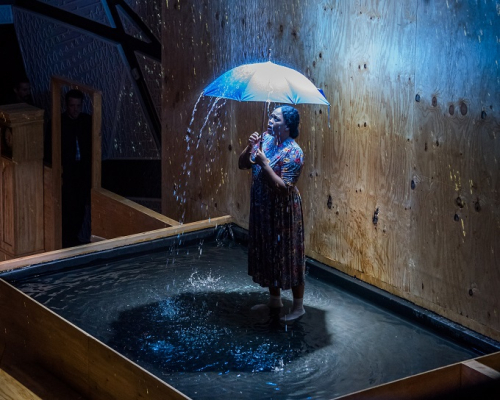
    Silent Light performance at NS_0498_


    Above: Brittany Renee; photo by Jill Steinberg


    Another remarkable aspect of this opera were the juxtapositions between silence or quiet sounds and loud, nearly overbearing sounds. Overall, I felt like there was minimal actual singing in this opera, but not in a bad way at all! As a listener, I tend to get fatigued when operas have extra long passages of continuous singing, so I really appreciated the many moments of silence or instrumental music—or even just foley sounds—that provided contrast (and rest for the singers’ voices too). There were also many moments of abrupt shift from sound to silence. One especially striking moment takes place when Johan and his wife Esther are driving in a truck, Esther knowing that Johan has just slept with Marianne. The music, accompanied by the sound of heavy rain, creates a steady and unceasing anxiety as Esther finally comes to terms with her own feelings about her husband’s affair. Then it suddenly stops as she rushes out of the truck, leaving behind just the sound of the rain (and the literal water which has started pouring down onto the stage!).


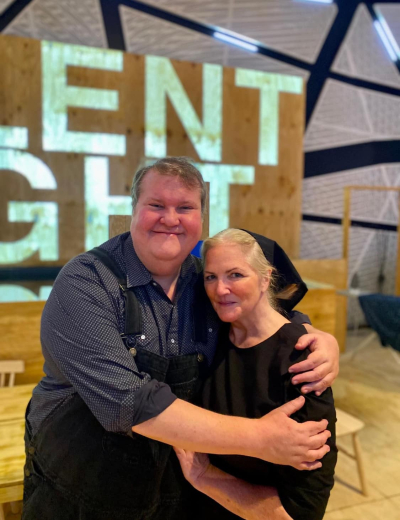
    Tony & margaret silent light


    Above: Anthony Dean Griffey and Margaret Lattimore; photo courtesy of Mr. Griffey


    I also want to add that the novelties of this opera did not go unsupported by amazing musicianship. All the singers were incredibly strong both vocally and as actors, and the lyricism of Prestini’s music really helped them sound even more amazing! I also enjoyed Prestini’s writing for brass. Because of the small size of the instrumental ensemble, the proportion of brass instruments to other types felt very high relative to, for example, an orchestra. I liked how predominant a role the trumpet and trombone played in the music, and they really added a unique depth to the sound that was especially resonant in the small performance space.


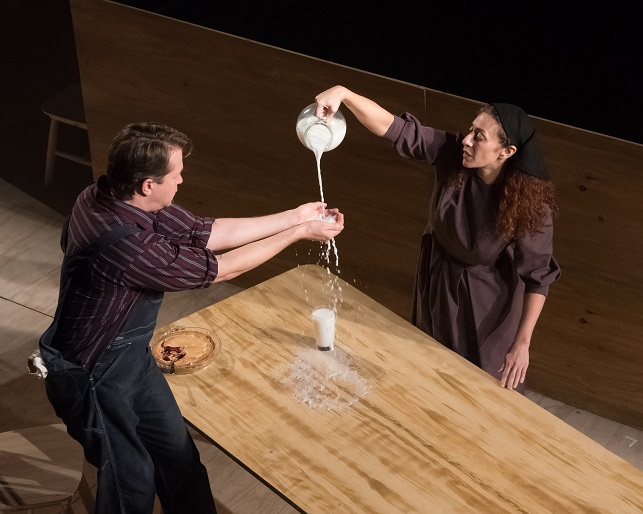
    Silent Light performance at NS_0230_


    Above: Daniel Okulitch and Julia Mintzer, photo by Jill Steinberg


    This opera contained so many interesting things that it’s honestly been difficult to write about everything that caught my attention! I thought it was a huge success at National Sawdust, and I hope it gets many more performances. It will be super interesting to see how the staging evolves in different spaces and with different cast members. Silent Light was an incredibly immersive experience, and there was always something of interest to listen to, look at, and even smell!


    ~ Lili Tobias