Peter Mattei sing’s Mahler’s Kindertotenlieder at a 2021 concert given by the Royal Concertgebouw Orchestra, conducted by Fabio Luisi.
Filmed during the pandemic; the orchestral soloists are particularly fine.
Peter Mattei sing’s Mahler’s Kindertotenlieder at a 2021 concert given by the Royal Concertgebouw Orchestra, conducted by Fabio Luisi.
Filmed during the pandemic; the orchestral soloists are particularly fine.
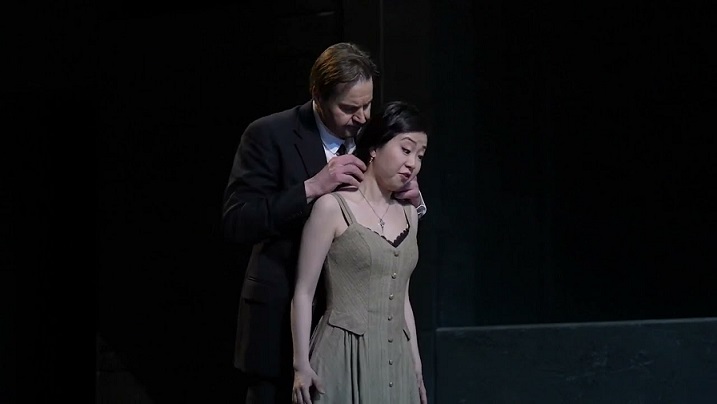
Above: Peter Mattei as Don Giovanni & Ying Fang as Zerlina
Author: Oberon
Saturday May 27th, 2023 matinee – The Met’s new DON GIOVANNI is a grey affair. Large grey architectural set pieces loom above the action; from time to time they are moved to form varying spaces as the story unfolds. The costumes are drab and muted, with the only color splash coming at the Don’s party when mannequins are wheeled in, brightly dressed in period gowns. Much of the time the singers are dressed as they might be for a rehearsal. The greyness prevails until the opera’s final sextet, when flowers, potted plants, and vari-colored domestic furnishings suddenly decorate the set.
Aside from the Don’s killing of the Commendatore with a gun rather than in a duel, there’s nothing radical in the staging. Of course, if the production had been set in the USA, everyone would have been toting an AK-15.
With so little to distract us visually, focus was on the singing. Adam Plachetka sounded muted in Leporello’s opening lines, but he bloomed vocally with his Catalogue Aria and was thereafter very impressive. Dmitry Belosselskiy was a strongly-sung Commendatore, responding ominously to the Don’s dinner invitation, still wearing the bloody shirt in which he was killed. In powerful voice, Mr. Belosselskiy made me look forward to his upcoming Daland.
As the peasant couple, Masetto and his Zerlina, Alfred Walker and Ying Fang were superb. Mr. Walker is always a joy to hear, and his excellent singing today turned the oft-neglected character into a leading role. Ying Fang, with one of the most appealing voices on the current operatic scene, was exquisite in both of her arias, and she blended with Peter Mattei’s suavely-phrased singing to make “La ci darem la mano” one of the highlights of the afternoon.
Ana Maria Martinez was a bit unsettled vocally at first, and I wasn’t sure that Donna Elvira was a role for her; but she convinced me otherwise as the opera progressed. Her “Mi tradi” was fabulously sung: in a delightful musical collaboration with conductor Nathalie Stutzmann, Ms. Martinez made the aria glow. The soprano, looking like an earnest CEO in her fitted forest-green frock and black stilettos, found the perfect mix of determination and frustration in the character.
Federica Lombardi had a triumph in her third Mozart role at The Met: following her Countess Almaviva and Elettra (IDOMENEO), she sang brilliantly as Donna Anna today, throwing in some embellishments along the way, which Mme. Stutzmann wisely allowed. All afternoon, the Lombardi voice rang clear and true, with free-flowing coloratura, and capping the ensembles brightly. In the great aria “Non mi dir“, Ms. Lombardi was poignantly expressive in her plea for understanding, and then set off the fireworks for the aria’s fast-paced conclusion.
Ben Bliss as Don Ottavio gave us some of the most expressive singing of the afternoon, with lovely dynamics in the touching “Dalla sua pace” and a sure command of the dazzling demands of “Il mio tesoro“. Ben’s visible frustration when Donna Anna asked for ‘more time’ after demise of her nemesis, Don Giovanni, was much appreciated by the audience.
Peter Mattei’s Don Giovanni made a huge impression at The Met in 2009, in another drab production, which I watched with Lisette Oropesa – the first act onscreen at List Hall and the second from a balcony box. We were both bowled over by his vivid characterization and his mellifluous singing. This afternoon, in a production that casts the Don as a psychopath, Mattei was equally impressive…and the voice is more beautiful and subtle than ever. His “La ci darem la mano” with Ying Fang, his ‘champagne aria’ (taken by Ms. Stutzmann at lightning speed) and his ravishing serenade, “Deh, vieni alla finestra“, were perfect.
What separated this performance from most everything else I have seen at The Met this season was the conducting: the majority of the operas have been played fast and loud, apparently in an attempt to make things more ‘exciting’. As a result, singers were often made to choose between forcing or being drowned out. As a singer, Ms. Stutzmann knows what to do on the podium; so today, every note and word was clearly audible, and no one seemed to be putting undue pressure on their voice.
Moreover, Ms. Stutzmann gave the music a wonderful sense of flow, often moving directly from recitative to aria without pause. There was an especially lovely trio continuo players today: John C. Kelly (fortepiano), Kari Jane Docter (cello), and John Lenti (theorbo and mandolin). It was Mr. Lenti who gave the Mattei serenade its enchanting accompaniment. I cannot say which of the Met Orchestra’s cellists was responsible for the splendid playing in Ms. Martinez’s wonderful “Mi tradi“, nor which clarinetist brought such warmth and clarity to the playing of the downhill scales in Figaro’s “Non piu andrai” as part of the Don’s dinner music.
And so, I wanted very much to meet Nathalie Stutzmann after the performance. I went down to the stage door – after the enthusiastic ovation during the curtain calls – to find that a large crowd had gathered there. The singers came out and were greeted like rockstars, and they all lingered, chatting up the fans.
I think all afternoon the scandale was on people’s minds – at least those people who like gossip. During the performance, there had been no hint of any tension between the pit and the podium, although the players who sit nearest the spot from which the conductor enters – and who usually start clapping loudly when Maestro X, Y, or Z first appears – didn’t do that for Ms. Stutzmann today. But the audience soon spotted her and gave her a round of bravas.
Ar last Ms. Stutzmann came out, and after she had greeted some other fans, it was my turn. I had thought of some non-controversial things to say to her, but my shyness overwhelmed me. She signed my program, and I embraced her, and said: “I love your Alto Rhapsody!” which made her smile. Listen to it here.

~ Oberon

Above: the Grail revealed: Peter Mattei as Amfortas and Rene Pape as Gurnemanz in Wagner’s PARSIFAL; a Ken Howard/Met Opera photo
~ Author: Oberon
Saturday February 17th, 2018 matinee – A powerful and thoroughly absorbing matinee performance of PARSIFAL, the only Wagner in the Metropolitan Opera’s repertory this season. This dark, barren, and brooding production premiered in 2013, at which time the total absence of a Grail temple from the scenic narrative seemed truly off-putting. All of the action of the outer acts takes place out-of-doors, whilst the second act – as we were told by someone who worked on the production at the time it was new – is set inside Amfortas’s wound.
Not everything in the production works, and the desolate landscape of the final act – with its open graves – is dreary indeed. But the devotional rites of the Grail brothers in Act I and the stylized movements of the Flowermaidens in the blood-drenched ‘magic garden’ of Act II are engrossing – especially today, where I found a personal link to both scenes.
Musically, it was a potent performance despite a couple of random brass blips. Since the 2013 performances, I’ve been going to a lot of symphonic and chamber music concerts and this has greatly enhanced my appreciation of the orchestra’s work whenever I am at the opera. From our perch directly over the pit today, I greatly enjoyed watching the musicians of the Met Orchestra as they played their way thru this endlessly fascinating score.
The Met’s soon-to-be music director, Yannick Nézet-Séguin, was on the podium this afternoon, and he seemed to inspire not only the orchestra, but also the principals, chorus, dancers, and supers all of whom worked devotedly to sustain the atmosphere of the long opera. While I did not feel the depth of mystery that I have experienced in past performances of this work conducted by James Levine or Daniele Gatti, in Maestro Nézet-Séguin’s interpretation the humanity of the music seemed to be to the fore. This meshes well with the physical aspects of the production, which strongly and movingly depicts the fraternity of the Grail and the desperate suffering of Amfortas. The orchestra’s poetic playing as Gurnemanz sings of the slaying of the swan was but one passage of many where I felt the music so deeply. And the transformation music of Act I was particularly thrilling to hear today.
The singing all afternoon was at a very high level, with the unfortunate exception of the Kundry of Evelyn Herlitzius. We’d previously heard her as Marie in WOZZECK, but Kundry’s music – especially in Act II – needs singing that has more seductive beauty than Ms. Herlitzius delivered. The soprano’s one spectacular vocal moment – “Ich sah Ihn – Ihn – und…lachte!“, where she tells how she had seen Christ on the cross and laughed – was truly thrilling, but not enough to compensate for her tremulous, throaty singing elsewhere.
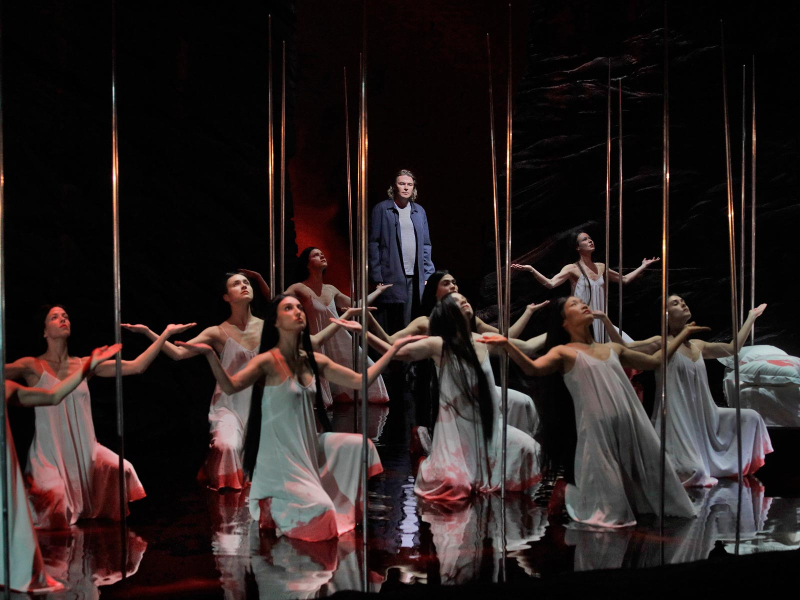
Above: In Klingsor’s Magic Garden, tenor Klaus Florian Vogt as Parsifal; a Met Opera photo
In 2006, Klaus Florian Vogt made an unforgettable Met debut as Lohengrin, and this afternoon as Parsifal the tenor again sang lyrically in a role that is normally sung by tenors of the more helden- type. The almost juvenile sound Vogt’s voice underscored Parsifal’s innocence; this worked especially well in Act I, and also brought us some beautiful vocalism in Act II. As Kundry’s efforts to seduce become more urgent, Vogt’s singing took on a more passionate colour. In his struggle between steadfastness and capitulation, the tenor’s cry of “Erlöse, rette mich, aus schuldbefleckten Händen!” (‘Redeem me, rescue me from hands defiled by sin!’) pierced the heart with his dynamic mastery.
Kundry’s wiles fail her, and with an upraised hand, Parsifal fends off Klingsor’s spear-wielding assault. Seizing the weapon that wounded Amfortas, the young man cries out “Mit diesem Zeichen bann’ ich deinen Zauber!” (‘With this Sign I banish your magic!’); the bloody back-lighting dissolves to white and Klingsor is cast down. Turning to Kundry, Mr. Vogt’s Parsifal has the act’s final line of premonition: “Du weisst, wo du mich wiederfinden kannst!” (‘You know where you can find me again’) and he strides out into the world to commence his long, labored journey back to the realm of the Grail. In the final act, Mr. Vogt’s expressive singing was a balm to the ear, lovingly supported by the conductor and orchestra.

Above: Rene Pape as Gurnemanz, in a Ken Howard/Met Opera photo
Repeating the roles they created when this production premiered in 2013, Rene Pape (Gurnemanz) and Peter Mattei (Amfortas) were again superb. Mr. Pape now measures out his singing of this very long part more judiciously than he has in the past, at times allowing the orchestra to cover him rather than attempting to power thru. But in the long Act I monolog, “Titurel, der fromme Held…”, the basso’s tone flowed like honey; and later, at “Vor dem verwaisten Heiligtum, in brünst’gem Beten lag Amfortas...” (‘Before the looted sanctuary, Amfortas lay in fervent prayer’) Mr. Pape’s emotion-filled delivery struck at the heart of the matter. Throughout Act III, leading to the consecrational baptism of Parsifal, Mr. Pape was at his finest.

Peter Mattei’s Amfortas (in a Ken Howard/Met Opera photo above) is truly one of the great operatic interpretations I have ever experienced, for it is not only magnificently sung but acted with matchless physicality and commitment. The guilt and suffering Mr. Mattei conveys both with his voice and his body is almost unbearable to experience in its intensity and sense of reality.
After a desperate show of resistance to calls for the Grail to be revealed in Act I, Amfortas – in abject anguish – performs the rite; his strength spent, he staggers offstage and as he does so, he locks eyes with Parsifal, the man who will succeed him as keeper of the Grail: one of the production’s most telling moments. And in the final act, Mr. Mattei throws himself into the open grave of his father, Titurel, as he begs for death to release him from his eternal suffering; this horrifies the assembled Grail knights. Such moments make for an unforgettable interpretation, yet in the end it’s the Mattei voice that sets his Amfortas in such a high echelon.

Evgeny Nikitin’s Klingsor (above), creepy and thrilling in 2013, incredibly was even better in this revival. The voice was flung into the House with chilling command, and the bass-baritone’s physical domination of his bloody realm and his hapless female slaves was conveyed with grim authority. His demise was epic.
Alfred Walker sang splendidly as the unseen Titurel, and I was very glad that he appeared onstage for the bows so I could bravo him for his wonderful outpourings of tone. Another offstage Voice, that of Karolina Pilou – who repeats the prophetic line “Durch Mitleid wissend…der reine Tor!” (‘Enlightened through compassion, the innocent fool…’) to end Act I – had beauty of tone, though the amplification was less successful here.
The Squires ( Katherine Whyte, Sarah Larsen, Scott Scully, and Ian Koziara) were excellent, especially as they harmonized on the emblematic “Durch Mitleid wissend…” theme, and the Flowermaidens sounded lovely, led with ethereal vocal grace by Haeran Hong. Mark Schowalter and Richard Bernstein were capital Knights, and I must again mention Mr. Bernstein’s terrific voice and physical presence as a singer underutilized by the Met these days. His lines ths afternoon were few, yet always on the mark; and in Act III, helping to bear the shrouded body of his late lord Titurel to its grave, Mr. Bernstein seemed to carry the weight of the world on his shoulder.
What gave the performance a deep personal dimension for me today was finding two dancers I have known for some time – David Gonsier and Nicole Corea – onstage in Acts I and II respectively. By focusing on them – Mr. Gonsier as a young Grail knight and Ms. Corea as a delicious Blumenmädchen – the ‘choreography’ given to these two groups became wonderfully clear and meaningful.
I first spotted Mr. Gonsier seated in the circle of knights; my imagination was immediately seized by the rapture evident in his eyes. For long, long stretches of the first act, I could not tear my gaze away from him as his mastery of the reverential gestural language and the deep radiance of his facial expressions spoke truly of what it means to be a knight of the Holy Grail. Amazingly, out of all the men I might have zeroed in on among the brotherhood, Mr. Gonsier was the last of the knights to leave the stage as Act I drew to an end: he received a personal blessing from Gurnemanz and their eyes met ever-so-briefly. So deeply moving.
Ms. Corea is beloved in the Gotham danceworld for her work with Lar Lubovitch; I ran into her on the Plaza before the performance today and she assured me I’d be seeing her this Spring at The Joyce as Mr. Lubovitch celebrates his 50th anniversary of making dances. Incredibly, within two seconds of the Act II curtain’s rise on the identically clad and be-wigged Flowermaidens standing in a pool of blood, I found Nicole right in my line of vision. Both in her compelling movement and her captivating face, Nicole became the icon of this band of bewitching beauties.
Whilst hailing some of the unsung cast members of the afternoon, mention must be made of the two heroic supers who literally keep Amfortas alive and mobile, frequently taking the full weight of the ailing man as he struggles to fulfill his dreaded duties as Lord of the Grail. Great work, gentlemen!
Much of the libretto of PARSIFAL‘s outer acts today seems like religious mumbo-jumbo. It’s the music – especially the ending of Act I – that most clearly speaks to us (and even to an old atheist like me) of the possibility of God’s existence. Perhaps He has simply given up on mankind, as His name – and his word – have been sullied in recent years by those very people who claim to revere him. Wagner may have foreseen all this, as he once wrote: “Where religion becomes artificial, it is reserved for Art to save the spirit of religion.”
At the end of Act I of today’s PARSIFAL, I momentarily questioned my disbelief. But then the applause – which I’ve always hated to hear after such a spiritual scene – pulled me back to reality. I’d much rather have stayed there, in Montsalvat.
Metropolitan Opera House
Saturday February 17th, 2018 matinee
PARSIFAL
Richard Wagner
Parsifal................Klaus Florian Vogt
Kundry..................Evelyn Herlitzius
Amfortas................Peter Mattei
Gurnemanz...............René Pape
Klingsor................Evgeny Nikitin
Titurel.................Alfred Walker
Voice...................Karolina Pilou
First Esquire...........Katherine Whyte
Second Esquire..........Sarah Larsen
Third Esquire...........Scott Scully
Fourth Esquire..........Ian Koziara
First Knight............Mark Schowalter
Second Knight...........Richard Bernstein
Flower Maidens: Haeran Hong, Deanna Breiwick, Renée Tatum, Disella Lårusdóttir, Katherine Whyte, Augusta Caso
Conductor...............Yannick Nézet-Séguin
~ Oberon
 Oberon's Glade