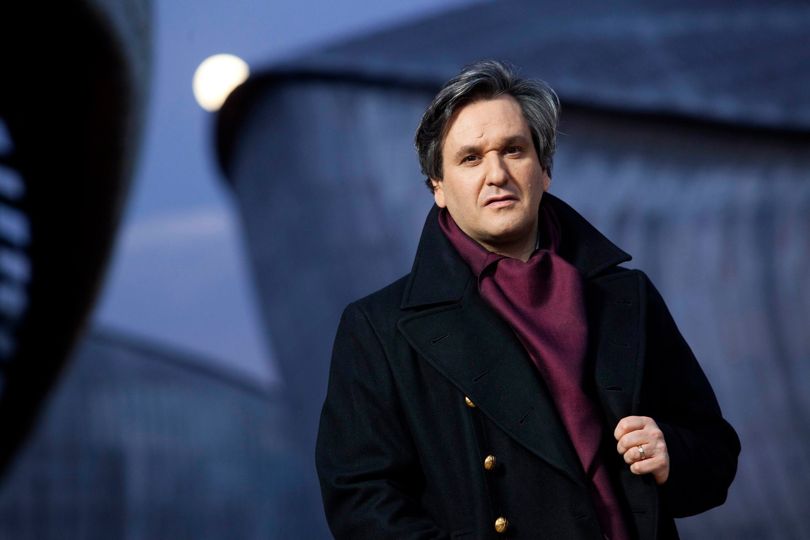
Above: Conductor Antonio Pappano; Photo Credit: Musacchio & Ianniello
~Author: Scoresby
Thursday February 8th, 2018 – The New York Philharmonic seemed in good form at David Geffen Hall. They were led by the wonderful Antonio Pappano, who I had never had the opportunity to hear before. I also hadn’t heard any of the works on the program live, though I have heard them all via recording. Pianist Leif Ove Andsnes and resident NY Philharmonic organist Kent Tritle rounded out the program. It is interesting to have heard the Philharmonic after a long break, as both this time and last time I heard the playing seemed higher quality than I recalled. It will be interesting to see how the sound changes again next year when Jaap Van Zweden assumes his full music directorship.
Ralph Vaughan Williams’s Fantasia on a Theme by Thomas Tallis opened the program. I was surprised to learn in the program notes that the last time this famous piece was performed was 20 years before – it seems unusual for a piece that is perhaps Vaughan Williams’s most well-known. The all string orchestra is divided into three distinct groups during this work, the normal string orchestra, a separate orchestra that acts as the melody center, and a string quartet consisting of the principal players. Here, Mr. Pappano put the melodic orchestra in a row behind the strings that played the background counterpoint.
I’ve never been particularly fond of this work, while stunningly beautiful I don’t feel the music goes anywhere. Mr. Pappano convinced me of its beauty though – the slow moving textures almost sounded like a minimalist organ work. The basses and cellos truly sounded like the pedals of an organ while the other strings managed to capture the full nuances of the Phrygian scale that the Tallis themed is based on. All the strings sounded quite clean. Perhaps the most convincing moment was when Cynthia Phelps entered with her melancholic viola melody (6:05 in the video above) – she managed to make the entire room sing. The other quartet members did a good job blending with her, but that lonely call after the richness of what precedes it will remain with me for a long time.
The second work on the program was the Britten Piano Concerto, Op. 13. It is a bit of an odd piece, structured in four movements and lasting about thirty-five minutes. While interesting to hear, it didn’t sound to me nearly as original as other Britten works. Sort of like a medley of Stravinsky, Shostakovich, and Prokofiev with some of Britten’s classic colorful instrumentation. Nonetheless, it is a fun virtuosic piece of music that really shows off an orchestra – even if not the most worthwhile music.

Above: Pianist Leif Ove Andsnes; Photo credit: Gregor Hohenberg
Mr. Andsnes milked the virtuosic first movement for all that it had, ripping through opening lines and making it sound gritty. Mr. Pappano’s accompaniment was spot on with the percussion cued perfectly for the piano’s percussive chords. Nonetheless, the movement is almost clown-esque and this interpretation seemed a little subdued for the material. Mr. Andsnes did seem to revel in the Rite of Spring-like chords (or perhaps I am thinking that because I’ve been listening to his new recording with Marc-André Hamelin).
The second movement is a little less chaotic than the first, the first few lines make it sound like one is in a jazz bar with people who are smoking. The bass is plucking away, while someone is lightly tapping on tambourine. The viola and clarinet exchange jazzy sounding lines. Ms. Phelps again did a fabulous job, here embracing that smoky texture as did Mr. Andsnes when the piano finally comes in to some music that sounds straight out of Prokofiev.
Eventually this setting yields to another virtuosic theme that recapitulates parts of the first movement. The third movement is a theme and variations that grows progressively denser – while interesting, it doesn’t quite feel like it belongs. Britten wrote many years later to replace a different version and it is easy to tell. The finale is exciting and showy, both Mr. Pappano and Andsnes making the most of it.
The second half of the concert was devoted to Saint-Saëns Symphony No. 3 in C minor, Op. 78 with Kent Tritle performing the organ. While a popular piece, it hasn’t been done at the NY Phil in 8 years and so I haven’t gotten the chance to hear it live before. In some ways though, I feel like I still haven’t heard the piece properly. Because Mr. Tritle was playing an electronic organ, some of the grandness of the work didn’t seem to be present – indeed my friend and I chuckled a bit when the electronic organ entered as it just didn’t sound right for such a delicately composed piece. That is no fault of the organist, however, it would be lovely if Lincoln Center built an organ in David Geffen Hall.
Mr. Pappano programmed the Vaughan Williams well, it mirrors both the sound of the organ and structure of the Saint-Saëns making for a satisfying second half. Mr. Pappano brought an incisive and almost frenzied energy to the Allegro moderato in the first movement. The famous theme sounded buzzing with energy. Most impressive though were the clear textures in the massive fugue in the second movement, not a note was out of place, being both transparent and energetic. One effect that I had never noticed was Saint-Saëns dazzling use of pianos in the second movement’s presto. They are light and just a tinkle above the orchestra, but give it this glistening sonority that sounded to me like stained glass in sunlight. It was delightful to hear and I look forward to hearing Mr. Pappano again. He manages to choral the orchestra into action and get the best of its players.
~ Scoresby

 Oberon's Glade